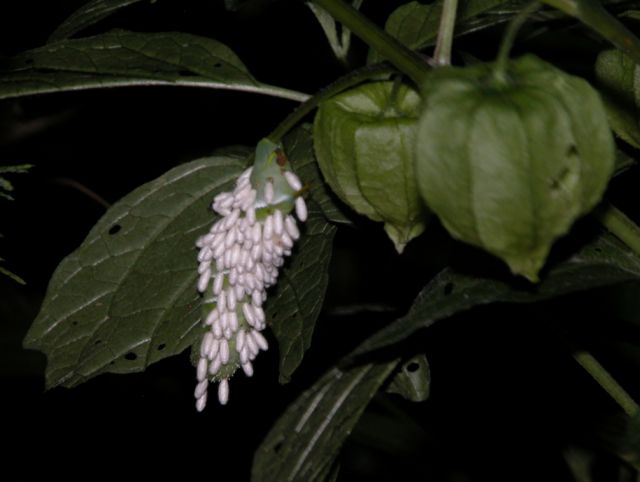
While admiring some ground cherries outside my front door, I noticed a number of leaves had been stripped off. Not grazed on by the deer that frequent the area, more like eaten by caterpillars. After a brief search I spotted a hornworm munching away. I didn’t bother killing the hornworm because, after all, the ground cherries are weeds growing amongst the black-eyed susans, and it’s less work for me if they take care of the weeds.
I looked again a few days later, and saw that the hornworm had sprouted numerous white appendages. These are the cocoons of pupating braconid wasps. Braconid wasps are parasitoids that inject their eggs beneath the skin of the host (hornworms are favored by the braconid wasp Contesia congregatus). After feeding on the convenient meal surrounding them, the wasp larvae emerge and spin their coccons, attached to the body of the unfortunate hornworm. In a few days, adult wasps emerge from their cocoons, leaving a dead caterpillar.
I later spotted a second hornworm, which suffered the same fate as the first.
Ewwwwwwww!
Spread the word; friends don't allow friends to repeat history.
Imagine for a moment that you are a wee little mousie, sitting on a tuft of grass nibbling on a seed. You think you feel a breath of a breeze from in back of you and you turn around to see this beautiful thing
Owls fly silently. Their feathers have evolved to move without rustles, to let the wind slip through them without making a whish. Owls demonstrate evolution at its mightiest, and nature, as the poets note, “red in tooth and claw.”
I’d like to know more about this film. Trained owl? Wild owl enticed by what kind of bait? Longer movie about eagle owls? I’m not familiar with them. So many little mysteries on the internet.
New Photron SA-2 High Definition High Speed Camera. Shot of ‘Checkers’ the eagle owl, 1000fps 1920×1080 resolution. Shot by SlowMo (www.slowmo.co.uk). See the owl and other birds of prey at www.turbarywoods.co.uk.
From Wikipedia
The Eurasian Eagle-owl (Bubo bubo) is a species of eagle owl resident in much of Europe and Asia. It is also one of the largest types of owls.
* * * * * *
The Eagle Owl is a large and powerful bird, smaller than the Golden Eagle but larger than the Snowy Owl. It is sometimes referred to as the world’s largest owl, but this is actually the Blakiston’s Fish Owl, which is slightly bigger on average.[2][3] The Eagle Owl has a wingspan of 138–200 cm (55–79 in) and measures 58–75 cm (23–30 in) long. Females weigh 1.75-4.5 kg (3.9-10 lbs) and males weigh 1.5-3.2 kg (3.3-7 lbs).[4][5][6] In comparison, the Barn Owl weighs about 500 grams (1.1 lbs).
Tip of the old scrub brush to Kathryn.
Spread the word; friends don't allow friends to repeat history.
Talk in class turned to Ben Franklin’s kite experiment. “Don’t try this at home,” I said.
Do students ever listen?
Here’s an amateur video showing why standing under a tree in a lightning storm could be a bad idea. Can students extrapolate this to flying a kite in a storm?
Surely there is better video of such events somewhere . . . can you tell us where?
Found it at Wimp.com, with a tip of the old scrub brush to Thom Holland, Scouter with the 626 units at Penasquitos Lutheran Church, San Diego, California.
Spread the word; friends don't allow friends to repeat history.
Among other things one might observe from this film, one might note that Yosemite National Park’s beauty is so great that it looks good from almost any angle, even with tourists plastered all over it.
This was released between Yosemite Nature Notes #14 and #15, and I find no other description. This remains a wonderful series showing off the geography and natural phenomena of Yosemite. I wish there were similar programs for Yellowstone, Glacier, Denali, Grand Canyon, Zion, Bryce, Big Bend, Great Smoky Mountains, and for the Adirondack State Park in New York, among many others.
Spread the word; friends don't allow friends to repeat history.
Great time-lapse video of the tides at Hopewell Rocks, Bay of Fundy, New Brunswick.
Teachers, can you get a decent geography warm-up with this video? Every high school kid should know about the Bay of Fundy, one of nature’s greater phenomena.
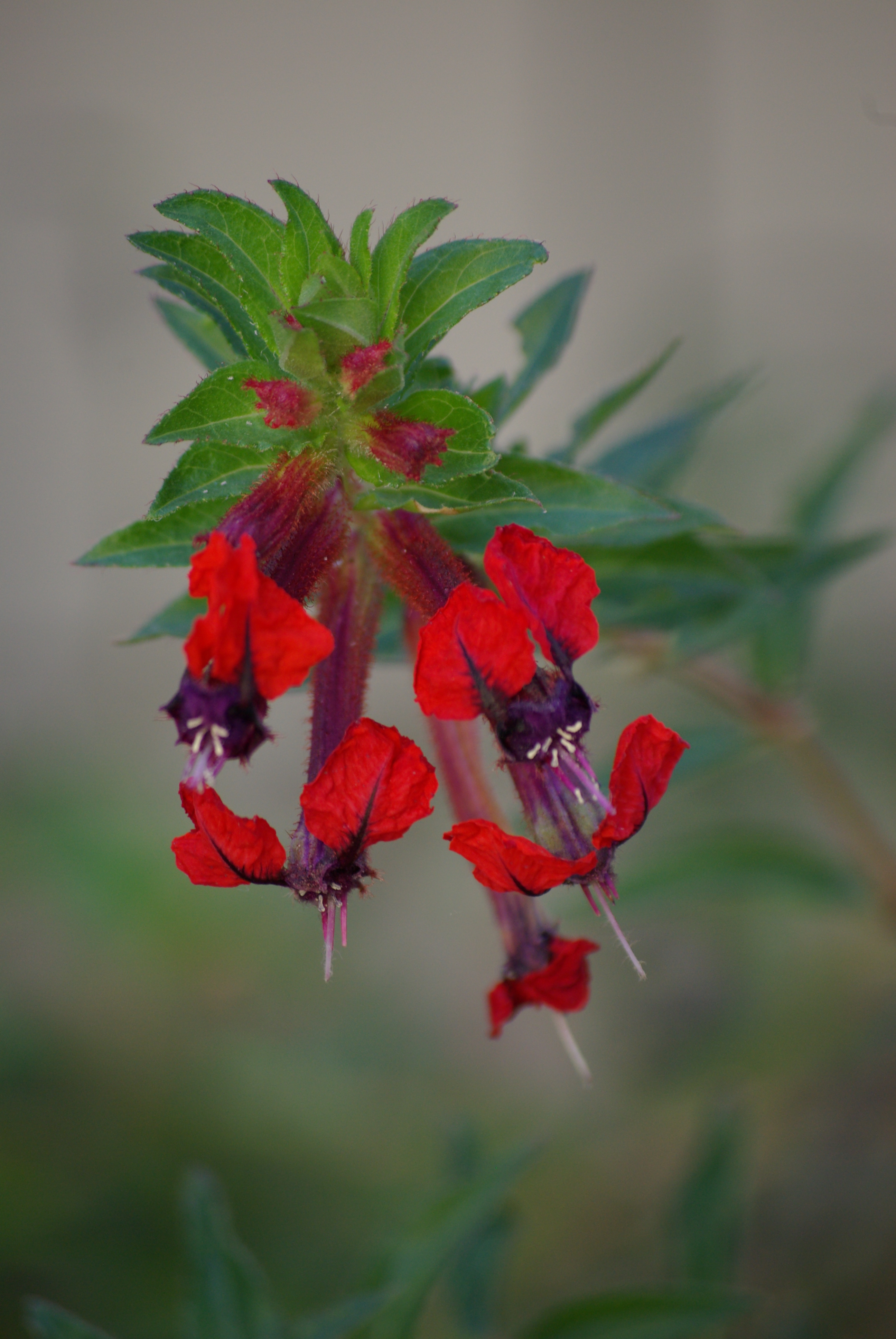
On a pedestal? Kathryn's potted bat-faced cuphea stands out when the mid-morning sun bathes it, but the yard in back still hovers in the shade of the live oak. Horticultural design by Kathryn Knowles; photo by Ed Darrell
Kathryn’s bat faced cuphea (Cuphea llavea)has graced our garden for several years with this particular plant, or its seedlings. It attracts butterflies and hummingbirds with regularity.
It gets its name because each blossom resembles the face of a tiny bat.
Each blossom of bat faced cuphea resembles the face of a bat.
Spread the word; friends don't allow friends to repeat history.
Dick Feynman taught in Rio de Janeiro for a while. He was frustrated at the way Brazilian students of that day learned physics by rote, instead of in labs. In a lecture he looked out from the classroom to the sun dancing on the waves of the Atlantic, and he realized it was a beautiful, brilliant demonstration of light refraction, the topic of the day. Sadly, the students didn’t understand that the beauty before them was a physics problem. (Was that story in Surely You’re Joking, Mr. Feynman, or What Do You Care What Others Think?)
Here, a marriage of physics, moonlight, spring runoff over a cliff, and modern photography, in Yosemite. If you don’t gasp, call your physician and find a new sensei:
(Programs and maintenance of this park are threatened by Republican budget writers, BTW.)
Spread the word; friends don't allow friends to repeat history.
It’s slower population growth than in the past, but earlier, too.
In earlier years we’ve had cicada killer wasps — cicada hawks, in some parlance — as early as July 7. Rains fell all spring in 2010, which discouraged the emergence of cicadas and their predators. First certified sighting in our backyard did not occur until July 18.
Cicada Killer, with cicada - photo by Ronald F. Billings, Texas Forest Service, Bugwood.org, via University of Delaware Cooperative Extension
We had modified a planter, and that may have killed some of the larvae. Generally 2010 was a slow year for the large wasps. My guess is that they were less active locally because the ground remained wet through July and into August. I still get e-mails asking about how to get rid of them, and I still recommend watering the spots you want them to leave. The females sting and paralyze a cicada, then plant that cicada in a tunnel underground with one wasp egg. The young wasp hatches and feeds on the cicada, emerging usually the next summer to carry on the cycle (in a long summer, there may be a couple of hatchings, I imagine). Females do not like to tunnel in wet ground, partly because it collapses on them, and I suspect wet ground is conducive to fungi and other pests that kill the eggs or hatchlings. Our wet weather kept them away last year.
I waited to say anything this year because I wanted more, but we saw the first cicada killer wasps this year on June 27, 2011, the earliest date we recorded here. I had hoped to get a good photo, but that hasn’t happened yet.
Down at Colorado Bend State Park, the cicada killers greeted our arrival, much to the panic of the little kids in the campsite next door. They were happy to learn the wasps don’t aim to sting them, and the kids actually watched them at work. One of the wasps reminded me of just how much they like dry ground — she kept tunneling into the fire pit, unused now because of the fire bans that cover 252 of Texas’s 254 counties. Covering the holes, putting objects over the holes, nothing could dissuade her from using that site. I hope for the sake of the larvae that they hatch soon, and get out, before someone builds a fire in the pit. Some of the cicadas in that area hit 110 decibels at least, and they badly need the discipline of a force of cicada killers, if you ask me.
Prowling the yard this morning I found two more emergence holes. The wasps leave a smaller hole than the cicadas, so I’m pretty sure they are back in force.
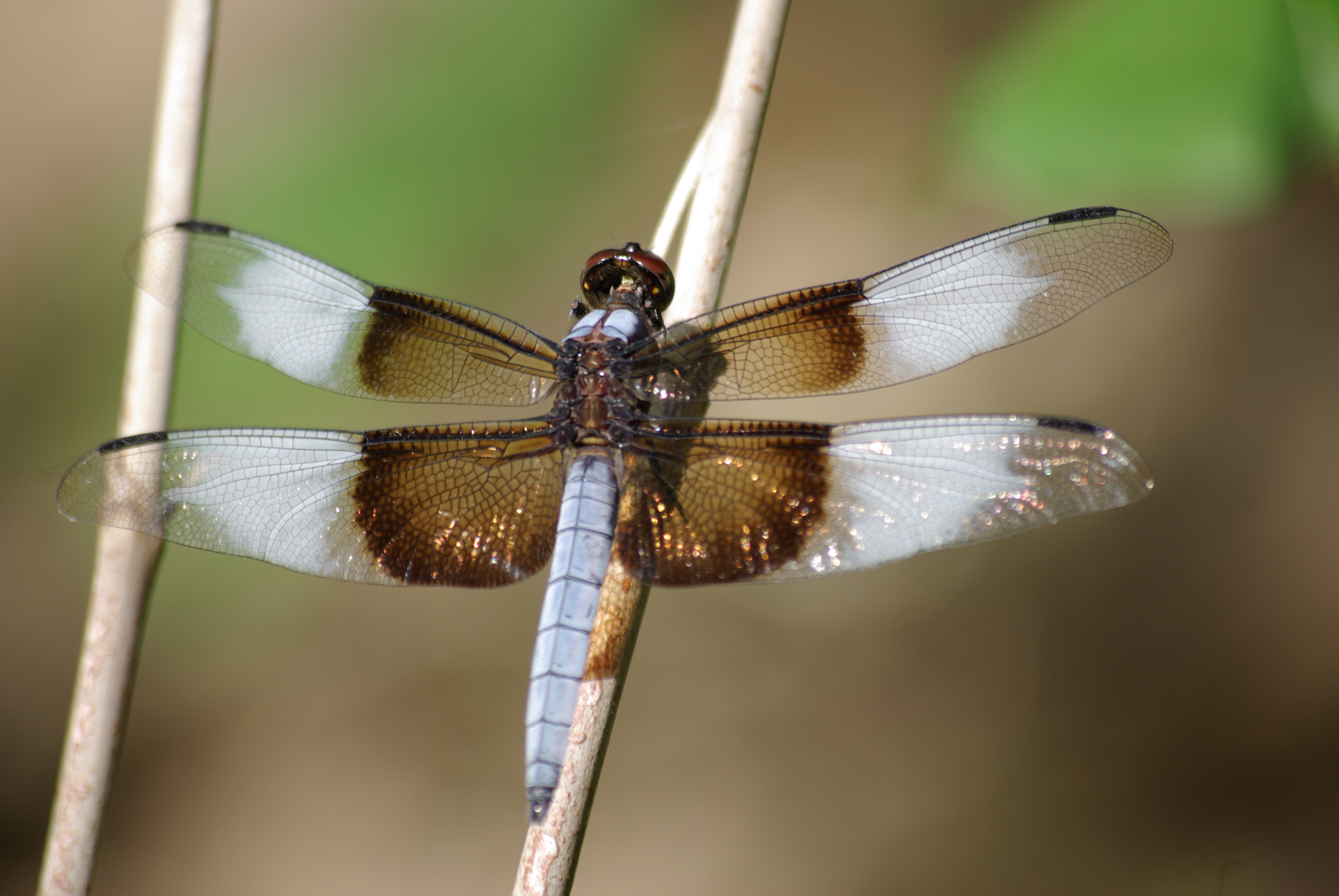
Lions Park in Duncanville, Texas, to be more precise. The dragon fly appears to me to be Neurothemis tullia, a Pied Paddy Skimmer, though I believe that is considered an Asian species. [But see note at the end of the post.]
Closely related? An exotic introduced to Texas? Here we had cotton fields, not rice paddies. The wings look like those of a Pied Paddy Skimmer, but most of the photos I’ve found show a black body, and this one is definitely gray. Hmmmm.
Dragon fly, Pied Paddy Skimmer, Neurothemis tullia - photo by Ed Darrell; copyright 2011, use permitted with attribution
Dragon flies look mean. As a very young child I was terrified of them, growing up on the banks of the Snake River in Idaho. My mother, a farm-raised girl, took me out for a walk among the diving, softly-humming aerobats, and explained they had no stingers, they ate other insects, and they seemed to like humans, if we’d watch them. As we watched, she held out her hand and a dragon fly landed, as if to say, “Hello! Listen to your mother. She knows us.”
Dragon fly takes a higher vantage point. Is this species exotic in Texas?
Up Payson Canyon, in Utah, at Scout Lake I passed many early morning hours, and many noon siestas, in the reeds watching the dragon flies. When we were in our canoes or rowboats they’d fly at us like rockets, appearing to think they were torpedo planes, then fly up, or right or left, at the last possible second, to avoid colliding with our craft. Through July they’d fly tandem, mating. This intrigued Scouts, and delighted them beyond measure when the nature merit badge counselor explained they were having sex. Red ones, blue ones, yellow, brown and black ones. Big ones, little ones.
Shortly after we moved to Texas, we discovered that a swarm of dragon flies probably meant a local colony of fire ants was casting off females, to mate and start a new mound of exotic, stinging terror. The dragon flies would catch and eat the queens-to-be. I had to use a broom to shoo off a neighbor with a can of insecticide, trying to kill the dragon flies in their work to keep us safe and happy. “But they look so mean,” she explained.
Judge no book by its cover (except Jaws); judge no insect by its eye apparel, or human eye appeal.
Heck, I’ve missed it every year since its inception in 1993.
As usual, I’ll have to hit the trails later in the summer — hello, Colorado Bend State Park. You can make it up, too. National Trails Day is a celebration that can be done any time you find to do it, really, any place you find to celebrate it.
So, hey, buddy: Take a hike!
And have fun doing it.
Information and resources for National Trails Day:
New program from Yosemite National Park’s “Nature Notes.”
This one has something to appeal to the heart of almost everybody: Photos from Ansel Adams, photos from Galen Rowell, interviews with sons of each, discussion of the (properly) much-maligned old “firefall” of hot fire coals for tourists — and the story of the natural firefall one might see, if the conditions are right, and if one is in Yosemite in the right place, on the right days of February.
This video was produced by Steven M. Bumgardner, with extra camera help from Josh Helling. Those guys do great work. It features photographer Michael Frye, Michael Adams, Ansel Adams’ son, and Tony Rowell, the son of Galen Rowell.
Spread the word; friends don't allow friends to repeat history.
Great mysteries of science, history and spirit call to us: How do the monarch butterflies do it?
Monarch butterflies (Danaus plexippus) fly north from their enclave in Mexico every spring, stopping to lay eggs on milkweed plants. After a migration of several hundred miles, that first group that left Mexico dies off. Their offspring hatch in a few days, devour the milkweed, make a chrysalis, metamorphose into butterflies, then fly farther north, where they repeat their parents’ behavior: Lay some eggs, and die. Within three generations, they’ve spread north into Canada.
Inviting the monarchs in: You can see how Kathryn worked to attract butterflies. In this photo, you can see the butterfly weed (a milkweed), red Turk's cap, and blue ageratum especially for the monarchs.
Then the fourth generation does something so strange and wonderful people can’t stop talking about it: They fly back to Mexico, to the same trees their great-great-great grandparents left. There they sip some nectar, get some water, and spend a lot of time hanging in great globs, huddling over the winter, to start life for generations of monarch butterflies the next spring.
Sometimes in Texas in October, we can see clouds of monarch butterflies winging south. If we’re lucky, they stop to visit our backyards and gardens, and we might provide some water and nectar to urge them homeward. Kathryn, of course, plants the stuff the monarchs like, to help them, and to give us a chance to see them.
Monarch habitat in Mexico is under severe stress and threat. Late storms and early freezes decimated monarch populations over the last decade [yes, that’s the proper use of “decimated;” look it up]. Human plantings are more critical to the monarch butterflies than ever before.
Two years ago Kathryn and I spent a September morning outside the library at Lawrence University, in Appleton, Wisconsin, watching monarchs sip nectar from local flowers for their journey. Those same butterflies — we hope — passed through Texas a couple of weeks later.
Two weeks ago . . . well, see for yourself:
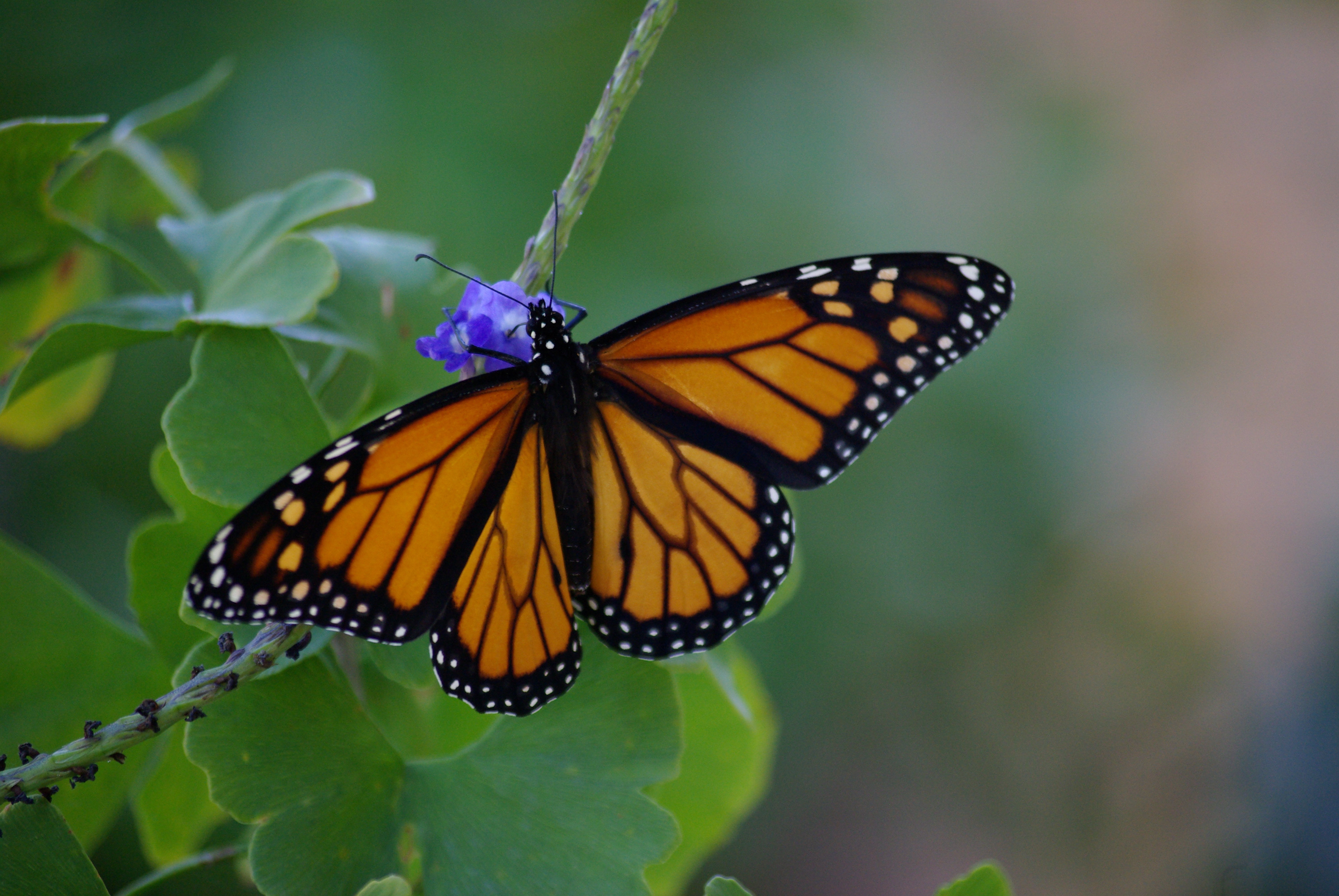
A monarch butterfly feeds on blue porterweed in Kathryn's garden, October 2010 - photo by Ed Darrell
. . . we're here with the camera, little guy, just open up those wings, please . . .
That's it! Beautiful! Have a safe trip, and come back next spring, will you?
Turk’s Cap passes under a lot of aliases: Drummond Wax-mallow, Texas Mallow, Mexican Apple, Red Mallow, May Apple, Wild Turk’s Cap, Bleeding Heart; Malvaviscus drummondii (M. arboreus var. drummondii)
Butterfly weed — there are several plants that take this name in various parts of the country, this one is Asclepias tuberosa, but Kathryn’s bloom redder and more intense yellow than any of the photos I’ve seen on line.
Or, until that account is unsuspended by the forces supporting Donald Trump: Follow @FillmoreWhite, the account of the Millard Fillmore White House Library
We've been soaking in the Bathtub for several months, long enough that some of the links we've used have gone to the Great Internet in the Sky.
If you find a dead link, please leave a comment to that post, and tell us what link has expired.
Thanks!
Retired teacher of law, economics, history, AP government, psychology and science. Former speechwriter, press guy and legislative aide in U.S. Senate. Former Department of Education. Former airline real estate, telecom towers, Big 6 (that old!) consultant. Lab and field research in air pollution control.
My blog, Millard Fillmore's Bathtub, is a continuing experiment to test how to use blogs to improve and speed up learning processes for students, perhaps by making some of the courses actually interesting. It is a blog for teachers, to see if we can use blogs. It is for people interested in social studies and social studies education, to see if we can learn to get it right. It's a blog for science fans, to promote good science and good science policy. It's a blog for people interested in good government and how to achieve it.
BS in Mass Communication, University of Utah
Graduate study in Rhetoric and Speech Communication, University of Arizona
JD from the National Law Center, George Washington University


 Posted by Ed Darrell








 Millard Fillmore's Bathtub