Sunrise at Hawk Mountain, Pennsylvania

October 4, 2013

Photograph posted on Facebook by the Hawk Mountain Sanctuary Association:

Sunrise at Hawk Mountain, Quelia Paulino, Hawk Mountain Sanctuary

Planning a trip to Hawk Mountain this weekend? Arrive early to enjoy great views of low-hanging fog and to see the sun peek out over the valley. It’s a great way to start any day. — with Quelia Paulino at Hawk Mountain Sanctuary Association.

More: 


Top o’ the world to you

September 3, 2013

Top of Colorado, anyway.

View from Longs Peak, yesterday:

View from Long's Peak, September 2, 2013; 14,259 ft.  Photo by Xiang Li.

View from Longs Peak, September 2, 2013; 14,259 ft. Photo by Xiang Li.

Xiang Li and James Darrell summited the mountain yesterday, a bit tougher climb than they had expected.  No view like that comes without some great effort somewhere.  They topped Grays Peak a couple of weeks ago — a slightly higher mountain (20 feet), but an easier climb.

Long’s Peak is the highest point in Rocky Mountain National Park.

Longs Peak is one of the 54 mountains with summits over 14,000 feet in Colorado.[3] It can be prominently seen from Longmont, Colorado, as well as from the rest of the Colorado Front Range. It is named after Major Stephen Long, who explored the area in the 1820s. Longs Peak is one of the most prominent mountains in Colorado, rising nearly 10,000 feet above the western edge of the Great Plains.

More:


Steens Mountain, sunrise, or sunset?

July 31, 2013

Either someone just spent a very cold night to get a photo, or they’re getting ready to spend a very cold night.

Which is it?

Steens Mountain in #Oregon

US Dept of Interior: If you haven’t seen Steens Mountain in #Oregon, you really should check out this stunning photo from @BLMOregon pic.twitter.com/H2eePMmfsX

Steens Mountain at sunrise is a very popular image for photographers — but very few get a shot from the mountain itself like this one.

Steens Mountain is a large fault-block mountain in the southeastern part of the U.S. state of Oregon. Located in Harney County, it stretches some 50 miles (80 km) long north to south, and rises from alongside the Alvord Desert at elevation of about 4,200 feet (1,300 m) to a summit elevation of 9,733 feet (2,967 m). It is sometimes confused with a mountain range, but is properly a single mountain.

More:

English: The Alvord Desert playa, looking sout...

The Alvord Desert playa, looking southeast from Steens Mountain, southeast Oregon; Wikipedia image


Craig Clyde’s “Flowers on Timpanogos”

July 27, 2013

Photo by Craig Clyde, who explained:

Spent the night on the north end of Mount Timpanogos at 10,000 feet, by myself, taking it all in.

Flowers on the north end of Utah's Mt. Timpanogos, about 10,000 feet up. Photo by Craig Clyde.

Flowers on the north end of Utah’s Mt. Timpanogos, about 10,000 feet up. Photo by Craig Clyde.

Photo from July 25, 2013. Flowers include “Blue-pod Lupine, Narrow Goldenrod, Giant Red Paintbrush and Mountain Bluebells.”

Contact him for prints for framing.

Save

Save


Return of the roadrunners

July 13, 2013

Our move to Texas in 1987 offered as one amenity, local roadrunners.

Camp Wisdom road was mostly two lanes then — it’s six, now.  Clark Road was two lanes.  It’s expanded to six, with a direct link to the freeway Spur 408.  Wheatland Road was two lanes.  You guessed it: Six now.

Not sure about baseball fields any more, but with roads, if you build ’em, people will come.  The empty prairie and cedar forests favored by golden-cheeked warblers, and favorable to lizard-eating roadrunners, gave way to bulldozers putting up apartment complexes, strip shopping centers (still mostly vacant), self-storage businesses, and more roads.  Roads bring automobiles, and autos provide collision courses for roadrunners.

In the summer, I used to see a roadrunner at least weekly at the intersection of Camp Wisdom and Clark; once watched one hunt down a very large Texas fence lizard and dash off with the lizard dangling from either side of its beak.  In the era before electronic cameras.

All that development takes the habitat of roadrunners, and that is the slow death of much wildlife.  Roadrunners dwindled down.  About 2009 we discussed how rare they were.  In 2011 Kathryn and I saw one lone roadrunner along Old Clark Road in Cedar Hill, precariously living in a 50-yard swath between two roads (which are slated to be widened), sharing a railroad track.  Nothing since.

Mama and chick roadrunners

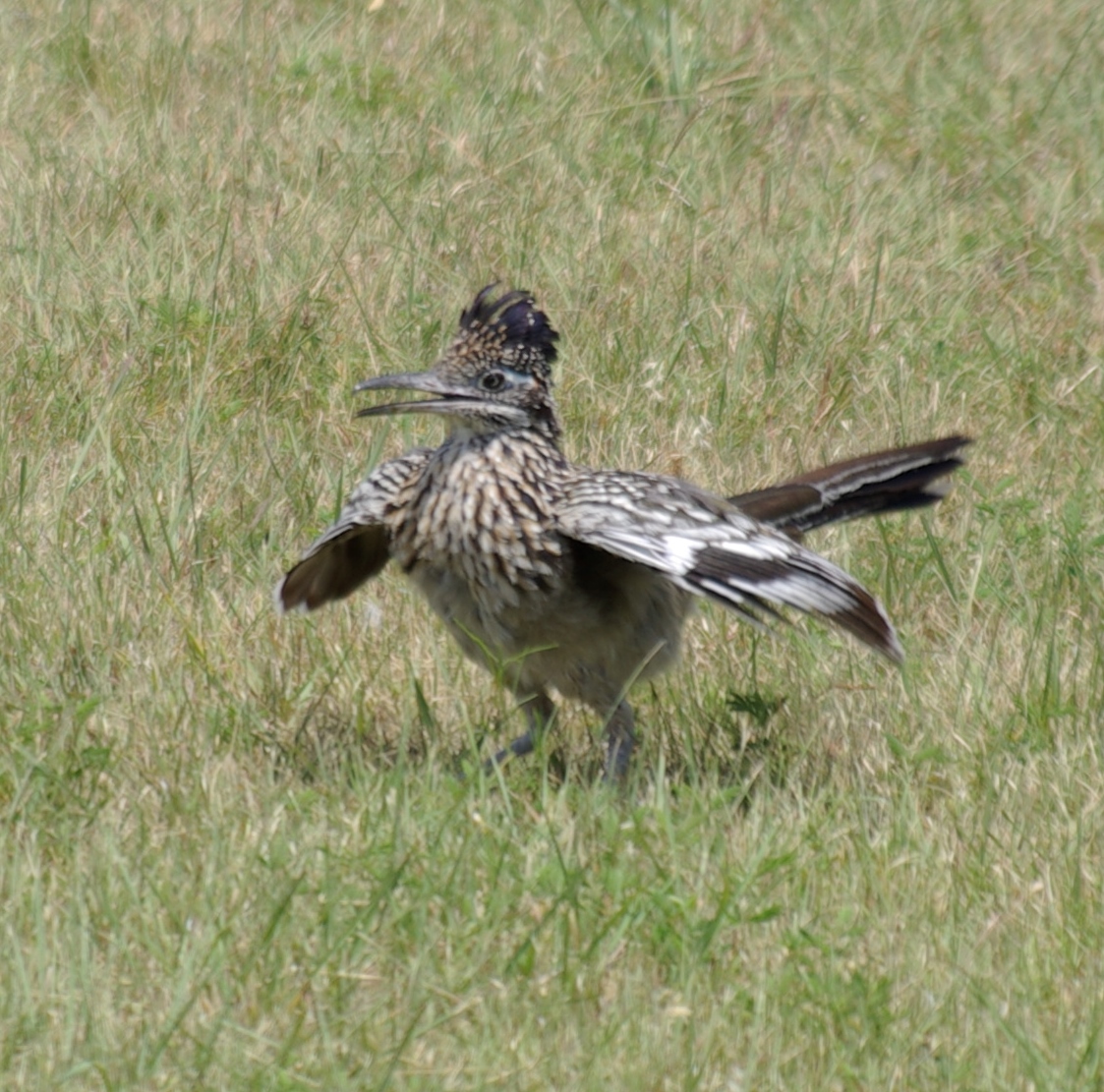
Mama roadrunner gives me the eyeball from the safety of the cedar tree, while the chick grooms. Is it safe to go out into the sun?

Until two weeks ago.  Kathryn called me, excited that she’d seen a roadrunner crossing Mountain Creek Parkway, where Wheatland Road dead-ends into it.  It’s good roadrunner weather.  We were happy to know at least one survived.

Then, last Thursday I was driving along Old Clark Road.  I brought along the Pentax K10D because I was hopeful of catching the hawk family living a block off of Wheatland and Cedar Ridge Roads.  A roadrunner dashed across the road from a small ranchette into a “vacant” field of wild prairie grasses dotted with Ashe cedars.  My experience is they are reclusive, and don’t like to be watched.  I grabbed the camera and got a couple of shots of the bird, running under a tree and meeting up with another, smaller one — a chick!

I doubled back and u-turned, hoping they might at least dash.  The larger one danced on the edge of the shadow of the tree for a minute, then uncharacteristically strutted out, hunting something to eat.  She got something that looked like a lizard, or a fantastically large grasshopper, and a few other tidbits from the grass.  She strutted around, and headed back to the shade, and to the younger one.

Mama Roadrunner flaps happily after ingesting a large something.

Mama Roadrunner flaps happily after ingesting a large something.

Roadrunners, the greater roadrunner, Geococcyx californianus (which means “Californian Earth-cuckoo,” a description of many politicians in the Golden State, perhaps).

I shot stills, with a 50-200 mm telephoto zoom, and I got a bunch of shots.  I strung them together in Windows Moviemaker.

Are the roadrunners doing okay?  Not really.  They’re not gone, but much of their old habitat disappeared from this hill, the highest point in Texas between the Louisiana border and the Rockies — swallowed by human development, homes, suburban shopping, and the roads that go with that development.

How are roadrunners doing in your area?  Got pictures?  (Cindy Knoke has a longer telephoto than I’ve got, and photos to prove it; go see.)

Greater Roadrunner running

Greater Roadrunner doing what roadrunners to, back to the shade of a cedar tree and her chick. It was 102 degrees F, after all.

More:


Time lapse at Everest – Elia Saikaly

June 13, 2013

English: Mount Everest North Face as seen from...

Mount Everest North Face as seen from the path to the base camp, Tibet. Wikipedia image

A pick from the staff at Vimeo.

It’s astonishing how many people ascend Mt. Everest in our time.  Look at the tent city.

Everest’s beauty is stunning, always has been, but is now revealed by high-definition image capture unavailable just 10 years ago, now distributed by the internet.

These photos are mostly from about 25,000 feet in elevation — about where much domestic U.S. air travel occurs.  The weather up there is spectacular, if you’re not in it. It’s spectactular if you’re in it, too — but I’m viewing it from Dallas, where we’re above 90 degrees in the day, now, just 800 feet above sea level.

As these climbers risk their lives in adventure (10% of all people who attempt to summit, die), the Himalayas suffer from effects of global climate change.  Pakistan suffers from flooding today from premature and quick melting of glaciers.

What a great planet we have.  Can we keep it?

Notes from the film maker, Elia Saikaly:

eliasaikaly.com
Experience the beauty of Mt. Everest at night in time-lapse.

While most climbers slept, I attempted to capture some of the magic that the Himalayan skies have to offer while climbing to the top of the world.

Here’s a bit of what I endured at the end to make this possible: eliasaikaly.com/2013/05/into-the-death-zone/

One of the most rewarding parts of the journey was being able to share it with thousands of students on epals.com/everest

This time lapse video is comprised of thousands of photographs, processed and assembled on Mt. Everest.

Shot on a Canon 5D Mark II
-Canon 2.8 16-35mm
-Canon 2.8 24-70mm
-Canon 2.8 70-200mm (which was way to heavy to carry beyond 6400M)
-TL Remote was purchased off eBay

Edited in Final Cut Pro
Processed in Adobe LightRoom
Movies compiled in Quicktime

Music: A Heartbeat away purchased on goo.gl/AJZcM

I hope you enjoy it. If you do, please leave a comment and let me know what you think.

My stock footage, professional and charitable work can be see on my website at eliasaikaly.com
And on FB: facebook.com/elia.saikaly.adventurer

More:

2004 photo mosaic the Himalayas with Makalu an...

2004 photo mosaic the Himalayas with Makalu and Mount Everest from the International Space Station, Expedition 8. (Photo credit: Wikipedia)


Holes in the wall, Glen Canyon NRA

June 11, 2013

Ever get one of those days you just want to find a nice, warm hole and crawl inside?

Then head out to Glen Canyon National Recreation Area:

There are many unique areas within America’s public lands. Case in point this spot in Glen Canyon National Recreation Area.  Photo: Cassandra Crowley

Caption from America’s Great Outdoors: There are many unique areas within America’s public lands. Case in point this spot in Glen Canyon National Recreation Area. Photo: Cassandra Crowley

More:


Beauty happens without warning

June 3, 2013

Brad Goldpaint (Goldpaint Photography) planned to shoot pictures of the Milky Way, something I’ve tried to do without much success, at Crater Lake National Park, one of the more spectacular backdrops for such a photograph.

Those plans were interrupted — without warning.  Thank goodness.

More information:

I drove to Crater Lake National Park on the night of May 31, 2013 to photograph the Milky Way rising above the rim. I’ve waited months for the roads to open and spring storms to pass, so I could spend a solitude night with the stars. Near 11pm, I was staring upward towards a clear night sky when suddenly, without warning, an unmistakable faint glow of the aurora borealis began erupting in front of me. I quickly packed up my gear, hiked down to my truck, and sped to a north facing location. With adrenaline pumping, I raced to the edge of the caldera, set up a time-lapse sequence, and watched the northern lights dance until sunrise. The moon rose around 2am and blanketed the surrounding landscape with a faint glow, adding depth and texture to the shot. The last image in the sequence above shows the route of the International Space Station (ISS) which flew over at 2:35am.

Please feel free to share #withoutwarning

See more images at goldpaintphotography.com/2013/06/02/without-warning/

Music composed by Ben Beiny entitled, “The Right Moment”

Limited edition, fine-art prints are available at goldpaintphotography.com/purchase

Follow me:
Facebook: facebook.com/goldpaintphotography
Twitter: twitter.com/goldpaintphoto
Google+: plus.google.com/117178975214870026107/
Newsletter: goo.gl/XLPgV

No motion control systems were used during the production of this time-lapse. We are actively seeking various marketing partnerships to strategically promote and develop, specialized photography equipment used in the field. If you are interested in soliciting your product with Goldpaint Photography, please contact us at info@goldpaintphotography.com.

Poetic understatement:  ” . . . without warning, an unmistakable faint glow of the aurora borealis began erupting in front of me.”

More:

Still from Brad Goldpaint's

Still from Brad Goldpaint’s “Without Warning,” image from Goldpaint via MSNBC


“Hit the trail!” June 1 is National Trails Day

June 1, 2013

National Trails Day logo

National Trails Day is the first Saturday in June, each year.

June 1 is National Trails Day, celebrated the first Saturday of June each year.  It’s a day designated by hikers and users of trails, the people who use trails for health, fun and adventure.

This should be a particularly American, and broadly celebrated event.  We are a nation of trails throughout our history — including in no particular order the Natchez Trace, the Chisholm Trail, various Trails of Tears, the Cumberland Trail, the Oregon Trail, the Overland Trail, the Goodnight Trail, the Santa Fe Trail, the Mission Trails, and countless others.  We fly across the continent in five hours today; when European explorers came, they explored the place on foot, first.  When humans migrated across the Bering Land Bridge, they came on foot, and populated the Americas from the Arctic Circle to Tierra del Fuego.

Hiking is much of who we are.

When is National Trails Day®?

This year National Trails Day® will occur on June 1, 2013. National Trails Day is always the first Saturday in June.

What is National Trails Day®?

American Hiking Society‘s National Trails Day® (NTD) is a celebration of America’s magnificent Trail System, occuring annually on the first Saturday in June. NTD features a series of outdoor activities, designed to promote and celebrate the importance of trails in the United States. Individuals, clubs and organizations from around the country host National Trails Day® events to share their love of trails with friends, family, and their communities. NTD introduces thousands of Americans to a wide array of trail activities: hiking, biking, paddling, horseback riding, trail running, and bird watching and more. For public and private land managers alike, National Trails Day® is a great time to showcase beautiful landscapes and special or threatened locales as thousands of people will be outside looking to participate in NTD events.

National Trails Day® evolved during the late ‘80s and ‘90s from a popular ethos among trail advocates, outdoor industry leaders and political bodies who wanted to unlock the vast potential in America’s National Trails System, transforming it from a collection of local paths into a true network of interconnected trails and vested trail organizations. This collective mindset hatched the idea of a singular day where the greater trail community could band together behind the NTD moniker to show their pride and dedication to the National Trails System.

View the National Trails Day® historical timeline.

Why Celebrate Trails?

America’s 200,000 miles of trails allow us access to the natural world for recreation, education, exploration, solitude, inspiration, and much more. Trails give us a means to support good physical and mental health; they provide us with a chance to breathe fresh air, get our hearts pumping, and escape from our stresses. All it takes is a willingness to use them!

National Trails Day® also aims to highlight the important work thousands of volunteers do each year to take care of America’s trails. Trails do not just magically appear for our enjoyment; their construction and maintenance takes hours of dedicated planning and labor. So give thanks to your local volunteers and consider taking a day to give back to your favorite trail.

Who Can Host a National Trails Day® event?

Anyone can host a National Trails Day® event. If you need help with programming ideas or would like more information, take some time to read through the materials on the host information page. There you will find all the information you need to host a successful event. Once you’ve planned the event, remember to register it!

Who Can Attend a National Trails Day® event?

Anyone is allowed to attend public NTD events, unless otherwise noted. All public events are listed under the event search page. Events registered as “private” will not appear on the event search page.

What Kinds of Events are Included?

National Trails Day® events involve a broad array of activities, including hiking, bike riding, trail maintenance, birding, wildlife photography, geocaching, paddle trips, trail running, trail dedications, health-focused programs, and children’s activities. Whatever you like to do outdoors, there is bound to be an event to fit your interests. If you don’t find the type of event you want, then plan it yourself — and be sure to register it.

How do Trails Make You Healthy?

Trails give you the opportunity to get your heart pumping, lungs expanding, and muscles working at various levels of difficulty, thereby improving your physical as well as mental well-being. With obesity rates skyrocketing, exercise is increasingly important, and trails provide a wide variety of opportunities for being physically active.

Does National Trails Day® have to be the first Saturday in June?

If your organization has a conflict with the first Saturday in June, plan your National Trails Day® event for a day or weekend that works best for you. No matter what day you choose, be sure to register your event with American Hiking Society; the national attention will draw more participants and media, and American Hiking Society will help you throughout the entire planning process.

Looking for ways to get involved year round?

Become a member of American Hiking Society or join the Alliance of Hiking Organizations.

Got a picture of your favorite trail?  Send it in, or link to it in comments.

Menunkatuck Blue-Blazed (CFPA) Trail. Particip...

Menunkatuck Blue-Blazed (CFPA) Trail. Participants in the National Trails Day 2010 inaugural Menunkatuck Trail hike sponsored by the Connecticut Forest and Park Association (CFPA), Guilford Conservation Land Trust (GCLT) and the New Haven Hiking Club (NHHC). Wikipedia photo

More:


Texas, “Go fish!”

May 28, 2013

No, this isn’t a comment about the Texas Lege.  That I have to tell you that is comment enough.

Texas Parks and Wildlife notes:

Catching a fish is fun for kids, but many families have questions about how to get started. That’s why some state parks are offering free fishing classes. They’ll teach you the basics through fun, hands-on activities. Texas Parks and Wildlife has this report on a program called “Go Fish” as the June Outdoor Activity of the Month.

To find places to fish and events near you, visit texasstateparks.org/fishing

Doesn’t seem that long ago, but he’s grown, graduated from college and moved 2,000 miles away; heck, both of the boys graduated and moved away.  We started our romancing of Texas State Parks at Ink’s Lake State Park, in one of the hottest Augusts I ever would wish to see.  We got a new tent, big enough for a family and bigger than the pup tent Kathryn and I used on the Atlantic Beaches (never did get that hurricane smell out of it . . .).  I worried about older son Kenny.  Little patience for anything not electronic.

The rules were they could play handheld games until we got there, in the car, but not once we got down to camping.  When we got to Ink’s Lake it was 105º F.  Kenny decided he’d rather stay in the car with his games.  Eventually the batteries died.

It was a fun, but not necessarily easy first day.  We had Disney TrueLife Adventure watching a wasp and spider fighting.  We had deer wandering through the site, including one with a deformed mouth (we named her Celeste, but don’t ask me why).  Deer would do almost anything for a bite of cantaloupe.  Swimming, rocks to jump off of . . . Kenny was bordering on crabby.

I never took to fishing.  That’s Kathryn’s bailiwick.  She got poles for the kids.  The whole point of the trip was to get back to fishing for Kathryn.  Kenny complained about the hot son on the end of the pier, about the worms, about the lack of video games.  He complained about everything until he got that pole in his hand and dropped the hook in the water.  I wish we had it on video.  Instantly, he became a man of patience.

Caught his first little fish that day, too.   Bluegill, or crappie — I don’t remember.  The next few days brought quite a bit of adventure — small boat tour of Ink’s Lake, big tourist boat trip on nearby Lake Buchanan (” . . . this is Texas, Honey. It’s pronounced buck-CANnon. Don’t forget.”).  We froze in Longhorn Cavern.  We found magic, and five-foot catfish, at Hamilton Pool.  The catfish were larger than James, but he took great delight in watching them in the bottom of the supernaturally-clear pool.

English: Photo taken by Reid Sullivan during d...

Hamilton Pool, near the Pedernales River – photo by Reid Sullivan during drought conditions 1/2/2006, via Wikipedia

Both boys got great at camping, both had long periods with Boy Scouts after YMCA Guides (Kenny got Life; James got Eagle).  I think both of them got the fishing merit badge with help from the Mighty Fisher, Eddie Cline.  We have thousands of photos, lots of great memories, and for our family, it started with that trip to Ink’s Lake.

The good stuff all started with fishing.

More:


Remembering Lindheimer’s muhly grass from last year’s garden

April 23, 2013

It’s spring.  The grasses are sprouting.

Texas is a good place for grasses.

Lindheimer's muhly grass, in the afternoon sun

Lindheimer’s muhly grass, Dallas, Texas, January 2013. Photo by Ed Darrell; horticultural adventures by Kathryn Knowles

Spring sunlight is spectacular on the new flowers; winter sunlight, in the afternoon, shows a different kind of spectacular.

Lindheimer’s muhly grass, Muhlenbergia lindheimeri, shows beauty from soon after it sprouts until long after it’s gone dormant.  A garden is a year-around project, and joy.

History lives in those grasses, too.  You can find some at the Native Plant Society of Texas’s website, and its description of Lindheimer’s muhly.

This seems pretty dumb now, but many years ago when I first heard about so many grasses called “muley,” I was puzzled about that name. I’d heard of muley cattle such as polled Herefords, but not hornless grass! Needless to say, as soon as I looked up Lindheimer muhly, I could see it is in a genus named after a Mr. Muhlenberg.

Gotthilf Hunrich Ernst Muhlenberg lived from 1753 to 1815. He was born into a prominent Pennsylvania family, and his father and brothers were influential patriots during the Revolutionary War. Because of his family’s involvement in the Revolution, Muhlenberg was on the British hit list.

While he was hiding out in a rural area away from Philadelphia during the Revolution, Muhlenberg became interested in botany. Through his extensive collections, Muhlenberg made major contributions to botany, and many plants have been named in his honor. For example, among our local flora are several species of muhly grass (Muhlenbergia) and Chinquapin oak (Quercus muhlenbergii).

Lindheimer muhly was named in honor of Ferdinand Lindheimer, the “Father of Texas Botany.” Many other plants native to the Texas Hill Country also bear the name “Lindheimer” or “Lindheimer’s.” Most of these plants were first collected by Lindheimer, who settled on the banks of the Comal River in New Braunfels in 1845.

Another entry in the Blackland Prairie Almanac, perhaps.

More:


Waiting for Comet Godot

March 14, 2013

Comet Pan-STARRS?

I just can’t see it.

The past two evenings, when it was supposed to be visible, we couldn’t find it.  Maddeningly, others have great photos of the thing.

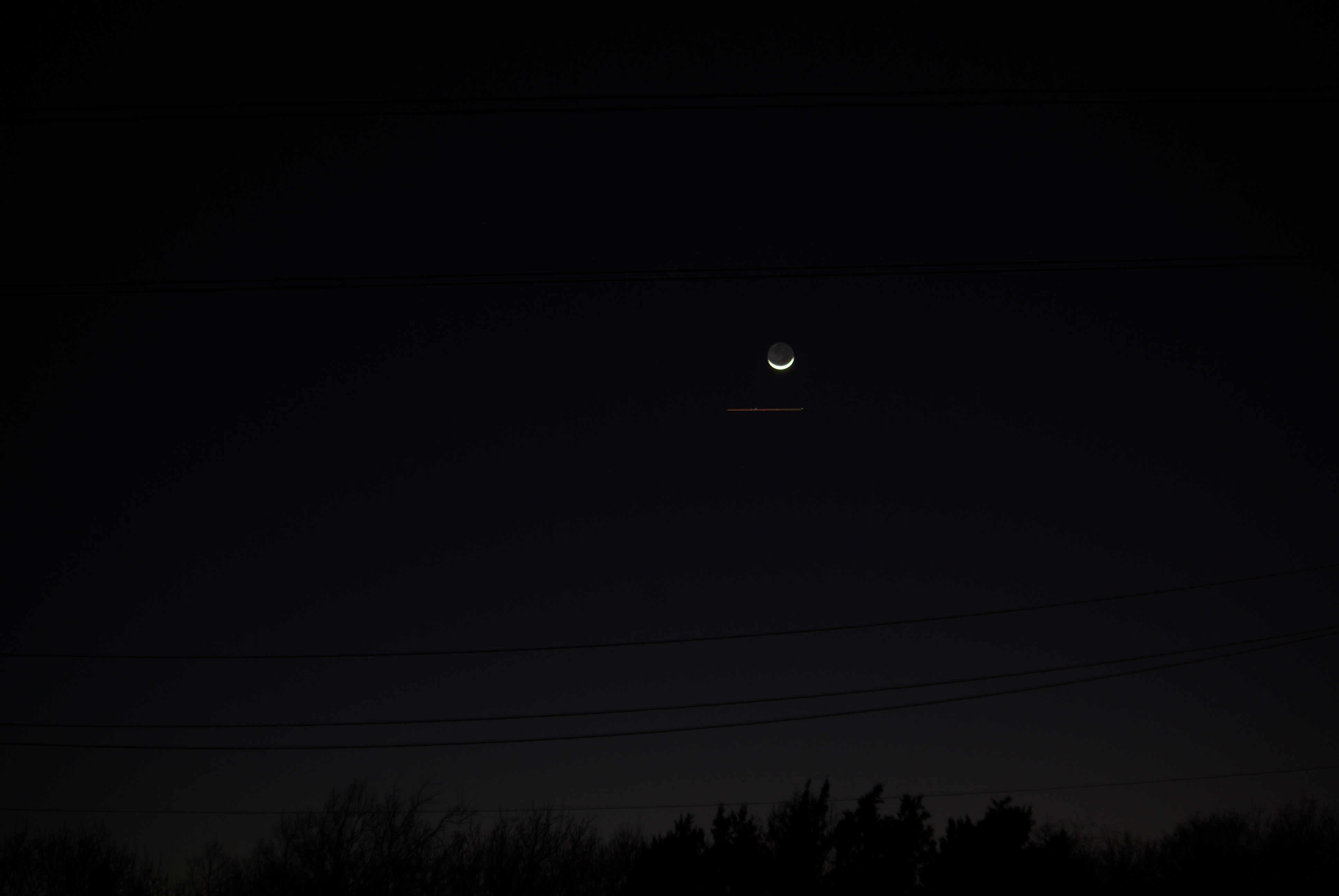
Here’s a photo of where it was supposed to be the evening of March 12.  Nice sliver of a Moon.

A view to the west over south Grand Prairie, Texas, showing the sliver of the new Moon, but a no-show Comet Pan-STARRS, March 12, 2013.  Photo by Ed, Kathryn and Peanut.

A view to the west over south Grand Prairie, Texas, showing the sliver of the new Moon, but a no-show Comet Pan-STARRS, March 12, 2013. Photo by Ed, Kathryn and Peanut.

We watched for over an hour, from just after the Sun’s winking out in a blaze of orange (Texas dust and DFW smog).  We were shooting without a tripod, and so it was difficult to capture just how thin was the line of the Moon for a long time.  It was not a clear crescent, with mountains of the Moon providing jagged lines that glistened like a crystal glass necklace.  Longer exposures revealed the comet to other observers in other places, but not to us.  Perched as we were right on the edge of the Austin Chalk Escarpment, we were joined by a dozen or so others who hoped to see the comet, or who were just putting their BMX bikes away.

A more detailed, and grainy, shot of the Moon (with no comet):

New Moon over Grand Prairie Texas, looking for Comet Pan-STARRS, photo by Ed Darrell

Eventually the Moon stated its presence, but still no Comet Pan-STARRS, on March 12, 2013. Looking west over Grand Prairie, Texas.  (Yeah, probably would have been a much better photo if not handheld.)

Here’s a photo of where it was supposed to be last night, the evening of March 13.

Moon over Grand Prairie, no comet, 3-13-2013

On March 13, Comet Pan -STARRS rode directly underneath the Moon; it’s invisible in this longer exposure, though you can see the streaking lights of a jetliner flying out of DFW International Airport under the Moon.

It’s like waiting for Godot.  Waiting for Comet Godot.

Quoting from SamuellBeckett.net:
ESTRAGON: 
People are bloody ignorant apes.  He rises painfully, goes limping to extreme left, halts, gazes into distance off with his hand screening his eyes, turns, goes to extreme right, gazes into distance. Vladimir watches him, then goes and picks up the boot, peers into it, drops it hastily.
VLADIMIR:  Pah!He spits. Estragon moves to center, halts with his back to auditorium.
ESTRAGON:  Charming spot. (He turns, advances to front, halts facing auditorium.)
Inspiring prospects. (He turns to Vladimir.)
Let’s go.
VLADIMIR:  We can’t.
ESTRAGON:  Why not?
VLADIMIR:  We’re waiting for Godot.
ESTRAGON:  (despairingly). Ah! (Pause.) You’re sure it was here?
VLADIMIR:  What?
ESTRAGON:  That we were to wait.
VLADIMIR:  He said by the tree. (They look at the tree.) Do you see any others?
ESTRAGON:  What is it?
VLADIMIR:  I don’t know. A willow.
ESTRAGON:  Where are the leaves?
VLADIMIR:

It must be dead.


More:

Brian Klimowski's photo of Comet Pan-STARRS, March 12, 2013

Other photographers found Comet Pan-STARRS. This photo comes via SpaceWeather.com. ” Brian Klimowski sends this picture from the countryside near Flagstaff, Arizona . . . ‘Beautiful show this evening!’ says Klimowski. ‘I took the photo from an altitude of about 9500 feet in the San Francisco Peaks near Flagstaff. A 1-second exposure with my Canon digital camera easily revealed the comet.'” Photo details: Canon 7D, 125 mm, 1s @ F/5.6. ISO 1250


Backyard birds: Goldfinch at the feeder

March 12, 2013

No, he’s not particularly gold — but this is winter, and if he’s going to get his breeding plumage, it will come in a couple of weeks.

We’ve had Niger thistle seed feeders out for years; this year one goldfinch (Spinus tristis) finally started to visit.  We’ve had as many as four at a time — but they’re probably headed north soon.

Here’s a shot of our first guest, from a couple of weeks ago.

Goldfinch at the feeder

A goldfinch male, checking out the feeder before bringing in his buddies — we hope.

If you’re north of Dallas, and you see this guy at your feeder this summer, tell him “hello” from us.

The non-breeding plumage isn’t so flashy as the bright yellow of the breeding males.  Some of the finches settle in to a beautiful, smooth olive-drab livery for much of the winter.  Close up, they look like good pen-ink-drawings by a master artist.

More:


How to tell Scouts are coming for dinner

March 11, 2013

Scout Dutch ovens at Camp Wisdom

Scouts coming for dinner – Dutch ovens ready for duty at Wisdom Trail District Outdoor Leader training, Camp Wisdom, Circle 10 Council BSA, March 9, 2013.

Dutch ovens lined up for duty is a tell that Scouts and Scouters are expected for dinner, aren’t they?

More:


Yosemite’s Horsetail Falls at its fiery best

February 26, 2013

Photo Tweeted from the National Park Service:

Bethany Gediman photo of Horsetail Falls, Yosemite NP, glowing orange

Horsetail Fall flows over the eastern edge of El Capitan in Yosemite Valley. It’s a small waterfall that many people don’t notice, but it has gained popularity as more and more people have noticed it can glow orange during sunset in mid to late February. The most popular place to see Horsetail Fall seemingly afire is El Capitan picnic area, west of Yosemite Lodge and east of El Capitan (see map below). The “firefall” effect generally happens during the second half of February. A clear sky is necessary for the waterfall to glow orange. Photo: Bethany Gediman, NPS

People living close to National Parks are lucky to do so; people who work in them luckier still, in the lifetime sweepstakes for seeing breathtaking sites.  NPS employee (Ranger?) Bethany Gediman caught this image of Horsetail Fall in Yosemite National Park.

Be sure to see the video of Yosemite Nature Notes No. 14, posted here earlier. It shows Horsetail at sunset in full glory.  Great photography.

How to get there:

Map to Horsetail Falls, Yosemite NP

Map of Yosemite National Park, showing Horsetail Falls and hiking trail to get to viewpoint in the photograph.

More: