Eclipse? Opportunity for photographers to show off

May 24, 2012

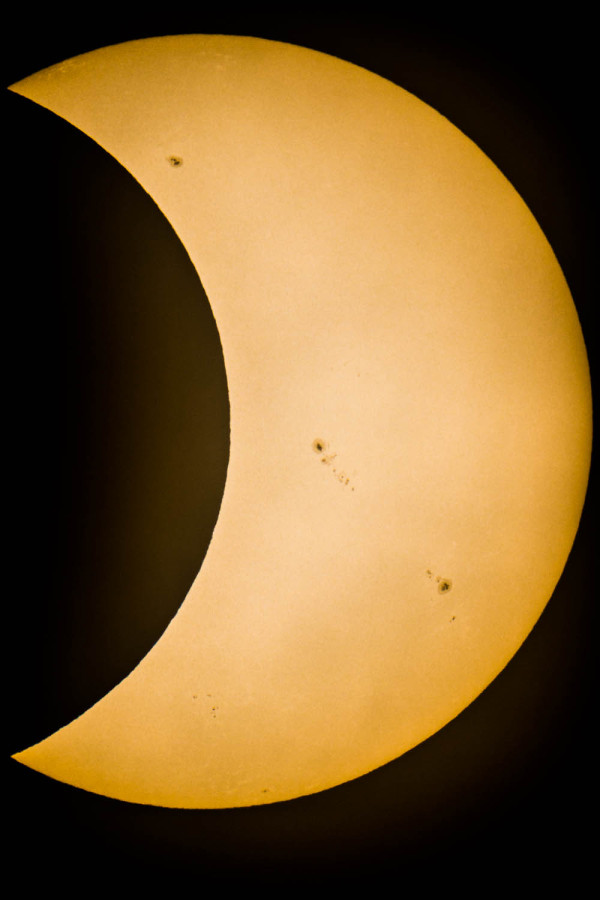
Some photographers have the patience and skills to show off well.  Found this picture of last week’s eclipse, by Mark Langridge, on TwitPic:

Mark Langridge photo, May 20, 2012 annular eclipse

Mark Langridge photograph of the May 20, 2012 annular eclipse

Annular eclipse of May 20, 2012 - photo by Langridge via twitpic

Annular eclipse of May 20, 2012 – photo by Mark Langridge via twitpic

Mr. Langridge provided details; he used a Celestron telescope with his Nikon camera:

Celestron CGEM 800 HD, Canon EOS 60Da, Kendrick Astro baadar solar filter.

Blow this image up, or go to Langridge’s TwitPic site and see it in its large format, glorious detail.  You can see the mountains on the Moon . . .


Time lapse photos: NYC, before 1975

May 22, 2012

Why does time-lapse photography fascinate me so?  It reveals changes over time we too often miss, or don’t stop to appreciate.

Here’s an excerpt from a 1975 film, set to music recently released.  Watch closely, you’ll see the shadows of the World Trade Center passing over New York City.

Described at Youtube:

A music video for the gorgeous track “Exercise #3 (Building) by CFCF (Mike Silver). Song is from his upcoming EP titled “Exercises,” which arrives on April 24th via Paper Bag Records.

Footage is from the 1975 short film “Organism,” by Hilary Harris.

For more on CFCF:

http://paperbagrecords.com/artists/cfcf
http://soundcloud.com/cfcf
https://www.facebook.com/pages/CFCF/196418801490

edited by https://www.facebook.com/daviddeanburkhart

More:

Tip of the old scrub brush to Slacktivist.


Heart of Atlanta Motel and civil rights

December 28, 2011

PG posted this photo in one of his collections at Chamblee54:
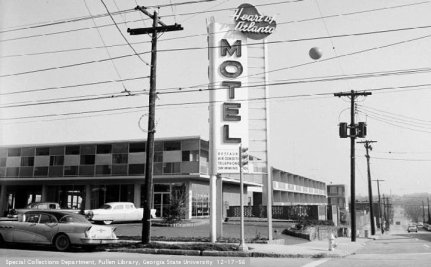
Heart of Atlanta Motel, 1956 - Special Collections and Archives,Georgia State University Library

Heart of Atlanta Motel, 1956 - Special Collections and Archives,Georgia State University Library

I wondered whether this is the motel in the case testing the 1964 Civil Rights Act — and sure enough, it is.  The case was decided, finally, by the U.S. Supreme Court in 1964, Heart of Atlanta Motel, Inc., v. United States, 379 U.S. 241 (1964) .

This important case represented an immediate challenge to the Civil Rights Act of 1964, the landmark piece of civil rights legislation which represented the first comprehensive act by Congress on civil rights and race relations since the Civil Rights Act of 1875. For much of the 100 years preceding 1964, race relations in the United States had been dominated by segregation, a system of racial separation which, while in name providing for “separate but equal” treatment of both white and black Americans, in truth perpetuated inferior accommodation, services, and treatment for black Americans.

During the mid-20th century, partly as a result of cases such as Powell v. Alabama, 287 U.S. 45 (1932); Smith v. Allwright, 321 U.S. 649 (1944); Shelley v. Kraemer, 334 U.S. 1 (1948); Sweatt v. Painter, 339 U.S. 629 (1950); McLaurin v. Oklahoma State Regents, 339 U.S. 637 (1950); NAACP v. Alabama, 357 U.S. 449 (1958); Boynton v. Virginia, 364 U.S. 454 (1960) and probably the most famous, Brown v. Board of Education of Topeka, 347 U.S. 483 (1954), the tide against segregation began to turn. However, segregation remained in full effect into the 1960s in parts of the southern United States, where the Heart of Atlanta Motel was located, despite these decisions.

The Atlanta Time Machine, a great collection of photos in the history of Atlanta and Georgia, has more photos, and this description of the site:

The Heart of Atlanta motel, located at 255 Courtland Street NE, was owned by Atlanta attorney Moreton Rolleston Jr.  Rolleston, a committed segregationist, refused to rent rooms at his hotel to black customers.  Upon passage of the Civil Rights Act of 1964, Rolleston immediately filed suit in federal court to assert that the law was the result of an overly broad interpretation of the U.S. Constitution’s commerce clause.  Rolleston represented himself in the case, HEART OF ATLANTA MOTEL, INC. v. UNITED STATES ET AL., which  went all the way to the United States Supreme Court.  Rolleston lost when the Supreme Court ruled that Congress was well within its powers to regulate interstate commerce in such a manner.  The Hilton Hotel now stands on the former site of the Heart of Atlanta Motel.

Texts in law school rarely have illustrations.  I know the motel mostly as a citation on pages of text, great grey oceans of somnambulent text.  This case is important in civil rights, though it is mentioned almost never in history texts.  What are these cases really about?  These photos offer us insight.

The Heart of Atlanta Motel aspired to greatness in the late 1950s and 1960s — evidenced by this publicity flyer photo from the Atlanta Time Machine; notice the flag flying for the motel’s Seahorse Lounge (Atlanta is landlocked):

Heart of Atlanta Motel publicity photo - Atlanta Time Machine

Heart of Atlanta Motel publicity photo - Atlanta Time Machine; not just a podunk "motor lodge," but a "resort motel." Click for larger image.

For the 1960s, this place offered great amenities, including two swimming pools and in-room breakfast service.

Flyer for the Heart of Atlanta Motel, circa 1960 - Atlanta Time Machine image

Flyer for the Heart of Atlanta Motel, circa 1960 - Atlanta Time Machine image

This photo is amusing — I can just imagine the difficulties of launching a motor boat of this size in one of the swimming pools, obviously for a publicity stunt.  The photo is dated February 27, 1960, in the Pullen Library Collection.

Boat in the pool at the Heart of Atlanta Motel, 1960 - Atlanta Time Machine image

Boat in the pool at the Heart of Atlanta Motel, 1960 - Atlanta Time Machine image

To compare how times have changed, you may want to look at this aerial photo of the area, including the Heart of Atlanta Hotel, and compare it with modern photos which show the Hilton Hotel that replaced the property.

Rolleston appears to have had a big ego.  As noted above, he represented himself in this case, and he argued it in the Supreme Court.  Here’s a picture from about that time, from the University of Missouri-Kansas City Law School “Famous Trials” site:

Moreton Rolleston, Jr., owner of the Heart of Atlanta Motel and the attorney who argued the case at the Supreme Court - UMKC Law School image

Moreton Rolleston, Jr., owner of the Heart of Atlanta Motel and the attorney who argued the case at the Supreme Court - UMKC Law School image; photo: Wayne Wilson/Leviton-Atlanta

You may decide for yourself whether this fits the old legal aphorism that a lawyer who represents himself in a case has a fool for a client.  The Oyez site at the University of Chicago provides access to the audio of the oral arguments.  Did Rolleston argue ably?  Rolleston argued against Archibald Cox, who went on to fame in the Watergate scandals.  This appears to have been Rolleston’s only appearance before the Supreme Court; it was Cox’s ninth appearance (he argued 20 cases before the Court in his career, several well known and notable ones).

Heart of Atlanta vs. United States was argued on October 5, 1964.  The opinion was issued on December 14, 1964, a 9-0 decision against Rolleston and segregation authored by Justice Tom C. Clark (one of Dallas’s earliest Eagle Scouts).

This was a fight Mr. Rolleston picked.  He was not cited nor indicted for violation of the Civil Rights Act, but instead asked for an injunction to prevent the law’s enforcement; according to the published decision,

Appellant, the owner of a large motel in Atlanta, Georgia, which restricts its clientele to white persons, three-fourths of whom are transient interstate travelers, sued for declaratory relief and to enjoin enforcement of the Civil Rights Act of 1964, contending that the prohibition of racial discrimination in places of public accommodation affecting commerce exceeded Congress’ powers under the Commerce Clause and violated other parts of the Constitution. A three-judge District Court upheld the constitutionality of Title II, §§ 201(a), (b)(1) and (c)(1), the provisions attacked, and, on appellees’ counterclaim, permanently enjoined appellant from refusing to accommodate Negro guests for racial reasons.

Oyez summarizes the case question:

Facts of the Case 

Title II of the Civil Rights Act of 1964 forbade racial discrimination by places of public accommodation if their operations affected commerce. The Heart of Atlanta Motel in Atlanta, Georgia, refused to accept Black Americans and was charged with violating Title II.

Question 

Did Congress, in passing Title II of the 1964 Civil Rights Act, exceed its Commerce Clause powers by depriving motels, such as the Heart of Atlanta, of the right to choose their own customers?

The decision turned on the commerce clause, and the reach of Congressional power to regulate interstate commerce.

Decision: 9 votes for U.S., 0 vote(s) against
Legal provision: Civil Rights Act of 1964, Title II

The Court held that the Commerce Clause allowed Congress to regulate local incidents of commerce, and that the Civil Right Act of 1964 passed constitutional muster. The Court noted that the applicability of Title II was “carefully limited to enterprises having a direct and substantial relation to the interstate flow of goods and people. . .” The Court thus concluded that places of public accommodation had no “right” to select guests as they saw fit, free from governmental regulation.

Good decision.

Heart of Atlanta Motel is gone.  The site is occupied by the Hilton Atlanta, today.


Louie Schwartzberg’s “Gratitude” at TEDS

November 26, 2011

Kathryn sent me the link and said I had to watch it. One learns to listen to one’s Trophy Wife™ if one has any sense.

Louie Schwartzberg’s TEDS appearances are greater than one (“(Louie at TEDS)>1”).  When you watch his films, you can understand why he’s popular among the secular wooists, and even among the thinkers and scientists.  One might rationally wonder why he’s not invited to speak at a lot of church services, but that would be a rational response.  Schwartzberg’s earlier appearance at the Bathtub covered his TEDS presentation on his film, “Pollination.”

This one is more ephemeral, but a lot more human.  I hope to see his work in theaters, soon.

What does this film make you feel, and what does it make you think?

How many of the locations on that film did you identify?


Yosemite Nature Notes extra: Time lapse of people visiting

September 4, 2011

Among other things one might observe from this film, one might note that Yosemite National Park’s beauty is so great that it looks good from almost any angle, even with tourists plastered all over it.

This was released between Yosemite Nature Notes #14 and #15, and I find no other description.  This remains a wonderful series showing off the geography and natural phenomena of Yosemite.  I wish there were similar programs for Yellowstone, Glacier, Denali, Grand Canyon, Zion, Bryce, Big Bend, Great Smoky Mountains, and for the Adirondack State Park in New York, among many others.


Floating over our problems

August 19, 2011

Do you ever dream of flying?

Natsumi Hayashi, a woman in Tokyo, Japan, posts a photo every day of herself, levitating nonchalantly around town and through life.

Great blog, great photos, fun stuff at YowaYowaCamera:

Photo by Natsumi Hayashi, Tokyo - levitating through the day

Natsumi Hayashi of Tokyo flies through the day, and has the photos to prove it at her blog, YowaYowaCamera.

Can you pick out locations from any of those photos?  Is there a good geography exercise in here somewhere?

More: 


Red dragonfly in Colorado Bend State Park, Texas

August 9, 2011

Dragon flies are not my area of expertise:  Can anyone identify this beauty?

Red Dragonfly in Colorado Bend State Park, Texas (photo by Ed Darrell)

Red dragonfly in Colorado Bend State Park, Texas - photo by Ed Darrell

_____________

Kate wrote in to say it’s probably Libella saturata.  From other photos I’ve found, that seems a good, accurate identification.  Citizens of Arizona have been urged to help identify dragon flies, odonates,  in their state, and this site explains how to do it with a camera and a notepad — with a fine picture of a Libella saturata for illustration.  And, as a reward to Kate and yourself, you may want to hop over to her blog, The Radula, and see what she’s got to look at.


Lesson for Congress: Sometimes an eagle has to drift a while just to survive

July 28, 2011

Maybe Ben Franklin got it wrong, and the bald eagle is the best candidate for our national bird.

Cousin Amanda, last year with the condors in California, spends this summer with the bears, salmon, whales and other spectacular wildlife in Alaska.  (Internships are great, for the interns, no?)

Comes this photo of our national symbol, the bald eagle:

Eagle in the water near Hoonah, Alaska; photo by Amanda Holland (rights reserved)

Yeah, it’s a bit of a flyspeck on the horizon photo, but it’s still instructive.  Probably looking for fish, this bird waded too far out into the estuary.  Once it realized it was wet, and in the water, it tried to swim to shore.  Eagle wings are made to soar, however, not swim.  Swimming didn’t work.  At this point, the bird could have continued to struggle to do the impossible, and probably drown; or it could just give up, and drown.

Or, it might sit tight and wait to see if another opportunity presents itself.  After about an hour in the water, the bird drifted into shallow water where it could walk out.

Ms. Holland posted this photo on her Facebook site.  A friend there observed, “The symbol of our nation floating aimlessly with the tide because it is too bogged down to do anything else… How much irony can exist in one single photograph?”

Sometimes we get in “too deep.”  We may want to soar, but that’s not possible.  But if we’re patient, if we don’t do stupid stuff, we might just drift into safer waters, and survive, and thrive.

Yeah, we know, Tea Partiers: You think the nation spends too much money.  That’s a debate worth having.

But that’s not worth failing to raise the debt ceiling.  Failing to raise the debt ceiling will cost the nation, by conservative estimates, a half-trillion dollars in increased interest rates, with no gain of any program or paying of any debt.

It’s time to drift with the flow of events.  Raise the debt ceiling now, and survive without doing something stupid.  We can discuss solutions later, rationally, once we prevent the waste of a half trillion dollars, eh?  Time to stop fighting and stay alive, Congress.

We can learn a lot from the bald eagle.  I think even Ben Franklin would agree.

What’s that, Ben?  Our follies tax us more than taxes?

“Friends,” says he [Father Abraham], “and Neighbours, the Taxes are indeed very heavy, and if those laid on by the Government were the only Ones we had to pay, we might more easily discharge them; but we have many others, and much more grievous to some of us. We are taxed twice as much by our Idleness, three times as much by our Pride, and four times as much by our Folly; and from these Taxes the Commissioners cannot ease or deliver us by allowing an Abatement. However let us hearken to good Advice, and something may be done for us; God helps them that help themselves, as Poor Richard says, in his Almanack of 1733.

— Ben Franklin, The Way to Wealth, 1758


Timelapse tour of natural wonders of the Southwest U.S. – spectacular!

July 19, 2011

Here’s a video I would like to use as a a warm-up, or prompt to a study of American geography.

Evosia Photography, the hangout of Henry Jun Wah Lee, has a short but spectacular tour of several sites in the American Southwest deserts — Arizona, California, Utah, and Navajoland — timelapse movies, usually shot at night with starry backgrounds.

He has set the photography against the music of a band named Conjure One, an edited version of their recording “Manic Star.”

Certainly there is copyright, at least a Creative Commons license — you should attribute this film to Mr. Lee and the music to Conjure One.

Can you identify these sites?  Can your students?  Can they map out a plan to visit these sites as one exercise?  Can you and your students identify any of the constellations on view? (List of sites, from Mr. Lee, below the fold.)

Have you, or your students, ever visited any of those sites, and gazed at the stars?  Why not?

2,912 looks

Read the rest of this entry »


Full Moon, waterfalls in Yosemite, modern cameras: Voila! Moonbows!

July 7, 2011

Dick Feynman taught in Rio de Janeiro for a while.  He was frustrated at the way Brazilian students of that day learned physics by rote, instead of in labs.  In a lecture he looked out from the classroom to the sun dancing on the waves of the Atlantic, and he realized it was a beautiful, brilliant demonstration of light refraction, the topic of the day.  Sadly, the students didn’t understand that the beauty before them was a physics problem.  (Was that story in Surely You’re Joking, Mr. Feynman,  or What Do You Care What Others Think?)

Here, a marriage of physics, moonlight, spring runoff over a cliff, and modern photography, in Yosemite.  If you don’t gasp, call your physician and find a new sensei:

(Programs and maintenance of this park are threatened by Republican budget writers, BTW.)


Dragon fly on a Saturday walk in the park

June 28, 2011

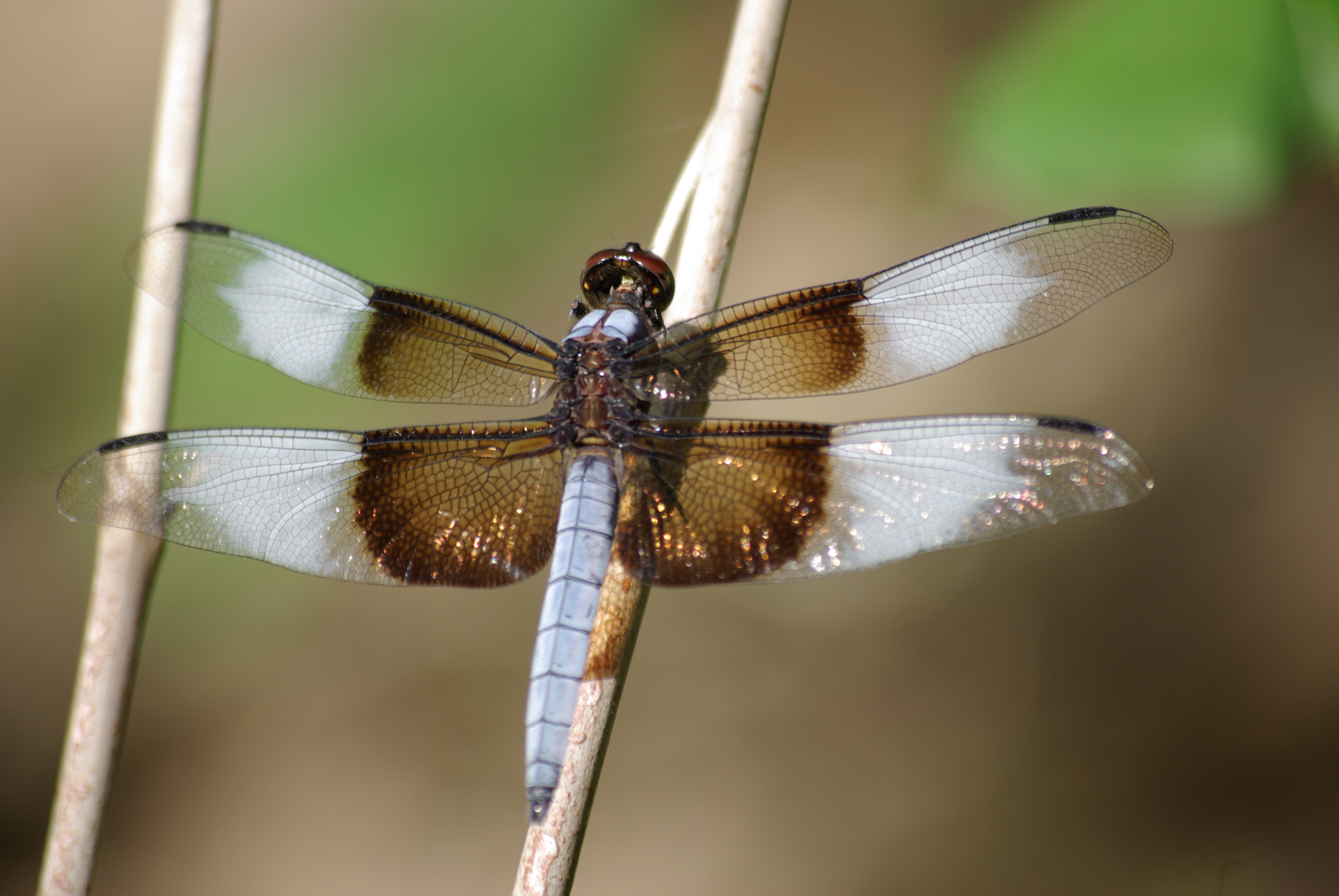
Lions Park in Duncanville, Texas, to be more precise.  The dragon fly appears to me to be Neurothemis tullia, a Pied Paddy Skimmer, though I believe that is considered an Asian species.  [But see note at the end of the post.]

Closely related?   An exotic introduced to Texas?  Here we had cotton fields, not rice paddies.  The wings look like those of a Pied Paddy Skimmer, but most of the photos I’ve found show a black body, and this one is definitely gray.  Hmmmm.

Dragon fly, Pied Paddy Skimmer, Neurothemis tullia - photo by Ed Darrell copyright 2011, use permitted with attribution

Dragon fly, Pied Paddy Skimmer, Neurothemis tullia - photo by Ed Darrell; copyright 2011, use permitted with attribution

Dragon flies look mean.  As a very young child I was terrified of them, growing up on the banks of the Snake River in Idaho.  My mother, a farm-raised girl, took me out for a walk among the diving, softly-humming aerobats, and explained they had no stingers, they ate other insects, and they seemed to like humans, if we’d watch them.  As we watched, she held out her hand and a dragon fly landed, as if to say, “Hello!  Listen to your mother.  She knows us.”

Dragon fly in Duncanville Lions Park, photo by Ed Darrell - use permitted with attribution

Dragon fly takes a higher vantage point. Is this species exotic in Texas?

Up Payson Canyon, in Utah, at Scout Lake I passed many early morning hours, and many noon siestas, in the reeds watching the dragon flies.  When we were in our canoes or rowboats they’d fly at us like rockets, appearing to think they were torpedo planes, then fly up, or right or left, at the last possible second, to avoid colliding with our craft.  Through July they’d fly tandem, mating.  This intrigued Scouts, and delighted them beyond measure when the nature merit badge counselor explained they were having sex.  Red ones, blue ones, yellow, brown and black ones.  Big ones, little ones.

Shortly after we moved to Texas, we discovered that a swarm of dragon flies probably meant a local colony of fire ants was casting off females, to mate and start a new mound of exotic, stinging terror.  The dragon flies would catch and eat the queens-to-be.  I had to use a broom to shoo off a neighbor with a can of insecticide, trying to kill the dragon flies in their work to keep us safe and happy.  “But they look so mean,” she explained.

Judge no book by its cover (except Jaws); judge no insect by its eye apparel, or human eye appeal.

Dragon fly, Neurothemis Tullia (perhaps), Duncanville Lions Park, 6-25-2011 - Photo by Ed Darrell, use permitted with attribution

Pied Paddy Skimmer rests from hunting

_____________

Update:  In comments below, Roused Bear wonders if this isn’t the Widow Skimmer, which is native to Texas.  That would make a lot more sense, wouldn’t it?  What do you think, Dear Reader:  Widow Skimmer, Libellula luctuosa?


Anniversary of the Magna Carta, 1215

June 15, 2011

On June 15, 1215, King John affixed his seal to the Magna Carta, in a ceremony at Runnymede, England.

An encore post:

Runnymede, Magna Carta Isle, photo by Wyrdlight, Antony McCallum, 2008 (Wikimedia)

What event critical to western history and the development of the democratic republic in the U.S. happened here in 1215?

A teacher might use some of these photos explaining the steps to the Constitution, in English law and the heritage of U.S. laws. Other than the Magna Carta, all the events of Runnymede get overlooked in American studies of history. Antony McCallum, working under the name Wyrdlight, took these stunning shots of this historic meadow. (He photographs stuff for studies of history, it appears.)

Maybe it’s a geography story.

View of Runnymede Meadow from Engham Village -- Wyrdlight photo through Wikimedia

View of Runnymede Meadow from Engham Village — Wyrdlight photo through Wikimedia

Several monuments to different events of the past millennium populate the site. The American Bar Association dedicated a memorial to the Magna Carta there — a small thing open to the air, but with a beautiful ceiling that is probably worth the trip to see it once you get to England.

Wikipedia explains briefly, with a note that the ABA plans to meet there again in 2015, the 800th anniversary of the Great Charter:

Magna Carta Memorial


The Magna Carta Memorial & view towards the ‘medes’


Engraved stone recalling the 1985 ABA visit

Situated in a grassed enclosure on the lower slopes of Cooper’s Hill, this memorial is of a domed classical style, containing a pillar of English granite on which is inscribed “To commemorate Magna Carta, symbol of Freedom Under Law”. The memorial was created by the American Bar Association to a design by Sir Edward Maufe R.A., and was unveiled on 18 July 1957 at a ceremony attended by American and English lawyers.[5]

Since 1957 representatives of the ABA have visited and rededicated the Memorial renewing pledges to the Great Charter. In 1971 and 1985 commemorative stones were placed on the Memorial plinth. In July 2000 the ABA came:

to celebrate Magna Carta, foundation of the rule of law for ages past and for the new millennium.

In 2007 on its 50th anniversary the ABA again visited Runnymede and during the convention installed as President Charles Rhyne who devised Law Day which seeks in the USA an annual reaffirmation of faith in the forces of law for peace.

The ABA will be meeting at Runnymede in 2015 on the 800th anniversary of the sealing of the original charter.

The Magna Carta Memorial is administered by the Magna Carta Trust, which is chaired by the Master of the Rolls.[10]

In 2008, flood lights were installed to light the memorial at night, but due to vandalism they now lie smashed.

I’ll wager the lights get fixed before 2015.


Detail of the Magna Carta monument at Runnymed...

Detail of the Magna Carta monument at Runnymede. I took this photo some time in the early Eighties. (Photo credit: Wikipedia)


Detail of ceiling of the Magna Carta Memorial detailing play of light, and star pattern, Runnymede – Wikimedia image

More, resources:

Also on June 15:


Old-Picture.com, good resource for teachers and students

May 31, 2011

Here’s a source of high-quality photos, most at least 90 years old.  A lot of these photos would fit nicely into presentations for history classes:  Old-Picture.com.

Many of the photos don’t appear much of any place else.  There are historic maps, too.

For example:  What’s a “whistlestop tour?”

Here is President William H. Taft making such a tour, or rather, speaking during a stop on such a tour, at Redfield (what state?  South Dakota?  Iowa?  New York?):

W. H. Taft on whistlestop tour, in Redfield

W. H. Taft on whistlestop tour, in Redfield

Here’s Taft, again, at “Boutelle at Janesville;” note especially the boys climbing the pole to get a better look:

1908 Taft whistlestop tour, Boutelle at Janesville (wherever that is!)

1908 Taft whistlestop tour, Boutelle at Janesville (wherever that is!)

Janesville is probably the city in Wisconsin.

Here’s Taft at a train, again in 1908 — might we assume it’s the same trip?

W. H. Taft at a train, in 1908 - campaigning?

W. H. Taft at a train, in 1908 -- campaigning?

Here Taft and his party are pictured on a train, in Chicago.  Same train?  Same trip?  Who are the other men with him?

W. H. Taft and party on a train, 1908 presidential campaign

W. H. Taft and party on a train in Chicago, 1908 presidential campaign

For another view, here’s what Taft saw at one of his stops — the crowd assembled to listen to him speak, in 1908:

Crowd gathered to hear Taft's campaign speech, 1908 (location, "West?")

Crowd gathered to hear Taft's campaign speech, 1908 (location, "West?") -- love that Tom Mix-looking hat on the guy in the middle, no?

Put these pictures together in a different order — it’s a clear illustration of just what a “whistlestop” tour is.  These slides could complement a presentation comparing this trip with Harry Truman’s 1948 whistlestop tour, just two generations later.  Or, juxtapose these pictures with pictures of John F. Kennedy in 1960, or Richard Nixon in 1968, or Bill Clinton’s bus tours in 1992 and 1996.

I’ll wager you’ve not seen at least one of these photos before (they are all new to me).  Old-Picture.com has a great collection of stuff.  So far as I can tell, the site administrator lists no copyright restrictions (there’s got to be a story in there somewhere).

What can you do with this collection?


Then and now: Big Cottonwood Canyon, Utah – 1869 and 2006

March 18, 2011

Photographer Timothy H. O’Sullivan toured the western territories — not yet states — for either the U.S. Army Corps of Engineers or the U.S. Geological Survey, around 1868 and 1869.  Color photography hadn’t been perfected.  His plates were black and white only.

He had been one of the photographers who captured parts of the Civil War on film, with particularly poignant photos of the battlefield at Gettysburg, Pennsylvania, within hours after the battle ended on July 4, 1863.

O’Sullivan’s photos appear in the collection at the Library of Congress, and at the George Eastman House (Eastman was the founder of Kodak, as you know).

O’Sullivan’s photos show the mineral and mining operations of Nevada, Utah and Idaho, and Arizona and New Mexico, so far that I’ve found.  Particularly in the mountains, the places he photographed can be tracked down today.

In this post we compare O’Sullivan’s photo up what he called “Great Cottonwood Canon of the Wahsatch,” what is today one of the beautiful canyons leading out of Salt Lake City, Big Cottonwood, in the Wasatch Front.  O’Sullivan took a shot up the canyon, then very much unroaded, at an enormous block of granite that came to be known as Storm Mountain.

In 1869:

"Great Cottonwood Canyon, Wahsatch Mountains," 1869 photo by Timothy H. O'Sullivan - USGS photo from Eastman collection

"Great Cottonwood Canyon, Wahsatch Mountains," 1869 photo by Timothy H. O'Sullivan - USGS photo from Eastman collection

Rich Legg of Salt Lake City captured the same mountain in 2006, and graciously consented to let us use it here for comparison.  This is Storm Mountain, now:

From LeggNet:

Big Cottonwood Canyon, Utah, 2006 - photo by Rich Legg, copyright and rights reserved

Big Cottonwood Canyon, Utah, 2006 - photo by Rich Legg, copyright and rights reserved; image here by express permission

Note from LeggNet blog: This recent capture was made in Big Cottonwood Canyon just outside of Salt Lake City. The striking shadows along with the jagged ridges create a dramatic lighting effect.

Legg’s camera and film allowed a quicker shot, I’ll wager (if he used film at all — it may be an electronic image).

The granite didn’t change much.  Storm Mountain is literally a fraction of a mile outside the city limits of Salt Lake City.  A photo the other way would show dramatic change.  A photo of Storm Mountain, which consists chiefly of naked granite, appears almost unchanged in over a century.  It’s difficult even to find places where the vegetation has changed.

In the past 20 years we have seen comparisons of America’s and the world’s glaciers, from photos through the late 19th and 20th centuries, compared to photos of today.  The archives of landscape photos held by groups like the George Eastman House offer opportunities for historians and land managers and policy makers to compare American lands from more than a century ago, to those same lands today.  Much of those older photo archives are available on line, at least for searching.  Will scholars make methodical use of these resources?


Firefall in Yosemite: Horsetail Fall’s spectacular February show

March 2, 2011

New program from Yosemite National Park’s “Nature Notes.”

This one has something to appeal to the heart of almost everybody:  Photos from Ansel Adams, photos from Galen Rowell, interviews with sons of each, discussion of the (properly) much-maligned old “firefall” of hot fire coals for tourists — and the story of the natural firefall one might see, if the conditions are right, and if one is in Yosemite in the right place, on the right days of February.

This video was produced by Steven M. Bumgardner, with extra camera help from Josh Helling.  Those guys do great work.  It features photographer Michael Frye, Michael Adams, Ansel Adams’ son, and Tony Rowell, the son of  Galen Rowell.