The Seeger Family, 1921 Pete Seeger, the now-93 year-old folk singer, is sitting on his father’s lap. Pete’s father was musicologist Charles Louis Seeger, Jr.; his mother was the violinist Constance de Clyver Edson. The other two children are probably Pete’s older brothers Charles, III, and John. This photo probably was taken while Charles and Constance toured the American south to teach music, after his having to leave UCLA because of his pacifist stance during World War I.
Judy Collins and Pete Seeger, photo by the preservationist David Rocco, at the Clearwater Festival in Hudson, New York, June 15, 2013. (We think that’s Pete’s wife, Toshi, on the far right edge of the photo.)
Still shot of the Supercell near Booker, Texas – photo by Mike Olbinski (copyright, rights reserved)
Photographer Mike Olbinski was on the road, near Booker, Texas, when the storm rolled in. According to him, he was on the wrong side of the storm to get great photos, and he set up at the wrong spot . . .
Technical deets: Canon 5D2, Rokinon 14mm 2.8…first three clips were at 1-second intervals = 880ish photos, the last sequence was around 90, 5-second exposures
A rotating supercell. And not just a rotating supercell, but one with insane structure and amazing movement.
I’ve been visiting the Central Plains since 2010. Usually it’s just for a day, or three, or two…but it took until the fourth attempt to actually find what I’d been looking for. And boy did we find it.
No, there was no tornado. But that’s not really what I was after. I’m from Arizona. We don’t get structure like this. Clouds that rotate and look like alien spacecraft hanging over the Earth.
We chased this storm from the wrong side (north) and it took us going through hail and torrential rains to burst through on the south side. And when we did…this monster cloud was hanging over Texas and rotating like something out of Close Encounters.
The timelapse was shot on a Canon 5D Mark II with a Rokinon 14mm 2.8 lens. It’s broken up into four parts. The first section ends because it started pouring on us. We should have been further south when we started filming but you never know how long these things will last, so I started the timelapse as soon as I could.
One thing to note early on in the first part is the way the rain is coming down on the right and actually being sucked back into the rotation. Amazing.
Joe Deshotel – Panorama of empty rotunda at Texas Capitol – dome to floor. Posted on Twitter June 27, 2013
This is the building that, just hours before, had been crowded by thousands of people hoping to get into the Texas Senate Chamber to see Sen. Wendy Davis’s filibuster.
Star on the dome of the Texas State Capitol; a similar star is five very long stories below, on the floor. Image via Shapleigh.org, “Grover’s Tub.”
Look carefully, and you can see that the guides in the Capitol don’t lie — the star on the dome reflects the star on the floor (or vice versa).
Can you get a similar shot of the rotunda of your state capitol? Would you do it and send it in, or post it and give us the link?
Mount Everest North Face as seen from the path to the base camp, Tibet. Wikipedia image
A pick from the staff at Vimeo.
It’s astonishing how many people ascend Mt. Everest in our time. Look at the tent city.
Everest’s beauty is stunning, always has been, but is now revealed by high-definition image capture unavailable just 10 years ago, now distributed by the internet.
These photos are mostly from about 25,000 feet in elevation — about where much domestic U.S. air travel occurs. The weather up there is spectacular, if you’re not in it. It’s spectactular if you’re in it, too — but I’m viewing it from Dallas, where we’re above 90 degrees in the day, now, just 800 feet above sea level.
One of the most rewarding parts of the journey was being able to share it with thousands of students on epals.com/everest
This time lapse video is comprised of thousands of photographs, processed and assembled on Mt. Everest.
Shot on a Canon 5D Mark II
-Canon 2.8 16-35mm
-Canon 2.8 24-70mm
-Canon 2.8 70-200mm (which was way to heavy to carry beyond 6400M)
-TL Remote was purchased off eBay
Edited in Final Cut Pro
Processed in Adobe LightRoom
Movies compiled in Quicktime
Photographer Randy Halverson lives and shoots in South Dakota, mostly. Here’s an almost-five minute piece showing the night skies of South Dakota with a little Wyoming thrown in.
Halverson’s description:
If you have ever been in a wide open landscape the most interesting thing isn’t necessarily the landscape itself, but what you see coming over the horizon. Growing up in South Dakota the landscape itself can be beautiful at times, but that doesn’t compare to what the sky can do, especially at night. Combine that with the landscape, and it makes for great photo opportunities. More information and stills at dakotalapse.com/2013/06/horizons/
Bear McCreary (The Walking Dead, Defiance, Battlestar Galactica, etc) once again helped me with some original music for the video. This time he suggested adding vocals to the mix. Brendan McCreary and his band (Young Beautiful in a Hurry) did just that. They came up with “I Forever” The single is available on iTunes tinyurl.com/pgrq45p , Amazon and other online sources.
I shot Horizons from April – October 2012 mostly in South Dakota, but also some at Devils Tower in Wyoming. From the rugged Badlands, the White River valley and the Black Hills, the horizons seem to endlessly change.
Photography and Editing – Randy Halverson
Production Assistants – River Halverson and Kelly McILhone
Color Correction – Jeff Zueger – Spectrum Films
Sponsors:
Dynamic Perception – The Stage Zero and Stage One dollies were used in many of the shots. I can’t recommend them enough for a quality product at a low price. dynamicperception.com/#oid=1005_1
Borrowlenses – Throughout the summer I got some great Canon and Zeiss lenses from Borrowlenses to use in the shoot. They have great service and every lens performed flawlessly. So if you ever want to try out a lens ,or just need one for an special shoot, give them a try! borrowlenses.com
Granite Bay Software – I try to avoid flicker in sunset or daytime timelapse while shooting. But sometimes it is unavoidable. I used GBDeflicker to smooth out the flicker in some of the sunset timelapse. granitebaysoftware.com/
Equipment Used
Canon 5D Mark III, sometimes with a 2nd from Borrowlenses.com
Canon 5D Mark II
Canon 60D
I used a variety of lenses, many from Borrowlenses.com
Canon 14, 16-35, 24-70, 50 F1.2, 70-200mm lenses
Zeiss 21, 25, 35mm lenses
Nikon 14-24mm with Novoflex Adapter
Available in 4K resolution.
Contact for licensing footage, shooting rates or anything else.
Randy Halverson dakotalapse@gmail.com
“Main Street Buffalo” – Looking down Main Street of Buffalo, Oklahoma as a severe thunderstorm dumping large hail sits nearly stationary just north of town. I’ve been wanting to get a scene like this for a long time. This was still in the late afternoon and it looked like evening outside, the locals were wondering why I’d keep running out in the middle of the road in between traffic with my camera one guy stopped to ask us if we were broke down. Great people!
You see a few of these skies in a week, you’re not so anxious to stand outside and deny global warming caused by humans. With luck, enough people will be driven to repent of their denialism, and we can get some serious action to restore the atmosphere.
Spread the word; friends don't allow friends to repeat history.
Brad Goldpaint (Goldpaint Photography) planned to shoot pictures of the Milky Way, something I’ve tried to do without much success, at Crater Lake National Park, one of the more spectacular backdrops for such a photograph.
Those plans were interrupted — without warning. Thank goodness.
I drove to Crater Lake National Park on the night of May 31, 2013 to photograph the Milky Way rising above the rim. I’ve waited months for the roads to open and spring storms to pass, so I could spend a solitude night with the stars. Near 11pm, I was staring upward towards a clear night sky when suddenly, without warning, an unmistakable faint glow of the aurora borealis began erupting in front of me. I quickly packed up my gear, hiked down to my truck, and sped to a north facing location. With adrenaline pumping, I raced to the edge of the caldera, set up a time-lapse sequence, and watched the northern lights dance until sunrise. The moon rose around 2am and blanketed the surrounding landscape with a faint glow, adding depth and texture to the shot. The last image in the sequence above shows the route of the International Space Station (ISS) which flew over at 2:35am.
No motion control systems were used during the production of this time-lapse. We are actively seeking various marketing partnerships to strategically promote and develop, specialized photography equipment used in the field. If you are interested in soliciting your product with Goldpaint Photography, please contact us at info@goldpaintphotography.com.
Poetic understatement: ” . . . without warning, an unmistakable faint glow of the aurora borealis began erupting in front of me.”
Caption from Pete Souza‘s slide show: A message from President Barack Obama is seen on a Plaza Towers Elementary School sign, at Moore Fire Department Station #1 in Moore, Okla., May 26, 2013. (Official White House Photo by Pete Souza)
Pete Souza‘s work as White House photographer will ultimately make historians’ work much richer. He’s got a great eye for a shot that needs to be snapped, and a great sense of art on the fly. If you’re not a regular watcher of Souza’s work, you probably should be, especially if you’re teaching history.
No campfire necessary? Henry Ford, Thomas Edison, President Warren Harding, and Harvey Firestone. Harding was probably the closest to poverty in this group. Photo may be from a camping trip in Maryland, circa 1921. AkronHistory.orgLibrary of Congress
Every Boy Scout knows, there’s something magical in a campfire. Sometimes, you don’t even need the campfire.
It’s a prize-winning photograph by “Scout Tufankjian, an independent photographer whose portfolio includes a book of photographs from Obama’s first run for the White House.”
Barack and Michelle Obama in Booth No. 3 at Lagomarcino’s in the Village of East Davenport, Iowa, during the 2012 election campaign
Photographs sometimes reveal truths, and sometimes those truths are wonderful, and smile-making.
THE QUIETUDE of the soda fountain booth was a marked difference from a rousing Obama appearance a half-hour earlier at a curb-to-curb outdoor rally.
After the speech, the Obamas adjourned to the cool of Lago’s. Tom had prepared for them to be seated in Booth No. 3.
“The Obamas were shaking so many hands before coming into our soda shop that I had to make three different chocolate sundaes for them.” Tom says. “They kept melting.”
Glenn Frankel at the University of Texas wrote a book about the John Ford movie, “The Searchers.” It’s release, and stories about it, should remind us of the history of Quanah Parker, the last great, chief of the Comanches. “The Searchers” was loosely based on a true story, the kidnapping of Cynthia Ann Parker, by Comanches, and her subsequent life with the tribe, and her recapture by white relatives. She had married in the tribe — Quanah Parker was her son.
Photographs of Native Americans reside among the publicly and internet available materials of the National Archives. Images can be ordered in sets of slides, or as individual prints, though many are available in quality high enough for PowerPoint works and use on classroom materials. Many of the photos are 19th century.
Quanah Parker stands as one of the larger Native Americans in Texas history. This photo puts a face to a reputation in Texas history textbooks. Texas teachers may want to be certain to get a copy of the photo. His life story includes so many episodes that seem to come out of a Native American version of Idylls of the King that a fiction writer could not include them all, were they not real.
Quanah’s mother was part of the famous Parker family that helped settle West Texas in the 1830s. Cynthia Ann Parker was captured in 1836 when Comanches attacked Fort Parker, near present-day Groesbeck, Texas, in Limestone County. (See Fort Parker State Park.) Given a new name, Nadua (found one), she assimilated completely with the Nocona band of Comanches, and eventually married the Comanche warrior Noconie (also known as Peta Nocona). Quanah was their first child, born in 1852.
Nadua was captured by a Texas party led by Lawrence Sullivan “Sul” Ross in 1860, in the Battle of Pease River. Noconie, Quanah, and most of the Nocona men were off hunting at the time, and the fact of Nadua’s capture was not realized for some time. Nadua asked to return to the Comanches and her husband, but she was not allowed to do so. When her youngest daughter, who had been captured with her, died of an infection, Nadua stopped eating, and died a few weeks later.
Sul Ross was a character in his own right. At the time he participated in the raid that recaptured Cynthia Parker, he was a student at Baylor University (“What do I do on summer breaks? I fight Indians.”) At the outbreak of the Civil War, Ross enlisted in the Confederate Army as a private. Over 135 battles and skirmishes he rose to the rank of Brigadier General, the ninth youngest in the Confederate Army. A successful rancher and businessman back in Texas after the war, he won election as governor in 1887, served two very successful terms (he resolved the Jaybird-Woodpecker War in Fort Bend County, and had to call a special session of the legislature to deal with a budget surplus), refused to run for a third term, and was named president of Texas Agricultural and Mechanical College (Texas A&M) within a few days of stepping down as governor. Ross’s leadership of the college is legendary — students put pennies near a statue of Ross in a traditional plea to pass final exams, among many other traditions. After his death, Texas created Sul Ross State University, in Alpine, Texas, in his honor.
Quanah Parker’s father, Noconie, died a short time after his mother’s capture. He left the Nocona band, joined the Destanyuka band under Chief Wild Horse, but eventually founded his own band with warriors from other groups, the Quahadi (“antelope eaters”) (also known as Kwahadi). The Quahadi band grew to be one of the largest and most notorious, always with Quanah leading them. The Quahadis refused to sign the 1867 Medicine Lodge Treaties, and so avoided immediate internment to a reservation. However, dwindling food supplies and increasing opposition forced Quanah to retire to a reservation in 1875, in what is now southwestern Oklahoma. This was the last Comanche band to come to the reservation.
Quanah was appointed Chief of all the Comanches.
Through investments, Quanah became rich — probably the richest Native American of his time.
Quanah hunted with President Theodore Roosevelt.
Quanah in European-American business attire. (Photo credit: Wikipedia)
Rejecting monogamy and Christianity, Quanah founded the Native American Church movement, which regards the use of peyote as a sacrament. Quanah had been given peyote by a Ute medicine man while recovering from wounds he’d suffered in battle with U.S. troops. Among his famous teachings: The White Man goes into his church and talks about Jesus. The Indian goes into his Tipi and talks with Jesus.
Bill Neeley wrote of Quanah Parker: “Not only did Quanah pass within the span of a single lifetime from a Stone Age warrior to a statesman in the age of the Industrial Revolution, but he never lost a battle to the white man and he also accepted the challenge and responsibility of leading the whole Comanche tribe on the difficult road toward their new existence.”
Quanah Parker died on February 23, 1911. He is buried at Fort Sill Cemetery, Oklahoma, next to his mother and sister.
Quanah Parker’s epitaph reads:
Resting Here Until Day Breaks
And Shadows Fall and Darkness Disappears is
Quanah Parker Last Chief of the Comanches
Born 1852
Died Feb. 23, 1911
Quanah Advances To Area Round (myhighplains.com) (No, this isn’t really relevant to Quanah Parker, other than showing that modern Texas honors the name.)
Spread the word; friends don't allow friends to repeat history.
Loren Holmes photograph straight up of Aurora borealis over Eureka, Alaska, on March 13, 2013. AlaskaDispatch.com
I love fireworks. Kathryn and I have been known to drive a couple hundred miles to see a good show. Fireworks in honor of the guy who gave us the Constitution and the First Amendment (and much more), seems a great idea to me.
But no one did it . . .
Sometimes the Sun, Moon, stars and planets conspire.
Here’s one of the best, most inspiring five minutes you’ll spend this week. Look what the Sun sent us, filmed in time-lapse glory above Eureka, Alaska, on March 16, 2013, the anniversary of James Madison’s birthday; from AlaskaDispatch.com:
A timelapse of the Aurora Borealis, Northern Lights, over Eureka, Alaska on March 16, 2013. Taken with a Canon 5D Mark III and 24mm f/1.4 and 70-200 f/2.8 lenses. Compiled from 3800 images, with exposures between 2 seconds and 30 seconds.
The past two evenings, when it was supposed to be visible, we couldn’t find it. Maddeningly, others have great photos of the thing.
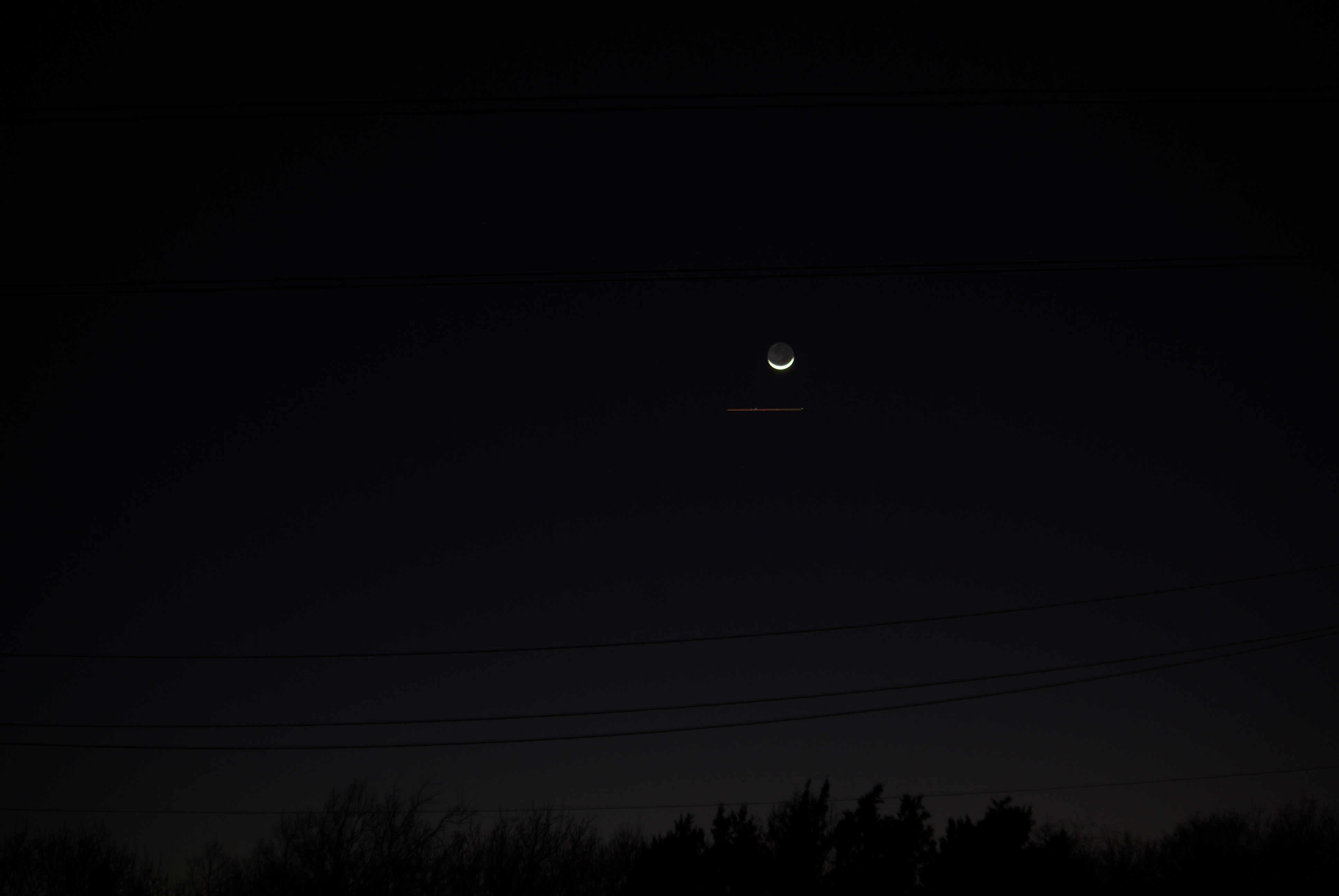
Here’s a photo of where it was supposed to be the evening of March 12. Nice sliver of a Moon.
A view to the west over south Grand Prairie, Texas, showing the sliver of the new Moon, but a no-show Comet Pan-STARRS, March 12, 2013. Photo by Ed, Kathryn and Peanut.
We watched for over an hour, from just after the Sun’s winking out in a blaze of orange (Texas dust and DFW smog). We were shooting without a tripod, and so it was difficult to capture just how thin was the line of the Moon for a long time. It was not a clear crescent, with mountains of the Moon providing jagged lines that glistened like a crystal glass necklace. Longer exposures revealed the comet to other observers in other places, but not to us. Perched as we were right on the edge of the Austin Chalk Escarpment, we were joined by a dozen or so others who hoped to see the comet, or who were just putting their BMX bikes away.
A more detailed, and grainy, shot of the Moon (with no comet):
Eventually the Moon stated its presence, but still no Comet Pan-STARRS, on March 12, 2013. Looking west over Grand Prairie, Texas. (Yeah, probably would have been a much better photo if not handheld.)
Here’s a photo of where it was supposed to be last night, the evening of March 13.
On March 13, Comet Pan -STARRS rode directly underneath the Moon; it’s invisible in this longer exposure, though you can see the streaking lights of a jetliner flying out of DFW International Airport under the Moon.
Quoting from SamuellBeckett.net: ESTRAGON: People are bloody ignorant apes. He rises painfully, goes limping to extreme left, halts, gazes into distance off with his hand screening his eyes, turns, goes to extreme right, gazes into distance. Vladimir watches him, then goes and picks up the boot, peers into it, drops it hastily. VLADIMIR: Pah!He spits. Estragon moves to center, halts with his back to auditorium. ESTRAGON: Charming spot. (He turns, advances to front, halts facing auditorium.)
Inspiring prospects. (He turns to Vladimir.)
Let’s go. VLADIMIR: We can’t. ESTRAGON: Why not? VLADIMIR: We’re waiting for Godot. ESTRAGON: (despairingly). Ah! (Pause.) You’re sure it was here? VLADIMIR: What? ESTRAGON: That we were to wait. VLADIMIR: He said by the tree. (They look at the tree.) Do you see any others? ESTRAGON: What is it? VLADIMIR: I don’t know. A willow. ESTRAGON: Where are the leaves? VLADIMIR:
It must be dead.
Other photographers found Comet Pan-STARRS. This photo comes via SpaceWeather.com. ” Brian Klimowski sends this picture from the countryside near Flagstaff, Arizona . . . ‘Beautiful show this evening!’ says Klimowski. ‘I took the photo from an altitude of about 9500 feet in the San Francisco Peaks near Flagstaff. A 1-second exposure with my Canon digital camera easily revealed the comet.'” Photo details: Canon 7D, 125 mm, 1s @ F/5.6. ISO 1250
Spread the word; friends don't allow friends to repeat history.
Or, until that account is unsuspended by the forces supporting Donald Trump: Follow @FillmoreWhite, the account of the Millard Fillmore White House Library
We've been soaking in the Bathtub for several months, long enough that some of the links we've used have gone to the Great Internet in the Sky.
If you find a dead link, please leave a comment to that post, and tell us what link has expired.
Thanks!
Retired teacher of law, economics, history, AP government, psychology and science. Former speechwriter, press guy and legislative aide in U.S. Senate. Former Department of Education. Former airline real estate, telecom towers, Big 6 (that old!) consultant. Lab and field research in air pollution control.
My blog, Millard Fillmore's Bathtub, is a continuing experiment to test how to use blogs to improve and speed up learning processes for students, perhaps by making some of the courses actually interesting. It is a blog for teachers, to see if we can use blogs. It is for people interested in social studies and social studies education, to see if we can learn to get it right. It's a blog for science fans, to promote good science and good science policy. It's a blog for people interested in good government and how to achieve it.
BS in Mass Communication, University of Utah
Graduate study in Rhetoric and Speech Communication, University of Arizona
JD from the National Law Center, George Washington University


 Posted by Ed Darrell







 Millard Fillmore's Bathtub
