March 15, 2009
A quick snippet of learning from my stay at Mount Vernon:
How many places are named after Washington? How many schools?
At the relatively new museum here I found a display that notes how Americans have honored our First President by naming things after him:
- 26 mountains
- 740 schools
- 155 places (the exhibit said “155 cities and counties,” but the map also showed the State of Washington)
(All of this comes without the aid of a George Washington Legacy Project to inflate his importance and the love of Americans for his work!)
George Washington can still lay claim to his friend Richard Lee’s eulogy, as “first in the hearts of his countrymen.”
I found the display on place names on the way out of the Education Center — a place designed to help visiting teachers learn about resources available for classroom use.
Of course the group works to help teachers who can’t visit at the moment, too. To that end they’ve published online a series of lesson plans developed by the George Washington Teachers’ Institute, a summer residency program that provides professional development.
Check out the lesson plans at http://www.mountvernon.org. Lesson plans are here. I particularly liked the political cartoons included in this lesson plan, all drawn by Pulitzer Prize-winning cartoonists.
Renovations and new construction at Mount Vernon during the past decade have made the place a much more valuable resource for teachers and students.
Let’s tip the entire Millard Fillmore’s Bathtub to the Bill of Rights Institute and Liberty Fund, who sponsored the program at Mount Vernon.
Spread the word; friends don't allow friends to repeat history.
 2 Comments |
  George Washington, History, History museums, Lesson plans, Political cartoons | Tagged: Education, George Washington, History, Lesson plans, Political cartoons |
  Permalink
 Posted by Ed Darrell
March 8, 2009
You be the judge, at Daryl Cagle’s Political Cartoonist Index.
Then come back here and tell us your opinion.
Spread the word; friends don't allow friends to repeat history.
4 Comments | Cartoons, Political cartoons | Tagged: Political cartoons, Politics, Rush Limbaugh | Permalink
Posted by Ed Darrell
December 13, 2008
Judges returned their ballots — the winners of the 2008 Ranan Lurie Political Cartoon Awards have been announced at the United Nations.
First place to a Greek cartoonist, Michael Kountouris of Eleftheros Typos:

Michael Kountoris, Eleftheros Typos, 1st place in the Lurie/UN Cartoon Awards, 2008
Of the 13 cartoons, 1st, 2nd, 3rd and honorable mentions, at least six touch on environmental topics. Is this a representation of a the cartoons published in the past year?
All the cartoons honored deserve your viewing — go see them here.
The award is offered annually by the UN Correspondents Association in honor of Ranan Lurie, who probably still is the most widely syndicated cartoonist in history. A sample of Lurie’s work, below the fold.
Read the rest of this entry »
Spread the word; friends don't allow friends to repeat history.
2 Comments | Cartoons, History, History images, Political cartoons, Politics, United Nations | Tagged: Cartoons, History, Political cartoons, Politics, Ranan Lurie, UN Correspondents Association, United Nations | Permalink
Posted by Ed Darrell
November 2, 2008
Elektratig relates views in a new book that makes a case that Millard Fillmore acted decisively and powerfully to prevent a war between the states in 1850, and thereby force the Compromise of 1850.
Among its many other virtues, Mark J. Stegmaier’s Texas, New Mexico, & The Compromise of 1850: Boundary Dispute & Sectional Crisis contains a detailed and balanced discussion of Millard Fillmore’s contributions toward the resolution of the Crisis of 1850.
A cartoon from April 1850 shows how raw were some of the emotions among national leaders, especiallyi n the Senate. It illustrates an incident that occurred April 17, 1850, when Sen. Henry S. Foote of Mississippi drew a pistol on Missouri’s Sen. Thomas Hart Benton. Elektratig used the cartoon to illustrate his post; it’s good enough to repeat here.

Cartoon by Edward Williams Clay, from the Library of Congress Collection. LOC Summary: A somewhat tongue-in-cheek dramatization of the moment during the heated debate in the Senate over the admission of California as a free state when Mississippi senator Henry S. Foote drew a pistol on Thomas Hart Benton of Missouri. In the cartoon Benton (center) throws open his coat and defiantly states, "Get out of the way, and let the assassin fire! let the scoundrel use his weapon! I have no arm's! I did not come here to assassinate!" He is attended by two men, one of them North Carolina senator Willie P. Mangum (on the left). Foote, restrained from behind by South Carolina's Andrew Pickens Butler and calmed by Daniel Stevens Dickinson of New York (to whom he later handed over the pistol), still aims his weapon at Benton saying, "I only meant to defend myself!" In the background Vice President Fillmore, presiding, wields his gavel and calls for order. Behind Foote another senator cries, "For God's sake Gentlemen Order!" To the right of Benton stand Henry Clay and (far right) Daniel Webster. Clay puns, "It's a ridiculous matter, I apprehend there is no danger on foot!" Visitors in the galleries flee in panic.
Real history: Stranger than you can imagine.
Spread the word; friends don't allow friends to repeat history.
2 Comments | Civil War, DBQ sources, History, Millard Fillmore, Political cartoons, Politics, U.S. Senate | Tagged: California Statehood, Civil War, Compromise of 1850, Crisis of 1850, DBQ, History, Millard Fillmore, Political cartoons, Politics, Senate Debate | Permalink
Posted by Ed Darrell
August 22, 2008
Did the cartoonist specifically have Texas and State Board of Education Chairman Don McLeroy in mind?

Cartoon from Thomas Kondenkandeth; was he thinking specifically of Texas?
Found it at the German language version of the Seed Magazine science blogs, Hintern Mond gleich links, “Bissige Wissenschafts-Cartoons.”
Spread the word; friends don't allow friends to repeat history.
Leave a Comment » | Cartoons, Political cartoons, Politics, Science, Texas | Tagged: Cartoons, Political cartoons, Politics, Science, Texas | Permalink
Posted by Ed Darrell
August 5, 2008
George Santayana is best known as a historian. He’s famous for his observation on the importance of studying history to understand it, and getting it right: “Those who cannot remember the past are condemned to repeat it.” (See citation in right column of the blog.)
Steve Greenberg is a historian cartoonist whose work is published in the Ventura County (California) Star. He offers a Santayana-esque analysis of economics positions of presidential candidates.

Steve Greenberg, published in the Ventura County Star
Click on the thumbnail for a larger version.
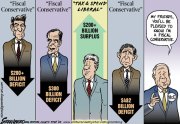
Steve Greenberg, Ventura County Star, via Cagle Comics
Greenberg has compressed into 33 words and 5 images a rather complex argument in this year’s presidential campaign.
Is Greenberg right? Do you see why Boss Tweed feared Thomas Nast’s cartoons more than he feared the reporters and editorial writers?
This election campaign we may be able to get the best analysis and commentary from cartoonists. Same as always. Teachers: Are you stockpiling cartoons for use through the year in government, economics, and history?
Other resources:
Note to Cagle cartoons: I think I’m in fair use bounds on this. In any case, I wish you would create an option for bloggers, and an option for teachers who may reuse cartoons year after year. I’ve tried to contact you to secure rights for cartoons in the past, and I don’t get responses. Complain away in comments if you have a complaint, but let us know how we can expose cartoonists to broader audiences and use these materials in our classrooms for less than our entire teacher salary.
Spread the word; friends don't allow friends to repeat history.
33 Comments | Campaigns, Cartoons, Economics, Elections, History, Political cartoons, Presidents | Tagged: Cartoons, Economics, History, John McCain, Political cartoons, presidential campaign, Steve Greenberg | Permalink
Posted by Ed Darrell
July 21, 2008
Goodnight Moon by Margaret Wise Brown and Clement Hurd is one of my favorite books of all time. I first read it when I was in college, but it was a toddler favorite of both of our sons, and it rapidly became one of mine, too. Reading it to them at bedtime helped calm them down and put them to sleep. There is from the book a feeling of safety, of warmth, coziness, and love. I may have liked reading it to them more than they liked being read to.
With our youngest off to college this fall, I wish there were some book to give them that would reproduce those good feelings of nearly 20 years ago.
::sigh::
Here’s what we have instead. Goodnight Bush.
This image is scary enough (see the bugging microphone? the burning ballot box? the tilted scales of justice? the polluting smokestacks?).

Cover of Goodnight Bush
This is the one that makes the more serious statement:

Goodnight human rights, everywhere
A story on this book at NPR was the “most e-mailed” last week.
Images by Gan Golen and Erich Origen, Goodnight Bush, copyright © 2008, Little, Brown and Co.
Spread the word; friends don't allow friends to repeat history.
4 Comments | Books, Elections, History, Human Rights, Political cartoons, Politics, Presidents | Tagged: Books, Cartoons, Elections, Human Rights, Political cartoons, Politics, President Bush | Permalink
Posted by Ed Darrell
January 13, 2008
Thomas Nast helped bring down the crooks at Tammany Hall with cartoons. Boss Tweed, the chief antagonist of Nast, crook and leader of the Tammany Gang, understood that Nast’s drawings could do him in better than just hard hitting reporting — the pictures were clear to people who couldn’t read.
But a cartoon has to get to an audience to have an effect.
Here’s one below, a comment on the security wall being built in Israel, that got very little circulation in the west at Christmas time. Can you imagine the impact had this drawing run in newspapers in Europe, the U.S., and Canada?
It’s a mashup of a famous oil painting related to the Christian Nativity, from a London-based artist who goes by the name Banksy. (Warning: Banksy pulls no punches; views shown are quite strong, often very funny, always provocative, generally safe for work unless you work for an authoritarian like Dick Cheney who wants no counter opinions.)

Tip of the old scrub brush to Peoples Geography.


Spread the word; friends don't allow friends to repeat history.
3 Comments | Art, Cartoons, Dissent, History, Palestine, Political cartoons | Tagged: Art, Banksy, Cartoons, Dissent, Israel's Wall, Mary and Joseph, Media, Palestine, Political cartoons, Politics | Permalink
Posted by Ed Darrell
December 13, 2007
I love Thomas Nast cartoons, partly for their dated look. They look like they are 100 years old from the style of the art.
For much the same reason, I love Herblock cartoons. They look like the middle of the 20th century. And Pat Oliphant cartoons look like post-Kennedy modern ideas.

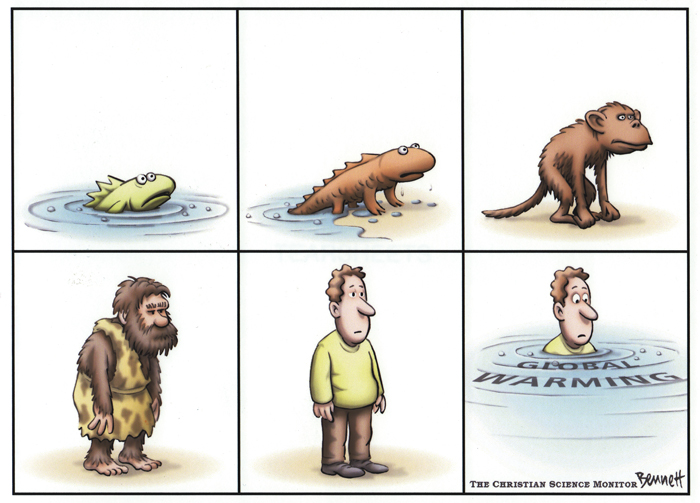
Clay Bennett, winner of the 2007 Curie UN Cartoon Award
Clay Bennett cartoons look like 21st century clean to me. There’s a smoothness, a silkiness of color that lends an immediacy to them. They really look good, and they look like they’d project well in a classroom (though I’ve not tried any of Bennett’s, actually).
All four of these cartoonists had or has something to say, too. I’ve enjoyed Bennett’s work in the Christian Science Monitor for some time. His work is clean, but it has a cutting edge that can’t be missed.
So, I was happy to see that he had won a commendation from the Ranan Lurie Cartoon Competition at the UN Correspondents’ Association dinner. Other people see good stuff in his drawings — I’m not alone.
Here’s his UN Lurie award-winning cartoon:
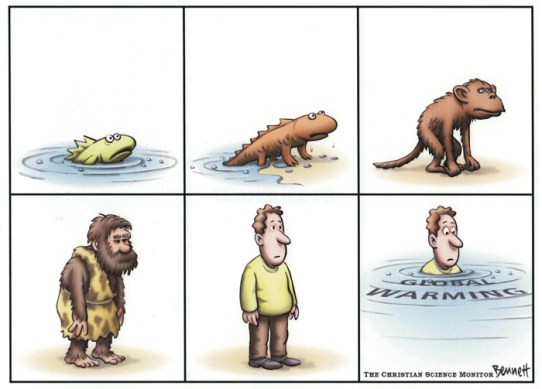
Cartoon winner of the 2007 Curie UN Cartoon Award
More of Bennett’s cartoons can be seen here, at the Clay Bennett Archives.
Bennett’s last cartoon in the Monitor was November 17. The good news: He’s moving to the Chattanooga Times-Free Press. We can hope that means one more opening is available for a cartoonist.
One more, below the fold. Read the rest of this entry »
Spread the word; friends don't allow friends to repeat history.
2 Comments | Cartoons, Climate change, climate_change, Global warming, Political cartoons, Politics | Tagged: Cartoons, Clay Bennett, Climate change, Evolution, Global warming, Intelligent Design, Political cartoons, Politics | Permalink
Posted by Ed Darrell
December 12, 2007
Winning cartoons revealed.

1st place to this haunting cartoon from Turkey’s Ahmet Aykanat, a free lancer.
Hunger, war and its unfair, collateral damage got attention from the cartoonists in the past year. Same themes as the previous years, actually. There is a lot of work to do.
The Ranan Lurie competition highlights cartooning on political and economic issues from around the world. Here in the U.S. we get some great cartoons — Oliphant, Sherffius, Grondahl, Telnaes, Toles, Sargent and dozens of others — but we miss out on great cartooning in Asia, South America, the Mediterranean, Europe and Africa.
One of my favorite North American cartoonists Clay Bennett of the Christian Science Monitor won a Citation for Excellence.
Cartoons carry a powerful punch. They make great lesson openers, or great lessons all in themselves.
Spread the word; friends don't allow friends to repeat history.
2 Comments | Cartoons, hunger, Peace, Political cartoons, Politics, Poverty, War | Tagged: Ahmet Aykanat, Cartoons, hunger, Peace, Political cartoons, Poverty, Ranan Lurie Competition, War | Permalink
Posted by Ed Darrell
December 9, 2007
The United Nations Correspondents Association was scheduled to announce awards, including the Ranan Lurie Cartoon Awards for 2007, at a dinner on December 7.
I find nothing about the awards anywhere — does somebody have, or has somebody found, a list of the 2007 winners, preferably with a gallery of the cartoons?
(C’mon, New York Times, Washington Post, International Herald Tribune, CNN, NBC, CBS and ABC — where is the news on this? Cagle?)
Spread the word; friends don't allow friends to repeat history.
2 Comments | Cartoons, Human Rights, Peace, Political cartoons, Politics | Tagged: Cartoons, Political cartoons, Politics, Ranan Lurie Awards, United Nations | Permalink
Posted by Ed Darrell
August 4, 2007
Who served the shortest term as a justice on the U.S. Supreme Court?
There is a clue in this famous cartoon by Thomas Nast (okay — the cartoon really gives it away, doesn’t it?):
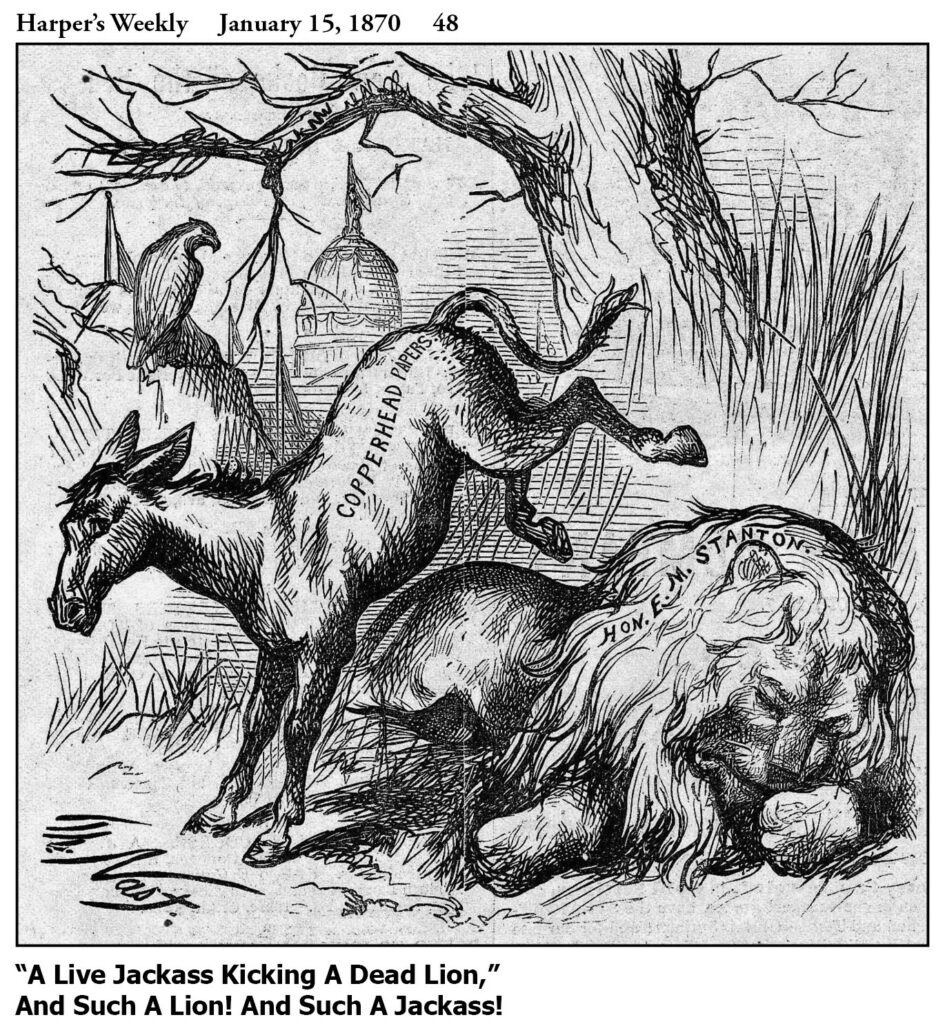
Cartoon depicting Democrats Thomas Nast, Live Jackass kicking a Dead Lion. Edwin Stanton was fired as Secretary of War by President Andrew Johnson, contrary to the Tenure of Office Act, and that action brought on the impeachment and trial of Johnson (who was acquitted by one vote). Later, President U. S. Grant appointed the financially and health ailing Stanton to the Supreme Court. Stanton was confirmed, but went home and died that night, December 24. Stanton’s opponents continued to try to smear him. Nast’s cartoon was the result. Harper’s Bazaar, January 15, 1870
Watch for the answer in a future post.
Image: Thomas Nast cartoon from Harper’s Weekly, January 15, 1870. Nast’s use in cartoons greatly popularized the use of a donkey as a symbol of the Democratic Party, whose official animal mascot is a rooster. Image in public domain, this one from the Thomas Nast Portfolio of The Ohio State University.
Also, note the explanation by Ray in comments, for historical accuracy.
Spread the word; friends don't allow friends to repeat history.
3 Comments | 1861-1865, Cartoons, Political cartoons, Reconstruction, U.S. Supreme Court | Tagged: History, Political cartoons, Politics, Reconstruction, Supreme Court, Thomas Nast | Permalink
Posted by Ed Darrell
December 22, 2006
Most readers here are from the United States. I wager you didn’t see this cartoon when it was first published:
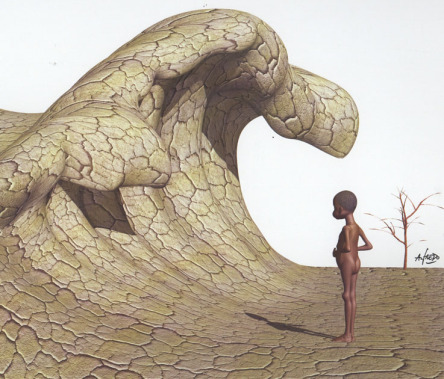
“Tsunami,” by Alberto Sabat, La Nacion in Argentina
This cartoon won the 2006 Ranan Lurie Award for editorial cartooning, an international competition supported by the United Nations Correspondents Association (other 2006 winners here). The title of the cartoon is “African Tsunami.”
The cartoonist is Alberto Sabat, the cartoon was published in La Nacion in Argentina. The award is named after the outstanding cartoonist Ranan Lurie, who himself was once nominated for a Nobel Peace Prize for his cartoons that promoted peace and understanding.
Political cartoons make classrooms interesting, and often provoke students to think hard and talk a lot about things they should be thinking and talking about. These links provide more sources of classroom material — please remember to note copyright information.
Tip of the old scrub brush to Reclaiming Space.
Update, December 2007: 2007 Lurie Awards announced; my post here, all the 2007 winners at the Lurie Awards site here.
Update, December 2008: 2008 awards post.
Update December 2009: 2009 awards listed here.
Share this post:
Spread the word; friends don't allow friends to repeat history.
23 Comments | Africa, Cartoons, Drought, Geography - Economic, Geography - Political, History, hunger, Newspapers, Political cartoons, Poverty | Tagged: Africa, African Tsunami, Alberto Sabat, Cartoons, drought, hunger, Lurie Award, Newspapers, Political cartoons, Ranan Lurie | Permalink
Posted by Ed Darrell






 Millard Fillmore's Bathtub