Is your science class as smart as a U-Haul truck?

October 23, 2013

We had to fight to keep this stuff in Texas science books.

Then, out on the street, I see a U-Haul truck.

U-Haul truck features geographic information, and geology information

U-Haul truck features geographic information, and geology information, about Arkansas and its Crater of Diamonds State Park.

Detail:  U-Haul truck features a graphic description of the geology and information about Arkansas's Crater of Diamonds State Park.

Detail: U-Haul truck features a graphic description of the geology and information about Arkansas’s Crater of Diamonds State Park.

Well played, U-Haul.  Can Texas catch up?

Update, October 24, 2013:  Turns out U-Haul has a website that features all of the graphics they use on their trucks.  I sense a geography or state history assignment in here, somewhere, social studies teachers.  Reminds me of the animals that used to (still do?) grace the tails of Frontier Airlines airplanes, the Native American on the tails of Alaska Airlines, and other specific destination promoting tricks businesses have used over the years.  Wish more businesses would do that.

http://twitter.com/SuperGraphic/status/393408729388834816

More:


Typewriters of the moment: Mitford and Carson, two environmental journalists

September 24, 2013

The great editorial cartoonist Bill Mauldin of the Chicago Sun-Times illustrates the gender dimension of the controversy over Carson and Silent Spring. In this 27 October 1963 cartoon he pairs her with Jessica Mitford, author of The American Way of Death, a scathing indictment of the funeral home industry. Men from both industries have been flattened under the platens of the women’s typewriters.  All rights reserved © 1963 by Bill Mauldin. Courtesy of Bill Mauldin Estate LLC

The great editorial cartoonist Bill Mauldin of the Chicago Sun-Times illustrates the gender dimension of the controversy over Carson and Silent Spring. In this 27 October 1963 cartoon he pairs her with Jessica Mitford, author of The American Way of Death, a scathing indictment of the funeral home industry. Men from both industries have been flattened under the platens of the women’s typewriters. All rights reserved © 1963 by Bill Mauldin. Courtesy of Bill Mauldin Estate LLC

Captured from Mark Stoll’s “Rachel Carson’s Silent Spring, a book that changed the world,” at the Environment and Society Portal.

A well-fitting image in the few days before the Society of Environmental Journalists (SEJ) opens its 2013 convention in Chattanooga, Tennessee (October 2-4).  It was the power of the typewriter in 1963; the power of the word processor in 2013, more likely.  In either case, it’s the hard work of environmental journalists, who are out to make the world a better place by showing us what it is, what shape it’s in, and how we might conserve it.

More:


Yosemite NP’s Rim Fire time-lapse

September 18, 2013

USDA/Flickr photo via Mother Jones: A National Park Service fire crew builds a sprinkler system around a grove of sequoias. USDA/Flickr

USDA/Flickr photo via Mother Jones: A National Park Service fire crew builds a sprinkler system around a grove of sequoias. USDA/Flickr

It’s a rolling tragedy, in time-lapse.  Fire always offers a chance at beauty, if we don’t think about the destruction the fire wreaks.

A lot of cameras around Yosemite, and some were set to do time-lapse photos of the recent Rim Fire.  One hopes there is some academic value to these films, perhaps in demonstrating how the diurnal rhythms of the atmosphere changes the behavior of fire (notice how smoke often changes directions at sunset, and then at sunrise, and back again).

All that smoke.  Much of it was living plant material just a few weeks ago, and we watch it turned to tiny particles and gases, and spread by the winds.

More information from the filmmakers and posters:

Published on Aug 28, 2013

Time-lapse photography shows various perspectives of the 2013 Rim Fire, as viewed from Yosemite National Park. The first part of this video is from the Crane Flat Helibase. The fire [was]  . . .burning in wilderness and  . . . not immediately threatening visitors or employees. The second half of the video is from Glacier Point, showing Yosemite Valley, and how little the smoke from the fire has impacted the Valley.

In this next piece, you’ll see footage of fire fighting operations, including a back-burn, and helicoptering of supplies to firefighters on the front lines.  It’s the non-time-lapse version, with wildtrack sound.

Published on Sep 7, 2013

Fire crews in Yosemite conducted firing operations along the Tioga Road this week to provide a buffer of protection from the Rim Fire. As you can see in this video, the fire mostly burns debris on the forest floor rather than the trees. It’s only when the forest floor accumulates too much debris or too many young trees that a small fire like this gets hot enough to torch mature trees and spread from treetop to treetop.

Later in the video, we give you a behind-the-scenes peek at Yosemite’s Helicopter 551 ferrying supplies from the Crane Flat helibase.

The timelapse, from August, has over a million-and-a-half views on YouTube; the non-timelapse, a few weeks later, has fewer than 6,000 views, as I write this.  Time-lapse is very popular.

More:


Yes, DDT is deadly to humans, as suicides demonstrate

September 16, 2013

One of the anti-environmental, anti-green false myths kicking around is that DDT is not harmful to humans, and therefore it probably shouldn’t have been banned, “and Rachel Carson was wrong.”

This poster from the U.S. Fish and Wildlife Service illustrates bioaccumulation, theprocess by which larger animals can be killed by acute DDT poisoning.

This poster from the U.S. Fish and Wildlife Service illustrates bioaccumulation, the process by which larger animals can be killed by acute DDT poisoning.

Reality is that DDT is a poison, but acute poisoning of large animals tends to take a lot.  Insectivorous animals or their predators can get those fatal amounts, but humans generally don’t.  DDT as a toxin kills mammals and birds and amphibians and reptiles and fish with equal alacrity, slowed only by the size of the organism and whether the organism’s diet consists of other things that consume and accumulate DDT.

Often that misperception is coupled with a claim that DDT does not cause cancer, and so should have its ban lifted.

But, the facts:

  • DDT is a neurotoxin; in accumulates in fat, and if enough of it courses through the blood of an animal at a given point, it kills off parts of the neurosystem including the brain.
  • DDT kills mammals (humans are mammals); in fact the U.S. Army argued to keep DDT on the market to use against bats that infested barracks in training camps (bats are mammals, too).  Death depends on the dose, which depends on body size.  Takes a fair amount to kill off a large mammal, quickly.  DDT is implicated in the near extinction of different species of migratory free-tail bats in the Southwest.
  • DDT is carcinogenic.  Fortunately for humans, it’s a weak carcinogen for most cancers, though research points to a troubling link to some cancers (breast, reproductive organs) that appear very late relative to exposure, especially if exposure to DDT occurs in utero, or in infancy.
  • DDT was not banned as a hazard to human health; it was banned as a hazard to wildlife.  DDT in almost all concentrations becomes an indiscriminate killer of wildlife when used outdoors.
  • DDT can kill humans with acute poisoning.

That last point isn’t easy to document in the U.S.  During the go-go DDT years there was one case of a young girl who drank from a prepared DDT solution, and died a short time later.  The incident was a tragedy, but not unique for the 1950s and 1960s.  It was written off to lax safety standards, and because it occurred long before the origin of on-line databases, essentially it has fallen out of history.  Just try to find a reference to the death today.

Partly, this lack of information on human toxicity is due to the fact that DDT use was slowing dramatically by the late 1960s (it was becoming ineffective), and after the ban in 1972, there were few cases in the U.S. where humans were exposed to the stuff, except in emissions from DDT manufacturing plants.  EPA’s order banning DDT in the U.S. applied only to agricultural use, and the chief agricultural use remaining was on cotton.  Manufacturing was not banned, however, which meant U.S. DDT makers could continue to pump the stuff out and sell it overseas, in Africa, and Asia.  This continued right up to that day in 1984 that U.S. companies became subject to damage for the poisons they make under the Superfund law — almost every DDT maker declared bankruptcy to escape liability in the weeks before the Superfund became effective, saddling taxpayers with a few dozen Superfund sites to be cleaned up on the taxpayer’s dime.

DDT has never been banned in Africa or Asia, however.  And there we find a badly-documented history of people poisoning themselves with DDT, usually in suicides.

Whatever other pathologies these cases may exhibit, they reveal that DDT does, indeed, kill humans.

Like this recent case, from Ghana; yes, that’s the illustration used in the newspaper; from the Ghana Broadcasting Corporation:

Sep 11, 2013 at 11:52am
Man commits suicide over wife’s confession

Benjamin Kwaku Owusu, a 40-year-old former Manager of Unity Oil Filling Station in Suhum, has committed suicide by drinking DDT Gamullio 20 insecticide.

A family spokesperson who spoke to the Ghana News Agency on condition of anonymity said Owusu and his wife lived at Suhum and had been married for five years but never had a child.

He said the situation often developed into misunderstanding between them but later the wife got pregnant and left for her home town.

According to the spokesperson, whiles Owusu was preparing for the wife to deliver, he had a shocking message from the wife that the pregnancy belonged to another man and not him.

He said Owusu, who had a shock, rushed into his room and drunk the DDT Insecticide and fell unconscious.

“Owusu was rushed to the hospital but died soon after he was admitted,” he said.

When the police at Suhum was contacted, they confirmed the story and said the body of the deceased had since been buried after post mortem examination at the Suhum Government Hospital.

GNA

Not sure what “Gamullio 20” means, but it seems to be the brand name of the poison used.

More:


Voyager I becomes Earth’s first interstellar object

September 14, 2013

Can you recall what you were doing on September 5, 1977?

The Voyager 1 aboard the Titan III/Centaur lif...

The Voyager 1 aboard the Titan III/Centaur lifted off on September 5, 1977, joining its sister spacecraft, the Voyager 2, on a mission to the outer planets. Wikipedia image, from NASA

That’s the day NASA launched Voyager I, on a trip to photograph planets in our solar system more close up than we can get with Earth-bound telescopes.  The Hubble Space Telescope was not even on the drawing board then.

After completing its mission, Voyager I continued on its path.  Scientists thought it would survive to leave the solar systems, and a few forward-looking thinkers hoped to learn more about just how far the influence of our Sun really extends.  At some point, Voyager I would leave space where the chief gravitational and wind influence is the Sun, and move into truly inter-stellar (“between the stars”) space, where gravity and particle emissions are dominated by other objects in our galaxy.

Last week NASA announced that time came in August of 2012, confirmed by data transmitted back to earth by Voyager’s primitive capabilities, over the last year.

Space.com explains it well:

Interesting to think of the investment in thought, money, effort and patience by scientists and policy-makers to wait more than 35 years for such a research result.

More:

Voyager I, artist's interpretation.  NASA image

Voyager I, artist’s interpretation. NASA image


Quote of the moment: Carl Sagan, on perspective on our own lives

September 14, 2013

You’ve heard the news by now: Voyager I has left the system.

What are we to think of that?

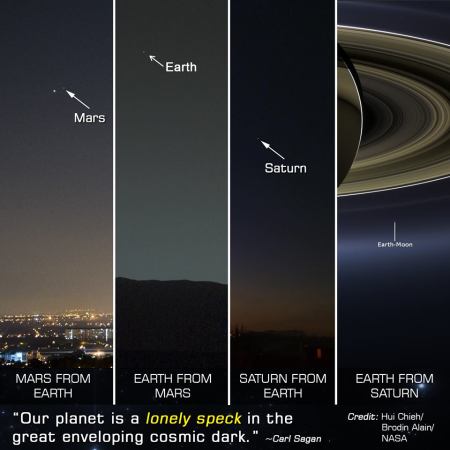
perspective-mars-earth-saturn

Earth, Moon, Mars, Jupiter – What you see depends on where you are, in reality as well as metaphorically. Images from NASA

” . . . astronomy is a humbling and character-building experience.”

Carl Sagan on how images of Earth from space change our perspective

Sagan’s words in the full passage impart a larger message, about caring for our planet and our neighbors on it.

From this distant vantage point, the Earth might not seem of any particular interest. But for us, it’s different. Consider again that dot. That’s here. That’s home. That’s us. On it everyone you love, everyone you know, everyone you ever heard of, every human being who ever was, lived out their lives. The aggregate of our joy and suffering, thousands of confident religions, ideologies, and economic doctrines, every hunter and forager, every hero and coward, every creator and destroyer of civilization, every king and peasant, every young couple in love, every mother and father, hopeful child, inventor and explorer, every teacher of morals, every corrupt politician, every “superstar,” every “supreme leader,” every saint and sinner in the history of our species lived there – on a mote of dust suspended in a sunbeam.

The Earth is a very small stage in a vast cosmic arena. Think of the rivers of blood spilled by all those generals and emperors so that in glory and triumph they could become the momentary masters of a fraction of a dot. Think of the endless cruelties visited by the inhabitants of one corner of this pixel on the scarcely distinguishable inhabitants of some other corner. How frequent their misunderstandings, how eager they are to kill one another, how fervent their hatreds. Our posturings, our imagined self-importance, the delusion that we have some privileged position in the universe, are challenged by this point of pale light. Our planet is a lonely speck in the great enveloping cosmic dark. In our obscurity – in all this vastness – there is no hint that help will come from elsewhere to save us from ourselves.

The Earth is the only world known, so far, to harbor life. There is nowhere else, at least in the near future, to which our species could migrate. Visit, yes. Settle, not yet. Like it or not, for the moment, the Earth is where we make our stand. It has been said that astronomy is a humbling and character-building experience. There is perhaps no better demonstration of the folly of human conceits than this distant image of our tiny world. To me, it underscores our responsibility to deal more kindly with one another and to preserve and cherish the pale blue dot, the only home we’ve ever known.

Carl SaganPale Blue Dot: A Vision of the Human Future in Space, 1997 reprint, pp. xv–xvi

In other words, we’re on our own.  What are we going to do about that?

Tip of the old scrub brush to Hashem Al-ghaili for making this image! https://www.facebook.com/ScienceNaturePage, and to All Science, All the Time.

It would be good to have better photo credits, including the genius who put together the montage.

More:

Voyager I photo of the Earth from outside Jupiter's orbit - the Pale Blue Dot photo

This is the photo that inspired Sagan’s reflection, as opposed to the photos in the poster mashup above. Via Wikipedia, with captions. ¶Seen from about 6 billion kilometers (3.7 billion miles), Earth appears as a tiny dot (the blueish-white speck approximately halfway down the brown band to the right) within the darkness of deep space. ¶This narrow-angle color image of the Earth, dubbed ‘Pale Blue Dot’, is a part of the first ever ‘portrait’ of the solar system taken by Voyager 1. The spacecraft acquired a total of 60 frames for a mosaic of the solar system from a distance of more than 4 billion miles from Earth and about 32 degrees above the ecliptic. From Voyager’s great distance Earth is a mere point of light, less than the size of a picture element even in the narrow-angle camera. Earth was a crescent only 0.12 pixel in size. Coincidentally, Earth lies right in the center of one of the scattered light rays resulting from taking the image so close to the sun. This blown-up image of the Earth was taken through three color filters – violet, blue and green – and recombined to produce the color image. The background features in the image are artifacts resulting from the magnification.

Save


September 12 — Anniversary of the 1962 day JFK challenged all of America to go to the Moon, “because it is hard”

September 12, 2013

President John F. Kennedy speaking to an audience in the football stadium at Rice University in Houston, September 12, 1962.  Kennedy made the public case for why the U.S. should try a Moon shot.  NASA photo.

President John F. Kennedy speaking to an audience in the football stadium at Rice University in Houston, September 12, 1962. Kennedy made the public case for why the U.S. should try a Moon shot. NASA photo.

Kennedy’s speech at Rice University, “We Choose to Go to the Moon,” was delivered in the football stadium (not nearly full), on September 12, 1962.

Obviously, that was back before global warming held such a tight death grip on Texas (it’s so bad here, even Rick Perry is trying to move north, out of the state).

Day in and day out, Kennedy’s speech, the text, the audio, and sources of commentary on it, are among the most popular of the nearly 5,000 posts at Millard Fillmore’s Bathtub. Go see why:

September 12, 1962, was also the ninth anniversary of JFK’s marriage to Jacqueline Bouvier.  She let him go out of town to talk rockets?

Anything for the nation, I suppose.

More:

Moonwalking astronaut salutes the U.S. flag on the Moon. Twelve people went to the Moon, all of them in the U.S. space program run by NASA.  (My photo source does not identify this astronaut.)

Moonwalking astronaut salutes the U.S. flag on the Moon. Twelve people went to the Moon, all of them in the U.S. space program run by NASA. (My photo source does not identify this astronaut.)


Not an emerald ash borer — but what is it?

August 21, 2013

Emerald green beetle, looks a lot like a longhorn.  I feared it to be a dreaded emerald ash borer, but it’s not.

Okay.  What is it?  Any body know?

From our Backyard Collection, two weeks ago:

What is this one? Looks like a longhorn beetle, emerald green.

What is this one? Looks like a longhorn beetle, emerald green. Not an emerald ash borer. Anyone know?

It’s too big to be an emerald ash borer.

Our mystery beetle is too big to be an emerald ash borer.

Our mystery beetle is too big to be an emerald ash borer. Brilliant orange underside.

Perhaps a flower longhorn beetle?

Caption from Field and Swamp Animals and their habitats:  Flower longhorn beetle (Encyclops caerulea), Glassmine Gap Trail, Macon County, NC, 5/28/13

Caption from Field and Swamp Animals and their habitats: Flower longhorn beetle (Encyclops caerulea), Glassmine Gap Trail, Macon County, NC, 5/28/13

Where’s Bug Girl when we need her?  (Moving?)  Roused Bear? Beetles in the Bush?

Update, mystery solved:  Ted C. MacRae said (see comments) it’s the bumelia borer (Plinthocoelium suaveolens).  He wrote about it here. So, Kathryn, what are they eating in our backyard? Bumelia lanuginosa is a Texas native; do we have one, or a relative, in the garden?  Dallas-area Dirt Doctor Howard Garrett says they’re mostly harmless in the garden.  (Here’s a closeup, from MacRae’s blog):

Brumelia borer, from Beetles in the Bush.  Photo by Ted C. MacRae

Bumelia borer, Plinthocoelium suaveolens,  from Beetles in the Bush. Photo by Ted C. MacRae


Annals of global warming: 2012 hits top 10 hottest years

August 6, 2013

NOAA’s article on the State of the Climate released today:

2012 was one of the 10 warmest years on record globally

The end of weak La Niña, unprecedented Arctic warmth influenced 2012 climate conditions

August 6, 2013

State of the Climate in 2012 - report cover.

The 2012 State of the Climate report is available online.
(Credit: NOAA)

Worldwide, 2012 was among the 10 warmest years on record according to the 2012 State of the Climate report released online today by the American Meteorological Society (AMS). The peer-reviewed report, with scientists from NOAA’s National Climatic Data Center in Asheville, N.C., serving as lead editors, was compiled by 384 scientists from 52 countries (highlights, full report). It provides a detailed update on global climate indicators, notable weather events, and other data collected by environmental monitoring stations and instruments on land, sea, ice, and sky.

“Many of the events that made 2012 such an interesting year are part of the long-term trends we see in a changing and varying climate — carbon levels are climbing, sea levels are rising, Arctic sea ice is melting, and our planet as a whole is becoming a warmer place,” said Acting NOAA Administrator Kathryn D. Sullivan, Ph.D. “This annual report is well-researched, well-respected, and well-used; it is a superb example of the timely, actionable climate information that people need from NOAA to help prepare for extremes in our ever-changing environment.”

Conditions in the Arctic were a major story of 2012, with the region experiencing unprecedented change and breaking several records. Sea ice shrank to its smallest “summer minimum” extent since satellite records began 34 years ago. In addition, more than 97 percent of the Greenland ice sheet showed some form of melt during the summer, four times greater than the 1981–2010 average melt extent.

Temperature in 2012 compared to the 1981-2010 average.

Temperature in 2012 compared to the 1981-2010 average. Credit: NOAA Climate.gov, based on NCDC data. See more.

The report used dozens of climate indicators to track and identify changes and overall trends to the global climate system. These indicators include greenhouse gas concentrations, temperature of the lower and upper atmosphere, cloud cover, sea surface temperature, sea-level rise, ocean salinity, sea ice extent and snow cover. Each indicator includes thousands of measurements from multiple independent datasets.

Highlights:

  • Warm temperature trends continue near Earth’s surface: Four major independent datasets show 2012 was among the 10 warmest years on record, ranking either 8th or 9th, depending upon the dataset used. The United States and Argentina had their warmest year on record.
  • La Niña dissipates into neutral conditions:  A weak La Niña dissipated during spring 2012 and, for the first time in several years, neither El Niño nor La Niña, which can dominate regional weather and climate conditions around the globe, prevailed for the majority of the year.
  • The Arctic continues to warm; sea ice extent reaches record low: The Arctic continued to warm at about twice the rate compared with lower latitudes. Minimum Arctic sea ice extent in September and Northern Hemisphere snow cover extent in June each reached new record lows. Arctic sea ice minimum extent (1.32 million square miles, September 16) was the lowest of the satellite era. This is 18 percent lower than the previous record low extent of 1.61 million square miles that occurred in 2007 and 54 percent lower than the record high minimum ice extent of 2.90 million square miles that occurred in 1980. The temperature of permafrost, or permanently frozen land, reached record-high values in northernmost Alaska. A new melt extent record occurred July 11–12 on the Greenland ice sheet when 97 percent of the ice sheet showed some form of melt, four times greater than the average melt this time of year.
  • Antarctica sea ice extent reaches record high: The Antarctic maximum sea ice extent reached a record high of 7.51 million square miles on September 26. This is 0.5 percent higher than the previous record high extent of 7.47 million square miles that occurred in 2006 and seven percent higher than the record low maximum sea ice extent of 6.96 million square miles that occurred in 1986.
  • Sea surface temperatures increase: Four independent datasets indicate that the globally averaged sea surface temperature for 2012 was among the 11 warmest on record.  After a 30-year period from 1970 to 1999 of rising global sea surface temperatures, the period 2000–2012 exhibited little trend. Part of this difference is linked to the prevalence of La Niña-like conditions during the 21st century, which typically lead to lower global sea surface temperatures.
  • Ocean heat content remains near record levels: Heat content in the upper 2,300 feet, or a little less than one-half mile, of the ocean remained near record high levels in 2012. Overall increases from 2011 to 2012 occurred between depths of 2,300 to 6,600 feet and even in the deep ocean.
  • Sea level reaches record high: Following sharp decreases in global sea level in the first half of 2011 that were linked to the effects of La Niña, sea levels rebounded to reach record highs in 2012. Globally, sea level has been increasing at an average rate of 3.2 ± 0.4 mm per year over the past two decades.
  • Ocean salinity trends continue: Continuing a trend that began in 2004, oceans were saltier than average in areas of high evaporation, including the central tropical North Pacific, and fresher than average in areas of high precipitation, including the north central Indian Ocean, suggesting that precipitation is increasing in already rainy areas and evaporation is intensifying in drier locations.

    Sea ice concentration reached a new record low in mid-September 2012.

    Sea ice concentration reached a new record low in mid-September 2012. Credit: NOAA Climate.gov, based on NSIDC data. See more.

  • Tropical cyclones near average: Global tropical cyclone activity during 2012 was near average, with a total of 84 storms, compared with the 1981–2010 average of 89. Similar to 2010 and 2011, the North Atlantic was the only hurricane basin that experienced above-normal activity.
  • Greenhouse gases climb: Major greenhouse gas concentrations, including carbon dioxide, methane, and nitrous oxide, continued to rise during 2012. Following a slight decline in manmade emissions associated with the global economic downturn, global CO2 emissions from fossil fuel combustion and cement production reached a record high in 2011 of 9.5 ± 0.5 petagrams (1,000,000,000,000,000 grams) of carbon , and a new record of 9.7 ± 0.5 petagrams of carbon  is estimated for 2012. Atmospheric CO2 concentrations increased by 2.1 ppm in 2012, reaching a global average of 392.6 ppm for the year. In spring 2012, for the first time, the atmospheric CO2concentration exceeded 400 ppm at several Arctic observational sites.
  • Cool temperature trends continue in Earth’s lower stratosphere: The average lower stratospheric temperature, about six to ten miles above the Earth’s surface, for 2012 was record to near-record cold, depending on the dataset. Increasing greenhouse gases and decline of stratospheric ozone tend to cool the stratosphere while warming the planet near-surface layers.

The 2012 State of the Climate report is peer-reviewed and published annually as a special supplement to the Bulletin of the American Meteorological Society. This year marks the 23rd edition of the report, which is part of the suite of climate services NOAA provides to government, the business sector, academia, and the public to support informed decision-making. The full report can be viewed online.

NOAA’s mission is to understand and predict changes in the Earth’s environment, from the depths of the ocean to the surface of the sun, and to conserve and manage our coastal and marine resources. Join us on FacebookTwitter and our other social media channels.

More:


Twitter open thread: Noah’s flood

July 30, 2013

No, the evidence doesn’t point to a Noachic flood.  Evidence contradicts the idea.

Welcome, @crazy_stairz @EdDarrell @paulmc107 @StrangerGirl2 @HomunculusLoikm @LogicBobomb, and anyone else who wants to join in.  Usual rules of civility apply.

Discussing this, and its many cousins:

http://twitter.com/crazy_stairz/status/362325832305348609


New Boy Scout merit badge: Sustainability

July 25, 2013

It’s Eagle required, too — well, Scouts can choose either Environmental Science or Sustainability, but must earn one or the other to earn Eagle rank.

Image of the Sustainability merit badge, from MeritBadge.org

Image of the Sustainability merit badge, from MeritBadge.org

Requirements for the new Sustainability merit badge were released on July 16, concurrent with the 2013 National Scout Jamboree at the Summit.  A lot of people missed the announcement, I’ll wager.

It’s good news.  Conservation and nature-related merit badges have suffered a decline in Scouting, it seems to me.  The conservation series was very much the keystone of a trek to Eagle when I was a Scout, at least as important as the citizenship series.  But I don’t see that emphasis in Scouting today, sadly.

BSA recently created a Mining merit badge, which created some quiet grumbles among conservationists — this new, Eagle-path badge more than makes up for that, I think (though mining is a great topic for Scouts, especially in the western U.S., I think).  This will not set well with the anti-conservation, anti-Agenda 21 crowd and their merry hoaxsters.  But nothing BSA does is removed from political criticism from the right any more (see this odd photo choice for the Sustainability badge notice at the radical right-wing Daily Caller site).

This announcement gives me hope.

More:

Below the fold, the requirements and announcement from Bryan on Scouting, at Scouting Magazine’s site, verbatim and in total.

Read the rest of this entry »


They’re coming for the science textbooks, again; join me in speaking up

July 23, 2013

I get e-mail, sometimes from the Texas Freedom Network. In this case, I’m happy to share. You need to know this.

Would you sign the petition?

Stand Up for Science

SUFS-Tex and T-Rex

Click Here to Sign the Petition

Dear Ed,

I’m worried about my kids’ future because of six words.

The Texas State Board of Education.

The state board has already begun working on its once-a-decade adoption of science textbooks for Texas classrooms. And for years, an anti-science faction of that board has done all it can to undermine the science of evolution and climate change by giving equal weight to nonscientific beliefs like climate change denial and the idea that dinosaurs and humans coexisted.

We’ve got news for those folks: Big Tex and T-Rex didn’t ride the range together.

It’s time to Stand Up for Science.

Click here to sign our petition and help us reach our goal of 5,000 signatures of Texans demanding that the State Board of Education approve science textbooks that are based on sound, peer-reviewed scholarship.

This fight is personal for me because from an early age, both my kids have loved science. In fact, my oldest son is enrolled in the “tech academy” at his middle school, where he’s learning about cool high-tech careers and honing computer skills that already put me to shame.

But whether you have school-aged kids or not, this fight is too important to the future of Texas and the nation to ignore. With over 5 million students, Texas is one of the country’s biggest buyers of textbooks. And that has an impact on other states because book publishers often follow our lead so that they don’t have to create different versions of the same science books.

I want my kids and every child to have classroom materials based on modern, mainstream science that gets them ready for college and prepares them for those high-tech jobs my son is learning about. Anything less handicaps their future and sets them up to fail.

For our children’s future, let’s win this.

Sign our petition to Stand Up for Science.

Regards,
Ryan Valentine
Deputy Director, Texas Freedom Network

They’re coming for Texas science textbooks, again; please stand up and speak out for science, for accuracy, for good education.

More:


Annals of global warming: Climate change hammers the Adelie penguins

July 22, 2013

Adelie penguins struggle to survive changes in their nesting and feeding sites caused by warming air and waters around Antarctica

Adelie penguins struggle to survive changes in their nesting and feeding sites caused by warming air and waters around Antarctica

New, very short film from the E. O. Wilson Biodiversity Foundation highlights threats to Adelie penguins from climate change, already.  Actor and conservation activist Harrison Ford narrated “Ghost Rookeries, Climate Change and the Adelie Penguin.”

Details from the Biodiversity Foundation at their YouTube site:

Published on Jun 26, 2013

“Ghost Rookeries,” narrated by actor, conservationist, and member of the E.O. Wilson Biodiversity Foundation (EOWBF) Board of Advisors Harrison Ford, conveys the story of the Adelie Penguin, whose habitat—and thus the biodiversity of all of Antarctica—is being threatened by real-time environmental changes.

“The consequences of a loss of biodiversity could encompass everything from altering key Antarctic marine food chains to the loss of species that may hold cures to cancer,” writes Dr. James McClintock, whose recent book, ‘Lost Antarctica: Adventures in a Disappearing Land’ (Palgrave/MacMilllan, 2012), forms the basis of “Ghost Rookeries.”

The E.O. Wilson Biodiversity Foundation (EOWBF) and the Association of Zoos and Aquariums (AZA) will be embarking on an exciting new initiative beginning in the summer of 2013. Beginning with “Ghost Rookeries: Climate Change and the Adelie Penguin” (4 minutes, 2013), short videos produced by the EOWBF will be shown at select AZA-accredited zoos and aquariums located in the United States. With the vast reach of AZA-accredited zoos and aquariums, “Ghost Rookeries” and future videos will be seen by millions of visitors.

Dr. Paula Ehrlich, President and CEO of the EOWBF, calls “Ghost Rookeries” and the partnership with AZA “. . . a wonderful way to engage audiences about the importance of preserving our biological heritage through story. The Adelie Penguin is an iconic story, a symbol, of the real-time effect of climate change on biodiversity.”

“Ghost Rookeries” was produced by the E.O. Wilson Biodiversity Foundation, with the University of Alabama at Birmingham, and the the Tennessee Aquarium.

This film looks at a small part of the Adelie penguin population, on Torgerson Island, near Palmer Station.  This population symbolizes the difficulties of dealing with climate change, or even knowing what the effects will be.  Critics of pollution control to stop climate change argue that populations of all animals and plants will adapt.  Indeed the last decade saw a rise in total numbers of Adelies across Antarctic waters, and Gentoo penguins have set up new colonies to avoid warming air and waters.

More careful watchers note problems, though.  Warming air, and decreasing hard ice, brings more snow — nominally good, if one assumes the snow turns to ice.  In this case, the snows are brief, and they melt quickly.  It’s the cold meltwater that kills the chicks, drowning them.  This may be counterintuitive, or even ironic,  that warming causes a cold water seabird to drown, or die of hypothermia.  Nature is stranger than we can imagine, and often strange enough that it defies the understanding of scientifically-dilettante politicians.

Generally the loss of ice is the biggest problem for penguins; specific populations face entirely different threats, however, depending on the local effects of climate change.

Dr. Jim McClintock, in Antarctica.  A professor at the University of Alabama-Birmingham

Dr. Jim McClintock, in Antarctica. A professor at the University of Alabama-Birmingham, he wrote Antarctica Lost, upon which the film about the Adelie penguins is based.

The film is a short project based off of the work of Dr. Jim McClintock, an almost-legendary Antarctic researcher based out of the University of Alabama at Birmingham (UAB).  McClintock published a book on his work last year that deals with many different aspects of climate change in the Southern Ocean and its continental land mass, Lost Antarctica, Adventures in a Disappearing Land.

More:


Humanity’s hope for the future: A giant leap for mankind on July 20, 1969

July 20, 2013

It’s a day to remember history.  Do you remember that day, the first time humans set foot on the Moon?

(This is based on an earlier post.)

Southwest Elementary in Burley, Idaho, existed in a world far, far away from the U.S. space program. We watched rocket launches on black and white televisions — the orbital launches were important enough my father let me stay home from school to watch, but when he dropped me off at school, I was in a tiny band of students who actually made it to school. Potato farmers and the merchants who supported them thought the space program was big, big stuff.

By John Glenn’s flight, a three-orbit extravaganza on February 20, 1962, a television would appear in the main vestibule of the school, or in the auditorium, and we’d all watch. There were very few spitballs. Later that year my family moved to Pleasant Grove, Utah.

Toward the end of the Gemini series, television news networks stopped providing constant coverage. The launch, the splashdown, a space walk or other mission highlight, but the nation didn’t hold its breath so much for every minute of every mission. Barry McGuire would sing about leaving the planet for four days in space (” . . . but when you return, it’s the same old place.”), then six days, but it was just newspaper headlines.

The Apollo 1 fire grabbed the nation’s attention again. Gus Grissom, one of the three who died, was one of the original space titans; death was always a possibility, but the U.S. program had been so lucky. Apollo’s start with tragedy put it back in the headlines.

The space program and its many successes made Americans hopeful, even in that dark decade when the Vietnam War showed the bloody possibilities of the Cold War. That darkest year of 1968 — see the box below — closed nicely with Apollo 8 orbiting the Moon, and the famous Christmas Eve telecast from the three astronauts, Frank Borman, Jim Lovell, and William A. Anders. The space program kept us hopeful.

By early 1969 many of us looked forward to the flight of Apollo 11 schedule for July — the space flight that promised to put people on the Moon for the first time in history, the realization of centuries-old dreams.

But, then I got my assignment for Scouting for the summer — out of nearly 50 nights under the stars, one of the days would include the day of the space walk. Not only was it difficult to get televisions into Maple Dell Scout Camp, a good signal would be virtually impossible. I went to bed knowing the next day I’d miss the chance of a lifetime, to watch the first moon landing and walk.

Just after midnight my sister Annette woke me up. NASA had decided to do the first walk on the Moon shortly after touchdown, at an ungodly hour. I’d be unrested to check Scouts in, but I’d have seen history.

And so it was that on July 20, 1969, Neil Armstrong became the first human to set foot on the Moon: “A small step for a man, a giant leap for mankind,” was what he meant to say in a transmission that was famously garbled (at least he didn’t say anything about jelly doughnuts).

P. Z. Myers says he remembers a lawnmower going somewhere. It must have been very bright in Seattle. (Thanks for the reminder, P.Z., and a tip of the old scrub brush to you.)

2013 will mark the 44th anniversary.

Texas Essential Knowledge and Skills (TEKS) lists 11 dates for U.S. history as the touchstones kids need to have: 1609, the founding of Jamestown; 1776, the Declaration of Independence; 1787, the Constitutional Convention; 1803, the Louisiana Purchase; 1861-1865, the American Civil War; 1877, the end of Reconstruction; 1898, the Spanish American War; 1914-1918, World War I; 1929, the Stock Market Crash and beginning of the Great Depression; 1941-1945, World War II; 1957, the launching of Sputnik by the Soviets. Most teachers add the end of the Cold War, 1981; I usually include Apollo 11 — I think that when space exploration is viewed from a century in the future, manned exploration will be counted greater milestone than orbiting a satellite; my only hesitance on making such a judgment is the utter rejection of such manned exploration after Apollo, which will be posed as a great mystery to future high school students, I think.)

* 1968, in roughly chronological order, produced a series of disasters that would depress the most hopeful of people, including: the Pueblo incident, the B-52 crash in Greenland, the Tet Offensive in Vietnam, the nerve gas leak at the Army’s facility at Dugway, Utah, that killed thousands of sheep, Lyndon Johnson’s pullout from the presidential race with gathering gloom about Vietnam, the Memphis garbage strike, the assassination of Martin Luther King, Jr., riots, the Black Panther shoot out in Oakland, the Columbia University student takeover, the French student strikes, the tornadoes in Iowa and Arkansas on May 15, the Catonsville 9 vandalism of the Selective Service office, the sinking of the submarine U.S.S. Scorpion with all hands, the shooting of Andy Warhol, the assassination of Robert F. Kennedy, the Buenos Aires soccer riot that killed 74 people, the Glenville shoot out in Cleveland, the cynicism of the Republicans and the nomination of Richard Nixon and Spiro Agnew, the Warsaw Pact invasion of Czechoslovakia crushing the “Prague Spring” democratic reforms, the Chicago Democratic Convention and the police riot, the brutal election campaign, the Tlatololco massacre of students in Mexico City, Black Power demonstrations by winning U.S. athletes at the Mexico City Olympics, coup d’etat in Panama. Whew!

More, from Millard Fillmore’s Bathtub:

And even more:


Again: Why do we worry about global warming? It ain’t the climate, it’s the people

July 15, 2013

This is almost entirely an encore post, repeated for the benefit of the millions who missed it the first time who make fools of themselves when they argue we don’t need to save trees.  It’s not about trees.

Kids hiking in a forest. These are the humans environmentalists worry about, these four, and a few billion like them.  Photo from American Forests.

Kids hiking in a forest. These are the humans environmentalists worry about, these four, and a few billion like them. Photo from American Forests.

Alun Salt gave great advice about not bothering to engage idiots, pigs, denialists or trolls (here, among other places).  He said I should avoid lengthy answers to blogs that have little audience.

This is probably one of those occasions.

But in a running attempt to stimulate serious thought at a denialist blog, I got a question that has been rather common, and a question which indicates the deep serious misunderstanding denialists and even some well-meaning, overly-skeptical sensible people have:

Why worry about  climate change, since the climate is changing all the time?  Especially, why are people like Al Gore urging that we stop climate change, when CO2 has no great direct effect on human health?  Shouldn’t environmentalists be cheering climate change on, since it’s a “natural process?”

The answer is lost on the other blog, as Mr. Salt predicted it would be.  But since I’ve gotten some version of the question repeatedly in the last month, I may as well repeat the answer here, for the record.

The short answer to why we worry about climate change is that, as with almost all environmental protection, we are worried first about the quality of life of humans, and ultimately about the ability of human life to survive at all.

Here’s the question put to me there:

Ed I’m a little confused. I thought we were talking about the effect of co2 on the climate not the effect of co2 on human health. Co2 is not a toxic gas and would have no effect on human health. The fact that humans weren’t around when co2 was 10-20 times higher has absolutely nothing to do with its effect on climate.
Ed there was no runaway greenhouse effect [link added here] or climate catastrophe. The planet was fine during the phanerazoic. There is actually a lack of co2 in the atmopshere comapred to that time.

Here’s my answer, with a few more links than their format would allow:

No, you’re not a little confused.  You’re a lot confused, greatly misinformed, and not thinking hard.

We worry about CO2’s effects on climate only because we worry about the future of humanity.  Many of us who have children and wish them the same blessings of having children and grandchildren, have thought through the truth of the matter that we don’t possess and rule the Earth for ourselves, but instead act only as stewards for future generations.

No Earth, no humans; but at the same time, no habitable Earth, no humans.  In the long run, Earth doesn’t care.  It’ll do fine — without humans.

We can’t damage the planet.  We can only damage its habitability for humans.

I don’t know what sort of dystopian Randian future you and other Do Nothings hope for, but it’s a future contrary to human life, American values, and all known religions.

We’re talking about the future of humans.  I tell “skeptics,” “If you don’t care, butt out.  You’ll be dead in the short run anyway, but that’s no reason to stand in the way of action not to ensure a livable planet for our grandchildren.”

You also fail to understand chemistry, pollution, and how the world works.  CO2 is indeed a toxic gas.  For about a century now we’ve had indoor air standards that require air circulation to keep CO2 down below concentrations of about 500 5000 ppm [see comments], because at that level it starts to have dramatic effects on humans working.  It clouds their thinking and causes drowsiness.  CO2 is a conundrum, in that it is also necessary to trigger mammalian breathing.  If CO2 drops too low, we don’t take in enough oxygen and may pass out.  Too much oxygen in place of CO2 is a problem in that regard.  A substance can be both essential and a  pollutant, at the same time. (This has vexed food safety experts for years, especially after the 1958 Delaney Clause; substances we know to be essential nutrients can be carcinogenic, in the same concentrations, or in the same concentrations with a slight twist in chemical formula — how do we regulate that stuff?)

English: Main symptoms of carbon dioxide toxic...

Main symptoms of carbon dioxide toxicity (See Wikipedia:Carbon_dioxide#Toxicity). References: Toxicity of Carbon Dioxide Gas Exposure, CO2 Poisoning Symptoms, Carbon Dioxide Exposure Limits, and Links to Toxic Gas Testing Procedures By Daniel Friedman – InspectAPedia Davidson, Clive. 7 February 2003. “Marine Notice: Carbon Dioxide: Health Hazard”. Australian Maritime Safety Authority. Model: Mikael Häggström. To discuss image, please see Template talk:Häggström diagrams (Photo credit: Wikipedia)

CO2 is toxic in much greater proportions — it was a CO2 cloud that killed thousands in Cameroon 30 years ago or so, if you know history.

Clearly you did not know that we’ve regulated indoor CO2 for decades.  Clearly you haven’t looked at the medical journals‘ discussion on CO2 — and I’ll wager you’d forgotten the Cameroon incident, if you ever knew about it.

CO2 is a toxic gas (the dose is the poison); CO2 has dramatic effects on human health — too little and we die, too much and we die.

The fact that humans were not around when CO2 was much higher is exactly the point.  That was presented here, as it is in most venues, as support for a claim that we don’t need to worry about CO2 pollution.  Well, that’s right — if we don’t care about a habitable Earth.  But when CO2 was higher, life for humans was impossible.

I think it’s reckless to run an experiment on what would happen with higher CO2 levels, using the entire planet as a testing place, and testing the hypotheses on just how much CO2 will kill us all off, and how.

How about a control group, at least?

In the past, massive CO2 created massive greenhouse effects that would devastate us today — not as a toxic gas, but as a result of the warming that greenhouse gases do.

Let us understand the physical conundrum of CO2 here:  Without the greenhouse effect from the human-historic levels of CO2, this would be an ice planet.  Our lives today depend on the greenhouse effects of CO2.

Consequently, anyone who claims there is no greenhouse effect fails to understand physics, chemistry, biology and history.  (Heck, throw in geology, too.)  Life would be impossible but for the greenhouse effect.  Life is impossible without water, too, but you can’t live totally surrounded by water.

Can it be true that there can never be too much of a good effect, with regard to greenhouse gases?  Ancient Greek ideas of “all things in moderation” applies here.  We need a Goldilocks amount of CO2 in our atmosphere — not to much, not too little; not too hot, not too cold.

To the extent that higher CO2 levels didn’t produce a total runaway greenhouse effect, as some hypothesize exists on Venus, we know that was due to other feedbacks.  Early on, for example, CO2 began to be reduced by photosynthesizing life.  Animal life today would be impossible but for that occurrence.  Few if any modern chordates could breathe the very-low oxygen atmosphere of the early Earth, and live.  Those feedbacks and limiting situations do not exist today.

Greenhouse Effect

Greenhouse Effect. Wikipedia image

So now we face a double or triple whammy.  The reduction in CO2 in the air was accomplished through a couple billion years of carbon sequestration through plants.  In fact, a lot of carbon was sequestered in carbon-rich fossils, stuff we now call coal and oil.  Oxygen replenishment was accomplished with massive forests, and healthy oceans, with a great deal of photosynthesis.  This created a rough CO2 equilibrium (with fluctuations, sure) that existed we know for at least the last 50,000 years, we’re pretty sure for the last 100,000 years (we know that from carbon-dating calibration exercises).

Today we have removed fully 30% of the forests that used to replenish oxygen and lock up a lot of CO2 (some estimates say 50% of the forests are gone); modern plant communities cannot pluck CO2 out fast enough.  Plus, we’re releasing a lot of that old, sequestered carbon in coal and oil — at rates unprecedented in human history.

Will more CO2 warm the planet?  We know from the fact that the planet is warm enough for life, that more CO2 will warm the planet more.  Anyone who says differently does not know physics and chemistry, nor history.

Is there anything that can stop that effect?  Sure — healthy, massive forests, and healthy oceans.  Reducing carbon emissions could help a lot, too.  But we’re committed for about a century.  CO2 in the atmosphere doesn’t fall to the ground like particulate pollution.  it drifts until it is incorporated into something else, either through photosynthesis or other chemical reactions.  It takes a mole of CO2 a couple of centuries to come out of the air.  We’re stuck with elevated and elevating CO2 regardless our actions, for a century or two, even if we are wildly successful in reining in emissions and creating sequestration paths.

What happens when CO2 levels get higher than 350 ppm?  History, physics and chemistry tells us glaciers will melt, rainfall patterns will alter dramatically, sea levels will rise, carbon will be absorbed by the seas in increasing amounts (causing acidification — simple chemistry).  [See the counter in the right column of this blog; by July 2013, CO2 temporarily climbed above 400 ppm in a spike, and rested dangerously close to 400 ppm constantly.]

It’s a very exciting experiment.  The entire human race is at stake. How much CO2 will it take to produce the effects that kill us all?  It’s likely that changing rainfall patterns and rising sea levels will produce wars over resources, long before CO2 itself starts being physically toxic.  That’s what the Pentagon’s big thinkers say.  That’s what the Chinese big thinkers say, which is why they are working to reduce emissions even without an enforceable treaty.

As experiments go, I think it’s immoral to use humans in experimentation without getting their consent, and without passing the entire experiment through the Institutional Review Board to make sure the experiment is useful, necessary, and done ethically.

Do you have those consent statements?  All seven billion of them?  Have you got approval from the research overseers of the institution?

If you don’t have permission to proceed with this progeny-killing experiment, why do you propose to proceed?  Many people believe that, if the courts on Earth don’t get us, a higher court will.

How will you plead wherever the call to justice is delivered?

More: