
Nice reminder, featuring an Eastern Box Tortoise (I think). Image from Conscious Companion.
More:
- Why did the turtle cross the road? at Conscious Companion — good advice on saving turtles and tortoises
Nice reminder, featuring an Eastern Box Tortoise (I think). Image from Conscious Companion.
More:
 1 Comment |
  Nature, Science | Tagged: Nature, Poster, Science, World Turtle Day |
  Permalink
 Posted by Ed Darrell

English: Turtles. Français : Tortoises. Deutsch: Schildkröten. Griechische Schildkröte (Testudo graeca). ¼. Klappschildkröte (Cinosternum pensylvanicum). ¼. Sumpfschildkröte (Cistudo lutaria). ¼. Matamata (Chelys fimbriata). 1/16. Großkopfschildkröte (Platysternum megalocephalurn). ¼. Lederschildkröte (Dermatochelys coriacea). 1/20. Karettschildkröte (Chelone imbricata). 1/20. (Photo credit: Wikipedia)
Just found out. Never heard of it before — and I’m rather a turtle & tortoise kind of guy, so you’d think I’d know that.

Logo for World Turtle Day
May 23 is World Turtle Day. In fact, this is the 13th World Turtle Day.
No grand pronouncements from Congress, probably — American Tortoise Rescue picked a day, and that was that.
American Tortoise Rescue (ATR) is sponsoring its 13th annual World Turtle Day 2013 on May 23rd. The day was created as an annual observance to help people celebrate and protect turtles and tortoises and their disappearing habitats around the world. Susan Tellem and Marshall Thompson, founders of ATR, advocate humane treatment of all animals, including reptiles. Since 1990, ATR has placed about 3,000 tortoises and turtles in caring homes. ATR assists law enforcement when undersize or endangered turtles are confiscated and provides helpful information and referrals to persons with sick, neglected or abandoned turtles.
“World Turtle Day was started to increase respect and knowledge for the world’s oldest creatures. These gentle animals have been around for about 200 million years, yet they are rapidly disappearing as a result of the exotic food industry, habitat destruction, global warming and the cruel pet trade,” says Tellem. “We are seeing smaller turtles coming into the rescue meaning that older adults are disappearing from the wild thanks to the pet trade, and the breeding stock is drastically reduced. It is a very sad time for turtles and tortoises of the world.” (See slide show here http://www.slideshare.net/tellem/where-have-all-the-turtles-gone.)
Turtles, Tortoises, and Terrapins are reptiles of the Order Testudines (all living turtles belong to the crown group Chelonia), most of whose body is shielded by a special bony or cartilagenous shell developed from their ribs. (Photo credit: Wikipedia)
Tellem says, “We are thrilled to learn that organizations throughout the world now are observing World Turtle Day, including those in India, Australia, the UK and many other countries.” Tellem notes that biologists and other experts predict the complete disappearance of these reptiles within the next 50 years. She recommends that adults and children do a few small things that can help to save turtles and tortoises for the next generation:
- Never buy a turtle or tortoise from a pet shop as it increases demand from the wild.
- Never remove turtles or tortoises from the wild unless they are sick or injured.
- If a tortoise is crossing a busy street, pick it up and send it in the same direction it was going – if you try to make it go back, it will turn right around again.
- Write letters to legislators asking them to keep sensitive habitat preserved or closed to off road vehicles, and to prevent off shore drilling that can lead to more endangered sea turtle deaths.
- Report cruelty or illegal sales of turtles and tortoises to your local animal control shelter.
- Report the sale of any turtle or tortoise of any kind less than four inches. This is illegal throughout the U.S.
“Our ultimate goal is to stop the illegal trade in turtles and tortoises around the world. Our first priority here in the U.S. is to stop pet stores and reptile shows from selling illegal hatchling tortoises and turtles,” says Thompson. “We also need to educate people who are unfamiliar with their proper care about the real risk of contracting salmonella from turtles. Schools and county fairs are no place for turtles. Wash your hands thoroughly every time you touch a turtle or its water, and do not bring turtles into homes where children are under the age of 12.”
For answers to questions and other information send e-mail to info@tortoise.com; on Twitter @tortoiserescue; “Like” American Tortoise Rescue at www.Facebook.com/AmericanTortoiseRescue; and join World Turtle Day on www.Facebook.com/WorldTurtleDay.
Here’s to you Freddie, the Western Box Tortoise from Idaho, and Truck, the desert tortoise from Southern Utah, the friends of my youth. And all you others.

Red-eared sliders cluster together to catch the sun on a spring day at Texas Discovery Gardens at Fair Park in Dallas. Photo by Ed Darrell, 2010
More:
Leave a Comment » | Nature, Science | Tagged: Herpetology, Nature, Science, Tortoises, Turtles, World Turtle Day | Permalink
Posted by Ed Darrell
This is mostly a reprise of a post from October, in which we noted that climate scientist James Hansen‘s off-handed prediction of what might be warming damage to New York had come true. Not that Hansen wanted it to ever occur, but Hansen’s conjecture had been the subject of great ridicule attempts in the warming [choose one: denialists’, critics’, apologists’s] Gish Gallop rebuttal attempts.
As it is again. This time, a discussant pointed the Anthony Watts’s Carnival of Misbelief as the source of a claim which, the discussant said, proved liberals don’t like facts.
Here’s the run-up question, and my response:
http://twitter.com/EdDarrell/status/336945436613038080
Mr. Mears tried to extend his argument:
http://twitter.com/dave_mears/status/336963677947301889
He should have quit at bafflegab. His link runs to Anthony Watts’s place, with the same attempted ridicule of James Hansen’s nightmare.
Watts made the same error Steve Goddard made, of course. Watts corrected one erroneous detail — the time in which Hansen said it might occur — but tried to make the ridicule stick:
As of this update in March 2011, we’re 23 years into his prediction of the West Side Highway being underwater. From what I can measure in Google Earth, Dr. Hansen would need at least a ten foot rise in forty years to make his prediction work. See this image below from Google Earth where I placed the pointe over the West Side Highway, near the famous landmark and museum, the USS Intrepid:
According to Google Earth, the West Side Highway is 10 feet above sea level here – click to enlarge
The lat/lon should you wish to check yourself is: 40.764572° -73.998498°
We turn to the events of last October, and the storm that was Hurricane Sandy, which slammed into New Jersey and New York, and that same West Side Highway.
I noted in an earlier post, on October 30 of last year:
No! Someone whose comments don’t show up at Steve Goddard’s blog? Must be some massive disruption in the force of the Tubes of the Interweb thingy.
What is this guy Tony on about?
At Steve Goddard’s blog — this is the same guy who said the western drought was over because Lake Powell rose a few feet, though the drought raged on everywhere else — Goddard and his flying and limping monkeys have been poking fun at something James Hansen is alleged to have said:
According to NASA’s top scientist, Manhattan has been underwater for the past four years, and is experiencing a horrific drought.
While doing research 12 or 13 years ago, I met Jim Hansen, the scientist who in 1988 predicted the greenhouse effect before Congress. I went over to the window with him and looked out on Broadway in New York City and said, “If what you’re saying about the greenhouse effect is true, is anything going to look different down there in 20 years?” He looked for a while and was quiet and didn’t say anything for a couple seconds. Then he said, “Well, there will be more traffic.” I, of course, didn’t think he heard the question right. Then he explained, “The West Side Highway [which runs along the Hudson River] will be under water. And there will be tape across the windows across the street because of high winds. And the same birds won’t be there. The trees in the median strip will change.” Then he said, “There will be more police cars.” Why? “Well, you know what happens to crime when the heat goes up.”
And so far, over the last 10 years, we’ve had 10 of the hottest years on record. [Quoting an article at Salon]
The West Side Highway under water? Ha.
Goddard’s blog has used Hansen’s quote as a regular punchline, not noticing that Hansen said “in 20 to 30 years,” and assuming he was just awfully, comically wrong. 30 years from 1988 will be 2018. This year is 2012, six years to go. Goddard tried to ridicule Hansen a few times over the past couple of years, for example:
AP may complain about this use, but this is an academic, learning exercise:

Caption from Yahoo! News: This photo provided by Dylan Patrick shows flooding along the Westside Highway near the USS Intrepid as Sandy moves through the area Monday, Oct. 29, 2012 in New York. Much of New York was plunged into darkness Monday by a superstorm that overflowed the city’s historic waterfront, flooded the financial district and subway tunnels and cut power to nearly a million people. (AP Photo/Dylan Patrick) MANDATORY CREDIT: DYLAN PATRICK
Dylan Patrick got the photographic evidence that shows, once again, warming denialists really are a classless, fact-lacking bunch. CNN has photos from Dylanphoto1 (the same guy, almost certainly), in a slide show, noting, “Most of the Westside Highway south of 49th street is flooded all the way down, and in front of the USS Intrepid.” Across from Pier 88 and the USS Intrepid, the street is indeed underwater.
So we learn that, as a comedian, Steve Goddard has an extremely limited range and depends on a sympathetic room to get laughs; and as a climate scientist, he is even more limited, and wrong, with 6 years to go in the 20 to 30 year range James Hansen offered. And we learn once again, sadly, that James Hansen was right back in 1988 when he hit the claxons to warn us of global warming.
23 times Goddard repeated the charge? Do you get the idea that “climate skeptics” ran out of material years ago, and have been dancing a cover-up for a very, very long time? Hurricane Sandy blew and floated his claim away.
In this reprise post, I add three photos to make it even more clear what happened:

From CNN: By dylanphoto1 | Posted October 29, 2012 | NYC, NY, New York — CNN PRODUCER NOTE dylanphoto1 told me, ‘It was fairly quiet with large gusts of wind and some rain. There were other people out and about taking photos and commenting on how crazy it is to see the water covering the highway. Cops were out chasing people off the highway.’
Yes, Dear Reader, that is indeed Pier 88. New Yorkers probably recognize it as the berthing place of the U.S.S. Intrepid, the same ship Watts shows in his photo, while laughingly promising that the West Side Highway would never be flooded by the ocean at that spot. Never?

CNN image, photo by dylanphoto1; in this view, Pier 88’s denizen, the U.S.S. Intrepid, can clearly be seen by the name on the stern of the ship.
One more photo from dylanphoto1:

At New York City’s Pier 88, the U.S.S. Intrepid, with the West Side Highway in the foreground, covered by surging and rising ocean waters.
So there you have it. Some conservatives will deny the science they claim to cling to, blaming liberals or James Hansen for being right all along.
Is this stuff from the anti-warms the Cargo Cult Science Dr. Feynman warned us about, do you think?
More (list from the October post):
Even more, a bit later:
And even more, from May 2013:
16 Comments | Climate change, climate_change, Global warming, History, NASA, Politics, Science | Tagged: Anthony Watts, Climate change, denialism, Global warming, History, Hurrican Sandy, James Hansen, NASA, Politics, Science, West Side Highway | Permalink
Posted by Ed Darrell

Oklahoma storm of May 20, 2013, as viewed by NASA Goddard’s Aqua satellite.
Residents of Moore got several minutes of warning before the tornado struck, saving perhaps hundreds of lives.
Can the U.S. afford to keep cutting resources from NASA and NOAA? Seriously?
Leave a Comment » | Government, History, NASA, NOAA, Science, Space exploration | Tagged: Government, NASA, NOAA, Science, Space exploration | Permalink
Posted by Ed Darrell
Wow.

Saturn, ready for its close up: Eclipse of the Sun by Saturn. NASA photo at Wikipedia
Sander van den Berg downloaded publicly-available images of Saturn and its moons and rings, and patched them together in make time-lapse movies.
This short feature will stun you; these are real images, not altered, only patched together to pixillate motion.
“Outer Space,” by Sander van den Berg:
van den Berg said the music is from the Cinematic Orchestra, “That Home (Instrumental).” Details on how he made the film at Vimeo.
Tip of the old scrub brush to Steve @vanesch, https://twitter.com/vanesch
More:
Leave a Comment » | Astronomy, NASA, Time-lapse photography | Tagged: Astronomy, Cassini, Cassini–Huygens, NASA, Sander van den Berg, Saturn, Science, Time-lapse, Voyager | Permalink
Posted by Ed Darrell
No, we’re not joking.
May 11 is the anniversary of the birth of Richard Feynman.

Richard Feynman. Borrowed from Luciano’s Tumblr, LikeaPhysicist
In addition to his winning the Nobel Prize for Quantum Electrodynamics (QED), Feynman popularized the critique of science and other enterprises with what we now call Cargo Cult science, or education, or whatever, where people follow the dance steps, but without the rhythm and music.
Those two things alone would make him a remarkable man. But, like a product offered for $19.95 as a good buy in a 2:00 a.m. infomercial, with Feynman, there’s more. With Feynman, there is always more.
I got alerted to Feynman in the first days of the old Quality Paperback Book Club, when they featured his new memoir, Surely You’re Joking, Mr. Feynman! QPBC was hot on the book, and with a title like that, how could I resist? When I got the book a week or so later, I read it within two days, while attending law school and working full time. I remember Feynman.
Norton published the book — and their description, alone, should make you want to read it:
A New York Times bestseller—the outrageous exploits of one of this century’s greatest scientific minds and a legendary American original.
In this phenomenal national bestseller, the Nobel Prize-winning physicist Richard P. Feynman recounts in his inimitable voice his adventures trading ideas on atomic physics with Einstein and Bohr and ideas on gambling with Nick the Greek, painting a naked female toreador, accompanying a ballet on his bongo drums and much else of an eyebrow-raising and hilarious nature.
All true, and that’s not even the half of the outrageousness, all done with great good humor, about a life lived in great good humor through what should have been a memorable age, but often was just terrifying.
I think sometimes that Feynman’s calm, alone, borne of that great good humor and insatiable curiosity, may have gotten us through the birth of the atomic age and the Cold War.
Feynman was a giant, and we don’t revere him enough. Consider:

US postage stamp featuring Richard Feynman
A special postal cancel was authorized by the USPS (United States Postal Service) to honor the 80th birthday of Richard Feynman. This cancel was used in Lake Worth, Florida. For this special day the post office was renamed “Feynman Station.”

The Feynman Diagram used for the postal cancel on this envelope depicts what is known as a “bubble process.” It shows a high energy particle, for example, a cosmic ray (a) from a distant supernova, which emits a high energy photon, for example, a gamma ray (b). The photon, in turn, creates a particle (c) and an anti-particle (d) that exists for a brief moment and then recombines.
As Feynman liked to point out, an anti-particle is the same thing as a particle with negative energy traveling backward in time (which is why the arrow at (d) points backwards, i.e. to the left). So you could say the photon created only one particle that, at first, traveled forward in time (the bottom semi-circle) and then reversed and went back in time (the top semi-circle) and annihilated itself! By inventing diagrams like this, Richard Feynman made it much easier to understand what is going on in the interactions between sub-atomic particles without getting lost in tremendous amounts of tedious math
There’s more — a lot more. Feynman outlined our current generation of computer memory devices — in 1959. No, he didn’t patent the idea. He did patent an idea for a nuclear-powered spacecraft. Another delightful story.

Feynman was featured in print and broadcast ads for Apple — not one, but two (did anyone else get that honor from Apple?). “Think Different.” This is one of Apple Computer’s most successful advertising campaigns. The theme of the campaign is one that celebrates figures in history who changed the world by thinking differently. Richard Feynman was among the chosen figures.
Feynman served on the board that approved science books for the California school system — his stories of that work will shock some, but it will make others shake their heads as they recognize the current crop of cargo-cultists and political bullies who dominate textbook approval processes, knowing nothing at all about what they are doing, or why.
No, I didn’t forget his brilliant work on the commission that studied the Challenger disaster, for NASA. There’s so much stuff to glorify!
In history, Feynman should be remembered much as we remember Thomas Jefferson, as a renaissance man in his time, a man who put great intellect to great work for his nation and all humanity.

The second Apple ad featuring Richard Feynman. An excerpt from Apple Computer’s campaign commercial: “Here’s to the crazy ones, the misfits, the rebels, the troublemakers, the round pegs in the square holes, the ones who see things differently. They’re not fond of rules and they have no respect for the status quo. You can quote them, disagree with them, glorify or vilify them… about the only thing you can’t do is ignore them, because they change things, they push the human race forward; and while some may see them as the crazy ones, we see genius, because the people who are crazy enough to think they can change the world are the ones who do.”
The sages say we shouldn’t have regrets, but I do have one. When the Challenger Commission was meeting in Washington, D.C., I was working on another commission up the street. I knew Feynman was ill, but our work was important, and we’d heard his disease was in remission. I didn’t goof off a day and go to any of the hearings to see him, to get an autograph, to meet the man. I though I’d have other opportunities to do that. Now I regret not having met him in person.
In print, and in film, I know him well. In our family, reading Feynman is something everybody does. Feynman’s memoir was one of the last books I read to our son, Kenny, as he was growing up, and growing into reading on his own. Even reading about Feynman, together, was an adventure. Our son, James, took us into the real physics of Feynman, and though I struggle with it more than James, we still read Feynman, for humor, and physics.
What would be appropriate ways to mark Feynman’s birth? At some future date, I hope we’ll have public readings of his books, showings of the documentaries about him, recreations of his lectures, perhaps. And then everyone can get in a circle, beating drums and singing about getting some orange juice, before sending postcards to our friends in Tuva.
Richard Feynman, we still need you, and miss you dearly.

Tuva’s capital is the delightfully-named Kyzyl. From this map, can you figure out where Tuva is, or how to get there — without Google, or Bing?

Tuva postcard, in honor of Richard Feynman — who loved to drum.
There will always be “More” about Richard Feynman, if we’re lucky:
10 Comments | Biography, Books, History, Humor, Life, Physics, Science | Tagged: Biography, Books, Feynman, History, Humor, Life, Nobel Prize, Physics, Richard Feynman, Science | Permalink
Posted by Ed Darrell
Our goldfinches left several weeks ago. The cedar waxwings came through in at least three big waves, starting in February (and the last just over a week ago). House finches moulted, and the breeding males have bright red heads. Migrating robins left us by the end of January, but a lot more residents stayed with us.
We have at least one, and maybe three cardinal families. A black-capped chickadee family stuck around. Haven’t seen a titmouse in a month, but I think they’re still in the neighborhood. The black-chinned hummingbird family is back, and maybe a few other hummers. The resident blue jays and white-winged doves duke it out every day. Carolina wren stayed, and may have already fledged; but there are too many wrens for one family — is that a Bewick’s wren?
What’s THAT?

White-winged dove, left, can’t scare away the rose-breasted grosbeak from the songbird feeder. Photo by Ed Darrell

Look closer. Photo by Ed Darrell
It’s a rose-breasted grosbeak, Pheucticus ludovicianus. It seems late for migrating birds, but only because so many migratory species migrate earlier these days.

Haunts of the rose-breasted grosbeak, from Cornell University’s ornithological laboratory.
Would love to have a grosbeak family, but the Cornell ornithologists say this is fly-through territory. Maybe that explains why it won’t scare by the white-winged dove, Zenaida asiatica. Dallas is the western edge of the grosbeaks’ migratory path, but the eastern edge of the dove’s territory. They probably don’t see much of each other.
We don’t even advertise clean restrooms.
More:
1 Comment | Bird Watching, Gardening, Geography - Physical, History, Nature, Ornithology, Science, Wildlife | Tagged: Bird Watching, geography, History, Nature, Ornithology, Rose-breasted Grosbeak, Science, Wildlife | Permalink
Posted by Ed Darrell
Not a word about condemning Rachel Carson. No plea to use DDT to try to poison Africa or Asia to health. That’s a great start.
More:

Mother and son under a protective bednet, the most efficient method to prevent malaria. Columbia University MVSim image
2 Comments | DDT, Disease, Geography - Physical, Geography - Political, History, Malaria, medicine, Science, World Health Organization (WHO), World Malaria Day | Tagged: Africa, Asia, DDT, Disease, geography, History, Malaria, medicine, Rachel Carson, Science, World Health Organization, World Malaria Day | Permalink
Posted by Ed Darrell
He’s absolutely right.

English: World Malaria Day Button (english) (Photo credit: Wikipedia)
What are you doing to fight malaria today?
More:
1 Comment | Disease, History, Malaria, medicine, Science | Tagged: April 25, Bill Clinton, Health care, Malaria, medicine, Science, World Health Organization, World Malaria Day | Permalink
Posted by Ed Darrell
It’s spring. The grasses are sprouting.
Texas is a good place for grasses.

Lindheimer’s muhly grass, Dallas, Texas, January 2013. Photo by Ed Darrell; horticultural adventures by Kathryn Knowles
Spring sunlight is spectacular on the new flowers; winter sunlight, in the afternoon, shows a different kind of spectacular.
Lindheimer’s muhly grass, Muhlenbergia lindheimeri, shows beauty from soon after it sprouts until long after it’s gone dormant. A garden is a year-around project, and joy.
History lives in those grasses, too. You can find some at the Native Plant Society of Texas’s website, and its description of Lindheimer’s muhly.
This seems pretty dumb now, but many years ago when I first heard about so many grasses called “muley,” I was puzzled about that name. I’d heard of muley cattle such as polled Herefords, but not hornless grass! Needless to say, as soon as I looked up Lindheimer muhly, I could see it is in a genus named after a Mr. Muhlenberg.
Gotthilf Hunrich Ernst Muhlenberg lived from 1753 to 1815. He was born into a prominent Pennsylvania family, and his father and brothers were influential patriots during the Revolutionary War. Because of his family’s involvement in the Revolution, Muhlenberg was on the British hit list.
While he was hiding out in a rural area away from Philadelphia during the Revolution, Muhlenberg became interested in botany. Through his extensive collections, Muhlenberg made major contributions to botany, and many plants have been named in his honor. For example, among our local flora are several species of muhly grass (Muhlenbergia) and Chinquapin oak (Quercus muhlenbergii).
Lindheimer muhly was named in honor of Ferdinand Lindheimer, the “Father of Texas Botany.” Many other plants native to the Texas Hill Country also bear the name “Lindheimer” or “Lindheimer’s.” Most of these plants were first collected by Lindheimer, who settled on the banks of the Comal River in New Braunfels in 1845.
Another entry in the Blackland Prairie Almanac, perhaps.
More:
Leave a Comment » | Botany, Gardening, Native Plants, Science, Texas, Texas history, Xeriscaping | Tagged: Botany, Gardening, History, Lindheimer's Muhly Grass, Muhlenbergia, Native Plants, Outdoor Recreation, Science, Texas, Xeriscaping | Permalink
Posted by Ed Darrell
You could write it off to pareidolia, once. Like faces in clouds, some people claimed to see a link. The first Earth Day, on April 22, 1970, coincided with Lenin’s birthday. There was no link — Earth Day was scheduled for a spring Wednesday. Now, years later, with almost-annual repeats of the claim from the braying right wing, it’s just a cruel hoax.
No, there’s no link between Earth Day and the birthday of V. I. Lenin:
One surefire way to tell an Earth Day post is done by an Earth Day denialist: They’ll note that the first Earth Day, on April 22, 1970, was an anniversary of the birth of Lenin.
Coincidentally, yes, Lenin was born on April 22 (new style calendar; it was April 10 on the calendar when he was born — but that’s a digression for another day).
It’s a hoax. There is no meaning to the first Earth Day’s falling on Lenin’s birthday — Lenin was not prescient enough to plan his birthday to fall in the middle of Earth Week, a hundred years before Earth Week was even planned.
About.com explains why the idea of a link between Earth Day and Lenin is silly:
Does Earth Day Promote Communism?
Earth Day 1970 was initially conceived as a teach-in, modeled on the teach-ins used successfully by Vietnam War protesters to spread their message and generate support on U.S. college campuses. It is generally believed that April 22 was chosen for Earth Day because it was a Wednesday that fell between spring break and final exams—a day when a majority of college students would be able to participate.U.S. Sen. Gaylord Nelson, the guy who dreamed up the nationwide teach-in that became Earth Day, once tried to put the whole “Earth Day as communist plot” idea into perspective.
“On any given day, a lot of both good and bad people were born,” Nelson said. “A person many consider the world’s first environmentalist, Saint Francis of Assisi, was born on April 22. So was Queen Isabella. More importantly, so was my Aunt Tillie.”
April 22 is also the birthday of J. Sterling Morton, the Nebraska newspaper editor who founded Arbor Day (a national holiday devoted to planting trees) on April 22, 1872, when Lenin was still in diapers. Maybe April 22 was chosen to honor Morton and nobody knew. Maybe environmentalists were trying to send a subliminal message to the national subconscious that would transform people into tree-planting zombies. One birthday “plot” seems just about as likely as the other. What’s the chance that one person in a thousand could tell you when either of these guys were born.
My guess is that only a few really wacko conservatives know that April 22 is Lenin’s birthday (was it ever celebrated in the Soviet Union?). No one else bothers to think about it, or say anything about it, nor especially, to celebrate it.

Inventor of Earth Day teach-ins, former Wisconsin Governor and U.S. Senator Gaylord Nelson
Wisconsin’s U.S. Sen. Gaylord Nelson, usually recognized as the founder and father of Earth Day, told how and why the organizers came to pick April 22:
Senator Nelson chose the date in order to maximize participation on college campuses for what he conceived as an “environmental teach-in.” He determined the week of April 19–25 was the best bet; it did not fall during exams or spring breaks, did not conflict with religious holidays such as Easter or Passover, and was late enough in spring to have decent weather. More students were likely to be in class, and there would be less competition with other mid-week events—so he chose Wednesday, April 22.
In his own words, Nelson spoke of what he was trying to do:
After President Kennedy’s [conservation] tour, I still hoped for some idea that would thrust the environment into the political mainstream. Six years would pass before the idea that became Earth Day occurred to me while on a conservation speaking tour out West in the summer of 1969. At the time, anti-Vietnam War demonstrations, called “teach-ins,” had spread to college campuses all across the nation. Suddenly, the idea occurred to me – why not organize a huge grassroots protest over what was happening to our environment?
I was satisfied that if we could tap into the environmental concerns of the general public and infuse the student anti-war energy into the environmental cause, we could generate a demonstration that would force this issue onto the political agenda. It was a big gamble, but worth a try.
At a conference in Seattle in September 1969, I announced that in the spring of 1970 there would be a nationwide grassroots demonstration on behalf of the environment and invited everyone to participate. The wire services carried the story from coast to coast. The response was electric. It took off like gangbusters. Telegrams, letters, and telephone inquiries poured in from all across the country. The American people finally had a forum to express its concern about what was happening to the land, rivers, lakes, and air – and they did so with spectacular exuberance. For the next four months, two members of my Senate staff, Linda Billings and John Heritage, managed Earth Day affairs out of my Senate office.
Five months before Earth Day, on Sunday, November 30, 1969, The New York Times carried a lengthy article by Gladwin Hill reporting on the astonishing proliferation of environmental events:
“Rising concern about the environmental crisis is sweeping the nation’s campuses with an intensity that may be on its way to eclipsing student discontent over the war in Vietnam…a national day of observance of environmental problems…is being planned for next spring…when a nationwide environmental ‘teach-in’…coordinated from the office of Senator Gaylord Nelson is planned….”
Nelson, a veteran of the U.S. armed services (Okinawa campaign), flag-waving ex-governor of Wisconsin (Sen. Joe McCarthy’s home state, but also the home of Aldo Leopold and birthplace of John Muir), was working to raise America’s consciousness and conscience about environmental issues.
Lenin on the environment? Think of the Aral Sea disaster, the horrible pollution from Soviet mines and mills, and the dreadful record of the Soviet Union on protecting any resource. Lenin believed in exploiting resources, not conservation.
So, why are all these conservative denialists claiming, against history and politics, that Lenin’s birthday has anything to do with Earth Day?
Can you say “propaganda?” Can you say “political smear?”
2013 Resources and Good News:
Good information for 2012:
Good information from 2011:
Good information from 2010:
2013 Wall of Shame:
Wall of Lenin’s Birthday Propaganda Shame from 2012:
Wall of Lenin’s Birthday Propaganda Shame from 2011:
Wall of Lenin’s Birthday Propaganda Shame from 2010:
Spread the word. Have you found someone spreading the hoax, claiming Earth Day honors Lenin instead? Give us the link in comments.
1 Comment | Environmental protection, History, Hoaxes, Political Smear, Science | Tagged: Earth Day, Environmental protection, Gaylord Nelson, History, Hoaxes, Political Smear, Science, Vladimir Lenin | Permalink
Posted by Ed Darrell
Welcome, refugees and truth-seekers from WUWT: If this site seems a little unusual to you, you should know that at Millard Fillmore’s Bathtub we try to stick to science, and we don’t censor opposing opinions. Genuinely interested in the DDT/Malaria issue? See this collection.
______________
A couple of physicists get together in a podcast from the Ayn Rand Institute, Poke in Your Eye to Eye, and demonstrate that they don’t know biology well, they know less about history, but they don’t hesitate to tell whoppers about Rachel Carson and the value of DDT: “Silent Spring 50 Years Later [a special Earth Day podcast].”

A better indication of the legacy of Rachel Carson: Schools across America named after the woman, to inspire children to explore science, and to read and write. Here, the main entrance of Rachel Carson Middle School in Herndon, Virginia. (Photo: Wikipedia)
Earth Day must be coming up. The usual suspects trot out their usual disinformation and hoax campaigns — and it will continue through Earth Day on April 22, International Malaria Day on April 25, through Rachel Carson’s birthday, and probably all summer.
Mencken warned us that hoaxes, once out of the bottle, can’t be put back. Twain (and others) remind us that whopping falsehoods travel around the world “while truth is getting its boots on.” Amanda Maxham, who is listed as an astrophysicist at the Rand site, interviewed physicist Keith Lockitch — and they repeat almost all the hoary old false fables invented by Gordon Edwards and Steven Milloy about malaria, DDT, and Rachel Carson.
A few of the errors committed by the polemicists at the Ayn Rand Institute:

Cleaning up DDT in Africa: 40 tons of 50 year old DDT were found in Menzel Bourguiba Hospital, Tanzania – FAO photo
Rachel Carson’s life is a model for budding scientists, aspiring journalists, and teachers of ethics. That so many people spend so much time making up false claims against her, in favor of a deadly toxin, and against science, tells us much more about the subrosa intentions of the claim fakers than about Rachel Carson.
Want the facts about Rachel Carson? Try William Souder’s marvelous biography from last year, On a Farther Shore. Want facts on DDT? Try EPA’s official DDT history online (or look at some of the posts here at Millard Fillmore’s Bathtub). Want the facts about malaria? Check with the world’s longest running, most ambitious malaria fighting campaign operated by the good people at the World Health Organization, Roll Back Malaria, or see Sonia Shah’s underappreciated history, The Fever: How malaria has ruled mankind for 500,000 years.
More:

Roll Back Malaria, World Malaria Day logo for 2013
Wall of Shame (hoax spreaders to watch out for this week):
8 Comments | DDT, Environmental protection, History, Hoaxes, Rachel Carson, Science, WHO - World Health Organization, World Malaria Day | Tagged: Ayn Rand Institute, DDT, Earth Day, Environmental protection, History, Hoaxes, Malaria, Rachel Carson, Science, Silent Spring, World Health Organization, World Malaria Day | Permalink
Posted by Ed Darrell
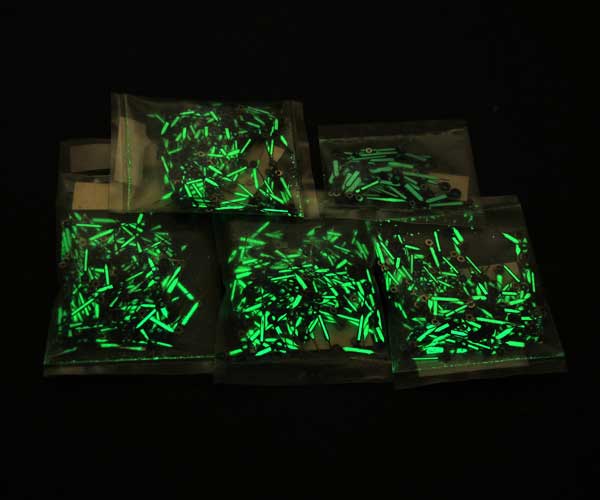
On April 20, 1902, Marie and Pierre Curie succeeded in isolating a chunk of the element radium, one of the earliest radioactive elements studied.
For this work they shared the Nobel Prize in Physics in 1903, with Henri Becquerel.
Pierre died in 1906, run over by a horse-drawn carriage. Marie won a second Nobel, in Chemistry, in 1911. Marie died in 1934 of aplastic anemia, a disease probably caused by her having received so much radiation over the course of her career.
More:
2 Comments | History, Physics, Radiation, Science | Tagged: History, Marie Curie, Nobel Prize in Physics, Physics, Pierre Curie, Radium, Science | Permalink
Posted by Ed Darrell
We shouldn’t get out of April 19 — a day marked by significant historic events through the past couple hundred years — without remembering that it is also the anniversary of the death of Darwin.
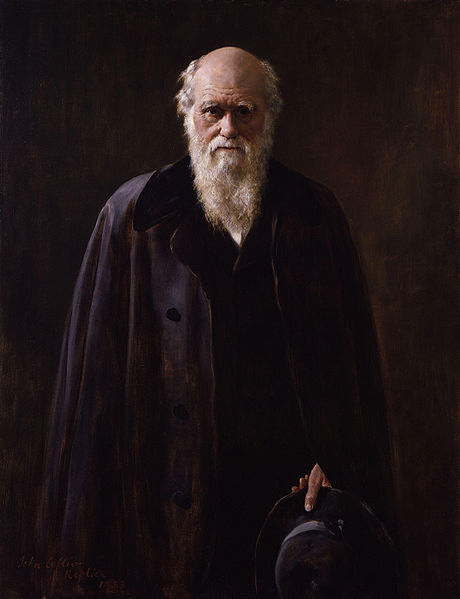
Charles Darwin in 1881, portrait by John Collier; after a Collier painting hanging in the Royal Society
Immortality? Regardless Darwin’s religious beliefs (I’ll argue he remained Christian, thank you, if you wish to argue), he achieved immortality solely on the strength of his brilliant work in science. Of course he’s best known for being the first to figure out that natural and sexual selection worked as tools to sculpt species over time, a theory whose announcement he shared with Alfred Russel Wallace, who independently arrived at almost exactly the same theory but without the deep evidentiary backup Darwin had amassed.
But had evolution turned out to be a bum theory, Darwin’s other works would have qualified him as one of the greatest scientists of all time, including:

Darwin’s theory set out a sequence of coral reef formation around an extinct volcanic island, becoming an atoll as the island and ocean floor subsided. Courtesy of the U.S. Geological Survey (Photo credit: Wikipedia)
US Geological Survey graphic demonstrating how coral atolls form on the sinking remains of old volcanic sea mounts, as Darwin described. Wikimedia commons image
Any of those accomplishments would have been a career-capping work for a scientist. Darwin’s mountains of work still form foundations of geology and biology, and are touchstones for genetics.
Born within a few hours of Abraham Lincoln on February 12, 1809, Darwin survived 17 years longer — 17 extremely productive years. Ill through much of his life with mystery ailments, perhaps Chaga’s Disease, or perhaps some other odd parasite or virus he picked up on his world travels, Darwin succumbed to heart disease on April 19, 1882.
More:
2 Comments | Biology, Charles Darwin, Darwin, Evolution, geology, History, Science | Tagged: Biology, Charles Darwin, Evolution, geology, History, Science | Permalink
Posted by Ed Darrell
If you needed turf grass, would you buy it from someone who doesn’t know beans about pesticides and ecosystems? Shouldn’t a turf grass provider know a bit more about ecology?

“Fairy ring” in turf grass — created by the pattern of spores dropping out of the mushrooms, not by fairies. Don’t tell the Saskatchewan Turfgrass Association. They appear to believe in fairies. (No, DDT won’t cure ’em.) Photo from Wikipedia, from Brisbane, Australia
Found this in the on-line newsletter of the Saskatchewan Turfgrass Association:
“State of Fear” written around 2006 by author Michael Crichton had interesting things to say about the once popular insecticide DDT. He wrote that arguably the greatest tragedy of the 20th Century was the removal of DDT for control of mosquitoes. DDT was the best insecticide on the market. Despite reviews to the contrary, no other products were as efficient, or as safe. Since the removal of DDT, it has been estimated that 30 to 50 million people have died unnecessarily. Before the removal of DDT, malaria had become almost a minor illness with only 50,000 deaths per year throughout the world. Remember the figures above are from 2006.
Nope. Crichton’s still wrong; he hasn’t corrected his errors since he died.
Malaria deaths are at historic lows, probably the lowest they’ve been in human history — thanks to Rachel Carson‘s integrated vector management methods and hard work by African malaria fighters working without DDT, mostly.
So, after the lie gets around the world before the truth gets its boots on, does the lie ever stop? Probably not.
We’re coming up on World Malaria Day on April 25. Corporately-funded hoaxsters will be spreading a lot of disinformation about malaria, about DDT, and about Rachel Carson, over the next month or so. And, probably for years beyond that.
More:
2 Comments | DDT, Hoaxes, Rachel Carson, Science | Tagged: DDT, Hoaxes, Michael Crichton, Rachel Carson, Science | Permalink
Posted by Ed Darrell


Ed Darrell on Texas's Colorado River


Come on in, the water's fine. Come often: Cleanliness is next to godliness.


 Millard Fillmore's Bathtub