Especially on his birthday, don’t call Darwin racist — he wasn’t

February 12, 2013

Creationists, Intelligent Design proponents, and several other anti-science and historical revisionist groups come unglued every February about this time — February 12 is Charles Darwin’s birthday.  He was born in 1809, on the exact same day as Abraham Lincoln.

Part of creationists’ coming unglued revolves around that fact that the science behind evolution grows stronger year by year, and at this point no argument exists that creationists can make against evolution that has not been soundly, roundly and thoroughly.  This makes creationists nervous in a discussion, because even they recognize when they lose arguments.   Creationists don’t like to lose arguments about how well Darwin’s theories work, because they erroneously believe that if Darwin is right, God and Jesus are wrong.

God and Jesus cannot be wrong, in their view, but intellectually they see they are losing the argument, and they grow desperate.  In their desperation they grasp for claims that shock uneducated or unfamiliar viewers.  Since about 1970, among the more shocking arguments one can make is to claim one’s opponent is racist.

Claiming Darwin, and hence evolution, boost racism, slaps history with irony.  Creationism’s roots were in denying that Europeans and Africans are evolutionarily equal, a claim necessary to allow slave holders to enslave Africans and go to church on Sundays.  The Civil War is 150 years away, the Emancipation Proclamation 148 years old, and even die-hard creationists generally have forgotten their own history.

Creationists accuse Darwin of being a racist, they claim evolution theory is racist, and they claim, therefore, it cannot be scientifically accurate.  There are a lot of holes in that chain of logic.

This is Darwin’s birthday.  Let me deal with major wrong premise, and give creationists room to correct their views with accurate history, so we don’t have a shouting match.

Way back in 2008, nominally-liberal evangelical preacher Tony Campolo got suckered in by a conservative evangelicals claim to him that evolution and Darwin are racist.  Below is my answer to him then — I think Campolo learned his lesson — but this builds on the claims Campolo made which are really copied from creationists.

In short, Darwin is not racist, and here are some explanations why, with a few updated links and minor edits for Darwin’s birthday, and Lincoln’s birthday, in 2013:

Tony Campolo is an evangelical Christian, a sociology professor and preacher who for the past 15 years or so has been a thorn in the side of political conservatives and other evangelicals, for taking generally more liberal stands, against poverty, for tolerance in culture and politics, and so on. His trademark sermon is an upbeat call to action and one of the more plagiarized works in Christendom, “It’s Friday, but Sunday’s Coming” (listen to it here). 
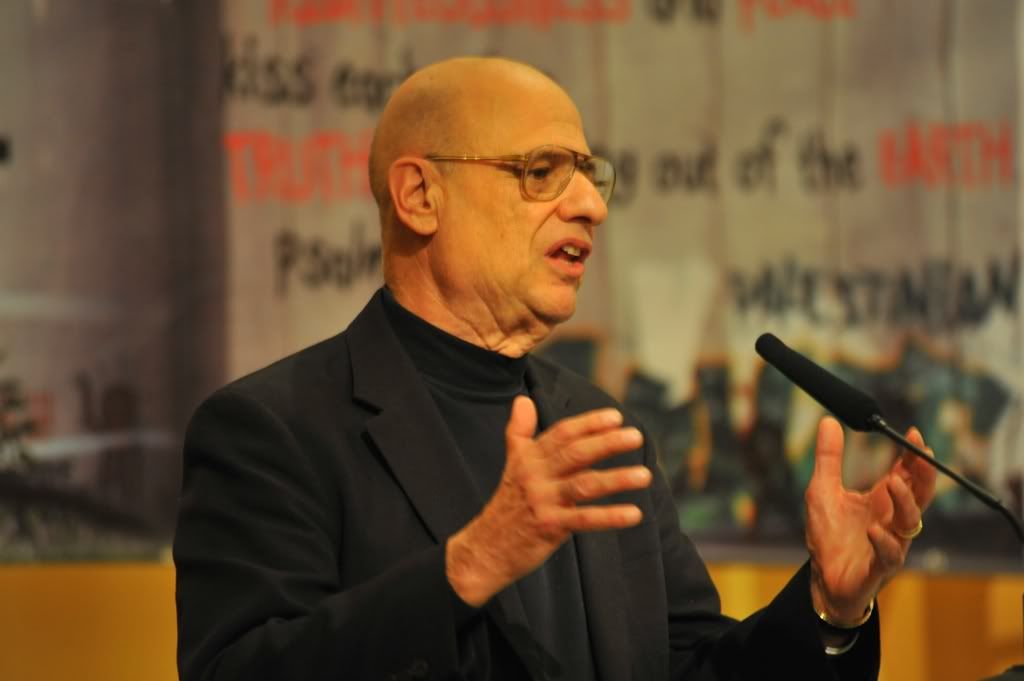
Tony Campolo

Rev. Tony Campolo

Since he’s so close to the mainstream of American political thought, Campolo is marginalized by many of the more conservative evangelists in the U.S. Campolo is not a frequent guest on the Trinity Broadcast Network, on Pat Robertson’s “700 Club,” nor on the white, nominally-Christian, low-budget knock-off of “Sabado Gigante!,” “Praise the Lord” (with purple hair and everything).

Campolo came closest to real national fame when he counseled President Bill Clinton on moral and spiritual issues during the Lewinsky scandal.

His opposite-editorial piece in the Philadelphia Inquirer back in 2008, “The real danger in Darwin is not evolution, but racism,” is out of character for Campolo as a non-conservative evangelistic thinker — far from what most Christians expect from Campolo either from the pulpit or in the college classroom. The piece looks as though it was lifted wholesale from Jerry Falwell or D. James Kennedy, showing little familiarity with the science or history of evolution, and repeating canards that careful Christians shouldn’t repeat.

Campolo’s piece is inaccurate in several places, and grossly misleading where it’s not just wrong. He pulls out several old creationist hoaxes, cites junk science as if it were golden, and generally gets the issue exactly wrong.

Evolution science is a block to racism. It has always stood against racism, in the science that undergirds the theory and in its applications by those scientists and policy makers who were not racists prior to their discovery of evolution theory. Darwin himself was anti-racist. One of the chief reasons the theory has been so despised throughout the American south is its scientific basis for saying whites and blacks are so closely related. This history should not be ignored, or distorted.

Shame on you, Tony Campolo.

Read the rest of this entry »


Lincoln and Darwin, born hours apart, February 12, 1809

February 12, 2013

Is it an unprecedented coincidence?  204 years ago today, just minutes apart according to unconfirmed accounts, Abraham Lincoln was born in a rude log cabin on Nolin Creek, in Kentucky, and Charles Darwin was born into a wealthy family at the family home  in Shrewsbury, England.

Gutzon Borglums 1908 bust of Abraham Lincoln in the Crypt of the U.S. Capitol - AOC photo

Gutzon Borglum’s 1908 bust of Abraham Lincoln in the Crypt of the U.S. Capitol – Architect of the Capitol photo

Lincoln would become one of our most endeared presidents, though endearment would come after his assassination.  Lincoln’s bust rides the crest of Mt. Rushmore (next to two slaveholders), with George Washington, the Father of His Country, Thomas Jefferson, the author of the Declaration of Independence, and Theodore Roosevelt, the man who made the modern presidency, and the only man ever to have won both a Congressional Medal of Honor and a Nobel Prize, the only president to have won the Medal of Honor.  In his effort to keep the Union together, Lincoln freed the slaves of the states in rebellion during the civil war, becoming an icon to freedom and human rights for all history.  Upon his death the entire nation mourned; his funeral procession from Washington, D.C., to his tomb in Springfield, Illinois, stopped twelve times along the way for full funeral services.  Lying in state in the Illinois House of Representatives, beneath a two-times lifesize portrait of George Washington, a banner proclaimed, “Washington the Father, Lincoln the Savior.”

Charles Darwin statue, Natural History Museum, London - NHM photo

Charles Darwin statue, Natural History Museum, London – NHM photo

Darwin would become one of the greatest scientists of all time.  He would be credited with discovering the theory of evolution by natural and sexual selection.  His meticulous footnoting and careful observations formed the data for ground-breaking papers in geology (the creation of coral atolls), zoology (barnacles, and the expression of emotions in animals and man), botany (climbing vines and insectivorous plants), ecology (worms and leaf mould), and travel (the voyage of H.M.S. Beagle).  At his death he was honored with a state funeral, attended by the great scientists and statesmen of London in his day.  Hymns were specially written for the occasion.  Darwin is interred in Westminster Abbey near Sir Isaac Newton, England’s other great scientist, who knocked God out of the heavens.

Lincoln would be known as the man who saved the Union of the United States and set the standard for civil and human rights, vindicating the religious beliefs of many and challenging the beliefs of many more.  Darwin’s theory would become one of the greatest ideas of western civilization, changing forever all the sciences, and especially agriculture, animal husbandry, and the rest of biology, while also provoking crises in religious sects.

Lincoln, the politician known for freeing the slaves, also was the first U.S. president to formally consult with scientists, calling on the National Science Foundation (whose creation he oversaw) to advise his administration.  Darwin, the scientist, advocated that his family put the weight of its fortune behind the effort to abolish slavery in the British Empire.  Each held an interest in the other’s disciplines.

Both men were catapulted to fame in 1858. Lincoln’s notoriety came from a series of debates on the nation’s dealing with slavery, in his losing campaign against Stephen A. Douglas to represent Illinois in the U.S. Senate.  On the fame of that campaign, he won the nomination to the presidency of the fledgling Republican Party in 1860.  Darwin was spurred to publicly reveal his ideas about the power of natural and sexual selection as the force behind evolution, in a paper co-authored by Alfred Russel Wallace, presented to the Linnean Society in London on July 1, 1858.   On the strength of that paper, barely noticed at the time, Darwin published his most famous work, On the Origin of Species, in November 1859.

The two men might have got along well, but they never met.

What unusual coincidences.  Today is the first day of a year-long commemoration of the lives of both men.  Wise historians and history teachers, and probably wise science teachers, will watch for historical accounts in mass media, and save them.

Go celebrate human rights, good science, and the stories about these men.

Resources:

Charles Darwin:

Abraham Lincoln:

More:

Anybody know what hour of the day either of these men was born?

This is mostly an encore post.


Abraham Lincoln, inventor – only president with a patent?

February 10, 2013

Lincoln’s (and Darwin’s) birthday rolls around again next week. What do we know about our 16th president who was the subject of a great and a silly movie in the last year?

Some wag sent out this Tweet today.

Any visitor to Thomas Jefferson’s home at Monticello knows of Jefferson’s wide-ranging interests, and work in science and invention.  I was rather surprised to discover the depth of George Washington’s inventive work, in a seminar sponsorred by the Bill of Rights Institute at Mount Vernon a few years ago.

Abraham Lincoln, too?

Sangamon_River_near_Lincoln's_First_Home_in_Il...

Sangamon River near Lincoln’s first home in Illinois – Photo from Wikipedia

Lincoln lived along the Sangamon River, and he saw development of the river for commercial navigation to be a boon for his district’s economic growth.  Unfortunately, the Sangamon is not deep; boats had difficult times navigating over the many logs and snags, and shallows.

So, Mr. Lincoln offered a technical solution, for which he was granted a patent in 1849.  Details below, from Google Patents:

lincoln-patent-for-buoying_vessels_over_shoals

lincoln-patent-for-boat-buoying-in-jpg

Drawing for Abraham Lincoln’s patent of a boat bouying apparatus.

Was Lincoln the only president to get a patent?  Thomas Jefferson and George Washington worked hard at inventions.  Jefferson shared Ben Franklin’s view that new inventions should be for the benefit of all; does that mean he didn’t seek patents?  Washington’s inventions — including the 16-sided barn for threshing wheat — tended to be improvements on processes; I don’t know of any evidence he even thought of patenting any idea.

It’s possible that Lincoln was the only president so far to have held a patent.

Lincoln’s invention was never built, and that patent never used.

This is an encore post with additions.

More, and miscellany:


Anthony Watts’s political push poll, “Gore or Obama?”

February 9, 2013

Al Gore and Barack Obama together in Detroit, June 2012, Rebecca Cook photo for Reuters, via NBC News photo

Al Gore and Barack Obama don’t appear to be on the opposite side of most issues, especially not climate change. Here they appear together in Detroit, circa June 11, 2012 – Rebecca Cook photo for Reuters, via NBC News photo

Anthony Watts strays farther and further from science with every passing day, and most of his new posts.

At the moment he’s got a doozy of a post, citing a bovine excrement question on a CFACT billboard, and offering a push-poll with three choices designed to push Watts’s preferred political answer, that ‘Obama and Gore go in different directions on global warming and climate change, and maybe they are both wrong.’   The end message Watts pushes is wrong, as you can see in the full texts below.(Morgan, here’s the link so you don’t have to flounder around with Google.)

Who do you believe?

◊  Barack Obama
◊  Neither one
◊  Al Gore

It’s based on these two quote mine products from the CFACT billboard:

WHAT DO YOU BELIEVE?

“Hurricane Sandy is a disturbing sign of things to come.”  — Al Gore, 10/30/2012

“We can’t attribute any particular weather event to global warming.”  — Barack Obama, 11/14/2012

Lying with quotes, demonstrated by CFACT

Propaganda group CFACT’s quote mining billboard, on which Anthony Watts’s push-poll is based.

Watts doesn’t offer a “both correct” choice.  That would be the accurate answer.

Gore’s comment at his blog on October 30, 2012, noted that while we can’t attribute the formation of Sandy to climate change, the effects of the storm were magnified by climate change.  Gore called that “disturbing.”

Obama, noting that while we can’t say for certain that any particular storm is caused entirely from human-created global warming, the long-term effects clearly have human causation and we need to act to stop it.

In short, Gore and Obama take the same side on this issue, the side of science and making sound public policy.  Watts works the old tobacco company strategy, suggesting that wherever studies showing health harms from tobacco differ from each other in the slightest jot or tittle, that means scientists can’t decide whether tobacco is harmful — substitute “human-caused climate change” for tobacco in that argument, and you see what Watts is trying to do.

Meanwhile, the Earth still warms:

Gore’s blog post in full:

Statement on Hurricane Sandy October 30, 2012 : 1:21 PM

This week, our nation has anxiously watched as Hurricane Sandy lashed the East Coast and caused widespread damage–affecting millions. Now more than ever, our neighbors need our help. Please consider donating or volunteering for your local aid organizations.

The images of Sandy’s flooding brought back memories of a similar–albeit smaller scale– event in Nashville just two years ago. There, unprecedented rainfall caused widespread flooding, wreaking havoc and submerging sections of my hometown. For me, the Nashville flood was a milestone. For many, Hurricane Sandy may prove to be a similar event: a time when the climate crisis—which is often sequestered to the far reaches of our everyday awareness became a reality.

While the storm that drenched Nashville was not a tropical cyclone like Hurricane Sandy, both storms were strengthened by the climate crisis. Scientists tell us that by continually dumping 90 million tons of global warming pollution into the atmosphere every single day, we are altering the environment in which all storms develop. As the oceans and atmosphere continue to warm, storms are becoming more energetic and powerful. Hurricane Sandy, and the Nashville flood, were reminders of just that. Other climate-related catastrophes around the world have carried the same message to hundreds of millions.

Sandy was also affected by other symptoms of the climate crisis. As the hurricane approached the East Coast, it gathered strength from abnormally warm coastal waters. At the same time, Sandy’s storm surge was worsened by a century of sea level rise. Scientists tell us that if we do not reduce our emissions, these problems will only grow worse.

Hurricane Sandy is a disturbing sign of things to come. We must heed this warning and act quickly to solve the climate crisis. Dirty energy makes dirty weather.

President Obama’s statement, excerpted from his November 14, 2012, press conference:

THE PRESIDENT:  Mark Landler.  Where’s Mark?  There he is right in front of me.

Q    Thank you, Mr. President.  In his endorsement of you a few weeks ago, Mayor Bloomberg said he was motivated by the belief that you would do more to confront the threat of climate change than your opponent.  Tomorrow you’re going up to New York City where you’re going to, I assume, see people who are still suffering the effects of Hurricane Sandy, which many people say is further evidence of how a warming globe is changing our weather.  What specifically do you plan to do in a second term to tackle the issue of climate change?  And do you think the political will exists in Washington to pass legislation that could include some kind of a tax on carbon?

THE PRESIDENT:  As you know, Mark, we can’t attribute any particular weather event to climate change.  What we do know is the temperature around the globe is increasing faster than was predicted even 10 years ago.  We do know that the Arctic ice cap is melting faster than was predicted even five years ago.  We do know that there have been extraordinarily — there have been an extraordinarily large number of severe weather events here in North America, but also around the globe.

And I am a firm believer that climate change is real, that it is impacted by human behavior and carbon emissions.  And as a consequence, I think we’ve got an obligation to future generations to do something about it.

Now, in my first term, we doubled fuel efficiency standards on cars and trucks.  That will have an impact.  That will take a lot of carbon out of the atmosphere.  We doubled the production of clean energy, which promises to reduce the utilization of fossil fuels for power generation.  And we continue to invest in potential breakthrough technologies that could further remove carbon from our atmosphere.  But we haven’t done as much as we need to.

So what I’m going to be doing over the next several weeks, next several months, is having a conversation, a wide-ranging conversation with scientists, engineers, and elected officials to find out what can — what more can we do to make a short-term progress in reducing carbons, and then working through an education process that I think is necessary — a discussion, a conversation across the country about what realistically can we do long term to make sure that this is not something we’re passing on to future generations that’s going to be very expensive and very painful to deal with.

I don’t know what either Democrats or Republicans are prepared to do at this point, because this is one of those issues that’s not just a partisan issue; I also think there are regional differences.  There’s no doubt that for us to take on climate change in a serious way would involve making some tough political choices.  And understandably, I think the American people right now have been so focused, and will continue to be focused on our economy and jobs and growth, that if the message is somehow we’re going to ignore jobs and growth simply to address climate change, I don’t think anybody is going to go for that.  I won’t go for that.

If, on the other hand, we can shape an agenda that says we can create jobs, advance growth, and make a serious dent in climate change and be an international leader, I think that’s something that the American people would support.

So you can expect that you’ll hear more from me in the coming months and years about how we can shape an agenda that garners bipartisan support and helps move this agenda forward.

Q    Sounds like you’re saying, though, in the current environment, we’re probably still short of a consensus on some kind of attack.

THE PRESIDENT:  That I’m pretty certain of.  And, look, we’re still trying to debate whether we can just make sure that middle-class families don’t get a tax hike.  Let’s see if we can resolve that.  That should be easy.  This one is hard — but it’s important because one of the things that we don’t always factor in are the costs involved in these natural disasters; we just put them off as something that’s unconnected to our behavior right now.  And I think what — based on the evidence we’re seeing, is that what we do now is going to have an impact and a cost down the road if we don’t do something about it.

In context, can you point to any points of conflict between what Al Gore said in October, and what President Obama said a couple of weeks later?  To me it looks as if they’re singing very much from the the same hymnal or songbook, and they’re in harmony, if not unison, especially in what I’ve turned into red-letter text.

Here’s the video of the entire Obama press conference (climate question comes at 42:19 in the video transcript):

More:


Science project: Hello Kitty at 94,000 feet

February 8, 2013

GoPro cameras weigh so little, work so well and are so tough that they go anywhere.  How we would have loved to attach one to the kites we sent a couple thousand feet above the Utah mountains.

Only time stood between the cameras and their use in high-altitude photography from weather balloons — even the topic of a credit card advertisement.  And now, a middle school science project, for a Christian parochial school (what science could a religious school foul up in studying the atmosphere?).

Four Go-Pros, a styrofoam box, a bunch of duct tape, a GPS-equipped locater (you could use a cell phone), some high-technology-now-cheap sensing equipment from High Altitude Science for temperature and air pressure — even a 7th-grade science project can make Galileo, Newton and Goddard jealous.

You can tell it’s 7th grade from the choice of the astroKittynaut to the choice of music, no?

Details:

Cornerstone Christian school 7th grade science project.
The effects of Altitude on air pressure and temperature.
Cameras: GoPro Hero2 video footage.
Edited By: Eddie Lacayo elacayo212@gmail.com
Flight gear: High Altitude Science.
Flight computer / Data acquisition: High Altitude Science.
Tree Climber: Woodpecker Arborist.

music: We Are Young by: Fun (Feat Janelle Monáe)
We Do Not Own The Rights To This Song
buy at: http://www.amazon.com/Are-Young-feat-…

This isn’t an ad for High Altitude Science, nor for GoPro (although if they want to send some products along for review, I would review them with full disclosure, and return what isn’t used up), but if you are inspired to try this, look at some of the details.

From High Altitude Science, a sales-pitch on how easy it is:

  • If you’re interested in starting your own space program, click here.
  • If you’re interested in purchasing weather balloons, satellite trackers, and weather balloon kits, visit our Store.
  • If you already have a weather balloon kit, but need some training or a refresher, read our Tutorials.
  • If you’re an educator who wants to inspire your students, visit our Education Page.
  • If you would like to see our products in action, visit our Videos Page.

I got my GoPro at REI; there are other vendors, and the new ones are very impressive.  High Altitude Science uses a special mount for the GoPro, which they sell with the camera.  For the project above, some of the cameras were borrowed.  Some adult supervision is needed — this package drifted more than 40 miles from the launch site; you want to be sure to avoid air travel lanes at launch (a lot of the Dallas-Ft.Worth area would be off limits); launching from Salt Lake or Utah Valleys could put the touchdown site 5,000 feet up in a wilderness area.  There are considerations on safety and recovery that require some thought.  When CNN tried it, they ran into problems — their account could be useful background (with cool photos, too).

What else could you do with these cameras and science project kits?  How about flying a kite, just to look at your town.  Attach a camera to a radio-controlled aircraft (a drone), and see what you can’t see of a wilderness area or riparian environment, or forest canopy, or rockface on a mountain.  Get the water-tight case, and put the thing into a river or lake.

A 7th-grade kid doing real science measurements at a Christian school — ain’t technology wonderful?

Is there gyroscope device to keep these devices from spinning so wildly?  Will the new GoPros support a radio contact to get images live from the device?

More:

Film from the physics class at East Union High School in Afton, Iowa, showing more detail of the data collection and analysis:

A July 2012 launch from Austin, Texas:

A Vimeo version, for a launch from farther east (BrooklynSpaceProgram.org), that garnered coverage from the New York Times:

How many of these projects have there been?


Time machine! For Digital Learning Day

February 6, 2013

Screen shot from HHMI's iPad app, Earth Viewer -- the time machine function.

Screen shot from HHMI’s iPad app, Earth Viewer — the time machine function.

Stealing the entire post from P. Z. Myers at Pharyngula:

I’ve been playing with it for a while. It turns out that when you go back to Cretaceous Morris, you need to be able to swim really well, but Cambrian Morris is high and dry on a fairly small landmass (whoa, but oxygen is way down and carbon dioxide way up). You can have your own time machine, too — it’s the EarthViewer app for iPad, and it’s free from HHMI Here’s what it has:

• Data and continental reconstructions dating back billions of years

• Climate and carbon dioxide data for the last 100 years

• The ability to manipulate the globe and zoom to any location

• Track the location of modern cities back over 500 million years

• In depth features on major geological and biological events in Earth history

• Clickable details on geologic eons, eras, and periods

• Automated play modes

• An extensive reference list

• Suggestions for classroom use

• Tutorial videos

Did I mention that it’s free? This HHMI thing is pretty danged sweet.

There is no creationist/Noah’s Flood version.

No Windows version, yet, either.

Did we mention the Howard Hughes Medical Institute made this and related apps free?


So, you want to be an astronaut?

February 2, 2013

What’s it like to be an astronaut?

You gotta learn how to cook and eat snake.

A discovery engine for meaningful knowledge, fueled by cross-disciplinary curiosity.
Edited by Maria Popova for Lore.
Twitter: @explorer

Art & Design Science & Technology Culture & Society History & Literature Creativity & Innovation Media & Communication Thought & Opinion About

Science & TechnologyHistory & Literature
What’s it like to be an astronaut? An animated first-hand account by NASA’s Jerry Carr, who tells his fascinating life story.

Complement with Sally Ride’s first-hand account of what it’s like to take off on a Space Shuttle, and this illustrated chronology of the Space Age.

Do kids dream of being an astronaut any more?  It’s a great, character-building dream.

Tip of the old scrub brush to BrainPicker, at Explore.

More:


Carl Sagan explains how science works: Eratosthenes and the size of the planet

January 23, 2013

It’s not exactly a hoax.  It started out as just bad reporting of history.

In his search for an easier route from Spain to China, in which he stumbled into the Americas, Christopher Columbus knew with  certainty the Earth is a round ball.  The story that he proved the Earth round, or rather than he laid the foundations for Magellan to prove the Earth round, is only a story, mostly devoid of fact.  Sailors knew something was up just from their having watched things while sailing on the ocean.  One can deduce the ball shape of the planet by watching other ships as they sail away, and sink below the horizon.  Were sailors of a more scientific bent, they could have made much of the fact that the guy in the crow’s nest could see a ship moving away — or an island or a continent — for a time longer than those a few dozen feet below, on the deck of the ship.

Long before that a Greek librarian and polymath, Eratosthenes, figured out that the surface of the Earth is curved, deduced that the planet is basically a ball, and calculated very closely how big the ball is, merely by noting the different shadows cast by the sun at the Spring/Vernal Equinox.  Carl Sagan used this story way back in his famous PBS series, Cosmos.  It’s still interesting, informative and instructive today (surely Texas 9th grade geography teachers use this example all the time, no?  9th grade math teachers?  Say, what?).

You can find this and more Sagan videos at the Carl Sagan Portal on YouTube.

How did he do it?  Wikipedia — as usual — has a good, relatively lay explanation:

Visual representation of Eratosthenes's calculations of the size of the spherical Earth.

Bathtub Art Figure 1:  Eratosthenes’ measurement of the Earth’s circumference.

Eratosthenes calculated the circumference of the Earth without leaving Egypt. Eratosthenes knew that, on the summer solstice, at local noon in the Ancient Egyptian city of Swenet (known in Greek as Syene, and in the modern day as Aswan) on the Tropic of Cancer, the sun would appear at the zenith, directly overhead (he had been told that the shadow of someone looking down a deep well would block the reflection of the Sun at noon). Using a gnomon, he measured the sun’s angle of elevation at noon on the solstice in his hometown of Alexandria, and found it to be 1/50th of a circle (7°12′) south of the zenith. Assuming that the Earth was spherical (360°), and that Alexandria was due north of Syene, he concluded that the meridian arc distance from Alexandria to Syene must therefore be 1/50 = 7°12’/360°, and was therefore 1/50 of the total circumference of the Earth. His knowledge of the size of Egypt after many generations of surveying trips for the Pharaonic bookkeepers gave a distance between the cities of 5,000 stadia (about 500 geographical miles or 927.7 km). This distance was corroborated by inquiring about the time that it takes to travel from Syene to Alexandria by camel. He rounded the result to a final value of 700 stadia per degree, which implies a circumference of 252,000 stadia. The exact size of the stadion he used is frequently argued. The common Attic stadion was about 185 m,[9] which would imply a circumference of 46,620 km, which is off the actual circumference by 16.3%; too large an error to be considered as ‘accurate’. However, if we assume that Eratosthenes used the “Egyptian stadion”[10] of about 157.5 m, his measurement turns out to be 39,690 km, an error of less than 2%.[11]

Description of Bathtub Art Figure 1:

Syene (S) is located on the Tropic of Cancer, so that at summer solstice the sun appears at the zenith, directly overhead. In Alexandria (A) the sun is \varphi south of the zenith at the same time. So the circumference of earth can be calculated being \frac{360^\circ}{\varphi} times the distance \delta between A and S.

Erastothenes measured the angle \varphi to be 1/50 of a circle and his access to knowledge of the size of Egypt gave a north/south distance \delta between Alexandria and Syene of 5000 stadia. His circumference of the Earth was therefore 250 000 stadia. Certain accepted values of the length of the stadia in use at the time give an error of less than 6% for the true value for the polar circumference.

Tropic of Cancer sign in Western Sahara

Tropic of Cancer sign in Western Sahara, placed by trans-Sahara racers, in English and Hungarian Photo: Wikipedia

A fun little exercise, but a remarkable achievement for anyone about 240 years before the birth of of the Biblical Jesus.  Syene, now known as Aswan, is on what we now call the Tropic of Cancer (the “tropics” were named by the Greeks, but I am uncertain whether the line had that name in Eratosthenes’s time).  The date is probably not important, so much as the observation that the sun was vertical at noon on a given date — and then Eratosthenes’s experiment to see whether that were true in Alexandria, and then his understanding of what that might mean and his work to assemble the data to make the calculations.   High school students — heck, junior high school students — should be able to figure all that out today, if they had the basics down.  I suspect that knowing this story would be a spur to students to learn the elements of the mystery and how it was solved, and what it might mean for later navigators of the oceans, land and air, for astronomers, for farmers and for mathematics.

I also like this story because it presents a strange conundrum, a paradox about what people know, and what they may reason from the foundation of what they know.  Our friend and frequent commenter Morgan, whose blog he calls the House of Eratosthenes.  I suspect he thinks himself some latter-day Eratosthenian (“Latter-day Erats?”).  He says as much in his blog FAQ:

I’m just like Eratosthenes peeking into a well here, and I don’t know what it means yet.

It’s an entertaining read and more enlightening that one might think from his forays here, so you probably ought to go read the FAQ and the reasons Morgan misbelieves liberals miss out on Eratosthenes’s wisdom.  Morgan has an explanation of Eratosthenes and his discoveries which I find too brief to be accurate (and I’m not sure why Morgan finds the name “Beta” to be dubious; being a polymath was not a small thing then, or now; second best in everything means one is first in the All-Around, first in the academic centathlon or millathlon — no mean set of feats at all).  I find that funny because, while he makes a pretense and some effort to following Eratosthenes and scientific methods, to me he seems to find science and logic things to run away from, as in our recent discussion where he ends up defending Anthony Watts’s erroneous views because Watts’s critics didn’t link to Watts (see comments in “It’s raining crazy,” and see also Morgan’s own post, which defies explanation).  Eratosthenes would find that funny, too, I hope, but not a demonstration of Eratosthenian logic and calculation.

Does anyone doubt where Carl Sagan would be in the debate between the dozen serious scientists and hundreds of political wankers who deny climate change, and the thousands of scientists and good citizens who recognize that it occurs and think we should get on with saving the future?

(Did James Burke cover Eratosthenes in his brilliant series Connections?  Which episode?)

Tip of the old scrub brush to Fred Clark at Slacktivist, whose compilation posts often overflow with stuff you ought to know or see, and whose post today sent me to Joe at It’s Okay to Be Smart and “Top 10 Reasons We Know The Earth Is Round.”

More:


Annals of global warming: NASA data show warming continues through 2012

January 16, 2013

This is a press release from NASA, presented here for the record, text unedited except for formatting where necessary, and the deletion of the press office phone numbers (I hope that’s not necessary, but earnest information seekers have links to get the information they seek).  Images are inserted from other, related NASA sites.

Steve Cole
Headquarters, Washington
stephen.e.cole@nasa.gov

Leslie McCarthy
Goddard Institute for Space Studies, New York
leslie.m.mccarthy@nasa.gov

Jan. 15, 2013

RELEASE : 13-021

NASA Finds 2012 Sustained Long-Term Climate Warming Trend

WASHINGTON — NASA scientists say 2012 was the ninth warmest of any year since 1880, continuing a long-term trend of rising global temperatures. With the exception of 1998, the nine warmest years in the 132-year record all have occurred since 2000, with 2010 and 2005 ranking as the hottest years on record.

NASA’s Goddard Institute for Space Studies (GISS) in New York, which monitors global surface temperatures on an ongoing basis, released an updated analysis Tuesday that compares temperatures around the globe in 2012 to the average global temperature from the mid-20th century. The comparison shows how Earth continues to experience warmer temperatures than several decades ago.

[Caption to video] NASA’s analysis of Earth’s surface temperature found that 2012 ranked as the ninth-warmest year since 1880. NASA scientists at the Goddard Institute for Space Studies (GISS) compare the average global temperature each year to the average from 1951 to 1980. This 30-year period provides a baseline from which to measure the warming Earth has experienced due to increasing atmospheric levels of heat-trapping greenhouse gases. While 2012 was the ninth-warmest year on record, all 10 of the warmest years in the GISS analysis have occurred since 1998, continuing a trend of temperatures well above the mid-20th century average. The record dates back to 1880 because that is when there were enough meteorological stations around the world to provide global temperature data.
Data source: NASA Goddard Institute for Space Studies
Visualization credit: NASA Goddard’s Scientific Visualization Studio

› Download this video and related materials in HD formats

The average temperature in 2012 was about 58.3 degrees Fahrenheit (14.6 Celsius), which is 1.0 F (0.6 C) warmer than the mid-20th century baseline. The average global temperature has risen about 1.4 degrees F (0.8 C) since 1880, according to the new analysis.

Scientists emphasize that weather patterns always will cause fluctuations in average temperature from year to year, but the continued increase in greenhouse gas levels in Earth’s atmosphere assures a long-term rise in global temperatures. Each successive year will not necessarily be warmer than the year before, but on the current course of greenhouse gas increases, scientists expect each successive decade to be warmer than the previous decade.

“One more year of numbers isn’t in itself significant,” GISS climatologist Gavin Schmidt said. “What matters is this decade is warmer than the last decade, and that decade was warmer than the decade before. The planet is warming. The reason it’s warming is because we are pumping increasing amounts of carbon dioxide into the atmosphere.”

Carbon dioxide is a greenhouse gas that traps heat and largely controls Earth’s climate. It occurs naturally and also is emitted by the burning of fossil fuels for energy. Driven by increasing man-made emissions, the level of carbon dioxide in Earth’s atmosphere has been rising consistently for decades.

The carbon dioxide level in the atmosphere was about 285 parts per million in 1880, the first year in the GISS temperature record. By 1960, the atmospheric carbon dioxide concentration, measured at NOAA’s Mauna Loa Observatory, was about 315 parts per million. Today, that measurement exceeds 390 parts per million.

NASA map, global temperature anomalies averaged from 2008 to 2012 - Goddard Institute for Space Studies

This map represents global temperature anomalies averaged from 2008 through 2012. Data source: NASA Goddard Institute for Space Studies Visualization credit: NASA Goddard’s Scientific Visualization Studio

› Larger image
› Larger image (tif)
› Color bar scale (png)

While the globe experienced relatively warm temperatures in 2012, the continental U.S. endured its warmest year on record by far, according to NOAA, the official keeper of U.S. weather records.

“The U.S. temperatures in the summer of 2012 are an example of a new trend of outlying seasonal extremes that are warmer than the hottest seasonal temperatures of the mid-20th century,” GISS director James E. Hansen said. “The climate dice are now loaded. Some seasons still will be cooler than the long-term average, but the perceptive person should notice that the frequency of unusually warm extremes is increasing. It is the extremes that have the most impact on people and other life on the planet.”

The temperature analysis produced at GISS is compiled from weather data from more than 1,000 meteorological stations around the world, satellite observations of sea-surface temperature, and Antarctic research station measurements. A publicly available computer program is used to calculate the difference between surface temperature in a given month and the average temperature for the same place during 1951 to 1980. This three-decade period functions as a baseline for the analysis. The last year that experienced cooler temperatures than the 1951 to 1980 average was 1976.

The GISS temperature record is one of several global temperature analyses, along with those produced by the Met Office Hadley Centre in the United Kingdom and the National Oceanic and Atmospheric Administration’s National Climatic Data Center in Asheville, N.C. These three primary records use slightly different methods, but overall, their trends show close agreement.

For images related to the data, visit:

http://go.nasa.gov/10wqITW

– end –

Related Links [from NASA]

› Goddard Institute for Space Studies GISTEMP Analysis
› Science Summary of NASA’s 2012 Temperature Analysis (pdf)
› NOAA State of the Climate Global Analysis: 2012
› Slides for Jan. 15 media teleconference (pdf)
› Download related multimedia in broadcast-suitable HD formats

More, and resources:


Passing the 200 post mark on Rachel Carson, DDT and Malaria

January 13, 2013

I’m running behind in listing some of the articles, but since Utah Rep. Rob Bishop first alerted me to the stupidity raging on Rachel Carson‘s reputation, DDT‘s dangers and malaria, Millard Fillmore’s Bathtub hosted more than 200 articles on the topics.

Palau's stamp honoring Rachel Carson

Postage stamp honoring Rachel Carson, part of the “20th century environmental heroes” set from the South Pacific nation of Palau, PlanetPatriot image

Overwhelmingly, the evidence is that Rachel Carson was right, DDT is still dangerous and needs to be banned, but malaria still declines, even with declining DDT use.

You can look at the list of 200 articles, in reverse chronological order, here.

More:


Annals of global warming: “Federal Advisory Committee Draft Climate Assessment Report Released for Public Review”

January 12, 2013

It’s taken too long, but the reports on climate change, required by a 1990 law, flow down the government report-to-the-public pipeline once again.  Mother Jones reports six chief points in the draft document, for which comments are invited before a final document will be issued:

  1. Climate change is definitely caused by human activities. Always nice to hear government officials acknowledge this essential fact. And the report concedes that our only hope of curbing warming is to kick our addiction to greenhouse-gas spewing fossil fuels.

  2. Extreme weather is increasing, and that’s our fault, too.  In particular, searing temperatures, heavy rain, and prolonged drought.

  3. Weather isn’t the only threat we have to worry about. The list sounds like the side-effect warnings at the end of a prescription drug commercial: decreased air quality, insect-borne diseases, and “threats to mental health” are all on the docket for the coming decades.

  4. Our infrastructure is getting hammered, and we’re not spending enough to save it. Floods are destroying farmland; extreme heat is damaging roads, rail lines, and airports; and military installations are at risk.

  5. Food and water security will be up in the air. Especially in water-scarce regions like the Southwest, decreasing snowpack and shrinking groundwater supplies will spark competition for water between “agricultural, municipal, and environmental” uses. At the same time, heavy floods could put water quality at risk with sediment and chemical contaminates. And by mid-century, efforts to artificially protect agriculture (like expanded irrigation) could be over-ridden by temperature and precipitation extremes.

  6. Climate change is hitting plants and animals just as hard as us. Beaches, forests, wetlands, and other ecosystems could shrink or disappear, especially a problem when they play a role in mitigating the impact from extreme weather. And warming, acidifying seas could slam sea life.

The document is available to read online; public comments are invited, but must come in a specific form to be analyzed (the authors expect a lot of comments, and a lot of detailed comments).  Here’s the transmission document from the agency (a few links added here):

Federal Advisory Committee Draft Climate Assessment Report Released for Public Review

A 60-person Federal Advisory Committee (The “National Climate Assessment and Development Advisory Committee” or NCADAC) has overseen the development of this draft climate report.

The NCADAC, whose members are available here (and in the report), was established under the Department of Commerce in December 2010 and is supported through the National Oceanic and Atmospheric Administration (NOAA). It is a federal advisory committee established as per the Federal Advisory Committee Act of 1972. The Committee serves to oversee the activities of the National Climate Assessment. Its members are diverse in background, expertise, geography and sector of employment. A formal record of the committee can be found at the NOAA NCADAC website.

The NCADAC has engaged more than 240 authors in the creation of the report. The authors are acknowledged at the beginning of the chapters they co-authored.

Following extensive review by the National Academies of Sciences and by the public, this report will be revised by the NCADAC and, after additional review, will then be submitted to the Federal Government for consideration in the Third National Climate Assessment (NCA) Report.  For more information on the NCA process and background, previous assessments and other NCA information, please explore the NCA web-pages. The NCA is being conducted under the auspices of the Global Change Research Act of 1990 and is being organized and administered by the Global Change Research Program.

To simply access and read the draft report, please download the chapters below. However, if you would like to submit comments on the report as part of the public process, you will need to enter the “review and comment system” and register with your name and e-mail address and agree to the terms.  All comments must be submitted through the review and comment system.

Contents of the report, chapter by chapter, for your download:

Download Chapters of the NCADAC Draft Climate Assessment Report! 
Download the Full Report (warning, 147Mb. Very large file)Between chapters, there are some page numbers that are not used. This is intentional and does not reflect missing pages.or download each chapter separately:

Cover page

Introduction: Letter to the American People

1. Executive Summary

2. Our Changing Climate

Introduction to Sectors

3. Water Resources

4. Energy Supply and Use

5. Transportation

6. Agriculture

7. Forestry

8. Ecosystems, Biodiversity, and Ecosystem Services

9. Human Health

10. Water, Energy, and Land Use

11. Urban Systems, Infrastructure, and Vulnerability

12. Impacts of Climate Change on Tribal, Indigenous, and Native Lands and Resources

13. Land Use and Land Cover Change

14. Rural Communities

15. Interactions of Climate Change and Biogeochemical Cycles

Introduction to Regions

16. Northeast

17. Southeast and Caribbean

18. Midwest

19. Great Plains

20. Southwest

21. Northwest

22. Alaska and the Arctic

23. Hawaii and the U.S. Affiliated Pacific Islands

24. Oceans and Marine Resources

25. Coastal Zone Development and Ecosystems

Introduction to Response Strategies

26. Decision Support: Supporting Policy, Planning, and Resource Management Decisions in a Climate Change Context

27. Mitigation

28. Adaptation

29. Research Agenda for Climate Change Science

30. The NCA Long-Term Process: Vision and Future Development

Appendix I: NCA Climate Science – Addressing Commonly Asked Questions from A to Z

Appendix II: The Science of Climate Change

To provide comments:

Between January 14th and April 12th only: Please go to the Review and Comment System to provide comments on the draft.

You must register and accept the terms in the Review and Comment System in order to review this document. Comments will only be accepted through this system.

NOTE: You will not be allowed to create an account in the system prior to 9am ET January 14th, 2013, and the comment period ends at 5pm ET on April 12th, 2013

If 2012 was, indeed, the year excrement got real in climate change, perhaps 2013 can be the year we start to do something about it.

More:


World Malaria Report 2012: Malaria still declining, but more resources needed fast

January 4, 2013

Significant gains against malaria could be lost because funding for insecticide-treated bednets has dropped, and malaria parasites appear to be developing resistance to the pharmaceuticals used to clear the disease from humans, while insects that transmit the parasites develop resistance to insecticides used to hold their populations down.

Malaria room

African bedroom equipped with LLINs (insecticidal bednets) Photo: YoHandy/Flickr

UN’s World Health Organization (WHO) published its annual report on the fight against malaria last month, December 2012.  Accompanying the many page World Malaria Report 2012  were a press release and a FAQ; the fact-sheet appears unedited below.

Insecticidal bednets have proven to be a major, effective tool in reducing malaria infections.  Careful studies of several different projects produced a consensus that distributing the nets for free works best; people in malaria-infected areas simply cannot afford to pay even for life-saving devices, but they use the devices wisely when they get them.  Nets often get abbreviated in official documents to “LLINs,” an acronym for “long-lasting insecticidal nets.”

Generally, the report is good news.

Dramatic facts emerge from the report:  The “million-a-year” death toll from malaria has been whacked to fewer than 700,000, the lowest level in recorded human history.  More people may die, and soon, if aid does not come to replace worn bednets, distribute new ones, and if the drugs that cure the disease in humans, lose effectiveness.  Many nations where the disease is endemic cannot afford to wage the fight on their own.

Links in the Fact Sheet were added here, and do not come from the original report — except for the link to the WHO site itself.

Logo for World Health Organization

17 December 2012

World Malaria Report 2012

FACT SHEET

Malaria is a preventable and treatable mosquito-borne disease, whose main victims are children under five years of age in Africa.

The World Malaria Report 2012 summarizes data received from 104 malaria-endemic countries and territories for 2011. Ninety-nine of these countries had on-going malaria transmission.

According to the latest WHO estimates, there were about 219 million cases of malaria in 2010 and an estimated 660,000 deaths. Africa is the most affected continent: about 90% of all malaria deaths occur there.

Between 2000 and 2010, malaria mortality rates fell by 26% around the world. In the WHO African Region the decrease was 33%. During this period, an estimated 1.1 million malaria deaths were averted globally, primarily as a result of a scale-up of interventions.

Funding situation

International disbursements for malaria control rose steeply during the past eight years and were estimated to be US$ 1.66 billion in 2011 and US$ 1.84 billion in 2012. National government funding for malaria programmes has also been increasing in recent years, and stood at an estimated US$ 625 million in 2011.

However, the currently available funding for malaria prevention and control is far below the resources required to reach global malaria targets. An estimated US$ 5.1 billion is needed every year between 2011 and 2020 to achieve universal access to malaria interventions. In 2011, only US$ 2.3 billion was available, less than half of what is needed.

Disease burden

Malaria remains inextricably linked with poverty. The highest malaria mortality rates are being seen in countries that have the highest rates of extreme poverty (proportion of population living on less than US$1.25 per day).

International targets for reducing malaria cases and deaths will not be attained unless considerable progress can be made in the 17 most affected countries, which account for an estimated 80% of malaria cases.

  • The six highest burden countries in the WHO African region (in order of estimated number of cases) are: Nigeria, Democratic Republic of the Congo, United Republic of Tanzania, Uganda, Mozambique and Cote d’Ivoire. These six countries account for an estimated 103 million (or 47%) of malaria cases.
  • In South East Asia, the second most affected region in the world, India has the highest malaria burden (with an estimated 24 million cases per year), followed by Indonesia and Myanmar.  50 countries are on track to reduce their malaria case incidence rates by 75%, in line with World Health Assembly and Roll Back Malaria targets for 2015. These 50 countries only account for 3% (7 million) of the total estimated malaria cases.

At present, malaria surveillance systems detect only around 10% of the estimated global number of cases.  In 41 countries around the world, it is not possible to make a reliable assessment of malaria trends due to incompleteness or inconsistency of reporting over time.

This year, the World Malaria Report 2012 publishes country-based malaria case and mortality estimates (see Annex 6A). The next update on global and regional burden estimates will be issued in December 2013.

Malaria interventions

To achieve universal access to long-lasting insecticidal nets (LLINs), 780 million people at risk would need to have access to LLINs in sub-Saharan Africa, and approximately 150 million bed nets would need to be delivered each year.

The number of LLINs delivered to endemic countries in sub-Saharan Africa dropped from a peak of 145 million in 2010 to an estimated 66 million in 2012. This will not be enough to fully replace the LLINs delivered 3 years earlier, indicating that total bed net coverage will decrease unless there is a massive scale-up in 2013. A decrease in LLIN coverage is likely to lead to major resurgences in the disease.

In 2011, 153 million people were protected by indoor residual spraying (IRS) around the world, or 5% of the total global population at risk. In the WHO African Region, 77 million people, or 11% of the population at risk were protected through IRS in 2011.

The number of rapid diagnostic tests delivered to endemic countries increased dramatically from 88 million in 2010 to 155 million in 2011. This was complemented by a significant improvement in the quality of tests over time.

In 2011, 278 million courses of artemisinin-based combination therapies (ACTs) were procured by the public and private sectors in endemic countries – up from 182 million in 2010, and just 11 million in 2005. ACTs are recommended as the first-line treatment for malaria caused by Plasmodium falciparum, the most deadly Plasmodium species that infects humans. This increase was largely driven by the scale-up of subsidized ACTs in the private sector through the AMFm initiative, managed by the Global Fund to Fight AIDS, Tuberculosis and Malaria.

Drug and insecticide resistance

Antimalarial drug resistance is a major concern for the global effort to control malaria. P. falciparum resistance to artemisinins has been detected in four countries in South East Asia: in Cambodia, Myanmar, Thailand and Viet Nam. There is an urgent need to expand containment efforts in affected countries. For now, ACTs remain highly effective in almost all settings, so long as the partner drug in the combination is locally effective.

Mosquito resistance to at least one insecticide used for malaria control has been identified in 64 countries around the world. In May 2012, WHO and the Roll Back Malaria Partnership released the Global Plan for Insecticide Resistance Management in malaria vectors, a five-pillar strategy for managing the threat of insecticide resistance.

www.who.int/malaria

You were perceptive.  You noted there is no call from malaria fighters for more DDT, nor for any change in DDT policy.  This is a report from medical personnel, from public health experts, the real malaria fighters.  It’s not a political screed.

More, and related articles:


December 31, 2012: Bright Idea Day, anniversary of Edison’s light bulb

December 31, 2012

Between Christmas and New Year’s Day, here at Millard Fillmore’s Bathtub we celebrate a variety of historically holy days.  December 31, by tradition, is Bright Idea Day, the anniversary of the day Thomas Edison demonstrated for the public a working light bulb in 1879.

100,000 people gather in Times Square, New York City, tonight, and millions more around the world, in festivities for the new year made possible by the work of Thomas Alva Edison.

Here it is, the invention that stole sleep from our grasp, made clubbing possible, and launched 50,000 cartoons about ideas:

The light bulb Thomas Edison demonstrated on December 31, 1879, at Menlo Park, New Jersey - Wikimedia image

The light bulb Thomas Edison demonstrated on December 31, 1879, at Menlo Park, New Jersey – Wikimedia image (GFDL)

The light bulb. It’s an incandescent bulb.

It wasn’t the first bulb. Edison a few months earlier devised a bulb that worked with a platinum filament. Platinum was too expensive for mass production, though — and Edison wanted mass production. So, with the cadre of great assistants at his Menlo Park laboratories, he struggled to find a good, inexpensive filament that would provide adequate life for the bulb. By late December 1879 they had settled on carbon filament.

Edison invited investors and the public to see the bulb demonstrated, on December 31, 1879.

Thomas Edison in 1878, the year before he demonstrated a workable electric light bulb.  Library of Congress image

Thomas Edison in 1878, the year before he demonstrated a workable electric light bulb. CREDIT: Thomas Edison, head-and-shoulders portrait, facing left, 1880. Prints and Photographs Division, Library of Congress. Reproduction number LC-USZ62-98067

Edison’s successful bulb indicated changes in science, technology, invention, intellectual property and finance well beyond its use of electricity. For example:

  • Edison’s Menlo Park, New Jersey, offices and laboratory were financed with earlier successful inventions. It was a hive of inventive activity aimed to make practical inventions from advances in science. Edison was all about selling inventions and rights to manufacture devices. He always had an eye on the profit potential. His improvements on the telegraph would found his laboratory he thought, and he expected to sell the device to Western Union for $5,000 to $7,000. Instead of offering it to them at a price, however, he asked Western Union to bid on it. They bid $10,000, which Edison gratefully accepted, along with the lesson that he might do better letting the marketplace establish the price for his inventions. Other inventive labs followed Edison’s example, such as the famous Bell Labs, but few equalled his success, or had as much fun doing it.  (Economics teachers:  Need an example of the marketplace in action?)
  • While Edison had some financial weight to invest in the quest for a workable electric light, he also got financial support, $30,000 worth, from some of the finance giants of the day, including J. P. Morgan and the Vanderbilts who established the Edison Light Company.
  • Edison didn’t invent the light bulb — but his improvements on it made it commercial. “In addressing the question ‘Who invented the incandescent lamp?’ historians Robert Friedel and Paul Israel list 22 inventors of incandescent lamps prior to Joseph Wilson Swan and Thomas Edison. They conclude that Edison’s version was able to outstrip the others because of a combination of three factors: an effective incandescent material, a higher vacuum than others were able to achieve (by use of the Sprengel pump) and a high resistance lamp that made power distribution from a centralized source economically viable.”
  • Edison’s financial and business leadership acumen is partly attested to by the continuance of his organizations, today — General Electric, one of the world’s most successful companies over the past 40 years, traces its origins to Edison.

Look around yourself this evening, and you can find a score of ways that Edison’s invention and its descendants affect your life. One of the more musing effects is in cartooning, however. Today a glowing lightbulb is universally accepted as a nonverbal symbol for ideas and inventions. (See Mark Parisi’s series of lightbulb cartoons, “Off the Mark.”)

Even with modern, electricity-saving bulbs, the cartoon shorthand hangs on, as in this Mitra Farmand cartoon.

Fusilli has an idea, Mitra Farmand, Fuffernutter

Brilliant cartoon from Mitra Farmand, Fuffernutter

Or see this wonderful animation, a video advertisement for United Airlines, by Joanna Quinn for Fallon — almost every frame has the symbolic lightbulb in it.

Other resources:

Patent drawing for Thomas Edison's successful electric lamp.  Library of Congress

Thomas Edison’s electric lamp patent drawing and claim for the incandescent light bulb CREDIT: “New Jersey–The Wizard of Electricity–Thomas A. Edison’s System of Electric Illumination,” 1880. Prints and Photographs Division, Library of Congress. Reproduction Number LC-USZ62-97960.

Yeah, this is mostly an encore post.

Even More, in 2012:


December 30: Hubble Day, look to the stars for our future

December 30, 2012

[Today is actually the day!  You may fly your flag if you choose.  This is the traditional Millard Fillmore’s Bathtub Hubble Day post.]

Lift a glass of champagne today in tribute to Edwin Hubble and his great discovery. Not sure what to call it — Hubble Day, Looking Up Day, Endless Possibilities Day — whatever, this is the anniversary of Edwin Hubble’s announcement that he had discovered the universe is much, much larger than anyone had imagined, containing far more stars than anyone had dared guess.

It’s a big universe out there.

Ultraviolet image of the Andromeda Galaxy, first known to be a galaxy by Edwin Hubble on December 30, 1924 - Galaxy Evolution Explorer image courtesy NASA

Ultraviolet image of the Andromeda Galaxy, first known to be a galaxy by Edwin Hubble on December 30, 1924 – Galaxy Evolution Explorer image courtesy NASA

So, today is a good day to celebrate the universe in all it’s glory – December 30.

On December 30, 1924, Edwin Hubble announced he’d discovered other galaxies in distant space. Though it may not have been so clear at the time, it meant that, as a galaxy, we are not alone in the universe (whether we are alone as intelligent life is a separate question). It also meant that the universe is much, much bigger than most people had dared to imagine.

I keep trying to get people to celebrate.

In 2008 for Hubble Day, Wired picked up on the story (with a gracious link to 2007’s post here at the Bathtub). Wired includes several links to even more information, a good source of information. See Wired’s 2009 post here.

Hubble was the guy who showed us the universe is not only bigger than we imagined, it’s probably much bigger and much more fantastic than we can imagine. Hubble is the guy who opened our imaginations to the vastness of all creation.

How does one celebrate Hubble Day? Here are some suggestions:

  • Easier than Christmas cards: Send a thank-you note to your junior high school science teacher, or whoever it was who inspired your interest in science. Mrs. Hedburg, Mrs. Andrews, Elizabeth K. Driggs, Herbert Gilbert, Mr. Willis, and Stephen McNeal, thank you.
  • Rearrange your Christmas/Hanukkah/Eid/KWANZAA lights in the shape of the Andromeda Galaxy — or in the shape of any of the great photos from the Hubble Telescope (Andromeda Galaxy pictured above; Hubble images here)

    A few of the images from the Hubble Telescope

    A few of the images from the Hubble Telescope

  • Go visit your local science museum; take your kids along – borrow somebody else’s kids if you have to (take them along, too); this year, in Dallas, you can visit the Perot Museum of Nature and Science — it’s a doozy
  • Spend two hours in your local library, just looking through the books on astronomy and the universe
  • Write a letter to your senators and congressman; tell them space exploration takes a minuscule portion of our federal budget, but it makes us dream big; tell them we need to dream big, and so they’d better make sure NASA is funded well.  While you’re at it, put in a plug for funding Big Bird and the rest of public broadcasting, too.  Science education in this nation more and more becomes the science shows on NPR and PBS, watched by kids who learned to read and think by watching Big Bird.
  • Anybody got a good recipe for a cocktail called “The Hubble?” “The Andromeda?” Put it in the comments, please.  “The Hubble” should have bubbles in it, don’t you think?  What was it the good monk said?  He was working to make great wine, but goofed somewhere, and charged the wine with another dose of yeast.  When he uncorked the very first bottle of what would come to be called champagne, Benedictine Monk Dom Pierre Perignon said “I am drinking stars!”  Only in French.  In any case, a Hubble cocktail should have bubbles, some of Perignon’s stars.

The encore post, from 2007:

December 30, 1924, Edwin Hubble announced the results of his observations of distant objects in space.

PBS

In 1924, he announced the discovery of a Cepheid, or variable star, in the Andromeda Nebulae. Since the work of Henrietta Leavitt had made it possible to calculate the distance to Cepheids, he calculated that this Cepheid was much further away than anyone had thought and that therefore the nebulae was not a gaseous cloud inside our galaxy, like so many nebulae, but in fact, a galaxy of stars just like the Milky Way. Only much further away. Until now, people believed that the only thing existing outside the Milky Way were the Magellanic Clouds. The Universe was much bigger than had been previously presumed.

Later Hubble noted that the universe demonstrates a “red-shift phenomenon.” The universe is expanding. This led to the idea of an initial expansion event, and the theory eventually known as Big Bang.

Hubble’s life offered several surprises, and firsts:

Hubble was a tall, elegant, athletic, man who at age 30 had an undergraduate degree in astronomy and mathematics, a legal degree as a Rhodes scholar, followed by a PhD in astronomy. He was an attorney in Kentucky (joined its bar in 1913), and had served in WWI, rising to the rank of major. He was bored with law and decided to go back to his studies in astronomy.

In 1919 he began to work at Mt. Wilson Observatory in California, where he would work for the rest of his life. . . .
Hubble wanted to classify the galaxies according to their content, distance, shape, and brightness patterns, and in his observations he made another momentous discovery: By observing redshifts in the light wavelengths emitted by the galaxies, he saw that galaxies were moving away from each other at a rate constant to the distance between them (Hubble’s Law). The further away they were, the faster they receded. This led to the calculation of the point where the expansion began, and confirmation of the big bang theory. Hubble calculated it to be about 2 billion years ago, but more recent estimates have revised that to 20 billion years ago.

An active anti-fascist, Hubble wanted to joined the armed forces again during World War II, but was convinced he could contribute more as a scientist on the homefront. When the 200-inch telescope was completed on Mt. Palomar, Hubble was given the honor of first use. He died in 1953.

“Equipped with his five senses, man explores the universe around him and calls the adventure Science.”

That news on December 30, 1924, didn’t make the first page of the New York Times. The Times carried a small note on February 25, 1925, that Hubble won a $1,000 prize from the American Academy for the Advancement of Science.

(Does anyone have a suitable citation for that video? Where did it come from? Who produced it? Is there more somewhere?)

Happy Hubble Day! Look up!

Resources:

Hubble Space Telescope - NASA image

Hubble Space Telescope, working homage to Edwin Hubble – NASA image

Even More Resources:


Remember: December 30 is Hubble Day

December 29, 2012

Get ready to look up!

Edwin Hubble.

Edwin Hubble. (Photo credit: snaphappygeek)

At Millard Fillmore’s Bathtub, for several years we’ve celebrated Hubble Day on December 30.

On December 30, 1924, Edwin Hubble announced he’d discovered other galaxies in distant space. Though it may not have been so clear at the time, it meant that, as a galaxy, we are not alone in the universe (whether we are alone as intelligent life is a separate question). It also meant that the universe is much, much bigger than most people had dared to imagine.

December 30, 2012 is the 82nd anniversary of the announcement.  When dealing with general science illiteracy, it’s difficult to believe we’ve been so well informed for more than eight decades.  In some quarters, news travels more slowly than sound in the vacuum of space.

I find hope in many places.  Just a few weeks ago the Perot Museum of Nature and Science opened in downtown Dallas.  It’s the old Dallas Museum of Science and Natural History, once cramped into a bursting building in historic Fair Park, now expanded into a beautiful new building downtown, and keeping the Fair Park building, too.  Considering the strength of creationism in Texas, the mere fact that private parties would put up $185 million for a museum dedicated to hard science.

Displays in the Perot border on brilliance at almost every stop.  Stuffy museum this is not — it’s designed to spark interest in science and engineering in kids, and I judge that it succeeds, though we need to wait 20 years or so to see just exactly what and who it inspires.

We visited the Perot last night.  As I was admiring a large map of the Moon, a family strolled by, and a little girl I estimate to be 8 or 9 pointed to the Moon and asked her maybe-30-something father where humans landed.  I had been working to see whether the very large photo showed any signs of activity — but the father didn’t hesitate, and pointed to the Sea of Tranquility.  “There,” he said.  The man was not old enough to have been alive at the time; I’d wager most of my contemporaries would hesitate, and maybe have to look it up.  Not that guy.

Visitors to the Perot Museum of Nature and Science, Dallas

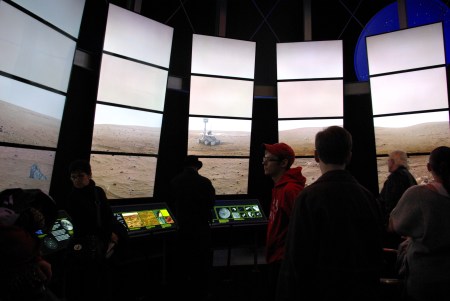
On 32 flat-panel video displays hooked together to make one massive display, visitors to the Perot Museum of Nature and Science view Mars as our new Mars Rover’s friend might see it, in a section of the museum devoted to astronomy, physics, astronomy and planetary exploration. Photo by Ed Darrell; use encouraged with attribution.

Still, kids today need this museum and the knowledge and excitement it imparts.  Last July I accompanied a group of Scouts from Troop 355 to summer camp in Colorado, to Camp Cris Dobbins in the foothills just east of Colorado Springs.  Near lights out one night I hiked the half-mile to our campsite admiring the Milky Way and other bright displays of stars that we simply do not get in light-polluted Dallas County.  I expected that our older Scouts would have already started on the Astronomy merit badge, but the younger ones may not have been introduced.  So I asked how many of them could find the Milky Way.  Not a hand went up.

“Dowse the lights, let’s have a five minute star lesson,” I said.  we trekked out to a slight opening in the trees, and started looking up.  I had just enough time to point out the milky fog of stars we see of our own galaxy, when one of the Scouts asked how to tell the difference between an airplane and a satellite.  Sure enough, he’d spotted a satellite quietly passing overhead — and just to put emphasis on the difference, a transcontinental jet passed over flying west towards Los Angeles or San Francisco.

Then, when we were all looking up, a meteoroid streaked from the south across almost the whole length of the visible Milky Way.  Teenaged kids don’t often go quiet all at once, but after the oohs and aahs we had a few moments of silence.  They were hooked already.  Less than five minutes in, they’d seen the Milky Way, found the Big Dipper, seen a satellite, a jet, and a shooting star.

Perfection!

Edwin Hubble’s discovery can now be the stuff of elementary school science, that the blobs in the sky astronomers had pondered for a century were really galaxies like our own, which we see only through a faint fuzz we call the Milky Way.

Do kids get that kind of stuff in elementary school?  Not enough, I fear.

We named a great telescope after the guy; shouldn’t we do a bit more to celebrate his discovery?

More: