Particle physics rap: Making the Large Hadron Collider sing

July 30, 2008

In the tradition of Richard Feynman’s ode to orange juice, but spiced with actual information: Tommaso Dorigo at A Quantum Diaries Survivor found a video on YouTube showing a rap about the Large Hadron Collider (LHC).

Katie McAlpine, on temporary assignment to CERN, put the rap and video together in her spare time. (CERN is the European Organization for Nuclear Research)

The video fills an educational need. It explains some of the work in high-energy particle physics going on there on the border between France and Switzerland.

Will it quiet the internet worries about whether the creation of tiny, disappearing black holes might accidentally lead to the end of the planet? Don’t bet on it.

This video could make a key part of a geography warm-up, noting research in the European Union. CERN’s premier position in nuclear particle research is due to the cancellation in 1993 of the Superconducting Super Collider, which was then under construction near Waxahatchie, Texas. A little bit of digging could produce a lesson plan on government funding of research, especially in nuclear physics, or on geography of such massive cyclotrons, or on the history of particle physics, black holes, or uses for atom splitting.

Other resources:


Uganda and malaria, from the inside

July 30, 2008

This is probably as close to we can come to know what’s going on inside Uganda, especially with regard to malaria and efforts to fight it there.  Go see Mars and Aesculapius, “World Malaria Day.

As you can see, simply pumping DDT into the countryside is unlikely to solve the problems.


Tricks to deal with dementia: Give them a clue – lie if necessary

July 29, 2008

If your family has not been touched by a member with Alzheimer’s Disease, senile dementia, or some other form of memory-killing disease, you’re in a lucky minority.

A good friend told how her brother-in-law eased the pain of her mother’s slide into dementia, with little lies. The mother developed an invisible friend who had to accompany her on most outings. The problem was that the invisible friend was also invisible to the mother. The brother-in-law, frustrated at the mother’s refusal leave her room for an outing because the friend was not apparent to accompany them, finally told the mother that the friend was already in the car. Mom happily scooted to the car and forgot about the friend completely by the time they got to the car.

The friend was “already there” for much of the rest of the mother’s life. It was a lie, a falsehood, but it made things so much easier.

CBS Evening News tonight featured a story on a potential new treatment for dementia. In one segment, a husband was quizzing his dementia-affected wife, and she could not recall what he had told her just a few minutes before, how many years they had been married. Frustrating for the victim as well as the family.

Vodpod videos no longer available.

more about “CBS report on Alzheimers“, posted with vodpod

A British psychologist, Oliver James, has a new book out that suggests such quizzes do more damage, and are unnecessary. Help the victim along with cues, he says. It’s a trick he got from his own mother-in-law, Penny Garner, from her experience working with her mother.

In Dorothy’s case, Garner found that while she [Dorothy] had no idea what she had done moments before, she automatically tried to make sense of her situation by matching it to past experiences. Dorothy had always enjoyed travelling, and so if she was asked to sit with other people for any length of time, she assumed she was in the Heathrow departure lounge. By not challenging this assumption, Garner found that her mother would sit peacefully for long periods. If she did wander off, Garner found she could encourage her to return by reminding her of her former skill as a bridge-player, telling her that the other players were waiting for her. “Given a properly set up bridge table, my mother would spend hours happily looking at her cards and waiting to play,” she says.

People with dementia are often exhausting to care for because they forget what they are doing during routine activities. Garner found that she could enable her mother to remain relatively independent by providing cues. “If while getting ready for bed, I noticed she had lost track of whether she was buttoning up the cardigan ready to go out or taking it off to go to bed, I would fiddle with my buttons alongside her and say ‘Oh good! No more travelling for us today! Glad we’ve got a bed for the night!’ I found that this simple cue was all she needed. Without it, she was inclined to get half-way through undressing and then start getting dressed again.”

We all look for such cues in everyday life, and we use them to remind us of what we are doing, where we are going, and why. Why not make it easier for victims of dementia?

Who is president of the United States? Half the time I’d prefer to forget it’s George W. Bush. Don’t quiz me on it. Ask me if it isn’t great that we’re electing someone to replace him, this fall.

Smart human tricks.

Resources:


Teach evolution at your peril

July 27, 2008

Untamed Teacher carries one more story about the dangers of trying to teach evolution to students who are not particularly interested, in a school where administrators don’t know much about science. Cynics will write it off as an inexperienced teacher in a difficult school — but that’s precisely where we need to be teaching the most serious material most often. (Tip of the old scrub brush to Education Notes Online.)

The Balloon Man notes a story in the Los Angeles Times about a much more experienced, and patient, teacher, whose lesson biology is heckled by religious students bent on disrupting the instruction.

How would Jesus heckle a teacher? Which parable covers being obnoxious?

Update: Open Parachute ponders whether the behaviors exhibited by the churchy adults in the news report below, constitute child abuse:

Can you imagine the reaction were a group of scientists to arrive at Ken Ham’s creation museum and lead a “science tour” of the place? Dollars to doughnuts Ham would come out looking a lot like Joe Stalin on the issue of allowing free discussion in his place.

Resource:  Why study evolution?  Read the benefits of such study in one of the permanent posts of this blog.


400 years of river history: NY celebrates Hudson, Champlain and Fulton in 2009

July 26, 2008

Okay, it’s the 202nd anniversary of Robert Fulton’s historic, 32-hour steamboat trip from New York City to Albany, demonstrating the viability of steamboat travel for commerce on the Hudson.  But for such a historic river, why not delay that fete for a couple of years and roll it into the 400th anniversary of Champlain’s exploration of the lake that now bears his name, and Henry Hudson’s discover of the mouth of the river to the south, the Hudson, whose mouth is home to New York City.

400 years of Hudson River history in 2009 - Hudson, Champlain, Fulton

400 years of Hudson River history in 2009 - Hudson, Champlain, Fulton

And so 2009 marks the Quadricentennial Celebration on the Hudson, honoring Hudson, Fulton and Champlain.

Alas, the committee to coordinate the celebration along the length of the river was not put in place until February, so there is a scramble.  Local celebrations will proceed, but the overall effort may fall short of the 1909 tricentennial, with replicas of Hudson’s ship, Half Moon, and Champlain’s boats, and Fulton’s steamer, and parades, and festivals, and . . .

Still, the history is notable, and the stories worth telling.

Most of my students in U.S. and world history over the past five years have been almost completely unaware of any of these stories.  One kid was familiar with the Sons of Champlin, the rock band of Bill Champlin, because his father played the old vinyl records.  Most students know nothing of the lore of Hudson, the mutiny and the old Dutch stories that have thunder caused by Hudson and his loyal crewman bowling in the clouds over the Catskills.  They don’t even know the story of Rip van Winkle, since it’s not in the Texas Essential Knowledge and Skills (TEKS) list and so gets left out of even elementary school curricula.  Is this an essential piece of culture that American children should know?  American adults won’t know it, if we don’t teach it.

Henry Hudson, from a woodcut

Henry Hudson, from a woodcut

Explorations and settlement of Quebec by Samuel de Champlain get overlooked in post-NCLB texts.  Texts tend to make mention of the French settlement of Canada, but placing these explorations in the larger frame of the drive to find a route through or around North America to get to China, or the often-bitter contests between French, English, Spanish, Dutch and other European explorers and settlers gets lost.  French-speaking Cajuns just show up in histories of Texas and the Southwest, with little acknowledgment given to the once-great French holdings in North America, nor the incredible migration of French from Acadia to Louisiana that gives the State of Louisiana such a distinctive culture today.

French explorer and settler Samuel de Champlain

French explorer and settler Samuel de Champlain

Champlain’s explorations and settlement set up the conflict between England and France that would result in the French and Indian War in the U.S., and would not play out completely until after the Louisiana Purchase and War of 1812.

Fulton’s steamboat success ushered in the age of the modern, non-sail powered navies, and also highlights the role geography plays in the development of technology. The Hudson River is ideally suited for navigation from its mouth, north to present-day Albany.  This is such a distance over essentially calm waters that sail would have been preferred, except that the winds on the Hudson were not so reliable as ocean winds.  Steam solved the problem.  Few other rivers in America would have offered such an opportunity for commercial development — so the Hudson River helped drive the age of steam.

New York City remains an economic powerhouse.  New York Harbor remains one of the most active trading areas in the world.  Robert Fulton helped propel New York ahead of Charleston, Baltimore and Boston — a role in New York history that earned him a place in for New York in the U.S. Capitol’s Statuary Hall.  The steamboat monopoly Fulton helped establish was a key player in Gibbons v. Ogden, the landmark Supreme Court case in which the Court held that Congress has the power to regulate commerce between states — an upholding of the Commerce Clause against the old structures created under colonial rule and the Articles of Confederation.

Robert Fultons statute in the U.S. Capitol - photo by Robert Lienhard

Robert Fulton's statute in the U.S. Capitol - photo by Robert Lienhard

400 years of history along the Hudson, a river of great prominence in world history.  History teachers should watch those festivities for new sources of information, new ideas for classroom exercises.

Resources:


Rachel Carson: Nice lady scientist, no mass murderer

July 26, 2008

Aaron Swartz has the summary.  Start with the introduction here, and see the full text with links here.

He goes easy on the hoaxers, those who cast stones at Ms. Carson, but you still get the idea if you read the article.


What if we’re wrong about global warming? Bob Park sez . . .

July 25, 2008

4. UNCOOL: LOT OF HEAT FROM GLOBAL-WARMING DENIERS.
Suppose, I asked myself, that the deniers are right and the CO2 thing is a mistake? What will happen if the world takes the CO2 thing seriously, adopting common sense measures to counter anthropogenic warming and there never was any warming in the first place? 1) there will more non-renewable resources to leave to our progeny; 2) we will breath cleaner air and see the stars again, the way we saw them half a century ago; 3) we could stop paving over the planet, and 4) cut down on the number of billionaires. If we’re wrong we could have a party. We could have a party either way.

Robert L. Park, What’s New, July 25, 2008

At Millard Fillmore’s Bathtub, see also: “Starbucks controversy: The Way I See It #289 (global warming)”


Real dope on human evolution

July 24, 2008

Subtitle this one, “DBQs in prehistory, paleontology, and anthropology.”

Younger son James complained yesterday about . . . well, about stuff he wasn’t taught. His questions to me were about what was available in the history textbooks on the great advances in science in the 20th century.

Very little is available, really. What had set him off was his summer reading where he’s been introduced, for the first time, to particle physics of the past 30 years. History texts may mention Einstein’s letter to FDR which started the Manhattan project. An outstanding history and science student in a U.S. high school can pass through the experience without ever learning what Einstein’s equation, E=mc², actually means, or how it pertains to his letter to Roosevelt, or when and how Einstein came up with it, how Einstein’s papers changed physics, how Einstein’s ideas were tested, how Einstein’s pacifism and Jewish heritage drove him to the U.S., and so on. Great advances in particle physics, or even in practical applications like CAT scans and PET scans, have fallen out of the books and out of the curriculum. 21st century medicine, but 20th century science texts and 19th century history texts. It’s the David-Bartonization of American education.

The stuff wasn’t covered in his AP physics or AP chemistry classes (what’s up with that?!), nor were most of the great discoveries even mentioned in any of the AP history courses.

No wonder the head of the Texas State Board of Education knows so little about science. Cue the country/western version of the story, “Been dumb as a stump so long it looks like genius to me.”** Plus, this makes it clear why the versions of curricula the SBOE head favors must be resisted.

Texas standards and national standards in history ask that students be familiar with American inventions and innovation. In reality that translates to Eli Whitney and the cotton engine, because it’s a key factor in the rise of plantation economics in the South prior to the Civil War; maybe some mention of water-powered looms; Edison and the light bulb; Ford and the assembly line; and maybe a mention of radio or television, usually with regard to the effects on culture. I know a teacher who has a great unit for Texas history on barbed wire and the Colt .45. World history mentions James Watt and the steam engine.* The Wright brothers and the airplane get a couple of sentences. Humans going to the Moon gets a few sentences, but not as much as Sputnik, because, well because Sputnik scared the bejeebers out of some of the people who yelled loudest at Texas and Florida textbook meetings, I imagine.

I’m not going to fix all of that, not right now. It’s a subject that deserves more time in the cooker, I think.

But I’m also working on plans for this next year. Pre-history human migrations, geological development of the planet — and last night I discovered a group hitting the Bathtub for information about humans and evolution. Sheesh! Another place where the history and science texts short the glorious science, where a student is more likely to be struck by lightning waiting for the bus than to get decent coverage of human evolution in the classroom. (Hey. Do you know a teacher who covers human evolution well in any subject? Put it in comments, below — I want to congratulate her, or him. I also want to steal the lesson plans.)

Here’s a quick fix, using some seminal documents that are perfectly classroom usable: Go to the Nature magazine website, and specifically look for the section, “focus on human origins.” If your administrators aren’t fully versed on No Child Left Behind, you can claim these as “research-based” (they are purely research-based; the law asks that our pedagogical methods be research-based, though, not the content, and that’s impossible; most of what we do in the classroom is tradition-based unsupported by any significant research, and federal laws and state regulations generally require the opposite of what the research says . . . don’t get me started). But I digress.

Nature is one of the premier science journals, a peer-reviewed or juried journal that is the prime place for key research findings to be published (along with Science, the other science journal giant). Most of their material is hidden away on the internet, held in proprietary sites available to scientists whose research institutions spring for expensive subscriptions (no, these journals are generally NOT available through the databases most high schools and non-research colleges purchase). Much of the best research of the last century is unavailable to high school teachers or students. This is true of chemistry, physics, biology and geology. The textbooks tend to obfuscate and cover the stuff up — or in the case of particle physics, ignore the field.

Several years ago Nature pulled about a dozen of the seminal papers in human evolution studies out of their vaults, making them available for free. These papers include some of the real classics:

Frankly, I wouldn’t expect to see these in a real DBQ in anything except, perhaps, human geography — but I can dream, can’t I? You can certainly create outstanding DBQ exercises with exerpts from these and a few other sources. Or you can simply use these complete papers in your classes. Except for a select few debate students at the upper echelons of competitiveness, real research papers fall out of the curriculum, and it’s a shame.

There is drama in these papers. Some of them shake the Earth, but in coolly scientific words. Ironically, the papers are not written so technically that they are beyond the ken of most high school readers. These papers are real history, real science, and our students deserve to read them.

Nature deserves our thanks for making these papers available. I wish other seminal papers were available, from Nature, and from other science and history research journals. Students would benefit from reading real history about the fall of the Berlin Wall, or the development of public health to fight tuberculosis. Students could mightily use to read about physics, biology, meteorology, geology, and other sciences upon which we rely to save the human race.

_____________________

* James Rowland of Woodlands High School in the Conroe Independent School District led a group of us teachers in an exercise last week at Texas Christian University in Fort Worth, asking the question about who invented the steam engine and when. With six different AP or advanced world history texts, we came up with eight different answers, including two different years given for Watt’s work.

** Yes, from Richard Fariña’s 1966 novel, Been Down So Long It Looks Like Up to Me (finished two days before his fatal motorcycle accident), and the song (pay no attention to the Lee Hazelwood-Nancy Sinatra song, but remember the Doors’s version is probably unsuitable for classroom use).

Resources:


Harrison Ford as Indiana Jones, for real

July 19, 2008

Don’t know how I missed this story earlier: Actor Harrison Ford won election to the Board of Directors of the Archaeological Institute of America (AIA).

In 1992, this hollow rock-crystal skull was sent to the Smithsonian anonymously. A letter accompanying the 30-pound, 10-inch-high artifact suggested it was of Aztec origin. (James Di Loreto & Donald Hurlburt/Courtesy Smithsonian Institution)

Caption from AIA's Archaeology: "In 1992, this hollow rock-crystal skull was sent to the Smithsonian anonymously. A letter accompanying the 30-pound, 10-inch-high artifact suggested it was of Aztec origin. (James Di Loreto & Donald Hurlburt/Courtesy Smithsonian Institution)"

He doesn’t just play one on the silver screen — he is one. Or at least, he’s part of the professional association. The press report from AIA stressed Ford’s support for archaeology and knowledge.

The Archaeological Institute of America is North America’s oldest and largest non-profit organization devoted to archaeology. With more nearly a quarter of a million members and subscribers and 105 local chapters, it promotes archaeological excavation, research, education, and preservation on a global basis. At the core of its mission is the belief that an understanding of the past enhances our shared sense of humanity and enriches our existence. As archaeological finds are a non-renewable resource, the AIA’s work benefits not only the current generation, but also those yet to come in the future.

“Harrison Ford has played a significant role in stimulating the public’s interest in archaeological exploration,” said Brian Rose, President of the AIA. “We are all delighted that he has agreed to join the AIA’s Governing Board.”

AIA was chartered by Congress in 1906 — a full decade before the Boy Scouts of America, for comparison — with a charge to help enforce the Antiquities Act (16 U.S.C. § 431).

More interesting, and more useful in the classroom, are the story and sidebar in the online magazine of the Institute, which notes that the crystal skull stories involve faked artifacts — and even that the idol in the opening scene of the very first Indy movie involves a faked artifact.

“Legend of the Crystal Skulls: The truth behind Indianapolis Jones’s latest quest” tells a great story by Jane MacLaren Walsh, a true story, the best kind for history buffs.

Sixteen years ago, a heavy package addressed to the nonexistent “Smithsonian Inst. Curator, MezoAmerican Museum, Washington, D.C.” was delivered to the National Museum of American History. It was accompanied by an unsigned letter stating: “This Aztec crystal skull, purported to be part of the Porfirio Díaz collection, was purchased in Mexico in 1960…. I am offering it to the Smithsonian without consideration.” Richard Ahlborn, then curator of the Hispanic-American collections, knew of my expertise in Mexican archaeology and called me to ask whether I knew anything about the object–an eerie, milky-white crystal skull considerably larger than a human head.

I told him I knew of a life-sized crystal skull on display at the British Museum, and had seen a smaller version the Smithsonian had once exhibited as a fake. After we spent a few minutes puzzling over the meaning and significance of this unusual artifact, he asked whether the department of anthropology would be interested in accepting it for the national collections. I said yes without hesitation. If the skull turned out to be a genuine pre-Columbian Mesoamerican artifact, such a rare object should definitely become part of the national collections.

I couldn’t have imagined then that this unsolicited donation would open an entirely new avenue of research for me.

Great story. In the classroom, it shows the methods of archaeologists and historians. Walsh reveals how archaeologists work, and along the way she details a lot of the history that prompts adventure stories like the Indiana Jones series.

Archaeology, the real stuff, never nukes the fridge.

File these links and this article away. The new movie in the “Mummy” series with Brendan Fraser in the starring role, is due out August 1, “The Mummy: Tomb of the Dragon Emperor.” The new movie is set on a dig in China, presenting more opportunities to use popular entertainment as an entré to real history, and real science (and probably all sorts of historical errors to correct).

But while the latest Indiana Jones epic reunites Jones with Marian Ravenwood played by Karen Allen, Rachel Weisz doesn’t appear in the pending Mummy installment. Weisz was replaced by another actress playing Evelyn O’Connell.


Powerline jumps on the chance to screw up

July 19, 2008

As long as there’s a dogpile of screw-ups, Powerline thought they’d jump on, regarding the hoaxes about a change in position on global warming at the American Physical Society.

If a lot of people screw up, where’s the shame? Right?

Powerline said, contrary to the facts:

Most people do not realize that the U.N.’s IPCC report was a political document, not a scientific one. As such, it explicitly refused to consider any of the recent scientific work on carbon dioxide and the earth’s climate. That work seems to show rather definitively that human activity has little to do with climate change, which has occurred constantly for millions of years.

Anyone who still had illusions that Powerline thinks about anything before they post it, or that they have any controls on accuracy or care for the facts, has had that illusion shattered. Of course, Powerline is a political organ, with not a whiff of science about it.

Give a fool enough rope . . .

Other resources:


Desperate climate change skeptics misread the news

July 18, 2008

Internet-fueled antagonists of global warming reports probably grow weary of the constant drizzle of reports and stories confirming the bare, consensus conclusion that rising temperatures, globally, are contributed to significantly by human-provided air pollution.

So, can you blame them when they trumpet that a major organization like the American Physical Society reverses its stand on global warming, and publishes a paper by a fellow usually considered a hoax and tinfoil hat favorite, Lord Monckton?

Well, yes, you can blame them. That’s not at all what happened. It turns out that a division of APS simply opened a discussion on global warming, and in doing that, they published Monckton’s piece for discussion.

With this issue of Physics & Society, we kick off a debate concerning one of the main conclusions of the International Panel on Climate Change (IPCC), the UN body which, together with Al Gore, recently won the Nobel Prize for its work concerning climate change research. There is a considerable presence within the scientific community of people who do not agree with the IPCC conclusion that anthropogenic CO2 emissions are very probably likely to be primarily responsible for the global warming that has occurred since the Industrial Revolution. Since the correctness or fallacy of that conclusion has immense implications for public policy and for the future of the biosphere, we thought it appropriate to present a debate within the pages of P&S concerning that conclusion. This editor (JJM) invited several people to contribute articles that were either pro or con. Christopher Monckton responded with this issue’s article that argues against the correctness of the IPCC conclusion, and a pair from Cal Poly San Luis Obispo, David Hafemeister and Peter Schwartz, responded with this issue’s article in favor of the IPCC conclusion. We, the editors of P&S, invite reasoned rebuttals from the authors as well as further contributions from the physics community. Please contact me (jjmarque@sbcglobal.net) if you wish to jump into this fray with comments or articles that are scientific in nature. However, we will not publish articles that are political or polemical in nature. Stick to the science! (JJM)

Newsbusters, a right-wing, tinfoil hat driver site announced this morning that APS has abandoned its long-time position on climate change. Anthony Watts couldn’t wait to talk about it as a major hole in the case for doing something to clean up air pollution.  “Myth of Consensus Explodes” Daily Tech breathlessly exclaimed.

By this afternoon, APS had warning labels up at their site to advise the unwary who might have been misled by the deniers:

The following article has not undergone any scientific peer review. Its conclusions are in disagreement with the overwhelming opinion of the world scientific community. The Council of the American Physical Society disagrees with this article’s conclusions.

Bob Parks, former APS spokescurmudgeon, wrote about it in his weekly news comment, What’s New:

1. GOOD LORD! GLOBAL WARMING DENIERS VANDALIZE APS.
Science is open. If better information becomes available scientists rewrite the textbooks with scarcely a backward glance. The Forum on Physics and Society of the APS exists to help us examine all the information on issues such as global climate change. There are physicists who think we don’t have warming right, I know one myself. It is therefore entirely appropriate for the Forum to conduct a debate on the pages of its newsletter. A couple of highly-respected physicists ably argued the warming side. Good start. However, on the denier’s side was Christopher Monckton, 3rd Viscount Monckton of Brenchley, who inherited his father’s peerage in 2006. Lord Monckton is not a scientist, his degree is in journalism and he’s a reporter for the Evening Standard, an English tabloid. Whatever it is that Viscounts do, he may do very well, but he doesn’t know squat about physics and his journalism suffers from it. Worse, somebody fed the media the line that Monckton’s rubbish meant the APS had changed its position on warming; of course it has not. Few media outlets took the story seriously.

How desperate are the anti-Gore-ites? They are desperate enough they’ll turn off their bovine excrement detectors, and claim Monckton’s goofy stuff is a new position for APS, without bothering to check the facts.

How long will this hoax survive on the internet?

Other resources:

  • APS Climate Change Statement
    APS Position Remains Unchanged

    The American Physical Society reaffirms the following position on climate change, adopted by its governing body, the APS Council, on November 18, 2007:

    “Emissions of greenhouse gases from human activities are changing the atmosphere in ways that affect the Earth’s climate.”

    An article at odds with this statement recently appeared in an online newsletter of the APS Forum on Physics and Society, one of 39 units of APS.  The header of this newsletter carries the statement that “Opinions expressed are those of the authors alone and do not necessarily reflect the views of the APS or of the Forum.”  This newsletter is not a journal of the APS and it is not peer reviewed.

  • Why Monckton is considered good for the tinfoil hat business
  • Tim Lambert on Monckton fantasies and deceptions before the U.S. Congress (for a very thorough vetting of Monckton, go to Lambert’s blog and do a search for “Monckton”)
  • A serious case against the conclusions of human causation for global warming, by Pat Frank, published in Skeptic’s online site, “A Climate of Belief.”  Dr. Frank is a careful and generally rigorous thinker, a physicist with no axes to grind against anyone involved, who has made a good case that we cannot conclude human causation; in discussions I’ve had with Dr. Frank, he’s limited his criticisms to the science.  I’m more of an effects guy myself — but this is the one article that keeps me hoping for more, better evidence (while we make plans to reduce emissions, of course — whether warming is human caused or not, we need cleaner air).

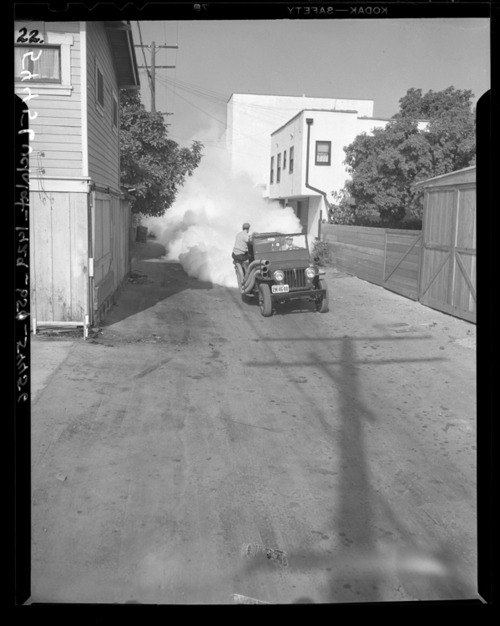
Wordless Wednesday: DDT, Santa Monica, 1940s

July 16, 2008

From This Isn’t Happiness: A photograph captioned only “Spraying DDT / Santa Monica, 1940s”:

Spraying DDT in Santa Monica, California, c. 1940s (UCLA; LA Times?)

Spraying DDT in Santa Monica, California, c. 1940s (UCLA; LA Times?)

See also, “5,700 Vintage Los Angeles Photos Now Online,” at MetBlogs.


News from Uganda? DDT, cotton, misreporting

July 13, 2008

In continuing efforts to slam environmentalists and Rachel Carson, Instapundit and RWDB complain (whine?) about the European Union’s efforts to block the importation of cotton from Uganda on fears of DDT contamination.

Meanwhile, back in Kampala, the news is that the EU has done the opposite, and is encouraging the use of DDT officially, not blocking its use at all. If DDT is used to fight malaria and not in uncontrolled agricultural use simply to keep products blemish-free, in carefully-controlled sprayings, EU has no complaints.

Is there any western news agency with a stringer in Kampala who could chase this story down? Beck and Reynolds still offer no evidence to back their odd claims, but the story could sure benefit from a solid chunk of reporting from BBC, or Reuters, or Agence France Presse, or someone who could talk with the EU and Uganda officials.

Other resources:

Full text of report, below the fold.

Read the rest of this entry »


Cicada Killers are back, 2008!

July 8, 2008

The Cicada Killers have returned!

Here’s a photo of our real, live version.

Cicada killers at Boisenberry Lane, Dallas

Cicada killers at Boisenberry Lane, Dallas

See last year’s post, here.


Thank God, and the Courts, for Charles Darwin

July 6, 2008

Rev. Michael Dowd has a book out, ThankGod for Evolution, and he wrote an op-ed in the Dallas Morning News on July 1 (as I understand it — wasn’t in Dallas that day).

I don’t vouch for the book — yet, at least. I’ve not read it. I find the study of science, and especially of evolution, offers no barrier to my faith, nor does my faith offer any barrier to my study of science. My faith, which requires an ethical life, offers barriers to creationism — a subject of other posts. But thank God for Charles Darwin? Sure. 

“Thank God for Charles Darwin.” T-shirt design from Redbubble


We also need to thank the federal courts, where the First Amendment is enforced, keeping unreasonable fables from diluting science education in public schools.

Which gets us to this: Chris Comer, the former science curriculum expert for the Texas Education Agency (TEA) who was fired for sending out an e-mail seen as supportive of evolution, is suing TEA, to get her job back (it’s illegal to fire public employees for bad religious reasons).

Watch that suit.

Rev. Dowd’s essay, courtesy of Sam Hodges and the Dallas Morning News Religion Blog, below the fold.

Read the rest of this entry »