DDT use plunged to just 10 nations in 2015; gone by 2020?

April 13, 2016

UN photo showing a mother and child protected from mosquito-borne disease by a bednet, the chief tool used in 2015 to prevent malaria transmission in endemic areas.

UN photo showing a mother and child protected from mosquito-borne disease by a bednet, the chief tool used in 2015 to prevent malaria transmission in endemic areas.

Just ten nations still used DDT in 2015, putting the planet on target to phase out all DDT use by 2020.

World Malaria Report 2015, published by the World Health Organization (WHO) in early December, notes those nations reporting that they use DDT in public health fights against disease. Under the Persistent Organic Pollutants Treaty, any nation may use DDT simply by notifying WHO.  Signatories of the treaty usually agree to stop all use of DDT once current use ends. Since 2003, most nations using it found DDT simply didn’t work well enough to continue use it to fight malaria or any other vector-borne diseases.

In the 2015 Report, Appendix 2A lists methods of vector control used in nations (“vector” being the fancy word for carrier of the disease, or mosquitoes in the case of malaria).  (See pages 234 to 237 of the .pdf.)

Nations in which DDT is used to fight malaria
World Malaria Report 2015 Appendix 2A

  1. Botswana
  2. Democratic Republic of the Congo
  3. Gambia
  4. Mozambique
  5. Namibia
  6. South Africa
  7. Swaziland
  8. Zambia
  9. Zimbabwe
  10. India

Ten nations total, nine in Africa, plus India.

Despite political calls to “bring back” DDT as a means of fighting mosquitoes that carry the Zika virus, no reports show any nation notified WHO it would do so. Most nations afflicted by Zika have been earlier afflicted by other diseases carried by the same species of mosquito, Aedes aegypti.  This species carries dengue fever, yellow fever and chikungunya, and perhaps others. Consequently, most of these nations have already tried DDT against the Zika carriers, and abandoned the projects when hoped-for results did not occur.

Every mosquito on Earth in 2016 carries at least a few of the alleles that make them resistant to, or even immune to DDT. DDT use also pushes mosquito populations to develop paths that make them quickly resistant to other pesticides. WHO guidelines urge public health officials never to use just one pesticide, but instead rotate among a dozen approved for vector use, in order to prevent the bugs from developing resistance. Resistance to pesticides remains one of the chief obstacles to eliminating disease, and a growing obstacle.

India is the world’s only known maker of DDT in 2015, and the heaviest user, using more of the pesticide than all other nations combined. Due to decreasing effectiveness of DDT as mosquito resistance to to it spreads and grows stronger, malaria has proliferated in India despite increased DDT application. In 2015, India announced to WHO it would suspend manufacture and use of DDT by 2020.

More:

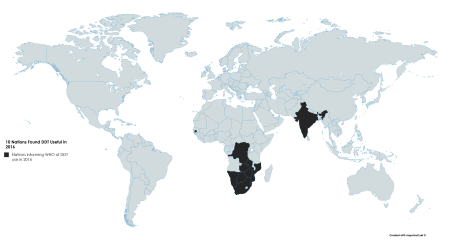
In black, the ten nations who used DDT in 2016, nine in Africa, and India. 43 nations used DDT in 2001. India pledges to stop manufacturing DDT by 2020. Map by Ed Darrell, using Mapchart.net

In black, the ten nations who used DDT in 2016, nine in Africa, and India. 43 nations used DDT in 2001. India pledges to stop manufacturing DDT by 2020. Map by Ed Darrell, using Mapchart.net

Save


March 14, 2016: π Day! A π roundup, mostly pie

March 14, 2016

Let’s rerun this one. Again.  I like the photographs. I may go search for a good piece of pie.

Of course you remembered that today is pi Day, right?

Pi Day Pie from Slashfood.com

Happy π Day! Pi Day Pie – Slashfood.com

Oh, or maybe better, π Day.

We’ll start with the brief post from a few months ago, and then build on it with some activities and posts from around the WordPress-o-sphere.

The good people at PiDay.org suggest a few ways you can celebrate:

Make (and Eat) a Pie – These pie recipes for Pi Day from NPR’s McCallister look incredibly tasty. But, there’s no shame in putting a frozen store-bought pie in the oven, or picking up a pie from your local bakery. Any kind of pie is great on Pi Day! If you’re making your own, get inspired by these beautifully designed Pi Day Pies. Tell us on Facebook: What’s your favorite kind of pie for Pi Day?

Hope your π Day is complete as a circle, and well-rounded!

How are others celebrating?  A look around WordPress:

At SocialMediaPhobe, a musical interpretation of pi featuring the music of Michael Blake:

So Long Freedom:

pidaypieToday is March 14th, also known as “Pi Day” for us math geeks out there because March 14th (3/14) is the first 3 digits of π (3.14159…).  To celebrate “Pi Day” I highly recommend doing something mathematical while having some pie at 1:59 pm.  I recommend Yumology‘s S’mores Pie as it has 3 main ingredients (chocolate, marshmallow, and graham cracker) and about 0.14159 other ingredients like sugar, butter, and stuff.  If you are not a math geek, its okay…you can still eat pie and count things like how many stop signs you pass on your way back to work from lunch.  Or you could go to the library and take out a book on something fun like binary code.  As we like to say, “There are only 10 types of people in the world:  Those that understand binary and those that don’t.”  Seriously, binary is as easy as 01000001, 01000010, 01000011.

Miles Free at PMPA Speaking of Precision:

Today 3-14 at 1:59 I will be celebrqting Pi Day. 3.14159 is the value of pi to 5 decimals...

So besides being  the cause of much techie “irrational” exuberance, Pi Day  is a great way to get some engagement with students.

Marymount High School has several activities, last year they had a design competition incorporating pi; the students then made and sold buttons of each design, proceeds going to the Red Cross.

Hmm- math subject matter, design, production, sales, accounting.

Sounds like what we do in manufacturing.
Maybe celebrating Pi Day is not so irrational as first thought.

Free said his pie is peach.

Steve Doyle at CraveDFW:

On March 12, 2009 your lawmakers  passed a non-binding resolution (HRES 224) recognizing March 14, 2009 as National Pi Day. It is one of the more legit holidays we discuss here, and it is actually an homage to geeks everywhere who see the date as a reason to celebrate due to its mathematical implications. We say any reason to celebrate anything is just fine by us.

Since we are predominately about food we will suggest a few places to actually enjoy a pie.

DSC06367

If you followed us at all this week you may have seen the pie at Bowl and Barrel pop up on our pages. This is the uber delicious Butterscotch Pie served as the solo dessert at the bowling alley and restaurant.  Go eat one of these.

He’s got more pi pie, if you click over there.

Gareth Branwyn at MakeZine offers more pie and a mnemonic:

How to Remember Pi to 15 Digits

Pi-Pie--69299

By way of sci-fi author and mathenaut Rudy Rucker’s Facebook wall comes this:

One way to remember the first few digits of pi is to count the letters in the words of this phrase:

“How I need a drink, alcoholic of course, after the heavy lectures involving quantum mechanics.”

[Image via FreakingNews]

Another song, on YouTube, at Awsomesauce:

b.love offers this clock image (is this clock for sale somewhere?):

A clock for pi day

TED Blog offers two videos:

Chirag Singh explains his “passion for pi.”

Daniel Tammet, “Different Ways of Knowing:

Geeks are really out in force today, flaunting pi for all they’ve got.

More:

Hey, students! Did any of your teachers do cool stuff for Pi Day? Tell us what, and who, in comments.

Yes, this is mostly an encore post. Fighting ignorance requires patience.

Yes, this is mostly an encore post. Fighting ignorance requires patience.


Happy birthday, Albert Einstein! 137 years, March 14

March 14, 2016

How many ways can we say happy birthday to a great scientist born on Pi Day?  So, an encore post.
E=mcc - logo from AIP

E=energy; m=mass; c=speed of light

Happy Einstein Day! to us.  Albert’s been dead since 1955 — sadly for us.  Our celebrations now are more for our own satisfaction and curiosity, and to honor the great man — he’s beyond caring.

Almost fitting that he was born on π Day, no? I mean, is there an E=mc² Day?

Albert Einstein was born on March 14, 1879, in Ulm, Germany, to Hermann and Pauline Einstein.

26 years later, three days after his birthday, he sent off the paper on the photo-electric effect; that paper would win him the Nobel Prize in Physics in 1921.

In that same year of 1905, he published three other papers, solving the mystery of Brownian motion, describing what became known as the Special Theory of Relativity and solving the mystery of why measurements of the light did not show any effects of motion as Maxwell had predicted, and a final paper that noted a particle emitting light energy loses mass. This final paper amused Einstein because it seemed so ludicrous in its logical extension that energy and matter are really the same stuff at some fundamental point, as expressed in the equation demonstrating an enormous amount of energy stored in atoms, E=mc².

Albert Einstein as a younger man - Nobel Foundation image

Albert Einstein as a younger man – Nobel Foundation image

Any one of the papers would have been a career-capper for any physicist. Einstein dashed them off in just a few months, forever changing the fields of physics. And, you noticed: Einstein did not win a Nobel for the Special Theory of Relativity, nor for E=mc². He won it for the photo electric effect. Irony in history.

106 years later Einstein’s work affects us every day. Relativity theory at some level I don’t understand makes possible the use Global Positioning Systems (GPS), which revolutionized navigation and mundane things like land surveying and microwave dish placement. Development of nuclear power both gives us hope for an energy-rich future, and gives us fear of nuclear war. Sometimes, even the hope of the energy rich future gives us fear, as we watch and hope nuclear engineers can control the piles in nuclear power plants damaged by earthquakes and tsunami in Japan.

English: Albert Einstein on a 1966 US stamp

Albert Einstein on a 1966 US stamp (Photo credit: Wikipedia)

If Albert Einstein was a genius at physics, he was more dedicated to pacifism. He resigned his German citizenship to avoid military conscription. His pacifism made the German Nazis nervous; Einstein fled Germany in the 1930s, eventually settling in the United States. In the U.S., he was persuaded by Leo Szilard to write to President Franklin Roosevelt to suggest the U.S. start a program to develop an atomic weapon, because Germany most certainly was doing exactly that. But while urging FDR to keep up with the Germans, Einstein refused to participate in the program himself, sticking to his pacifist views. Others could, and would, design and build atomic bombs. (Maybe it’s a virus among nuclear physicists — several of those working on the Manhattan Project were pacifists, and had great difficulty reconciling the idea that the weapon they worked on to beat Germany, was deployed on Japan, which did not have a nuclear weapons program.)

English: USSR stamp dedicated to Albert Einste...

Everybody wanted to claim, and honor Einstein; USSR issued this stamp dedicated to Albert Einstein Русский: Почтовая марка СССР, посвящённая Альберту Эйнштейну (Photo credit: Wikipedia)

Einstein was a not-great father, and probably not a terribly faithful husband at first — though he did think to give his first wife, in the divorce settlement, a share of a Nobel Prize should he win it. Einstein was a good violinist, a competent sailor, an incompetent dresser, and a great character. His sister suffered a paralyzing stroke. For many months Albert spent hours a day reading to her the newspapers and books of the day, convinced that though mute and appearing unconscious, she would benefit from hearing the words. He said he did not hold to orthodox religions, but could there be a greater show of faith in human spirit?

Einstein in 1950, five years before his death

Einstein in 1950, five years before his death

When people hear clever sayings, but forget to whom the bon mots should be attributed, Einstein is one of about five candidates to whom all sorts of things are attributed, though he never said them. (Others include Lincoln, Jefferson, Mark Twain and Will Rogers). Einstein is the only scientist in that group. So, for example, we can be quite sure Einstein never claimed that compound interest was the best idea of the 20th century. This phenomenon is symbolic of the high regard people have for the man, even though so few understand what his work was, or meant.

A most interesting man. A most important body of work. He deserves more study and regard than he gets.

More, Resources:


Pi Day countdown widget

March 4, 2016

You may add this countdown timer to your blog.

Pi Day Countdown

From PiDay.org.

FlippyCat offers a video on dominoes, to celebrate Pi Day.


Darwin and Lincoln and February 12: Cool coincidence or divine intervention?

February 12, 2016

Is it an unprecedented coincidence?  207 years ago today, just minutes (probably hours) apart according to unconfirmed accounts, Abraham Lincoln was born in a rude log cabin on Nolin Creek, in Kentucky, and Charles Darwin was born into a wealthy family at his family’s home  in Shrewsbury, England.

Gutzon Borglums 1908 bust of Abraham Lincoln in the Crypt of the U.S. Capitol - AOC photo

Gutzon Borglum’s 1908 bust of Abraham Lincoln in the Crypt of the U.S. Capitol – Architect of the Capitol photo

Lincoln would become one of our most endeared presidents, though endearment would come after his assassination.  Lincoln’s bust rides the crest of Mt. Rushmore (next to two slaveholders), with George Washington, the Father of His Country, Thomas Jefferson, the author of the Declaration of Independence, and Theodore Roosevelt, the man who made the modern presidency, and the only man ever to have won both a Congressional Medal of Honor and a Nobel Prize, the only president to have won the Medal of Honor. 

In his effort to keep the Union together, Lincoln freed the slaves of the states in rebellion during the civil war, becoming an icon to freedom and human rights for all history.  Upon his death the entire nation mourned; his funeral procession from Washington, D.C., to his tomb in Springfield, Illinois, stopped twelve times along the way for full funeral services.  Lying in state in the Illinois House of Representatives, beneath a two-times lifesize portrait of George Washington, a banner proclaimed, “Washington the Father, Lincoln the Savior.”

Charles Darwin statue, Natural History Museum, London - NHM photo

Charles Darwin statue, Natural History Museum, London – NHM photo

Darwin would become one of the greatest scientists of all time.  He would be credited with discovering the theory of evolution by natural and sexual selection.  His meticulous footnoting and careful observations formed the data for ground-breaking papers in geology (the creation of coral atolls), zoology (barnacles, and the expression of emotions in animals and man), botany (climbing vines and insectivorous plants), ecology (worms and leaf mould), and travel (the voyage of H.M.S. Beagle).  At his death he was honored with a state funeral, attended by the great scientists and statesmen of London in his day.  Hymns were specially written for the occasion.  Darwin is interred in Westminster Abbey near Sir Isaac Newton, England’s other great scientist, who knocked God out of the heavens.

Lincoln would be known as the man who saved the Union of the United States and set the standard for civil and human rights, vindicating the religious beliefs of many and challenging the beliefs of many more.  Darwin’s theory would become one of the greatest ideas of western civilization, changing forever all the sciences, and especially agriculture, animal husbandry, and the rest of biology, while also provoking crises in religious sects.

Lincoln, the politician known for freeing the slaves, also was the first U.S. president to formally consult with scientists, calling on the National Science Foundation (whose creation he oversaw) to advise his administration.  Darwin, the scientist, advocated that his family put the weight of its fortune behind the effort to abolish slavery in the British Empire.  Each held an interest in the other’s disciplines.

Both men were catapulted to fame in 1858. Lincoln’s notoriety came from a series of debates on the nation’s dealing with slavery, in his losing campaign against Stephen A. Douglas to represent Illinois in the U.S. Senate.  On the fame of that campaign, he won the nomination to the presidency of the fledgling Republican Party in 1860.  Darwin was spurred to publicly reveal his ideas about the power of natural and sexual selection as the force behind evolution, in a paper co-authored by Alfred Russel Wallace, presented to the Linnean Society in London on July 1, 1858.   On the strength of that paper, barely noticed at the time, Darwin published his most famous work, On the Origin of Species, in November 1859.

Darwin and Lincoln might have got along well, but they never met.

What unusual coincidences.

Go celebrate human rights, good science, and the stories about these men.

A school kid could do much worse than to study the history of these two great men.  We study them far too little, it seems to me.

Resources:

Charles Darwin:

Abraham Lincoln:

More:

Anybody know what hour of the day either of these men was born?

Yes, you may fly your flag today for Lincoln’s birthday, according to the Flag Code; the official holiday, Washington’s Birthday, is next Monday, February 15th — and yes, it’s usually called “Presidents Day” by merchants and calendar makers. You want to fly your flag for Charles Darwin? Darwin never set foot in North America, remained a loyal subject of Her Majesty, Queen Victoria, to the end of his days. But go ahead. Who would know?

Yes, this is mostly an encore post. Fighting ignorance requires patience.

Yes, this is mostly an encore post. Fighting ignorance requires patience.


Spark ignited a fire that became an environmental alarm, Silent Spring

February 3, 2016

The letter to the editor of the late Boston Herald that sparked Rachel Carson to write Silent Spring.

Oddly, the Tweet from American Scientist doesn’t link to the letter at all. Instead it links to a timeline of events regarding the magazine’s changing treatment of DDT as a subject, since 1944. It’s a useful timeline, but it leaves us wondering about that 1958 letter to the editor.

I’d like to have an original image, but have not found one.  Instead, I found a retyped copy of the text of the letter, looking as though it came from a 1958 typewriter.

Text of letter to the editor by birdwatcher Olga Owens Huckins, published in the Boston Herald on January 30, 1958. The letter sparked naturalist and author Rachel Carson to open a file on pesticides, which she eventually turned into Silent Spring. Image from Weebly

Text of letter to the editor by birdwatcher Olga Owens Huckins, published in the Boston Herald on January 30, 1958. The letter sparked naturalist and author Rachel Carson to open a file on pesticides, which she eventually turned into Silent Spring. Image from Weebly

Do you know where we might find an image of the original letter as published — preferably on the internet?

It also occurs to me that this could be a key piece for a short lesson on the value of citizen involvement, for a class in civics and government, or in a class for Boy Scouts or Girl Scouts on one of the citizenship merit badges.

Mrs. Huckins’s letter is a fine example of the citizen acorns from which grow the oaks of political drives for better communities, and a better world.

More:


Report that malaria and DDT hoaxsters hope you never see

January 21, 2016

 Cover of World Health Organization's "World Malaria Report 2015," which reported dramatic progress controlling malaria.

Cover of World Health Organization’s “World Malaria Report 2015,” which reported dramatic progress controlling malaria.

World Malaria Report 2015 dropped in mid-December, with United Nations-style fanfare.

Which means, you probably heard little to nothing about it in U.S. media, and “conservatives” and anti-science hoaxsters hope you won’t ever see it, so they can claim contrary to the facts that liberals kill kids in Africa.

My cynicism about the fight against malaria dissipates some, but my cynicism about hoaxes substituting for political dialogue grows.

World Health Organization (WHO) releases an annual report near the end of every year, detailing the fight against malaria and progress or lack of it.

Good news this year: WHO estimates deaths to malaria fell below 500,000 per year in 2015. That’s at least a 50% reduction since renewed vigor in the malaria fight in 2000, and it’s a 90% reduction from peak DDT use years, 1958-1963, when WHO estimated 5 million people died each year from malaria.

About 80% of malaria deaths take children under the age of 5.

Bigger picture: Malaria is on the run. Humans are winning the fight against malaria. Much remains to be done, however. Plus, malaria fighters warn that malaria can come roaring back, if governments neglect to follow through on promises of funding, and with well-run programs to cure humans of malaria and prevent new cases.

World Malaria Report 2015 should influence policy discussions in U.S. elections. But generally, this report was ignored.

Millard Fillmore’s Bathtub will feature in-depth discussions of parts of the report, and simple repetition for the record of the report, as part our long-term battle against hoaxsters who claim the U.S. ban on use of DDT on U.S. farms somehow increased malaria in Africa, and killed millions, when malaria actually decreased and millions were saved from death.

Malaria loses only with hard work on the ground by medical people treating and curing humans of the disease, and by public health people working hard to prevent new infections. Most of that work is not glorious, occurs relatively anonymously and away from television cameras and photographers with access to social media.  Which is to say, the hard work of defeating malaria goes unsung around the world. We should work to change that.

What did others say about World Malaria Report?

A collection of Tweets, and other links, for your study.

http://twitter.com/bbbrieger/status/674591008139681793

http://twitter.com/wardhealth/status/674610775646978048

http://twitter.com/News__World/status/674612996484808704

http://twitter.com/DTNIndia/status/684830093085032448


December 31, 2015: Bright Idea Day, anniversary of the Day the Lights Went On

December 31, 2015

Between Christmas and New Year’s Day, here at Millard Fillmore’s Bathtub we celebrate a variety of historically holy days.  December 31, by tradition, is Bright Idea Day, the anniversary of the day Thomas Edison demonstrated for the public a working light bulb, in 1879.

100,000 people gather in Times Square, New York City (surely not the 1 million predicted by NBC!) tonight, and millions more around the world, in festivities for the new year made possible by the work of Thomas Alva Edison.

Here it is, the invention that stole sleep from our grasp, made clubbing possible, and launched 50,000 cartoons about ideas:

The light bulb Thomas Edison demonstrated on December 31, 1879, at Menlo Park, New Jersey - Wikimedia image

The light bulb Thomas Edison demonstrated on December 31, 1879, at Menlo Park, New Jersey – Wikimedia image (GFDL)

The light bulb. It’s an incandescent bulb.

It wasn’t the first bulb. Edison a few months earlier devised a bulb that worked with a platinum filament. Platinum was too expensive for mass production, though — and Edison wanted mass production. So, with the cadre of great assistants at his Menlo Park laboratories, he struggled to find a good, inexpensive filament that would provide adequate life for the bulb. By late December 1879 they had settled on carbon filament.

Edison invited investors and the public to see the bulb demonstrated, on December 31, 1879.

Thomas Edison in 1878, the year before he demonstrated a workable electric light bulb. Library of Congress image

Thomas Edison in 1878, the year before he demonstrated a workable electric light bulb. CREDIT: Thomas Edison, head-and-shoulders portrait, facing left, 1880. Prints and Photographs Division, Library of Congress. Reproduction number LC-USZ62-98067

Edison’s successful bulb indicated changes in science, technology, invention, intellectual property and finance well beyond its use of electricity. For example:

  • Edison’s Menlo Park, New Jersey, offices and laboratory were financed with earlier successful inventions. It was a hive of inventive activity aimed to make practical inventions from advances in science. Edison was all about selling inventions and rights to manufacture devices. He always had an eye on the profit potential. His improvements on the telegraph would found his laboratory he thought, and he expected to sell the device to Western Union for $5,000 to $7,000. Instead of offering it to them at a price, however, he asked Western Union to bid on it. They bid $10,000, which Edison gratefully accepted, along with the lesson that he might do better letting the marketplace establish the price for his inventions. Other inventive labs followed Edison’s example, such as the famous Bell Labs, but few equalled his success, or had as much fun doing it.  (Economics teachers:  Need an example of the marketplace in action?)
  • While Edison had some financial weight to invest in the quest for a workable electric light, he also got financial support, $30,000 worth, from some of the finance giants of the day, including J. P. Morgan and the Vanderbilts who established the Edison Light Company.
  • Edison didn’t invent the light bulb — but his improvements on it made it commercial. “In addressing the question ‘Who invented the incandescent lamp?’ historians Robert Friedel and Paul Israel list 22 inventors of incandescent lamps prior to Joseph Wilson Swan and Thomas Edison. They conclude that Edison’s version was able to outstrip the others because of a combination of three factors: an effective incandescent material, a higher vacuum than others were able to achieve (by use of the Sprengel pump) and a high resistance lamp that made power distribution from a centralized source economically viable.”
  • Edison’s financial and business leadership acumen is partly attested to by the continuance of his organizations, today — General Electric, one of the world’s most successful companies over the past 40 years, traces its origins to Edison.

Look around yourself this evening, and you can find a score of ways that Edison’s invention and its descendants affect your life. One of the more musing effects is in cartooning, however. Today a glowing lightbulb is universally accepted as a nonverbal symbol for ideas and inventions. (See Mark Parisi’s series of lightbulb cartoons, “Off the Mark.”)

Even with modern, electricity-saving bulbs, the cartoon shorthand hangs on, as in this Mitra Farmand cartoon.

Fusilli has an idea, Mitra Farmand, Fuffernutter

Brilliant cartoon from Mitra Farmand, Fuffernutter (regrettably, we note this site is no longer there; but with some hope, we find a new site here)

Or see this wonderful animation, a video advertisement for United Airlines, by Joanna Quinn for Fallon — almost every frame has the symbolic lightbulb in it.

Electrification of America, and the consequent spread of electric lighting and electrical machines to make domestic and industrial life more productive, and the spread of great public works to enable these and other inventions to spread, were made possible by a people roughly united in advancing progress, what historians now call “the progressive agenda” and the great advances of the Progressive Era.

Could we get such agreement among workers, corporate bosses and many levels of government today? When we celebrate anniversaries, like the demonstration of the light bulb, we celebrate the united polity that made such things possible, too.

Other resources:

Patent drawing for Thomas Edison's successful electric lamp. Library of Congress

Thomas Edison’s electric lamp patent drawing and claim for the incandescent light bulb CREDIT: “New Jersey–The Wizard of Electricity–Thomas A. Edison’s System of Electric Illumination,” 1880. Prints and Photographs Division, Library of Congress. Reproduction Number LC-USZ62-97960.

Yeah, this is mostly an encore post. ‘Tis the season for tradition, especially good, wise tradition.

Even More, in 2012 and 2013:


December 30, 2015, Hubble Day! Look to the stars for our future

December 30, 2015

[Today is actually the day!  You may fly your flag if you choose.  This is the traditional Millard Fillmore’s Bathtub Hubble Day post.]

Lift a glass of champagne today in tribute to Edwin Hubble and his great discovery. Not sure what to call it — Hubble Day, Looking Up Day, Endless Possibilities Day — whatever, this is the anniversary of Edwin Hubble’s announcement that he had discovered the universe is much, much larger than anyone had imagined, containing far more stars than anyone had dared guess.

It’s a big universe out there.

Ultraviolet image of the Andromeda Galaxy. Wired caption: Photo: Edwin Hubble’s 1920s observations of Andromeda (whose ultraviolet spectrum is rendered here) expanded our notions of the size and nature of a universe that is itself expanding. Galaxy Evolution Explorer image courtesy NASA.

Ultraviolet image of the Andromeda Galaxy. Wired caption: “Photo: Edwin Hubble’s 1920s observations of Andromeda (whose ultraviolet spectrum is rendered here) expanded our notions of the size and nature of a universe that is itself expanding. Galaxy Evolution Explorer image courtesy NASA.”

So, today is a good day to celebrate the universe in all it’s glory – December 30.

On December 30, 1924, Edwin Hubble announced he’d discovered other galaxies in distant space. Though it may not have been so clear at the time, it meant that, as a galaxy, we are not alone in the universe (whether we are alone as intelligent life is a separate question). It also meant that the universe is much, much bigger than most people had dared to imagine.

91 years ago today.

I keep trying to get people to celebrate.

In 2008 for Hubble Day, Wired picked up on the story (with a gracious link to 2007’s post here at the Bathtub). Wired includes several links to even more information, a good source of information. See Wired’s 2009 post here.

Hubble was the guy who showed us the universe is not only bigger than we imagined, it’s probably much bigger and much more fantastic than we can imagine. (See J. B. S. Haldane’s “queerer” quote.) Hubble is the guy who opened our imaginations to the vastness of all creation.

Hubble’s work would have been impossible without the earlier work of one of the great, unsung women of science, Henrietta Leavitt, as Wired explained:

He trained the powerful new 100-inch telescope at Mount Wilson in Southern California on spiral nebulae. These fuzzy patches of light in the sky were generally thought to be clouds of gas or dust within our galaxy, which was presumed to include everything in the universe except the Magellanic Clouds. Some nebulae seemed to contain a few stars, but nothing like the multitudes of the Milky Way.

Hubble not only found a number of stars in Andromeda, he found Cepheid variable stars. These stars vary from bright to dim, and a very smart Harvard computationist named Henrietta Leavitt had discovered in 1912 that you could measure distance with them. Given the brightness of the star and its period — the length of time it takes to go from bright to dim and back again — you could determine how far away it is.

Hubble used Leavitt’s formula to calculate that Andromeda was approximately 860,000 light years away. That’s more than eight times the distance to the farthest stars in the Milky Way. This conclusively proved that the nebulae are separate star systems and that our galaxy is not the universe.

How does one celebrate Hubble Day? Here are some suggestions:

  • Easier than Christmas cards: Send a thank-you note to your junior high school science teacher, or whoever it was who inspired your interest in science. Mrs. Hedburg, Mrs. Andrews, Elizabeth K. Driggs, Herbert Gilbert, Mr. Willis, and Stephen McNeal, thank you.
  • Rearrange your Christmas/Hanukkah/Eid/KWANZAA lights in the shape of the Andromeda Galaxy — or in the shape of any of the great photos from the Hubble Telescope (Andromeda Galaxy pictured above; Hubble images here)

    A few of the images from the Hubble Telescope

    A few of the images from the Hubble Telescope

  • Go visit your local science museum; take your kids along – borrow somebody else’s kids if you have to (take them along, too); this year, in Dallas, you can visit the Perot Museum of Nature and Science — it’s a doozy
  • Spend two hours in your local library, just looking through the books on astronomy and the universe
  • Write a letter to your senators and congressman; tell them space exploration takes a minuscule portion of our federal budget, but it makes us dream big; tell them we need to dream big, and so they’d better make sure NASA is funded well.  While you’re at it, put in a plug for funding Big Bird and the rest of public broadcasting, too.  Science education in this nation more and more becomes the science shows on NPR and PBS, watched by kids who learned to read and think by watching Big Bird.
  • Anybody got a good recipe for a cocktail called “The Hubble?” “The Andromeda?” Put it in the comments, please.  “The Hubble” should have bubbles in it, don’t you think?  What was it the good monk said?  He was working to make great wine, but goofed somewhere, and charged the wine with another dose of yeast.  When he uncorked the very first bottle of what would come to be called champagne, Benedictine Monk Dom Pierre Perignon said “I am drinking stars!”  Except, he said it in French.  In any case, a Hubble cocktail should have bubbles, some of Perignon’s stars.

The encore post, from 2007:

December 30, 1924, Edwin Hubble announced the results of his observations of distant objects in space.

PBS

Edwin Hubble

In 1924, he announced the discovery of a Cepheid, or variable star, in the Andromeda Nebulae. Since the work of Henrietta Leavitt had made it possible to calculate the distance to Cepheids, he calculated that this Cepheid was much further away than anyone had thought and that therefore the nebulae was not a gaseous cloud inside our galaxy, like so many nebulae, but in fact, a galaxy of stars just like the Milky Way. Only much further away. Until now, people believed that the only thing existing outside the Milky Way were the Magellanic Clouds. The Universe was much bigger than had been previously presumed.

Later Hubble noted that the universe demonstrates a “red-shift phenomenon.” The universe is expanding. This led to the idea of an initial expansion event, and the theory eventually known as Big Bang.

Hubble’s life offered several surprises, and firsts:

Hubble was a tall, elegant, athletic, man who at age 30 had an undergraduate degree in astronomy and mathematics, a legal degree as a Rhodes scholar, followed by a PhD in astronomy. He was an attorney in Kentucky (joined its bar in 1913), and had served in WWI, rising to the rank of major. He was bored with law and decided to go back to his studies in astronomy.

In 1919 he began to work at Mt. Wilson Observatory in California, where he would work for the rest of his life. . . .
Hubble wanted to classify the galaxies according to their content, distance, shape, and brightness patterns, and in his observations he made another momentous discovery: By observing redshifts in the light wavelengths emitted by the galaxies, he saw that galaxies were moving away from each other at a rate constant to the distance between them (Hubble’s Law). The further away they were, the faster they receded. This led to the calculation of the point where the expansion began, and confirmation of the big bang theory. Hubble calculated it to be about 2 billion years ago, but more recent estimates have revised that to 20 billion years ago.

An active anti-fascist, Hubble wanted to joined the armed forces again during World War II, but was convinced he could contribute more as a scientist on the homefront. When the 200-inch telescope was completed on Mt. Palomar, Hubble was given the honor of first use. He died in 1953.

“Equipped with his five senses, man explores the universe around him and calls the adventure Science.”

That news on December 30, 1924, didn’t make the first page of the New York Times. The Times carried a small note on February 25, 1925, that Hubble won a $1,000 prize from the American Academy for the Advancement of Science.

(Does anyone have a suitable citation for that video? Where did it come from? Who produced it? Is there more somewhere?)

Happy Hubble Day! Look up!

Resources:

Hubble Space Telescope - NASA image

Hubble Space Telescope, working homage to Edwin Hubble – NASA image

Even More Resources:

Andromeda as we can see it today. Wikimedia image: The Andromeda Galaxy is a spiral galaxy approximately 2.5 million light-years away in the constellation Andromeda. The image also shows Messier Objects 32 and 110, as well as NGC 206 (a bright star cloud in the Andromeda Galaxy) and the star Nu Andromedae. This image was taken using a hydrogen-alpha filter.

Andromeda as we can see it today. Wikimedia image: The Andromeda Galaxy is a spiral galaxy approximately 2.5 million light-years away in the constellation Andromeda. The image also shows Messier Objects 32 and 110, as well as NGC 206 (a bright star cloud in the Andromeda Galaxy) and the star Nu Andromedae. This image was taken using a hydrogen-alpha filter.

Yes, this is mostly an encore post. Fighting ignorance requires patience.

Yes, this is mostly an encore post. Fighting ignorance requires patience.


December 30 is Hubble Day; are you ready to celebrate?

December 29, 2015

Get ready to look up!

Edwin Hubble.

Edwin Hubble. (Photo credit: snaphappygeek)

At Millard Fillmore’s Bathtub, for several years we’ve celebrated Hubble Day on December 30.

On December 30, 1924, Edwin Hubble announced he’d discovered other galaxies in distant space. Though it may not have been so clear at the time, it meant that, as a galaxy, we are not alone in the universe (whether we are alone as intelligent life is a separate question). It also meant that the universe is much, much bigger than most people had dared to imagine.

December 30, 2015 is the 91st anniversary of the announcement.  When dealing with general science illiteracy, it’s difficult to believe we’ve been so well informed for more than nine decades.  In some quarters, news travels more slowly than sound in the vacuum of space.

I find hope in many places.  Just three years ago the Perot Museum of Nature and Science opened in downtown Dallas.  It’s the old Dallas Museum of Science and Natural History, once cramped into a bursting building in historic Fair Park, now expanded into a beautiful new building downtown, and keeping the Fair Park building, too.  Considering the strength of creationism in Texas, it’s great news that private parties would put up $185 million for a museum dedicated to hard science.

Displays in the Perot border on brilliance at almost every stop.  Stuffy museum this is not — it’s designed to spark interest in science and engineering in kids, and I judge that it succeeds, though we need to wait 20 years or so to see just exactly what and who it inspires.

We visited the Perot regularly through 2014.  On one visit in 2012, as I was admiring a large map of the Moon, a family strolled by, and a little girl I estimated to be 8 or 9 pointed to the Moon and asked her maybe-30-something father where humans landed.  I had been working to see whether the very large photo showed any signs of activity — but the father didn’t hesitate, and pointed to the Sea of Tranquility.  “There,” he said.  The man was not old enough to have been alive at the time; I’d wager most of my contemporaries would hesitate, and maybe have to look it up.  Not that guy.

Visitors to the Perot Museum of Nature and Science, Dallas

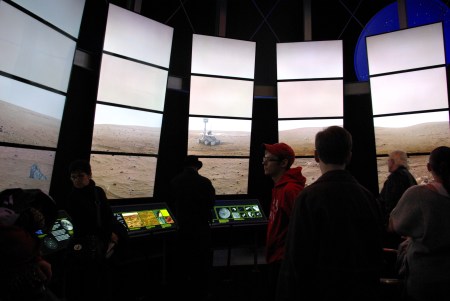
On 32 flat-panel video displays hooked together to make one massive display, visitors to the Perot Museum of Nature and Science view Mars as our new Mars Rover’s friend might see it, in a section of the museum devoted to astronomy, physics, astronomy and planetary exploration. Photo by Ed Darrell; use encouraged with attribution.

Still, kids today need this museum and the knowledge and excitement it imparts.  One recent July I accompanied a group of Scouts from Troop 355 to summer camp in Colorado, to Camp Chris Dobbins in the foothills just east of Colorado Springs.  Near lights out one night I hiked the half-mile to our campsite admiring the Milky Way and other bright displays of stars that we simply do not get in light-polluted Dallas County.  I expected that our older Scouts would have already started on the Astronomy merit badge, but the younger ones may not have been introduced.  So I asked how many of them could find the Milky Way.  Not a hand went up.

“Dowse the lights, let’s have a five minute star lesson,” I said.  we trekked out to a slight opening in the trees, and started looking up.  I had just enough time to point out the milky fog of stars we see of our own galaxy, when one of the Scouts asked how to tell the difference between an airplane and a satellite.  Sure enough, he’d spotted a satellite quietly passing overhead — and just to put emphasis on the difference, a transcontinental jet passed over flying west towards Los Angeles or San Francisco.

Then, when we were all looking up, a meteoroid streaked from the south across almost the whole length of the visible Milky Way.  Teenage kids don’t often go quiet all at once, but after the oohs and aahs we had a few moments of silence.  They were hooked already.  Less than five minutes in, they’d seen the Milky Way, found the Big Dipper, seen a satellite, a jet, and a shooting star.

Perfection!

Edwin Hubble’s discovery can now be the stuff of elementary school science, that the blobs in the sky astronomers had pondered for a century were really galaxies like our own, which we see only through a faint fuzz we call the Milky Way.

Do kids get that kind of stuff in elementary school?  Not enough, I fear.

We named a great telescope after the guy; shouldn’t we do a bit more to celebrate his discovery?

More:

Yes, this is mostly an encore post. Fighting ignorance requires patience.

Yes, this is mostly an encore post. Fighting ignorance requires patience.


What is global warming? Great explanation, in 3 minutes

December 24, 2015

Katharine Hayhoe, climate scientist, image from NOVA's "Secret Life of Scientists"

Katharine Hayhoe, climate scientist, image from NOVA’s “Secret Life of Scientists”

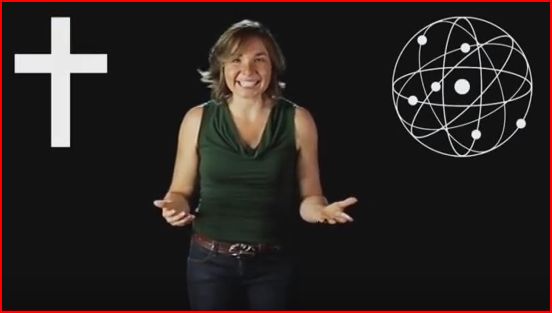
Katharine Hayhoe, the evangelical Christian who studies climate change, explained global warming at Facebook, in an Earth video she made with Lazy Chief:


Beauty in nature: Stingray x-ray

December 13, 2015

A stunning photograph, with much to think about.  It wandered around the internet a couple of years ago, and it’s good enough, it’s going around again.

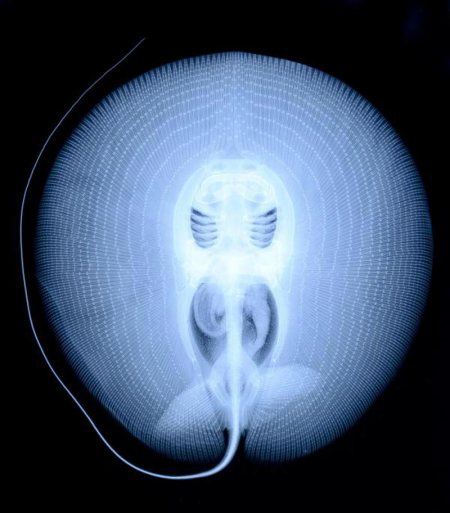
It’s an x-ray of a stingray. Consider what Charles Darwin might have thought about such an image. It’s a species discovered only in the last decade, imaged by a means of photography not known to be possible until more than a decade after Darwin’s death. What would he make of the discovery of a species, and the ability to see inside the thing, showing the cartilaginous skeleton (compare with the rays’ cousins, the sharks), and showing the organs Darwin knew would be there if evolution was, in fact, accurate.

21st century science brings such beauty:

x-ray-of-a-stingray

Caption from TwistedSifter: “The photograph above is an x-ray of a freshwater stingray species discovered in 2011 in the Amazon rain forest. The discovery was made by the research team of Nathan Lovejoy, a biologist at the University of Toronto in Scarborough; and Marcelo Rodrigues de Carvalho of the University of Sao Paolo in Brazil. The new species is known as Heliotrygon gomesi. Besides the pancake-like appearance, the ray is big, with slits on its belly and a tiny spine on its tail.” Photo by Ken Jones.

More:


Why not a price on carbon, a tax with cap-and-trade capabilities?

October 29, 2015

Tax on air pollutants with a cap-and-trade process worked wonders cleaning up acid rain in the U.S.  Is there any rational reason to oppose such a plan, in the U.S. or anywhere else, to help clean up carbon air pollution to slow or stop global warming?

Germany’s Chancellor Angela Merkel issued a call for a carbon pricing system. Who will listen?

It’s a feature story from World Bank, who seems to have figured out that global warming poses great threats to commerce and growing the world’s economies.

Heads of State, City, Regional and Business Leaders Unite to Call for Price on Carbon

October 19, 2015

For the first time Heads of State, city and provincial leaders have come together with the support of leading companies to urge countries and companies around the world to put a price on carbon pollution.

For the first time Heads of State, city and provincial leaders have come together with the support of leading companies to urge countries and companies around the world to put a price on carbon pollution.


STORY HIGHLIGHTS
  • Carbon pricing is a key building block to tackle climate change and drive investment in a low carbon future.
  • Launched today, the Carbon Pricing Panel is an unprecedented alliance of Global Leaders united to put a price on carbon pollution.
  • The number of implemented or scheduled carbon pricing instruments has nearly doubled since 2012, reaching an aggregate market value of about $50 billion.

What can be done to reduce greenhouse gas emissions, protect our environment, and help support people most vulnerable to climate change?

The answer is simple: A key element for any strategy to tackle climate change must be to put a price on carbon pollution. The transition to a cleaner future requires government action and the right incentives. Carbon pricing is a key building block to help cut pollution and drive investment in a low carbon future.

It’s a point recognized by leaders from Europe, across to Africa and Asia, who have today – for the first time – come together with the support of leading private companies to urge countries and businesses around the world to put a price on carbon.

Convened by World Bank Group President Jim Yong Kim and the International Monetary Fund’s Managing Director Christine Lagarde, the high-level Carbon Pricing Panel is calling on their peers to follow their lead and put a price on carbon. They are joined in this effort by OECD Secretary General Angel Gurria.

The call by the leaders comes on the first day of the last round of negotiations ahead of the Paris climate talks in December. The leaders aim to seize the momentum generated by the Paris talks to spur further, faster action towards carbon pricing, as a necessary path to a low carbon, productive, competitive economy of the future.

Members of the Carbon Pricing Panel include German Chancellor Angela Merkel, Chilean President Michelle Bachelet, French President François Hollande, Ethiopian Prime Minister Hailemariam Desalegn, Philippines President Benigno Aquino III, Mexican President Enrique Peña Nieto, Governor Jerry Brown of California, and Mayor Eduardo Paes of Rio de Janeiro.

Private sector support is spearheaded by Anne Stausboll, CEO of US Institutional Investor CalPERS, Gérard Mestrallet, CEO of ENGIE of France, Anand Mahindra, Chairman and Managing Director of Mahindra Group of India, and Feike Sijbesma, Chairman and CEO of Netherlands-based Royal DSM.


” There has never been a global movement to put a price on carbon at this level and with this degree of unison. It marks a turning point from the debate on the economic systems needed for low carbon growth to the implementation of policies and pricing mechanisms to deliver jobs, clean growth and prosperity. The science is clear, the economics compelling and we now see political leadership emerging to take green investment to scale at a speed commensurate with the climate challenge. “

ImageJim Yong Kim
World Bank Group President

Summary map of existing, emerging and potential regional, national and sub-national carbon pricing instruments (ETS and tax)

Summary map of existing, emerging and potential regional, national and sub-national carbon pricing instruments (ETS and tax)


Around the world, about 40 nations and 23 cities, states and regions have implemented or are putting a price on carbon with programs and mechanisms covering about 12 percent of global greenhouse gas emissions.

The number of implemented or scheduled carbon pricing instruments has nearly doubled since 2012, reaching an aggregate market value of about $50 billion.

And already more than 400 businesses around the world are using a voluntary, internal price on carbon as part of their investment strategies, with prices ranging from US$4 to over US$100 per ton of CO2. This is a tripling in the number of companies compared with last year reporting that they price their emissions.

Carbon pricing delivers a triple dividend.

Firstly, it is good for the environment and it reduces emissions – lowering social costs of health impacts on people, as well as tackling the global warming.  A price on carbon can help alleviate health and environmental problems like premature deaths from exposure to outdoor air pollution. According to the World health Organization, an estimated 3.7 million people die prematurely from outdoor air pollution.

Secondly, carbon pricing is an essential part of getting prices right for the move to a low carbon more resilient growth. It raises revenue efficiently, making it possible to reduce more distortionary taxes, and it allows for targeted support for clean energy solutions rather than harmful subsidies that do little for poor people or the environment.

And thirdly, it drives innovation and critically needed investments in low-carbon solutions, boosting private sector investment in clean tech research and development, and offering the prospect of job creation in the sectors of the future.

Why is is it important to act now on carbon pricing? Because strong public policy gives the private sector the certainty and predictability to make the necessary long-term investments in climate-smart development and prevent catastrophic impacts from climate change. Carbon pricing is the cornerstone of a package of policy measures designed to achieve emission reductions at lowest cost.

Today, countries and regions are learning from one another and creating a set of successful approaches to pricing carbon. Some early lessons are described in the World Bank Group publication The FASTER Principles for Successful Carbon Pricing – which lays out principles for effective, efficient and fair pricing of carbon.

Some examples include:

  • The Canadian province of British Columbia was an early mover on carbon pricing, with the creation of a carbon tax in 2008, with the tax used to cut income taxes and fund tax credits. Also, British Columbia is home to a growing clean technology sector, with more than 150 firms in 2013, accounting for 22% of Canada’s clean tech presence in a province with only 12% of Canada’s GDP. Several experts attribute this growth to the carbon tax.
  • California, Quebec and the European Union allocate a portion of their emissions trading scheme (ETS) auction revenues to designated green technology funds and innovation, to support sectors affected directly or indirectly by higher carbon costs.
  • In Chile, the government has passed legislation on a carbon tax – effective as of 2017 – as part of a much larger tax reform package with the explicit aim of providing additional resources for education and other social protection programs.
  • In Northeastern United States, the Regional Greenhouse Gas Initiative is expected to save people money on energy bills. The RGGI states have invested over $1 billion from ETS proceeds in energy-efficiency program, which are expected to return more than $2.3 billion in lifetime energy bills savings to 1.2 million participating households. Also, from 2008-2012, RGGI invested more than $130 million to help energy and electricity customers in need.

The high level panel provides political momentum to complement the voices of government and industry leaders in the Carbon Pricing Leadership Coalition (CPLC), a working coalition that is being formed on the back of support for carbon pricing from 74 countries and 1,000 companies, at the 20014 UN summit on climate change.

Putting a price on carbon can be done in many ways: using an emissions trading system (ETS), like the one in Europe, or introducing carbon taxes and fees, like in Sweden and Norway. Most importantly, the “polluter pays” principle applies – those who are responsible for the pollution face the cost of it.


September 23, 1858: DON’T wash your hands!

September 23, 2015

Ignaz Semmelweiss

Dr. Ignaz Semmelweis

This is one of the classic stories of public health, an issue that most U.S. history and world history texts tend to ignore, to the detriment of the students and the classroom outcomes.

This is the story as retold by Christopher Cerf and Victor Navasky in The Experts Speak:

In the 1850s a Hungarian doctor and professor of obstetrics named Ignaz Semmelweis [pictured at left] ordered his interns at the Viennese Lying-in Hospital to wash their hands after performing autopsies and before examining new mothers. The death rate plummeted from 22 out of 200 to 2 out of 200, prompting the following reception from one of Europe’s most respected medical practitioners:

“It may be that it [Semmelweis’ procedure] does contain a few good principles, but its scrupulous application has presented such difficulties that it would be necessary, in Paris for instance, to place in quarantine the personnel of a hospital during the great part of a year, and that, moreover, to obtain results that remain entirely problematical.”

Dr. Charles Dubois (Parisian obstetrician), memo to the French Academy
September 23, 1858

Semmelweiss’ superiors shared Dubois’ opinion; when the Hungarian physician insisted on defending his theories, they forced him to resign his post on the faculty.

Gotta wonder what Dr. Dubois would make of the suits and sanitation procedures required today for health professionals who treat Ebola victims.

More: 

Yes, this is mostly an encore post. Fighting ignorance requires patience.

Yes, this is mostly an encore post. Fighting ignorance requires patience.


Milky Way over Argentina observatory

September 22, 2015

From NASA’s Astronomy Picture of the Day:

Milky Way over Bosque Alegre Station in Argentina Image Credit & Copyright: Sebastián D' Alessandro. To see the picture in its unadorned glory without the explanatory overlay, click on the image to get to NASA's APOD site.

Milky Way over Bosque Alegre Station in Argentina Image Credit & Copyright: Sebastián D’ Alessandro. To see the picture in its unadorned glory without the explanatory overlay, click on the image to get to NASA’s APOD site.

Stars in the Southern Hemisphere differ a lot from what we see in the North, most famously with the Southern Cross (Crux, in the image above).

Glorious anyway; more glory to go around.

If you click over to the APOD site, you can also see this photo without the overlay, which is another whole world of wonderfulness.

APOD said:

Explanation: What are those streaks of light in the sky? First and foremost, the arching structure is the central band of our Milky Way galaxy. Visible in this galactic band are millions of distant stars mixed with numerous lanes of dark dust. Harder to discern is a nearly vertical beam of light rising from the horizon, just to the right of the image center. This beam is zodiacal light, sunlight scattered by dust in our Solar System that may be surprisingly prominent just after sunset or just before sunrise. In the foreground are several telescopes of the Bosque Alegre Astrophysical Station of the National University of Cordoba in Argentina. The station schedules weekend tours and conducts research into the nature of many astronomical objects including comets, active galaxies, and clusters of galaxies. The featured image was taken early this month.