One of our more adventurous teachers spent the summer on a Fulbright-Hays program in Senegal, in West Africa.
No, that's not William Adkins. That's his lunch one day in Senegal.
William Adkins’ African adventure blog is here. Mine it for stuff you can use in economics, art, world history, world geography, or anything else. He’ll probably give you free reign to use the photos for classroom presentations.
What did you do on your summer vacation?
Spread the word; friends don't allow friends to repeat history.
Just as a reminder about what we’re doing in education, I hope every teacher and administrator will take three minutes and view this video (that allows you some time to boggle).
Surely you know who Tom Peters is. (If not, please confess in comments, and I’ll endeavor to guide you to the information you need.)
“This country doesn’t value teachers, and that upsets me,” she said. “Teachers don’t earn much, and this country worships making money. In China, teachers don’t earn a lot either, but it’s a very honorable career.”
Ms. Zheng said she spent time clearing up misconceptions about China.
“I want students to know that Chinese people are not crazy,” she said. For instance, one of her students, referring to China’s one-child-per-family population planning policy, asked whether the authorities would kill one of the babies if a Chinese couple were to have twins.
Some students were astonished to learn that Chinese people used cellphones, she said. Others thought Hong Kong was the capital.
Barry Beauchamp, the Lawton superintendent, said he was thrilled to have Ms. Zheng and two other Chinese instructors working in the district. But he said he believed that the guest teachers were learning the most from the cultural exchange.
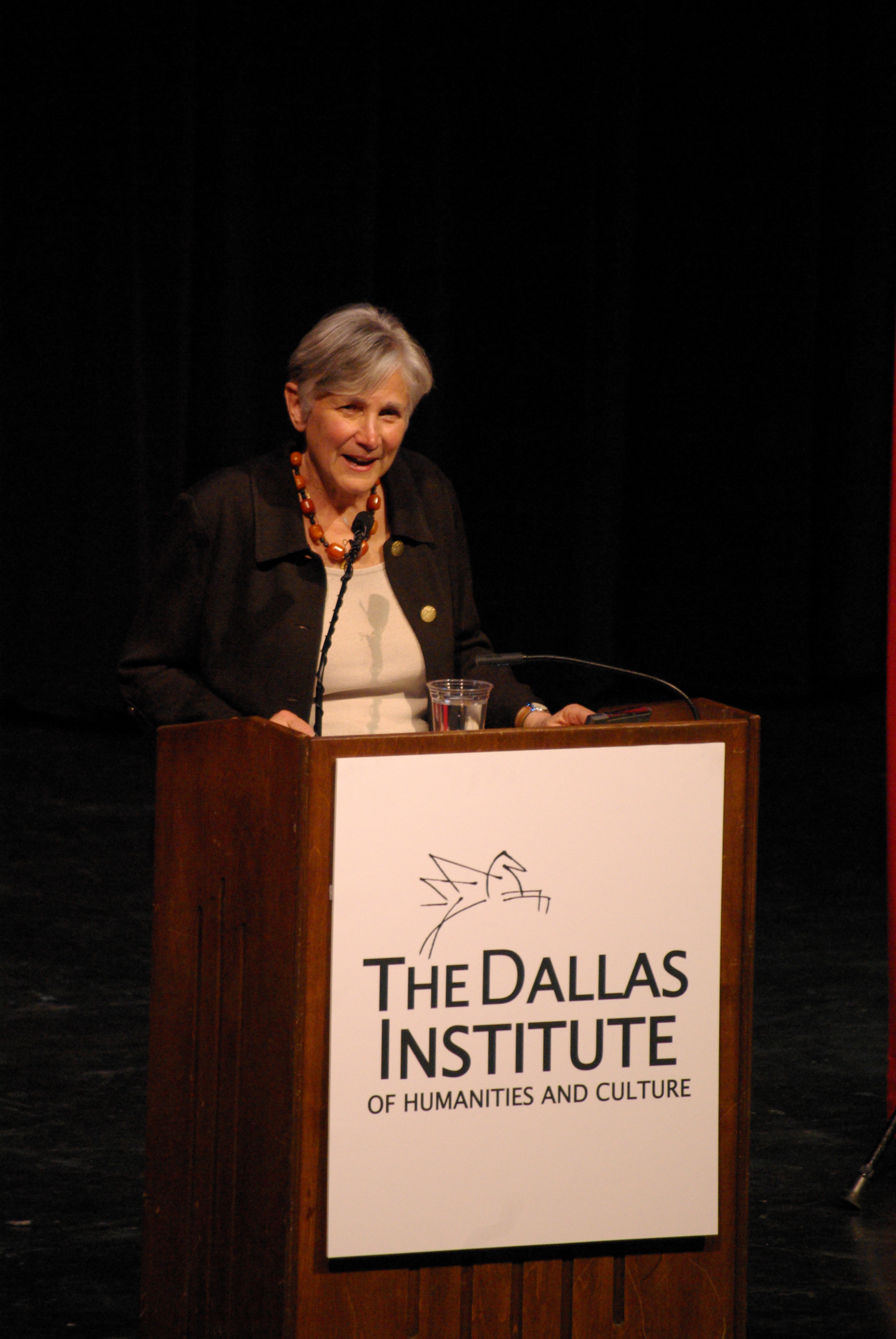
I first met Ravitch a couple of decades ago when I worked for Checker Finn at the Office of Educational Research and Improvement. Ted Bell’s idea of a commission to look at education quality, and it’s 1983 report, saved the Reagan administration and assured Reagan’s reelection in 1984. She was one of the most prodigious and serious thinkers behind education reform efforts, then a close friend of Finn (who was Assistant Secretary of Education for Research) — a position that Ravitch herself held in the administration of George H. W. Bush.
Ravitch now criticizes the end result of all that turmoil and hard work, the No Child Left Behind Act, and the way it has distorted education to keep us in the crisis we were warned of in 1983. Then, the “rising tide of mediocrity” came in part because we didn’t have a good way to compare student achievement, state to state. Today, the mediocrity is driven by the tests that resulted from legislative efforts to solve the problem.
Conditions in education in America have changed. We still have a crisis after 27 years of education reform (how long do we have a crisis before it becomes the norm), but for the first time, Ravitch said, “There is a real question about whether public education will survive.” The past consensus on the value of public education and need for public schools, as I would put it, now is challenged by people who want to kill it.
“The new issue today: Will we have a public education system bound by law to accept all children.”
Ironic, no? The No Child Left Behind Act has instead created a system where many children could be forced to the rear.
I took an evening in the middle of a week of TAKS testing — the Texas Assessment of Knowledge and Skills. With ninth through twelfth grades, we had four days of testing which essentially requires the shutdown of the education for the week (we had Monday to review for the test). It was a week to reflect on just how far we have strayed from the good intentions of public education advocates who pushed the Excellence in Education Commission’s report in 1983.
Ravitch spoke for over an hour. I’ll have more to report as I get caught up, after a month of meetings, test prep, testing, and little sleep.
I am forever grateful for that nameless White female, who, in her clunky shoes and calf-length tweed skirts, passed out poems on mimeograph paper to her first-grade students. When talking to students myself, I often tell the story of the very prim and ebony Mrs. Covington who challenged her junior high school English class to memorize “Invictus” before telling us who had authored the poem.
Words to teach by. “Invictus?” You know it, even if you don’t think you do.
Out of the night that covers me,
Black as the pit from pole to pole,
I thank whatever gods may be
For my unconquerable soul.
In the fell clutch of circumstance
I have not winced nor cried aloud.
Under the bludgeonings of chance
My head is bloody, but unbowed.
Beyond this place of wrath and tears
Looms but the Horror of the shade,
And yet the menace of the years
Finds and shall find me unafraid.
It matters not how strait the gate,
How charged with punishments the scroll,
I am the master of my fate:
I am the captain of my soul.
At the age of 12, Henley became a victim of tuberculosis of the bone. A few years later, the disease progressed to his foot, and physicians announced that the only way to save his life was to amputate directly below the knee. It was amputated at the age of 25. In 1867, he successfully passed the Oxford local examination as a senior student. In 1875, he wrote the “Invictus” poem from a hospital bed. Despite his disability, he survived with one foot intact and led an active life until his death at the age of 53.
Angst over the state of education never goes away:
Much more important is the way we seem to have turned away from the very idea of education that sustains a healthy, vibrant liberal democracy. As I write this I am conscious of how unfashionable it sounds. However, there has been a steady erosion of the notion that education can and should fuel our individual ability to think critically about the world as we find it – which requires knowledge and understanding of how the world has come to be. We are swamped with a language of targets, skills and 21st century ‘learning to learn’, but have forgotten what it is that distinguishes learning (a word that now seems to carry huge weight and always deemed a good thing in itself, when clearly it is not) from education. All worthwhile education is, in the end self-education, based on the student’s curiosity, their need to know and readiness to rise to the challenge of finding out. Indeed, offering challenge to young people is one way to motivate them – so different from today’s orthodoxy which says we should make learning accessible, bite-sized and achievable by all.
I used to love math tests. And math homework. When I knew the stuff, I’d start hearing Bach in my head and get into a rhythm of solving the problems (though I didn’t know it was Bach until much later — “Aha! That’s the math solving music!”).
But eventually my brain ossified, before I got calculus into it. I believe (this is belief, not science) that at some point rather early in life our brains lose the ability to pick up new math ideas. If you don’t have most of the stuff you need already in there, you won’t get it. I frittered my math ability away in the library and traveling with the debate squad, not knowing that I’d never be able to get it back. In my dual degree program, I ran into that wall where I had five years worth of credits, but was still a year away from the biology degree with a tiny handful of core courses for which calculus was a prerequisite. Worse, I was close to completing a third major.
And I’d failed at calculus four times.
So I graduated instead, didn’t go to grad school in biology.
Earlier this last evening I sat with a couple of new teachers in math at a parents’ night function for seniors. They commiserated over trying to make math relevant for students. One said he couldn’t figure out how history teachers survive at all with no mass of problems to solve at the end of each chapter (that was refreshing).
Students need to feel inspired, particularly when it comes to a difficult subject. While I was at the Kavli Institute for Theoretical Physics last year as journalist in residence, I got to know UC-Santa Barbara mathematician Bisi Agboola, who generously shared his own story with me. Bisi was educated in the UK and failed most of his math classes through their equivalent of high school. “I found it dull, confusing and difficult.” As a child, he was determined to find a career where he wouldn’t need any math, finally announcing to his skeptical parents that he would be a woodcutter. He was crushed when they pointed out that he would need to measure the wood.
But one summer he encountered a Time-Life book on mathematics –- Mathematics by David Bergamini -– that offered “an account of the history of some of the main ideas of mathematics, from the Babylonians up until the 1960s, and it captured my imagination and made the subject come alive to me for the very first time.” It changed his mind about this seemingly dry subject. He realized there was beauty in it. He wound up teaching himself calculus, and told me he is convinced most physicists also do this. Today he is a PhD mathematician specializing in number theory, and exotic multidimensional topologies. Ironically, he still doesn’t much like basic arithmetic: “I find it boring.”
Jennifer is writing a book on calculus, how it’s real-life stuff. I hope it’s a great success. I hope it works. I hope some student is inspired to get calculus before her or his brain gets ossified.
Mathematics in daily life: “Waxing eloquently on the basic importance of Mathematics in human life, Roger Bacon (1214-1294), an English Franciscan friar, philosopher, scientist and scholar of the 13th century, once stated: ‘Neglect of mathematics works injury to all knowledge, since he who is ignorant of it cannot know the other sciences or the things of the world.’ And the ingenuity of his statement is there before us to see, in this Internet era.”
Not really, but it feels similar. Starting Monday I’ll be leaving seventh grade US History for the high school and Civics, Free Enterprise and World Geography.
I like the parish in which I teach. My principal, not so much. While she’s a micromanager and extremely disorganized, I’m very independent and CDO (that’s OCD in alphabetical order, like it should be). As a teacher, my only request from administrators is to be left the heck alone. I have the best test scores in the school, I have no discipline problems, I’m never absent, the students like me and their parents like me. With those credentials, I figured any sensible principal would be more than happy to leave me be and go worry about stuff that actually needs attention. Not so at my school. I actually had a written reprimand placed in my personnel file because I abbreviated the days of the week on my lesson plans. That’s just one example.
It’s a good read, about why a good teacher would abandon students and leave his principal in a fix, mid-year.
WASHINGTON – The Aldine Independent School District (AISD) outside Houston won the 2009 Broad Prize for Urban Education, the largest education award in the country, and as a result will receive $1 million in college scholarships, The Eli and Edythe Broad Foundation announced today. Aldine, where four out of five students qualify for free and reduced-priced school lunch, has shown some of the most consistent student achievement gains nationally in the last decade and has been recognized as one of the top five most improved urban American school systems in four of the last six years.
U.S. Secretary of Education Arne Duncan joined philanthropist Eli Broad and members of Congress on Capitol Hill in Washington, D.C. to announce the winner. Aldine ISD was selected by a bipartisan jury of eight prominent American leaders from government, education, business and civic sectors, including three former U.S. secretaries of education.
The $2 million Broad (rhymes with “road”) Prize is an annual award that honors the five large urban school districts that demonstrate the strongest student achievement and improvement while narrowing achievement gaps between income and ethnic groups. The money goes directly to graduating high school seniors for college scholarships.
“Aldine shows us that it’s possible for a district facing tough circumstances to get excellent results,” said Secretary Arne Duncan, who opened up the envelope and announced the winner. “We need to highlight the success of Aldine and districts like it so that others can follow their examples and lift up all students.”
As the winner of The Broad Prize, the Aldine Independent School District will receive $1 million in college scholarships for graduating seniors next spring. The four finalists—Broward County Public Schools in southern Florida; Gwinnett County Public Schools outside Atlanta; the Long Beach Unified School District in California; and the Socorro Independent School District in Texas—will each receive $250,000 in college scholarships. Long Beach won the 2003 Broad Prize, and this marked the third year that the former winner returned as a finalist. Broward is a two-time finalist for the award, while this was Gwinnett’s and Socorro’s first year in the running.
How does that sit with us in Dallas? Gossip at the Dallas Morning News blog, DallasISD:
I don’t know if you all have noticed but talk of DISD winning the Broad Prize for Urban Education by 2010 is nearly non-existent. Superintendent Michael Hinojosa used to always refer to the district’s goal to obtain the award, and he gave himself five years to do it shortly after his arrival in 2005. DISD has obviously made academic gains, but not much is uttered anymore about the “Road to Broad,” the district’s nickname for the roadmap to its reform effort.
Which is to say in other words, Dallas is concentrating on getting performance up, while cleaning up a few nasty administrative messes. On the teacher level, the work towards excellence doesn’t change much whether Dallas administrators talk about the Broad Prize or not.
Congratulations to Aldine. Teachers there worked their butts off.
Can anyone find any correlation between Aldine’s winning the award and anything Texas has done as a state? Did performance pay help out in any way? Have poor science standards and the assault on social studies standards helped, or hurt Aldine’s performance?
Aldine parent Carlos Deleon, who has had three children educated in the district, attributed its success to “the community, the parent involvement and, of course, most important, the good teachers.”
“When I hear they’re awarded more scholarships,” Deleon said of the students, “wow, that’s great. These kids work so hard.”
Good teachers constantly search for good ideas and effective ways to make learning fun, efficient and thorough. So the search for new material and new ideas is constant.
Same on the web. Where are the good blogs? Where are the useful blogs? (Many days readers here ask those questions repeatedly.)
It’s a great math blog, a great teachers’ blog — and I love the Running Guy with Briefcase in the header.
Plus, at least once a year I get to spring Zeno’s Paradox on some unsuspecting young student who makes some silly claim about the superiority of logic to evidence. And then I send the student packing to Halfway There for serious understanding. (Anyone who knows there are more than one size of infinity must be a fan of George Gamow, I figure.)
Or, until that account is unsuspended by the forces supporting Donald Trump: Follow @FillmoreWhite, the account of the Millard Fillmore White House Library
We've been soaking in the Bathtub for several months, long enough that some of the links we've used have gone to the Great Internet in the Sky.
If you find a dead link, please leave a comment to that post, and tell us what link has expired.
Thanks!
Retired teacher of law, economics, history, AP government, psychology and science. Former speechwriter, press guy and legislative aide in U.S. Senate. Former Department of Education. Former airline real estate, telecom towers, Big 6 (that old!) consultant. Lab and field research in air pollution control.
My blog, Millard Fillmore's Bathtub, is a continuing experiment to test how to use blogs to improve and speed up learning processes for students, perhaps by making some of the courses actually interesting. It is a blog for teachers, to see if we can use blogs. It is for people interested in social studies and social studies education, to see if we can learn to get it right. It's a blog for science fans, to promote good science and good science policy. It's a blog for people interested in good government and how to achieve it.
BS in Mass Communication, University of Utah
Graduate study in Rhetoric and Speech Communication, University of Arizona
JD from the National Law Center, George Washington University


 Posted by Ed Darrell




 Millard Fillmore's Bathtub