News flash: Dallas 5th graders not ready for college? How about middle school?

October 23, 2009

It’s not so much of a “Duh!” moment as you might think.

Studies by the Dallas Independent School District indicate that about half of all Dallas fifth grades students are not on the development arc they need to be on to be ready for college upon graduation seven years later.  Half of fifth graders are not even ready for middle school.

As Dallas schools focus on getting all students ready for college, they face a daunting challenge uncovered by a new district tracking system: Almost half of fifth-graders are not even ready for middle school.

Roughly 52 percent of the fifth-graders were considered “on track for middle school” at the end of their elementary years in 2008-09, according to a Dallas Morning News analysis of data recently released by the school district.

That seriously impinges on my ability to teach them what they need to know when I get them.

Here’s the newspaper article from the Dallas Morning News.  Here’s school-by-school data.

I predict DISD will take hits for “failing” instead of getting plaudits for finding a root source of a much bigger problem that manifests later.  Stay tuned.

Add to FacebookAdd to NewsvineAdd to DiggAdd to Del.icio.usAdd to StumbleuponAdd to RedditAdd to BlinklistAdd to TwitterAdd to TechnoratiAdd to Furl


Texas State Dinosaur an affront to creationists

October 22, 2009

Texas has a new State Dinosaur.

Scientists are working to make a good model of the beast for the Fort Worth Museum of Science and History, as reported in the October 6 Fort Worth Star-Telegram (often referred to locally as the “Startle-gram,” but still one of America’s good-to-great newspapers).  David Casstevens reported:

The official state dinosaur would look big even inside Cowboys Stadium.

The creature stood 15 feet tall at the shoulders.

Sixty feet long, head to tail, it weighed 20 tons or more.

Sadly, despite being native to Texas, the species lived and died without ever tasting brisket.

“It was a herbivore,” paleontologist Dale Winkler said.

The quadrupedal sauropod — sort of a giant prehistoric giraffe — was the state’s first vegetarian.

Winkler, an SMU professor, stood with several other men around a workbench inside a building west of Azle, arms folded, their eyes studiously fixed on a rare and wondrous object, the skull that once contained the very small brain of Paluxysaurus jonesi.

They are members of a team that is meticulously reconstructing the dinosaur’s framework.

An articulated skeleton of the beast, which roamed this part of the country more than 100 million years ago, will become the centerpiece of DinoLabs, a dinosaur exhibit at the new $80 million Fort Worth Museum of Science and History, which opens Nov. 20.

Texas is the ample belly of the nation’s Bible Belt, don’t you know.  Creationists could not let such science endeavors proceed without their version of a blessing, provided in this case by a letter to the editor by a local guy named Richard Hollerman:

Unwarranted assumptions

David Casstevens’ Oct. 6 story tells of work to restore a dinosaur, Paluxysaurus jonesi, that will soon have its place in the Fort Worth Museum of Science and History. (See: “Dinosaur skeleton to lead exhibit”)

Thousands of professing Christians, including scientists with advanced degrees, deny basic elements of his account and views held by unbelieving paleontologists. (1) Consistent Christians believe God created dinosaurs relatively recently — about 6,000 years ago — whereas skeptical scientists assert they lived 100 million years ago. (2) Christians contend that dinosaurs were created as dinosaurs instead of evolving from prehistoric life that spontaneously sprang from nonlife 3 billion years ago. (3) Consistent Christians believe that dinosaurs became extinct after the worldwide Noaic flood 4,500 years ago.

We totally reject the unfounded assertion that this dinosaur “roamed this part of the country more than 100 million years ago” — as the reporter asserts. The discerning reader can verify this by consulting the Institute for Creation Research ( www.icr.org), Answers in Genesis ( www.answersingenesis.org), Apologetics Press ( www.apologeticspress.org) and others showing the fallacy of the evolution model and reasonableness of recent creation, along with the creation and extinction of dinosaurs.

I encourage the Star-Telegram to report these findings in a way that harmonizes with established facts instead of blindly accepting unfounded assertions by unbelieving paleontologists.

— Richard Hollerman, Richland Hills

You should be impressed that so many other local residents have differing views.  The newspaper published several letters in response to Hollerman, on October 17:

Good science vs. non-science

After reading Richard Hollerman’s Oct. 14 letter, “Unwarranted assumptions,” I gather that he believes that only atheist scientists think that dinosaur fossils are millions of years old.

That is incorrect. The vast majority of scientists, regardless of religious beliefs, think that the evidence is overwhelming that dinosaur fossils are millions of years old. If he needs some examples of scientists who are Christian, specifically evangelical Christians, I would point out Mary Schweitzer, Keith Miller, Francis Collins, Richard G. Colling and Stephen J. Godfrey, who are biologists and paleontologists and are also evangelical Christians. Were it not for space limitations I could list thousands more.

This is not about belief vs. disbelief. It is about good science vs. non-science.

— Bill Robinson, Arlington

Hollerman and “thousands of professing Christians” have declared that their religious beliefs trump science, and they have a constitutional right to their notions. On top of that, they also have their churches, family units, private schools, home schooling, colleges that teach pseudo-science and the amazing Creation Museums in which Noah built a third tier on the “ark” to keep dinosaurs at a respectful distance. Fine.

Those of us who do not share the beliefs of “thousands” ask only that you use the aforementioned resources to educate your young, accustom yourselves to the thought of life in a Third World country and leave the rest of us alone!

— Jackie Bell, River Oaks

According to creationists, science is correct about the following:

Chemistry, computer science, mathematics, engineering, sociology, systems science, psychology, medicine, nuclear science, agronomy, astronomy, nanotechnology, acoustics, biophysics, condensed matter physics, electronics, fluid dynamics, geophysics, plasma physics, vehicle dynamics, solar astronomy, meteorology, limnology, soil science, toxicology, marine biology, parasitology, anatomy, biochemistry, structural biology, entomology, cetology, phylogeny, algebra, calculus, cartography, geopolitics, criminology, agriculture, language engineering, pathology, pediatrics, nutrition, physical therapy and dermatology.

But for some reason, according to creationists, science is wrong about evolution. How is that even possible?

— Mark Stevens, Fort Worth

Millions of professing Christians, including intelligent people from all religions and all walks of life, view the basic elements of paleontology as reasonable and logical. (1) Bones found in the different layers of soil show a chronological time line extending much further than 6,000 years ago. (2) Evolution is an observable, rational concept that is ongoing even in today’s “educated” world. (3) Claims that dinosaurs became extinct in a worldwide flood 4,500 years ago are laughable.

Uneducated Christians contend that dinosaurs became extinct in the Noaic flood, yet if you read the Bible it says Noah took two of every animal into the ark to preserve the different species. Did he overlook dinosaurs? Were they deemed unfit to survive by God?

Being raised as a Southern Baptist, I was taught that God guided evolution to fit His plan. Even the most devout Christians in my church had enough intelligence to see the facts that were right before their eyes. I encourage Star-Telegram readers to open their minds and their eyes to prevent the corruption of future generations and find a way to harmonize their beliefs with established facts instead of blindly accepting unfounded fantasies from uneducated Christians.

— Terry Brennan, Haltom City

I sat in total amazement after reading Hollerman’s letter disagreeing with the history of the Paluxysaurusjonesi. To cite Genesis as a historical reference is almost laughable, except for the fact that there are people who honestly believe the Adam and Eve story of creation. To believe that humans lived in this form, only with less clothing, millions of years ago is incredulous to say the least.

I give thanks that there is a science that disproves these myths. Why can’t these folks see the divine spirit in the creation and evolution of life forms on our planet, rather than actually believing what is in the Bible literally? I find it exciting that there are higher forms of being, and that new knowledge is being revealed every moment of every day.

— Betsy Stell, Arlington

I don’t know whom Hollerman was referring to in his letter when he wrote about “Consistent Christians.” I guess he means “fundamentalists” since they’re the only ones who believe in Bronze Age myths rather than modern science. Or perhaps he means people who believe the pseudo-science in the silly, anti-evolution Christian fundamentalist Web sites he cited.

The truth, of course, is that every scientific discipline from archeology to zoology contributes to the vast body of knowledge and huge amount of evidence supporting evolution. Thanks, Star-Telegram, for publishing facts and not allegorical stories written by Middle Eastern tribesmen thousands of years ago.

— Terry McDonald, Grapevine

I was impressed by the Star-Telegram’s reporting on the restoration of the fossil Paluxysaurus jonesi by the Fort Worth Museum of Science and History. The article gave the facts and some feel-good information about the people involved in the reconstruction of the dino fossil.

However, Hollerman’s letter would be a joke if it weren’t for the fact that so many people really do think that the Earth is only 6,000 years old and will deny the fact that the Earth is about 4.5 billion years old. It has been proven by scientific method.

Creationists have a distorted view because the one book that they use (written 2,000 years ago by primitives) disagrees with the science that proves the existence of natural history. The age of this fossil is not unfounded but rests on the work of many thousands of scientists over a couple of hundred years in scores of different scientific disciples. The scientific method that is used to vet new and existing research is a crucible that is used to sort facts from fallacy and has been used to debunk fake, false and misleading science for a couple of hundred years.

We would still be living in caves without the scientific and technological advances that we enjoy today. I applaud the Star-Telegram for its fair and unbiased science reporting. Keep it up.

— Charlie Rodriguez, Arlington

Meanwhile, e-mails between members of Texas Citizens for Science chase another interesting facet:  Where in Texas is there enough Jurassic rock to support such a find?

Oh, those scientists!

More information:

Tip of the old scrub brush to Annette Carlisle, a member of Texas Citizens for Science.

Cast away a note in a bottle, in the Paluxy River:


Add to FacebookAdd to NewsvineAdd to DiggAdd to Del.icio.usAdd to StumbleuponAdd to RedditAdd to BlinklistAdd to TwitterAdd to TechnoratiAdd to Furl


Chess games of the rich and famous: Willie Nelson

October 11, 2009

Willie Nelson playing chess on the band bus - Texas School of Music Collection

Willie Nelson playing chess on the band bus - Texas School of Music Collection

Did Willie ever play Ray Charles in chess?  Did anyone get a photo of the game?


Whales and evolution: Gingerich at SMU, this afternoon

October 7, 2009

From an SMU press release:

Evolution Expert Philip D. Gingerich to Speak at SMU on Oct. 7

Philip D. Gingerich, a leading expert in the evolution of primates and whales, will speak at 5 p.m. Wednesday, Oct. 7, in Dallas Hall’s McCord Auditorium.

Philip D. Gingerich

Philip D. Gingerich

Gingerich’s lecture on “Darwinian Pursuit in Paleontology: Origin and Early Evolution of Whales” is part of SMU’s year-long celebration of naturalist Charles Darwin’s 200th birthday and the 150th anniversary of his world-changing publication, On the Origin of Species.

Gingerich, the Darwin Year Visiting Scholar for SMU’s Institute for the Study of Earth and Man, is Case Collegiate Professor of Paleontology at the University of Michigan. He also is professor of geological sciences and director of UM’s Museum of Paleontology. A recipient of UM’s 1997 Distinguished Faculty Achievement Award, he teaches courses on primate and mammalian evolution and supervises undergraduate and graduate student research on mammals and evolution.

His research focuses on vertebrate paleontology, especially the origin of modern orders of mammals and quantitative approaches to paleobiology and evolution.

A winner of numerous awards, Gingerich is a member of the National Geographic Society Committee for Research and Exploration, associate editor of American Journal of Science, and co-editor of Causes and Consequences of Globally Warm Climates in the Early Paleogene. In 2001 he was a scientific adviser to “Walking with Prehistoric Beasts,” a television documentary produced by the BBC and aired on the Discovery Channel.


Museum of North Texas History: 100 years of Scouting

October 3, 2009

Wondering what to do while you’re in Wichita Falls, Texas?

Through March 2010, you can view a display commemorating Scouting’s 100th anniversary in the United States, featuring nearly 100 years of Scouting history in Wichita Falls.

Stephanie Wood, assistant curator of the exhibit “Boy Scouts of America: 100 Years,” hangs Boy Scout uniforms at the Museum of North Texas History.  Photo by Photos by Marissa Millender/Times Record News

Stephanie Wood, assistant curator of the exhibit “Boy Scouts of America: 100 Years,” hangs Boy Scout uniforms at the Museum of North Texas History. Photo by Photos by Marissa Millender/Times Record News

Again showing the value of local “mainstream” media, the Wichita Falls Times-Record News featured a story on the exhibit on September 14, “Scouting through the ages.”

History teaches us if you learn from the past, you’ll be better prepared for the future. But being prepared is a quality also embraced by another organization — the Boy Scouts of America.

And so it seemed fitting that when the Boy Scouts reached their 100th anniversary this year, the Northwest Texas Council would commemorate the event at the Museum of North Texas History.

The downtown museum will open its latest exhibit, “Boy Scouts of America: 100 Years,” with a preview dinner at 6 p.m. Thursday at the dowtown museum, 720 Indiana, though more than 400 visitors got a sneak peek of the display Saturday during the Wichita Falls Museum Coalition’s Stroll ‘N’ Roll Museum Day.

The $40 preview dinner will include a viewing of the exhibit and a talk by Jim Hughes, George Adams and Darrell Kirkland.

Hughes, the Boy Scouts Chartered Organization Representative at Floral Heights United Methodist Church, has been involved in Scouting for about seven decades. A lot of his Scouting memorabilia peppers the exhibit, such as his Order of the Arrow badges and Boy Scout, Cub Scout and Explorer awards.

One of the most valuable pieces of memorabilia in the display, he said, is a flag hand-sewn by Scouts in 1913.

“Boys didn’t have money back then and had to make their own flag,” Hughes said.

Another impressive contribution to the exhibit is Bill McClure’s Eagle badge. McClure received his Eagle rank — the highest rank that can be achieved in the organization — in 1921. He was the first Eagle in the Wichita Falls Council to do so. He earned 21 merit badges and would eventually become a journalist for the Times Record News and sold advertising for KWFT before his death in 1982.

Hughes said what he treasures most among his scouting collection over the years is his own Eagle badge.

The exhibit, curated by Betsy O’Connor with Stephanie Wood as assistant curator, also includes a Pinewood Derby track on which visitors can race wooden cars, along with a display of a tent and camp fire.

Visitors will see Boy Scout, Cub Scout and Webelos uniforms on display, as well, such as the 1930s-era uniform of Billy Sims, the 1961 outfit of Tim Hunter and the 1998 uniform of Cory Wood, along with the “brag vest” of Cole Watson.

One area features information about Philmont Scout Ranch, a 137,493-acre ranch in the mountains of northeastern New Mexico in the Sangre de Christo Range of the Rockies, donated by Oklahoma oilman Waite Phillips.

Posters in the exhibit show various ropes and knots Scouts learn to tie, and things Scouts can do in nature conservation.

From left, Betsy O’Connor, curator, and Stephanie Wood, assistant curator, set up a camping display in the “Boy Scouts of America: 100 Years” exhibit at the Museum of North Texas History.  Photos by Marissa Millender/Times Record News

From left, Betsy O’Connor, curator, and Stephanie Wood, assistant curator, set up a camping display in the “Boy Scouts of America: 100 Years” exhibit at the Museum of North Texas History. Photos by Marissa Millender/Times Record News

Other items to look for: Carl Watson’s walking stick, an Order of the Arrow Native American headdress and Eagle Claw necklace and photographs of local scouts.

The Boy Scouts of America was incorporated on Feb. 8, 1910, by William D. Boyce and others. It was modeled after an organization in Great Britain founded by Lord Baden-Powell.

In 1911, Dr. J.L. McKee, pastor of First Presbyterian Church, organized the first troop in Wichita Falls with 27 members before the troop disbanded after McKee left town. But two years later, four more troops were organized. The Wichita Falls Council became the Northwest Texas Council in 1937.

All three of Jim Hughes’ sons, like their father, earned the rank of Eagle Scout. So has one of his grandsons. Another grandson is a Cub Scout who is continuing the tradition of Scouting in the Hughes family.

“I got so much out of it,” Hughes said. “I wanted to have my kids have the same experience.”

Following the exhibit’s opening, “Boy Scouts of America” can be viewed through March 2010.

Do museums in your area have Scouting exhibits planned, or already up?  Let us know in comments.

Share this post with others:

Add to FacebookAdd to NewsvineAdd to DiggAdd to Del.icio.usAdd to StumbleuponAdd to RedditAdd to BlinklistAdd to TwitterAdd to TechnoratiAdd to Furl


Fighting the flu in Texas

September 27, 2009

Texas government worries about the flu, with good cause.

The Texas Department of State Health Services set up a flu information page at its website, urging Texans to act now to prevent trouble later:

Flu season is here — here’s what you can do:

  • Stay Informed
    TexasFlu.org is the DSHS site for flu information in Texas. Bookmark it. Sign up to receive Twitter and e-mail notices when information is posted.
  • Get a Seasonal Flu Shot Now
    Don’t wait. Get your seasonal flu vaccination now. It’s one of the best ways to protect yourself and others from seasonal flu. Also, be prepared to get the 2009 H1N1 flu vaccine later. It is expected to be available in mid-October.
  • Stop the Spread
    Wash hands frequently. Cover coughs and sneezes. Stay home if you’re sick. Have a plan to care for sick family members at home
  • 18 Texas kids have died from influenza in the past 52 weeks.  Health officials hope immunization will keep pediatric and other deaths low, for both the regular seasonal flu viruses and the novel H1N1 which is the subject of a WHO-declared pandemic.

    (By the way, “pandemic” does not have “panic” at its root; it’s a combination of “pan” from Greek and roughly meaning “all people“, and “demic” meaning a health issue “people. (See Mr. B’s comment below.)

    According to the World Health Organization (WHO), a pandemic can start when three conditions have been met:[1]

    • emergence of a disease new to a population;
    • agents infect humans, causing serious illness; and
    • agents spread easily and sustainably among humans.

    A disease or condition is not a pandemic merely because it is widespread or kills many people; it must also be infectious. For instance, cancer is responsible for many deaths but is not considered a pandemic because the disease is not infectious or contagious.

    Complaints that deaths are low from H1N1 should be regarded as a compliment to the work of health care workers and officials; and statements that we don’t have a flu pandemic ‘because not many people have died’ miss the definition of “pandemic.”)


    Scouting as a tool to fight gang violence

    September 22, 2009

    Video from my council, Circle 10, in and around Dallas, Texas:

    Interestingly, I’ve not seen the video before I found it on YouTube.  Have I just missed chances, or has it not been promoted as well as it should have been?


    Nation’s best, but sub-par in Texas school ratings

    September 18, 2009

    In discussing the Broad Prize won yesterday by Aldine Independent School District (near Houston), William McKenzie, an editorial writer at the Dallas Morning News unintentionally summed up part of the problem with Texas’s testing-uber-alles school ratings, at the DMN’s blog site:

    Like Brownsville last year, the state only recognized Aldine as an “acceptable” district, not a “recognized” or “exemplary” one. That could be for several reasons, but the best way to look at the difference between the state’s ranking and Aldine’s Broad Prize is that Aldine is showing substantial progress but still has a high mountain to climb before it’s on a par with suburban districts that do reach the exemplary level.

    It doesn’t matter if your district has two of the top high schools in the nation on the Newsweek ratings, as Dallas ISD does.  It doesn’t matter if 85% of a high school’s kids go to great colleges with lots of scholarship money.  A school can get hammered by statistical flukes.

    Too often teachers are pushed to focus on getting the subpar up to mediocre.  A school gets no additional credit, in state rankings, for championship performance in the top tier of its students — and so some of the best performing schools in Texas have rankings less than they should have.

    It’s nice that Aldine ISD got the Broad Prize.  That prize recognizes outstanding achievement by students in many areas.  But it counts for absolutely nothing in the state’s rankings of schools and districts.

    Remember, Texas is one of those states where International Baccalaureate programs come under fire for requiring kids to read “suspect” books, and study hard, and where AP-required course material is dismissed as wrong by members of the State Board of Education.

    For teachers in Texas, daily floggings will continue until teacher morale improves enough to push scores up.  Or until someone in authority gets rid of the flogging (I was going to say “shoots the flogger,” but this is Texas; somebody might start shooting).


    Rasberry Crazy Ants – where’s Godzilla when you need him?

    September 12, 2009

    Texas holds more than its share of nasty pests:  Imported Argentine Fire Ants, Canadian thistle, zebra mussels, creationists — and now, Rasberry Crazy Ants, Paratrechina sp. nr. pubens.

    (Hey, Texas A&M spells it “Rasberry” without a “p,” so do I.  It’s named after Pearland, Texas, exterminator Tom Rasberry, who first identified the Texas pest.)

    Remember the wonderful old Japanese monster movies, where monsters from past Tokyo ransackings would return to fight the new monsters?  Texas could use a good Godzilla or two.

    Texas A&M’s Center for Urban and Structural Entomology has an extensive information and warning piece out on the beasts — reprinted for you below the fold.

    Look what else you can find:

    Read the rest of this entry »


    Intelligent design in science classes: Two views

    August 19, 2009

    Texas’s ACLU chapter’s convention on August 1 featured a lively and informative session on intelligent design.  It might seem like it was set up as a debate, but as the video shows, the two views complemented each other surprisingly.

    Presenters were Liberty Legal Institute’s Hiram Sasser and Barbara Forrest, a professor of philosophy at Southeastern Louisiana University, the premier chronicler of the creationism wars in the U.S.

    Help others to see:

    Add to FacebookAdd to NewsvineAdd to DiggAdd to Del.icio.usAdd to StumbleuponAdd to RedditAdd to BlinklistAdd to TwitterAdd to TechnoratiAdd to Furl


    Blue jay, purple pepper

    July 23, 2009

    We’ve been bumping around 100° F for about a month now.  It’s Texas.  It’s hot.

    Sometimes the blue jays do all they can to stay out of the sun — like this guy, who was bent on getting some of Kathryn’s weird purple peppers.

    Blue jay working to get a purple pepper

    Blue jay working to get a purple pepper

    Considering these shots were done in the shade, with just a 200 mm zoom, through a foggy window, they came out pretty well.

    Blue Jay wrestles the pepper from the plant

    Blue Jay wrestles the pepper, or something, from the plant.

    The peppers eventually grow to be the size of a Bing cherry — too big for the jays, then.  They go after these peppers before they mature, and after they dry.

    With her prize, the blue jay heads for its dining area in the live oak.

    With her prize, the blue jay heads for its dining area in the live oak.

    Mary K left us with her old bird feeder when she moved.  This year we’ve kept feeders in both the front and back yards.  Blue jays appear to have recovered from their West Nile devastation three years ago — we had one family nesting in the live oak earlier, in the spring — and Kathryn learned that the jays like peanuts still in the shell.

    It’s been a good year for watching birds in our yard.  Still haven’t captured that little green hummer in a camera, though.


    News flash: Texas has a second natural lake!

    July 20, 2009

    Years ago, in Virginia, I had learned that Virginia had only one natural lake, the Great Dismal Swamp.  Accompanying that chunk of information in that lecture was that Texas had only two natural lakes.

    But upon arriving in Texas, I could find reference to only one natural lake, Caddo, and it had ceased being fully natural when its maintenance fell to a dam.

    What happened to Texas’s second natural lake?

    A Google search right now on “Texas +’natural lake'” produces ten listings on the first page, all of them pointing to the fact that Texas has just one natural lake.  Here are the first five:

    I have found a second natural lake in Texas. It’s not a new discovery at all — it’s just a case of people not having the facts, and overlooking how to find the truth.  It’s especially difficult when the lake hides itself.

    Our testing coordinator at Molina High School, Brad Wachsmann, spins yarns that belie his youth.  In the middle of one yarn last year, corroborated by other yarns, he mentioned that he has family in Big Lake, Texas; and he described visiting and having relatives urge people to run out and see the lake since it’s rebirth in torrential rains.

    “A second natural lake in Texas?” I asked.  Wachsmann knew the drill.  Yes, Big Lake is a natural lake in Texas, and yes, people forget about it.

    Texas teachers, listen to your testing coordinators, okay?

    All of this came to mind reading the Austin American-Statesman, still a bastion of great journalism despite problems in the newspaper industry.  On Monday, July 7, the paper ran a story and an editorial about the clean up of the oil industry refuse that killed the shoreline of part of the lake; the springs that once fed the lake have mostly gone dry, but that’s likely due to agricultural water mining.

    It’s a story of boom and bust, environmental degradation for profit, and eventual recovery we hope.

    Looking at the landscape that surrounds the Reagan County seat, you wonder whether the name Big Lake was somebody’s idea of joke. It’s dry and dusty, where the flora sprouts reluctantly and lives precariously.

    Yet, the West Texas town of Big Lake got its name from a natural lake that was fed by springs that have long since gone dry. While the area may not fit everyone’s definition of photogenic, it has its own brand of charm – charm that could be enhanced if the damage done to the fragile ecosystem by salt spills were reversed or even minimized.

    As the American-Statesman’s Ralph K.M. Haurwitz reported in Monday’s editions, the University of Texas and Texas A&M systems have benefited from the $4.4 billion in royalty payments and mineral income produced by its West Texas acreage since Santa Rita No. 1 well came in on May 28, 1923.

    The salt water byproduct of oil and natural gas production, however, contaminated 11 square miles near Big Lake, killing most everything that grows. The lack of vegetation allows wind and water erosion.

    Hey, it gets better.  This is real Texas history, real American history — you can’t make this stuff up.  Haurwitz’s article talks about the heritage of Texas education.   Remember that old story about setting aside certain sections of townships to help fund education in lands on the American frontier?  Texas wasn’t a public lands state as farther west, but it still reserved sections of land for the benefit of education.

    Rose petals blessed by a priest?  I’ll wager the priest didn’t make the trip to the top of the derrick.  Haurwitz wrote:

    BIG LAKE — Investors appealed to the patron saint of impossible causes when oil drilling began on University of Texas System land in 1921. It didn’t hurt.

    Santa Rita No. 1 blew in on May 28, 1923, after rose petals blessed by a priest were scattered from the top of the derrick at the behest of some Catholic women in New York who had purchased shares in the Texon Oil and Land Co., which drilled that first well.

    Since then, the UT System’s 2.1 million acres in West Texas have produced $4.4 billion in royalty payments and other mineral income for the Permanent University Fund, an endowment that supports the UT and Texas A&M University systems.

    But this long-running bonanza for higher education exacted a price from the remote, semiarid landscape where it all began. Millions of barrels of salt water, a byproduct of oil and natural gas production, contaminated 11 square miles, or more than 7,000 acres, killing virtually all vegetation and leaving the land vulnerable to wind and water erosion. Hundreds of mesquite stumps with three feet of exposed roots testify to the dramatic loss of topsoil.

    Texas, and Big Lake - from BigLakeTx.com

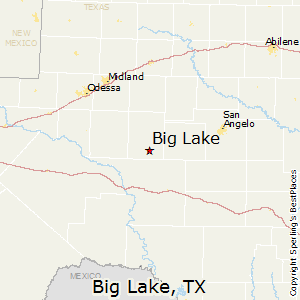
    Where in Texas is Big Lake?

    The town of Big Lake is just north of the lake itself, on State Highway 137 running north and south, and U.S. Highway 67 running east and west, approximately 65 miles west of San Angelo.   Big Lake sits about 10 miles north of Interstate 10, and about 75 miles south of Interstate 20.  Big Lake calls itself “the gateway to the Permian Basin.”

    Big Lake is the home of Reagan County High School.  Jim Morris was baseball coach for the Reagan High Owls when his team persuaded him to try out for a major league baseball team.  His story was chronicled, with some artistic license, in the Disney movie “Rookie.”

    Land managers are working to stop erosion on the often-dry shores of Big Lake using any trick they can find.  One trick:  Plant salt grass.

    Salt grass?  Along Texas’s Gulf Coast, there are a few species of grass that, while not halophytes, are at least salt tolerant.  Salt grass.  This grass made it profitable to graze cattle on what would otherwise have been unproductive land in the Texas cattle boom.  This role in Texas history is memorialized in the Salt Grass Steakhouse chain, now found in five states.

    And if planting salt grass works to control erosion, it will help clean up a large part of Texas other natural lake, Big Lake.

    Big Lake’s being wet or dry is a whim of local climate.  You could say that half of all of Texas’s natural lakes are now dry as a result of continued warming; you could say that two good gully-washers or toad-stranglers could restore water to half of Texas’s natural lakes.

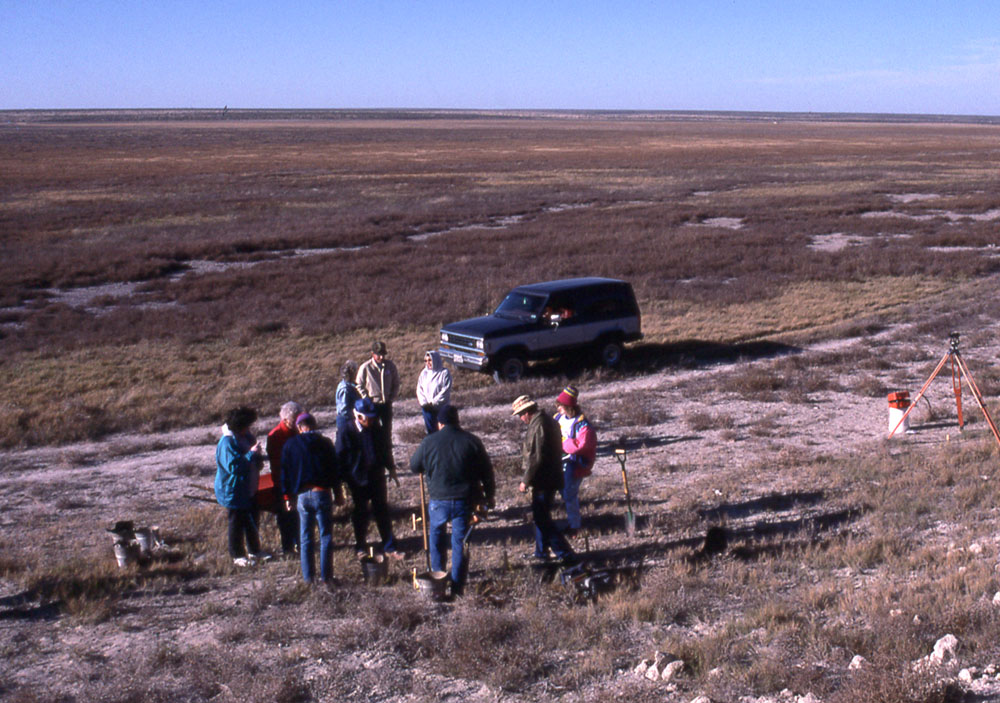
    Big Lake Playa, from NightOwl Bakery and Roastery in Big Lake, Texas

    Field crew meeting at the outset of the 1992 excavations at the Big Lake Bison Kill site. The dry bed of Big Lake stretches for miles in the background. Big Lake is an intermittent saline lake or playa, an uncommon landform on the Edwards Plateau. Photo by Larry Riemenschneider, Concho Valley Archeological Society.

    More details about Big Lake and prehistory, below the fold.

    Read the rest of this entry »


    Scientist steps in to try to save the day

    July 19, 2009

    On the one hand, you hope he’s got a good copy of the original cast recording of “Man of La Mancha,” with the late Richard Kiley singing the importance of dreaming the impossible dream.  On the other hand, you hope it’s not an impossible situation at all.

    Mathematics Professor Lorenzo Sadun declared his candidacy for the Texas State Board of Education seat representing District 10. He’ll be running against incumbent Cynthia Dunbar in a district that has a history of electing people with little or no education background and a commitment to scorched Earth conservative policies — if Dunbar chooses to run again.  Dunbar has not announced her intentions.

    Sadun is professor of mathematics at the University of Texas, in Austin.

    Mathematics Prof. Lorenzo Sadun, University of Texas - Daily Texan photo by Mike Paschal

    Mathematics Prof. Lorenzo Sadun, University of Texas - Daily Texan photo by Mike Paschal

    In the 2006 election, there was no Democratic nominee. Dunbar ran against a Libertarian and won approximately 70 percent of the vote. The 2010 primary election is scheduled for March, and Sadun declared last week that he will seek the Democratic nomination.

    The Place 10 seat-holder may become very influential. With the board almost evenly split, a negative or positive vote can greatly affect educational policy and standards.

    If Sadun is elected, he will be the only scientist on the board. He said that even though he may encounter opposition from members of the board, he will find a common ground with his colleagues and will pursue agreement without sacrificing the quality of education for Texas students.

    “Despite my taking a fairly hard line, I am a conciliator,” Sadun said. “I have not met a person who knew so much I couldn’t teach them something, and I’ve never met someone who knew so little that they couldn’t teach me something.”

    District 10 includes 14 counties surrounding Travis County to the east of the county, and the northern part of Travis County.  Travis, home to the Texas state capital Austin and one of Texas’s five supercounties, was split in education board districts to limit the influence of its  highly-educated, more liberal voter population.

    District 10, Texas State Board of Education

    District 10, Texas State Board of Education

    Burnt Orange Report wrote that Dunbar will face opposition if she chooses to run again.

    Events in District 10 offer a sign of hope that the era ended when apathy from candidates and voters allowe anti-public education forces to dominate the Texas State Board of Education.  And if Sadun were to win, it would be the first time a working scientist was elected to SBOE.

    Who knows?  Sadun could succeed — but if he wins a seat on the SBOE, it’s not likely he’d sing that other song Richard Kiley made famous, “Stranger in Paradise.”  He’s no stranger to quality education, and SBOE isn’t paradise.


    Probably not the way to get a good reputation among scientists

    July 19, 2009

    Tensions between science and religion, and science and business, continue to drag down Texas’s hopes to be known as a major research location.

    A hard look shows it’s not just the Deliverance-style local politics at the State Board of Education on science standards.  Texas has trouble in a lot of areas.

    For example, imagine a hurricane wiped out the town where one of the state’s major medical schools resides, and in the aftermath, rather than working to preserve the jobs of professors who agree to come back to the damaged buildings and storm-wracked town, the university uses the troubles as an excuse to get rid of faculty — not bad faculty, necessarily, just faculty the administration doesn’t like, or doesn’t know, or just for the heck of it.

    This ain’t no way to run a medical school.

    The rolling disaster that hit the Universityof Texas Medical Branch in Galveston, starting with Hurricane Ike, continued through unexpected layoffs of faculty on top of the 3,000 people laid off due to storm damage.  The layoffs were unjustified, too, many thought, and so they appealed.  The appeals process seems to have offered only a semblance of justice, to many of those involved, according to an article in The Scientist (free subscription required).

    The story hasn’t got much traction in Texas media.


    Trouble at the Texas State Board of Education: Social studies curriculum

    July 15, 2009

    I’m posting on the run from an AP Summer Institute at Texas Christian University, so just the facts.

    Today’s Fort Worth Start Telegram featured a story on the social studies curriculum battles in the Texas State Board of Education.  It’s one of those stories that does well in presenting the facts, but for the sake of “objectivity” treats the yahoos of the review committee — David Barton and Peter Marshall in particular — as respected academics.

    Of particular note, a very brief summary of the credientials and comments of the “expert” reviewing panel.

    Should Texas be worried?

    See immediately previous post with the address to listen to live webcasts of the Board’s meetings this week.