Fishy education software bill out of Utah

October 28, 2008

Remember about a year ago when Utah was all atwitter over a voucher proposal that was on a ballot?  Remember all the talk about saving money in education?

Utah Education Issues explains odd features in an omnibus funding bill recently passed by the Utah Legislature (The Economist praised Utah’s efficiency*).  Among other things, it gives away $1 million to an educational software company that will provide families with reading software — at a fantastic pricetag of $3,400 per installation (computer included, but still . . .).

Describing the smell of this bill doesn’t come close to the total repugnance — go read the report.  Fewer than 300 families can be served at that price, statewide.  One might suspect the true beneficiaries of this bill are not Utah voters, not Utah educators, nor even the Utah families who get the freebies.  Did I mention this involves a major publisher of public school textbooks?

It’s a commendable job of reporting for a blog, no?

Footnote:

*   The “cultural thing”, as businessmen from out of state delicately refer to Mormonism, helps in other ways. Utah’s almost universal conservatism makes for stable, consensual politics. It took the state legislature just two days last month to plug a $272m hole in the budget. By contrast, California’s budget was 85 days late. Nevada’s politicians are preparing for a nasty fiscal fight next year.


In the Utah desert, a GPS is no substitute for common sense

August 10, 2008

A cardinal rule of driving the western U.S. is this: Don’t head off through the mountains or desert without knowing how you’re going to get back, or get to the next smattering of civilization.

Why? Old friend Peter B. Pope once trekked a chunk of Wyoming with another friend, and they had a bit of an altitude sickness scare. After three days above 9,000 feet, they realized they needed to get down, and that was a problem — miles of hiking. Help?

They picked that area of Wyoming to hike because the USGS topographical map showed no roads at all in that section. Real adventure territory. The only way to get help was to get out, and what they needed, really, was just to get out.

Or, consider the sign that used to greet travelers leaving Green River, Utah, going west on U.S. Highway 50: “No services for next 140 miles.” I once stopped to help a guy who had run out of gas 42 miles into that stretch. He confessed he’d seen the sign, but thought a bit less than a quarter-tank of gas in his old gas guzzler would do it. It hadn’t occurred to him it also meant no food or water, or towns, or telephones (I wonder if that road has cell coverage now). He was thinking of walking back for gas. 42 miles. It was well over 100°. I’m sure the highway patrol could have found him before he died.

Maps help. A compass is good. Having the skills of a First Class Boy Scout to use the map and compass together also benefits travelers.

If you have a compass, you still need a map; if you have a GPS, you still need to know whether the roads are passable. In short, you need to know where you’re going, how to get there, and whether you have the equipment to make the trip.

Comes this story from the Associated Press, in USA Today, about a “convoy” of people who thought they’d use a GPS to navigate the back country from Bryce Canyon National Park to the Grand Canyon. The only appropriate response is the one Will Smith’s character gave the woman whose husband had been killed so his skin could be used as a disguise by a giant interstellar cockroach in “Men In Black.” He said: “I mean . . . damn!”

Old friend, John Hollenhorst’s story of the incident on KSL-TV (Channel 5) carries pictures and maps that show just how foolish is the assumption that “a GPS and a cell phone are all they need to get by.”

Vodpod videos no longer available.

more about “ksl.com – Deputies rescue tourists lo…“, posted with vodpod

(KSL ought to let Hollenhorst play the expert on this story — he’s an Eagle Scout and once was an accomplished outdoorsman himself, perhaps still is.)

The group took off heading south from Grosvenor Arch, a natural arch south of the National Geographic-named Kodachrome Basin State Park. To get to Kodachrome Basin, you travel ten miles on unpaved roads. Going south out of Kodachrome Basin to Grosvenor Arch, you find the roads get less well-maintained. The maps show nothing but dirt roads, though some maps show a rather major dirt road that connects with Highway U.S. 89 east of Kanab, Utah, on the way to Page, Arizona. Most highway maps probably don’t convey the reality of the situation. This is the landscape you find:

White Cliffs in the Grand Staircase/Escalante National Monument (BLM photo)

White Cliffs in the Grand Staircase/Escalante National Monument (BLM photo)

It’s not exactly friendly to non-four-wheel-drive vehicles. It’s not friendly to any vehicle.

You don’t see a lot of roads in the 50 or 70 miles you can see, either. Roads that go through that area are unpaved, often unauthorized, and shouldn’t be on any map. Hollenhorst painted the scene:

The Californians ventured into one of the roughest and most remote landscapes in the United States. They believed their GPS unit would lead them back to a paved highway. They wound up desperately calling relatives in California in the middle of the night.

Yes, Virginia — and New York, and California — there really are places like that in America.

One relative, Esther Lahiji, said, “They ran out of gas and they lost their way. It was dark at night. And thank God they could charge their cell phones in their cars.”

The convoy of four vehicles, containing 13 adults and 10 children, had visited Bryce Canyon and Kodachrome Basin. But it left pavement to visit Grosvenor Arch. Using a GPS unit, they tried to reconnect to a paved road far to the south. But they got lost in a network of dirt roads, which Kane County Sheriff Lamont Smith says often lead nowhere.

“Those little spurs, those little dirt sandy spurs go out to the cliffs and dead-end,” he said.

With one vehicle stuck in sand and others running out of gas, they couldn’t go back. And heat was an issue, especially for the children.

The group stumbled into an area with cell phone coverage skipping from a distant tower — an area of accidental coverage (weather can change such coverage patterns — they are hit and miss, at best). They were able to phone for help.

After they called for help by cell phone, rescuers delivered food, water and gasoline and escorted them out.

Sheriff Smith says tourists just shouldn’t rely on a GPS unit in such rugged country.

“If you go off the pavement, you either need to ask the locals where the road goes or which roads to take, or else just stay on the paved roads, because a lot of these roads just don’t go anywhere,” he said.

Need we say it? Out there, one may not find locals to talk to. Last time Kathryn and I visited Kodachrome Basin, there were no other parties camping there — in August, at the height of the tourist season. South of the park? Are you serious? (We didn’t visit Kodachrome this summer.)

From Grosvenor Arch, to get to the Grand Canyon, go north back to Utah State Road 12; it’s about 20 miles. Then go east, through Tropic, Utah, and past the entrance to Bryce Canyon National Park to U.S. Highway 89 (about 30 miles). Highway 89 south to Kanab is another of the most spectacular drives in America, through miles and miles of millions of years of petrified sand dunes — white, red, ochre, maroon, purple and chocolate cliffs, juniper-pinyon desert, pink sands, green cottonwoods, and nice paved roads.

You can stop for coffee in Kanab, in the afternoon at a book/outdoors outfitter/coffee shop, Willow Canyon Outdoor (we stopped three different days — it’s a great cup of good coffee in an area more than 200 miles from the nearest Starbucks; which Starbucks may have the New York Times, Willow Canyon will have the latest High Country News to read; we picked up a couple of CDs of Beethoven for the drive, and had I had more sense, I could have gotten some good trekking poles there).

From Willow Canyon Outdoor, it’s about 40 miles to where that dirt road from Bryce Canyon enters U.S 89, if you survive the drive. It’ll take you two to three hours to make the drive and get coffeed up on paved road if you take the long way — this group from California spent several times that amount of time, and risked their lives.

Paved roads, great scenery, good coffee, nice drive, or you can eat dust and threaten your life. You choose.

Resources:


Disaster at Arches National Park

August 10, 2008

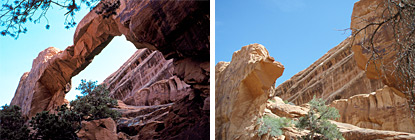
Wall Arch, 12th largest, one of the better-known and most-seen natural arches in Arches National Park, Utah, collapsed.

Wall Arch, before and after collapse - National Park Service photos

Wall Arch, before and after collapse – National Park Service photos

“Not being a geologist, I can’t get very technical but it just went kaboom,” [Arches NP] Chief Ranger Denny Ziemann said. “The middle of the arch just collapsed under its own weight. It just happens.”

Wall Arch, located along the popular Devils Garden Trail, was 71 feet tallwide and 33 1/2 feet widetall, ranking it 12th in size among the known arches inside the park. Lewis T. McKinney first reported and named Wall Arch in 1948.

No one reported observing the arch collapse and there were no visitor injuries, the National Park Service said.

Read the report from the Salt Lake Tribune.

Some tourist on Sunday, August 3, or Monday, August 4, got the last photograph of Wall Arch still standing. Was it you? Were you close? Give us a shout in the comments if so.

Other resources:

x

Other blogs and later reports:


Alpine Loop? Try Utah’s, gentler, prettier than Colorado’s

August 6, 2008

Utah’s canyons have so many pretty spots. Taking visitors through them I always heard about how no one expected such beauty in the desert. So I was excited to see the headline in Sunday’s Dallas Morning News about taking the Alpine Loop.

Autumn aspens in Utahs Alpine Loop - Wikimedia photo

Autumn aspens in Utah's Alpine Loop - Wikimedia photo

Prettiest drive you can make in a day. Start out in American Fork, head up American Fork Canyon, cross over to the backside of Mt. Timpanogos — you’ll see aspen, pines, fir, some of the prettiest streams you’ve ever seen anywhere. Some years back the Utah Travel Council had a spectacular poster showing the colors in the fall — about five shades each of red, gold and green, aspen and cottonwoods against the balsam and Douglas fir and a few scattered pines. Stop and hike up to Timpanogos Cave National Monument. See where the glacier was on the east side of Timpanogos.

End up passing Robert Redford’s Sundance Ski Resort, and down Provo Canyon (when I skied there it was $6.50 for a full-day pass; have the rates gone up?) — finish up with dinner in a good restaurant in Provo (or drive the 36 miles back to Salt Lake City and have world-class sushi at Takashi).

Alas. The article was about Colorado’s Alpine Loop. Who knew Colorado even had one by that name?

I suspect the Colorado version is less-traveled. The author took a four-wheel-drive vehicle.

Utah Travel Council photo of the Alpine Loop showing some of the autumn colors -- not the great shot from the long-ago poster, alas.

Utah Travel Council photo of the Alpine Loop showing some of the autumn colors -- not the great shot from the long-ago poster, alas.

Utah’s Alpine loop is paved the entire way, closed maybe only during a winter of very heavy snow. If you’re just passing through, you can do the drive in three hours or less, easily. If you have a day, grab a picnic, and spend some time stopping to enjoy the mountains.

(Go see Rich Legg’s photos of the east side of Timpanogos, here.)

Some time I’d like to check out the Colorado version. Odds are that I’ll be back in Utah County before then, however, and odds are you’ll be closer to the Utah version than the Colorado version, too.

You know the old saying about “take time to stop and smell the balsam, and ooh and aah at the aspen?” The Alpine Loop is what the aphorist was thinking about. Theodore Roosevelt would have gone there, had he known about it. You know about it now.

Windleys Google map of Utahs Alpine Loop, around Mt. Timpanogos

Windley's Google map of Utah's Alpine Loop, around Mt. Timpanogos


Utah beer brewers have a wicked sense of humor

July 5, 2008

Three decades out of Utah, who could have seen this coming?

Utah beer brewers make good beer, and they have a wicked sense of humor.  Yes, that’s “Provo Girl,” as in the town where the LDS Church’s Brigham Young University calls home.  And that winsome woman is smiling before Bridal Veil Falls of Provo Canyon.  Let’s just say there’s a lot of history in that drawing.

Face it, brewing beer in a Mormon-dominated state is spitting into the wind anyway (Mormons don’t drink beer, for religious reasons).

Brewers must make money from non-Mormons, and from tourists.  Maybe that explains the proliferation of labels that rather stick it to the local religious authorities.  Humor seems to be a favored marketing device.

Other labels to watch for :


Missing the point in Happy Valley

January 15, 2008

Utah’s Cache Valley is home to the city of Logan, and to Utah State University, the land-grant college for the state. For several humorous reasons, some of them good, the place sometimes is called Happy Valley.

Small county in a beautiful setting + good university with a good school of education = good conditions for teacher recruiting. Logan’s schools have been very good over the years, in academics and all forms of competition.

As we discovered with the voucher fiasco in 2007, Utah’s education situation is not completely happy any more. Classrooms are crowded, teachers are overworked, and for the first time since the Mormon pioneers first settled Utah, educational achievement is declining.

The editorial board at Logan’s Herald-Journal noticed the problems. It’s tough to recruit teachers. If Milton Friedman were alive, we’d look for a classic free-market economics solution, something like raising teacher pay to stop the exodus from the profession.

Milton Friedman is dead. His ghost doesn’t seem to have much clout in Logan, Utah, either. What does the Herald-Journal propose? Loosen standards, look for uncertified people to teach.

When people leave the job they worked hard to earn certification for, what will happen with people who are not certified and are untrained in classroom management?

Why not just raise teacher pay, and attract more well-trained teachers?

Let me ask the key question, more slowly this time so I’m sure it’s caught: Why not just raise teacher pay?

Fishing for teachers? Bait the hook with money.

(Full Herald-Journal opinion below the fold.)

Read the rest of this entry »


Quote of the moment: Threat to public education?

November 16, 2007

According to former Delaware Gov. Pete DuPont, the Republican Speaker of the Utah House of Representatives Greg Curtis said this:

“We do not reward excellence in education. We don’t fund it, we don’t demand it, and don’t encourage it.”

So, is his advocacy of vouchers part of his plan to not reward excellence in education?  Utah schools perform above the national average with far less than the national average in per pupil funding, with overcrowded classes, and with teacher pay below the norm.  By almost all measures, Utah public schools provide excellence in education.

Why doesn’t the legislature reward such performance?

That’s not what Curtis meant to say, for course.  Somebody tell Greg Curtis that his Freudian slip is showing.


Roundup of Utah-based comments on Utah voucher defeat

November 8, 2007

LaVarr Webb’s UtahPolicy.com features a roundup of comments from blogs on the Utah election, and the referendum defeat of vouchers:

Blog Watch

Lots of reaction to the voucher referendum outcome: See BoardBuzz, Steve Urquhart, SLCSpin, The Utah Amicus, Dynamic Range, The Senate Site, Paul Rolly, Out of Context, Reach Upward, COL Takashi, Jeremy’s Jeremiad, Davis County Watch, Salt Blog, and Millard Fillmore’s Bathtub.

Utah is a small state, blessed with television, radio and newspaper outlets that perform way beyond what the population should expect.  Webb’s site tends to summarize most of the important political stuff every day.

It is exactly that type of information that led to the defeat of the voucher plan, I think.  More later, maybe.  Go take a look at Webb’s link to a CATO Institute commentary; voucher advocates are not giving up in any way.


And just who is Tim Panogos?

November 5, 2007

Mt Timpanogos, from geobloggers, photo by a4gpa

Yes, there really are mountains of such stark beauty, in Utah, next to civilization.


Mount Timpanogos

July 4, 2006

Among many underappreciated mountain peaks in the U.S. is Mount Timpanogos, in the Wasatch Range of the Rockies. It is northeast of Provo, Utah, and it was due east of my bedroom window for the nine years I lived in Pleasant Grove, Utah, before I headed off to college.

Here is a site that offers some stunning views of the mountain: http://utahpictures.com/Timpanogos.html [update:  pictures moved to this site:  http://utahpictures.com/Timpanogos.php]. While I often hiked the “backside” of the mountain, I never made it all the way to the top. You can see what I missed.