Do birds know when they’re making humans look silly?
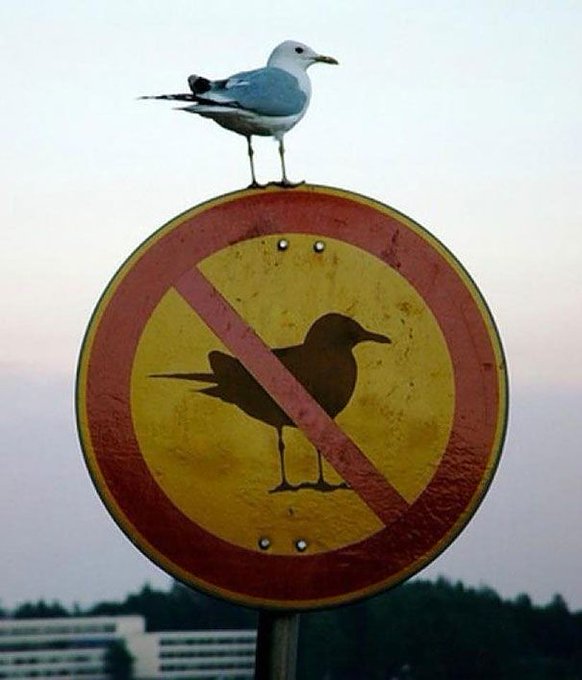
Seagull blithely ignoring the wishes of local human rule makers. (Who took this photo?)
Do birds know when they’re making humans look silly?
Seagull blithely ignoring the wishes of local human rule makers. (Who took this photo?)
 2 Comments |
  History, Humor, Signs, Signs of Life, Wildlife | Tagged: Humor, Signs of Life, Wildlife |
  Permalink
 Posted by Ed Darrell
I mean, Albuquerque.
(Fans of the Owl Cafe and the Owlburger will understand.)
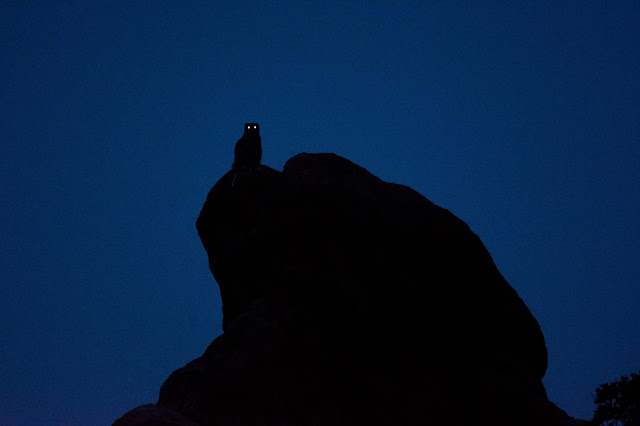
Is that a great photo, or what?
More:
6 Comments | Food history, History, photography, Travel, Wildlife | Tagged: Albuquerque New Mexico, Owl Cafe, photography, Travel, Wildlife | Permalink
Posted by Ed Darrell
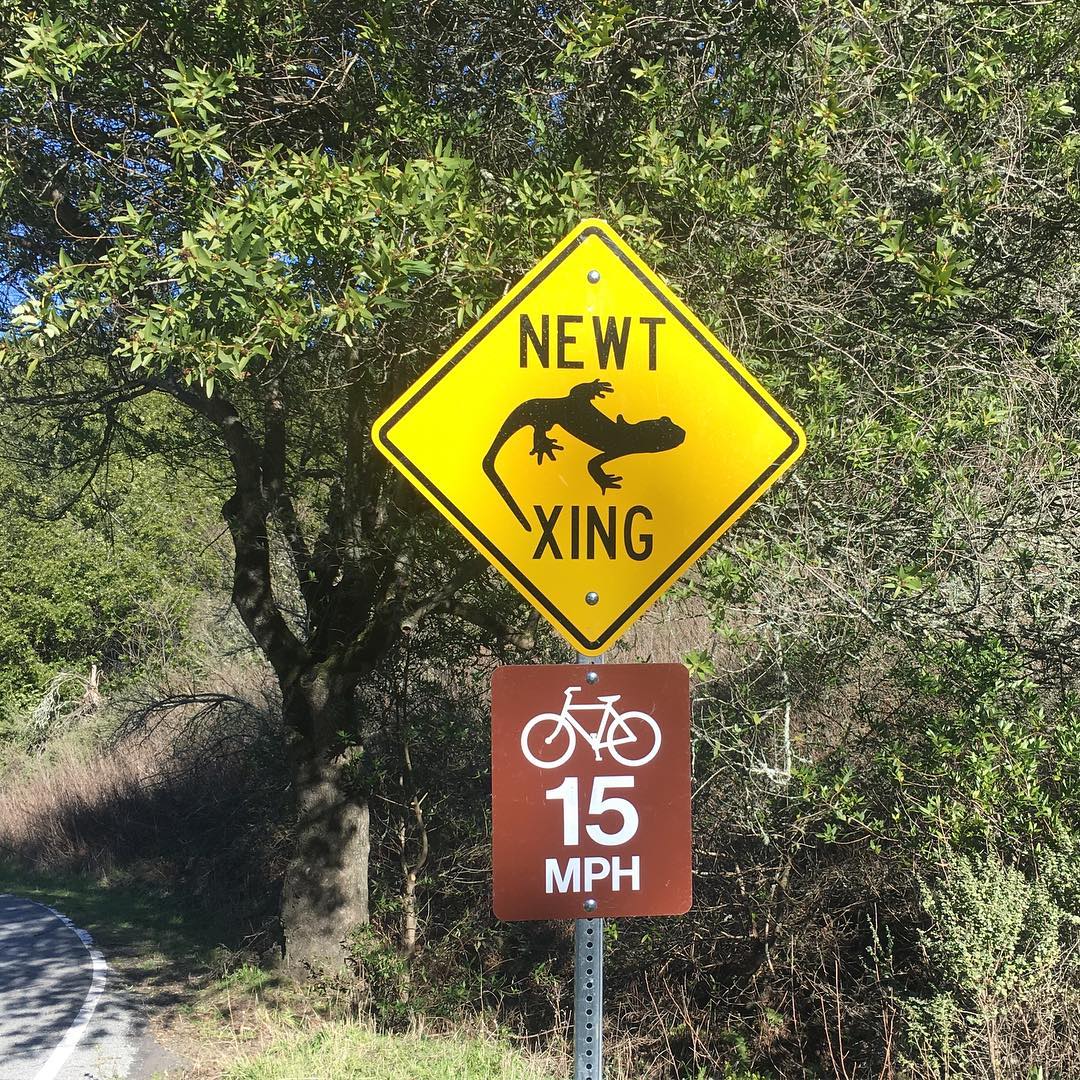
From Instagram: pkwanpiOf course there’s a #newtcrossing — this is #berkeley after all! In Tilden Regional Park
Oakland side of San Francisco Bay has a stunning string of parks from the water’s edge, following abandoned rail lines, through parks in the city, wending and winding up into the mountains into real wilderness. It’s impressive, decades later, to remember the President’s Commission on Americans Outdoors touring these sites as they were being redeveloped from abandoned industrial sites, real brownfield recovery — and see what a grand complex it is now.
And there, one may find a newt crossing one’s path. Watch out for the newts!
Leave a Comment » | Nature, photography, Travel, Wildlife | Tagged: Berkeley, California, Nature, photography, Signs, Signs of Life, Travel, Wildlife | Permalink
Posted by Ed Darrell
From @BestEarthPix on Twitter:

Frustratingly, the only information from @BestEarthPix is “Oregon, USA.” It’s a mule deer, in a lake. Which lake? Who was the lucky/skilled photographer? No details.
Can you supply details? The photographer should get credit, I think.
Update: This site, 500px, attributes the photo to Stijn Dijkstra. But Amazon.com/UK leads me to believe this is a sunrise at Yellowstone Lake, with a deer’s profile PhotoShopped in. See “Sunrise at Yellowstone Journal” and this photo.
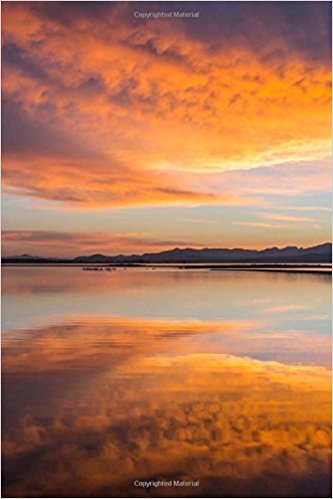
From “Sunrise at Yellowstone Lake Journal,” available from Amazon.com/UK
Further update: It’s a stock photo from Alamy, PhotoShopped.
The Flat Mountain arm of Yellowstone Lake at sunrise, Yellowstone National Park, Wyoming, 2016. Image courtesy Neal Herbert/Yellowstone National Park. Gado Images/Alamy Stock Photo
How disappointing, and maddening, that what looks like a great image turns out to be faked.
2 Comments | Geography - Physical, photography, Travel, Wildlife | Tagged: geography, Oregon, photography, Travel, Wildlife | Permalink
Posted by Ed Darrell
Utah’s wildlife managers were plugging the deadline to apply for permits to take an elk in the wild, and they added this picture:

Utah elk in the sagebrush, with mountains in the background. Photo from Utah Division of Wildlife Resources, “courtesy Jim Shuler.”
Don’t know the location, but I’m guessing south of Provo, since the mountains in the back look a little redder than they would be just from afternoon sunlight (anyone know?).
In my original home town, Burley, Idaho, we got Challenge Dairy products. For reasons I don’t remember or know, my mother bought Challenge butter over others, from a large display in the small Sparr’s Grocery (did I get the name right? Still there?) . I liked their stuff because they had the coolest logo. I regretted losing access to that stuff when we moved to Utah.

Butter box from Challenge Dairy showing the full logo for the company.
That photo above reminded me of the Challenge logo.
Surprised to discover Challenge Dairy is a California co-op, and not an Idaho concern.
Today we get Challenge Butter in our local Tom Thumb supermarkets in North Texas — but Tom Thumb was bought by Safeway, which was bought by Albertson’s, both of whom have deep history in the west.
Deadline for Utah elk permits was March 2, by the way. Probably about the same time next year, for 2018, if you’re looking to hunt.
Leave a Comment » | History, Utah, Wildlife | Tagged: Elk, History, Utah, Wildlife | Permalink
Posted by Ed Darrell

Phys.org caption: The American robin, a familiar species across much of continental USA, has declined in some southern states such as Mississippi and Louisiana, but increased in north-central states, such as the Dakotas. Credit: US Fish & Wildlife Service Read more at: http://phys.org/news/2016-03-strong-effects-climate-common-bird.html#jCp
Most serious birdwatchers can tell you about global warming and climate change, just from watching the birds at their feeders, and when those birds migrate.
Now comes a study to confirm with data and controlled observation what the birders have been saying all along. Phys.org reported:
Scientists have shown for the first time that common bird populations are responding to climate change in a similar pronounced way in both Europe and the USA.
An international team of researchers led by Durham University, UK, found that populations of bird species expected to do well due to climate change had substantially outperformed those expected to do badly over a 30 year period from 1980 to 2010.
The research, conducted in collaboration with the RSPB and the United States Geological Survey (USGS), is published in the journal Science.
It is the first real demonstration that climate is having a similar, large-scale influence on the abundance of common birds in widely separated parts of the world, the researchers said.
Among the species showing pronounced effects of climate change are common woodland and garden birds such as the wren, in Europe, and the American robin in the USA.
(Read more at: http://phys.org/news/2016-03-strong-effects-climate-common-bird.html#jCp)
Biologists especially work to predict effects of warming on plants and animals, both to help plan changes in activities such as farming and hunting, and to protect species that are endangered now, or are likely to become so due to changing climate factors.
This study shows scientists can predict with accuracy some of the wildlife effects.
These changes are consistent with changing climate suitability within those areas, the researchers said.
Other factors, such as the size of the birds, the habitats they live in and their migratory behaviour, all affect bird populations, but did not differ systematically between groups advantaged or disadvantaged by climate change.
Therefore, only climate change could explain the differences between average population trends in advantaged and disadvantaged groups, the researchers said.
The study’s lead authors, Dr Stephen Willis and Dr Philip Stephens, of Durham University’s School of Biological and Biomedical Sciences, said the findings showed there was a large-scale, consistent response by bird populations to climate change on two continents.
The study was published in the April 1, 2016 issue of Science, “Consistent response of bird populations to climate change on two continents.”
Tip of the old scrub brush to Svein T veitdal:
2 Comments | Annals of Global Warming, Biology, Bird Watching, Climate change, climate_change, Global warming, Migration, Research, Wildlife | Tagged: Bird Watching, Birds, Climate change, Global warming, Migration, Ornithology, Research, Wildlife | Permalink
Posted by Ed Darrell
National Wildlife Refuges. Four days ago, most people were very fuzzy on what they are, except for members of Ducks Unlimited, and conservationists.
Here are a few Tweets to help the rest along.
Moose at the National Elk Refuge, outside Jackson Hole, Wyoming:
Wisdom is a 64-year old albatross who remarkably returns to the Midway National Wildlife Refuge every year, and has raised chicks most of those years. Midway NWR is northwest of Hawaii:
Sparky the lightning catching bull bison, at the Midwest NWR:
Every Kid in a Park shares a photo of an unnamed wild area (threw it in just for the heck of it):
Yellow-rumped warbler at the Sacramento NWR:
USFWS workers conduct a controlled burn at the Okefenokee NWR in Florida:
Hamden Slough NWR, Minnesota, is 26 years old today, January 5:
Great blue heron at Sacramento NWR:
Pied-billed grebe at Sacramento NWR:
Conservatives keep misattributing a famous quote to Thomas Paine, but it was Ed Abbey who said it. Rumor is you can find Abbey at the Caza Prieta NWR in Arizona:
Buenos Aires NWR, Arizona:
Wichita Mountains NWR, Oklahoma:
Bosque del Apache NWR, New Mexico (near Las Vegas, New Mexico, home of the first Owl Cafe and the wonderful Owl Burger):
https//twitter.com/CherylRofer/status/683725871123791872
Back to the Midway Atoll NWR:
1908 photo from Oregon’s Malheur NWR:
Working against extinction of monarch butterflies, at St. Marks NWR:
Lake Klamath NWR in Oregon, critical habitat for ducks along the Pacific flyway:
Loxahatchee NWR:
“Conservatives” want to sell these lands off, or drill for oil or gas, or mine for minerals, on many of these lands. Will these places be preserved for your great grandchildren and America’s future?
2 Comments | Bird Watching, Geography - Economic, Geography - Physical, History, National Wildlife Refuge, Ornithology, photography, Public Lands, Wildlife | Tagged: Bird Watching, geography, National Wildlife Refuge System, Ornithology, photography, Public Lands, Wildlife | Permalink
Posted by Ed Darrell
One of our local pharmacists travels on vacations, and takes photos. Pharmacies being what they are, people wait in line with nothing to do but count ticks on the clock. No one takes a book to the pharmacy to wait.
But the guy, Mark de Zeeuw, has a good sense of customer service. He got one of those photo frames that had a video display to show photos. Over time, it morphed to an extra computer screen, and probably an old computer (don’t know for sure).
At the Tom Thumb supermarket in Duncanville, Texas, customers get to see photos of the pharmacist’s travels. A lover of travel and photography, and a too-frequent customer at the pharmacy, I think I may have seen every photo on that harddrive. Many of them are very good. He travels to Alaska and across the American west, and he’s got at least one telephoto that works well on wildlife — this I know from watching the photos. I’ve never discussed it with the guy (who is always busy working on prescriptions, or fighting with insurance companies over the phone; Tom Thumb’s being a large company, there may be other pharmacists on duty at the time).
Okay, I’m shy. I’ve wanted to ask him for copies of several of the photos to share, one in particular. It’s a nice shot of the yellow warning/information signs you see at the side of a highway. With a bright blue sky in back, and obviously a lot of unpopulated territory, it says “Eagles On Highway.” I broke the shyness enough to learn it was a photo from eastern Utah.
Surely someone else noticed the sign?
Yep! Wonders of Google, Bing and flickr: Here’s a shot I found at Wanderlust Cafe:

“Eagles on Hwy.” Sign on eastbound Interstate 70, near the Moab turnoff in Utah. Photo by Lou Ann Granger, via Wanderlust Cafe
Out on Interstate 70, the rabbits and occasional ground squirrel, lizard or coyote fall victim to speeding cars in the night. In the daylight, carrion eaters — including eagles — clean up the road. Alas, eagles have not been bred to recognize those vehicles, tiny in the distance, rush at them at 70 miles per hour. Worse, it’s a violation of federal law and regulations to kill the eagles (few are ever cited for accidents).
Local authorities put up signs warning drivers of this odd hazard: “Eagles on Highway.” Drivers are supposed to slow down, be wary, and avoid hitting the eagles.
Others grew curious about the signs, too. The Deseret News in Salt Lake City explained back in 1990 that six of the signs were put up, in hopes of reducing kills of immature golden eagles.
They have to rank as the most unusual highway signs anywhere in the state. But preliminary indications are the six “Eagles on Highway” warning signs in central Utah are doing the job.
Not a single golden eagle was struck by a car during the 1989-90 winter season.In the two years previous, 30 golden eagles were killed and another 11 crippled by automobiles on a stretch of I-70 between the Colorado border and the San Rafael Swell.
“We don’t know whether it’s because the mild winter has spread the birds around more or whether it’s because the prairie dog population is down and the birds have moved elsewhere, or what,” said Miles Moretti, regional supervisor for the Division of Wildlife Resources.
“What we do know is we’ve received a lot of comments from people seeing signs and watching the birds and being aware of the problem. From a public awareness standpoint the program is a success.”
I wonder if we can track down someone in authority with numbers to show the signs are working after 25 years. And maybe I can get a copy of pharmacist de Zeeuw’s photo here — his is better, I think.
More:
Leave a Comment » | Geography - Physical, Signs, Signs of Life, Travel, Utah, Wildlife | Tagged: geography, Signs, Signs of Life, Travel, Utah, Wildlife | Permalink
Posted by Ed Darrell

Nice reminder, featuring an Eastern Box Tortoise (I think). Image from Conscious Companion.
A poster from 2013. Still accurate for World Turtle Day 2015.
We’re off in the rain to look for turtles and tortoises and other adventures. Saw a lot of turtles last week at the flooded White Rock Lake. This week?
Have a great World Turtle Day! Go do something nice for your neighborhood turtles and tortoises.
Other views:
From there, it’s turtles all the way down!
More:

Yes, this is mostly an encore post. Fighting ignorance requires patience, stamina, repetition, and love for turtles.
Leave a Comment » | Conservation, Nature, Science, Wildlife | Tagged: Conservation, Nature, Poster, Science, Wildlife, World turtle, World Turtle Day | Permalink
Posted by Ed Darrell
It came from @planetpics on Twitter.

“A beautiful picture of a polar bear cub getting a lift across the water from its mom!” Life on Earth/@planetpics
Couldn’t help but wonder if that cub will survive the next few months, let alone to adulthood.
Generally, polar bear mothers den on pack ice, and the cub would be kept on the ice while the mother hunted from that platform. Polar bears can swim, but not well, and not far, usually. They cannot hunt while swimming. To eat, they wait on the ice for seals to come up for air, then grab the seals.
Lack of hard ice platforms, pack ice, means mother polar bears can’t hunt to feed their cubs. While an adult polar bear can swim a distance to find ice, the cubs can’t. And if the adult doesn’t find hard ice, they perish. Long swims are deadly to cubs.
It’s a cute pic, and we hope momma bear is swimming to an ice platform and can feed that cute little cub so it grows and flourishes.
We know the odds are against it.
1 Comment | Climate change, climate_change, Environment, Geography - Physical, Global warming, Wildlife | Tagged: Arctic Ice, Climate change, environment, geography, Global warming, Polar Bears, Wildlife | Permalink
Posted by Ed Darrell
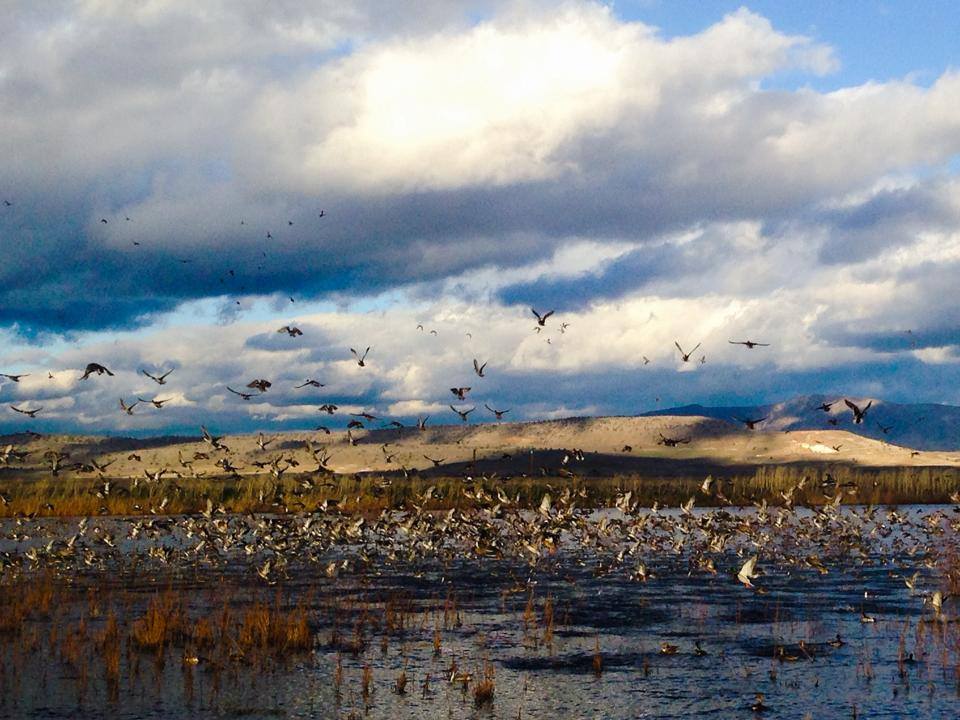
Flights Arriving Daily! Birds are funneling into Klamath Basin National Wildlife Refuge Complex Photo: A Mize/USFWS; from @USFWSPacSWest
Photo from last fall. Some of the ducks probably overwinter. Others continued south, and will be arriving at Klamath NWR soon, again, heading north.
Our public lands at work.
More:
1 Comment | National Wildlife Refuge, Outdoor Recreation, photography, Public Lands, Wildlife | Tagged: Klamath NWR Complex, Outdoor Recreation, photography, Public Lands, Wildlife | Permalink
Posted by Ed Darrell
A good sign is self-explanatory. Alas, this came to me with no photo credit.
Still no credit, but I found it on Imgur.
Shake of the old scrub brush to Ellie!
Leave a Comment » | Humor, Signs, Wildlife | Tagged: Humor, Signs, Signs of Life, Wildlife | Permalink
Posted by Ed Darrell
Turns out there are real turkeys in Alabama. They’ve expressed some concern that Judge Roy Moore impersonates a turkey in court.
A Thanksgiving salute from the denizens of our public lands.
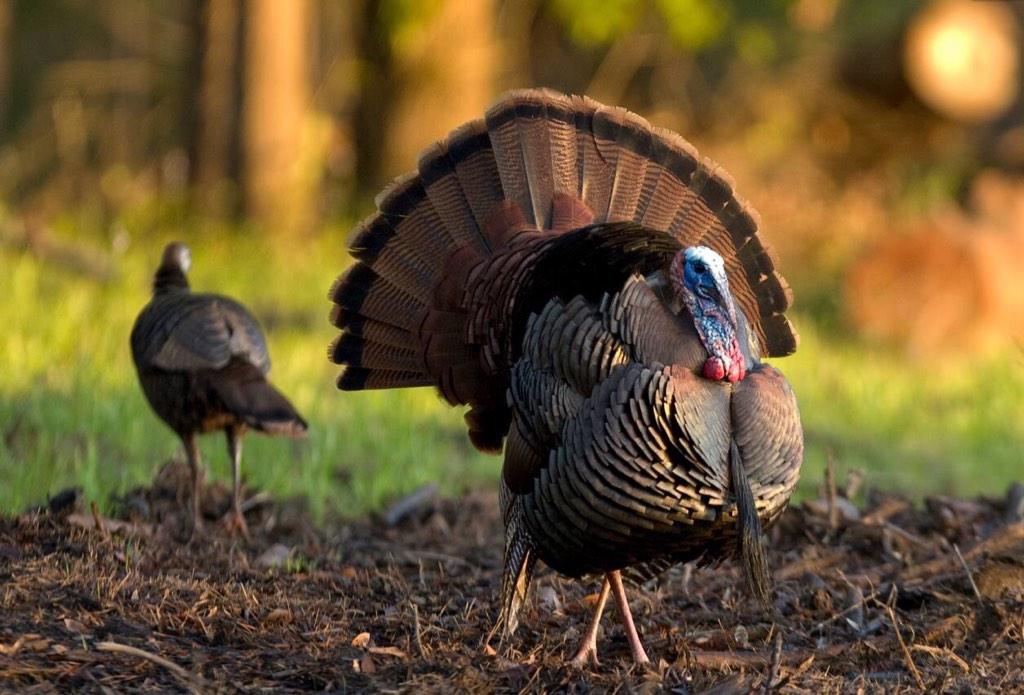
From Interior Department’s Twitter feed: Here’s a handsome pair of wild turkeys to celebrate #Thanksgiving! Photo at Eufala NWR by Michael Padgett #Alabama
More:
Leave a Comment » | National Wildlife Refuge, Outdoor Recreation, Public Lands, Wildlife | Tagged: Eufala NWR, Outdoor Recreation, Public Lands, Turkeys, US Fish and Wildlife Service, Wildlife | Permalink
Posted by Ed Darrell

Moose in the sunlight – Back lit bull moose on the Seedskadee National Wildlife Refuge, Wyooming. Photo: #USFWS
How could you miss a moose in broad daylight? Easy to miss, if you’re not looking with thought.
Do moose think about coming at you from out of the sun?
If you’re looking for that particular moose, the Seedskadee National Wildlife Refuge is near Green River, Wyoming.
Leave a Comment » | National Wildlife Refuge, Nature, photography, Wildlife | Tagged: Moose, Nature, photography, Seedskadee NWR, Wildlife | Permalink
Posted by Ed Darrell
Frans de Waal posted this on Facebook a while back.
Wouldn’t it be great to be able to join the crows in vulture surfing? Doesn’t that look like fun?

A crow, surfing on a vulture. Place, time, and photographer unknown to me. Via Frans de Waal.
You’ll not convince me easily that the crows don’t know what they’re doing, and don’t have loads of fun doing it.
2 Comments | Bird Watching, Humor, Wildlife | Tagged: Bird Watching, Crows, Humor, Vultures, Wildlife | Permalink
Posted by Ed Darrell


Ed Darrell on Texas's Colorado River


Come on in, the water's fine. Come often: Cleanliness is next to godliness.


 Millard Fillmore's Bathtub
