Historic carnival season

March 15, 2007

Kurt Nordstrom photo of Texas State Fair

Early Modern Notes hosts the 50th History Carnival. Early Modern Notes was the inaugural host for the carnival, back in 2005. A lot of history under the bridge since then.

Posts at the Carnival include a small handful of tributes to the late Arthur Schlesinger, Jr., whose death should remind us how valuable can be the contributions of historians who get the ear of policy makers. The Carnival also features posts useful to teachers, on grading and plagiarism.

The host sprinkled “Bonus links” throughout the Carnival, including this link to the 21st Teaching Carnival at the Salt Box, which I had missed earlier this month.  Good ideas, nice presentation — you could learn something if you dropped by.


Strong hints that “Texas Chainsaw Massacre” is fiction

March 14, 2007

The DVD release of the Texas Chainsaw Massacre’s latest cinema episode is probably driving the traffic to the post I did a while ago noting that the movies are not based on any Texas incidents (see “Based on a true story, except . . .). The original movie, in 1974, was billed as “based on a true story.” “The film which you are about to see is an account of the tragedy which befell a group of five youths, in particular Sally Hardesty and her invalid brother, Franklin,” the Narrator says opening the film.

The latest enfilmations apparently carry the same claim (I say apparently because I have never seen any of them through, and only a few snippets on television of any of them — I go by what I hear and see from others).

We have the testimony of the author of the original screenplay that it is fiction, loosely based on a famous case in Wisconsin which was also, very loosely, the basis for Alfred Hitchcock’s Psycho and the later, more horrifying Silence of the Lambs. Other internet sites say it’s fiction, such as Snopes.com (a favorite and very good hoax and error debunking site).

Still, the kids ask.

Why not turn this into a geography and/or history exercise? Read the rest of this entry »


Quote of the Moment: Teddy Roosevelt on beating depression

March 14, 2007

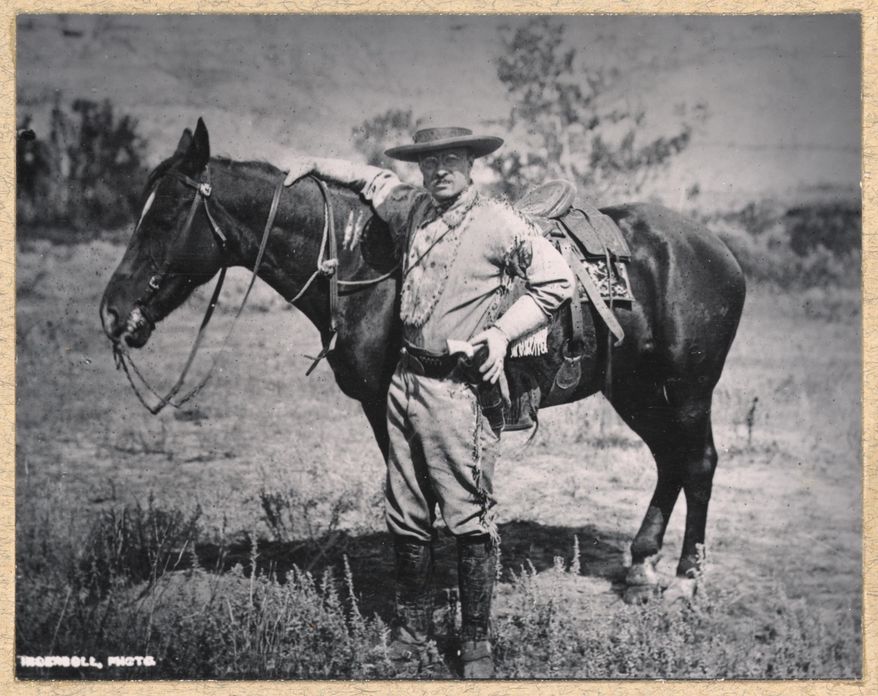
After the same-day deaths in 1884 of his beloved wife Alice, in childbirth, and his mother, who lived with the family, Teddy Roosevelt went into a depression. To beat the depression, he moved to South Dakota and became a cowboy, a very good cowboy.

TR with horse, in the Dakotas

Black care rarely sits behind a rider whose pace is fast enough.

— Attributed to Teddy Roosevelt by David McCullough, on the frontispiece for McCullough’s biography of Roosevelt, Mornings on Horseback (Simon & Schuster, 1981).

Save


Quote of the Moment: Charles Darwin, noble monkey ancestors

March 13, 2007

Charles Darwin, image from Deviant Art; Artwork : www.davidrevoy.com

Charles Darwin, image from Deviant Art; Artwork : http://www.davidrevoy.com

For my own part I would as soon be descended from that heroic little monkey, who braved his dreaded enemy in order to save the life of his keeper, or from that old baboon, who, descending from the mountains, carried away in triumph his young comrade from a crowd of astonished dogs — as from a savage who delights to torture his enemies, offers up bloody sacrifices, practices infanticide without remorse, treats his wives like slaves, knows no decency, and is haunted by the grossest superstitions.

– Charles R. Darwin,
The Descent of Man,
1871, ch. 6


Teacher and student history resources, from the Feds

March 13, 2007

Federal Resources for Educational Excellence (FREE) is a great idea. Federal agencies are loaded with information useful to teachers and students, formerly available in print if one could find the appropriate phone number or get lucky with a mail sweepstakes. Now a lot of the information is compiled specifically for education, and the U.S. Department of Education has compiled a user-congenial site to help educators find the stuff.

FREE image from home page

Under “U.S. History and Topics” you may find a good deal of support for most social studies disciplines. The Women’s History Month focus highlights two topics from the Library of Congress and two from the National Endowment for the Humanities.   Read the rest of this entry »


‘We could tell you how to save your life, but it’s secret, and we can’t tell you.’

March 12, 2007

Communications students at Brigham Young University (BYU) were assigned to test the public disclosure laws as practiced by Utah’s 29 county governments. They decided to use as their test, county emergency evacuation plans, critically important in the wake of terrorist attacks on the U.S. in the past 15 years, and especially critical after the disasters in evacuation failures during Hurricane Katrina and Hurricane Rita.

The Deseret Morning News reports:

Many Utah counties contacted by the BYU students outright refused public access to any information about their plans, while a good number of them said the plan was being revised and not available because it had not been officially adopted.

[Joel] Campbell [assistant professor in the department of communications,] said there were a few counties that at least tried to balance the public’s interest with security concerns by providing some information.

“In today’s world of threats of violence and terrorism, a county official charged with law enforcement responsibilities, as some who were contacted, could and probably should be suspicious about releasing such information,” said Brent Gardner, executive director for the Utah Association of Counties.

One might think that emergency evacuation plans would be spread as far and wide as possible, so that citizens could have at their fingertips the information they need to save their lives.

Not in Utah. Read the rest of this entry »


Textbook wars: APA resolution against intelligent design as science

March 12, 2007

Psychology rests out on the end of the science spectrum, closer to “social sciences” than other branches of hard, research science, and sometimes affiliated with the pseudo-scientific, even while debunking false claims, such as the studies of parapsychology. Were there scientific merit in claims of evidence for supernatural design, psychology would be a natural home for most of the claims and much of the research. If any branch of science were to endorse intelligent design as science, psychology would be a likely first branch.

But not even psychology accepts intelligent design as science.

The American Psychology Association’s (APA) Council of Representatives adopted a resolution earlier this month which says intelligent design is not science, and that teaching it as science undermines the quality of science education and science literacy. The entire press release, and the resolution are below the fold.

This should be a serious blow to advocates of intelligent design who had hoped to make some recovery after the devastating loss in federal court in Pennsylvania in 2005, in the next round of textbook approvals in large states like California, Florida and Texas. There is no comment yet from the Discovery Institute, the leading organization in the assault on teaching evolution in public schools.

Read the rest of this entry »


Education Carnival 109, Spring Break Edition

March 11, 2007

Heritage schoolhouse, York Region District Schoolboard

Old photo of what is now the Heritage Schoolhouse, York Region District Schoolboard, Ontario, Canada

What It’s Like on the Inside hosts edition 109, at the first of the Spring Break season here in the U.S. I think, perhaps, the University of Texas at Dallas was the only college on break over the last week; festivities and parental worrying start in earnest this week.


Tom Peters, good leadership, or the lack of it

March 10, 2007

My aging process keeps jumping up to nip at my heels and remind me that time doesn’t just pass; time zips along well over the posted speed limit.

In a couple of my past incarnations Tom Peters was part of my daily reading. At AMR’s Committing to Leadership, we purchased parts of Tom’s “In Search of Excellence” video as jumping off points for key leadership techniques. I was especially fond of Tom’s take on training at Disney, and I loved the retail wisdom of Stew Leonard at Stew Leonard’s Dairy in Connecticut. (The other segments we used detailed the work of a woman who turned around a GM plant — she took a buyout package midway through the first year of our use of the stuff — and the turnaround at Harley Davidson. The Disney stuff became cliche, I haven’t heard much of Stew Leonard lately, GM is clearly on the ropes, but everybody still likes Harley Davidson. There was also a segment on a principal in New Hampshire who had gotten great results from management-by-wandering around; I have no idea where he is today, or how his school is doing.*)

Good business consultants should know what Peters said. I have run into a few managers who claim Peters is not au currante with their business or methods, and I know a few consultants who think they know better and know more. I don’t like to work with those people. They are often wrong about other things, too.

Mentioning Peters and his uncanny resemblance to Millard Fillmore a couple of posts ago reminded me to check to see what he’s up to recently. Hard core bloggers will not be impressed by his blog output. If you do not find something useful in the last ten posts, however, you may want to have your physician check out your cynicism level.

Peters’ theme since he left McKinsey — heck, for a good deal of time while he was there — is the search for excellent performance. Some of the organizations he’s profiled have later failed. Bob Dylan noted, “the first one now will later be last/the times, they are a-changin'” and it’s still true. We can learn a lot by focusing on the first one, now, and how and why she is not last, now (we can learn a lot by studying the later fall, too).

Peters also tends to note things that are good and potentially useful, without over analysis. Contrast Peters’ comments about wikis, here, with the comments by the cynical and overweeningly self-righteous “Constructive Curmudgeon.” Peters wouldn’t run from a title of curmudgeon, I think. But he’d make sure that he was an effective and genuinely constructive curmudgeon.

We can observe a lot just by watching, Yogi Berra said.

I lament that so many in education, teachers and administrators, don’t take a more business-like attitude in appropriate things. Often when I mention Tom Peters in education meetings, I get blank looks. Peters’ first books mention “management by wandering around,” which is a great technique. Recently I mentioned to a colleague that a principal had not visited my classroom in several weeks. She looked a little tired, and said that he’d not visited her classroom to see her teach, ever. Not in years. A quick survey of other colleagues found similar results, but also got the opinion that the only time the principal did visit a classroom, it was bad news.

How can such a leader defend and represent his team in administrators’ meetings?

Educators, go read Tom Peters.

In a Twitter exchange with Tom Peters in 2013, @Tom_Peters, I learned this principal has moved from public schools to a private school in Connecticut.  That’s not really good news, I think.


District goofs, asks teachers to return “incentive” pay

March 10, 2007

That the program was not well thought out, untimely, and poorly understood, almost guaranteed that the Houston Independent School District’s ballyhooed incentive pay plan would get jeers.

But it gets worse. The District programmed the formula incorrectly. It has asked about a hundred teachers to return as much as $2,790, each. Could you make this stuff up?

Motivation? That’s not a game many educational institutions seem to know much about.


“Penetration however slight”: More on a good and noble hoax – the U.S.S. Pueblo

March 9, 2007

1968 brought one chunk of bad news after another to Americans. The year seemed to be one long, increasingly bad disaster. In several ways it was the mark of the times between the feel-good, post-war Eisenhower administration and the feel-good-despite-the-Cold-War Reagan administration. 1968 was depressing.

What was so bad? Vietnam manifested itself as a quagmire. Just when Washington politicians predicted an end in sight, Vietcong militia launched a nationwide attack in South Vietnam on the Vietnamese New Year holiday, Tet, at the end of January. Civil rights gains stalled, and civil rights leaders came out in opposition to the Vietnam war. President Johnson fared poorly in the New Hampshire primary election, and eventually dropped out of the race for the presidency (claiming he needed to devote time to making peace in Vietnam). Labor troubles roiled throughout the U.S., including a nasty strike by garbage collectors in Memphis. It didn’t help to settle the strike that the sanitation workers were almost 100% African American, the leadership of Memphis was almost 100% white, and race relations in the city were not so good as they might have been – the strike attracted the efforts of the Southern Christian Leadership Conference, and Martin Luther King, Jr. – who was assassinated there in early April. In response, riots broke out in 150 American cities.

More below the fold, including the key confession to “penetration.” Read the rest of this entry »


Tom Peters? Izzat you?

March 8, 2007

I posted it earlier today, and this photo bugged me:

Wax head of Millard Fillmore

Why? What was it that made that thing appear so familiar?

I finally figured it out. The good news: Business change guru Tom Peters will be pleased to hear that this man above, rendered in wax, Millard Fillmore, was once called “the handsomest man I ever met,” by Queen Victoria.

Why would Peters be pleased?

Look:

Tom Peters

Tom Peters

Or maybe this one better makes the point:

Tom Peters

Tom Peters

Uncanny resemblance, no?

Maybe Peters’ company could buy the wax head . . .

_____________

Update, October 9, 2011 — Upon reflection, I think Tom Peters the much more handsome man.  Mind you, the story is that Queen Victoria called Fillmore the “most handsome man” she had ever seen.  That was before Sean Connery, before Brad Pitt, before Clark Gable, before Morgan Freeman . . .


Millard Fillmore’s famous quotes?

March 8, 2007

Some U.S. history curricula ran into Millard Fillmore — 8th grade in Texas, a few AP courses, perhaps. This blog is getting hit by people looking for “Millard Fillmore’s famous quotes.”

Here’s a word of warning, kids: You’ll probably get bad quotes if you hit the standard sites. The quotes listed on the quote sites and Wikipedia, I would not vouch for, for accuracy.

Instead, take a look at Fillmore’s State of the Union Speeches, and whatever else you can get from the New York State Library, Cornell University Library, or the Buffalo and Erie County Historical Society. You’re in an area that historians have not trod, much — which quotes do you think should be Fillmore’s “famous” ones? You get to decide, kids.

Drop a line here, and tell us which ones you listed, will you? This is your chance to write some history worth the reading.

Nota bene:  If you need information about Millard Fillmore’s childhood, this source at the Cornell University Library is the best I’ve found — in Fillmore’s own words.


Quarter past a generation gap

March 8, 2007

I left the building by a side door. 30 minutes after the final bell, the rules are that students are to be off campus. Two students were sitting on the retaining wall at the end of the walk, near the parking lot. “Hey, mister – you got a cell phone?” Was this the classic ‘may-I-borrow-your-cell-phone scam?

“Tell me why you want to know.”

“Oh, I just wondered what time it is,” he said, quite as if it was the normal way of the world.

“I have a watch; it’s 4:15.”

“A watch! Cool!”

Another generation gap: Many kids don’t wear watches. They carry cell phones that have the time accurate to within a few seconds – most of them. A few waiting for rides didn’t have a phone, and so they had no way to know the time.

How much longer will Rolex be able to hold on?

(Where were their parents or other rides?)


Millard Fillmore: Still dead, still misquoted, 133 years later

March 8, 2007

Millard Fillmore wax head A wax likeness of Millard Fillmore’s head, appearing to be for sale for $950.00.

March 8, 2007, is the 133rd anniversary of Millard Fillmore’s death.

Manus reprints the text from the New York Times story a few days later:

Buffalo, N.Y., March 8 — 12 o’clock, midnight. — Ex-President Millard Fillmore died at his residence in this city at 11:10 to-night. He was conscious up to the time. At 8 o’clock, in reply to a question by his physician, he said the nourishment was palatable; these were his last words. His death was painless.

First, I wonder how the devil the writer could possibly know whether Fillmore’s death was painless?

And second, accuracy obsessed as I am, I wonder whether this is the source of the often-attributed to Fillmore quote, “The nourishment is palatable.” Several sources that one might hope would be more careful attribute the quote to Fillmore as accurate — none with any citation that I can find. Thinkexist and Brainyquote charge ahead full speed. Wikipedia lists it. Snopes.com says the quote is “alleged,” in a discussion thread.

I’ll wager no one can offer a citation for the quote. I’ll wager Fillmore didn’t say it.

Millard Fillmore: We’d protect his legacy, if only anyone could figure out what it is.