Update: War against science and Rachel Carson

July 11, 2007

Some links you should check out, in the continuing fight for reason against the bizarre campaign against the reputation of Rachel Carson, against the World Health Organization, and against fighting malaria, and for unwise use of DDT:

1.  Alan Dove, at Dove Docs, notes an entirely new way of thinking about immunity against malaria:  “A New Twist on Herd Immunity”

2.  Insight from Bug Girl:  “Scientists, media, and political activism;”  also check out her post on new research on mosquito bed nets.

3.   Deltoid posted several good pieces since last I linked; go here, and here.  Be ready:  Tinfoil hat brigade comes out in the comments to the first piece.


DDT: The problems the WHO/Rachel Carson critics don’t want you to know

July 10, 2007

The merry bands of hoaxsters at “JunkScience.com” and the Competitive Enterprise Institute hope you think DDT is a well-targeted, perfect solution to get rid of malaria. They ignore the devastating effects DDT has on birds, bats and other mammals (including humans), beneficial insects and fish. They don’t care about the difficulties in treating malaria in hospitals, which would continue or grow worse were DDT to be sprayed willy-nilly across the malaria-endemic world.

Cover, War on Insects

Plus, CEI is well-funded and has been hammering away on spreading the hoaxes for several years. You may have to dig hard to find the facts, such as the fact that the inventors of DDT as insecticide warned against over-use exactly as did Rachel Carson, (see the Dove Docs archives), or that the death of beneficial insects and beneficial animals can cause disasters, too — or did CEI tell you that DDT can cause your roof to cave in, in Borneo, and that they had to parachute cats in to prevent an epidemic of typhus, caused by DDT?

Read the rest of this entry »


Quote of the moment: Learned Hand

July 10, 2007

Learned Hand

If we are to keep our democracy, there must be one commandment: Thou shalt not ration justice.

Learned Hand, 1872-1961, U.S. judge, U.S. Court of Appeals for the 2d Circuit, 1924-1951, chief judge after 1939 to retirement; “Thou Shalt Not Ration Justice,” 1951.


Quote of the moment: Rachel Carson on DDT fish kills

July 9, 2007

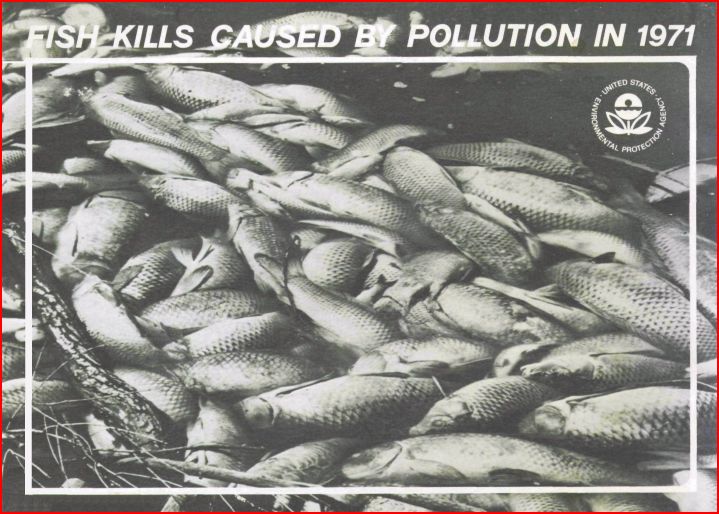
Cover of 1971 EPA publication, Fish Kills Caused By Pollution in 1971.

Cover of 1971 EPA publication, Fish Kills Caused By Pollution in 1971. According to the publication, in Texas, in 1971, 16 million fish died in just 6 pollution-caused incidents. (page 9 of the report).

One of the most spectacular fish kills of recent years occurred in the Colorado River below Austin, Texas, in 1961. Shortly after daylight on Sunday morning, January 15, dead fish appeared in the new Town Lake in Austin and in the river for a distance of about 5 miles below the lake. None had been seen the day before. On Monday there were reports of dead fish 50 miles downstream. . . . By January 21, fish were being killed 100 miles downstream. . . . During the last week of January the locks on the Intracoastal Waterway were closed to exclude the toxic waters from Matagorda Bay and divert them into the Gulf of Mexico.

. . . investigators in Austin noticed an odor associated with the insecticides. . . The manager of the (chemical) plant admitted that quantities of powdered insecticide had been washed into the storm sewer recently and, more significantly, he acknowledged that such disposal of insecticide spillage and residues had been common practice for the past 10 years.

. . . For 140 miles downstream from the lake the kill of fish must have been almost complete, for when seines were used later in an effort to discover whether any fish had escaped they came up empty. Dead fish of 27 species were observed, totaling about 1000 pounds to a mile of riverbank.

Rachel Carson, 1962, Silent Spring

Cribbed from the US Geological Survey site.


Nutshell: The case against the critics of Rachel Carson

July 9, 2007

Mothers who read Rachel Carson’s book asked supermarkets to stop carrying produce or other products laced with DDT, as a precaution against damage to their children. It’s appropriate that a mom’s blog would make the case against Carson’s critics so succinctly, so go read it.


Another reason why DDT use damages mosquito control: Bats

July 9, 2007

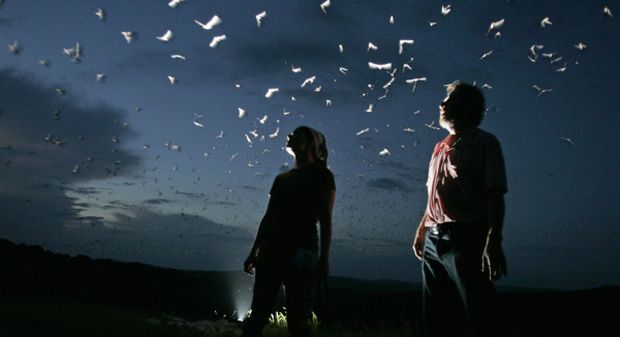
Erich Schlegel photo, bats leaving a cave near Frio, Texas, U of Tenn researchers look on

UTenn grad student Noa Davidai (L) and Prof Gary McCracken watch bats come out of Frio Cave

  • Photos by ERICH SCHLEGEL/DMN

University of Tennessee graduate student Noa Davidai (left) and professor Gary McCracken watch freetail bats emerge from the Frio Cave near Uvalde, Texas. They study the range and value of bats, such as insect control for farmers. And ‘fecal rain’? That enriches soil, Dr. McCracken says. (Dallas Morning News, July 9, 2007, p. 1)

It’s easy to understand. Look at the on-line Dictionary.com definition of the Mexican free-tailed bat, for example:

Mexican free-tailed bat

–noun

any of several small, insect-eating bats of the genus Tadarida, of Mexico and the southwestern U.S., inhabiting limestone caves: residual DDT has reduced most populations.

Dictionary.com Unabridged (v 1.1)
Based on the Random House Unabridged Dictionary, © Random House, Inc. 2006.

Was that difficult? It’s right there in the definition of the animal: DDT kills bats.

Bats eat mosquitoes, those things that carry malaria and other diseases. A Mexican free-tailed bat eats about 70% of its body weight in mosquitoes, every night.

This morning’s Dallas Morning News has a front page story, with great photo, on the value of bats in Texas, “Taking bats to the bank.”

Researchers have long known that bats in Texas caves dine on insect pests. But just how many bats there are and the value of their feeding had proved elusive until a five-year, $2.4 million National Science Foundation study by scientists from Boston University, the University of Tennessee, the U.S. Department of Agriculture and Texas Parks and Wildlife.

From sundown to sunup, the freetail bats consume a staggering 400 metric tons of insects a year in the Winter Garden, or 2 million pounds each night. They range over a radius of 75 miles and feed from ground level to 10,000 feet.

The bats help save $1.7 million annually by preventing crop damage and additional pesticide use in the eight-county Winter Garden, which produces $6 million in cotton each year, according to the report by the Boston University team.

“Most people think of bats as ugly or vile, but there is a real value they provide humankind,” said principal investigator Tom Kunz of Boston University. “The bats are a literal shield for this crop region. But until this project, no one developed a means to measure the specific economic value of bats to agriculture.”

From my experience with agriculture, that $1.7 million figure looks low, way low. Scientific studies like this tend to be very conservative, though, so we can say with great confidence that this is a floor figure.

DDT kills bats, and those bats who don’t die from eating DDT-laced insects often provide meals for predator birds, who then get a greater dose of the next-generation-killing chemical.

Studies have shown that the pesticide DDT often used by farmers in the 1950s and 1960s may also have led to the depletion of large numbers of Mexican free-tailed bats (Clark).The Carlsbad Caverns colony decreased steadily in size from nearly 20 million down to only a couple hundred thousand during the 1960s due to DDT use (Wilson 110).A study in 1974 documented levels of the toxin in fat stores the bats would accumulate before migration, and found that when those fat stores were metabolized during the long flight, DDT levels were high enough to kill many of the bats (Wilson 110).In addition, DDT ingested by mother bats was passed along to their young causing most of them to die before reaching maturity (Wilson 110).Clark’s follow up study in 2001 also showed levels of DDT in bat specimens from the 1950s and 1960s to be considerably higher than in specimens from later decades (Clark).These kinds of toxin levels would account for the dramatic decrease in the Carlsbad bat population.

All of this adds up to a conclusion that critics of Rachel Carson who make the wild claims that DDT is harmless, and that but for DDT mosquito control would have been achieved, and therefore malaria would be wiped out do not have a clue what they are talking about, and probably have some skullduggery in mind when they go after Rachel Carson. Ironically, overuse of DDT actually benefits mosquitoes in the U.S., killing the predators of mosquitoes and other crop and human pests, allowing the mosquitoes to breed and feed uninhibited.

In her book Silent Spring, Rachel Carson had noted a pesticide spill in Austin, Texas, which occurred in 1961 and virtually cleaned out all the fish in the Colorado River downstream — fish, of course, prey on mosquito larvae. DDT use in Texas, therefore, hammers mosquito abatement possibilities at both ends. Read the rest of this entry »


Whom the gods destroy, they first make mad

July 9, 2007

(Who said that, first?)

Vox Day writes a column at the abominable WorldNet Daily. Also he blogs.  Frequently he demonstrates the flight of reason from those pages, such as his column on July 7, in which he wrote:

What is interesting is observable evidence shows that even professional evolutionary biologists are increasingly frightened to expose themselves to the ridicule that the softness of their science renders them liable. Consider this recent post at the science blog Pharyngula by Dr. P.Z. Myers, a biologist and associate professor at the University of Minnesota, Morris, entitled Don’t Debate Creationists.

Why does that demonstrate Day’s flight from reason?  Here, let me explain.

First, Day establishes as his premise that real biologists, scientists who practice in the real world and actually understand Darwin and evolution, are “afraid to expose themselves to the ridicule that the softness of their science renders them liable.”  In short, he’s saying they don’t talk to the public.

His evidence?  He cites a blog post by P. Z. Myers, an evolutionary development biologist at the University of Minnesota, Morris, a co-founder of and frequent contributor to the evolution-promoting weblog Panda’s Thumb, and the creator and author of the science weblog Pharyngula.

So, what Day is saying is that Myers doesn’t bother to expose himself to public scrutiny despite Myers’ being a distinguished researcher and teacher who daily exposes himself to tens of thousands of readers on two of the most heavily trafficked blogs in the world — generally, many times each day — in addition to his work exposing himself to other scientists via his research publications, and through his teaching several classes. 

Right.  And preachers never speak, Pope Benedict is not Catholic, and polar bears don’t defecate on the ice or in the water.  Nor is the sky blue.

Of such evidence are most rants at WorldNet Daily made.


Upon these rocks . . .

July 9, 2007

. . . Ken Ham’s creationist museum is established. An amateur geologist/paleontologist in Cincinnati lets the rocks tell their own story. Interestingly, the story they cry out is not the one promoted by Ken Ham.

Tip of the old scrub brush to Panda’s Thumb and P. Z. Myers.


Buy a piece of a National Forest, help fund schools

July 8, 2007

I’m trying to figure out how to use this amazing spectrum of maps in class.

But, one set can do something good for schools:  You can buy a piece of a national forest, and thereby contribute to a fund to help schools.  It’s a bit of a crackpot idea, really — selling off the national forests to provide a minuscule amount of money for schools.  But there may be some gems of land out there that could be used for  .  .  . decreasing global warming by creating a preserve for trees.

Davey Crockett National Forest, parcels for sale:  This map shows land in Texas for sale.

Your local National Forest may be represented, too.  Get there before the developers?  Not likely — but you can dream, can’t you?

Please be warned, though, I find the site a real memory hog.  If you’re running several programs, and you’re memory deficient as I appear to be for this set of maps, be careful.

Seriously, the site offers a variety of maps of public lands under the jurisdiction of the Bureau of Land Management and National Forest Service.  Mineral leasing, oil and gas, coal, and other resources are mapped.  This affects the western public lands states mostly, but it could be a great source for a geography project on energy or mineral or timber resources for the nation.

What do you think?


Image of the moment: San Francisco de Asis without Adams or O’Keefe

July 6, 2007

Neither Ansel Adams nor Georgia O’Keefe noted the power lines, or the gas meter.

They must be recent additions.

The essential beauty of the church remains.

1549-san-francisco-de-asis-church-in-taos-july-5-2007.jpg

The original adobe construction of the church was completed in 1772 — four years prior to the Declaration of Independence. It is built in the shape of a cross, but structural weaknesses required the addition of buttresses, shown in the photograph — also of adobe.

A bad photograph of the church is almost impossible.

The interior is cool on a hot afternoon. Adobe construction offers significant advantages, even in the 21st century. The church hosts an active congregation, without air conditioning.

Photo: Copyright 2007, Ed Darrell; you may reproduce for educational or non-profit use, so long as attribution is attached. Attribution must be attached.

Welcome, visitors!  Please leave a comment, at least tell why you visited, and where you’re from.  Thank you.


Electronic imaging: Photography

July 6, 2007

If you care about such things and have been paying attention here, you may have noted that I do not often post material from my electronic camera. The reason is simple: I’m stuck in the film age.

We have four single-lens reflex cameras, and a couple of other 35mm film-using cameras that served us well for the past 30 years or so. We have some wonderful images, and lots of snapshots. An early experience with electronic images suggested the color might not be as good in purely electronic images, and of course, the detail . . .

Well, I borrowed son Kenny’s Canon PowerShot S70 for the current trip to New Mexico, and I think the results are spectacular. In only one category have I found a flaw: Extreme telephotography.

My thought is that teachers should get a good digital camera for use in creating images for classroom and internet use. No, not the clunky things most schools had that I’ve seen in the past four years — a good Canon or Nikon, or Sony or Fuji or Panasonic, or Kodak. Budget to update every two years or so for the school (the camera I’m shooting with is more than two years old, though).

There’s just no substitute for good images in teaching.

Student applies lessons in building with adobe, in Taos, New Mexico fieldtrip

Photo taken 12 hours ago, on July 5, 2007, of student James Darrell applying lessons in building with adobe, in an adobe house under construction in Taos, New Mexico.  Photo taken while photographer was balanced precariously atop a ladder and holding concrete forms.  Copyright 2007, Ed Darrell


Put Ezra Pound in your classroom

July 5, 2007

This is very, very encouraging.

Ezra Pound in 1971, in Italy

Here’s what eSchool News says about the archive:

July 1, 2007—Thanks to an online audio archive developed by professors at the University of Pennsylvania, recordings of Ezra Pound or William Carlos Williams can take their places on students’ iPods alongside tunes from Better than Ezra or Carlos Santana. Recordings of these two poets’ works are now available free of charge through PennSound, which features about 200 writers and more than 10,000 recordings contributed by poets, fans, and scholars worldwide. The two-year-old site recently acquired rare readings by Pound, some previously unknown. Hearing any poet “makes the poems easier to move into, in some cases,” said Tree Swenson, director of the Academy of American Poets in New York. “Our ears are less logical than our eyes, somehow.” Pound in particular, she said, “is a perfect example of a poet whose tone and phrasing is so distinctive.” While many web sites stream poetry readings, they require an active internet connection. With PennSound, files are downloadable in MP3 format and can be played offline and on portable devices such as iPods, said Charles Bernstein, an English professor and the site’s co-director.

http://writing.upenn.edu/pennsound

Wow. Ezra Pound may not have a lot of usage in high school classes, but the PennSound site features a lot of commentary by highly-qualified students of literature, and poets. There are good readings of classics by good readers, where the authors were long-dead before audio recording was invented — such as John Richetti reading Pope and Swift.

I think the material is not perfectly catalogued. Go look around the site to see what you can find.

This is wonderfully promising.

And, if you’re looking for poetry read aloud, check out The Poetry Foundation, too:  PoetryFoundation.org.  That site features the complete text to one of my favorite poems from contemporary poets, “The Shirt,” by the late Jane Kenyon.  Her husband, the poet Donald Hall, provided a reading of it for NPR once upon a time (here’s another reading by Hall of the same poem) (Here’s more on Hall as the nation’s Poet Laureate).

Poets reading poetry is often wonderful — take twice daily, repeat for the rest of your life.


Waving the flag liberally

July 5, 2007

Carnival of the Liberals has a special July 4 edition, up at Zaius Nation. It’s the Flag Waving edition — go give it a look, especially since the carnival features a sideshow from this blog!


Quote of the moment: Jefferson on the 4th of July

July 4, 2007

Thomas Jefferson to Roger Weightman, declining to attend the 50th anniversary of the Declaration of Independence in the District of Columbia. This was the last letter written by Jefferson, who died 10 days later, on July 4, 1826. –LB

Monticello, June 24, 1826

Respected Sir –

The kind invitation I receive from you, on the part of the citizens of the city of Washington, to be present with them at their celebration of the fiftieth anniversary of American Independence, as one of the surviving signers of an instrument pregnant with our own, and the fate of the world, is most flattering to myself, and heightened by the honorable accompaniment proposed for the comfort of such a journey. It adds sensibly to the sufferings of sickness, to be deprived by it of a personal participation in the rejoicings of that day. But acquiescence is a duty, under circumstances not placed among those we are permitted to control. I should, indeed, with peculiar delight, have met and exch anged there congratulations personally with the small band, the remnant of that host of worthies, who joined with us on that day, in the bold and doubtful election we were to make for our country, between submission or the sword; and to have enjoyed with them the consolatory fact, that our fellow citizens, after half a century of experience and prosperity, continue to approve the choice we made. May it be to the world, what I believe it will be, (to some parts sooner, to others later, but finally to all,) the signal of arousing men to burst the chains under which monkish ignorance and superstition had persuaded them to bind themselves, and to assume the blessings and security of self-government. That form which we have substituted, restores the free right to the unbounded exercise of reason and freedom of opinion. All eyes are opened, or opening, to the rights of man.

The general spread of the light of science has already laid open to every view the palpable truth, that the mass of mankind has not been born with saddles on their backs, nor a favored few booted and spurred, ready to ride them legitimately, by the grace of God. These are grounds of hope for others. For ourselves, let the annual return of this day forever refresh our recollections of these rights, and an undiminished devotion to them.

I will ask permission here to express the pleasure with which I should have met my ancient neighbors of the city of Washington and its vicinities, with whom I passed so many years of a pleasing social intercourse; an intercourse which so much relieved the anxieties of the public cares, and left impressions so deeply engraved in my affections, as never to be forgotten. With my regret that ill health forbids me the gratification of an acceptance, be pleased to receive for yourself, and those for whom you write, the assurance of my highest respect and friendly attachments.

Th. Jefferson

Cribbed entirely from Counterpunch. Tip of the old scrub brush to Bernarda, in comments on the previous post.

Read the Declaration of Independence today.


Oklahoma opposes civil rights? What is this?

July 4, 2007

Americans seeking justice and healing for crimes committed during the civil rights movement, from about 1953 through at least the 1970s, championed a proposed law that would establish a unit in the Justice Department to clear up some of these old cases before the perpetrators all die — sort of a civil rights cold case division.

H.R. 923 is called “The Emmett Till Unsolved Civil Rights Crime Act” in honor of the slain young boy whose murderers were convicted by a racist-tinged jury, and then bragged about the murder in a national magazine.

The bill passed the House of Representatives June 21, 422 to 2.

It was scheduled for a quick vote in the U.S. Senate, a unanimous consent motion, to speed the bill to President Bush, so the investigations can begin quickly.

Then that old curmudgeon hurdle to progress and to the 21st century, Oklahoma Republican Sen. Tom Coburn stepped in.  He put a “hold” on the bill, which is a notice that a senator has gross objections to a matter.  As a matter of courtesy in that great deliberative body, holds are honored.

The bill is dead, unless Coburn removes his hold.

Coburn may be a nice guy otherwise, but his recent holds, stopping action honoring Presidential Medal of Honor winner Rachel Carson, and now, delaying justice already too long denied, go beyond the pale of polite society.  These are thuggish actions.

I hope he’ll reconsider.  But if past history is any sign — his refusal to allow the Senate to vote to stop cockfighting was one mackerel by moonlight — he won’t.

Say a prayer for America today.  When justice and honor cannot be had in the U.S. Senate, because one man is a crank — when his saner colleagues cannot prevail upon him — our nation is in trouble.  Don’t fly your flag upside down today — but be sure it flies in protest of Sen. Tom Coburn’s inactions.