Michael Mann exhonerated again: E-mail thieves still at large

July 2, 2010

News from Pennsylvania State University.  The second investigation of Michael Mann, to determine whether he did not adhere to the high ethical standards of research scientists in activities revealed by e-mails stolen from East Anglia University late last year, concluded that Mann acted honorably.

Via Deltoid:

Penn State investigation concludes:

The Investigatory Committee, after careful review of all available evidence, determined that there is no substance to the allegation against Dr. Michael E. Mann, Professor, Department of Meteorology, The Pennsylvania State University.

More specifically, the Investigatory Committee determined that Dr. Michael E. Mann did not engage in, nor did he participate in, directly or indirectly, any actions that seriously deviated from accepted practices within the academic community for proposing, conducting, or reporting research, or other scholarly activities.

The decision of the Investigatory Committee was unanimous.

The person or persons who hacked into the computers at East Anglia University remain at large.

More:


Something to think about as you get your flag ready to fly for July 4

July 2, 2010

This is mostly an encore post, from last year.

July 4th is the 234th anniversary of the announcement of the Declaration of Independence.  I hope you’re thinking about how you’ll fly the flag this weekend in honor of the Declaration of Independence.

The resolution proposed by Richard Henry Lee calling for independence of the 13 colonies passed the Continental Congress on July 2, 1776.  The Declaration would be Thomas Jefferson’s crowning achievement, outshining even his presidency and the Louisiana Purchase.   John Adams wrote to his wife, Abigail, that July 2 would forever be marked by patriotic displays.

But the Declaration itself, which gave teeth to the resolution, was adopted two days later on July 4 — and that has come to be the day we celebrate.

Detail, John Trumbull's Signing of the Declaration of Independence - Theodor Horydczak photo, Library of Congress

Detail, John Trumbull's Signing of the Declaration of Independence - The committee of five presents the Declaration of Independence to John Hancock, the President of the Second Continental Congress; from left, the committee is John Adams, Robert Livingston, Roger Sherman, Thomas Jefferson, and Ben Franklin. Theodor Horydczak photo, Library of Congress

Adams didn’t miss a beat.  Who quibbles about a couple of days when the celebrating is so good?

Adams and Jefferson were two of the five-member committee the Congress had tasked to write a declaration.  Adams and Ben Franklin quickly determined to leave it up to Jefferson, who had a grand flair with words, and who had just written a couple of stirring documents for Virginia.  Roger Sherman and Robert Livingston, the other two members, went along.  And so it was that the Declaration of  Independence is almost completely the work of Thomas Jefferson.

Adams and Jefferson became friends only later, when they both served the nation at war as ambassadors to France, and then for Adams, to England.  A widower, Jefferson was taken in by Abigail Adams who worried about him.  After the war, Jefferson was in England when Adams was to meet King George III in a grand ceremony in which the king would accept the credentials of all the ambassadors of foreign nations to England.  As the king strode down the line, each ambassador or delegation would bow, the king would acknowledge them, the papers would be passed, and the king would move on.  Adams and Jefferson bowed.  King George moved on, ignoring them completely.

In such a case of such a snub, the snubbed foreigners usually made a quick exit.  Adams and Jefferson did not.  They stood at attention as if the king had treated them like all the rest, reversing the snub.  From the beginning, Americans and the United States pushed for more practical, reasonable, and compassionate government and relations.

Back in America in peacetime, and both members of the administration of George Washington, Adams and Jefferson fell out.  Secretary of State Jefferson favored a more limited federal government; Vice President Adams favored a more powerful one.  By the end of Washington’s second term, party politics had been well developed.  Adams defeated Jefferson in the election of 1796.  As was the law then, Jefferson was vice president as the runner-up vote getter in the electoral college; but Adams kept Jefferson out of all government affairs.  Perhaps because he didn’t have Jefferson to help, Adams’s presidency did not go well.  In the rematch election in 1800, one of  the bitterest fights ever, Jefferson’s party defeated Adams.  The gleeful Democratic-Republican electors all voted one ballot for Jefferson, the presidential candidate, and one ballot for Aaron Burr, the party’s vice presidential candidate.

Alas, that produced a tie vote in the electoral college.  Adams’s party, the Federalists, still held the House of Representatives before the new Congress came in.  A tie vote goes to the House for decision.  They could not bring themselves to vote for Jefferson, and the deadlock continued for 37 ballots.  Finally Jefferson’s former friend but now arch enemy Alexander Hamilton intervened, explaining that Burr was clearly the greater scoundrel, and the House elected Jefferson.  Adams slunk out of town, avoiding the inauguration.

It wasn’t until after 1809 when Benjamin Rush hoodwinked Jefferson into writing to Adams, and Adams to Jefferson, that the two became friendly again.  For the next 17 years Jefferson and Adams carried on perhaps the greatest series of correspondence in history between two great minds.  Letters went out almost daily, from Monticello, Virginia,  to Braintree, Massachusetts, and from Braintree to Monticello.  They discussed the weather, their families, old times, farming — but especially the republic they had been most instrumental in creating, and how it might be preserved, and prosper.  Eventually the letters became harder to read, both because their eyesight was failing, and because their penmanship deteriorated, too.

The ideas, however, flowed like a great river of freedom.

Letter from Thomas Jefferson to John Adams, August 15th, 1820 - Library of Congress image

Letter from Thomas Jefferson to John Adams, August 15th, 1820. From The Thomas Jefferson Papers at the Library of Congress, Thomas Jefferson Papers Series 1. General Correspondence. 1651-1827. Library of Congress image

Both men took ill early in 1826.  This was a landmark year, 50 years since the Declaration of Independence.  In Massachusetts, a grand display of fireworks was to cap off a day of feasting and celebration.  Adams hoped he might attend.  In Virginia, a week before, it became clear Jefferson was too ill to venture even as close as Charlottesville for the celebration.  Jefferson slept through most of July 3, but awoke about 9:00 p.m., and asked, “This is the fourth?”  It was not.  These are the last significant, recorded words of Jefferson.  He awoke at about 4:00 a.m. on the Fourth of July, 1826, but could not make a rally.  He died at 12:50 in the afternoon.

Adams, too, was too ill to attend the celebrations.  In the late afternoon or early evening of the Fourth, he awoke, and heard the celebration in the town.  Almost as if he had worked just to live to see that particular day, he checked the date.  Realizing he was near the end, happy that he’d seen 50 years after the Declaration, and unaware of the events earlier that day in Virginia, Adams said, “Thomas Jefferson still survives.”  Adams, too, died on July 4, 1826.

Fly your flag July 4th. Remember John Adams and Thomas Jefferson.  Remember their great work in creating the nation that protects our freedoms today.  Remember their great friendship.  Write a letter to a good friend you’ve not written to lately.

It is Independence Day this Sunday.  Their spirit survives in us, as we celebrate, and if we remember why we celebrate.


Skeptics noise broad; no deep effects on American opinions

July 2, 2010

A commenter with the handle Klem complained about my outlook on global warming issues, in a recent post about the desperation I see in the warming denialist world.  Klem finds my views not pessimistic enough:

Those purloined emails have ultimately destroyed the IPCC, it has no credibility with the public anymore. You seem like a smart guy but I can’t believe after this amount of time you still don’t understand this. And you say it’s the anti-warming camp which is desperate? Oops I think you’re in denial.

I’ve been involved in environmental issues since well before the first Earth Day.  Lack of understanding among the public at large is a constant issue, and not a recent development.  Lack of support for a clean environment rarely is an issue, however.  The old progressive era push for clean water, clean air, outdoor activities, and healthy living, continues probably stronger today than ever before.  No one defends smoking stacks as symbols of progress anymore.

Even petroleum companies spend millions in advertising to tout their “green” tendencies.  Big Oil doesn’t spend money like that if they don’t have clear indicators that it’s effective.

One indication of how deep is the desire for environmental protection is the mini-movement chronicled and maybe led by conservative writer Rod Dreher, known as “crunchy conservatism.” Dreher wrote about conservatives who, from most outward appearances — Birkenstock sandals, organic-food heavy diets, environmentally-friendly yards and homes — might be considered lefty environmentalists, but who adhere to conservative social and economic policies, and the Republican party (yes:  educated people who vote against their own best interests; go figure).

No matter how odd their views on economics, no matter how odd their views on their fellow humans, they recognize the basic benefits of the progressive movement on their own lives, and they would like to conserve those benefits.

Have the so-called skeptics changed those trends?  Did the stealing of e-mails convince most Americans that scientists are evil, conniving, and wrong?

Rather than take the denialists’ methods, the famous MSU technique*, how about we actually ask people what they think?

Recent polls with some depth on environmental issues show most Americans to be quite  level-headed about warming and other environment issues, and not so subject to the hot winds of talk-without-fact from Fox News, the Heartland Institute, or other paragons of science denialism.

Most Americans remain concerned about global warming

Pay attention to reality for a moment; the headline on the press release is, “Large majority of Americans still believe in global warming, Stanford poll finds”:

Three out of four Americans believe that the Earth has been gradually warming as the result of human activity and want the government to institute regulations to stop it, according to a new survey by researchers at the Woods Institute for the Environment at Stanford University.

The survey was conducted by Woods Institute Senior Fellow Jon Krosnick, a professor of communication and of political science at Stanford, with funding from the National Science Foundation. The results are based on telephone interviews conducted from June 1-7 with 1,000 randomly selected American adults.

“Several national surveys released during the last eight months have been interpreted as showing that fewer and fewer Americans believe that climate change is real, human-caused and threatening to people,” Krosnick said. “But our new survey shows just the opposite.”

For example, when respondents in the June 2010 survey were asked if the Earth’s temperature probably had been heating up over the last 100 years, 74 percent said yes. And 75 percent said that human behavior was substantially responsible for any warming that has occurred. Krosnick has asked similar questions in previous Woods Institute polls since 2006.

“Our surveys reveal a small decline in the proportion of people who believe global warming has been happening, from 84 percent in 2007 to 74 percent today,” Krosnick said. “Statistical analysis of our data revealed that this decline is attributable to perceptions of recent weather changes by the minority of Americans who have been skeptical about climate scientists.”

In terms of average Earth temperature, 2008 was the coldest year since 2000, Krosnick said. “Scientists say that such year-to-year fluctuations are uninformative, and people who trust scientists therefore ignore this information when forming opinions about global warming’s existence,” he added. “But people who do not trust climate scientists base their conclusions on their personal observations of nature. These ‘low-trust’ individuals were especially aware of the recent decline in average world temperatures; they were the ones in our survey whose doubts about global warming have increased since 2007.”

According to Krosnick, this explanation is especially significant, because it suggests that the recent decline in the proportion of people who believe in global warming is likely to be temporary. “If the Earth’s temperature begins to rise again, these individuals may reverse course and rejoin the large majority who still think warming is real,” he said.

Ah, the Fickle Public — it appears only a small fraction of the public is fickle, after all.  Shifts in public opinion on the reality of warming were driven by weather, not weather men.

The poll also specifically addressed the effect of the computer break-in that exposed a few thousand e-mail messages from climate scientists under attack by anti-green critics:

‘Climategate’

“Overall, we found no decline in Americans’ trust in environmental scientists,” Krosnick said. “Fully 71 percent of respondents said they trust scientists a moderate amount, a lot or completely.”

Several questions in the June survey addressed the so-called “climategate” controversy, which made headlines in late 2009 and early 2010.

“Growing public skepticism has, in recent months, been attributed to news reports about e-mail messages hacked from the computer system at the University of East Anglia in Britain – characterized as showing climate scientists colluding to silence unconvinced colleagues – and by the discoveries of alleged flaws in reports by the Intergovernmental Panel on Climate Change (IPPC),” Krosnick said. “Our survey discredited this claim in multiple ways. ”

For example, only 9 percent of respondents said they knew about the East Anglia e-mail messages and believed they indicate that climate scientists should not be trusted, and only 13 percent said the same about the controversial IPPC reports.

That may explain why Anthony Watts’ logo for his Australian tour shows a kangaroo whose rear end has just been kicked (you can tell by the stars).

Climate skeptics butt-kicked in Australia logo

In cartoons, stars show where a character has been punched or kicked, right?

No agreement to control greenhouse gases came out of the Copenhagen conference last fall.  So-called climate skeptics patted each other on the back, claimed victory, and proceeded to send Christopher Monckton on his Bonnie Lies All Around the World Tour.  In cool light of morning, however, the facts can’t be silenced:  Warming continues, science shows the extremely high probability that humans cause it, official investigations show that climate scientists who had their e-mails stolen were victims of crime, not perpetrators, and climate skeptics failed to stop warming with their big-dollar, nice-banquet meetings with the Heartland Institute, or anywhere else.

If they are skeptics, they are pretty bad at it, falling like chumps for a story that fourth-grade science project made the case they have failed to make everywhere else, and for the story that one of their comrades was sent a bomb in the mail (it turned out to be a misdirected fuel filter).

No wonder Americans remain concerned about warming.

_____________

* Make S[tuff] Up

More, resources:


Texas Democrats in convention, 2010, Corpus Christi

July 1, 2010

Texas Democrats convention in Corpus Christi, June 26, 2010 - photo by Ed Darrell

Texas Democrats convention in Corpus Christi, June 26, 2010 - photo by Ed Darrell - Click picture for a larger view

Even with all the other wonderful distractions at political conventions — speeches, caucuses, t-shirts, posters and bumpersticker sales, great parties, and old friends — people watching is a key activity.  Democratic conventions are a lot more fun than Republican conventions, in my opinion, solely for the diversity of people who show up as delegates.

This is a panoramic shot from my seat in the 23rd Senatorial District Delegation, during a break to count delegate votes on some issue in the morning. In the afternoon, Jack’s Lounge (the bright blue room opening in the upper left) filled up with delegates cheering the U.S. against Ghana in the World Cup, and TCU against UCLA in the College World Series.  Click the picture for a larger view.

Are you in this picture somewhere?

Texas Democratic Convention, Saturday, July 26, 2010 - floor shot - photo by Ed Darrell

Texas Democratic Convention, Saturday, July 26, 2010, a shot from the floor - photo by Ed Darrell


Ed Brayton on the unbearable lightness of anti-Obama thought

July 1, 2010

This is why I like Ed Brayton’s blog, and why you should be reading him with some regularity: his ability to distinguish dross from gold, sometimes even without turning on his solid gold Hemingway s— detector.

Today’s example comes from Brayton’s Dumb[burro] Quote of the Day feature:

From Rick “Man on Dog” Santorum:

“Obama is detached from the American experience. He just doesn’t identify with the average American because of his own background. Indonesia and Hawaii. His view is from the viewpoint of academics and the halls of the Ivy league schools that he went to and it’s not a love of this country and an understanding of the basic values and wants and desires of its people.”

Isn’t that amazing? He’s unable to understand “the American experience” both because of his humble upbringing and because of his elite Ivy League education.

That leaves completely unexplained Rick Santorum’s detachment from the American experience, and detachment from reality.

One non-explanation at a time, I suppose.


Very large bird

June 30, 2010

DFW Airport - Kenny Darrell leaves for Greece

Kathryn, Kenny, Kenny's grandfather Ken Knowles, under the giant wishbone at DFW Airport

Actually, he’s been in Crete now for two weeks, and he’s deep into training for how to teach.  I’m just slow on getting the posts up.

Kenny left for Greece, despite the lack of visitor facilities on either side of the TSA checkpoints, we all went along for the ride and the farewell, Kathryn, Kathryn’s father Ken Knowles, and I.  Airport art and history displays always fascinate me — there are some great pieces hidden away in U.S. airports.  Sometimes the airlines even spring to pay for the stuff (I wonder how much this thing cost).

A great place for a photo of a family  wishing someone bon voyage. A wishbone, how appropriate.  Was this just a coincidence, or is it a little, pricey arty joke?  “Silver bird.”  Oh.  Right.

It’s metal.  I think it’s the wishbone of a Boeing 767.

Kenny leaves for Greece - detail - IMGP2085

Kenny Darrell and his grandfather, Ken Knowles; DFW Airport, under the giant wishbone -- Kathryn snapping a shot at the right.

Bon voyage, Kenny!

Terry Allen sculpture, Wish, 2005 (DFW Airport)

Terry Allen sculpture, Wish, 2005 (DFW Airport)

More:


Desperation shows in the anti-warming camp

June 30, 2010

Willis Eschenbach, whose credentials I do not know, is back for another guest post at Watt’s Up With That.

Eschenbach contests conclusions drawn by the U.S. House of Representatives Select Committee on Energy Independence and Global Warming, about the effects of warming in New England.

In a probably-unintentionally humorous way, Eschenbach shows just how desperate grow the anti-warming camp.  The purloined e-mails show no wrong-doing, and worse for denialists, no significant errors in the case that global warming occurs and is problematic.  Legislation to fight climate change has a chance of passing this Congress.  EPA promulgated rules on measuring CO2 and other greenhouse gases, and Alaska Sen. Lisa Murkowski’s resolution to stop EPA failed in the Senate.  There was the hoax about the fourth-grade science project claimed to refute Nobel-quality research, and then there was the bungled story that mistakenly claimed a solar-energy company sent a non-working bomb to an economics professor in Spain in revenge for his paper against government support of green energy.  One can see how such a string of losses might set back the hopes of even the most delusional denialist.

Either ignorant of Godwin’s Law, or so desperate he thinks it worth the gamble, Eschenbach quoted somebody (did he ever name who?) going on about the Big Lie technique attributed to the Nazis in establishing policy in Germany before and during World War II.

Mike Godwin, discoverer of Godwin's Law - Wikimedia image

Mike Godwin, discoverer of Godwin's Law - Wikimedia image

Is there a more plaintive or pitiful way to say one is over one’s head and has run out of argumentative gasoline?

Eschenbach’s case is not particularly strong — he pulled temperature data (he said) from the U.S. Historical Climatology Network (USHCN) to make charts showing, Eschenbach claimed, there is no 4°F rise in average New England winter temperatures since 1970.

After a couple of skirmishes to see whether Watts’ watchdogs still prevent my posting, I offered a small rebuttal that, of course, slipped quickly into the abyss of Watts Moderation.  It may eventually escape that particular eddy, but in case it doesn’t, here’s the post:

Tim Neilson asks:

PS Ed Darrell – do you have any evidence refuting the post?

Most claims of someone practicing “big lie” tactics are self-refuting, the opposite of a self-proving document under the law. Is this any exception? Mr. Eschenbach offers no evidence to suggest that a committee of Congress publishes material it knows to be wrong for propaganda effect. (The quotes relating to Hitler comprise a grand rhetorical tactic known as “red herring.” The mere presence of that material, were we to apply Godwin’s law, refutes Mr. Eschenbach’s case.)

There is no evidence to refute.

Mr. Eschenbach offers a few jabs at data that show the effects of warming in New England, but he does not appear to bother to look at the data the committee used. This is a bait-and-switch tactic of argumentation that most rhetoricians would label a spurious. Does Eschenbach rebut or refute the committee’s data? How could anyone tell?

The site of the committee, the House Select Committee on Energy Independence and Global Warming, offers several arguments to suggest changes in New England from warming might pose problems. So far as I see, Mr. Eschenbach addresses only one of those arguments, and that one incompletely.

1. The committee claims that average winter temperatures in New England have risen by 4 degrees F since 1970. Eschenbach offers a chart that, so far as I can tell, confirms the committee’s claim — but Eschenbach uses a chart that covers a much longer period of time, and offers it in a way that makes it difficult to determine what temperatures are, let alone what the trend is (IMHO, the trend is up, and easily by 4 degrees in Eschenbach’s chart). Oddly, he illustrates the chart by showing a surfer in a wet suit, surfing in winter in New England. Surfing is generally a warm-weather enterprise, and though the man has a wetsuit, and though the Gulf Current would warm those waters, the picture tends to deny Eschenbach’s claim, doesn’t it? If it’s warm enough to surf in winter, it’s warmer than the Rime of the Ancient Mariner.

And look at the actual numbers — Eschenbach confesses a rise of 2.7 degrees, roughly 9/13 of the rise he intends to deny. Heck, that nearly-three degree rise is enough to cause concern, or should be.

2. The committee notes warmer temperatures would put more precipitation as rain, and not snow. Eschenbach offers no comment on this. Ski seasons in New England have suffered recently because it’s been too warm to keep natural snow, and too warm to make artificial snow (68 degrees F on January 6, 2007). (This is a national concern, by the way.) If the committee errs in this claim, Eschenbach offers no data.

And especially, he offers no data to back his “big lie” claim, that the committee knows differently from what it says.

3. The committee notes that warmer temperatures produce later autumns — a huge impact on tourist revenue in New England, where an enormous travel industry has built up around watching the changing colors of the trees. Such a change would be consistent with other long-term observations, such as those by the Department of Agriculture and Arbor Day Foundation, that the plant zones across America show warming (and some cooling).

Eschenbach doesn’t contest this in any way. Should we presume this is Eschenbach’s agreement that this claim is not a “big lie” claim?

3. The committee refers to warming oceans, and the potential effects on certain parts of the fishing industry, especially cod and lobster. This is caused by ocean warming, not atmospheric warming — so Eschenbach is again silent on this claim. The committee’s claim tends to undercut Eschenbach’s claim of a “big lie” here, and Eschenbach offers no support for his own argument.

4. The committee refers to greater storm damage due partly to rising sea levels. Eschenbach offers no rebuttal of any sort.

Eschenbach fails to make a prima facie case for his big lie claim, and his rebuttal is restricted solely to one measure of temperature that Eschenbach fuzzes up with an unclear chart.

May I ask, since you style yourself a skeptic, what evidence you found in the post that makes a case at all?

Will it ever see light of day at WUWT?

Update: Yes, it sees the light of day at WUWT.  Maybe all my kvetching had an effect.

Don’t let crabby blog moderators frustrate you; share the information:

Add to FacebookAdd to NewsvineAdd to DiggAdd to Del.icio.usAdd to StumbleuponAdd to RedditAdd to BlinklistAdd to TwitterAdd to TechnoratiAdd to Furl


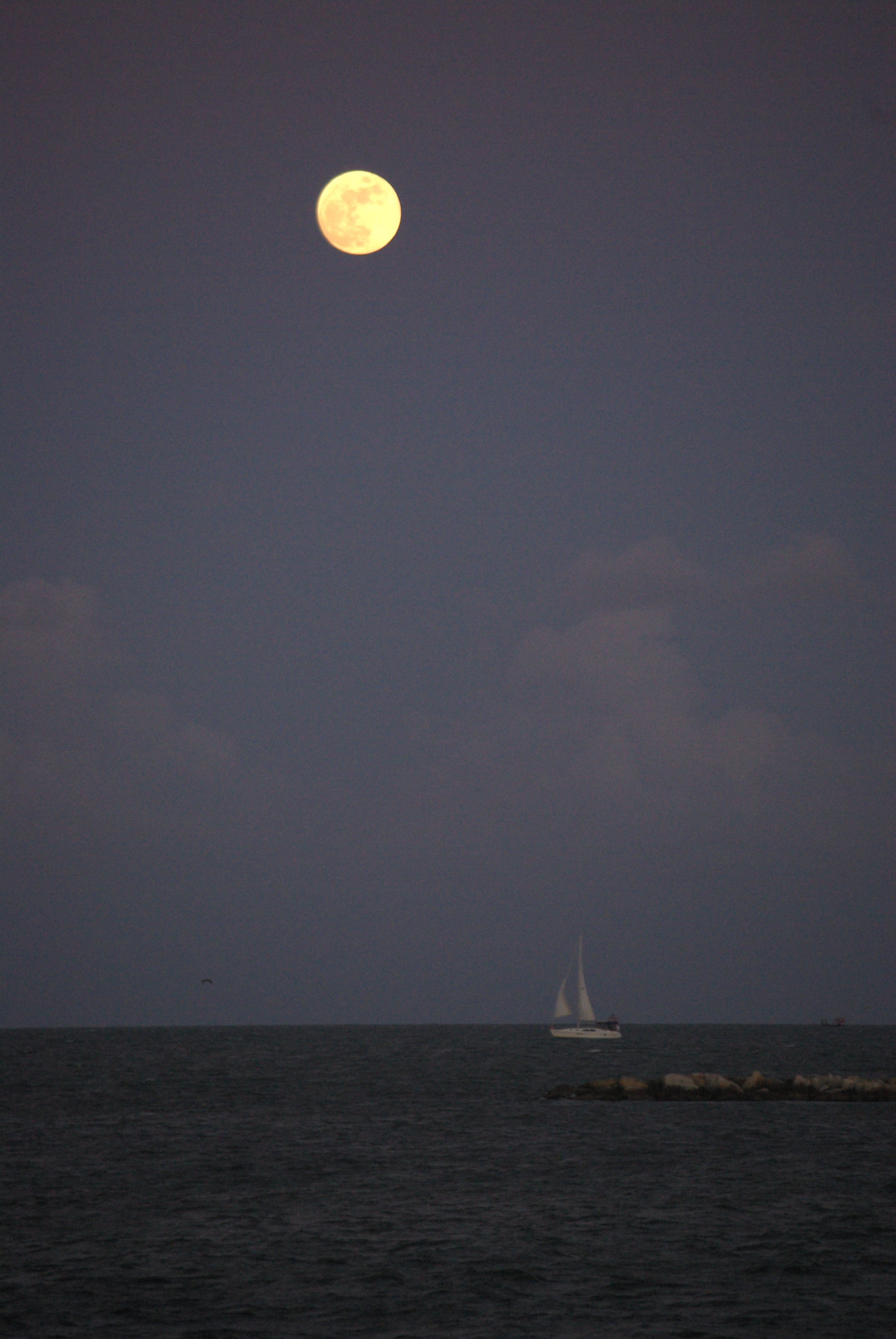
Full moon, sailing tide for Democrats in Corpus Christi

June 29, 2010

Moon over Corpus Christi Bay, June 25, 2010 - photo by Ed Darrell

Moon over Corpus Christi Bay, June 25, 2010 - photo by Ed Darrell; use permitted with attribution

This is the scene that greeted delegates to the Texas Democratic Convention as they left the American Bank Center in Corpus Christi, Texas, at about 8:00 p.m. last Friday, June 25.  (Natural light photo, handheld, 1/60th exposure at ISO 400)

The Moon was near full, and the tide was good for sailing.

Delegates had just heard Bill White accept the party’s nomination for governor.

In my brief period as a Sea Scout, I most enjoyed evening and night sailing.  Water is astoundingly quiet at dusk and later, when sailing.  In Corpus Christi I got a half-dozen shots and lamented I didn’t have a tripod, to get a better shot of the Moon.

Actually, the tide was on the way out at 8:00 p.m. — it had peaked about about 1:10.  But it was still good for sailing.

I thought of Shakespeare:

There is a tide in the affairs of men
Which, taken at the flood, leads on to fortune;
Omitted, all the voyage of their life
Is bound in shallows and in miseries.
On such a full sea are we now afloat,
And we must take the current when it serves,
Or lose our ventures.

(Julius Caesar, Act IV.ii.269–276)


Quote of the moment: Frank Zappa, on hydrogen or stupidity

June 29, 2010

Some scientists claim that hydrogen, because it is so plentiful, is the basic building block of the universe. I dispute that. I say there is more stupidity than hydrogen, and that is the basic building block of the universe.

Cover of The Real Frank Zappa Book

Cover of The Real Frank Zappa Book - Wikimedia image

—  Frank Zappa and Peter Occhiogrosso: The Real Frank Zappa Book , 1989, page 239

Actually, I think the claim is that hydrogen is the most common element in the universe, since it’s so simple.  Its abundance is a result of that simplicity.

Physics in 2010 would probably go for dark matter as even more plentiful than hydrogen, but so little is known about dark matter.  As we learn more about dark matter, we could discover Zappa was a physics theorist before his time.  It’s a short line from Zappa to Zwicky.

______________

I’m relieved to have a credible source for the quote — I had found it attributed to Einstein, another case of Darrell’s Law of Quote Misattribution (“any good quote whose source is unknown will be attributed to Jefferson, Lincoln or Einstein; consequently any quote attributed to those people should be sourced before being taken as accurate”).

A couple more I’d like to put to bed, both attributed to Einstein:

  • “The difference between genius and stupidity is that genius has its limits” (from a coffee mug I got years ago at the late Shakespeare, Beethoven & Co.).
  • “Coffee makes me smart” (from another coffee mug).
Simulation of the distribution of dark matter haloes - Max Planck Institute

Simulation of the distribution of dark matter haloes - Max Planck Institute

Like this post? Please share:

Add to FacebookAdd to NewsvineAdd to DiggAdd to Del.icio.usAdd to StumbleuponAdd to RedditAdd to BlinklistAdd to TwitterAdd to TechnoratiAdd to Furl


EPA posts greenhouse gas reporting requirements

June 29, 2010

What’s that racket, that squealing, that ‘stuck’ pig noise?

Orbitals model of sulfur hexafluoride (SF6) - Wikimedia image

Space-filling model of sulfur hexafluoride (SF6) - Wikimedia image. Sulfur hexafluoride is one of the most powerful greenhouse gases known, with "global warming potential" 22,800 times that of CO2. EPA proposes to measure SF6 emissions as a first step toward reducing emissions. Warming deniers propose to stop the regulations.

EPA published regulations for measuring greenhouse gases as part of its CO2 emission regulatory program — and the noise is the reaction of the anti-warmists.

Here’s EPA’s press release — notice the links to longer explanations, and note especially that the regulations are not final yet, but are instead open for public comment.

FOR IMMEDIATE RELEASE
June 29, 2010

EPA Issues Greenhouse Gas Reporting Requirements for Four Emissions Sources

Agency also to consider data confidentiality

WASHINGTON The U.S. Environmental Protection Agency (EPA) is finalizing requirements under its national mandatory greenhouse gas (GHG) reporting program for underground coal mines, industrial wastewater treatment systems, industrial waste landfills and magnesium production facilities. The data from these sectors will provide a better understanding of GHG emissions and will help EPA and businesses develop effective policies and programs to reduce them.

Methane is the primary GHG emitted from coal mines, industrial wastewater treatment systems and industrial landfills and is more than 20 times as potent as carbon dioxide at warming the atmosphere.  The main fluorinated GHG emitted from magnesium production is sulfur hexafluoride, which has an even greater warming potential than methane, and can stay in the atmosphere for thousands of years.

These source categories will begin collecting emissions data on January 1, 2011, with the first annual reports submitted to EPA on March 31, 2012.

In a separate proposed rule, EPA is requesting public comment on which industry related GHG information would be made publicly available and which would be considered confidential. Under the Clean Air Act, all emission data are public. Some non-emission data, however, may be considered confidential, because it relates to specific information which, if made public, could harm a business’s competitiveness. Examples of data considered confidential under this proposal include certain information reported by fossil fuel and industrial gas suppliers related to production quantities and raw materials. EPA is committed to providing the public with as much information as possible while following the law.

The GHG reporting program requires suppliers of fossil fuels or industrial GHGs and large direct emitters of greenhouse gases to report to EPA.  Collecting this data will allow businesses to track emissions and identify cost effective ways to reduce emissions.  EPA is preparing to provide data to the public after the first annual GHG reports are submitted in March 2011.

There will be a 60-day public comment period on the proposed rules that will begin upon publication in the federal register.

More information on the final rule to add reporting requirements for four source categories:

http://www.epa.gov/climatechange/emissions/remaining-source-categories.html

More information on the proposal on data confidentiality:

http://www.epa.gov/climatechange/emissions/CBI.html

R227

These regulations are those complained about and proposed to be stopped by critics of the campaign to stop global warming.  Alaska’s pro-warming Sen. Lisa Murkowski introduced a resolution to stop these regulations, with the support of junk science lobbyists including the National Center for Policy Research.  Fortunately, on June 10 the Senate voted 47-53 to reject a motion to consider the resolution, S. J. Res. 26, “A joint resolution disapproving a rule submitted by the Environmental Protection Agency relating to the endangerment finding and the cause or contribute findings for greenhouse gases under section 202(a) of the Clean Air Act.”

Both of Texas’s senators were suckered by the junk science.  Sen. John Cornyn and Sen. Kay Bailey Hutchison both co-sponsored the losing resolution.  Texas Gov. Rick Perry and Attorney General Greg Abbott filed suit to stop the regulations.  Abbott’s opponent in the 2010 elections, Barbara Ann Radnofsky, probably the only one of these Texans who might understand sulfur hexafluoride’s role as a pollutant, criticized the suit and urged Abbott to spend his time protecting Texas oil fields from oil company sabotage.

Help control emissions from climate “skeptics,” and spread the good word:

Add to FacebookAdd to NewsvineAdd to DiggAdd to Del.icio.usAdd to StumbleuponAdd to RedditAdd to BlinklistAdd to TwitterAdd to TechnoratiAdd to Furl


Educating for a creative society

June 29, 2010

Just as a reminder about what we’re doing in education, I hope every teacher and administrator will take three minutes and view this video (that allows you some time to boggle).

Surely you know who Tom Peters is.  (If not, please confess in comments, and I’ll endeavor to guide you to the information you need.)

Technically, Texas’s early elementary art standards are not so bad as Peters describes them.  But, check this document, from the Texas Education Code (§117.1. Implementation of Texas Essential Knowledge and Skills for Fine Arts, Elementary).  Do a search of the Texas standards and count how many times students are expected to stay “within guidelines.”


Community colleges pushed to become diploma mills

June 28, 2010

Zeno at Halfway There describes a terrible situation in California community colleges — not unlike the situation Texas high schools face.  Don’t tell Texas Republicans, they’ll want to adopt it for community colleges, too.

State senator Carol Liu is the author of SB 1143, a measure which would somehow incorporate course completion rates in the formula for computing state funding for community colleges. Think about that for a moment. (Try giving it more thought than our legislators do.) Colleges that pass more students through their curriculum will get more funding. Colleges that pass fewer will get less. At first blush, that might seem reasonable.

Liu forgot, however, to include any quality standards in her bill. Schools that are willing to become diploma mills will prosper under her dollars for scholars program. The pressure to lower standards will be intense.


Which party encourages education in Texas?

June 28, 2010

You have the tools to compare the party platforms and determine for yourself which part supports education in Texas — I mean, really supports education, as opposed to using Doublespeak to profess support while angling to get a shiv in the back of education.

You can look at the 2010 Texas Republican Party Platform here.  There are brief mentions of education in other sections, but you’ll find education starting on page 12.  Texas Democrats put education up front, on page 2 (unofficial version, but the emphasis won’t change).

Education sections of the 2010 Texas Democratic Party Platform appear immediately previous to this post, in eleven sections.

Which party is more favorable to educating our children well?


2010 Texas Democratic Platform: Diversity

June 28, 2010

This post is tenth in a series on the education planks of the 2010 Texas Democratic Party Platform.

This is an unofficial version published in advance of the final version from the Texas Democrats, but I expect very few changes.

DIVERSITY

Texas Democrats support innovative approaches to ensure diversity in every Texas institution of higher education. We condemn intolerance on Texas campuses and encourage universities to develop and offer culturally diverse curricula, student activities, and student recruitment policies that promote understanding, respect and acceptance.


2010 Texas Democratic Platform: Community Colleges

June 28, 2010

This post is tenth in a series on the education planks of the 2010 Texas Democratic Party Platform.

This is an unofficial version published in advance of the final version from the Texas Democrats, but I expect very few changes.

COMMUNITY COLLEGES

Democrats recognize and support the essential role of Texas community colleges, where almost 60% of Texas post-secondary students are enrolled. By combining affordability, high quality and responsiveness to community needs, these institutions provide an education to those who would be otherwise excluded.

Republicans have drastically reduced funding for community colleges and that burden has been shifted onto students, their families and property taxpayers. A significant funding increase would be needed just to restore Republican cuts to the 2002-3 state funding level, without adjusting for inflation. Not only do the Governor and Republican politicians again want to shift hundreds of millions of dollars in additional costs for employees’ group insurance onto students and local property taxpayers, they have already cut funding by 5% this year. And they are asking for an additional 10% in cuts to Republican budgets that currently allow only 4% of students eligible for Texas Equal Opportunity Grants to receive grants designated for community college students. To maintain community colleges’ role in providing lifelong education, we endorse:

  • full formula funding of the cost of instruction and of the growth in student enrollments;
  • fully state-funded full time employee group health insurance and proportional health benefits for adjunct instructors;
  • funding for new campuses and program expansions, especially in critical need programs, sufficient to meet Closing the Gaps goals;
  • rolling back tuition and fees that have increased over 50% under Republican control;
  • sufficient financial aid to cover 260,000 community college students who are eligible for grant assistance but receive none because state funding is inadequate; and
  • elimination of financial aid rules that penalize students who transfer to universities from community colleges.

To prevent further erosion of community colleges’ ability to serve their communities, Texas Democrats oppose:

  • proposals for “proportionality” that would shift group insurance costs onto students and property taxpayers;
  • shifting the basis of formula funding away from actual costs; and
  • “incentive programs that would discriminate against colleges and programs serving disadvantaged and non-traditional students or against non-degree skill-building and retraining programs.