American Education Week, November 7-13 (1943) – locked up in Manzanar

November 8, 2011

Education Week poster at Manzanar War Relocation Center, 1943 - Ansel Adams, Library of Congress

"A woman prepares a sign promoting American Education Week by attaching it to the wall of the Education Department office." Photo by Ansel Adams, 1943, at Manzanar War Relocation Center - Library of Congress collections

Just an ironic blast from the past, an Ansel Adams photograph of an interned American citizen of Japanese descent, putting up a poster celebrating “American Education Week,” at the Manzanar War Relocation Center, California.  Photo details:

  • Title: Education week sign / photograph by Ansel Adams.
  • Creator(s): Adams, Ansel, 1902-1984, photographer
  • Date Created/Published: [1943]
  • Medium: 1 photographic print : gelatin silver.
    1 negative : nitrate.
  • Summary: A woman prepares a sign promoting American Education Week by attaching it to the wall of the Education Department office.
  • Reproduction Number: LC-DIG-ppprs-00417 (b&w digital file from original print) LC-DIG-ppprs-00158 (b&w digital file from original neg.) LC-A35-T01-6-M-6 (b&w film dup. neg.)
  • Rights Advisory: No known restrictions on publication.
  • Call Number: LOT 10479-7, no. 20 [P&P]
  • Repository: Library of Congress Prints and Photographs Division Washington, D.C. 20540 USA
  • Notes:
    • Title transcribed from Ansel Adams’ caption on verso of print.
    • Original neg. no.: LC-A35-6-M-6.
    • Gift; Ansel Adams; 1965-1968.
    • Forms part of: Manzanar War Relocation Center photographs.

Theological disproof of evolution? Hornworms and braconid wasps

November 7, 2011

“Nature red in tooth and claw,” the poet Tennyson said.

Darwin thought these critters a clear disproof of creationism — no god would make such creatures intentionally!

Mark reports at The Divine Afflatus:

Hornworm Hosts its Destruction

While admiring some ground cherries outside my front door, I noticed a number of leaves had been stripped off. Not grazed on by the deer that frequent the area, more like eaten by caterpillars. After a brief search I spotted a hornworm munching away. I didn’t bother killing the hornworm because, after all, the ground cherries are weeds growing amongst the black-eyed susans, and it’s less work for me if they take care of the weeds.

I looked again a few days later, and saw that the hornworm had sprouted numerous white appendages. These are the cocoons of pupating braconid wasps. Braconid wasps are parasitoids that inject their eggs beneath the skin of the host (hornworms are favored by the braconid wasp Contesia congregatus). After feeding on the convenient meal surrounding them, the wasp larvae emerge and spin their coccons, attached to the body of the unfortunate hornworm. In a few days, adult wasps emerge from their cocoons, leaving a dead caterpillar.

I later spotted a second hornworm, which suffered the same fate as the first.

Ewwwwwwww!


How about we get a government big enough, strong enough, and smart enough to protect your right to vote?

November 7, 2011

Oy.  Here’s a doozy from the Northwest Progressive Institute Advocate newsletter:

Washingtonians who recently registered to vote using the Department of Licensing’s website may not have actually been added to the rolls, the Secretary of State’s office disclosed today in a late afternoon media advisory.

The Department of Licensing, which issues driver’s licenses, vehicle licenses, and boat licenses, allows voters to request that their voter registration be updated when they update their driver’s license. DOL also allows Washingtonians to register to vote when obtaining a license through its website.

But apparently, DOL hasn’t been forwarding these new and updated voter registrations to the Secretary of State’s office. Until last Friday, that is.

The Secretary of State’s office says a total of 21,000 voters may potentially be affected in some way by the blunder.

Here’s a more detailed explanation from co-elections director Katie Blinn:

When people update their address for their driver’s license with the state Department of Licensing, they can also request to update their address for voter registration purposes. This program is commonly known as Motor-Voter. DOL recently added a question about voter registration to its address update page on its website. However, the Secretary of State’s office has not been receiving these voter registration updates from DOL, and therefore has not been able to pass these updates on to the county elections offices. The Secretary of State’s Office just received the information Friday evening, just two business days before Election Day.

Obviously, ballots have already been mailed to voters, so this is a problem. The question is… how big of a problem?

Approximately 14,800 address updates were submitted to DOL that were not received by the Secretary of State’s Office. However, we think that county elections offices had already received some of these address changes due to voters contacting the elections office directly, or receiving address update information from the Post Office.

We think? Wouldn’t it be better to know for sure?

An additional 5,900 people requested to update their voter registration information on the DOL website, but were not previously registered. The information previously provided by the DOL address update system is not sufficient to complete a new voter registration so these people will be receiving a notice from their county elections office asking them to complete the registration. They can respond to the notice or fill out a new voter registration form. If anyone wants to vote in this General Election, they can go to their county elections office to vote a provisional ballot and complete the registration.

Great. So that means nearly six thousand people who thought they’d done what they needed to do to be added to the rolls didn’t actually get added, and now they’re going to have jump through more hoops in order to vote.

KING-TV Channel 5 points out a dispute between two arms of the state government, each giving different versions of the story behind why the 21,000 Washingtonians didn’t get their ballots as required by law.

Vodpod videos no longer available.

WA Secretary of State: As many as 21,000 ballot…, posted with vodpod

Is this the result of years of budget cuts?  Have we finally cut even great state governments like Washington to the point that they cannot even get the ballots out anymore?

Time to stop cutting government budgets, eh?


November 7, Elijah Lovejoy and the cause of abolition

November 7, 2011

Many key events on November 7.  November 17, 1917, the Bolshevik Revolution replaced the Kerensky government in Russia, for example.  The Bolsheviks pulled Russia out of World War I, and set the nation on a course towards soviet government whose advocacy of soviet communism would be one of the major issues of the 20th century.

Let us not forget the death of Elijah Lovejoy on November 7, 1837.  Lovejoy edited an abolitionist newspaper in Alton, Illinois — then a rival of St. Louis and larger than Chicago.

A pro-slavery mob murdered Lovejoy on November 7, 1837.  Details from the American Memory project at the Library of Congress; all links go to the Library of Congress sources:

Elijah Lovejoy

a page of text with a silhouette image of Lovejoy

Elijah Parish Lovejoy,

1891.

Prints & Photographs Online Catalog

On November 7, 1837, Elijah Parish Lovejoy was killed by a pro-slavery mob while defending the site of his anti-slavery newspaper The Saint Louis Observer. His death both deeply affected many individuals who opposed slavery and greatly strengthened the cause of abolition.

Sacramental Scene in a Western Forest
“Sacramental Scene in a Western Forest,”
Lithograph by P. S. Duval, ca. 1801,
from Joseph Smith, Old Redstone,
Copyprint. Philadelphia: 1854,
General Collections, Library of Congress.
Section VII: Religion and the New Republic,
Religion and the Founding of the American Republic

Lovejoy, who was born on November 9, 1802, in Albion, Maine, decided to seek his fortune in the Midwest after graduating from college. Short on funds, he walked to St. Louis, Missouri, where, over time, he became editor and part-owner of The St. Louis Times. His name appeared in the Times for the first time on August 14, 1830, and for the last time—as editor—on February 18, 1832.

In 1832, caught up in the powerful religious revival movement sweeping the U.S. and its frontier territories, Lovejoy experienced a conversion, which led him to sell his interests in the paper and enroll in Princeton Theological Seminary in New Jersey. Two years later, a group of St. Louis businessmen, who sought to start a newspaper to promote religious and moral education, recruited Lovejoy to return to the city as editor of The St. Louis Observer.

Lovejoy, supported by abolitionist friends such as Edward Beecher (the brother of Harriet Beecher Stowe, author of Uncle Tom’s Cabin), became ever more radical in his anti-slavery editorials. He first supported African recolonization then endorsed gradual emancipation. By 1835, he sanctioned abolition in the District of Columbia, and, by 1837, championed immediate universal emancipation.

Lovejoy’s editorials raised local ire while they increased national circulation. A group of local citizens, including the future Senator Thomas Hart Benton, declared that freedom of speech did not include the right to speak against slavery. As mob violence increased over the issue, Lovejoy, now a husband and father, decided to move his family to Alton, across the Mississippi River in the free state of Illinois.

Alton, Illinois

The City of Alton, Illinois,

1908.

Taking the Long View: Panoramic Photographs, 1851-1991

At the time Elijah Lovejoy moved to Alton it was “a booming town.” Alton had some 2,500 residents and was considered both the rival of St. Louis and a far more important Illinois city than Chicago.

Mobs had destroyed Lovejoy’s presses on a number of occasions, but when a new press arrived in November 1837, the violence escalated. No sooner was the new press offloaded from the steamboat Missouri Fulton than a drunken mob formed and tried to set fire to the warehouse where it was stored. When Lovejoy ran out to push away a would-be-arsonist, he was shot.

Throughout the North and West, membership in anti-slavery societies increased sharply following Lovejoy’s death. Yet officials in Illinois, with one exception, made little comment. Twenty-eight year old State Representative Abraham Lincoln stated publicly:

Let every man remember that to violate the law, is to trample on the blood of his father, and to tear the charter of his own, and his children’s liberty…Let reverence for the laws be breathed by every American mother…in short let it become the political religion of the nation…1

  • Search the collection Slaves and the Courts, 1740-1860 on Elijah P. Lovejoy and Alton Trials to find items pertaining to the progression of the Alton riots and the death of Reverend Elijah P. Lovejoy.
  • Learn more about the Second Great Awakening, the religious movement that swept the U.S. between the inaugurations of Thomas Jefferson and Abraham Lincoln. See Section VII of the online exhibition Religion and the Founding of the American Republic.
  • Search across the American Memory “Photos, Prints” collections on the terms Missouri and Illinois for more images. Search on the term press for images of a wide variety of printing presses more modern than those in use during the life of Elijah Lovejoy.
  • Search across all collections on the term press for images of a wide variety of printing presses more modern than those used during the life of Elijah Lovejoy.
  • See the Abolition section of the online exhibition The African American Odyssey: A Quest for Full Citizenship which discusses anti-slavery movements in the nation, and the rise of the sectional controversy.

1 Paul Simon, Freedom’s Champion: Elijah Lovejoy (Southern Illinois University Press: 1994), 163.


Oklahoma earthquake swarm, November 2011?

November 6, 2011

Is it enough to call it a swarm?  Oklahoma hadn’t had a quake of great signficance in about 30 years, but they had a 5.6 and a 4.7  yesterday — and look at this list for today and yesterday from the USGS (list will probably change at USGS as time moves on):

MAG UTC DATE-TIME
y/m/d h:m:s
LAT
deg
LON
deg
DEPTH
km
LOCATION
MAP 3.3 2011/11/06 18:26:56 35.478 -96.864 5.0 4 km ( 2 mi) SE of Meeker, OK
MAP 3.7 2011/11/06 17:52:34 35.547 -96.819 5.0 7 km ( 4 mi) S of Sparks, OK
MAP 3.9 2011/11/06 15:07:05 35.535 -96.909 5.0 4 km ( 3 mi) NNW of Meeker, OK
MAP 3.2 2011/11/06 11:20:23 35.525 -96.883 5.0 3 km ( 2 mi) NNE of Meeker, OK
MAP 3.0 2011/11/06 11:16:20 35.523 -96.844 4.9 6 km ( 3 mi) ENE of Meeker, OK
MAP 3.4 2011/11/06 11:03:52 35.539 -96.825 5.0 8 km ( 5 mi) S of Sparks, OK
MAP 3.9 2011/11/06 10:52:35 35.567 -96.797 5.0 5 km ( 3 mi) SSE of Sparks, OK
MAP 4.0 2011/11/06 09:39:57 35.506 -96.865 5.0 3 km ( 2 mi) ENE of Meeker, OK
MAP 3.4 2011/11/06 09:22:04 35.585 -96.823 5.0 3 km ( 2 mi) S of Sparks, OK
MAP 2.7 2011/11/06 08:14:12 35.474 -96.794 5.0 7 km ( 4 mi) NNE of Johnson, OK
MAP 3.2 2011/11/06 07:32:40 35.544 -96.901 4.9 5 km ( 3 mi) N of Meeker, OK
MAP 3.8 2011/11/06 06:31:10 35.559 -96.874 5.0 7 km ( 4 mi) NNE of Meeker, OK
MAP 3.0 2011/11/06 04:54:00 35.540 -96.687 5.0 6 km ( 4 mi) N of Prague, OK
MAP 3.6 2011/11/06 04:03:41 35.554 -96.760 5.0 8 km ( 5 mi) SE of Sparks, OK
MAP 5.6 2011/11/06 03:53:10 35.537 -96.747 5.0 8 km ( 5 mi) NW of Prague, OK
MAP 3.6 2011/11/05 14:36:30 35.584 -96.789 4.9 4 km ( 2 mi) SE of Sparks, OK
MAP 3.4 2011/11/05 13:42:26 35.530 -96.766 5.0 9 km ( 5 mi) NW of Prague, OK
MAP 3.3 2011/11/05 11:24:15 35.521 -96.778 5.0 9 km ( 6 mi) WNW of Prague, OK
MAP 3.3 2011/11/05 09:12:11 35.591 -96.788 4.9 4 km ( 2 mi) SE of Sparks, OK
MAP 2.7 2011/11/05 07:50:42 35.559 -96.762 4.8 8 km ( 5 mi) SE of Sparks, OK
MAP 2.7 2011/11/05 07:44:34 35.488 -96.755 5.0 6 km ( 4 mi) W of Prague, OK
MAP 3.4 2011/11/05 07:27:20 35.566 -96.698 5.0 9 km ( 6 mi) N of Prague, OK
MAP 4.7 2011/11/05 07:12:45 35.553 -96.748 4.0 9 km ( 6 mi) SE of Sparks, OK

Back to Map Centered at 36°N, 96°W (That’s Tulsa, roughly)


23 quakes in two days.  Oklahomans might be excused for wondering what’s up.

Just technical details here.  USGS issued a notice on both of the larger quakes, the 4.7 on Saturday, November 5, and the 5.6 on Sunday, November 6.

Still, this isn’t much of a swarm for an active quake zone, like California, or Yellowstone, or Alaska.

But, for Oklahoma, this is big.  Plus, it appears to lay observers that earthquake intensity and frequency both have been building for over a year.   Recent earthquakes in Arkansas and Texas concern some local residents who fear the quakes are the result of hydrofracturing (fracking) activities being conducted in relation to natural gas and oil drilling and extraction.

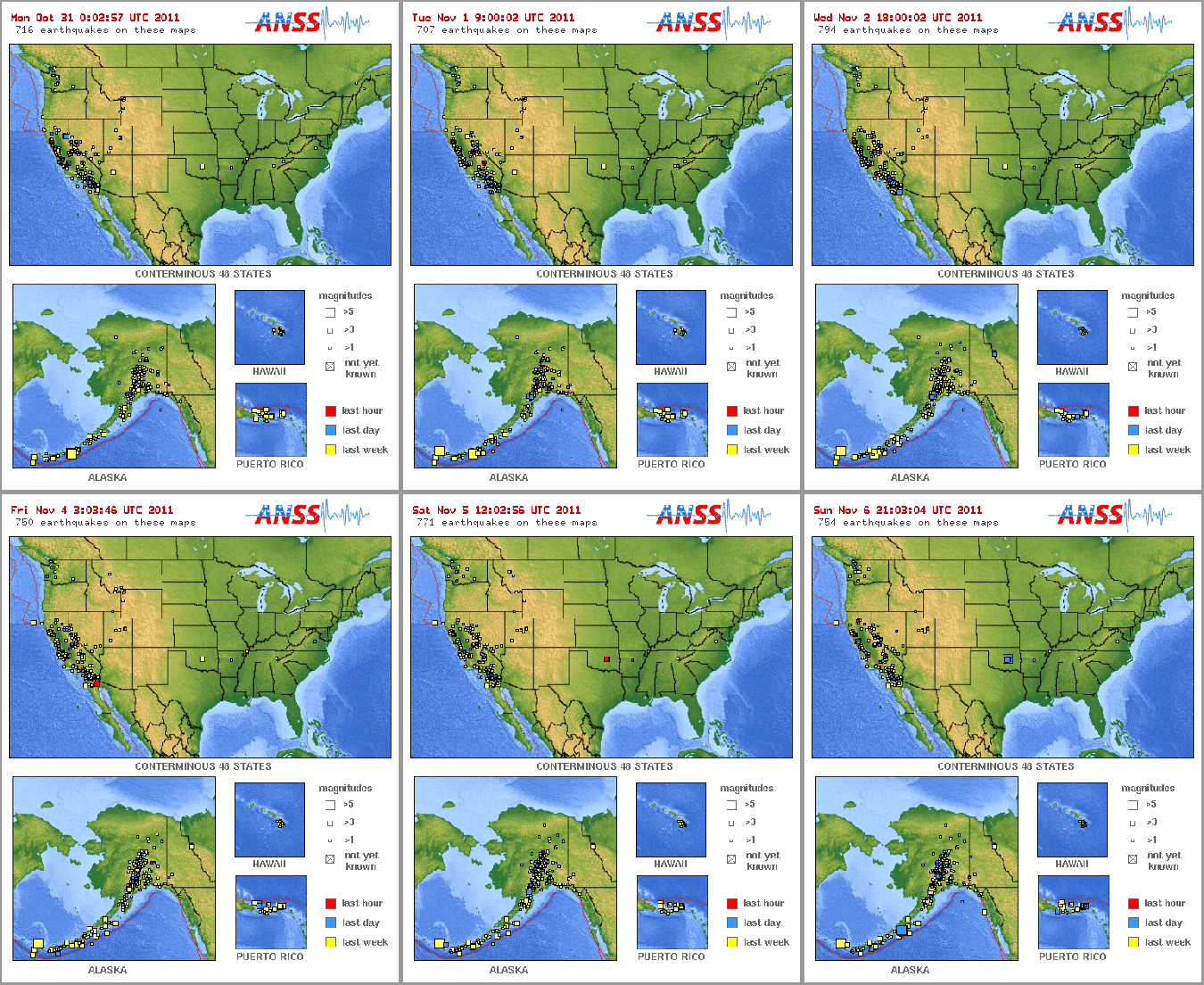
And as this map of U.S. quakes in the preceding week shows, the quakes in Oklahoma are the largest in the U.S. for the week.

USGS animation of quakes in US for week ending Nov 6, 2011, afternoon

More quakes in California, on the USGS maps -- but the Oklahoma quakes are biggest

Research continues, and local residents stay nervous.

Here’s a map that should update with new quake information — which means, Oklahomans hope, that the indicators of quakes will go away over the next few days.

USGS map of Oklahoma City/Tulsa area where earthquakes occurred in the week leading up to November 6, 2011

USGS map of Oklahoma City/Tulsa area where earthquakes occurred in the week leading up to November 6, 2011


CNN special on “fixing” education in the U.S.

November 6, 2011

I get press releases in e-mail:

FIXING EDUCATION is Focus of New “Restoring the American Dream” FAREED ZAKARIA GPS Primetime Special

Restoring the American Dream – FIXING EDUCATION Debuts Sunday at 8:00pm ET and PT

TIME Magazine Companion Story “When Will We Learn?” Hits Newsstands Friday

American primary and secondary education were once envied by much of the world, but over the last few decades U.S. students have fallen behind – while students in other countries have benefitted from improvements to their educational systems.  CNN and TIME magazine’s Fareed Zakaria interviews innovative and creative leaders working on solutions to fix what ails American education in his November primetime special, Restoring the American Dream – FIXING EDUCATION, on Sunday, Nov. 6 at 8:00pm & 11:00pm ET & PT, and for a companion TIME magazine cover article, “When Will We Learn?” that hits newsstands Friday.

Time Magazine cover for November 4, 2011

Time Magazine cover for November 4, 2011, featuring Fareed Zakaria's story on education reform

PISA, the Program for International Student Assessment, ranks 15-year-olds for basic skills achievement in 65 industrialized nations.  In the latest PISA rankings, the U.S. ranks 15th in reading, 23rd in math, and 31st in science.  Zakaria guides viewers through tours of what is working in education in countries with high rankings – to South Korea where students have more classroom time; and Finland , where professionalization of the teacher workforce has improved educators – in order to mine ideas for what could put U.S. education back on the right track.

Featured in the special are:

  • ·Microsoft founder and philanthropist Bill Gates, whose foundation has donated $5 billion dollars to schools, libraries, and scholarships tells Zakaria that the single most important determinant in the quality of a student’s education is the teacher.  The Gates Foundation is the leading source of private money for education in the U.S. .
  • ·Salman Khan,< founder of the Khan Academy , an educational organization that provides free, self-paced tutorials and student assessments online.  Khan’s famous podcasts have delivered more than 83 million free lessons in math, science and other topics, and he tells Zakaria that customizing education can improve learning through leveraging how students learn differently.  He thinks it would not be that difficult to teach all American students this way.
    • NYU Professor, former Assistant U.S. Secretary of Education, and author (The Death and Life of the Great American School System: How Testing and Choice Are Undermining Education, 2010) Diane Ravitch has spent a lifetime in education policy analysis and has seen education reforms come and go – and harm students.  Ravitch supports a rigorous national curriculum and tells Zakaria that standardized testing, charter schools, and modeling public education after business models have politicized American education and degraded schools for a generation.
    • ·Michelle Rhee, former chancellor of D.C. Public Schools, in Washington, now leads StudentsFirst, a nonprofit aimed at education reform through, among other measures, ending teacher tenure and supporting charter school alternatives to traditional public schools.

A FAREED ZAKARIA GPS Special:Restoring the American Dream – FIXING EDUCATION – debuts Sunday, Nov. 6 at 8:00p.m. and 11:00p.m. ET/PT on CNN/U.S.  It will replay on Saturday, Nov. 12 at 8:00p.m. and 11:00p.m. ET/PT on CNN/U.S.  Preview available here: Fareed Zakaria and Brooke Baldwin discuss what makes a great teacher.

Fareed Zakaria’s TIME magazine cover story, When Will We Learn? hits newsstands Friday, Nov. 4.

So the Time story is already out (home delivery has already occurred in many cases).

If you’re interested in this special, you may want to record it yourself — CNN tells me no DVD will be available.

I have AT&T cable, so we don’t get CNN, which is reserved for the high-cost, not-teachers-salary package.  Somebody tell me how it goes.

Zakaria thinks solidly and well on a number of topics, especially where comparison with foreign nations is made.  Ravitch was struck with an epiphany on testing and the No Child Left Behind Act over a year ago, as described in the press release.  She came to see that testing sucks rigor out of classrooms, instead of instilling rigor as we discussed 30 years ago in the education reform movement.

What in the world can Michelle Rhee add to this discussion?  From the press release it looks a lot like the “balance” fallacy makes the show suffer:  Journalists think they need a contrasting view, so when Euclid tells a writer that 2+2=4, the journalist seeks out others who have different opinions, and prints those opinions no matter how stupid, insipid, or dangerous they may be.

Let us keep hope alive.

See also at Millard Fillmore’s Bathtub:


Glories of Glacier N.P.

November 6, 2011

Seven-plus minutes of good reason to get your tail to Glacier National Park as soon as you can.

Produced and shot by Joshua Thompson, this is part of an award-winning film made to promote the park and get money for the research that the park hosts.

Grizzly Bears, Bighorn Sheep, spectacular sunsets and more…..

Part 3 of the recently shot Glacier DVD. This 20 min. film recently was nominated for best new nature documentary in the music category as well received an award for photography from the Wildlife Film Festival held in May of 2008. All funds for this project are being donated to the Glacier National Park Fund. For more info: http://www.glaciernationalparkfund.org/cart.php?page=glacier_national_park_fu…

I’ve been there only once.  A wise American would get there before turning 35, and return several times.


What were scientists saying about global warming in 1971?

November 3, 2011

What did scientists know and say about climate change and global warming in the 1970s?  I keep running into claims by modern climate change denialists that scientists in the 1970s firmly predicted a pending ice age.  This is usually posited to establish that scientists are fools, and that concerns about warming now are probably displaced because the same scientists were in error 40  years ago.

I worked in air pollution studies way back then.  That’s not how I remember it at all.  I remember great, good-natured debates between Ph.Ds in the Department of Biology at the University of Utah, and other scientists from other institutions passing through and working in the field with us.  Greenhouse effect was very well understood even back then, and the discussions were on the nature of just how much human pollution would affect climate, and in which way.

Savvy scientists then well understood that there were two competing trends in air pollution:  Greenhouse gases and particulates and aerosols.  Greenhouse gases would warm the climate, but they were offset by particulates and aerosols that reflect solar radiation back into space before warming can occur.  At least, back then, the particulates and aerosols counteracted the greenhouse gases.

Manhattan skyline enveloped in heavy smog, May 1973: Chester Higgins/NARA. via Mother Jones

EPA collection, Manhattan skyline enveloped in heavy smog, May 1973: Chester Higgins/NARA. via Mother Jones

Looking for something else, I took off my shelf a book we used as a text in air pollution courses at the University of Utah in the 1970s, Whatever Happened to Fresh Air? by Michael Treshow.  Treshow taught at Utah.  He was deeply involved in several research projects on air pollution.  He was also a great conversationalist and competitive tennis player.  His book was a good text, but he intended it to be read by lay people, especially policy makers, also.  It’s easy to fathom, intentionally so.

Here, below, is what Treshow wrote in the early pages about carbon dioxide as an air pollutant, in sketching the global problems of air pollution.  Notice that, while he makes note of the predictions of what would happen with uncontrolled particulate and aerosol pollution, he gives the science straight up, telling what pollution can do, depending on local circumstances and global circumstances.  Treshow notes the research that the denialists cite now, but he explains enough of the science so that any reasonable person should be able to see that, if one form of pollution is controlled and another is not, the effects might be different.

Michael Treshow:

Over the past several million years, the earth’s animal and plant life have reached a workable equilibrium in sharing this atmosphere and keeping the oxygen and carbon dioxide concentrations in balance.  But man, by burning fossil fuels (particularly coal) at an accelerated rate and by removing vegetation at the prodigious rate of 11 acres per second in the U.S., may be upsetting this equilibrium.  Many scientists believe this carbon dioxide build-up is one of the major threats to man’s environment.

Carbon dioxide (CO2) is occasionally regarded as an air pollutant for this reason, even though it is a natural and essential component of the atmosphere.  Certainly the present concentrations are not dangerous; but what would happen if the amount of carbon dioxide in the atmosphere should increase appreciably?  What hazards would be imposed?

An increase in carbon dioxide would benefit the green plants since they need it for photosynthesis.  But what effect would it have on man and animals?  Or on the physical environment?  The main hazard lies in the effect that carbon dioxide has in absorbing the infrared radiation which normally radiates from the earth back to the atmosphere.  If the carbon dioxide content of the lower atmosphere were to increase, it would prevent the infrared heat absorbed by the earth from the sun from reradiating into the atmosphere.  Heat energy would accumulate and cause a general increase in the earth’s temperature.  Such an increase in temperature, often called the “greenhouse effect,” could cause the ice caps to melt, raising the level of the oceans and flooding most of the world’s major cities.

It is awesome to realize that sea level is actually rising.  It is now 300 feet above what it was 18,000 years ago, and is reportedly rising nearly nine inches higher each century.  Beaches are being wasted away and tides lap ever closer to the steps of coastal homes.  But is the displacement of our beaches more closely related to increasing carbon dioxide concentrations or to the normal warming process between ice ages?

Not everyone agrees that carbon dioxide is to blame.  Concentrations vary greatly around the world.  Near urban areas, where fossil fuels are burned, concentrations are high; over forested areas, where plants are rapidly removing the gas, they are low.  Concentrations also vary with the height above the ground, the latitude, whether over the ocean or land and even with the time of day and season of the year.  All of these variables make it difficult to agree on a reasonable average carbon dioxide concentration.

Despite some disagreement, it is generally conceded that carbon dioxide has been added to the atmosphere at an alarming rate during the past century.  Actual measurements show that between 1857 and 1956, carbon dioxide concentrations increased from an average of 0.0293 to 0.0319 percent; 360 X [10 to the 9th] tons of carbon dioxide have been added to the atmosphere by man during this period.  Upwards of a trillion tons will be added by the year 2000.  Such  a tremendous release of carbon dioxide would increase the atmospheric concentrations appreciably unless some mechanism is available to absorb the surplus and to maintain equilibrium.

Extensive measurements suggest that carbon dioxide concentrations near the earth’s surface have increased about 10 percent since 1900.  During this same time, fossil fuel consumption increased about 15 percent.  This is a remarkably, close, meaningful relationship.  The 5 percent difference is readily accounted for, since this much would be absorbed by the ocean or by rocks and living organisms, particularly plants, which absorb much of the surplus carbon dioxide.  In fact, green plants probably have the capacity to absorb and utilize far more carbon dioxide than man is likely to release.

Calculations presented by Gordon MacDonald of the University of California at Santa Barbara show that a 10 percent increase in the total carbon dioxide content theoretically should cause an increase of 0.4° F in the average temperature of the earth.  Although the carbon dioxide content is being increased about 0.06 percent each year by the combustion of fossil fuels, no temperature increase has been demonstrated.  Rather, the average temperature appears to be decreasing.  During the past 25 years, when the addition of carbon dioxide has been most rapid, the average temperature has dropped half a degree.

This temperature drop has been thought to result from the increase in the amount of submicron sized particulates which remain suspended in the atmosphere. These aerosols obstruct the entrance of the sun’s heat and light rays, thereby disrupting the earth’s energy balance.  The effect is one of less heat and lower temperatures.  Dr. William E. Cobb of the National Oceanic and Atmospheric Agency predicts the possibility of another ice age.

Whatever Happened to Fresh Air, Michael Treshow, University of Utah Press, 1971, pp. 3-6.

What changed since then?  The Clean Air Act provided the legal drive to clean particulates and aerosols out of the air.  Alas, we did not then have good controls for greenhouse gases.  The success of the Clean Air Act, and similar laws worldwide, rather left the pollution field open for greenhouse gases.  Without pollution to offset the effects of GHG, warming became the stronger trend.

I think Treshow was quite prescient back then.  His work is still accurate, when we adjust for the events of history that came after he wrote the book.

Time Magazine cover for January 27, 1967, photo by Larry Lee. The photo shows a typical Los Angeles day at 3:30 p.m., with photochemical smog restricting visibility dramatically. Particulate pollution, and sulfates, added to the visibility problems, and made air pollution a greater health hazard. An accompanying story was titled,

Time Magazine cover for January 27, 1967, photo by Larry Lee. The photo shows a typical Los Angeles day at 3:30 p.m., with photochemical smog restricting visibility dramatically. Particulate pollution and sulfates added to the visibility problems, and made air pollution a greater health hazard. An accompanying story was titled, “Ecology: The Menace in the Skies.”

It’s popular among those opposed to the science of climate change to claim scientists don’t know what they’re talking about, because ‘back in the 1970s they predicted a new ice age, and they were wrong.’

Dr. Treshow’s book presents the state of the science of air pollution in the early 1970s. He didn’t “predict” an ice age. He noted that particulate pollution was a major problem, and that particulates and other pollution created a cooling effect that could offset and perhaps overpower the warming effects of CO2, as he discusses in the passage above. In lay terms, in a few brief passages, Treshow notes the conflicting results of different types of pollution.

CO2’s warming effects were well known, and acknowledged. If particulates and other aerosols won the battle to pollute the skies, the Earth would cool. If GHGs won the battle, the Earth would warm.

Claiming scientists “predicted” an ice age tells only half the story, and thereby becomes a grossly misleading, whole lie.

More:


Cartoons on the rise of Arab freedom

November 2, 2011

. . . which accompany this now eerie picture.

Toppling Dictators in Arab world

Actually, I hear tell of a cartoon that looks more like the earlier photo, with a fellow walking away after having crossed out the images of Ali and Mubarak . . . anyone got a link?


Transplanting the futile arguments of the old AOL boards

November 2, 2011

Two strings of correspondents in my e-mail date back more than a decade.  We met on the old AOL discussion boards, on evolution, and on religious freedom.  Occasionally someone in one of those groups will lament the passing of the innocence of those days, and the heated discussions with trolls and reality deniers, and the grand, irreplaceable characters who made last stands denying science to the end, or claiming that Dwight Eisenhower really was Satan in disguise and that America was ruined when he failed to insist Congress open every meeting with prayers, or some other silly folderol.

Amazon.com has opened discussion boards.  Excuse me, but I believe all of those nuts from the past have rolled out from their various closets, couches and corners, to join or frustrate discussion.  It makes one nostalgic, and it makes one reach for the “delete” key.

Black holes sucking in intelligence and time on evolution, global warming, and other silly questions that bring out the hard-core denialists and contrary marys.

Were I you, I wouldn’t go there.  Surely those “discussions” are part of Amazon’s plan to take over the world.


FDR on Social Security — “Our Plain Duty”

November 1, 2011

A film from the Pare Lorentz Center and FDR Library:

This film, produced by the Pare Lorentz Center at the Franklin D. Roosevelt Presidential Library and Museum, commemorates the 75th Anniversary of Social Security. The film asks the question: Is it still Our Plain Duty?

Big question.  Do we have an obligation to continue Social Security, especially now that everyone has a pension from their employer, no one has any difficulty getting access to health care, there are no homeless people in the streets, and no older Americans live and die in poverty?

2,671 views at posting

Howard Zinn: Empire or humanity?

November 1, 2011

We get to choose.

We can choose, if we know there are choices, and how to distinguish between them.

Do we know there are choices?  Can we distinguish?

Wish I’d seen this little film a couple of years earlier; but it’s more poignant now, perhaps, that Zinn is no longer with us.

It’s a film from Henry Holt and Metropolitan Books, made to promote Zinn’s 2008 book, A People’s History of American Empire.  This is how the film is described at the Holt site at YouTube:

Empire or Humanity?
What the Classroom Didn’t Teach Me about the American Empire
by Howard Zinn
Narrated by Viggo Mortensen
Art by Mike Konopacki
Video editing by Eric Wold

To read more from Howard Zinn visit http://www.TomDispatch.com.

A serious student of U.S. history should always consider the view of Howard Zinn on an issue or period.  Teachers of history must consider Zinn’s views, agree or disagree.