Watching the drought roll in at Colorado Bend State Park

July 6, 2011

It took me a couple of tries to figure it out — last week when I told people Kathryn and I were off to Colorado Bend State Park to spend time on the river, several people commented about how much cooler it would be there.

What?  West of Killeen about an hour, ten miles of dusty road outside of Bend, Texas (population 1,637), Colorado Bend is not cooler than Dallas.  It was over 100° F every day we were there, stayed well above 90° most  of the nights.

Kathryn Knowles checking wildflowers, Colorado River, Texas

Kathryn studied wildflowers at a spring at the side of the Colorado River during a break from kayaking; this spring's flow was reduced, but still moist enough to create a near-oasis.

Our well-wishers were geographically confused.  They thought we were headed to the Colorado River in Colorado, not the Colorado River in Texas, which is not the same river at all.  I didn’t bother to check the temperatures in Colorado, but one might be assured that it was cooler along the Colorado River in Colorado than it was along the Colorado River in Texas.

It was a return trip.  We stumbled into the park 16 years ago with the kids, for just an afternoon visit.  The dipping pools  in the canyon fed by Spicewood Springs captivated us.  It took a while to get back, and then the kids were off doing their own thing.

So, just a quick weekend of hiking/camping/kayaking/soaking/stargazing/bird watching/botanical and geological study.   Park officials closed the bat caves to human traffic in hope of keeping White Nose Syndrome from the bats; we didn’t bother to sign up for the crawling cave tour through another.

Ed Darrell at Colorado Bend State Park, Texas

The author, still working to master that Go-Pro camera on the hat -- some spectacular shots, but I don't have the movie software to use it all; you know it's hot when SPF 75 sunscreen is not enough.

What did we see?  Drought has a firm grip on Texas, especially in the Hill Country, especially outside of Dallas.  The Colorado River  is mostly spring fed; many of the springs are dry.  No water significant water flowed through the park while we  were there — kayak put-ins have been reduced to the downriver-most ramp, and the bottom of the boat launch ramp is three feet above water.  Gorman Falls attracts visitors and scientists, but the springs feeding it are about spent this year — just a few trickles came over the cliff usually completely inundated with mineral-laden waters.

Drought produces odd things.  The forest canopy around the park — and through most of the Hill Country we saw — is splattered with the gray wood of dead trees, many of which at least leafed out earlier this spring.  The loss to forests is astonishing.  Deer don’t breed well in droughts; deer around the campsites boldly challenge campers for access to grasses they’d ignore in other seasons.  One ranger said he hadn’t seen more than about three fawns from this past spring, a 75% to 90% reduction in deer young (Eastern White Tail, the little guys).  Raccoons are aggressively seeking food from humans, tearing into tents and challenging campers for food they can smell (lock your food in the car!).  Colorado Bend is famous for songbirds, including the endangered Golden Cheeked Warbler, and the elusive, spectacular painted bunting.  But the most commonly-sighted birds this year are turkey vultures, dining on the young that didn’t make it healthy into the summer and won’t survive until fall.

Warming denialists’ claims of “not so bad a drought” ring out as dangerous, wild delusion.  (By actual measurement, Texas average rainfall the past nine months was 8.5 inches, the driest ever recorded in Texas, shattering the old record drought of 1917).

Great trip.  Kathryn’s menu planning was spectacular.  The old Coleman stove  — a quarter century old, now, with fuel almost that old — performed like a champ even without the maintenance it needs (later this week).  Other than the hot nights, it was stellar.

Stellar.  Yeah.  Stars were grand.  It was New Moon, a happy accident.  A topic for another post, later.  Think, “Iridium.”

So posting was slow over the weekend.  How far out in the Hill Country were we?  Neither one of us could get a bar on our phones.  We were so far out the Verizon Wireless guy was using smoke signals.

Thoreau was right, you know.


That flag you flew yesterday — want to burn it today?

July 5, 2011

Some of the more astute students in our high school classes ask questions about everything.  For example, they ask:  “What does the Pledge of Allegiance mean, when it says, ‘ . . . and to the Republic for which it stands?'”

Is the Pledge all that important?  Is the flag all that important?

Maybe.  How would you answer that question, really?

Penn and Teller offer a demonstration:

What do you think?  Did they burn a flag?  Should that sort of performance be legal?

What if Penn and Teller burned a flag in the White House?

An exercise in ambiguity:  A fictional drama about a sleight of hand, illusionary performance.  (Best line:  The answer to the question, “Did you go to law school?”  For the record, yes, I did go to law school.  I’m an amateur clown.)

Did you fly your  flag yesterday?


July 4, 2011 – Fly your flag today

July 3, 2011

Fourth of July: NPR has already read the Declaration of Independence, PBS broadcast the Capitol Fourth concert  last night (maybe a rebroadcast is available — check your local listings), your town has a parade somewhere this weekend, and fireworks are everywhere.

Remember to put your flag up today.

Astronaut Eugene Cernan and the U.S. Flag -- Apollo 17 on the Moon (NASA photo)

Last flag on the Moon: Astronaut Eugene Cernan and the U.S. Flag -- Apollo 17 on the Moon (NASA photo)

Also:

Lunar Reconnaissance Orbiter photo of Apollo 17 landing site

Lunar Reconnaissance Orbiter photo of Apollo 17 landing site

This is mostly an encore post, but I so love that photo of the flag with the Earth in the distance.

Happy birthday, Kathryn!


Little Rock’s Central High School, monument for civil rights

July 1, 2011

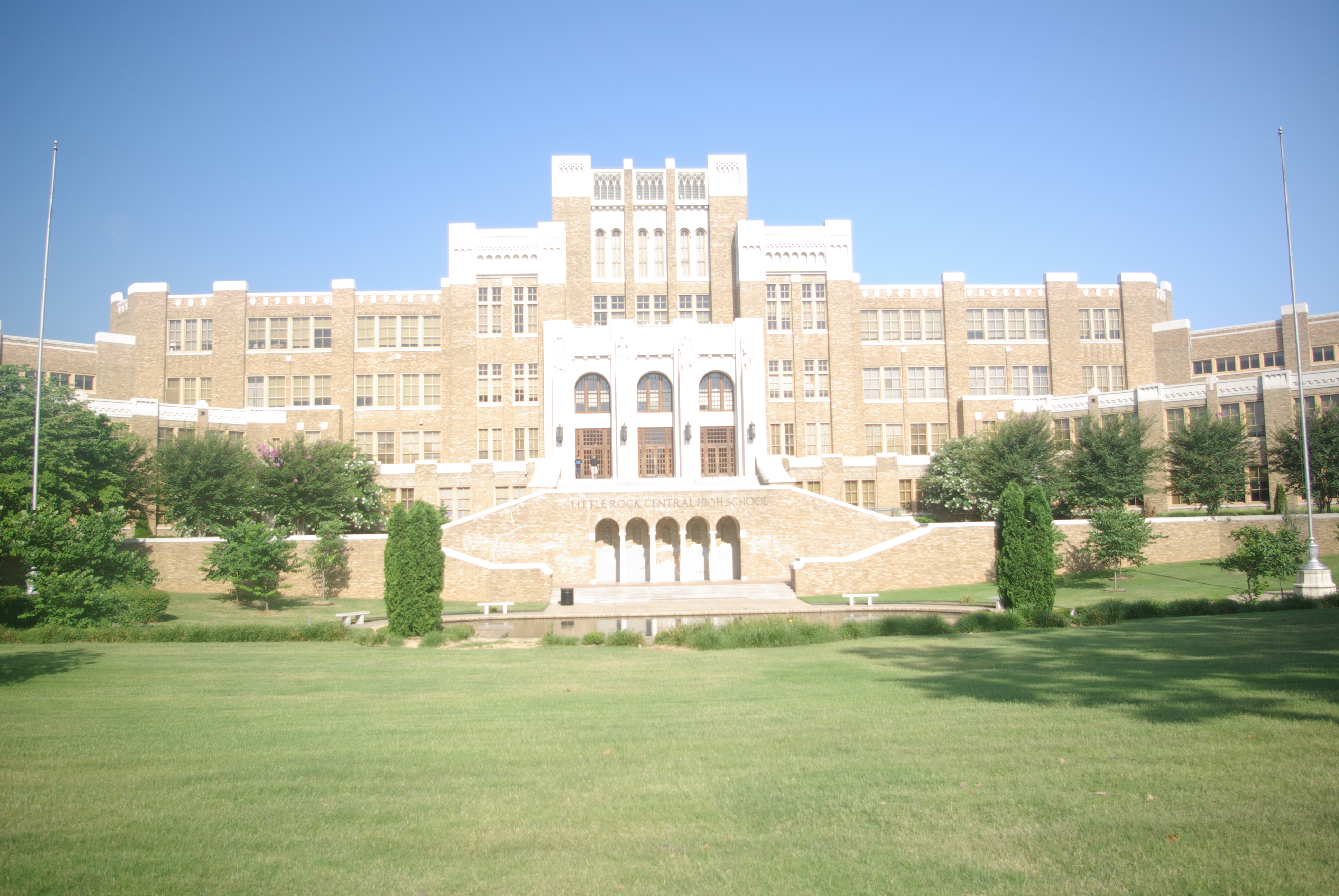
On the way out of Little Rock, Arkansas, after our day at the William Jefferson Clinton Presidential Library and Museum, we stopped at the Little Rock Central High School National Historic Site.

Little Rock Central High School in 2011, photo by Ed Darrell - use permitted with attribution

Little Rock Central High School in 2011, photo by Ed Darrell - use permitted with attribution

In 1957 nine African American kids tried to enroll at the school, breaking high school segregation in Little Rock.  After assuring President Dwight Eisenhower that the Arkansas National Guard would preserve the peace, Gov. Orval Faubus ordered the Guard to keep the students out.  Eisenhower called up the Guard to federal duty, and sent in the 101st Airborne from the regular U.S. Army to enforce the desegregation rules.  (Imagine any president doing that today!)

Pre-Art Deco front of Little Rock Central High School, built in 1927 - photo 2011 by Ed Darrell, use permitted with attribution

Pre-Art Deco front of Little Rock Central High School, built in 1927

Eventually Little Rock closed down all the schools for more than a year, and then federal courts ordered the schools opened, but desegregated.  One black student graduated that first year, Ernest Green.  The other eight all graduated, but from other schools around the world.

Today, it’s history, even in Little Rock.

Little Rock Central High remains in use today.  The National Park Service maintains a visitor center across the intersection from the school, with the old Magnolia Oil gas station, restored, on another corner, and a monument to the Little Rock Nine and civil rights on the remaining corner  (Magnolia Oil was absorbed into Mobil, which took on Magnolia’s flying horse emblem).  Our Dallas Independent School District, Teaching American History Grant group visited in mid-June.  Classes were out.   The visitor center remains open year around.

I was particularly curious to see whether and how the historical events, and the commemoration of them, affect the school itself.

Hallway inside Little Rock Central High School, photo by Ed Darrell, use permitted with attribution

The hallway outside the auditorium on the main floor of Little Rock Central High School.

On the inside, it’s a normal American high school — though in a grand building (I’d compare this to Ogden, Utah’s Ogden High School, a WPA-style project of a decade later’s construction, and a grand old building students and citizens have come to love).

Walls bear posters from student clubs.  Signs direct students to classes, or the auditorium, or the lunchroom.  The office looks more like the 1970s than the 1930s — I suspect it has been updated.  Ceilings have been redone since 1927, with newer fluorescent lighting and acoustic ceiling tiles, which only brings the architecture of 1927 down to 1970s box-style building standards.

Sign announcing a club meeting, Little Rock Central High School, 2011 - photo by Ed Darrell, use permitted with attribution

Walls of Little Rock Central carry notices of club meetings, much as in 1957. Some of the clubs have changed; the Gay-Straight Alliance probably was not active in LIttle Rock in 1957. Changes in U.S. culture in the 54 years since the Little Rock Nine, are reflected in the citizens and their actions, and not necessarily in the physical buildings.

It’s a working school, and not a monument on a pedestal frozen in time in any sense.

The school opened 30 years before it became an icon in the struggle for civil rights.   It is a massive structure, intended perhaps as a sort of monument to Little Rock and to Education.  NPS describes it at their website:

Built in 1927 as Little Rock Senior High School, Central was named “America’s Most Beautiful High School” by the American Institute of Architects.

Designed as a mix of Art Deco and Collegiate Gothic architectural styles, the building is two city blocks long and includes 150,000 square feet of floor space. More than 36 million pounds of concrete and 370 tons of steel went into the building’s construction. It cost $1.5 million to construct in 1927. The school received extensive publicity upon its opening. An article in the Arkansas Gazette said, “we have hundreds of journalists in our fair city for the dedication” of the new high school.

At its construction, Central’s auditorium seated 2,000 people and included a 60 x 160 ft. stage that doubled as the gymnasium. A new library was built in 1969 and named for longtime principal Jess W. Matthews.  In 1953 the school’s name was changed to Little Rock Central High School, in anticipation of construction of a new high school for white students, Hall High School in Pulaski Heights.

Computer classroom at Little Rock Central High, June 2011 - photo by Ed Darrell; use premitted with attribution

Computer classroom at Little Rock Central High - Historic preservation cannot prevent the updating of classroom technology. Wiring these classroomms for computer networks must be quite difficult.

I thought it interesting that the original construction did not include a library.  The auditorium’s doubling as a basketball gymnasium explains the massive stage — suitable for Las Vegas, really.  “Multi-purpose” building for schools originated much earlier than the 1970s as I had imagined.  The 1927 plans included neither the tendency to overbuild fschools for athletics, nor today’s pre-occupation with making schools appear as academic enclaves.

Visiting the site you can learn that the $1.5 million cost consumed the entire building budget for the district in 1927.  In keeping with the separate but equal doctrine of the times (see Plessy v. Ferguson), the Little Rock district “planned” to build a high school for blacks at the same time.  No money remained for either design or construction.

City leaders — I would imagine black city leaders, without much help from whites, but I may be too cynical — raised money to pay the same architects to create a complementary design for the school that would be called Dunbar.  Private funding paid for construction, too.  Exactly this sort of discrimination against blacks roiled across America from 1896 into the 1950s — only 16 states banned discrimination by race, with laws that were not always enforced.  These issues were key to several of the cases rolled into the Supreme Court appeal that we usually call simply The Brown Decision — facilities were involved in the cases in Topeka, Kansas, Prince Edward County, Virginia, Delaware, and Washington, D.C.

Looking at Little Rock Central High School today one can see the physical manifestation of the insidious separate but equal doctrine, and understand perhaps why it collided with the drive for rights in Little Rock, at the corner of 14th Street and South Park Street.  The school’s address is listed as 1500 South Park.  14th Street, running along the north edge of campus, has been renamed Daisy L. Gatson Bates Drive, in honor of the NAACP organizer who provided wise counsel, sage advice, a ride to school on most mornings and friendship to the students who made up the Little Rock Nine.

A large amount of history resides in Little Rock.

Ha! — You don’t need to rely on my photos at all.  Turns out NPS has a photo slide show at their website.  Note how my ideas paralleled theirs — and honest, I didn’t see that before our tour.  Actually, the auditorium curtains were closed, nor did we get into the balcony — the photo from NPS is much better than any I got.

Nota bene: The intense, three-year program of study of U.S. history for this three dozen or so teachers is made possible by a grant from the U.S. Department of Education, a Teaching American History Grant.  Such grants fund the study of American history for teachers across the nation, to spur better teaching from greater understanding and knowledge of history.  These grants generally float at the top of the pool of programs to be cut first when the budget axes fall.  We are grateful to the Department of Education.  And while my writings here do not necessarily reflect the views of any of my employers, past or present, they should — and the Senate, Department of Education and others in the stream of funding would be well-advised to continue these grants.


Quote of the moment: John Adams, celebrating the 2nd of July

July 1, 2011

“The Second Day of July 1776 will be the most memorable Epocha, in the History of America. . . . It ought to be solemnized with Pomp and Parade, with Shews, Games, Sports, Guns, Bells, Bonfires, and Illuminations from one End of this Continent to the other from this Time forward forever more.”
John Adams to Abigail Adams, July 3, 1776

1776 filled the calendar with dates deserving of remembrance and even celebration.  John Adams, delegate from Massachusetts to the Second Continental Congress, wrote home to his wife Abigail that future generations would celebrate July 2, the date the Congress voted to approve Richard Henry Lee’s resolution declaring independence from Britain for 13 of the British colonies in America.

Two days later, that same Congress approved the wording of the document Thomas Jefferson had drafted to announce Lee’s resolution to the world.

Today, we celebrate the date of the document Jefferson wrote, and Richard Henry Lee is often a reduced to a footnote, if not erased from history altogether.

Who can predict the future?

(You know, of course, that Adams and Jefferson both died 50 years to the day after the Declaration of Independence, on July 4, 1826.  In the 50 intervening years, Adams and Jefferson were comrades in arms and diplomacy in Europe, officers of the new government in America, opposing candidates for the presidency, President and Vice President, ex-President and President, bitter enemies, then long-distance friends writing almost daily about how to make a great new nation.  Read David McCullough‘s version of the story, if you can find it.)

Update, July 4, 2013: You may want to check the updated version of this post, with more links, and even more history.

2015 edition, with more links for teachers and historians, here.


Teachers, look! Cheaper, fun way to get giant whiteboards

June 30, 2011

It’s a great idea, but I didn’t even dare think it possible

We’ve had blackboard paint for at least a century.  Teachers at our school sometimes paint their closet doors, or part of a wall, to use as a chalkboard.

I prefer whiteboards, though.

Watching Neil deGrasse Tyson on Nova:  Science Now, I caught a reference to a researcher whose lab walls are all painted with “dry-erase” paint.  (The NOVA piece is the episode on how the brain works; this segment deals with researcher David Eagleman.)

Is that even possible?

Vodpod videos no longer available.

Quick answer: Yes!

Check out applications ideas at IdeaPaint’s blog.

Lowe’s carries IdeaPaint, the stuff displayed in the graphic above.  It isn’t as cheap as other paint, but compared to the cost of a whiteboard, it’s pretty good.  RustOleum manufactures a version available at Home Depot and other outlets.  It’s advertised as cheap as $20 per kit online, but runs as high as $40.  One kit covers about 49 square feet (7 feet by 7 feet).  I’ve found at least five different manufacturers of the stuff, with different features.

I haven’t calculated prices (at about $3.25/square foot), but there are also dry-erase skins which can be applied to any wall — with the added advantage that the product claims to be erasable for virtually any marker, including Sharpies® and other permanent markers.   One manufacturer offers skins in clear, to allow underlying paint colors to show through, and white, and says it will match colors on a whole-roll basis (pricey, I’ll wager).

Uses for math and writing should be obvious — think about those mural-sized wall maps in a geography or history class, covered with clear, dry-erase paint . . .

Wouldn’t it be great if school districts had architects, or instruction coaches, who knew about this stuff and could help us keep up in the technology and tool wars/sweepstakes?

More, resources:  

  • Dry-erase painting at Charlestown (state? Massachusetts?) schools:
  • Case study from Milford High, Milford, Massachusetts
  • Case study, Dever-McCormack School, Boston school district
  • Evernote software teams with IdeaPaint . . . look at the video

Why is the Texas Chainsaw Massacre so popular?

June 29, 2011

And, why do people so very, very much, want that story to be true and not fictional?

Here’s the list of stories from this blog that were most popular over the past seven days; the top two stories hold about those ranks week in and week out:

Top Posts (the past week)

Based on a true story — except, not Texas. Not a chainsaw. Not a massacre. 530 views

28 poems on living life to the fullest, today 425 views

True story: Yellow Rose of Texas, and the Battle of San Jacinto 167 views

News flash: Texas has a second natural lake! 136 views

Nuclear power plant incident in Nebraska?

“When we’re telling whoppers about Obama and government, please don’t pester us with the facts” Department

Hoaxed Nebraska nuclear plant crisis update

Quote of the moment: John F. Kennedy, “We choose to go to the Moon”

Someone somewhere is discussing whether the story behind the Texas Chainsaw Massacre movies is real or fictional.  I can’t find that discussion, alas.

Either that, or we have a lot of prurient interests out there.

Interesting mix of story viewings, otherwise.


PestAway: Exterminator deals with DDT, honestly

June 29, 2011

Here’s a cool breeze:  Pest Away Exterminators in New York explains, patiently, that DDT no longer works against bedbugs, and is otherwise ill-advised in most applications.

Try to find an error in this short post:

DDT

The truth about DDT…

  • It was highly effective when it was first introduced.
  • It nearly wiped out bed bugs in America.
  • It is NO LONGER effective in treating bed bugs.
  • It is more dangerous than people realized.

In 1939, DDT (Dichloro-Diphenyl-Trichloroethane) was introduced as the “miracle pesticide.” It was effectively used in military and civilian arenas to control lice, malaria, mosquitoes and bed bugs. It nearly wiped out all bed bugs in an allegedly “safe” method, but by the 1960’s, bed bugs had built up a resistance and potential immunity to DDT.

In 1962, Rachel Carson wrote Silent Spring, which essentially demonized DDT and helped launch the environmental movement. By 1972, DDT was banned in the USA, but DDT is still used very effectively in other countries to control Malaria. Although there is a public outcry to bring DDT back, it’s very unlikely that it would have any meaningful effect on controlling bed bugs.

Jeff Eisenberg founded the company in 1991, after a career with a large accounting firm.  It appears his training on the importance of accuracy in numbers, and honesty in facing tough situations, carried over to his new business.  Good on him.


Meanwhile, in the evolution debates, where we find the Mother of All Denialism . . .

June 29, 2011

Other fronts in the War on Education may have earned more attention here in the Bathtub, lately — and in state legislatures.  Threats from the dilution and elimination of good, hard science courses continue to pose problems, especially from creationists and their shyer, camouflage troops from the Chapel of Intelligent Design.

We need to stay aware of the creationist/creationism threat.  At its heart, creationism requires adherents to reject the facts of science, to reject the workings of science, and to reject the functions of debate about what is real, and what is not.  It is to me a rather simple discussion of the quality of evidence.

Eugenie Scott and her colleagues from the National Center for Science Education provide a great update in what is going on, with a great video, and an informative and troubling explanation of the links between creationism and the “unbelievers” in climate change.

Be sure to watch the first ten minutes, to see the video update on the fight to keep good science education in schools, especially the teaching of evolution.


Memphis Public Library assembling history of 2011 floods

June 28, 2011

Here’s a good idea:  The Memphis Public Library is putting together an archive on the 2011 floods in the area, we learn from the Memphis Daily News:

St. Mary’s Senior Helps Library Build Flood Archive

St. Mary’s Episcopal School student Ellery Ammons is devoting her summer break to helping the Memphis Public Library & Information Center build an archive documenting the Mid-South floods of 2011.

Ammons, an employee of the Shelby Forest General Store owned by her parents, is also a Girl Scout, working toward her Gold Award.

Recognizing the need to document this year’s historic deluge, the high school senior decided to take on the tasks of soliciting, cataloging and archiving community photos to create the 2011 Flood Collection.

She plans to create a digital archive of flood photographs to provide future generations with an accurate record of the floods that ensued when the Mississippi and its tributaries overflowed in Memphis and the surrounding areas this past spring.

Library digital projects manager Sarah Frierson said she’s delighted to have the extra hands in the history department, saying the collection “will be a wonderful complement to the library’s existing Mid-South Flood Collection, which documents the floods of 1927 and 1937.”

The Benjamin L. Hooks Central Library, 3030 Poplar Ave., is seeking photo donations to add to the 2011 Flood Collection. Donations, which will become part of the library’s permanent collection, can be brought to the history department on the main library’s fourth floor or e-mailed to Flood2011.Photography@gmail.com.

– Aisling Maki


UFOs? Obama-ordered news blackouts? No: Brain failures

June 28, 2011

Come on, you can figure out how this applies to those stories about Obama’s secret orders — or more accurately, the lack of those orders.  From Neil deGrasse Tyson and the argument from ignorance, presented at St. Petersburg College, Florida, 2007:

Tip of the old scrub brush to Neil deGrasse Tyson, and his Tweet.


Dragon fly on a Saturday walk in the park

June 28, 2011

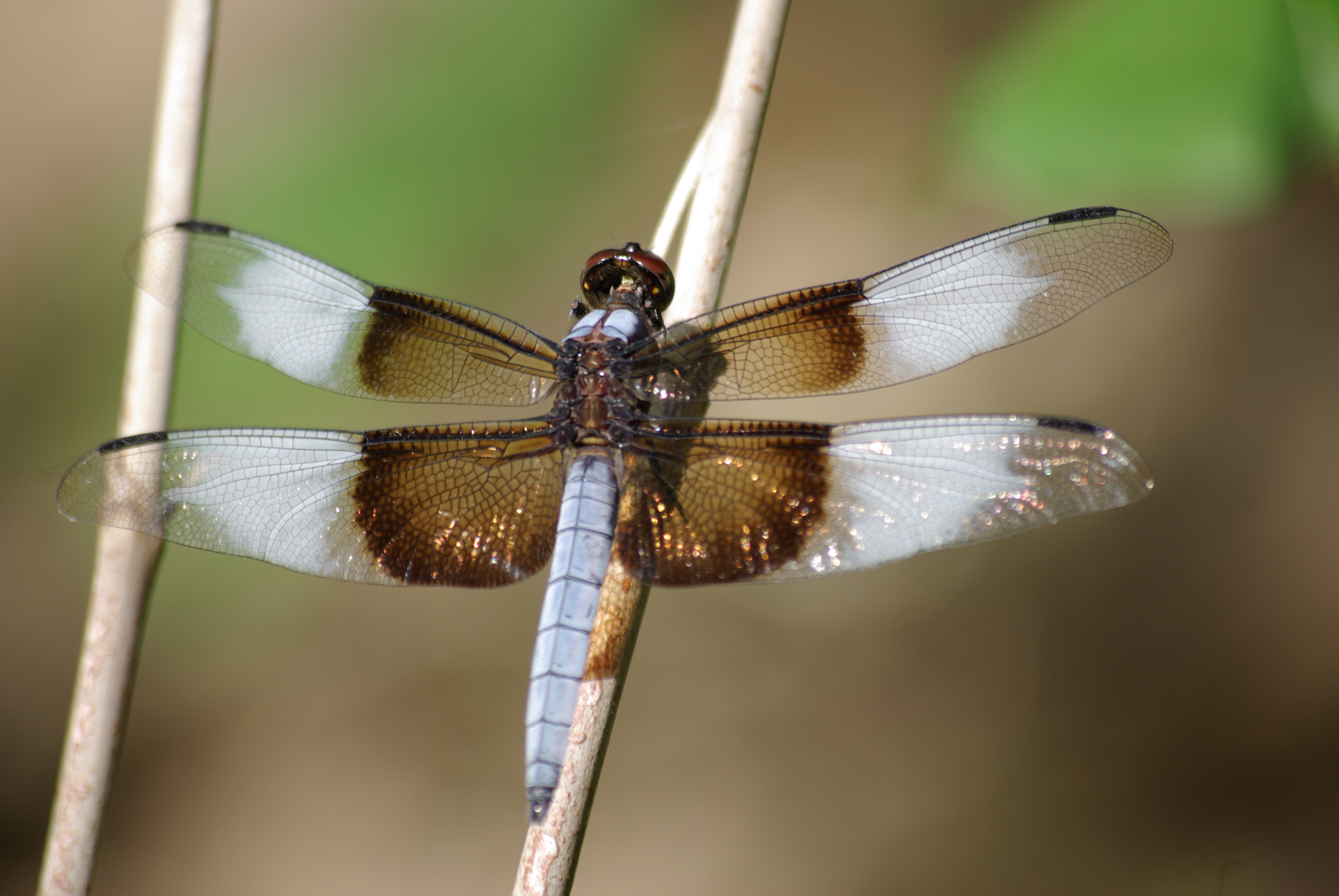
Lions Park in Duncanville, Texas, to be more precise.  The dragon fly appears to me to be Neurothemis tullia, a Pied Paddy Skimmer, though I believe that is considered an Asian species.  [But see note at the end of the post.]

Closely related?   An exotic introduced to Texas?  Here we had cotton fields, not rice paddies.  The wings look like those of a Pied Paddy Skimmer, but most of the photos I’ve found show a black body, and this one is definitely gray.  Hmmmm.

Dragon fly, Pied Paddy Skimmer, Neurothemis tullia - photo by Ed Darrell copyright 2011, use permitted with attribution

Dragon fly, Pied Paddy Skimmer, Neurothemis tullia - photo by Ed Darrell; copyright 2011, use permitted with attribution

Dragon flies look mean.  As a very young child I was terrified of them, growing up on the banks of the Snake River in Idaho.  My mother, a farm-raised girl, took me out for a walk among the diving, softly-humming aerobats, and explained they had no stingers, they ate other insects, and they seemed to like humans, if we’d watch them.  As we watched, she held out her hand and a dragon fly landed, as if to say, “Hello!  Listen to your mother.  She knows us.”

Dragon fly in Duncanville Lions Park, photo by Ed Darrell - use permitted with attribution

Dragon fly takes a higher vantage point. Is this species exotic in Texas?

Up Payson Canyon, in Utah, at Scout Lake I passed many early morning hours, and many noon siestas, in the reeds watching the dragon flies.  When we were in our canoes or rowboats they’d fly at us like rockets, appearing to think they were torpedo planes, then fly up, or right or left, at the last possible second, to avoid colliding with our craft.  Through July they’d fly tandem, mating.  This intrigued Scouts, and delighted them beyond measure when the nature merit badge counselor explained they were having sex.  Red ones, blue ones, yellow, brown and black ones.  Big ones, little ones.

Shortly after we moved to Texas, we discovered that a swarm of dragon flies probably meant a local colony of fire ants was casting off females, to mate and start a new mound of exotic, stinging terror.  The dragon flies would catch and eat the queens-to-be.  I had to use a broom to shoo off a neighbor with a can of insecticide, trying to kill the dragon flies in their work to keep us safe and happy.  “But they look so mean,” she explained.

Judge no book by its cover (except Jaws); judge no insect by its eye apparel, or human eye appeal.

Dragon fly, Neurothemis Tullia (perhaps), Duncanville Lions Park, 6-25-2011 - Photo by Ed Darrell, use permitted with attribution

Pied Paddy Skimmer rests from hunting

_____________

Update:  In comments below, Roused Bear wonders if this isn’t the Widow Skimmer, which is native to Texas.  That would make a lot more sense, wouldn’t it?  What do you think, Dear Reader:  Widow Skimmer, Libellula luctuosa?


Solar power at your house? “How to do it” graphic

June 28, 2011

While a few (crabs?) argue that solar power will never make a significant contribution to our daily energy budgets in the U.S., others quietly slip the bonds of the grid and go solar.  If solar works, it will work one house at a time.

If you wish to go solar, where do you start?  The Orange County (California) Register provided a great graphic to illustrate some of the considerations a homeowner needs to make, and how much it might cost.

OC Register graphic, how to do solar panels

From the Orange County Register, accessed June 2011 - click for larger image

Orange County, California, is the hotbed of conservative politics, and warming denialism such as it exists in California.  In Orange County, solar power is a question of practicality, and one’s desire to save money on electricity.  It’s in the Home and Garden section of the newspaper, not politics, not business.

Another gift from mainstream media that bloggers don’t equal, yet.

Is a Smart-Meter required for solar, today?


Whenever she opens her mouth

June 27, 2011

After the Republican presidential candidates’ debate, observers of the pageant opined that Michelle Bachmann had little command of history (as usual, in her case), but a great command of turning phrases that telegraph to particular interest groups that she is one of them.  For example, somewhere in the debate Bachmann sneaked in a claim that “we are the head and not the tail.”  This was said to be a cryptic shout out to fundamentalist Christians, a reference to Deuteronomy 28.13.

So, if Bachmann is so thoughtful, so careful to send coded messages to her supporters, one may wonder:  What group is she giving a shout out to, here, in her appearance in Waterloo, Iowa:

Nominally, one might think she’s sending a note to all of us in the John Wayne fan club.  But some of us in the fan club remember that Marion Mitchell Morrison  (John Wayne’s non-screen name) was born — in Iowa, true — but in Winterset, in the southern part of the state.

Waterloo was the home of another man who was born with the name “John Wayne.”  But that was John Wayne Gacy, the serial murderer who moved to Waterloo, Iowa in the middle 1960s.

Oy.  Wrong John Wayne to affiliate with Waterloo, or even to remind Waterloo residents about.  History that is, regretfully, bogus.  Or voodoo history, depending on whether one thinks Bachmann is conscious, not on drugs, and meant what she said.

Bachmann told CBS News that she’s running because “People are tired of being told things that aren’t so.”  Practice what you preach, Ms. Bachmann?

Sunday I watched Bachmann vs. CBS’s veteran report Bob Schieffer.  Schieffer asked her about her tendency to tell extremely tall tales — like her claim that the Obama administration had failed to approve any oil leases, when the total approved at that point was 270 leases.  Bachmann went off on a tangent.  Schieffer asked the question a second time.  She went on another tangent.  Schieffer asked a third time, a third tangent.

History challenged, veracity challenged: Every time Michelle Bachmann opens her mouth, it’s an adventure.


Blame global warming for wild weather? NASA says, “Blame La Nada”

June 27, 2011

Here’s what NASA said:

What’s to Blame for Wild Weather? “La Nada”

Such sheets of fire, such bursts of horrid thunder,
Such groans of roaring wind and rain, I never
Remember to have heard; man’s nature cannot carry
The affliction nor the fear
… from Shakespeare’s Tragedy of King Lear

June 21, 2011: Record snowfall, killer tornadoes, devastating floods: There’s no doubt about it. Since Dec. 2010, the weather in the USA has been positively wild. But why?

Some recent news reports have attributed the phenomenon to an extreme “La Niña,” a band of cold water stretching across the Pacific Ocean with global repercussions for climate and weather. But NASA climatologist Bill Patzert names a different suspect: “La Nada.”

“La Niña was strong in December,” he says. “But back in January it pulled a disappearing act and left us with nothing – La Nada – to constrain the jet stream. Like an unruly teenager, the jet stream took advantage of the newfound freedom–and the results were disastrous.”

Wild Weather (La Nina, 558px)

The blue and purple band in this satellite image of the Pacific Ocean traces the cool waters of the La Niña phenomenon in December 2010. (from Ocean Surface Topography Mission (OSTM)/Jason-2 satellite, Credit: NASA JPL)

La Niña and El Niño are opposite extremes of a great Pacific oscillation. Every 2 to 7 years, surface waters across the equatorial Pacific warm up (El Niño) and then they cool down again (La Niña). Each condition has its own distinct effects on weather.

The winter of 2010 began with La Niña conditions taking hold. A “normal” La Niña would have pushed the jet stream northward, pushing cold arctic air (one of the ingredients of severe weather) away from the lower US. But this La Niña petered out quickly, and no El Niño rose up to replace it. The jet stream was free to misbehave.

“By mid-January 2011, La Niña weakened rapidly and by mid-February it was ‘adios La Niña,’ allowing the jet stream to meander wildly around the US. Consequently the weather pattern became dominated by strong outbreaks of frigid polar air, producing blizzards across the West, Upper Midwest, and northeast US.”1

The situation lingered into spring — and things got ugly. Russell Schneider, Director of the NOAA-NWS Storm Prediction Center, explains:

“First, very strong winds out of the south carrying warm, moist air from the Gulf of Mexico met cold jet stream winds racing in from the west. Stacking these two air masses on top of each other created the degree of instability that fuels intense thunderstorms.”

Extreme contrasts in wind speeds and directions of the upper and lower atmosphere transformed ordinary thunderstorms into long-lived rotating supercells capable of producing violent tornadoes.2

Wild Weather (La Nada, 558px)

This satellite image, taken in April 2011, reveals La Niña’s rapid exit from the equator near the US coast. The cool (false-color blue) water was gone by early spring. (from Ocean Surface Topography Mission (OSTM)/Jason-2 satellite, Credit: NASA JPL)

In Patzert’s words, “The jet stream — on steroids — acted as an atmospheric mix master, causing tornadoes to explode across Dixie and Tornado Alleys, and even into Massachusetts.”

All this because of a flaky La Niña?

“La Niña and El Niño affect the atmosphere’s energy balance because they determine the location of warm water in the Pacific, and that in turn determines where huge clusters of tropical thunderstorms form,” explains Schneider. “These storms are the main energy source from the tropics influencing the large scale pattern of the jet stream that flows through the US.”

In agreement with Patzert, he notes that the very strong and active jet stream across the lower US in April “may have been related to the weakening La Niña conditions observed over the tropical Pacific.”

And of course there’s this million dollar question: “Does any research point to climate change as a cause of this wild weather?”

“Global warming is certainly happening,” asserts Patzert, “but we can’t discount global warming or blame it for the 2011 tornado season. We just don’t know … Yet.”3

What will happen next? And please don’t say, “La Nada.”

Author: Dauna Coulter | Editor: Dr. Tony Phillips | Credit: Science@NASA

End Notes

(1) Other atmospheric factors also contributed to the inflow of frigid polar air, says Patzert. One of the most significant was a weakening in the whirlpool motion of the air around the North Pole. As a result of this weakening, more cold air flowed away from the pole and down toward the states. Climatologists call this an “arctic oscillation.”

(2) Imagine a paddle wheel oriented like a Ferris wheel and placed in winds that that are much stronger at the top than at the bottom. The wheel will spin in the direction of the strong winds above. This spring, these strong, turning winds led to ongoing rotation of the supercells themselves. So we ended up with intense rotation and updraft close to Earth’s surface — conditions ripe for strong tornadoes.

(3) On May 26, 2011, Patzert posted a comment about this topic on Andrew Revkin’s The New York Times’ DOT EARTH Blog, “Demography, Design, Atom Bombs and Tornado Deaths.” See comment 6 at this URL.

Looks to me as if the people at NASA are saying we should go slow, and not rush to blame our weather woes on climate change. Climate change “skeptics” should be so skeptical.