News flash: Texas has a second natural lake!

July 20, 2009

Years ago, in Virginia, I had learned that Virginia had only one natural lake, the Great Dismal Swamp.  Accompanying that chunk of information in that lecture was that Texas had only two natural lakes.

But upon arriving in Texas, I could find reference to only one natural lake, Caddo, and it had ceased being fully natural when its maintenance fell to a dam.

What happened to Texas’s second natural lake?

A Google search right now on “Texas +’natural lake'” produces ten listings on the first page, all of them pointing to the fact that Texas has just one natural lake.  Here are the first five:

I have found a second natural lake in Texas. It’s not a new discovery at all — it’s just a case of people not having the facts, and overlooking how to find the truth.  It’s especially difficult when the lake hides itself.

Our testing coordinator at Molina High School, Brad Wachsmann, spins yarns that belie his youth.  In the middle of one yarn last year, corroborated by other yarns, he mentioned that he has family in Big Lake, Texas; and he described visiting and having relatives urge people to run out and see the lake since it’s rebirth in torrential rains.

“A second natural lake in Texas?” I asked.  Wachsmann knew the drill.  Yes, Big Lake is a natural lake in Texas, and yes, people forget about it.

Texas teachers, listen to your testing coordinators, okay?

All of this came to mind reading the Austin American-Statesman, still a bastion of great journalism despite problems in the newspaper industry.  On Monday, July 7, the paper ran a story and an editorial about the clean up of the oil industry refuse that killed the shoreline of part of the lake; the springs that once fed the lake have mostly gone dry, but that’s likely due to agricultural water mining.

It’s a story of boom and bust, environmental degradation for profit, and eventual recovery we hope.

Looking at the landscape that surrounds the Reagan County seat, you wonder whether the name Big Lake was somebody’s idea of joke. It’s dry and dusty, where the flora sprouts reluctantly and lives precariously.

Yet, the West Texas town of Big Lake got its name from a natural lake that was fed by springs that have long since gone dry. While the area may not fit everyone’s definition of photogenic, it has its own brand of charm – charm that could be enhanced if the damage done to the fragile ecosystem by salt spills were reversed or even minimized.

As the American-Statesman’s Ralph K.M. Haurwitz reported in Monday’s editions, the University of Texas and Texas A&M systems have benefited from the $4.4 billion in royalty payments and mineral income produced by its West Texas acreage since Santa Rita No. 1 well came in on May 28, 1923.

The salt water byproduct of oil and natural gas production, however, contaminated 11 square miles near Big Lake, killing most everything that grows. The lack of vegetation allows wind and water erosion.

Hey, it gets better.  This is real Texas history, real American history — you can’t make this stuff up.  Haurwitz’s article talks about the heritage of Texas education.   Remember that old story about setting aside certain sections of townships to help fund education in lands on the American frontier?  Texas wasn’t a public lands state as farther west, but it still reserved sections of land for the benefit of education.

Rose petals blessed by a priest?  I’ll wager the priest didn’t make the trip to the top of the derrick.  Haurwitz wrote:

BIG LAKE — Investors appealed to the patron saint of impossible causes when oil drilling began on University of Texas System land in 1921. It didn’t hurt.

Santa Rita No. 1 blew in on May 28, 1923, after rose petals blessed by a priest were scattered from the top of the derrick at the behest of some Catholic women in New York who had purchased shares in the Texon Oil and Land Co., which drilled that first well.

Since then, the UT System’s 2.1 million acres in West Texas have produced $4.4 billion in royalty payments and other mineral income for the Permanent University Fund, an endowment that supports the UT and Texas A&M University systems.

But this long-running bonanza for higher education exacted a price from the remote, semiarid landscape where it all began. Millions of barrels of salt water, a byproduct of oil and natural gas production, contaminated 11 square miles, or more than 7,000 acres, killing virtually all vegetation and leaving the land vulnerable to wind and water erosion. Hundreds of mesquite stumps with three feet of exposed roots testify to the dramatic loss of topsoil.

Texas, and Big Lake - from BigLakeTx.com

Where in Texas is Big Lake?

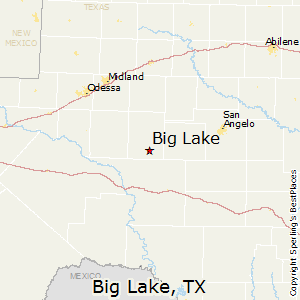
The town of Big Lake is just north of the lake itself, on State Highway 137 running north and south, and U.S. Highway 67 running east and west, approximately 65 miles west of San Angelo.   Big Lake sits about 10 miles north of Interstate 10, and about 75 miles south of Interstate 20.  Big Lake calls itself “the gateway to the Permian Basin.”

Big Lake is the home of Reagan County High School.  Jim Morris was baseball coach for the Reagan High Owls when his team persuaded him to try out for a major league baseball team.  His story was chronicled, with some artistic license, in the Disney movie “Rookie.”

Land managers are working to stop erosion on the often-dry shores of Big Lake using any trick they can find.  One trick:  Plant salt grass.

Salt grass?  Along Texas’s Gulf Coast, there are a few species of grass that, while not halophytes, are at least salt tolerant.  Salt grass.  This grass made it profitable to graze cattle on what would otherwise have been unproductive land in the Texas cattle boom.  This role in Texas history is memorialized in the Salt Grass Steakhouse chain, now found in five states.

And if planting salt grass works to control erosion, it will help clean up a large part of Texas other natural lake, Big Lake.

Big Lake’s being wet or dry is a whim of local climate.  You could say that half of all of Texas’s natural lakes are now dry as a result of continued warming; you could say that two good gully-washers or toad-stranglers could restore water to half of Texas’s natural lakes.

Big Lake Playa, from NightOwl Bakery and Roastery in Big Lake, Texas

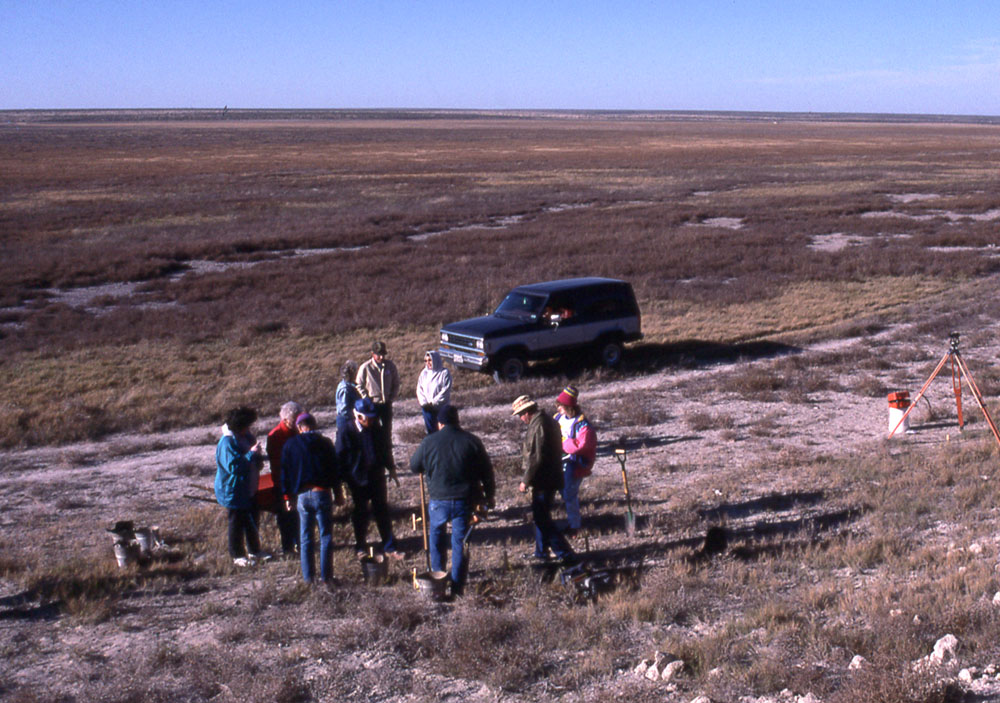
Field crew meeting at the outset of the 1992 excavations at the Big Lake Bison Kill site. The dry bed of Big Lake stretches for miles in the background. Big Lake is an intermittent saline lake or playa, an uncommon landform on the Edwards Plateau. Photo by Larry Riemenschneider, Concho Valley Archeological Society.

More details about Big Lake and prehistory, below the fold.

Read the rest of this entry »


Alas, that’s the way it is: Walter Cronkite dead at 92

July 18, 2009

You can’t explain the influence of Walter Cronkite to a high school kid today.  They don’t have any experience that begins to corroborate what you’d say.

Walter Cronkite in the last decade - Texas Parks and Wildlife photo by Richard Roberts

Walter Cronkite in the last decade - Texas Parks and Wildlife photo by Richard Roberts

Along with Chet Huntley and David Brinkley on NBC, Mr. Cronkite was among the first celebrity anchormen. In 1995, 14 years after he retired from the “CBS Evening News,” a TV Guide poll ranked him No. 1 in seven of eight categories for measuring television journalists. (He professed incomprehension that Maria Shriver beat him out in the eighth category, attractiveness.) He was so widely known that in Sweden anchormen were once called Cronkiters. (from the New York Times)

I’m saddened at the death of Cronkite.  One of the things that saddens me is that he probably could have anchored for at least a decade past when he last signed off.  Nothing against Dan Rather, at least not from me — just that Cronkite was one of a kind.  He won’t be missed by too many people alive today who never had a chance to see him work.

So, go see him work. Media Decoder has a series of YouTube pieces showing what Cronkite could do, what Cronkite did.  It’s history go see.

Other posts on Cronkite at Millard Fillmore’s Bathtub:

More, probably better stuff


Star-spangled voodoo history

July 16, 2009

Star-spangled Banner and the War of 1812 - The original Star-Spangled Banner, the flag that inspired Francis Scott Key to write the song that would become our national anthem, is among the most treasured artifacts in the collections of the Smithsonian’s National Museum of American History in Washington, D.C.

Star-spangled Banner and the War of 1812 – The original Star-Spangled Banner, the flag that inspired Francis Scott Key to write the song that would become our national anthem, is among the most treasured artifacts in the collections of the Smithsonian’s National Museum of American History in Washington, D.C.

(Hey, Dear Reader; this post got an update many months later — you may want to check it out for better links and more information.)

Every school kid learns the story of the “Star-Spangled Banner,” or should.

During the War of 1812, Georgetown lawyer Francis Scott Key, stood aboard a British ship in Baltimore Harbor to negotiate the release of his friend, Dr. William Beanes, who had been taken prisoner while the British stormed through Bladensburg, Maryland, after burning Washington, D.C.  Key witnessed the British shelling of Fort McHenry, the guardian of Baltimore’s harbor.  Inspired when he saw the U.S. flag still waving at dawn after a night of constant shelling, Key wrote a poem.

Key published the poem, suggested it might be put to the tune of “Anachreon in Heaven” (a tavern tune popular at the time) — and the popularity of the song grew until Congress designated it the national anthem in 1931.  In telling the story of the latest restoration of that garrison flag now housed at the Smithsonian Museum of American History, Smithsonian Magazine repeated the story in the July 2000 issue:  “Our Flag Was Still There.”

It’s a wonderful history with lots of splendid, interesting details (Dolley Madison fleeing the Executive Mansion clutching the Gilbert Stuart portrait of George Washington, the guy who had introduced Dolley to James Madison and then snubbed them after they were married; the British troops eating the White House dinner the Madisons left in their haste; the gigantic, 42 by 30 foot flag sewn by Mary Pickersgill, a Baltimore widow trying to support her family; the rag-tag Baltimore militia stopping cold “Wellington’s Invicibles;” the British massing of 50 boats and gunships; and much more).

It’s a grand and glorious history that stirs the patriotic embers of the most cynical Americans.

And it’s all true.

So it doesn’t deserve the voodoo history version, the bogus history created by some person preaching in a church (I gather from the “amens”) that is making the rounds of the internet, stripped of attribution so we cannot hunt down the fool who is at fault.

We got this in an e-mail yesterday; patriots save us, there must be a hundred repetitions that turn up on Google, not one correcting this horrible distortion of American history.

Horrible distortion of American history

(The full version is a mind-numbing 11 minutes plus.  Some people have put it on other sites.)

Why do I complain?

  1. It was the War of 1812, not the Revolutionary War — there were 15 states, not 13 colonies.
  2. There was no ultimatum to to Baltimore, nor to the U.S., as this fellow describes it.
  3. Key negotiated for the release of one man, Dr. Beanes.  There was no brig full of U.S. prisoners.
  4. It’s Fort McHenry, not “Henry.”  The fort was named after James McHenry, a physician who was one of the foreign-born signers of the Constitution, who had assisted Generals Washington and Lafayette during the American Revolution, and who had served as Secretary of War to Presidents Washington and Adams.
  5. Fort McHenry was a military institution, a fort defending Baltimore Harbor.  It was not a refuge for women and children.
  6. The nation would not have reverted to British rule had Fort McHenry fallen.
  7. There were 50 ships, not hundreds.  Most of them were rafts with guns on them.  Baltimore Harbor is an arm of Chesapeake Bay; Fort McHenry is not on the ocean.
  8. The battle started in daylight.
  9. Bogus quote:  George Washington never said “What sets the American Christian apart from all other people in this world is he will die on his feet before he will live on his knees.”  Tough words.  Spanish Civil War.  Not George Washington.  I particularly hate it when people make up stuff to put in the mouths of great men.  Washington left his diaries and considerably more — we don’t have to make up inspiring stuff, and when we do, we get it wrong.
  10. The battle was not over the flag; the British were trying to take Baltimore, one of America’s great ports.  At this point, they rather needed to since the Baltimore militia had stunned and stopped the ground troops east of the city.  There’s enough American bravery and pluck in this part of the story to merit no exaggerations.
  11. To the best of our knowledge, the British did not specifically target the flag.
  12. There were about 25 American casualties.  Bodies of the dead were not used to hold up the flag pole — a 42 by 30 foot flag has to be on a well-anchored pole, not held up by a few dead bodies stacked around it.

You can probably find even more inaccuracies (please note them in comments if you do).

The entire enterprise is voodoo history.  The name of Key is right; the flag is right; almost everything else is wrong.

Please help:  Can you find who wrote this piece of crap?  Can you learn who the narrator is, and where it was recorded?

I keep finding troubling notes with this on the internet: ‘My school kids are going to see this to get the real story.’  ‘Why are the libs suppressing the truth?’  ‘I didn’t know this true story before, and now I wonder why my teachers wouldn’t tell it.’

It’s voodoo history, folks.  It’s a hoax.  The real story is much better.

If Peter Marshall and David Barton gave a gosh darn about American history, they would muster their mighty “ministries” to correct the inaccuracies in this piece.  But they are silent.

Clearly, it’s not the glorious history of this nation they love.

More:

Please share that voodoo, as you do so well:

Add to FacebookAdd to NewsvineAdd to DiggAdd to Del.icio.usAdd to StumbleuponAdd to RedditAdd to BlinklistAdd to TwitterAdd to TechnoratiAdd to Furl

Save

Save


Hoax exposed: “The Great Global Warming Swindle’s” swindle

July 14, 2009

Nicely done, too, I think; this is one more alarm bell to tell us why there will be no Nobel Peace Prize for global warming deniers.

From the same guy who so brilliantly brings us the Global Warming Crock of the Week:

Tip of the old scrub brush to Tim Lambert at Deltoid.


Insurance experts: Get ready for climate change now

July 12, 2009

Climate change denialism is an astounding ball of contradictions and conundrums.

For example, while most denialists claim to be free-market devotees, they pointedly ignore market indications that climate change is real, aggravated by human actions (and inaction), and that humans can do anything about it.

Look at the insurance industry.  I’ve noted often that, here in Texas, we pay higher premiums on home insurance because climate change has produced worse weather, which costs insurance companies a lot.  Insurance company actuaries are paid to predict the future, reliably.  If they fail, insurance companies die quickly.

Weather-related catastrophes, such as wildfires, are posing a serious threat to the insurance industry worldwide. (Photograph source: John McColgan, Bureau of Land Management, Alaska Fire Service.) Caption from Berkeley Lab Research News

Weather-related catastrophes, such as wildfires, are posing a serious threat to the insurance industry worldwide. (Photograph source: John McColgan, Bureau of Land Management, Alaska Fire Service.) Caption from Berkeley Lab Research News

The “market” girds itself to fight climate change that governments are not going to move fast enough to prevent.  This will cost you a lot of money.

A good place to go for information about climate change and how it affects is the Lawrence Berkeley Laboratories, a group that studies the future and is no longer limited (if it ever was) to nuclear future issues.

Insurance in a Climate of Change, The Greening of Insurance in a Warming World, is loaded with information about insurance industry calculations of what the future is, and how insurance companies might and should react to the changes.

How relevant are weather-related natural disasters for insurers, and is there any evidence that the situation is worsening?

Globally, we are seeing about $80 billion/year in weather-related economic losses, of which $20 billion (about a quarter) are insured. This is like a “9/11” every year. Weather-related losses represent about 90% of all natural disaster losses, and the data I just cited do not include an enormous amount of aggregate losses from small-scale or gradual, non-catastrophic events (e.g., lightning, soil subsidence, gradual sea-level rise).

Inflation-adjusted economic losses from catastrophic events rose by 8-fold between the 1960s and 1990s and insured losses by 17-fold. Losses are increasing faster than insurance premiums. The insured share of total losses has increased dramatically in recent decades, and variability is increasing (a key trouble sign for risk-wary insurers). Weather-related catastrophes have clearly visible adverse effects on insurance prices, and availability. Of particular concern are the so-called “emerging markets” (developing countries and economies in transition”, which already have $375 billion per year in insurance premiums (about 12% of the global market at present, but rising). They are significantly more vulnerable to climate change than are industrialized countries. Emerging markets are the center of growth for the industry, yet they are also the center of vulnerability.

Increased exposures are surely influenced—and no doubt heavily in some areas—by rising demographic and socioeconomic exposures. Yet, the rise in losses has outpaced population, economic growth, and insurance penetration. The science of “attribution analysis” is still in primitive stages, and thus we cannot yet quantify the relative roles of global climate change and terrestrial human activities. Some have prematurely jumped to the conclusion [PDF] that demographic trends explain the entire rise in observed losses. In the year 2005, three independent refereed <!– –>scientific articles drew linkages between hurricane trends and climate change.

Denialists claim weather stations are badly-placed, and so we need not worry about climate change since warming can’t accurately be measured — never mind the worldwide rise in temperatures of atmosphere and oceans.   Denialists claim that the greenhouse effect cannot be blamed on carbon dioxide emissions since carbon dioxide is such a small proportion of the gases in the atmosphere, apparently wholly unaware of the greenhouse effect in atmospheric gases, or unaware that only a thin pane of glass makes a greenhouse work.  Denialists claim that polar bears do not decline precipitously, yet, so all wildlife will be unaffected – nevermind the dramatic shifts in migration patterns of birds and migrating mammals, and the dramatic shift in the arrival of spring.  Denialists claim that Boston Harbor has survived 300 years of human development, so all harbors can survive any increase in ocean levels, nevermind the pending disasters of islands sinking out of site and destroying entire nations in the South Pacific, and never mind the drownings in Bengla Desh at every cyclone.

Most denialists rent apaartments or own homes.  Denying the insurance increases will be more difficult, though I fully expect Anthony Watts and Co. will deny that the insurance company actions and studies of global warming are warranted or accurate.

Is there any good news in all of this?

By all means. Insurers need to look no farther than their roots as founders of the original fire departments, early advocates for building codes and fire safety, etc. That is to say that insurers’ history is all about risk management and loss prevention. The same thinking can apply in the case of climate change. Just as insurers fought fire risks through encouraging fire safety, better modeling, and fire suppression, so too can they be part of the climate change solution. This can take many forms, ranging from providing new insurance products (e.g., for carbon trading or energy savings insurance [PDF]), to promoting energy-efficient and renewable technologies [PDF] that also help prevent everyday losses, to engaging in the broader policy discussion on climate change. Insurers can also be part of improving the underlying science of climate change, modeling, and impacts assessment. We maintain an extensive compilation of examples of how leading insurers are stepping into the arena in a constructive manner.

Alas, there is no insurance against the dithering of climate change denialists.

Go, with all thy internet getting, get thee wisdom.


Bated breath, bated brains, bated sense and DDT

July 11, 2009

At the root of all the false tales about Rachel Carson and DDT there are a handful of sources, all of them with an axe to grind.  In any discussion where someone tries to make a claim that DDT is good but misunderstood, or that Rachel Carson was evil tantamount to Pol Pot, Mao ze Dong and Lex Luther combined, the sources will turn out to be Gordon Edwards, Steven Milloy parroting Gordon Edwards, Elizabeth Whelan, Roger Bate, or Richard Tren.

Oh, there’s that Driessen guy, but he just quotes these other guys, appearing not to bother to check the accuracy of their statements.

Roger Bate in his high-salaried position as a propagandist for AEI.

Roger Bate in his well-paid position as a propagandist for AEI.

Not one of these sources is an expert on DDT or its class of chemicals.  None of them is an entomologist, other than Gordon Edwards, whose productive work in entomology ended well before he fell in with Lyndon LaRouche and other America-hating groups.

It’s a tight-knit bunch, largely out of the sight of reporters and fact-checkers — and definitely out of the sight of scientists who work in either malaria reduction, wildlife management, or toxics control

If you care about science, about the War on Science (you out there, Mooney?), if you care about health care in Africa, Africa, Asia or generally about fighting malaria and saving kids’ lives; if you have any dog in the wise management of natural resources and especially wildlife; if you care about environmental protection, and wise government policies that will protect your children’s and grandchildren’s health and heritage, you need to read this article on Roger Bate. [Article archived here, now; or here.]

Now operating out of the conservative American Enterprise Institute (AEI), Bate’s signature coup to date has been to spread the myth that environmentalists, by preventing the use of the pesticide DDT (Dichloro-Diphenyl-Trichloroethane) to kill mosquitoes in developing countries, have heartlessly caused millions of malaria deaths worldwide. It needs to be said at the outset that this argument is untrue. While some groups have pressed hard to find alternatives, there is little evidence that a concerted effort to abolish anti-malaria DDT spraying ever occurred. Of the few environmental organizations that even pay attention to pesticide use overseas, the ones with any clout all support a clause in the Stockholm Convention that allows DDT use for public health reasons.

The fact that this knowledge has not stopped Roger Bate is not surprising. The wider the untrue story spreads, the worse environmentalists look, and that’s always been his bottom line. For all his personal likeability, he is a man on a mission, and because he doesn’t let anything slow down the pace and scope of his argument, he is very good at what he does.

The story is titled “Bate and Switch: How a free-market magician manipulated two decades of environmental science.”

Adam Sarvana wrote the story for the Public Education Center (PEC), a non-profit center with an investigative journalism experiment based in Washington, D.C.  (Note to newspapers:  You can probably get rights to print this story.)

Quick!  Warn the others:

Add to FacebookAdd to NewsvineAdd to DiggAdd to Del.icio.usAdd to StumbleuponAdd to RedditAdd to BlinklistAdd to TwitterAdd to TechnoratiAdd to Furl

Read the rest of this entry »


David Barton: Mediocre scientists who are Christian, good; great scientists, bad

July 9, 2009

I’m reviewing the reviews of Texas social studies curricula offered by the six people appointed by the Texas State Board of Education.  David Barton, a harsh partisan politician, religious bigot, pseudo-historian and questionable pedagogue, offers up this whopper, about fifth grade standards.:

In Grade 5 (b)(24)(A), there are certainly many more notable scientists than Carl Sagan – such as Wernher von Braun, Matthew Maury, Joseph Henry, Maria Mitchell, David Rittenhouse, etc.

Say what?  “More notable scientists than Carl Sagan . . . ?”  What is this about?

It’s about David Barton’s unholy bias against science, and in particular, good and great scientists like Carl Sagan who professed atheism, or any faith other than David Barton’s anti-science brand of fundamentalism.

David Barton doesn’t want any Texas child to grow up to be a great astronomer like Carl Sagan, if there is any chance that child will also be atheist, like Carl Sagan.  Given a choice between great science from an atheist, or mediocre science from a fundamentalist Christian, Barton chooses mediocrity.

Currently the fifth grade standards for social studies require students to appreciate the contributions of scientists.  Here is the standard Barton complains about:

(24) Science, technology, and society. The student understands the impact of science and technology on life in the United States. The student is expected to:

(A) describe the contributions of famous inventors and scientists such as Neil Armstrong, John J. Audubon, Benjamin Banneker, Clarence Birdseye, George Washington Carver, Thomas Edison, and Carl Sagan;
(B) identify how scientific discoveries and technological innovations such as the transcontinental railroad, the discovery of oil, and the rapid growth of technology industries have advanced the economic development of the United States;
(C) explain how scientific discoveries and technological innovations in the fields of medicine, communication, and transportation have benefited individuals and society in the United States;
(D) analyze environmental changes brought about by scientific discoveries and technological innovations such as air conditioning and fertilizers; and
(E) predict how future scientific discoveries and technological innovations could affect life in the United States.

Why doesn’t Barton like Carl Sagan?  In addition to Sagan’s being a great astronomer, he was a grand populizer of science, especially with his series for PBS, Cosmos.

But offensive to Barton was Sagain’s atheism.  Sagan wasn’t militant about it, but he did honestly answer people who asked that he found no evidence for the efficacy or truth of religion, nor for the existence of supernatural gods.

More than that, Sagan defended evolution theory.  Plus, he was Jewish.

Any one of those items might earn the David Barton Stamp of Snooty-nosed Disapproval, but together, they are about fatal.

Do the scientists Barton suggests in Sagan’s stead measure up? Barton named four:

Wernher von Braun, Matthew Maury, Joseph Henry, Maria Mitchell, David Rittenhouse

In the category of “Sagan Caliber,” only von Braun might stake a claim.  Wernher von Braun, you may recall, was the guy who ran the Nazi’s rocketry program.  After the war, it was considered a coup that the U.S. snagged him to work, first for the Air Force, and then for NASA.  Excuse me for worrying, but I wonder whether Barton likes von Braun for his rocketry, for his accommodation of anti-evolution views, or for his Nazi-supporting roots.  (No, I don’t trust Barton as far as I can hurl the Texas Republican Party Platform, which bore Barton’s fould stamp while he was vice chair of the group.)

So, apart from the fact that von Braun was largely an engineer, and Sagan was a brilliant astronomer with major contributions to our understanding of the cosmos, what about the chops of the other four people?  Why would Barton suggest lesser knowns and unknowns?

Matthew Maury once headed the U.S. Naval Observatory, in the 19th century.  He was famous for studying ocean currents, piggy-backing on the work of Ben Franklin and others.  Do a Google search, though, and you’ll begin to undrstand:  Maury is a favorite of creationists, a scientist who claimed to subjugate his science to the Bible.  Maury claimed his work on ocean currents was inspired at least in part by a verse in Psalms 8 which referred to “paths in the sea.”  Maury is not of the stature or achievement of Sagan, but Maury is politically correct to Barton.

Joseph Henry is too ignored, the first head of the Smithsonian Institution. Henry made his mark in research on magnetism and electricity.  But it’s not Henry’s science Barton recognizes.  Henry, as a largely unknown scientist today, is a mainstay of creationists’ list of scientists who made contributions to science despite their being creationists.  What?  Oh, this is inside baseball in the war to keep evolution in science texts.  In response to the (accurate) claim that creationists have not contributed anything of scientific value to biology since about William Paley in 1802, Barton and his fellow creationists will trot out a lengthy list of scientists who were at least nominally Christian, and claim that they were creationists, and that they made contributions to science.  The list misses the point that Henry, to pick one example, didn’t work in biology nor make a contribution to biology, nor is there much evidence that Henry was a creationist in the modern sense of denying science.  Henry is obscure enough that Barton can claim he was politically correct, to Barton’s taste, to be studied by school children without challenging Barton’s creationist ideas.

Maria Mitchell was an American astronomer, the second woman to discover a comet. While she was a Unitarian and a campaigner for women’s rights, or more accurately, because of that, I can’t figure how she passes muster as politically correct to David Barton.  Surely she deserves to be studied more in American history than she is — perhaps with field trips to the Maria Mitchell House National Historic LandmarkIt may be that Barton has mistaken Mitchell for another creationist scientist. While Mitchell’s life deseves more attention — her name would be an excellent addition to the list of woman scientists Texas children should study — she is not of the stature of Sagan.

David Rittenhouse, a surveyor and astronomer, and the first head of the U.S. Mint, is similarly confusing as part of Barton’s list.  Rittenhouse deserves more study, for his role in extending the Mason-Dixon line, if nothing else, but it is difficult to make a case that his contributions to science approach those of Carl Sagan.  Why is Rittenhouse listed by Barton?  If nothing else, it shows the level of contempt Barton holds for Sagan as “just another scientist.”  Barton urges the study of other scientists, any other scientists, rather than study of Sagan.

Barton just doesn’t like Sagan.  Why?  Other religionists give us the common dominionist or radical religionist view of Sagan:

Just what is the Secular Humanist worldview? First and foremost Secular Humanists are naturalists. A naturalist believes that nature is all that exists. “The Cosmos is all there is, or was, or ever will be.” This was the late Carl Sagan’s opening line on the television series “Cosmos.” Sagan was a noted astronomer and a proud secular humanist. Sagan maintained that the God of the Bible was nonexistent. (Imagine Sagan’s astonishment when he came face to face with his Maker.)

Sagan’s science, in Barton’s view, doesn’t leave enough room for Barton’s religion.  Sagan was outspoken about his opposition to superstition.  Sagan urged reason and the active use of his “Baloney-Detection Kit.” One of Sagan’s later popular books was titled Demon-haunted World:  Science as a candle in the dark.  Sagan argued for the use of reason and science to learn about our world, to use to build a framework for solving the world’s problems.

Barton prefers the dark to any light shed by Sagan, it appears.

More resources on the State Board of Education review of social studies curricula


#1 hoax site on the web

July 5, 2009

This may be the #1 hoax site on the web:  Martinlutherking.org. Certainly it is a site dangerous for children, because it cleverly purports to be an accurate history site, while selling voodoo history and racism.

A racist group bought the domain name (note the “.org” suffix), and they’ve managed to keep it.  The site features a drawing of Martin Luther King, Jr., on the first page.  The racist elements are subtle enough that unwary students and teachers may not recognize it for the hoax site it is.

It is both racist and hoax:  Note the link to a racist argument on “Why the Martin Luther King, Jr., holiday should be repealed;”  note the link to a hoax page, “Black invention myths.”

Students, nothing on that site should be trusted. Teachers, warn students away from the site.  You may want to use that site as a model of what a bad site looks like, and the importance of weighing the credibility of any site found on the web.

Why do I even mention the racist, hoax site? Because it comes upi #3 on Google searches for “Martin Luther King.”  Clearly a lot of people are being hoodwinked into going to that site.  I’ve seen papers by high school students citing the site, with teachers unaware of the site’s ignoble provenance.

Update: The site is owned by Stormfront, a white supremicist organization.

Here are a few good sites on the Rev. Dr. Martin Luther King, Jr.; you can help things by clicking on each one of these sites, and by copying this list with links and posting it on your blog:

More resources:


Michael Shermer’s baloney detection kit

June 25, 2009

Hmmmm.  May have to use this to start out the history classes next year, on the topic of “How do we know what we know?”

Michael Shermer explains the tools we use to detect baloney.  Shermer is the editor of Skeptic magazine; here he speaks in a video produced by the Richard Dawkins Foundation for Reason and Science, via Boing! Boing!:


For science, Bing loses badly to Google; not safe for school kids?

June 24, 2009

Have you tried Bing yet?

Nice pictures — the wallpaper is cooler than Google’s rather sterile white background.  I’m not much fond of the way Bing shows images, with some down the side when you check out another, but without any identifying data to help you figure out which ones to check out.

But I stumbled into a major problem:  At least on DDT, Bing favors the Tinfoil Hat Brigades™, featuring crank science almost exclusively on the first page in my early searches, compared to Google’s pointing first to the hard science.

Importantly, this tells me that Bing is not safe to assign to students doing research.

Bing will bear watching all summer.  Can they get it up to speed by the opening of schools in the fall?

Here’s the Google web search for “ddt”:

  1. DDT – Wikipedia, the free encyclopedia

    – 2 visits – May 27

    DDT (from its trivial name, dichlorodiphenyltrichloroethane) is one of the most well-known synthetic pesticides. It is a chemical with a long, unique,
    en.wikipedia.org/wiki/DDTCachedSimilar

  2. DDT, What is DDT? About its Science, Chemistry and Structure

    Find out about the science and chemistry of DDT (Banned Insecticide), see colourful images of DDT and explore interactive 3D molecules of DDT.
    http://www.3dchem.com/molecules.asp?ID=90CachedSimilar

  3. DDT Ban Takes Effect | EPA History | US EPA

    – Jun 17

    The general use of the pesticide DDT will no longer be legal in the United States after today, ending nearly three decades of application during which time
    http://www.epa.gov/history/topics/ddt/01.htm – CachedSimilar

  4. DDT |Persistent Bioaccumulative and Toxic (PBT) Chemical Program

    Prior to 1972 when its use was banned, DDT was a commonly used pesticide. Although it is no longer used or produced in the United States, we continue to
    http://www.epa.gov/pbt/pubs/ddt.htm – CachedSimilar
    More results from www.epa.gov »

  5. News results for ddt


    The Associated Press
    EPA plans hearings on DDT deposit off SoCal coast‎ – 1 day ago

    “We have the worst DDT hotspot in the entire US,” he said. “That we’re still stuck with this horrible legacy decades later is awful.” From 1947 to 1971,

    The Associated Press231 related articles »

  6. What’s This?

    ATSDR – ToxFAQs™: DDT, DDE, and DDD

    – 2 visits – 10/28/07

    Sep 11, 2007 Exposure to DDT, DDE, and DDD occurs mostly from eating foods containing small amounts of these compounds, particularly meat,
    http://www.atsdr.cdc.gov/tfacts35.htmlCachedSimilar

  7. EPA plan targets vast DDT deposit off Calif. coast – Yahoo! News

    A plan to cap a vast, long-neglected deposit of the pesticide DDT on the ocean floor off Southern California got its first public airing Tuesday — nearly
    news.yahoo.com/s/ap/20090623/ap_on_re_us/us_ocean_ddtSimilar

  8. Silent spring – Google Books Result

    by Rachel Carson, Edward O. Wilson – 2002 – Nature – 378 pages
    Even if she had not inspired a generation of activists, Carson would prevail as one of the greatest nature writers in American letters” (Peter Matthiessen,…
    books.google.com/books?isbn=0618249060

  9. What’s This?

    Junkscience.com — 100 things you should know about DDT

    – 7 visits – 6/15/08

    Rachel Carson sounded the initial alarm against DDT, but represented the science of DDT The use of DDT under the regulations involved here do not have a
    http://www.junkscience.com/ddtfaq.html – CachedSimilar

  10. DDT : An Introduction

    Not many of us, though, are aware of what DDT is and how it works. This module is here to hopefully give you some insight into the science behind this
    http://www.chem.duke.edu/~jds/cruise_chem/pest/pest1.htmlCachedSimilar

No crank science until #9 in the search. Compare it to Bing:

  • · Cached page
  • The third entry goes to a wrestling maneuver, the fifth entry is the biggest crank science site.  The ninth entry plunges back into crank science at its worst.   This is much improved since I tried it last night and got nothing but crank science (Bing is improving quickly).

    Note: Vaibhav has a post comparing Bing to Google, as he notes in comments.  You may want to check that out, too.  He’s sticking with Bing as default, though he finds Google serves his needs better.  Go figure.


    Encore post: Rebutting junk science, “100 things to know about DDT” point #6 (the “500 million saved” or “500 million died” errors)

    June 22, 2009

    Encore post — originally posted in August 2007.  Another in a continuing series, showing the errors in JunkScience.com’s list of “100 things you should know about DDT.” (No, these are not in order.)  In the summer of 2009, the denialists have trotted this error out again.

    Steven Milloy and the ghost of entomologist J. Gordon Edwards listed this as point six in their list of “100 things you should know about DDT “[did Edwards really have anything to do with the list before he died?]:

    6. “To only a few chemicals does man owe as great a debt as to DDT… In little more than two decades, DDT has prevented 500 million human deaths, due to malaria, that otherwise would have been inevitable.”

    [National Academy of Sciences, Committee on Research in the Life Sciences of the Committee on Science and Public Policy. 1970. The Life Sciences; Recent Progress and Application to Human Affairs; The World of Biological Research; Requirements for the Future.]

    In contrast to their citation for the Sweeney hearing record, which leads one away from the actual hearing record, for this citation, the publication actually exists, though it is no longer available in print. It’s available on-line, in an easily searchable format. [I urge you to check these sources out for yourself; I won’t jive you, but you should see for yourself how the critics of Rachel Carson and WHO distort the data — I think you’ll be concerned, if not outraged.] The quote, though troubled by the tell-tale ellipses of the science liar, is accurately stated so far as it goes.

    The problems? It’s only part of the story as told in that publication.  The National Academy of Science calls for DDT to be replaced in that book; NAS is NOT calling for a rollback of any ban, nor is NAS defending DDT against the claims of harm. The book documents and agrees with the harms Rachel Carson wrote about eight years earlier.

    Sign at the National Academy of Sciences building, Washington, D.C.

    Sign at the National Academy of Sciences building, Washington, D.C.

    Milloy (and Edwards, he claims), are trying to make a case that the National Academy of Sciences, one of the more reputable and authoritative groups of distinguished scientists in the world, thinks that DDT is just dandy, in contrast to the views of Rachel Carson and environmentalists (who are always cast as stupid and venal in Milloy’s accounts) who asked that DDT use be reduced to save eagles, robins and other songbirds, fish, and other wildlife, and to keep DDT useful against malaria.

    First, there is no way that a ban on DDT could have been responsible for 500 million deaths due to malaria.  Calculate it yourself, the mathematics are simply impossible: At about 1 million deaths per year, if we assume DDT could have prevented all of the deaths (which is not so), and had we assumed usage started in 1939 instead of 1946 (a spot of 7 years and 7 million deaths), we would have 69 million deaths prevented by 2008. As best I can determine, the 500 million death figure is a misreading from an early WHO report that noted about 500 million people are annually exposed to malaria, I’m guessing a bit at that conclusion — that’s the nicest way to attribute it to simple error and not malicious lie. It was 500 million exposures to malaria, not 500 million deaths. It’s unfortunate that this erroneous figure found its way into a publication of the NAS — I suppose it’s the proof that anyone can err.

    This error, “500 million deaths,” crops up in several publications after it was originally made near the end of the 1960s; honest researchers would get a good copy editor who would do the math and realize that 500 million people would not have died from malaria had there been no control at all, since 1939, when DDT was discovered to have insecticidal properties. Were Milloy and Edwards making a good faith case, I’d excuse it; but Edwards was a scientist and should have known better, Milloy has been spreading this falsehood long enough he could not fail to know better.

    But the actual publication from the National Academy of Sciences suggests other issues that JunkScience.com would rather you not know about.

    Importantly and specifically, the National Academy of Sciences is calling for broad research 1.) to avoid the problems that DDT presented (problems which Junk Science denies exist), and 2.) to combat the continuing evolution of the insect pests (evolution which Junk Science also denies), and 3.) to provide insecticides that hit specific targets to avoid the collateral damage of harming helpful insects, other animals and especially predators of the harmful insects (more problems that Junk Science pretends do not exist).

    Three pages carry references to DDT in the book, The Life Sciences: Recent Progress and Application to Human Affairs — The World of Biological Research Requirements for the Future (National Academy of Sciences, 1970). This was a study of the state of science in several areas, with a survey of places particularly ripe for research considering human needs in the world. It was a sort of road map of where governments and other funders of research should spend their research monies in order to have the greatest beneficial effects.

    The book suggests the need for extensive funding for research in biology over the following decade or two, or four. Were Milloy and Edwards correct that DDT was the panacea lifesaver, one might wonder why DDT was included in the book at all except to note a great success that precludes need for further research. That’s not what the book says at all.

    Among the chief recommendations, NAS said research had to focus on rapidly biodegradable, closely targeted chemical pesticides to replace the DDT-style, long-lived, broad spectrum pesticides. NAS recognized the environmental dangers of DDT first and foremost in the introduction and statement of key recommendations:

    It is imperative that new, degradable insecticides and pesticides with highly specific actions be devised and that their ecological consequences be understood, as it is imperative that the full ecological impact of the existing armamentarium of such agents be evaluated. Classical dose responses, evaluated only in terms of mortality or morbidity statistics, will not suffice; such data also must include an assessment in terms of modern knowledge of cell physiology, metabolism, and cytogenetics. [see page 11 of the book.]

    These are exactly the things Milloy and Edwards ignore. This is a warning that simple toxicity tests on humans are not enough — pesticides need to be tested for downstream effects. That is what Rachel Carson called for in Silent Spring, research to understand the full effects of chemicals we use in the wild. This recommendation from NAS fully recognizes that chemicals like DDT, while they may offer significant benefits, can at the same time be significantly dangerous and damaging.

    From the general introduction, the NAS authors point to three specific DDT-related issues. In general, the NAS view of DDT can be summarized like this: ‘DDT produced some great benefits fighting harmful insects, but its benefits need to be balanced against its great dangers and great potential for long-term damage. DDT is the poster child for beneficial chemicals that are also hazardous. We need to understand all the dangers as well as some of the benefits, in order to make wise decisions on chemical use. In the interim, where we have gaps in our knowledge, we should be careful.’

    By carefully selecting only part of a statement by the NAS in one of the three areas of research, and leaving out all the qualifying statements, Milloy and the late Edwards misrepresent what NAS said. NAS was not calling for greater use of DDT. NAS was not calling for continued use of DDT. NAS was not criticizing any of the bans on DDT usage. NAS was saying we don’t know how great is the danger from DDT, and more study is needed; and use of DDT must be restricted in the interim.

    Excerpt 1: Crop research

    Increase research in rotating crops, herbicides and pesticides: In a section mentioning the need for alternative treatments, and commending organic methods of farming, on page 182 NAS notes the efficacy of crop rotation, and then talks about the need to have several different tools available to get rid of weeds and insect pests.

    Similarly, recognition of the insecticidal properties of DDT in 1939, initially used against insects directly injurious to man, indicated the intelligent application of understanding of insect physiology, entomology, pharmacology, and the arts of the organic chemist could prevent crop destruction by insects. To date, the use of 2,4-D has increased yearly even though it has been replaced in part, and DDT is being withdrawn because of concern for its potentially adverse effects on man, transfer to the general environment, prolonged persistence, destruction of beneficial insects and possibly other wildlife, and stimulation of resistance in the target insects. These are now matters of broad general concern, and it is regrettable that public decisions must be made on the basis of our limited knowledge. But these compounds paved the way for modern agriculture. Without their equivalent, modern intensive agriculture is not possible, and, just as the continual breeding of new crop strains is imperative, so too is a continuing search for effective herbicides and pesticides, optimally with specific effects on offending organisms, degradable in the soil and nontoxic to man and animals. Attainment of these goals will require continuously increasing understanding of plant and insect physiology and life cycles.

    Control of undesirable species by biological means is, in many ways, the most attractive possibility for future exploration. The notion is by no means new; attempts at such control began late in the nineteenth century. Indeed, some 650 species of beneficial insects have been deliberately introduced into the United States from overseas, of which perhaps 100 are established. These are now major factors in the control of aphids and a variety of scale insects and mealybugs. More recently, microbes and viruses have been considered for these purposes, a few of which are being used; for example, spores of the bacterium B. thuringiensis are used to control the cabbage looper and the alfalfa caterpillar. Some insects have been utilized for control of weeds — e.g., prickly pear in Australia and the Klamath weed in the western United States — while a combination of the cinnabar moth and the ragwort seed fly is required to keep down the population of the toxic range weed, the tansy ragwort.

    There is no ringing endorsement for bringing back DDT, but rather a much more sophisticated understanding demonstrated that a variety of tools, some chemical and some living, need to brought to bear in agriculture and health — coupled with a clear understanding that non-beneficial effects need to be studied and understood, for all attempts to control pests for crops, and threats to humans. This is quite contrary to the general tone of Milloy’s and Edwards’s list, and far beyond the misleading snippet they offer.

    Near the end of that first paragraph, the NAS call for pesticides that are pest specific, rapidly degradable once released, and nontoxic to humans and other beneficial creatures, targets and shoots directly at DDT, which is non-specific, long-lived in the soil, and toxic to almost everything.

    That’s just the first of the three mentions of DDT.

    Excerpt 2: Industrial technologies – Pesticide research

    The second mention is in a discussion specific to pesticides. The NAS panel recommends research to find safe, short-lived alternatives that target specific pests. DDT is a long-lived toxin that has broad targets. This is a very long entry, but unlike the JunkScience.com guys, I think accuracy is more than one quote ripped out of context; in context, you see that NAS is not defending DDT as a safe, panacea against malaria.

    I quote from the NAS publication at length, below; I want you to see that NAS is not contradicting Rachel Carson in any way; in fact, NAS is paying homage to Carson, adopting her calls to action in research and development, while updating the science which showed, in 1969, that Carson was right more than anyone could have known. Because it’s a long quote, I’ll put it in a different color, not boxing it where the formatting gets out of hand:

    ___________________________

    From: The Life Sciences: Recent Progress and Application to Human Affairs — The World of Biological Research Requirements for the Future (National Academy of Sciences, 1970)

    [Beginning on page 213]

    Pesticides

    As noted earlier, the properties of DDT and 2,4-D inaugurated a new era in management of our living resources and gave rise to a new industry. Each touched off a wave of research that continues to the present, seeking newer compounds that are species-specific, safe, and degradable. For the moment, the use of such compounds is indispensable; until superior means and materials are found, these compounds are essential to the success of our agriculture, while assisting in maintenance of our woodlands and protection of our health. It is the scale of this use, rather than their intrinsic toxicity, that has properly generated public concern over the effects of these chemicals on the public health. In 1966, total production of all pesticides in the U.S. was 1,012,598,000 pounds.

    The rapid increase in use occurred because new pesticides have been developed that control hitherto uncontrolled pests, and broader use of pesticides in large-scale agriculture has increased crop yields significantly. Current trends in crop production involving large acreages, greater use of fertilizers, and intensive mechanized cultivation and harvesting offer particularly favorable opportunities for insect pests and would result in large crop losses to these pests unless control measures were applied.

    The increased number of new pesticides in part reflects a second generation of pesticides with more appropriate persistence for economic control of specific pests, more complete control of the pest, less hazard for the applicator, or less hazardous residues on the crop. An additional impetus to the development of the pesticides comes from the fact that many insect pests have developed resistance to the older pesticides. The development of pest resistance does not necessarily entail the development of more dangerous pesticides; the new agent need only be chemically different to overcome resistance. The continuing search for new, more nearly ideal pesticides requires the joint effort of research teams composed of organic chemists, biochemists, pharmacologists, physiologists, entomologists, and botanists. The effort is managed much like the development of new drugs, each chemical entity being tested in a “screen” of a variety of insects.

    About 73 percent of the total insecticide usage is in agriculture, and about 25 percent is used in urban areas by homeowners, industry, the military, and municipal authorities. The remaining 2 percent is applied to forest lands, grassland pasture, and on salt and fresh water for mosquito control. Over 50 percent of the insecticide used in agriculture is applied to cotton acreage alone.

    When insect-control measures are not used in agriculture, insect pests take 10 to 50 percent of the crop, depending on local conditions. Losses of this magnitude are not readily tolerated in the United States in the face of a rapidly increasing population and a concomitant decrease in agricultural acreage. In this sense, the use of pesticides might be deemed essential at this time for the production and protection of an adequate food supply and an adequate supply of staple fiber. While alternative methods of pest control are under investigation and development, they are not yet ready to displace completely the chemical pesticides, and it appears that a pesticide industry will be required for some years to come.

    Pesticides have been tremendously effective, but individual pesticides, like sulfa drugs and antibiotics, tend to lose their effectiveness as species resistance to them develops. Hence, there will be a continuing search for new pesticides as long as pesticides are considered to be required for the economy or the public health. This search will require the continuing participation of able biologists. As with drugs, new pesticides, optimally, should be selectively toxic for specific pests, rather than broadly toxic against a wide variety of pests with serious side-effects on nonpest species. Broad-spectrum pesticides affect an essential enzyme or system common to a wide variety of pests. A selective pesticide, on the other hand, either should affect an essential enzyme or system peculiar to a particular pest or should be applied in such a way that only the particular pest gains access to it.

    An interesting example of a selective pesticide is the rodenticide norbormide, which is highly toxic for rats, particularly for the Norway rat. By contrast, the acute oral toxicity of norbormide for other species is much lower, the lethal dose for a great variety of birds and mammals, per kilogram of body weight, being more than 100 times greater. The mechanism of the selective toxic action of the norbormide for rats is not yet elucidated.

    Achievement of target specificity requires a sophisticated knowledge of the anatomical, physiological, or biochemical peculiarities of the target pest as compared with other pests or vulnerable nonpests; a pesticide may then be developed that takes advantage of these peculiarities. This is obviously not easy to accomplish, and norbormide may prove to be unique for many years. An alternative is the introduction of a systemic pesticide into the host or preferred food of the target pest. Other pests or nonpests would not contact the pesticide unless they shared the same host or food supply. As an example, a suitable pesticide may be applied to the soil and imbibed by the root system of a plant on which the pest feeds. The pest feeding on the plant then receives a toxic dose. The application of attractants or repellents (for nontarget species) would increase the selectivity of the systemic pesticide. The use of systemic pesticides on plants used for food by humans or domestic animals poses an obvious residue problem.

    There has been a strong public reaction against the continued use of pesticides on the grounds that such use poses a potential threat to the public health as well as being a hazard to wildlife. Careful investigations have so far failed to establish the magnitude of the threat to the public health; i.e., there are as yet few if any clear-cut instances of humans who have suffered injury clearly related to exposure to pesticides that have been used in the prescribed manner. Report No. 1379 of the 89th Congress (July 21, 1966)* concluded:

    The testimony balanced the great benefits of disease control and food production against the risks of acute poisoning to applicators, occasional accidental food contamination and disruption of fish and wildlife. . . . The fact that no significant hazard has been detected to date does not constitute adequate proof that hazards will not be encountered in the future. No final answer is possible now, but we must proceed to get the answer. (Italics ours [NAS]).

    Failure to establish such hazard does not mean that it does not exist. There are no living animals, including those in the Antarctic, that do not bear a body burden of DDT. Large fish kills and severe effects on bird populations have been demonstrated. The large-scale use of these agents has been practiced for less than two decades, and use has increased annually until this year (1969). Whereas the anticholinesterase compounds, which have high acute toxicity (and hence are highly hazardous to the applicator), are readily and rapidly degraded in nature, the halogenated hydrocarbons are not. With time, their concentration in the soil and in drainage basins, lakes, ponds and even the oceans must continue to increase, thereby assuring their buildup in plant and animal tissues. Over a sufficient time period, this is potentially disastrous. And should such a period pass without relief, the situation could not be reversed in less than a century. Because of the large economic benefit to the farmer, it is pointless to adjure him to be sparing; unless restrained by law, he will make his judgment in purely personal economics terms. But mankind badly needs the incremental food made possible by use of effective pesticides, and the enormous benefit to public health of greatly reducing the population of insects that are disease vectors is a self-evident boon to humanity. Thus it is imperative that alternative approaches to pest control be developed with all possible dispatch, while we learn to use available pesticides only where they are clearly necessary and desirable and to apply them in the minimal amounts adequate to the purpose.

    A recent development in insect-pest control has been the possible use of juvenile hormone. This hormone, normally produced by insects and essential for their progress through the larval stages, must be absent from the insect eggs if the eggs are to undergo normal maturation. If juvenile hormone is applied to the eggs, it can either prevent hatching or result in the birth of immature and sterile offspring. There is evidence to suggest that juvenile hormone is much the same in different species of insects, and analogs have been prepared that are effective in killing many species of insects, both beneficial and destructive. There would, therefore, be great danger of upsetting the ecological balance if juvenile hormone were applied on a large scale.

    What is needed, then, is development of chemical modifications of juvenile hormone that would act like juvenile hormone for specific pests but not for other insects. For example, a preparation from balsam fir, which appears to be such an analog, has been identified and is effective against a family of bugs that attack the cotton plant, but not against other species. If it proves possible to synthesize similar analogs specific for other pests, a new type of pesticide may emerge. If this happens, it will be extremely important to explore possible side-effects on other insect species and on warm-blooded animals before introduction of yet a new hazard into the biosphere.

    We cannot rest with existing pesticides, both because of evolving resistance to specific compounds and because of the serious long-term threat posed by the halogenated hydrocarbons. While the search for new, reasonably safe pesticides continues, it is imperative that other avenues be explored. It is apparent that this exploration will be effective only if there is, simultaneously, ever-increasing understanding of the metabolism, physiology, and behavior of the unwanted organisms and of their roles in the precious ecosystems in which they and we dwell.

    __________________

    * U.S. Congress. Senate. Committee on Government Operations. Interagency Environmental Hazards Coordination, Pesticides and Public Policy (Senate Report 1379). Report of the Subcommittee on Reorganization and International Organizations (pursuant to S. R. 27, 88th Cong., as amended and extended by S. R. 288), 89th Cong., 2d sess., Washington, D.C., U.S. Government Printing Office, 1966.

    ________________________________

    Anyone should be able to see from various parts of that excerpt that NAS was not defending DDT as harmless; that instead, NAS was saying that despite its great utility, DDT use needed to be extremely limited, and that substitutes for it needed to be found as quickly as possible — and then, the substitutes need to be researched to make sure they don’t have unintended bad effects, on other species, at other places, at other times.

    Excerpt 3: The Great Hazards – Man and his environment

    The third excerpt has the money quote — it contains an obvious error of fact, but an error that has been seized upon and trumpeted from one end of the world to the other: The 500 million dead miscalculation. Critics of environmental stewards like to trot this out, sometimes going so far as to accuse Carson and environmentalists of genocide, for the deaths of 500 million people that would have been prevented but for our concerns ‘for a few silly birds.’

    I reiterate, the mathematics do not work. If we assumed 5 million deaths to malaria every year for the 20th century, we’d get 500 million deaths. Records indicate total deaths as high as 3 million in some years; since World War II, deaths have averaged about 1 million per year. So, even were it true that DDT bans unnecessarily caused all those deaths (and it’s not true), the total, between 1946 and 2006 would be about 50 million deaths. The “500 million deaths” figure is incorrect by a multiple of 10, at least, in addition to being absolutely in error historically. DDT never offered the realistic hope of eradicating malaria; by 1965, it was already failing where it was applied, and human institutional failures (not environmentalists) prevented its application in places where it might have helped.

    The National Academy of Sciences (NAS) discusses hazards from chemistry and biochemistry, in one of its final chapters studying life sciences and their applications to human affairs. NAS authors write about the need to study causes of deaths and how to prevent them (including lung cancer and smoking), and there is discussion on the difficulty of getting clear answers to every question. In a section titled “Man and his environment,” NAS discusses environmental damage: Deforestation, pollution, and animal and plant extinctions. On page 430, there is an example given of supposedly beneficial chemicals turning toxic once released; DDT is the example:

    Then NAS discusses DDT:

    Large-scale use of pesticides can start a chain in which these substances concentrate in plant an animal tissues and, when ingested, accumulate in the adipose [fat] tissue of the human body. As an illustration of this process, consider the record of Clear Lake, California, where DDD (a breakdown product of DDT) entered the lake at 0.02 part per million (ppm). A year later, its concentration was 10 ppm in the plankton, 900 ppm in fish that eat the plankton, and 2,700 ppm in fish that eat fish that eat plankton. No data are available concerning people who ate such fish.

    * * * * *

    The effects of these changes in the environment on man himself are not known.

    NAS notes that absence of proof of damage should not imply safety, and the article notes that small doses of pollutants, repeated over time, can cause serious health problems.

    And then, on page 432, NAS discusses the harmful, latent effects of substances considered to be beneficial — using DDT as the example:

    Until reliable evidence thus obtained becomes available, public health measures designed to minimize exposure to such pollutants are patently advisable. But surely a rule of reason should prevail. To only a few chemicals does man owe as great a debt as to DDT. It has contributed to the great increase in agricultural productivity, while sparing countless humanity from a host of diseases, most notably, perhaps, scrub typhus and malaria. Indeed, it is estimated that, in a little more than two decades, DDT has prevented 500 million deaths due to malaria that would otherwise have been inevitable. Abandonment of this valuable insecticide should be undertaken only at such time and in such places as it is evident that the prospective gain to humanity exceeds the consequent losses. At this writing, all available substitutes for DDT are both more expensive per crop-year and decidedly more hazardous to those who manufacture and utilize them in crop treatment or for other, more general purposes.

    The health problems engendered by undesirable contaminants of the environment may also be raised by substances that are intentionally ingested. Only large-scale, long-term epidemiological research will reveal whether the contraceptive pills, pain killers, sleeping pills, sweetener, and tranquilizers, now consumed on so great a scale, have any untoward long-range effects on their consumers.* Man has always been exposed to the hazards of his environment and it may well be that he has never been more safe than he is today in the developed nations. Food contamination is probably minimal as compared with that in any previous era, communal water supplies are cleaner, and, despite the smog problem, air is probably less polluted than in the era of soft coal or before central heating systems were the norm. Witness the fact that jungle dwelling natives of South America exhibit a considerably higher incidence of chromosomal aberrations in their somatic cells than does the American population. But modern man also increasingly exposes himself to the chemical products of his own technologies and has both the biological understanding to ascertain the extent of such hazards and the prospect of technological innovation to minimize them where they are demonstrated. To do less would be improvident and derelict.

    __________________________

    * This sentence was written in June 1969. Revelations of the untoward effects of both steroid contraceptives and cyclamates were made public months later.

    __________________________

    As presented by the “100 facts about DDT” list, all the qualifiers, warnings, and listed harms of DDT are left off. The numbers cited in the quoted section are in error, and considering that the NAS was calling for research into the harms of DDT, research to replace DDT with chemicals that were short-lived, more carefully targeted by species, and fully researched to avoid the collateral harms DDT caused, it seems dishonest to present that edited quote as an endorsement of DDT. It is no endorsement at all.

    And so, it is dishonest to present the quote at all so grossly out of context.

    Steven Milloy should strike #6 from his list of “100 things you should know about DDT.”

    Save

    Save


    Is Texas the state most vulnerable to global climate change?

    June 6, 2009

    John Mashey occasionally graces these pages with his comments — a cool, reasoned head on hot issues like global warming/global climate change, despite his history in computers or maybe because of it (which would put the lie to the idea that computer programming explains why so many computer programmers are wacky intelligent design advocates).

    Mashey offered a comment over at RealClimate on a post about hoaxer and science parodist Christopher Monckton — a comment you ought to read if  you think about Texas ever, and especially if you like the place.  It’s comment #413 on that Gigantor blog.

    Monckton wrote a letter to the New York Times and attached to it a graph.  The graph, it turns out, probably would need to be classified in the fiction section of a library or book store, were it a book.  Much discussion occurs, absent any appearance by Monckton himself who does not defend his graphs by pointing to sources that might back what his graphs say, usually.

    In short, the post and the extensive comments shed light on the problems of veracity which plague so many who deny either that warming is occurring, or that air pollution from humans might have anything to do with it, or that humans might actually be able to do anything to mitigate the changes or the damage, or that humans ought to act on the topic at all.

    So I’ve stolen Mashey’s comment lock, stock and barrel, to give it a little more needed highlight.

    If you follow environmental issues much, you probably know Count Christopher Monckton as a man full of braggadocio and bad information on climate.  He is known to have worked hard to hoodwink the U.S. Congress with his claims of expertise and policy legitimacy, claiming to be a member of the House of Lords though he is not (some climate change deniers in Congress appear to have fallen for the tale).  He pops up at denialist conferences, accuses scientists of peddling false information, and he is a shameless self-promoter.

    After much discussion, Mashey turned his attention to claims that Texans don’t know better than Monckton, and other things; Mashey notes that denialists cite Monckton’s performance at a conservative political show in Texas, instead having paid attention to real climate scientists who were meeting just up the road, for free:

    AGW’s impact depends on where you live
    OR
    Texas is Not Scotland, even when a Scottish peer visits

    1) SCOTLAND
    Viscount Monckton lives in the highlands of Scotland (Carie, Rannoch, 57degN, about the same as Juneau, AK, but warmer from Gulf Stream.)

    a) SEA LEVEL, STORMS
    Most of Scotland (esp the highlands) is well above sea level, and in any case, from Post-Glacial Rebound, it’s going up. [Not true of Southern England.]

    b) PRECIPITATION
    Scotland gets lots of regular precipitation. From that, he likely gets ~1690mm or more rainfall/year, noticeably more than Seattle or Vancouver.

    Scotland has complex, variable weather systems, with more rain in West than in East, but has frequent precipitation all year.

    c) TEMPERATURE
    Scotland’s climate would likely be better with substantial warming. See UK Met Office on Scotland, which one might compare with NASA GISS Global Annual Mean Surface Air Temperature Change. Scotland average maximum temperatures are 18-19C in the summer, i.e., in most places it might occasionally get up to 70F, although of course it varies by geography. +3C is no big deal. The record maximum was 32.9C (91F), set in 2003. Maybe there is yet a good future for air-conditioning/cooling vendors.

    If one does a simple linear regression on both sets of annual data, one finds that SLOPE(Scotland) = .0071C/year, SLOPE(world) = .0057C/year, i.e., Scotland is warming slightly faster than the world as a whole.

    d) AGRICULTURE
    The combination of b) and c) is, most likely *good* for agriculture in Scotland. There is plenty of rain, and higher temperatures mean less snow and a longer growing season. Great!

    In addition, the British geoscientist/vineyard archaeologist Richard Selley thinks that while it may be too hot for good vineyards in Southern England by 2080, it will be fine for some areas of Scotland.
    Future Loch Ness Vineyard: great!

    e) OIL+GAS, ENERGY
    Fossil fuel production (North Sea oil&gas) is very important to the Scotland economy. Wikipedia claims oil-related employment is 100,000 (out of total population of about 5M).

    Scotland has not always been ecstatic to be part of the UK.

    2) TEXAS
    The Viscount Monckton spoke for Young Conservatives of Texas, April 28 @ Texas A&M, which of course has a credible Atmospheric Sciences Department. Of course, many of them were unable to hear the Viscount because they were in Austin at CLIMATE CHANGE Impacts on TEXAS WATER, whose proceedings are online. See especially Gerald North on Global Warming and TX Water.

    Monckton delivered his message: “no worries, no problems” which might well fit Scotland just fine, at least through his normal life expectancy.

    The message was delivered to Texans typically in their 20s, many of whom would expect to see 2060 or 2070, and whose future children, and certainly grandchildren, might well see 2100.

    Texas is rather different from Scotland, although with one similarity (oil+gas).

    a) SEA LEVEL, STORMS

    Texas has a long, low coastline in major hurricane territory.
    Brownsville, TX to Port Arthur is a 450-mile drive, with coastal towns like Corpus Christi, Galveston, and Port Arthur listed at 7 feet elevations. The center of Houston is higher, but some the TX coast has subsidence issues, not PGR helping it rise. The Houston Ship Canal and massive amounts of infrastructure are very near sea level. More people live in the Houston metropolitan area + rest of the TX coast than in all of Scotland.

    Of course, while North Sea storms can be serious, they are not hurricanes. IF it turns out that the intensity distribution of hurricanes shifts higher, it’s not good, since in the short term (but likely not the long term), storm surge is worse than sea level rise.

    Hurricane Rita (2005) and Hurricane Ike (2008) both did serious damage, but in some sense, both “missed” Houston. (Rita turned North, and hit as a Category 3; Ike was down to Category 2 before hitting Galveston).

    Scotland: no problem
    TX: problems already

    b) RAINFALL
    Texas is very complex meteorologically, and of course, it’s big, but as seen in the conference mentioned above (start with North’s presentation), one might say:

    – The Western and Southern parts may well share in the Hadley-Expansion-induced loss of rain, i.e., longer and stronger droughts, in common with NM, AZ, and Southern CA. Many towns are dependent on water in rivers that come from the center of the state, like the Brazos.

    – The NorthEast part will likely get more rain. [North’s comment about I35 versus I45 indicates uncertainty in the models.]

    – Rain is likely to be more intense when it happens, but droughts will be more difficult.

    Extreme weather in TX already causes high insurance costs, here, or here.

    Scotland: no problem
    Texas: problems.

    c) TEMPERATURE

    Texas A&M is ~31degN, rather nearer the Equator than 57degN.
    Wikipedia has a temperature chart. It is rather warmer in TX, but is also more given to extremes.

    Scotland: +3C would be dandy,
    Texas: +3C not so dandy.

    d) AGRICULTURE
    Between b) and c), less water in dry places, more water in wet places, more variations in water, and higher temperatures (hence worse evaporation/precipitation difference) are not good news for TX agriculture, or so says Bruce McCarl, Professor of Agricultural Economics at TAMU.

    For audiences unfamiliar with Texas A&M, the “A” originally stood for Agriculture, and people are called Aggies. One might assume that agricultural research is valued.
    Politically, “Aggie-land” would not be considered a hotspot of hyper-liberal folks prone to becoming climate “alarmists”.

    Scotland: warmer, great! Wine!
    Texas: serious stress.

    d) OIL+GAS, ENERGY
    Here, there is more similarity: fossil fuels are economically important.

    On the other hand, Scotland was settled long before the use of petroleum, and while places like the highlands are very sparse, cities like Edinburgh and Glasgow are relatively dense, and many villages are quite walkable. Warmer temperatures mean *lower* heating costs.

    Texas has naturally developed in a very different style, and with forthcoming Peak Oil, this may be relevant. In 2006, according to EIA, Texas was #1 in energy consumption, 5th per-capita (after AK, WY, LA, ND) and uses 2X/capita of states like NY or CA. Some of that is inherent in different climate and industry.

    Sprawling development in a state with water problems, subject to dangerous weather extremes, and already seriously-dependent on air-conditioning, may end being expensive for the residents.

    Scotland: makes money from fossil energy, but it was mostly built without it. Warmer temperatures reduce energy use.
    Texas: already uses ~2.5-3X higher energy/capita, compared to Scotland. Warmer temperatures likely raise energy use.

    3. SUMMARY

    Gerald North’s talk ended by asking:
    “Is Texas the most vulnerable state?”

    That sounds like an expert on trains, hearing one coming in the distance, standing on the tracks amidst a bunch of kids, trying to get them off the tracks before there’s blood everywhere.

    On the other side, someone safely away from tracks keeps telling the kids that experts are wrong, there is no danger, so they can play there as long as they like.

    You will be well informed if you also read Mashey’s comments at #120 and #132.


    Reagan years: A contrarian’s view

    June 4, 2009

    California abandoned the memory of the guy who worked tirelessly to keep California in the Union during the Civil War, Unitarian Universalist preacher Starr King, replacing his statue in the U.S. Capitol’s pantheon of state heroes (two to a state) with a statue of Ronald Reagan.  June 4 marks the fifth anniversary of Reagan’s passing.

    Statute of Thomas Starr King of California, then in National Statuary Hall (U.S. Capitol)

    Statute of Thomas Starr King of California, then in National Statuary Hall (U.S. Capitol)

    Older son Kenny sent a note today, saying he now understands why I was so troubled by the Reagan years.  Some guy at The Free Speech Zone added it up — it has what AP history classes call a “point of view,” but calculate the serious factual error to fact ratio:

    1) Treason: As a private citizen, and BEFORE the election, in contravention of both law and tradition, Reagan’s minions and handlers illegally negotiated with the Iranians to induce them hold the American Embassy hostages until after the elections,to embarrass President Carer and to prevent his successful negotiation of an “October Surprise.” Sent future VP George Bush, Sr., and future CIA chief William Casey to Paris to negotiate the deal.

    2) Sent arms, including chemical weapons, to both Iraq and Iran during the decade-long Iran-Iraq war, making those two countries the two biggest US arms trading partners at precisely the time when it was illegal to trade with either due to both US and UN laws.

    3) Iran/Contra: Used drug traffickers to transport illegal arms to Nicaragua, ignoring the contraband which was brought back on the return trip, creating  a massive and immediate increase in cocaine trade in urban California. Illegally used the CIA to mine harbors and ferry Contra troops in Nicaragua. Eventually, several administration staffers were convicted of crimes ranging from lying to Congress to conspiracy  to defraud the U.S. The scandal involved the administration selling arms  to  Iran and using proceeds from the sales to fund a guerrilla insurgent group in Nicaragua

    4) Created alQaeda in Afghanistan to oppose the Soviet puppet/occupation there

    5) Sponsored right-wing, State terrorism in El Salvador,  Honduras, Haiti, and Guatemala against indigenous insurgents who were fighting the dictatorial, hereditary regimes there. Illegally invaded  and occupied Grenada, overthrowing the democratically elected President

    6) Lied about ALL of this activity before Congress, and suborned his Secretary of Defense to perjury, as well.

    7) Rescinded Carter policy that all US international financial support be based upon valid human rights records.

    8) Took the world to the brink of nuclear war, putting nuclear weapons into Europe, violating the very provision that was the settlement to the Cuban missile crisis.

    9) Instituted the so-called “Mexico City” doctrine, effectively barring recipients of U.S. foreign aid from promoting abortion as a  method of family planning.

    10) Instigated trickle-down/voodoo economics, which was the beginning of what has recently culminated in the crash of the bubbles. Here is a subset of his regime’s economic sins:

    a) Within the first year of the policy, we were in a depression caused in large measure by the policy. The “historic” 27% tax-cut was skewed two to one in favor of those making over $200,000 per year, in percentages, and far more in real dollars. By the end of the second year, increases in state and local taxes more than replaced the cuts for the middle class. b) Wages throughout Reagan/Bush remained stagnant in real dollars for the next 12 years, the longest and worst growth performance in middle class wages in US history. Average national growth was the lowest since the early 30s.

    c) Conspired with corpoRat and congressional allies to sustain spending by loosening credit, to replace the wages they were  not going to increase.

    d) Named Ayn Rand acolyte and free-market apostle Alan Greenspan as Chief of the Federal Reserve.

    11) The HUD/DoI Scandals: Samuel Pierce and his associates were found to have rewarded wealthy  contributors to the administration’s campaign with funding for low  income housing development without the customary background checks, and lobbyists, such as former Secretary of the Interior James G. Watt, were rewarded with huge lobbying  fees for assisting campaign contributors with receiving government loans and  guarantees. Sixteen  convictions were eventually handed down, including several members of the Reagan  administration.

    12) Appointed some of the “worst” Federalist Society/strict constructionists to the federal bench, including Scalia, Kennedy, and O’Connor, ALL of whose votes were crucial in (illegally) installing GW Bush in the presidency in 2000, and named Rehnquist Chief Justice.

    13) Ordered the revocation of the FCC regulation called “the Fairness Doctrine,” and opened up the Press to the rash of consolidations which has led, now, to a compromised, toothless, stenographic, lap-dog “Fourth Estate.”

    14) Initiated the attack on labor unions by attacking PATCO, the Air Traffic Controllers union, creating a crisis in airport control towers nation-wide, and importantly, started the slow erosion of US worker wages and benefits.

    15) Through the appointment of James Watt, who claimed that the environment was “expendable” since the “second coming of Christ was at hand,”, Reagan reduced clean water and air standards, reduced labor, mine, and industrial safety standards,and cut funding to supervisory and regulatory agencies charged with monitoring those industries.

    16) Increased the defense budget to 240% previous levels.

    17)  Systematically ignored the beginning of the AIDS/HIV epidemic, blaming the victims publically.

    18)The S&L collapse: Reagan’s “elimination of loopholes” in the tax code included the elimination of  the “passive loss” provisions that subsidized rental housing. Because this was  removed retroactively, it bankrupted many real estate developments made with  this tax break as a premise. This with some other “deregulation” policies  ultimately led to the largest political and financial scandal in U.S. history:  The  Savings and Loan crisis. The ultimate cost of the crisis is estimated to have totaled around USD $150 billion, about $125 billion of which was consequently and directly subsidized by the U.S.  government, which contributed to the large  budget deficits of the  early 1990s.

    19) Called ketchup a vegetable for the purposes of school-lunch funding and reduced early education and head-start funding.

    20) Symbolically ripped the solar panels, installed by Pres. Carter, from the White House,and blamed trees for causing air pollution.

    I had thought the savings and loan crisis more the result of Senate Banking Committee Chairman Jake Garn’s doing, but the dates are right.  Nobel Economics Memorial Prize winner Paul Krugman offered some insight there, don’t miss Krugman’s column on our current economic woes.

    He didn’t mention the killing of the program to wipe out measles, in the 1981 Budget Reconciliation.  Paltry program cost $3 million a year, should have been done by 1985.  Savings of about $12 million.  Without the program, measles roared back.  I could come up with a half dozen similar stories.

    History teachers, got enough for a POV question on Reagan?

    Scared yet?


    Insanity at Texas state school board – economics, geography and history

    May 27, 2009

    Tim Ritz cartoon, for Americans United

    Tim Ritz cartoon, for Americans United

    Texas Freedom Network’s Insider blog reports that embattled chairman Don McLeroy is working to create a panel of experts to review studies curricula.  The experts he has proposed so far are all well-known cranks in academia, people who bring their axes to grind on the minds of innocent children.

    This panel is a bold insult to Texas’s community of economists, historians, and other practitioners of fields of social studies, not to mention educators.  A more qualified panel of experts could be assembled in the coffee break rooms of the history departments at most of Texas’s lesser known state colleges and universities.

    Why does Don McLeroy hate Texas so?

    I’ve been buried in teaching, grading, planning and the other affairs of the life of a teacher, and had not paid much attention to the movement on this issue (“movement” because I cannot call it “progress”).  My students passed the state tests by comfortable margins, more than 90% of them; this news from SBOE makes me despair even  in the face of the news that our achievements are substantial in all categories.

    The panel lacks knowledge and experience in economics, geography and history.  The panel is grotesquely unbalanced — at least two of the panel members remind me of Ezra Taft Benson, who was Secretary of Agriculture for Dwight Eisenhower.  When he resigned from that post, he complained that Eisenhower was too cozy with communism.  Barton and Quist lean well to the right  of Ezra Taft Benson.  Quist has complained of socialist and Marxist leanings of Reagan administration education policy and policy makers.

    Samuel Morse sent the first telegraphic message on May 24, 1844:  “What hath God wrought?”

    Sitting here on the morning of May 27, 2009, I wonder what rot hath Don.


    Wingnuttery to a higher dimension: Obama’s citizenship

    May 20, 2009

    I can’t believe there are still people out there who argue that President Obama is not eligible to be president, and who still refuse to look at the evidence.

    Here’s a measure of how far down in the barrel they have to scrape to keep this issue alive:  Check out this blog by a New Mexico paralegal who is a source for World Net Daily.  A nation loaded with good Constitutional scholars in law schools, history departments, political science departments and public affairs and management schools, and WND finds an obscure paralegal in New Mexico instead, to get the lowdown on U.S. law on citizenship.

    There’s a sucker born every minute, but WND’s philosophy is that anyone can act like a sucker if you work hard enough at it.  WND is working very hard.

    Other comments at MFB