Some images are just plain extraordinary — and often, the photographer has invested a great deal of time and effort to make that image happen. Photographer Dave Morrow describes the process of among this image from Mount Rainier National Park in October 2012. “I went up to Sunrise Point at Mt. Rainier last weekend with my buddy Keith. After a lame sunset, we waited for the Milky Way to come out. The placement was just perfect and the sky was pitch black! Time to jack up the ISO and shoot some stars . . . this was one of many from the night.”
[Today is actually the day! You may fly your flag if you choose. This is the traditional Millard Fillmore’s Bathtub Hubble Day post.]
Lift a glass of champagne today in tribute to Edwin Hubble and his great discovery. Not sure what to call it — Hubble Day, Looking Up Day, Endless Possibilities Day — whatever, this is the anniversary of Edwin Hubble’s announcement that he had discovered the universe is much, much larger than anyone had imagined, containing far more stars than anyone had dared guess.
It’s a big universe out there.
Ultraviolet image of the Andromeda Galaxy, first known to be a galaxy by Edwin Hubble on December 30, 1924 – Galaxy Evolution Explorer image courtesy NASA
So, today is a good day to celebrate the universe in all it’s glory – December 30.
On December 30, 1924, Edwin Hubble announced he’d discovered other galaxies in distant space. Though it may not have been so clear at the time, it meant that, as a galaxy, we are not alone in the universe (whether we are alone as intelligent life is a separate question). It also meant that the universe is much, much bigger than most people had dared to imagine.
Hubble was the guy who showed us the universe is not only bigger than we imagined, it’s probably much bigger and much more fantastic than we can imagine. Hubble is the guy who opened our imaginations to the vastness of all creation.
How does one celebrate Hubble Day? Here are some suggestions:
Easier than Christmas cards: Send a thank-you note to your junior high school science teacher, or whoever it was who inspired your interest in science. Mrs. Hedburg, Mrs. Andrews, Elizabeth K. Driggs, Herbert Gilbert, Mr. Willis, and Stephen McNeal, thank you.
Rearrange your Christmas/Hanukkah/Eid/KWANZAA lights in the shape of the Andromeda Galaxy — or in the shape of any of the great photos from the Hubble Telescope (Andromeda Galaxy pictured above; Hubble images here)
Spend two hours in your local library, just looking through the books on astronomy and the universe
Write a letter to your senators and congressman; tell them space exploration takes a minuscule portion of our federal budget, but it makes us dream big; tell them we need to dream big, and so they’d better make sure NASA is funded well. While you’re at it, put in a plug for funding Big Bird and the rest of public broadcasting, too. Science education in this nation more and more becomes the science shows on NPR and PBS, watched by kids who learned to read and think by watching Big Bird.
Anybody got a good recipe for a cocktail called “The Hubble?” “The Andromeda?” Put it in the comments, please. “The Hubble” should have bubbles in it, don’t you think? What was it the good monk said? He was working to make great wine, but goofed somewhere, and charged the wine with another dose of yeast. When he uncorked the very first bottle of what would come to be called champagne, Benedictine Monk Dom Pierre Perignon said “I am drinking stars!” Only in French. In any case, a Hubble cocktail should have bubbles, some of Perignon’s stars.
In 1924, he announced the discovery of a Cepheid, or variable star, in the Andromeda Nebulae. Since the work of Henrietta Leavitt had made it possible to calculate the distance to Cepheids, he calculated that this Cepheid was much further away than anyone had thought and that therefore the nebulae was not a gaseous cloud inside our galaxy, like so many nebulae, but in fact, a galaxy of stars just like the Milky Way. Only much further away. Until now, people believed that the only thing existing outside the Milky Way were the Magellanic Clouds. The Universe was much bigger than had been previously presumed.
Later Hubble noted that the universe demonstrates a “red-shift phenomenon.” The universe is expanding. This led to the idea of an initial expansion event, and the theory eventually known as Big Bang.
Hubble’s life offered several surprises, and firsts:
Hubble was a tall, elegant, athletic, man who at age 30 had an undergraduate degree in astronomy and mathematics, a legal degree as a Rhodes scholar, followed by a PhD in astronomy. He was an attorney in Kentucky (joined its bar in 1913), and had served in WWI, rising to the rank of major. He was bored with law and decided to go back to his studies in astronomy.
In 1919 he began to work at Mt. Wilson Observatory in California, where he would work for the rest of his life. . . .
Hubble wanted to classify the galaxies according to their content, distance, shape, and brightness patterns, and in his observations he made another momentous discovery: By observing redshifts in the light wavelengths emitted by the galaxies, he saw that galaxies were moving away from each other at a rate constant to the distance between them (Hubble’s Law). The further away they were, the faster they receded. This led to the calculation of the point where the expansion began, and confirmation of the big bang theory. Hubble calculated it to be about 2 billion years ago, but more recent estimates have revised that to 20 billion years ago.
An active anti-fascist, Hubble wanted to joined the armed forces again during World War II, but was convinced he could contribute more as a scientist on the homefront. When the 200-inch telescope was completed on Mt. Palomar, Hubble was given the honor of first use. He died in 1953.
“Equipped with his five senses, man explores the universe around him and calls the adventure Science.”
(Does anyone have a suitable citation for that video? Where did it come from? Who produced it? Is there more somewhere?)
Happy Hubble Day! Look up!
Resources:
Journey to Palomar site (production currently being broadcast on PBS affiliates – wonderful story of George Ellery Hale and the origins of modern astronomy at Palomar; that’s where Hubble worked)
On December 30, 1924, Edwin Hubble announced he’d discovered other galaxies in distant space. Though it may not have been so clear at the time, it meant that, as a galaxy, we are not alone in the universe (whether we are alone as intelligent life is a separate question). It also meant that the universe is much, much bigger than most people had dared to imagine.
December 30, 2012 is the 82nd anniversary of the announcement. When dealing with general science illiteracy, it’s difficult to believe we’ve been so well informed for more than eight decades. In some quarters, news travels more slowly than sound in the vacuum of space.
I find hope in many places. Just a few weeks ago the Perot Museum of Nature and Science opened in downtown Dallas. It’s the old Dallas Museum of Science and Natural History, once cramped into a bursting building in historic Fair Park, now expanded into a beautiful new building downtown, and keeping the Fair Park building, too. Considering the strength of creationism in Texas, the mere fact that private parties would put up $185 million for a museum dedicated to hard science.
Displays in the Perot border on brilliance at almost every stop. Stuffy museum this is not — it’s designed to spark interest in science and engineering in kids, and I judge that it succeeds, though we need to wait 20 years or so to see just exactly what and who it inspires.
We visited the Perot last night. As I was admiring a large map of the Moon, a family strolled by, and a little girl I estimate to be 8 or 9 pointed to the Moon and asked her maybe-30-something father where humans landed. I had been working to see whether the very large photo showed any signs of activity — but the father didn’t hesitate, and pointed to the Sea of Tranquility. “There,” he said. The man was not old enough to have been alive at the time; I’d wager most of my contemporaries would hesitate, and maybe have to look it up. Not that guy.
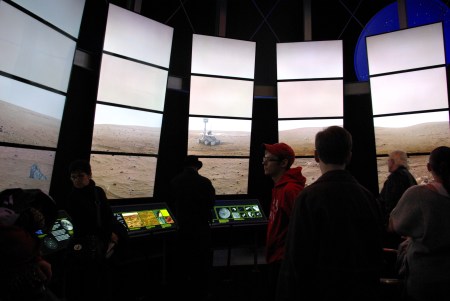
On 32 flat-panel video displays hooked together to make one massive display, visitors to the Perot Museum of Nature and Science view Mars as our new Mars Rover’s friend might see it, in a section of the museum devoted to astronomy, physics, astronomy and planetary exploration. Photo by Ed Darrell; use encouraged with attribution.
Still, kids today need this museum and the knowledge and excitement it imparts. Last July I accompanied a group of Scouts from Troop 355 to summer camp in Colorado, to Camp Cris Dobbins in the foothills just east of Colorado Springs. Near lights out one night I hiked the half-mile to our campsite admiring the Milky Way and other bright displays of stars that we simply do not get in light-polluted Dallas County. I expected that our older Scouts would have already started on the Astronomy merit badge, but the younger ones may not have been introduced. So I asked how many of them could find the Milky Way. Not a hand went up.
“Dowse the lights, let’s have a five minute star lesson,” I said. we trekked out to a slight opening in the trees, and started looking up. I had just enough time to point out the milky fog of stars we see of our own galaxy, when one of the Scouts asked how to tell the difference between an airplane and a satellite. Sure enough, he’d spotted a satellite quietly passing overhead — and just to put emphasis on the difference, a transcontinental jet passed over flying west towards Los Angeles or San Francisco.
Then, when we were all looking up, a meteoroid streaked from the south across almost the whole length of the visible Milky Way. Teenaged kids don’t often go quiet all at once, but after the oohs and aahs we had a few moments of silence. They were hooked already. Less than five minutes in, they’d seen the Milky Way, found the Big Dipper, seen a satellite, a jet, and a shooting star.
Perfection!
Edwin Hubble’s discovery can now be the stuff of elementary school science, that the blobs in the sky astronomers had pondered for a century were really galaxies like our own, which we see only through a faint fuzz we call the Milky Way.
Do kids get that kind of stuff in elementary school? Not enough, I fear.
We named a great telescope after the guy; shouldn’t we do a bit more to celebrate his discovery?
Sunset on BLM land near the Little Snake River, in northwest Colorado. Photo by Shannon Diszmang, via Royal Gorge National Recreation Area.
Note from America’s Great Outdoors blog:
Earlier this year, the Royal Gorge Recreation Area staff had a photo contest on their Facebook page and here is one of the great photos that was submitted. Here’s what photographer, Shannon Diszmang, had to say about it.
“This is BLM land in Northwest Colorado (Little Snake River district). I fell in love with this place. The red haze in this photo is the smoke coming from the wildfires on the west coast at the time. This is one of the lowest light pollution spots in our state which makes star gazing the absolute best.”
So, if you’re nearby, and you want a good place to look at the Geminid meteor shower tonight, odds are high there will be little light pollution here. If there aren’t many clouds, you’re in luck.
P.S.: The stunningly beautiful photo above is NOT the winner of the photo contest(!). BLM wrote in a November press release:
CAÑON CITY, Colo. – Today the BLM Royal Gorge Field Office announced the winners of its BLM-sponsored photo contest. The two winners were decided by the public via the RGFO’s Facebook page: one winner is based on the most “likes” and the other is based on the most “shares.” Only those “likes” and “shares” that originated from the Royal Gorge Facebook page were tallied towards a winner.
Both photos will be featured on the RGFO’s Facebook page throughout November and may be featured in future BLM Colorado publications and social media sites.
The photo contest began Oct. 2 and ended Nov. 4 with more than 60 photos submitted. All the photos that were entered into the contest may be viewed via the “Photo Contest” album on the RGFO’s Facebook page: http://www.facebook.com/BLMRoyalGorge
Yeah, were I you, I’d go see what the winners looked like.
Spread the word; friends don't allow friends to repeat history.
If you were disappointed with the meager showing put on by this year’s Leonid Meteor Shower, don’t fret. What potentially will be the best meteor display of the year is just around the corner, scheduled to reach its peak on Thursday night, Dec. 13: the Geminid Meteors.
The Geminids get their name from the constellation of Gemini, the Twins. On the night of this shower’s maximum the meteors will appear to emanate from a spot in the sky near the bright star Castor in Gemini.
The Geminid Meteors are usually the most satisfying of all the annual showers, even surpassing the famous Perseids of August. Studies of past displays show that this shower has a reputation for being rich both in slow, bright, graceful meteors and fireballs as well as faint meteors, with relatively fewer objects of medium brightness. Geminids typically encounter Earth at 22 miles per second (35 kilometers per second), roughly half the speed of a Leonid meteor. Many appear yellowish in hue. Some even appear to travel jagged or divided paths.
EarthSky.org said the show starts as soon as Gemini rises — soon after sunset in the nothern middle latitudes. Look east to the constellation Gemini, toward the star Castor. (I’m using my iPhone NightSky app; wish I had my old Android and Google Sky.) Get a coat. Get your binoculars, your tripod and camera (you’ll want time exposures, yes?). Maybe take some gloves, and a Thermos of hot chocolate. Out of the city, out where the sky is dark. The Moon is in a new phase, and shouldn’t be visible when the meteor watching is hot.
Faithful stargazers may already have spotted a few shooting stars from this year’s Leonid shower. Best estimates are that the peak will come the night of Saturday, November 17.
A meteor streaks across the sky during the 2009 Leonid meteor shower. (Navicore / Wikimedia Commons via Los Angeles Times)
The next meteor shower is the Leonids on the night of November 17
The best viewing for this year’s Leonid meteor shower will be several hours before dawn on November 17. The shower should produce perhaps a dozen or so “shooting stars” per hour. The best view comes in the wee hours of the morning, as your part of Earth turns most directly into the meteor stream.
* * * * *
What is a meteor shower?
A meteor shower is a spike in the number of meteors or “shooting stars” that streak through the night sky.
Most meteor showers are spawned by comets. As a comet orbits the Sun it sheds an icy, dusty debris stream along its orbit. If Earth travels through this stream, we will see a meteor shower. Although the meteors can appear anywhere in the sky, if you trace their paths, the meteors in each shower appear to “rain” into the sky from the same region.
Meteor showers are named for the constellation that coincides with this region in the sky, a spot known as the radiant. For instance, the radiant for the Leonid meteor shower is in the constellation Leo. The Perseid meteor shower is so named because meteors appear to fall from a point in the constellation Perseus.
What are shooting stars?
“Shooting stars” and “falling stars” are both names that describe meteors — streaks of light across the night sky caused by small bits of interplanetary rock and debris called meteoroids vaporizing high in Earth’s upper atmosphere. Traveling at tens of thousands of miles an hour, meteoroids quickly ignite from the searing friction with the atmosphere, 30 to 80 miles above the ground. Almost all are destroyed in this process; the rare few that survive and hit the ground are known as meteorites.
When a meteor appears, it seems to “shoot” quickly across the sky, and its small size and intense brightness might make you think it is a star. If you’re lucky enough to spot a meteorite (a meteor that makes it all the way to the ground), and see where it hits, it’s easy to think you just saw a star “fall.”
How can I best view a meteor shower?
Get away from the glow of city lights and toward the constellation from which the meteors will appear to radiate.
For example, drive north to view the Leonids. Driving south may lead you to darker skies, but the glow will dominate the northern horizon, where Leo rises. Perseid meteors will appear to “rain” into the atmosphere from the constellation Perseus, which rises in the northeast around 11 p.m. in mid-August.
After you’ve escaped the city glow, find a dark, secluded spot where oncoming car headlights will not periodically ruin your sensitive night vision. Look for state or city parks or other safe, dark sites.
Once you have settled at your observing spot, lie back or position yourself so the horizon appears at the edge of your peripheral vision, with the stars and sky filling your field of view. Meteors will instantly grab your attention as they streak by.
How do I know the sky is dark enough to see meteors?
If you can see each star of the Little Dipper, your eyes have “dark adapted,” and your chosen site is probably dark enough. Under these conditions, you will see plenty of meteors.
What should I pack for meteor watching?
Treat meteor watching like you would the 4th of July fireworks. Pack comfortable chairs, bug spray, food and drinks, blankets, plus a red-filtered flashlight for reading maps and charts without ruining your night vision. Binoculars are not necessary. Your eyes will do just fine.
Real science often is more fantastic that the stuff people make up. Haldane was right.
Not the Sun you’re used to seeing.
In a century our studies of the Sun progressed from the deep calculations based on erroneous assumptions of what our star is make of (Lord Kelvin‘s calculations on how long the iron in the Sun would take to cool to its present color), to today’s solar studies, in which nearly every moment of the Sun’s life is recorded through a half dozen different sensors, by satellites and telescopes and whatever other means we have to capture data from the Sun’s burning.
It’s hard science — but it borders on art, too, doesn’t it? Watch this:
Watching a particularly beautiful movie of the sun helps show how the lines between science and art can sometimes blur. But there is more to the connection between the two disciplines: science and art techniques are often quite similar, indeed one may inform the other or be improved based on lessons from the other arena. One such case is a technique known as a “gradient filter” – recognizable to many people as an option available on a photo-editing program. Gradients are, in fact, a mathematical description that highlights the places of greatest physical change in space. A gradient filter, in turn, enhances places of contrast, making them all the more obviously different, a useful tool when adjusting photos. Scientists, too, use gradient filters to enhance contrast, using them to accentuate fine structures that might otherwise be lost in the background noise. On the sun, for example, scientists wish to study a phenomenon known as coronal loops, which are giant arcs of solar material constrained to travel along that particular path by the magnetic fields in the sun’s atmosphere. Observations of the loops, which can be more or less tangled and complex during different phases of the sun’s 11-year activity cycle, can help researchers understand what’s happening with the sun’s complex magnetic fields, fields that can also power great eruptions on the sun such as solar flares or coronal mass ejections.
The images here show an unfiltered image from the sun next to one that has been processed using a gradient filter. Note how the coronal loops are sharp and defined, making them all the more easy to study. On the other hand, gradients also make great art. Watch the movie to see how the sharp loops on the sun next to the more fuzzy areas in the lower solar atmosphere provide a dazzling show.
NASA Goddard Space Flight Center enables NASA’s mission through four scientific endeavors: Earth Science, Heliophysics, Solar System Exploration, and Astrophysics. Goddard plays a leading role in NASA’s accomplishments by contributing compelling scientific knowledge to advance the Agency’s mission.
Teachers ought to figure out how to use this in classrooms — and I don’t mean astronomy, physics and chemistry only. Can you find a use for this film in geography? History? English and literature?
Sometime shortly after World War II scientists captured film of a mass coronal ejection from the Sun. You probably can imagine the film I’m remembering. That snippet found its way into films students saw in science, geography, chemistry, biology (“this is our Sun, from which all living things get energy, through photosynthesis”), and probably a half dozen other subjects. It was spectacular, and it was just about all that was available for classroom use, then. Students now probably have never seen it. Worse, my experience is that students in high school generally have very little familiarity with the science projects carried out by agencies like NASA and the National Science Foundation, and they know very little about the Sun, or the Moon and other planets.
Teachers, the state isn’t going to help you put this into your classrooms. Can you figure out some way to get it in?
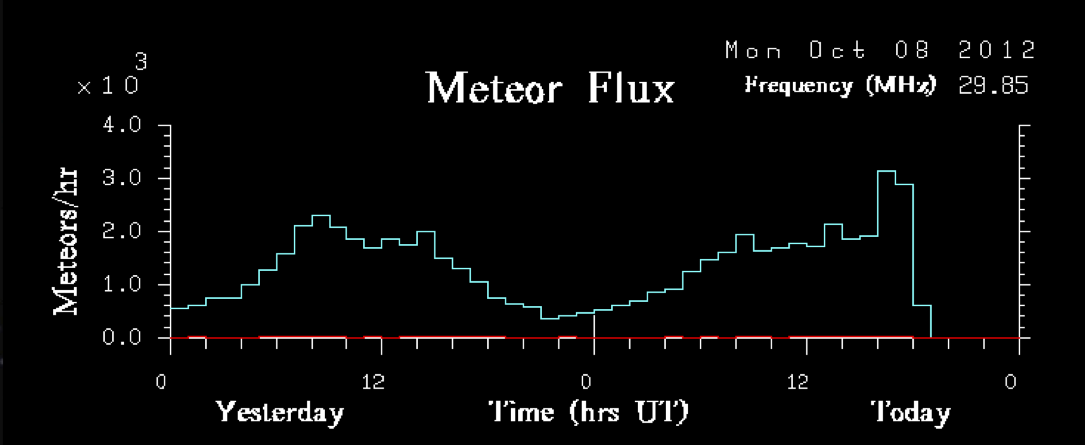
Space Weather says radar suggests a big show, already begun, with 1,000 meteoroids an hour:
DRACONID METEOR OUTBURST UNDERWAY: The CMOR radar in Canada is picking up a major outburst of Draconid meteors commencing at 16 UT on Oct. 8th. “Radar rates are at 1000 meteors per hour,” reports Bill Cooke of NASA’s Meteoroid Environment Office. “This is greater than last year’s outburst, and 5x the 2005 level.” Cooke encourages northern sky watchers, especially in Europe where night is falling, to be alert for Draconid activity. Because radars are sensitive to very small meteoroids, there is no guarantee that this radar outburst will translate into meteors visible to the human eye. On the other hand, a brilliant display could be in progress. The only way to know is to go outside and look. [CMOR radar data] [sky map] [Submit:reports or photos] Listen: Tune into Space Weather Radio to hear live Draconid radar echoes.
Can you see these rocks as they burn up? Or are they too small to make a visible “splash,” even though registering on radar?
Draconids are most active in the early evening (other showers tend to be active after midnight). Look toward the head of Draco the Dragon. EarthSky.org offers a skymap to help out:
Draconid meteor shower, October 8, 2012 – map from EarthSky.org
Yosemite’s vast acreage and remote location protect some of the darkest night skies in the country. Astronomers, photographers and city dwellers flock to the park to take advantage of this unique opportunity to view planets, stars, and galaxies.
For classroom use, some topics and questions to pursue:
For geography, where is Yosemite N.P.? Flying commercially, which airport is the best to get to the park?
President Teddy Roosevelt and conservationist John Muir pose at Overhanging Rock at the top of Glacier Point, near which the men camped in a hollow and awoke to five inches of snow in 1903. National Park Service image
Map reading and orientation: In the time-lapse sequences, you can frequently see lights streaking across the sky. Those are commercial airliners — can you tell what airport they are headed to, or from? Can you tell which ones are coming, which going?
Science: What star formations do you see in these photographs that you can see from your house? What star formations are not visible from your house?
Government: Who signs the checks that pay the rangers pictured in the film? For which agency do the work, in which branch of which government?
People in the film discuss light pollution from nearby cities. Is there an agency in the federal government who has jurisdiction over light pollution? How about an agency in the state government? What are the rules on light pollution for cities around Yosemite?
Can you identify the landmarks, the cliffs, rocks, mountains and rivers, portrayed in the film? (Students might use a USGS topographical map, California state tourist promotion maps and websites, National Park Service databases, Google Earth, Google, and a wide variety of other sources.
Who was president of the U.S. when Yosemite was set aside as a National Park, and what were the controversies surrounding it?
Who lived in Yosemite, if anyone, before the Spanish missions were established in California? When were the missions established? How did the U.S. gain possession of the Yosemite Valley?
Spread the word; friends don't allow friends to repeat history.
As the astrophysicist Neil deGrasse Tyson put it on the Hayden Planetarium website, “Manhattanhenge may just be a unique urban phenomenon in the world, if not the universe.”
Surely there is a phenomenon almost as cool, somewhere in the American Midwest or Mountain West, perhaps, where the good Presbyterian, Lutheran and Mormon pioneers laid out their cities and entire states with clean Cartesian grids . . . anyone got information to correct Dr. Tyson?
Maybe the question to ask, perhaps from Tyson, is how to calculate when an east-west street in your town might get a “henge” moment.
Sunrise at Delicate Arch, Arches National Park, by Alex Savage
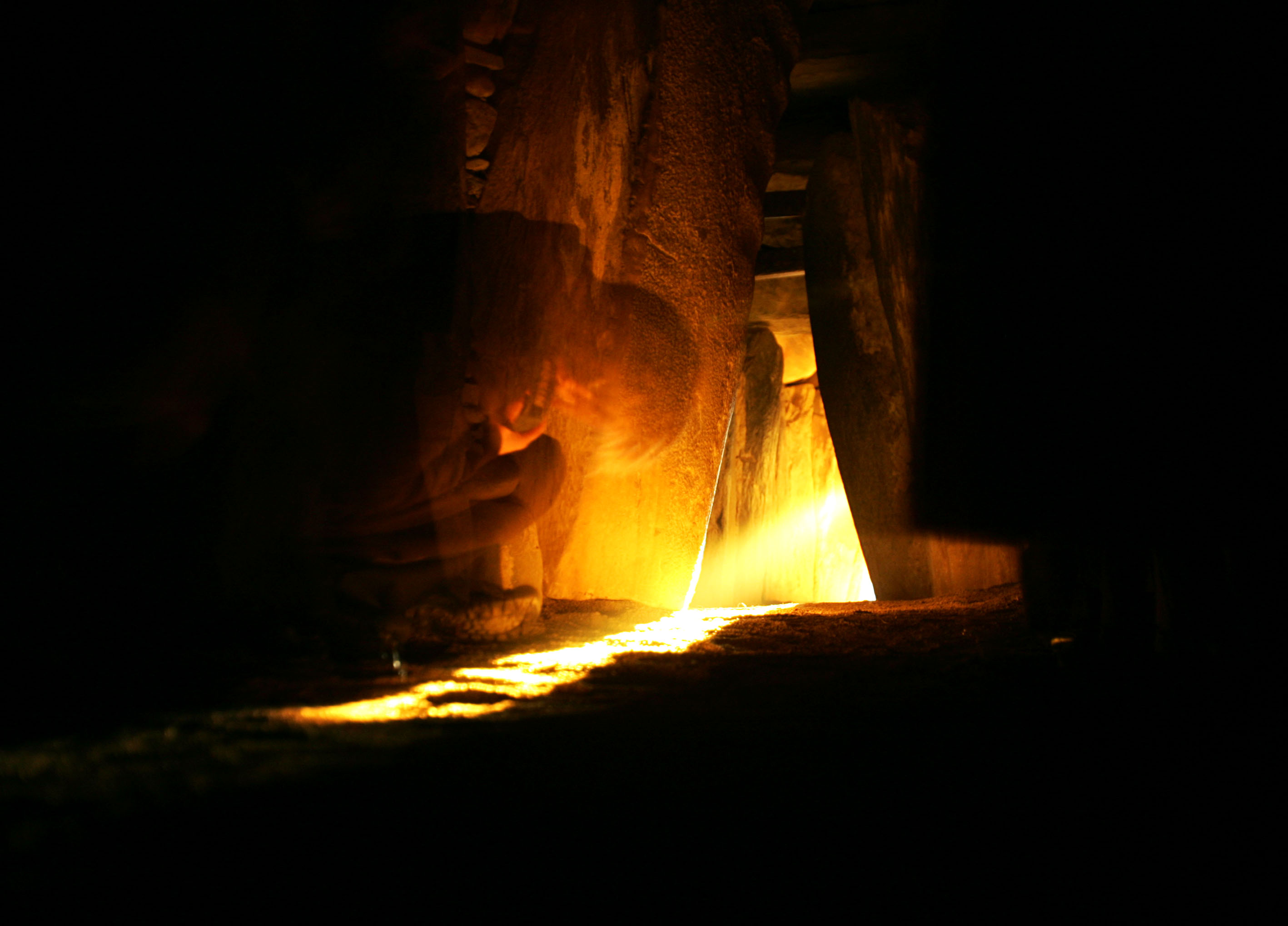
December 20, 2009, solstice sunrise at Newgrange, Ireland – Photograph by Cyril Byrne – courtesy of The Irish Times (Astronomy Picture of the Day, NASA)
Sunrise over Stonehenge on the summer solstice, June 21, 2005 — the analogy of Manhattan’s skyscrapers to the rocks of Stonehenge is obvious (Photo credit: Wikipedia)
Dr. Tyson at the November 29, 2005 meeting of the NASA Advisory Council, in Washington, D.C. (Photo credit: Wikipedia)
Some time ago astronomy phenom Neil de Grasse Tyson mentioned the twice-a-year happenstance of the sun’s setting perfectly in line with New York City’s east-west gridded streets. On many streets, on most streets, you can watch the sun all the way down to the horizon, between the massive “rocks” of Manhattan skyscrapers, almost like watching the solstices at Stonehenge.
On May 30 at 8:16 p.m. and again on July 11 at 8:24 p.m., Manhattanhenge reaches its point of perfection as the full setting sun aligns with the city’s grid of East-West streets, according to the American Museum of Natural History’s Hayden Planetarium. The best places to view the fiery canyon of skyscrapers are at 14th, 23rd, 34th, 42nd, 57th Streets. The Empire State Building and the Chrysler Building offer especially good views.
Manhattanhenge on 34th Street, by Chaitanya Kapadia / UGC – Here’s what Chaitanya Kapadia says about this picture: “I had set up on a nice spot right in the middle of 34th Street, between the double yellow lines with a few photographers wanting to get the Empire State Building in my shot. However, I should have anticipated photographers to just swarm the streets when the sun lined up with the grid. Minutes later, the police drove down the middle of the road, getting everyone out, which only meant stepping to the side until they passed you, and then right back. Took this using three exposures hand-held.”
Lift a glass of champagne today in tribute to Edwin Hubble and his great discovery. Not sure what to call it — Hubble Day, Looking Up Day, Endless Possibilities Day — whatever, this is the anniversary of Edwin Hubble’s announcement that he had discovered the universe is much, much larger than anyone had imagined, containing far more stars than anyone had dared guess.
It’s a big universe out there.
Ultraviolet image of the Andromeda Galaxy, first known to be a galaxy by Edwin Hubble on December 30, 1924 - Galaxy Evolution Explorer image courtesy NASA
So, today is a good day to celebrate the universe in all it’s glory – December 30.
On December 30, 1924, Edwin Hubble announced he’d discovered other galaxies in distant space. Though it may not have been so clear at the time, it meant that, as a galaxy, we are not alone in the universe (whether we are alone as intelligent life is a separate question). It also meant that the universe is much, much bigger than most people had dared to imagine.
Hubble was the guy who showed us the universe is not only bigger than we imagined, it’s probably much bigger and much more fantastic than we can imagine. Hubble is the guy who opened our imaginations to the vastness of all creation.
How does one celebrate Hubble Day? Here are some suggestions:
Easier than Christmas cards: Send a thank-you note to your junior high school science teacher, or whoever it was who inspired your interest in science. Mrs. Hedburg, Mrs. Andrews, Elizabeth K. Driggs, Herbert Gilbert, Mr. Willis, and Stephen McNeal, thank you.
Rearrange your Christmas/Hanukkah/Eid/KWANZAA lights in the shape of the Andromeda Galaxy — or in the shape of any of the great photos from the Hubble Telescope (Andromeda Galaxy pictured above; Hubble images here)
A few of the images from the Hubble Telescope
Go visit your local science museum; take your kids along – borrow somebody else’s kids if you have to (take them along, too)
Spend two hours in your local library, just looking through the books on astronomy and the universe
Write a letter to your senators and congressman; tell them space exploration takes a minuscule portion of our federal budget, but it makes us dream big; tell them we need to dream big, and so they’d better make sure NASA is funded well. While you’re at it, put in a plug for funding Big Bird and the rest of public broadcasting, too. Science education in this nation more and more becomes the science shows on NPR and PBS, watched by kids who learned to read and think by watching Big Bird.
Anybody got a good recipe for a cocktail called “The Hubble?” “The Andromeda?” Put it in the comments, please. “The Hubble” should have bubbles in it, don’t you think? What was it the good monk said? He was working to make great wine, but goofed somewhere, and charged the wine with another dose of yeast. When he uncorked the very first bottle of what would come to be called champagne, Benedictine Monk Dom Pierre Perignon said “I am drinking stars!” Only in French. In any case, a Hubble cocktail should have bubbles, some of Perignon’s stars.
In 1924, he announced the discovery of a Cepheid, or variable star, in the Andromeda Nebulae. Since the work of Henrietta Leavitt had made it possible to calculate the distance to Cepheids, he calculated that this Cepheid was much further away than anyone had thought and that therefore the nebulae was not a gaseous cloud inside our galaxy, like so many nebulae, but in fact, a galaxy of stars just like the Milky Way. Only much further away. Until now, people believed that the only thing existing outside the Milky Way were the Magellanic Clouds. The Universe was much bigger than had been previously presumed.
Later Hubble noted that the universe demonstrates a “red-shift phenomenon.” The universe is expanding. This led to the idea of an initial expansion event, and the theory eventually known as Big Bang.
Hubble’s life offered several surprises, and firsts:
Hubble was a tall, elegant, athletic, man who at age 30 had an undergraduate degree in astronomy and mathematics, a legal degree as a Rhodes scholar, followed by a PhD in astronomy. He was an attorney in Kentucky (joined its bar in 1913), and had served in WWI, rising to the rank of major. He was bored with law and decided to go back to his studies in astronomy.
In 1919 he began to work at Mt. Wilson Observatory in California, where he would work for the rest of his life. . . .
Hubble wanted to classify the galaxies according to their content, distance, shape, and brightness patterns, and in his observations he made another momentous discovery: By observing redshifts in the light wavelengths emitted by the galaxies, he saw that galaxies were moving away from each other at a rate constant to the distance between them (Hubble’s Law). The further away they were, the faster they receded. This led to the calculation of the point where the expansion began, and confirmation of the big bang theory. Hubble calculated it to be about 2 billion years ago, but more recent estimates have revised that to 20 billion years ago.
An active anti-fascist, Hubble wanted to joined the armed forces again during World War II, but was convinced he could contribute more as a scientist on the homefront. When the 200-inch telescope was completed on Mt. Palomar, Hubble was given the honor of first use. He died in 1953.
“Equipped with his five senses, man explores the universe around him and calls the adventure Science.”
(Does anyone have a suitable citation for that video? Where did it come from? Who produced it? Is there more somewhere?)
Happy Hubble Day! Look up!
Resources:
Journey to Palomar site (production currently being broadcast on PBS affiliates – wonderful story of George Ellery Hale and the origins of modern astronomy at Palomar; that’s where Hubble worked)
Great pictures from NASA’s Solar Dynamics Observatory.
A newly-discovered comet, Comet Lovejoy, orbited dangerously close to the Sun for a ball of ice. Experts predicted it would be the last trip for the little planetoid.
But, then Lovejoy zoomed out from the other side of our home star. Amazing.
See it for yourself:
How surprising was this? Look at this earlier piece, inviting people to watch the end of the comet:
Dec. 16, 2011: This morning, an armada of spacecraft witnessed something that many experts thought impossible. Comet Lovejoy flew through the hot atmosphere of the sun and emerged intact.
“It’s absolutely astounding,” says Karl Battams of the Naval Research Lab in Washington DC. “I did not think the comet’s icy core was big enough to survive plunging through the several million degree solar corona for close to an hour, but Comet Lovejoy is still with us.”
The comet’s close encounter was recorded by at least five spacecraft: NASA’s Solar Dynamics Observatory and twin STEREO probes, Europe’s Proba2 microsatellite, and the ESA/NASA Solar and Heliospheric Observatory. The most dramatic footage so far comes from SDO, which saw the comet go in (movie) and then come back out again (movie).
In the SDO movies, the comet’s tail wriggles wildly as the comet plunges through the sun’s hot atmosphere only 120,000 km above the stellar surface. This could be a sign that the comet was buffeted by plasma waves coursing through the corona. Or perhaps the tail was bouncing back and forth off great magnetic loops known to permeate the sun’s atmosphere. No one knows.
“This is all new,” says Battams. “SDO is giving us our first look1 at comets travelling through the sun’s atmosphere. How the two interact is cutting-edge research.”
“The motions of the comet material in the sun’s magnetic field are just fascinating,” adds SDO project scientist Dean Pesnell of the Goddard Space Flight Center. “The abrupt changes in direction reminded me of how the solar wind affected the tail of Comet Encke in 2007 (movie).”
Comet Lovejoy was discovered on Dec. 2, 2011, by amateur astronomer Terry Lovejoy of Australia. Researchers quickly realized that the new find was a member of the Kreutz family of sungrazing comets. Named after the German astronomer Heinrich Kreutz, who first studied them, Kreutz sungrazers are fragments of a single giant comet that broke apart back in the 12th century (probably the Great Comet of 1106). Kreutz sungrazers are typically small (~10 meters wide) and numerous. The Solar and Heliospheric Observatory sees one falling into the sun every few days.
At the time of discovery, Comet Lovejoy appeared to be at least ten times larger than the usual Kreutz sungrazer, somewhere in the in the 100 to 200 meter range. In light of today’s events, researchers are re-thinking those numbers.
This coronagraph image from the Solar and Heliospheric Observatory shows Comet Lovejoy receding from the sun after its close encounter. The horizontal lines through the comet’s nucleus are digital artifacts caused by saturation of the detector; Lovejoy that that bright! [movie]
“I’d guess the comet’s core must have been at least 500 meters in diameter; otherwise it couldn’t have survived so much solar heating,” says Matthew Knight. “A significant fraction of that mass would have been lost during the encounter. The remains are probably much smaller.”
SOHO and NASA’s twin STEREO probes are monitoring the comet as it recedes from the sun. It is still very bright and should remain in range of the spacecrafts’ cameras for several days to come.
What happens next is anyone’s guess.
“There is still a possibility that Comet Lovejoy will start to fragment,” continues Battams. “It’s been through a tremendously traumatic event; structurally, it could be extremely weak. On the other hand, it could hold itself together and disappear back into the recesses of the solar system.”
“It’s hard to say,” agrees Knight. “There has been so little work on what happens to sungrazing comets after perihelion (closest approach). This continues to be fascinating.”
Author:Dr. Tony Phillips| Production editor: Dr. Tony Phillips | Credit: Science@NASA
More Information
Footnote:1“When SDO was launched we thought we would see nothing besides the Sun and the dark disks of the Moon, Earth, Venus, and Mercury in our images,” says SDO project scientist Dean Pesnell of GSFC. “No other bright object would be visible because our instruments are designed to look at the Sun. Now we are measuring the mass and composition of comets by turning the comet inside out.”
Spread the word; friends don't allow friends to repeat history.
Or, until that account is unsuspended by the forces supporting Donald Trump: Follow @FillmoreWhite, the account of the Millard Fillmore White House Library
We've been soaking in the Bathtub for several months, long enough that some of the links we've used have gone to the Great Internet in the Sky.
If you find a dead link, please leave a comment to that post, and tell us what link has expired.
Thanks!
Retired teacher of law, economics, history, AP government, psychology and science. Former speechwriter, press guy and legislative aide in U.S. Senate. Former Department of Education. Former airline real estate, telecom towers, Big 6 (that old!) consultant. Lab and field research in air pollution control.
My blog, Millard Fillmore's Bathtub, is a continuing experiment to test how to use blogs to improve and speed up learning processes for students, perhaps by making some of the courses actually interesting. It is a blog for teachers, to see if we can use blogs. It is for people interested in social studies and social studies education, to see if we can learn to get it right. It's a blog for science fans, to promote good science and good science policy. It's a blog for people interested in good government and how to achieve it.
BS in Mass Communication, University of Utah
Graduate study in Rhetoric and Speech Communication, University of Arizona
JD from the National Law Center, George Washington University


 Posted by Ed Darrell











 Millard Fillmore's Bathtub