Caption from Pete Souza‘s slide show: A message from President Barack Obama is seen on a Plaza Towers Elementary School sign, at Moore Fire Department Station #1 in Moore, Okla., May 26, 2013. (Official White House Photo by Pete Souza)
Pete Souza‘s work as White House photographer will ultimately make historians’ work much richer. He’s got a great eye for a shot that needs to be snapped, and a great sense of art on the fly. If you’re not a regular watcher of Souza’s work, you probably should be, especially if you’re teaching history.
A few minutes ago, a disaster/rescue official in West, Texas, said he fears as many as 100 dead in the explosion of the fertilizer plant there, earlier this evening. Another fertilizer tank may explode, and the town is being evacuated.
New London, Texas, school after the March 18, 1937, natural gas explosion that killed about 300 people.
View of Texas City from Galveston, across the bay, after the explosion of the French ship SS Grandchamp, April 16, 1947. Photo from International Association of Fire Fighters Local 1259. 576 people died in that series of explosions.
The fertilizer tank that exploded contained several hundred times the amount of the same explosive used to destroy the Murrah Federal Building in Oklahoma City.
Presidential Proclamation — Honoring the victims of the tragedy in Boston, Massachusetts
HONORING THE VICTIMS OF THE TRAGEDY IN BOSTON, MASSACHUSETTS
– – – – – – –
BY THE PRESIDENT OF THE UNITED STATES OF AMERICA
A PROCLAMATION
As a mark of respect for the victims of the senseless acts of violence perpetrated on April 15, 2013, in Boston, Massachusetts, by the authority vested in me as President of the United States by the Constitution and the laws of the United States of America, I hereby order that the flag of the United States shall be flown at half-staff at the White House and upon all public buildings and grounds, at all military posts and naval stations, and on all naval vessels of the Federal Government in the District of Columbia and throughout the United States and its Territories and possessions until sunset, April 20, 2013. I also direct that the flag shall be flown at half-staff for the same length of time at all United States embassies, legations, consular offices, and other facilities abroad, including all military facilities and naval vessels and stations.
IN WITNESS WHEREOF, I have hereunto set my hand this sixteenth day of April, in the year of our Lord two thousand thirteen, and of the Independence of the United States of America the two hundred and thirty-seventh.
BARACK OBAMA
Spread the word; friends don't allow friends to repeat history.
Most high school history students don’t know about it. Most high school history students in Texas don’t know about it.
New London School, New London, Texas, before the 1937 disaster. Photo from the New London Museum
I wonder, sometimes, how many Texans remember at all.
I wonder, too, if there are lessons to be learned from the New London tragedy, while the nation debates what to do to prevent recurrences of school shootings.
The deadliest disaster ever to hit a public school in the U.S. struck on March 18, 1937, when a natural gas explosion destroyed the new school building at New London, Texas, killing about 300 people — 76 years ago today.
The remains of the London School after the explosion of March 18, 1937. Wikipedia photo
Noise from the blast alerted the town, and many people in the oilfields for many miles. Telephone and telegraph communication got word out. Oil companies dismissed their employees, with their tools, to assist with rescue and recovery efforts. Notably, 20-year-old Walter Cronkite came town to report the news for a wire service.
Investigation determined that a leak in a newly-installed tap into the waste gas pipe coming from nearby oil fields probably allowed natural gas to accumulate under the building. A spark from a sander started a fire in gas-filled air, and that in turn exploded the cavern under the school. School officials approved the tap to the waste gas line to save money. Natural gas is odorless. One result of the disaster was a Texas law requiring all utility natural gas to be odorized with ethyl mercaptan.
Though the Great Depression still gripped the nation, wealth flowed in New London from oil extraction from the nearby oil fields. The school district completed construction on a new building in 1939, just two years later — with a pink granite memorial cenotaph in front.
Today, disasters produce a wealth of litigation, tort suits trying to get money to make the injured whole, and to sting those at fault to change to prevent later disasters. In 1937 official work cut off such lawsuits.
Three days after the explosion, inquiries were held to determine the cause of the disaster. The state of Texas and the Bureau of Mines sent experts to the scene. Hearings were conducted. From these investigations, researchers learned that until January 18, 1937, the school had received its gas from the United Gas Company. To save gas expenses of $300 a month, plumbers, with the knowledge and approval of the school board and superintendent, had tapped a residue gas line of Parade Gasoline Company. School officials saw nothing wrong because the use of “green” or “wet” gas was a frequent money-saving practice for homes, schools, and churches in the oilfield. The researchers concluded that gas had escaped from a faulty connection and accumulated beneath the building. Green gas has no smell; no one knew it was accumulating beneath the building, although on other days there had been evidence of leaking gas. No school officials were found liable.
These findings brought a hostile reaction from many parents. More than seventy lawsuits were filed for damages. Few cases came to trial, however, and those that did were dismissed by district judge Robert T. Brown for lack of evidence. Public pressure forced the resignation of the superintendent, who had lost a son in the explosion. The most important result of the disaster was the passage of a state odorization law, which required that distinctive malodorants be mixed in all gas for commercial and industrial use so that people could be warned by the smell. The thirty surviving seniors at New London finished their year in temporary buildings while a new school was built on nearly the same site. The builders focused primarily on safety and secondarily on their desire to inspire students to a higher education. A cenotaph of Texas pink granite, designed by Donald S. Nelson, architect, and Herring Coe, sculptor, was erected in front of the new school in 1939. (Texas Handbook of History, Online, from the Texas State Historical Association)
Of about 500 students, more than 50% of them died. Once the new school and memorial were built, and the law passed requiring utilities to odorize natural gas so leaks could be detected earlier, survivors and rescuers rather shut down telling the history. A 1977 reunion of survivors was the first in 40 years.
New London School shortly after the March 18, 1937, explosion. Photo from the New London Museum.
Because of that healing silence, the story slipped from the pages of most history books.
New London, and the New London Museum, work to remember the dead and honor them. Work continues on a film about the disaster, perhaps for release in 2013:
Now, more than 75 years later, the London Museum, across the highway from where the original school was destroyed, keeps alive the memory of much of a generation who died on that terrible day.
This video was produced by Michael Brown Productions of Arlington, TX as a prelude to a feature documentary on the explosion and its aftermath which is planned for
the spring of 2013. . . .
What are the lessons of the New London Disaster? We learned to remember safety, when dealing with natural gas. A solution was found to alert people to the presence of otherwise-odorless, explosive gases, a solution now required by law throughout the U.S. Natural gas explosions decreased in number, and in damages and deaths. Wealthy schools districts, cutting corners, can create unintended, even disastrous and deadly consequences. Quick rebuilding covers the wounds, but does not heal them.
Remembering history takes work; history not remembered through the work of witnesses, victims and survivors, is quickly forgotten — to the detriment of history, and to the pain of the witnesses, victims and survivors.
New, New London School and granite cenotaph memorial to the victims of the 1937 explosion. Photo from Texas Bob Travels.
An observer of American politics may wonder whether the past few days have changed any of the old political lines on gun control issues and the Second Amendment.
U.S. flag at half-staff, at the Minuteman Memorial in Lexingon, Massachusetts (Summer’s End. Lexington Green, 11 September 2002. Photo taken in Minute Man National Historical Park. Sculpture : “Minuteman” by sculptor Henry Hudson Kitson (1863-1947), dedicated April 19, 1900. Erected 1899 : SIRIS Image: Wikipedia)
Spread the word; friends don't allow friends to repeat history.
Today comes the sad news that Big Tex, the symbol of the Fair, burned to his metal bones.
Big Tex at 60, earlier this week, catching sun on a good Fair day.
It was more of an unposed photo, as Kathryn and James read about the landscaping and the use of large, unsculpted Oklahoma stone in the garden at his feet.
Kathryn and James admiring the rockscaping at Big Tex’s garden, October 16, 2012
Big Tex looked fine — if we’d thought his 60 years showed at all, I’d have worked to get the focus just right, and get more of Tex in the photo.
Later that evening I thought the Dracula lighting might show a bit of his years. Maybe it was just the lighting, though. It had been a long day, and it was less than a week before the end of his 2012 run.
Dracula lighting at night highlighted craggy old Tex’s age, perhaps.
Tex had always been a popular stop, one place everyone knew. The family safety plan always included Big Tex. “Where do I go if we get separated.” “We’ll meet at Big Tex.” Heck, even after the advent of cell phones, Big Tex was a popular meet-up-after-the-fair-day location.
They say your arteries, veins and nerves get worn after a good life. Big Tex had some electronics in him, and electrical motors, to operate his jaw and to allow an announcer (in a booth on the ground) to play the Voice of Big Tex, offering a Texas “Howdy, Folks!” to people coming in to the Fair for the first, or 100th time. One of those pieces of wire seems to have crossed another one this morning, some time after 8:00 a.m., just as the Fair opened for it’s last Friday of 2012 (the Fair closes Sunday).
There was a spark. And then, he was gone.
Big Tex on fire, photo by John McKibbin via DallasNews.com
“Flood losses are increasing at an alarming rate while the insurability of floods provides unique challenges for the industry, according Swiss Re’s latest report, “Flood – an underestimated risk: Inspect, inform, insure”.” …
“No other natural catastrophe impacts as many people as flooding with an estimated 500 million people affected every year. Insured flood losses are also increasing significantly; 1970’s annual claims were between USD 1–2 billion, whereas insured flood losses amounted to USD 15 billion in 2011. Recent flood events in Thailand, Australia and the Philippines have shown that floods are now rivalling earthquakes and hurricanes in terms of economic losses.” …
“Population growth, demographic change, a higher concentration of assets in exposed areas, greater vulnerability of insured objects and climate change are all contributing to the increasing costs of flood damage. The rising costs of floods are creating challenges for the insurance industry and the economic viability of flood insurance is currently an issue under scrutiny.”
2011 saw 14 severe weather events that caused more than $1 billion in damage each. The pre-Halloween snow disaster may push the total up to 15 such events. NOAA is calling these billion-dollar-plus events “climate disasters.”
On top of the year 2011’s rating in the top 10 of warmest years on record, the sheer number of expensive weather extremes powerfully suggest that global warming already costs Americans billions of dollars in damage, lost production and disease.
NOAA announces two additional severe weather events reached $1 billion damage threshold, raising 2011’s billion-dollar disaster count from 12 to 14 events
January 19, 2012
Selected Annual Climate Records for 2011 - Green dots show the wettest, yellow dots the driest, red dots the warmest and blue dots the coolest records. Click image for high resolution version from NOAA (NOAA image)
According to NOAA scientists, 2011 was a record-breaking year for climate extremes, as much of the United States faced historic levels of heat, precipitation, flooding and severe weather, while La Niña events at both ends of the year impacted weather patterns at home and around the world.
NOAA’s annual analysis of U.S. and global conditions, conducted by scientists at NOAA’s National Climatic Data Center, reports that the average temperature for the contiguous U.S. was 53.8 degrees F, 1.0 degree F above the 20th century average, making it the 23rd warmest year on record. Precipitation across the nation averaged near normal, masking record-breaking extremes in both drought and precipitation.
On a global scale, La Niña events helped keep the average global temperature below recent trends. As a result, 2011 tied with 1997 for the 11th warmest year on record. It was the second coolest year of the 21st century to date, and tied with the second warmest year of the 20th century.
From extreme drought, heat waves and floods to unprecedented tornado outbreaks, hurricanes, wildfires and winter storms, a record 14 weather and climate disasters in 2011 each caused $1 billion or more in damages — and most regrettably, loss of human lives and property. Click image for high resolution version. (NOAA image)
Tropical Storm Lee, which made landfall on the Gulf Coast on September 2, caused wind and flood damage across the Southeast, but considerably more damage to housing, business and infrastructure from record flooding across the Northeast states, especially Pennsylvania and New York. The storm occurred in an area that had experienced high rainfall from Hurricane Irene barely a week earlier.
Tropical Storm Lee, on September 3, 2011 - Image via Wikipedia
A Rockies and Midwest severe weather outbreak, which occurred July 10-14, included tornadoes, hail and high winds. Much of the damage was from wind, hail, and flooding impacts to homes, business, and agriculture.
Together, these two events resulted in the loss of 23 lives (21 from Tropical Storm Lee, 2 from the Rockies/Midwest outbreak).
Nationally
Warmer-than-normal temperatures were anchored across the South, Mid-Atlantic and the Northeast. Delaware had its warmest year on record, while Texas had its second warmest year on record. The U.S. has observed a long-term temperature increase of about 0.12 degrees F per decade since 1895.
Summer (June-August) 2011 was the second warmest on record for the Lower 48, with an average temperature of 74.5 degrees F, just 0.1 degree F below the record-warm summer of 1936. The epicenter of the heat was the Southern Plains, where Louisiana, New Mexico, Oklahoma and Texas all had their warmest summer on record. The 3-month average temperatures for both Oklahoma (86.9 degrees F) and Texas (86.7 degrees F) surpassed the previous record for warmest summer in any state.
With the exception of Vermont, each state in the contiguous U.S. had at least one location that exceeded 100 degrees F. Summertime temperatures have increased across the U.S. at an average rate of 0.11 degrees F per decade. Much of this trend is due to increases in minimum temperatures (“overnight lows”), with minimum temperature extremes becoming increasingly commonplace in recent decades.
Despite a “near normal” national precipitation average, regional precipitation outcomes varied wildly. Texas, ravaged by exceptional drought for most of 2011, had its driest year on record. In contrast, seven states in the Ohio Valley and Northeast — Connecticut, Indiana, Kentucky, New Jersey, New York, Ohio, and Pennsylvania — had their wettest year on record.
The past nine years have been particularly wet across the Northeast region – since 2003, the annual precipitation for the region is 48.96 inches, 7.88 inches above the 20th century average. Precipitation averaged across the U.S. is increasing at a rate of about 0.18 inches per decade.
Precipitation extremes and impacts were most prevalent during spring (March – May) 2011. Across the northern U.S., ten states were record wet, and an additional 11 states had spring precipitation totals ranking among their top ten wettest. These precipitation extremes, combined with meltwater from a near-record snow pack, contributed to historic flooding along several major rivers across the central United States.
Meanwhile, drought rapidly intensified in the southern Plains, where Texas had only 2.66 inches of precipitation, its driest spring on record. This led to record breaking drought and wildfires, which devastated the southern Plains. Following 2010, during which drought across the country was nearly erased, the 12 percent of the continental U.S. in the most severe category of drought (D4) during July 2011 was the highest in the U.S. Drought Monitor era (1999-2011).
The spring brought a record breaking tornado season to the United States. Over 1,150 tornadoes were confirmed during the March-May period. The 551 tornado-related fatalities during the year were the most in the 62-year period of record. The deadliest tornado outbreak on record (April 25-28th) and the deadliest single tornado (Joplin, Missouri) contributed to the high fatality count.
Globally
This year tied 1997 as the 11th warmest year since records began in 1880. The annual global combined land and ocean surface temperature was 0.92 degrees F above the 20th century average of 57.0 degrees F. This marks the 35th consecutive year, since 1976, that the yearly global temperature was above average. The warmest years on record were 2010 and 2005, which were 1.15 degrees F above average.
Separately, the 2011 global average land surface temperature was 1.49 degrees F above the 20th century average of 47.3 degrees F and ranked as the eighth warmest on record. The 2011 global average ocean temperature was 0.72 degrees F above the 20th century average of 60.9 degrees F and ranked as the 11th warmest on record.
Including 2011, all eleven years of the 21st century so far (2001-2011) rank among the 13 warmest in the 132-year period of record. Only one year during the 20th century, 1998, was warmer than 2011.
La Niña, which is defined by cooler-than-normal waters in the eastern and central equatorial Pacific Ocean that affects weather patterns around the globe, was present during much of 2011. A relatively strong phase of La Niña opened the year, dissipated in the spring before re-emerging in October and lasted through the end of the year. When compared to previous La Niña years, the 2011 global surface temperature was the warmest observed.
The 2011 globally-averaged precipitation over land was the second wettest year on record, behind 2010. Precipitation varied greatly across the globe. La Niña contributed to severe drought in the Horn of Africa and to Australia’s third wettest year in its 112-year period of record.
Arctic sea ice extent was below average for all of 2011, and has been since June 2000, a span of 127 consecutive months. Both the maximum ice extent (5.65 million square miles on March 7th) and the minimum extent (1.67 million square miles on September 9th) were the second smallest of the satellite era.
For the second year running, NCDC asked a panel of climate scientists to determine and rank the year’s ten most significant climate events, for both the United States and for the planet, to include record drought in East Africa and record flooding in Thailand and Australia. The results are at http://www.ncdc.noaa.gov/climate-monitoring.
Scientists, researchers and leaders in government and industry use NOAA’s monthly and annual reports to help track trends and other changes in the world’s climate. This climate service has a wide range of practical uses, from helping farmers know what and when to plant, to guiding resource managers’ critical decisions about water, energy and other vital assets.
NOAA’s mission is to understand and predict changes in the Earth’s environment, from the depths of the ocean to the surface of the sun, and to conserve and manage our coastal and marine resources. Join us on Facebook, Twitter and our other social media channels.
Denialist bedbugs complain that there is no definition of “climate disaster” offered from the agency. (Denialists are dictionary-challenged?)
Mercury poisoning marches through our culture with a 400-year-old trail, at least. “Mad as a hatter” refers to the nerve damage hatmakers in Europe demonstrated, nerve damage we now know came from mercury poisoning.
In the 20th century annals of pollution control, the Minimata disaster stands as a monument to unintended grotesque consequences of pollution, of mercury poisoning.
Anyone who scoffs at EPA’s four-decades of work to reduce mercury pollution should watch this film before bellyaching about damage to industry if we don’t allow industry to kill babies and kittens in blind, immoral pursuit of profit at public expense.
American Elephants, for example, is both shameless and reckless in concocting lies about mercury pollution regulation (that site will not allow comments that do not sing in harmony with the pro-pollution campaign (I’d love for someone to prove me wrong)). Almost every claim made at that post is false. Mercury is not harmless; mercury from broken CFL bulbs cannot begin to compare to mercury in fish and other animals; mercury pollution is not minuscule (mercury warnings stand in all 48 contiguous states, warning against consumption of certain fish). President Obama has never urged anything but support for the coal-fired power industry — although he has expressed concerns about pollution, as any sane human would.
Republicans have lost their moral compass, and that loss is demonstrated in the unholy campaign for pollution, the campaign against reducing mercury emissions. It’s tragic. Action will be required in November to stop the tragedy from spreading. Will Americans respond as they should at the ballot boxes?
New short from the Texas Parks and Wildlife people:
The smoke may be gone but the Bastrop fires of Labor Day weekend are still a smoldering concern for biologists. They’re keeping tabs on the Houston Toad. And with only an estimated 2,000 left in Texas, this endangered species is facing its next challenge as the drought continues. More on Houston toads at http://www.houstonzoo.org/HoustonToad/
For background, see this earlier reel from TPWS on the fires at Bastrop State Park:
Spread the word; friends don't allow friends to repeat history.
About genocide and other political issues that lead to the deaths of tens of thousands, or hundreds of thousands of people: We keep saying “never again!” When is never? There is famine today in Somalia.
This week, the U.N. declared a state of famine in parts of Somalia. Need to Know speaks with Adrian Edwards of the U.N.’s Refugee Agency about the unfolding humanitarian crisis in the region.
If a global warming debate about certainty and cause only deepens doubt and defensiveness, what kind of debate would create support for action? We saw Hurricane Katrina as an opportunity to shift from the tired debate over cause and prevention to a new discussion about preparedness, thus reframing global warming from certainty to uncertainty and from limits on human activity to greater activity. Regardless of the cause, global warming is here and we need to prepare for it in the same way we prepare for any other imaginable natural disaster, not knowing exactly when or where it will strike. Global Warming Preparedness was created to test the possibility that action on global warming could be taken, not in spite of uncertainty, but because of it. (Breakthrough Institute, Plan for Global Warming Preparedness)
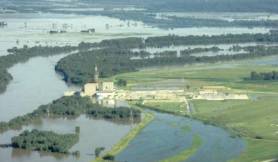
The military helicopter’s black shadow dances on an engorged Missouri River as the aircraft slowly loops the flood-encircled Fort Calhoun Nuclear Station — the same left-leaning turns the pilot navigated two days prior.
Warrant Officer Boe Searight, 32, with the Nebraska Air National Guard wants the infrared camera mounted under the chopper to record similar flood scenes for levee experts on the ground to compare.
He and his colleague Chief Warrant Officer 2 Eric Schriner also are looking for new signs of trouble for the flooded plant.
“Keep daily eyes on it and see if anything changes,” says Schriner, 31.
Far below, on mosquito-infested riverbanks, two-person crews with the Nebraska National Guard and Iowa National Guard patrol the Omaha and Council Bluffs levees in mud-caked boots.
Members of the Guard are the front-line levee watchers in an operation that clearly has high stakes: Levees protect about 40,000 people from homelessness in the neighboring river cities — as well as the region’s key airport.
The levee watchers are out there right now — three shifts a day, all week, searching for gopher holes, chasing away sightseers who could fall from the levees, and checking for signs of water seepage.
More than 130 men and women with the Nebraska Army and Air National Guard work each day for flood duty, along with 120 from the Iowa Army and Air National Guard.
The idea is to spot trouble early. Levees don’t always give notice before they rupture, but more often than not they do.
If trouble is spotted, steps can be taken to shore up or boost a weakened levee.
Good to know. Still no nuclear incident along the lines of the hoax report from the Pakistani outlet alleged to be based on a report from a Russian agency — which is also good news — but no cause for abatement of overall concern.
Sometimes safety preparations work. Kudos to the Air National Guards, to the Nuclear Regulatory Agency, and to the companies who own the power plants. May their work continue to pay off in no nuclear incidents.
The flooding situation in Nebraska has been the subject of bizarre conspiracy theories originating in Russia and Pakistan alleging that a meltdown has occurred at Ft. Calhoun and that the government is covering it up.
One U.S. web site, Business Insider, ran with the story as legitimate and set off a huge round of copy cat reports on the Internet.
Reports of a U.S. news blackout are also part of the conspiracy theory even though Nebraska papers such as the Omaha World-Herald and the New York Times have run major stories on measures by the two reactor sites to prevent the flood waters from reaching important infrastructure such as switch yards
Spread the word; friends don't allow friends to repeat history.
Here’s a good idea: The Memphis Public Library is putting together an archive on the 2011 floods in the area, we learn from the Memphis Daily News:
St. Mary’s Senior Helps Library Build Flood Archive
St. Mary’s Episcopal School student Ellery Ammons is devoting her summer break to helping the Memphis Public Library & Information Center build an archive documenting the Mid-South floods of 2011.
Ammons, an employee of the Shelby Forest General Store owned by her parents, is also a Girl Scout, working toward her Gold Award.
Recognizing the need to document this year’s historic deluge, the high school senior decided to take on the tasks of soliciting, cataloging and archiving community photos to create the 2011 Flood Collection.
She plans to create a digital archive of flood photographs to provide future generations with an accurate record of the floods that ensued when the Mississippi and its tributaries overflowed in Memphis and the surrounding areas this past spring.
Library digital projects manager Sarah Frierson said she’s delighted to have the extra hands in the history department, saying the collection “will be a wonderful complement to the library’s existing Mid-South Flood Collection, which documents the floods of 1927 and 1937.”
The Benjamin L. Hooks Central Library, 3030 Poplar Ave., is seeking photo donations to add to the 2011 Flood Collection. Donations, which will become part of the library’s permanent collection, can be brought to the history department on the main library’s fourth floor or e-mailed to Flood2011.Photography@gmail.com.
– Aisling Maki
Spread the word; friends don't allow friends to repeat history.
This is more evidence that the whole flap is a hoax.
True to form, several birther and other conspiracy paranoiac sites claim that these plants in Nebraska are gone, in flames, or leaking water that nearly glows.
Can’t Sarah Palin point her bus to Nebraska and let her press entourage get the real story?
Spread the word; friends don't allow friends to repeat history.
Or, until that account is unsuspended by the forces supporting Donald Trump: Follow @FillmoreWhite, the account of the Millard Fillmore White House Library
We've been soaking in the Bathtub for several months, long enough that some of the links we've used have gone to the Great Internet in the Sky.
If you find a dead link, please leave a comment to that post, and tell us what link has expired.
Thanks!
Retired teacher of law, economics, history, AP government, psychology and science. Former speechwriter, press guy and legislative aide in U.S. Senate. Former Department of Education. Former airline real estate, telecom towers, Big 6 (that old!) consultant. Lab and field research in air pollution control.
My blog, Millard Fillmore's Bathtub, is a continuing experiment to test how to use blogs to improve and speed up learning processes for students, perhaps by making some of the courses actually interesting. It is a blog for teachers, to see if we can use blogs. It is for people interested in social studies and social studies education, to see if we can learn to get it right. It's a blog for science fans, to promote good science and good science policy. It's a blog for people interested in good government and how to achieve it.
BS in Mass Communication, University of Utah
Graduate study in Rhetoric and Speech Communication, University of Arizona
JD from the National Law Center, George Washington University


 Posted by Ed Darrell










 Millard Fillmore's Bathtub
