Canada? It’s in North America? What?

March 27, 2011

And in other news that didn’t make most U.S. local newspapers today, the government of Canada fell yesterday.

Canada government falls, Politically-Illustrated

"The Conservative government in Canada was toppled on Friday after a vote of no-confidence passed in the parliament by 156 to 145." Cartoon at Politically Illustrated by Cam Cardow

You know:  Canada.  That nation north of North Dakota, the one that keeps Alaska stuck to the North American Continent.  Remember?   It’s got about 20% of the world’s fresh water.  Those guys who helped us whip Hitler on D-Day.

Oh, c’mon.  Google the place, will you?  It’s the nation where, when you go there, ‘those bastards with the drug problem south of the border’ is the United States.

No, no, it’s probably not important.  We buy a lot of our oil from Canada.  Canada is our biggest trading partner.  They buy a lot of the goods that we still produce here.

And the conservative government there, under a parliamentary system that kids in the U.S. are never tested on in Texas, lost a vote of confidence Friday, in Ottawa.

Ottawa?  It’s the capital of Canada.  No, Montreal isn’t even the capital of Quebec.

Oh, come on! Quebec.  Quebec! It’s the province of Canada with all the French speakers. Yeah, Quebec City is the capital of Quebec.

Ottawa’s in Ontario.  No, Ottawa is the capital of the whole nation, Canada.  Ontario’s capital is Toronto.

Lone Ranger?  No, Toronto has nothing to do with the Lone Ranger.  It’s the biggest city in Canada.

Anyway, to get back to the topic, Canada’s government failed.  Conservatives lost a vote because of ethics issues.

Ethics issues, conservatives.  No news there.  No wonder it wasn’t covered better.

Elections in May. You’d know this, if you read the blogs of the Natural Resources Defense Council.

As if anyone cared.

Hey, get this:  Ontario alone has more than 250,000 lakes, natural lakes.  In a good, very wet year, Texas has two, maybe three natural lakes.

You could look it up.

No, NATO won’t intervene.  Canada is part of NATO.

More seriously:

Energy- and environment-interested people should take note. Canada is our largest source of imported oil at about 2 million barrels a day — more than Mexico and Saudi Arabia imports combined — and we share two ocean coasts with the nation.  See what Susan Casey-Lefkowitz said at her blog:

Hopefully, whoever takes over next in Canada will be a bigger proponent of clean energy and fighting climate change than the Harper government has been. The Harper government has been a vocal proponent of tar sands oil expansion – pushing this dirty fuel in the United States and in Europe. In fact, the Harper government has been instrumental in undermining clean energy efforts at home and abroad all to promote the tar sands oil industry. A fresh approach in Canada gives the country a chance to get back to its green roots and to listen to its provincial governments such as Ontario, Quebec, Manitoba and British Columbia who have been developing innovative ways to promote clean energy and fight climate change. A fresh approach also provides an opportunity to lessen Canada’s dependence on the oil and gas sector and its heavy control over the Canadian dollar leading many to fear “Dutch disease.”

Clean energy and fighting climate change are critical issues now and in the coming decades. Hopefully, Canada can step forward as a leader on both in the future.

We can overlook the abuse of the word “hopefully” to extract important information, I think.  Did your local paper cover this story today?

More, resources:


Yellowstone, Land to Life — a film to free from bondage

March 20, 2011

Yes, it’s a tease.  Drat.  Just a trailer for the film.

But how exquisite is just the trailer!

Yellowstone National Park Orientation Film (excerpt) from Northern Light Productions on Vimeo.

Northern Light Productions made the film for the “Canyon Visitor Education Center in Yellowstone National Park. The film offers a compelling overview of the ‘big picture’ geology that has shaped and continues to influence Yellowstone and its ecosystem.”

Big picture geology?  How about making this film available to schools to talk about geology, geography, and history?

Yellowstone National Park annually gets about three million visitors.  Yellowstone is one of those places that ever American should see — but at that rate, it would be more than 100 years before everybody gets there.

We need good, beautifully shot, well-produced, interesting films on American landmarks in the classroom.

How do we get this one freed for America’s kids, Yellowstone Park?


What’s the radiation level right now?

March 19, 2011

Concerned about radiation from Japan?

It’s highly improbable that dangerous levels of radiation would drift more than a few miles from the damaged nuclear power plants in Japan, but maybe seeing some actual readings might convince people there’s not much to worry about — other than our sympathy for Japan, the Japanese people and especially those workers who have stayed on the site of the power plant to work to secure the reactors so they do not become hazards to the population at large.  Those workers may be exposed to significant, harmful radiation, and they deserve all the thanks you can give them.

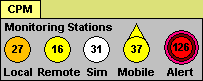
Below is a map of the contiguous 48 states of the U.S., showing live readings from about a dozen sampling sites across the nation.  The map should update about every minute (if it doesn’t, and  you want to see updates, click through to the Radiation Network site).

Normal background levels are about 25 to 75; a low-level warning might be given if readings are sustained at 100.  These numbers are Counts Per Minute (CPM), a very crude measure from a Geiger counter showing how many radioactive particles or rays hit the sensor in a minute.  It does not distinguish alpha, beta or gamma, and it may be dependent on the design of the Geiger counter, especially the size of the sensor — differently designed machines give different readings even right next to each other.

So it’s a crude count, but it’s a map of counts.

Radiation Network map of radiation in the U.S.  Read legend, use with caution

Radiation Network map of radiation in the U.S. Read legend, use with caution. Click map to go to Radiation Network site.

Here is legend information for the map:

Legend for Radiation Network map

Sampling station symbols, Radiation Network

Nuclear site, calculated by the Radiation Network

At left is a symbol used on the map to mark “nuclear sites” by the Radiation Network.  Note that a nuclear “site” is not necessarily a nuclear power station.  For example, there are nuclear sites designated near Moab, Utah; there are a couple of ore refining facilities or tailing ponds there, but no nuclear power station.  The map shows a nuclear site in the Texas Panhandle.  There is no nuclear power station there.

Instructions on how to read the map, from RadNet:

How to Read the Map:

Referring to the Map Legend at the bottom left corner of the map, locate Monitoring Stations around the country that are contributing radiation data to this map as you read this, and watch the numbers on those monitoring stations update as frequently as every minute (your browser will automatically refresh).  The numbers represent radiation Counts per Minute, abbreviated CPM, and under normal conditions, quantify the level of background radiation, i.e. environmental radiation from outer space as well as from the earth’s crust and air.  Depending on your location within the US, your elevation or altitude, and your model of Geiger counter, this background radiation level might average anywhere from 5 to 60 CPM, and while background radiation levels are random, it would be unusual for those levels to exceed 100 CPM.  Thus, the “Alert Level” for the National Radiation Map is 100 CPM, so if you see any Monitoring Stations with CPM value above 100, further indicated by an Alert symbol over those stations, it probably means that some radioactive source above and beyond background radiation is responsible.

Notice the Time and Date Stamp at the bottom center of the Map.  That is Arizona Time, from where we service the Network, and your indication of how recently the Radiation Levels have been updated to the Map.

(Please note: Any White circles on the map represent Monitoring Stations that are running Simulations, instead of using a real Geiger counter, so any Alert levels that may occur over those stations are to be ignored since they represent only momentary testing.)

Remember, “alert level” is sustained count above 100. But again, be alert that this is only counts per minute, and may be difficult to translate to an accurate radiation reading.

The Radiation Network is an all volunteer operation, no government funding or other involvement.  In fact, the network is seeking volunteers to get a Geiger counter and hook it up to the internet to provide even more real-time readings.  See “How to Participate in the Nationwide Radiation Network.”

If you’re a denier of global warming/climate change, you should use your usual denial tool, claiming that because radiation at background levels is “normal,” no level of radiation can be harmful.  In fact, if you’d make that claim and volunteer to go staff the crews trying to cool the reactors, the entire world would salute you.

Should you be concerned? MIT’s Technology Review explains that the levels of radiation at the plant site itself are quite low, though higher than normal (article by Courtney Humphries).  The article also explains that radiation levels rapidly drop the farther from the plant one is; while we may be able to detect increases in radiation attributable to the radiation from Fukushima site, it is highly unlikely that radiation will exceed safety standards:

In terms of potential health dangers from radiation from the Fukushima Daiichi Nuclear Power Station, “the people who are in the most immediate danger from acute and severe radiation doses are those people who are on site at the moment and who are desperately trying to keep the reactors under control,” says Jacqueline Williams, a radiation oncologist at the University of Rochester Medical Center.

Moving away from the immediate vicinity of the plant, radiation levels drop very rapidly. James Thrall, radiologist-in-chief at Massachusetts General Hospital, says that radiation levels are inversely proportional to the square of the distance from the source: The level at two miles from the source are one-quarter what they are at one mile, and “at 10 miles away, it’s almost an infinitesimal fraction,” he says. Individual exposure also varies widely depending on whether a person is outside or indoors, or shielded with protective clothing. Japanese authorities have evacuated the population living within a 20-kilometer radius of the plant, and have warned those living within 30 kilometers to stay indoors. Some experts say that people living beyond this range have no cause for concern at this time. “This has nothing to do with the general population,” McBride says.

The trickier question is whether lower doses of radiation—well below the threshold of acute illness—could lead to long-term health consequences for those in that area. Thrall says that epidemiological studies on survivors of nuclear attacks on Japan have found that those receiving 50 millisieverts or more had a slightly elevated cancer risk—about 5 percent higher than expected—and that risk seemed to rise with higher exposures. But scientists still vigorously debate whether that risk can be extrapolated down to even lower exposures.

After the nuclear disaster at Chernobyl, the population experienced a surge in thyroid cancers in children. However, scientists found that the culprit was not radiation in the air but radioactive contamination of the ground, which eventually found its way into cow’s milk. Thrall points out that in Japan, this is highly unlikely because the authorities are carefully monitoring the water and food supplies and keeping the public informed, which did not happen at Chernobyl.

More, resources:


7 Billion: Are you typical? Year-long Nat Geo special reports

March 13, 2011

7 Billion: Are you typical?

Vodpod videos no longer available.

7 Billion: Are you typical? Year-long Nat Geo s…, posted with vodpod

I could see a bell-ringer in there somewhere.  Who do you think ought to see this thing?  What classes in public schools should see it, for what purpose?

I hope the year-long series lives up to the video.  I hope there are a lot more videos to go along with it.  As a piece of persuasive rhetoric, it does make a decent case for subscribing to National Geographic for a year.  How’s that for rhetorical criticism?


The 12 States of America from The Atlantic: Income inequality marks majority of America

March 10, 2011

Graphics story in The Atlantic this month — “The 12 States of America.”

Looking at my print copy I was struck that most of the “states” listed — really communities of people — have lost economic ground in the past decade.  Average per capita incomes dropped for most groups.

Since 1980, income inequality has fractured the nation. Click each icon to see each of the dozen states, which counties belong to them and how median income has changed over the last 30 years.

The old income inequality monster rearing its ugly, ugly head again.  America is losing ground.  No wonder the Republicans are discouraged — but why don’t they understand that its their policies that create the trouble?

This is a good version, but you’d do well to go check out a larger version at The Atlantic site, and read the short article by Dante Chinni and James Gimpel.

Vodpod videos no longer available.

The 12 States of America – The Atlantic, posted with vodpod

Click on any descriptor, and it will show which counties in America match that description.

Hmmm. In the headline, should that be “scars” instead of “marks?”


Latitude and Longitude in two minutes

March 3, 2011

Teachers, can you use a video that covers latitude and longitude in just over two minutes?

A good idea, generally, from Matt Rosenberg (a better idea without “autoplay”) — a few more videos at Ask.com Geography.

[Editor’s note:  I’ve put the video below the fold because I can’t find an easy way to turn off the autoplay command.  My apologies to anyone bothered by the problem.]

Read the rest of this entry »


Firefall in Yosemite: Horsetail Fall’s spectacular February show

March 2, 2011

New program from Yosemite National Park’s “Nature Notes.”

This one has something to appeal to the heart of almost everybody:  Photos from Ansel Adams, photos from Galen Rowell, interviews with sons of each, discussion of the (properly) much-maligned old “firefall” of hot fire coals for tourists — and the story of the natural firefall one might see, if the conditions are right, and if one is in Yosemite in the right place, on the right days of February.

This video was produced by Steven M. Bumgardner, with extra camera help from Josh Helling.  Those guys do great work.  It features photographer Michael Frye, Michael Adams, Ansel Adams’ son, and Tony Rowell, the son of  Galen Rowell.


England? Britain? United Kingdom? Everything explained

February 4, 2011

Is it England, Britain or UK?  The explanation:

Tip of the old scrub brush to Joe Carter at First Things.


American Icons: Half Dome in Yosemite National Park

February 2, 2011

One of what should be an occasional series of posts on American iconic places, natural features, sights to see, etc.  For studies of U.S. history and U.S. geography, each of these posts covers subjects an educated American should know.  What is the value of these icons?  Individually and collectively, our preservation of them may do nothing at all for the defense of our nation.  But individually and collectively, they help make our nation worth defending.

This is a less-than-10-minute video you can insert into class as a bell ringer, or at the end of a class, or as part of a study of geologic formations, or in any of a number of other ways.  Yosemite Nature Notes provides glorious pictures and good information about Yosemite National Park — this video explains the modern incarnation of Half Dome, an enormous chunk of granite that captures the imagination of every living, breathing soul who ever sees it.

Potential questions for class discussion:

  • Have you put climbing Half Dome on your bucket list yet?  Why not?
  • Is it really wilderness when so many people go there?
  • How should the National Park Service, and the Forest Service and Bureau of Land Management, manage these spectacular, completely unique features, both to preserve their wild nature, and allow people to visit them?
  • What are the federalism issues involved in protecting Half Dome, or any grand feature, like the Great Smokey Mountains, Great Dismal Swamp, Big Bend, Yellowstone Falls, or Lincoln Memorial?
  • Does this feature make you wonder about how glaciers carve mountains and valleys?  (Maybe you should watch this video about glaciers in Yosemite.)
  • What is the history of the preservation of the Yosemite Valley?
  • Planning your trip to Yosemite:  Which large city airports might be convenient to fly to?  (What part of which state is this in?)
  • What other grand sights are there to see on your trip to Yosemite?
  • What does this image make you think?  Can you identify the people in it?

    John Muir and Teddy Roosevelt in Yosemite Valley

    Who are those guys? Why might it matter? (Answer below the fold)

  • How about this image? Who made this, and so what?

    Albert Bierstadt, Sunrise, Yosemite Valley, ca. 1870 - Amon Carter Museum, Fort Worth, Texas

    Photo or painting? Where could you see this work?

Read the rest of this entry »


Ironic: Super Bowl host cities shut down by ice

February 1, 2011

280 sanding trucks patrol the streets of Dallas County, but the thin sheet of ice closed us down.  Dallas ISD did the right thing — and it turns out that DISD’s closing for weather is so rare that every other institution we work with keys off of them, knowing that means fewer shutdowns.  But today, ice, no dice.

Dallas ice, January 2009 - photo by Lauren Allen

Sorta like this 2009 photo of north Dallas, but without the pretty sky, with duller ice, and more cold. Lauren Allen is a professional photographer -- did she add in the nice sunrise? (Buy the photo and see!) It doesn't look so treacherous as it is; not seen in the photo: an estimated (by me) 24 jackknifed 18-wheelers on I-635, just a few blocks away.

So, five days to Super Bowl, and Green Bay and Chicago Pittsburgh fans can’t fly to Dallas because of ice.  I imagine fans already here a jumping up and down in their $500-a-night hotel rooms, incredulous that such a thin sheet of cold stuff is keeping them holed up like naked mole rats.  Host city events in Fort Worth and Dallas are cancelled for today, and maybe for much of the rest of the week.

Son James, at Lawrence University in Appleton, Wisconsin, is just three degrees colder, but missing the ice and wind we have.  His windchill isn’t so great as ours.  Windy City, you ain’t seen nothing like the winds of Texas.  Usually they don’t blow so cold, though.

Our front gate is frozen.  The lock won’t budge.  We’ll have to snowshoe from the backyard to get the newspaper.

Global warming deniers are dancing with glee.  They think the fact that we’ve got Arctic weather means warming isn’t happening, forgetting to look to the Arctic, which is eerily warm.

But it’s all cool.  No school!


Depending on your perspective, the world looks pretty good

January 2, 2011

If you’re a few dozen miles from the Earth, for example:

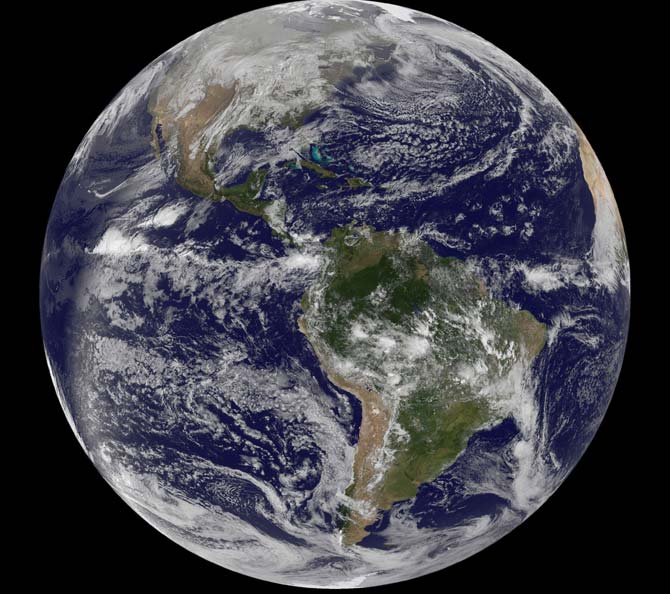
Earth full disc, December 30, 2010 - NASA, GOES

From NASA: The GOES-13 satellite captured a "full-disk image" of North and South America in an image created December 30 at 1445 UTC (9:45 a.m. EST), as the world awaits the new year. Credit: NOAA/NASA GOES Project; click on picture for larger view

Press information from NASA:

As the World Turns to 2011 GOES Satellites Watch its Approach and Look Back at 2010

The GOES series of satellites keep an eye on the weather happening over the continental U.S. and eastern Pacific and Atlantic Oceans and had a busy time with wild weather in 2010. Today, GOES-13 captured one of the last images of North and South America in 2010 as the world continues to turn toward 2011.

The Geostationary Operational Environmental Satellite called GOES-13 satellite captured a “full-disk image” of North and South America in an image created December 30 at 1445 UTC (9:45 a.m. EST) as the world awaits the new year. The stunning image shows cloud cover associated low pressure areas over the upper Midwestern U.S. and Colorado’s Rocky Mountains.

NASA’s GOES Project, located at NASA’s Goddard Space Flight Center in Greenbelt, Md., procures and manages the development and launch of the GOES series of satellites for NOAA on a cost-reimbursable basis. NASA’s GOES Project also creates some of the GOES satellite images and GOES satellite imagery animations. NOAA manages the operational environmental satellite program and establishes requirements, provides all funding and distributes environmental satellite data for the United States.

NASA’s GOES Project was very busy this year. GOES-13 monitors the eastern continental U.S., Atlantic Ocean, Gulf of Mexico and Caribbean, while GOES-11 monitors weather conditions over the western U.S. and the Eastern Pacific Ocean.

In 2010, GOES satellites were busy providing images and animations of weather systems from nor’easters to tropical cyclones that caused blizzards, flooding and wind damage.

Most recently, the GOES project used satellite data to create an impressive animation of the great Christmas weekend blizzard that pummeled the northeastern U.S. Prior to that, GOES imagery showed travel conditions for the holiday weekend when that low was over the Colorado Rockies.

On Dec. 19, the GOES-11 satellite captured an image of the famous “Pineapple Express.” Occasionally in the winter, a large jet stream forms across the mid-Pacific, carrying a continuous flow of moisture from the vicinity of Hawaii to California, bringing heavy rain and snow to the Sierra-Nevada for several days.

On Dec. 8 GOES-13 satellite imagery revealed a snow-covered, winter-like upper Midwest, several weeks before astronomical winter. On Nov. 24, GOES satellites helped Thanksgiving travelers figure out where delays may be happening.

During the summer, on July 25, GOES-13 imagery tracked one of the most destructive storms in years to strike Washington, D.C. and the surrounding area. Strong winds downed trees and power lines, leaving hundreds of thousands of residents without power, stopping elevators, and darkening malls and movie theaters. Falling trees killed at least two people. The NASA GOES Project created a satellite animation of the storm as moved through the region.

GOES-13 was busy in the Atlantic during the 2010 hurricane season. The Atlantic season started on June 1 and ended on November 30. The Atlantic season tied for third with two other years (1995 and 1887) as having the largest number of named storms at 19, and tied with two other seasons (1969 and 1887) for the second largest number of hurricanes, with 12. GOES-13 covered all of those tropical cyclones. GOES-11 didn’t see the action in the Eastern Pacific tropics that GOES-13 did, however. Because of a La Niña event, the 2010 Pacific hurricane season (which began May 15 and ended Nov. 30) was the least active season in terms of the number of named storms and hurricanes on record. All tropical cyclones can be seen at NASA’s Hurricane page archives for 2010 at: http://www.nasa.gov/mission_pages/hurricanes/archives/index.html.

On April 14, months before hurricane season started, GOES-13 became the official GOES-EAST satellite. GOES-13 was moved from on-orbit storage and into active duty. It is perched 22,300 miles above the equator to spot potentially life-threatening weather, including tropical storm activity in the Atlantic Ocean and Gulf of Mexico..

Before GOES-13 moved into the position previously occupied by GOES-12, GOES-12 captured a parade of three large storms the flooded the upper Midwest and Northeast in the second half of March. In the first half of March, GOES-12 covered storms as they dumped heavy rainfall in the Northeastern U.S.

On March 12, GOES-12 captured a very rare event in the tropics: the second–ever known tropical cyclone called Tropical Storm 90Q formed in the South Atlantic Ocean off the coast of Argentina.

During the first two weeks of February 2010, the GOES-12 weather satellite also observed a record-setting series of “Nor’easter” snow storms which blanketed the mid-Atlantic coast in two blizzards.

Whatever and wherever the weather in 2011, the GOES series of satellites will always go.

Related Links:

› GOES-POES web site
› NOAA web site

Rob Gutro
NASA’s Goddard Space Flight Center, Greenbelt, Md.


Eclipse! Fun watching, little success photographing

December 21, 2010

Joni Mitchell warned us:  Clouds get in the way:

Lunar eclipse 12-21-2010 - beginning, with clouds - Photo by Ed Darrell - IMGP5738

A clouded view for openers

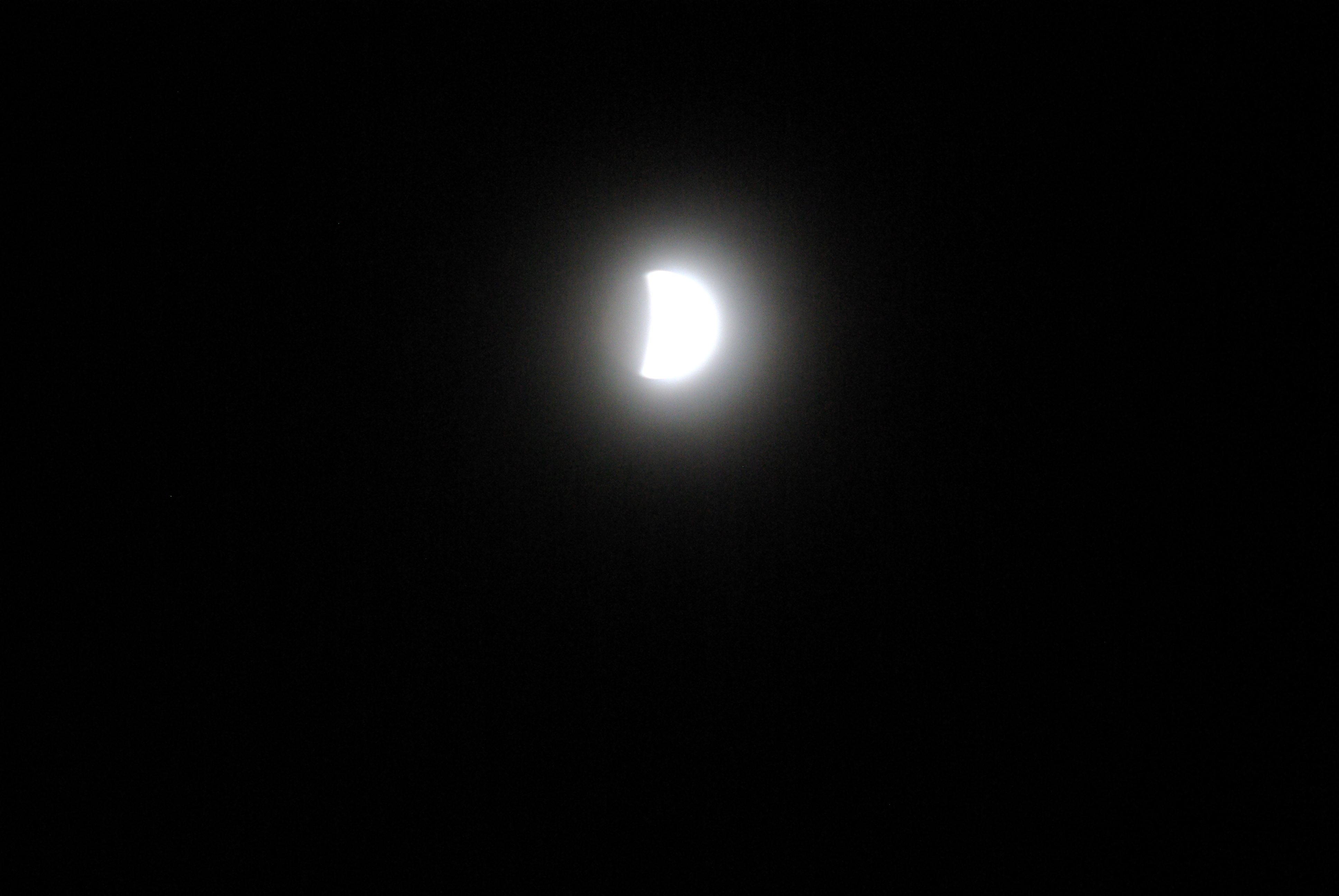
A long eclipse — more than an hour of almost-total coverage of the Moon’s disk.  Clouds came and went, with a few good viewing times.  With the naked eye, the view was spectacular.  Through the 200 mm Pentax zoom, not quite as spectacular, even with the tripod mount.  Photographing eclipses takes some skill that I don’t yet possess.

Solstice eclipse - clouds took a break IMGP5760 - Photo by Ed Darrell

Clouds took a break

Eclipse totality, with clouds - IMGP5778 - Photo by Ed Darrell

Eclipse totality

A better shot, near the end - IMGP5798 - photo by Ed Darrell

Eclipse nearing its end

Near the end of totality, where the shadow slips away from the full Moon, a bright white light provides a dazzlying view that confounds the light meters.

Bright sliver as eclipse totality ends - IMGP5813 - Ed Darrell photo

Celestial orange, tinged in silver

Ending eclipse with more of the sky - IMGP5822 - Ed Darrell photo

Step back, see a few of the starts, even from inside Dallas city limits

Bright light at the edge of Earth's shadow - IMGP5844 Ed Darrell photo

To every Earth shadow, there's a silver lining to confuse the built-in light meter

Blood-tinge gone, Earth's shadow retreats - IMGP5881 Ed Darrell photo

Blood-tinge gone, Earth's shadow retreats (all photos by Ed Darrell)

Eclipse over, clouds again fog the view - IMGP5884 - Ed Darrell photo

Eclipse nearly over, clouds again fog the view

Longer lens, better tripod next time.  (Heh.  We should live so long.)


Stunning photo: What happened here, 795 years ago?

December 5, 2010

Runnymede, Magna Carta Isle, photo by Wyrdlight, Antony McCallum, 2008 (Wikimedia)

What event critical to western history and the development of the democratic republic in the U.S. happened here in 1215?

A teacher might use some of these photos explaining the steps to the Constitution, in English law and the heritage of U.S. laws.  Other than the Magna Carta, all the events of Runnymede get overlooked in American studies of history. Antony McCallum, working under the name Wyrdlight, took these stunning shots of this historic meadow.  (He photographs stuff for studies of history, it appears.)

Maybe it’s a geography story.

View of Runnymede Meadow from Engham Village -- Wyrdlight photo through Wikimedia

View of Runnymede Meadow from Engham Village -- Wyrdlight photo through Wikimedia

Several monuments to different events of the past millennium populate the site.  The American Bar Association dedicated a memorial to the Magna Carta there — a small thing open to the air, but with a beautiful ceiling that is probably worth the trip to see it once you get to England.

Wikipedia explains briefly, with a note that the ABA plans to meet there again in 2015, the 800th anniversary of the Great Charter:

Magna Carta Memorial


The Magna Carta Memorial & view towards the ‘medes’


Engraved stone recalling the 1985 ABA visit

Situated in a grassed enclosure on the lower slopes of Cooper’s Hill, this memorial is of a domed classical style, containing a pillar of English granite on which is inscribed “To commemorate Magna Carta, symbol of Freedom Under Law”. The memorial was created by the American Bar Association to a design by Sir Edward Maufe R.A., and was unveiled on 18 July 1957 at a ceremony attended by American and English lawyers.[5]

Since 1957 representatives of the ABA have visited and rededicated the Memorial renewing pledges to the Great Charter. In 1971 and 1985 commemorative stones were placed on the Memorial plinth. In July 2000 the ABA came:

to celebrate Magna Carta, foundation of the rule of law for ages past and for the new millennium.

In 2007 on its 50th anniversary the ABA again visited Runnymede and during the convention installed as President Charles Rhyne who devised Law Day which seeks in the USA an annual reaffirmation of faith in the forces of law for peace.

The ABA will be meeting at Runnymede in 2015 on the 800th anniversary of the sealing of the original charter.

The Magna Carta Memorial is administered by the Magna Carta Trust, which is chaired by the Master of the Rolls.[10]

In 2008, flood lights were installed to light the memorial at night, but due to vandalism they now lie smashed.

I’ll wager the lights get fixed before 2015.

Detail of ceiling of the Magna Carta Memorial, Runnymede - Wikimedia image

Detail of ceiling of the Magna Carta Memorial detailing play of light, and star pattern, Runnymede - Wikimedia image

More, resources:


Leonid meteor shower 2010: Moon, Jupiter, and Leonids

November 17, 2010

Some stellar fireworks will be visible in your skies tonight, November 17, 2010.

The Moon is in conjunction with Jupiter.  The Leonid Meteor Shower will peak soon after the Moon and Jupiter set.

Oh, to be in the desert tonight, far away from the lights of the city!

Even in a city, the Moon and Jupiter should be clear, and near spectacular.

Things are great, if you’re looking up.

Moon and Jupiter, conjunction 1990 - ICSTAR

It won't be this spectacular -- this is a photo of the 1990 Moon/Jupiter conjunction (ICSTARS photo)


Butterflies are free, to move about the country

October 24, 2010

Great mysteries of science, history and spirit call to us:  How do the monarch butterflies do it?

Monarch butterflies (Danaus plexippus) fly north from their enclave in Mexico every spring, stopping to lay eggs on milkweed plants.  After a migration of several hundred miles, that first group that left Mexico dies off.  Their offspring hatch in a few days, devour the milkweed, make a chrysalis, metamorphose into butterflies, then fly farther north, where they repeat their parents’ behavior:  Lay some eggs, and die.  Within three generations, they’ve spread north into Canada.

Kathryn's butterfly plantings, October 2010 - photo by Ed Darrell

Inviting the monarchs in: You can see how Kathryn worked to attract butterflies. In this photo, you can see the butterfly weed (a milkweed), red Turk's cap, and blue ageratum especially for the monarchs.

Then the fourth generation does something so strange and wonderful people can’t stop talking about it:  They fly back to Mexico, to the same trees their great-great-great grandparents left.  There they sip some nectar, get some water, and spend a lot of time hanging in great globs, huddling over the winter, to start life for generations of monarch butterflies the next spring.

Sometimes in Texas in October, we can see clouds of monarch butterflies winging south.  If we’re lucky, they stop to visit our backyards and gardens, and we might provide some water and nectar to urge them homeward.  Kathryn, of course, plants the stuff the monarchs like, to help them, and to give us a chance to see them.

Monarch habitat in Mexico is under severe stress and threat.  Late storms and early freezes decimated monarch populations over the last decade [yes, that’s the proper use of “decimated;” look it up].  Human plantings are more critical to the monarch butterflies than ever before.

Two years ago Kathryn and I spent a September morning outside the library at Lawrence University, in Appleton, Wisconsin, watching monarchs sip nectar from local flowers for their journey.  Those same butterflies — we hope — passed through Texas a couple of weeks later.

Two weeks ago . . . well, see for yourself:

Monarch butterfly on blue porterweed, Dallas, TX October 2010 - photo by Ed Darrell IMGP5343

A monarch butterfly feeds on blue porterweed in Kathryn's garden, October 2010 - photo by Ed Darrell

Monarch butterfly on blue porterweed, Dallas, October 20101 - photo by Ed Darrell IMGP5347

. . . we're here with the camera, little guy, just open up those wings, please . . .

Monarch  butterfly on blue porterweed, Dallas, Texas October 2010 - photo by Ed Darrell IMGP5345

That's it! Beautiful! Have a safe trip, and come back next spring, will you?

Resources, more:

Conoclinium coelestinum