Columbus feared that King Ferdinand and Queen Isabella would not honor pledges they had made to him as recompense and honor for his great work of discovery on their behalf. Before his final voyage, he assembled a legal document showing those promises made to him, and his work for Spain.
This illustrates, once again, the human dimension of the great drama of the age of exploration, of Columbus’s stumbling on to the America’s in his efforts to get to China.
On January 5, 1502, prior to his fourth and final voyage to America, Columbus gathered several judges and notaries in his home in Seville. The purpose? To have them authorize copies of his archival collection of original documents through which Isabel and Fernando had granted titles, revenues, powers and privileges to Columbus and his descendants. These 36 documents are popularly called “Columbus’ Book of Privileges.” Four copies of his “Book” existed in 1502, three written on vellum and one on paper. The Library’s copy, one of the three on vellum, has a unique paper copy of the Papal Bull Dudum siquidem of September 26, 1493, which extended the Spanish claim for future explorations.
Teachers looking for a good way to portray urban sprawl, for geography and history classes, should take a look at this photo essay at the New York Times; unfortunately for teachers, Christoph Gielen’s stunning aerial landscapes cannot be copied for PowerPoint.
(Caption from New York Times presentation): Untitled XI Nevada, 2010 This Vegas-area community was built by the same company that designed the circular communities on the outskirts of Phoenix in “Untitled X / XII / XI.” Credit: Christoph Gielen (Go see the presentation at the Times site to see the other photos)
Did I mention that San Francisco is one of my favorite cities in the world?
A lot of reasons. My father had businesses there (1930s?). My parents wooed in and around there. Our Favorite Aunt Linda did well in the area (Marin County, but that just adds to the beauty).
I was accepted at Hastings College of Law. We figured we had enough saved that we could either pay tuition at Hastings, and live on what Kathryn could earn, if she could get a job; or we could buy a house in the D.C. area, keep our jobs on Senate staff, and pay tuition.
We had a wonderful week in San Francisco getting no job interviews. On our last night we found a Tower Record Store and stocked up (back in the days of vinyl) for the next four years at George Washington, and sadly left the city. In a fit of irony, Tower Records opened a store across the street from GW’s law school two years later.
Earlier, after the 1976 elections, I hid out at Aunt Linda’s joint, Red Robin Catering, tending bar, washing dishes, washing a lot of lettuce, and generally trying to make a car payment and enjoy San Francisco. She catered the opening of the Marin/San Francisco ferry, which meant more than a dozen trips overall, as I recall, serving champagne mostly. Now I look back on how unfair it was that my youth did not include electronic cameras.
Early mornings — and there were more than a few — the city is just unsurpassed in beauty. Cousin Steve pushed me out of bed to go see the Muir Woods at near dawn (I confess I did not go often enough). Some nights I’d just cruise across the Golden Gate Bridge for the views.
Like this one, a composition from several shots from the same place, woven together with the wonders of electronic camera software:
Golden Gate Bridge and San Francisco, and fog, from Marin County - Wikimedia image, panorama photo stitching by Mila Zinkova
It’s shot from Marin County, west of the Golden Gate Bridge, I think — that’s the North Tower of the bridge, with the Bay Bridge and the city of San Francisco in the background.
Discussion at Wikimedia: Those are crepuscular rays coming through the trees. There’s an SAT vocabulary word for you: Crepuscular.
More crepuscular rays from Marin County, Wikimedia photo by Mila Zinkova
More:
More great shots of San Francisco at Heida Biddle’s Tales of 7, here, and especially here
Spread the word; friends don't allow friends to repeat history.
Santa Monica, California, August 27, 2010 /PRNewswire/ — The Eames Office announces with pleasure the Tenth Annual International Powers of Ten Day on October 10, 2010 (10/10/10). Powers of Ten Day promotes and encourages Powers of Ten Thinking, a form of rich, cross-disciplinary thought that approaches ideas from multiple interrelated perspectives, ranging from the infinitesimal to the cosmic—and the orders of magnitude in between.
Powers of Ten Day is inspired by the classic film Powers of Ten by designers Charles and Ray Eames. The film, a nine-minute visual journey of scale, takes the viewer from a picnic out to the edge of space and then back to a carbon atom in the hand of the man sleeping at the picnic. Every 10 seconds the view is from 10 times further away. In all, more than 40 Powers of Ten are visualized seamlessly. One of the most widely seen short films of all time—at the Smithsonian Air and Space Museum for decades and still widely used in schools around the world—Powers of Ten has influenced pop culture from The Simpsons to the rock band Coldplay, from Hummer commercials to the movie Men in Black. But Powers of Ten received perhaps the ultimate accolade in 1998 when the Library of Congress selected it, along with Easy Rider, Bride of Frankenstein, and Tootsie, for the National Film Registry—one of the 25 films of great cultural value chosen each year.
And the film’s importance only grows. Scale is not precisely just size, it is the relative size of things. As Eames Demetrios, director of the Eames Office, has said: “Scale is the new geography. So many of our challenges today are ultimately matters of scale. To be a good citizen of the world and have a chance to make it a better place, a person must have a real understanding of scale.”
Powers of Ten Day is for teachers, librarians, architects, designers, store owners, webmasters, business people, scientists, filmmakers, meditation gurus, parents, kids, and anyone wanting to extend the boundaries of their thinking. Participating can be as simple as watching the video (showing online throughout October [the tenth month] at www.powersof10.com), or putting together a screening of the film for friends or co-workers—at home, in a school, or at a library. Our goal is for as many people as possible to watch or share the film on that day. Some will be seeing it for the first time. Some will be revisiting a favorite classic. Everyone can be part of the conversation.
Powers of Ten Day can also be a lot more. Activities are happening worldwide throughout October. With the help of the DVD Scale is the New Geography as well as a Powers of Ten Box Kit, individuals (teachers in the broadest sense) can lead engaging workshops for kids and/or adults that let participants create their own scale journeys. Although those materials may be purchased at www.eamesoffice.com, as Eames Office Education Director Carla Hartman notes, “We’ve set aside some sets to be available at no charge for inquiring schools and teachers.” Those supplies are limited—and some are already being put to use. To inquire about availability of Powers of Ten supplies at no charge, email info@eamesoffice.com.
The Eames Office also encourages you to create and share your contributions. Over the years art has been created, music shared, global pilgrimages performed, and more. But most of all there has been hands-on learning. Events can be registered, and photographs, drawings, and writings uploaded. Sorted by power and by event, these will serve as inspiration and fodder for other events around the world—more than 1,000, possibly 10,000.
Anyone living in or visiting Southern California is welcome to visit the Powers of Ten Exhibition at the Eames Office in Santa Monica from now until the end of the year. There will be an event each day the exhibition is open during the month of October. Many more fun and thought-provoking activities will be available at www.powersof10.com by the end of the summer. The exhibit includes such things as a box that can hold 1 million pennies; as of mid-August, there were already 250,000! All the pennies collected will be given to TreePeople, an environmental nonprofit that unites the power of trees, people and technology to grow a sustainable future for Los Angeles.
Powers of Ten Thinking extends beyond this unique date of 10/10/10. As Demetrios says, “There is a little bit of the numerologist in all of us, so we love celebrating this date, but empowering people to explore and make connections between scales is a year-round goal of ours.” The Eames Office looks forward to tracking and inspiring another decade’s worth of Powers of Ten events. Towards that end, a map of the Earth on the website (and at the Office) will track events around our world.
The Powers of Ten Exhibition is open from 11 to 6, Wednesday through Saturday at the Eames Office, 850 Pico Boulevard, Santa Monica, CA 90405; 310/396-5991.
Powers of Ten Day is generously sponsored by IBM Corporation with additional support from Herman Miller Inc., Vitra, and Penfolds.
Your school should have one of the Eames versions of the film in the school library (they did more than one). This is truly a classic, and it should be a good discussion starter for several different topics — map reading, map scaling, environmentalism, existentialism, transcendentalism, and more.
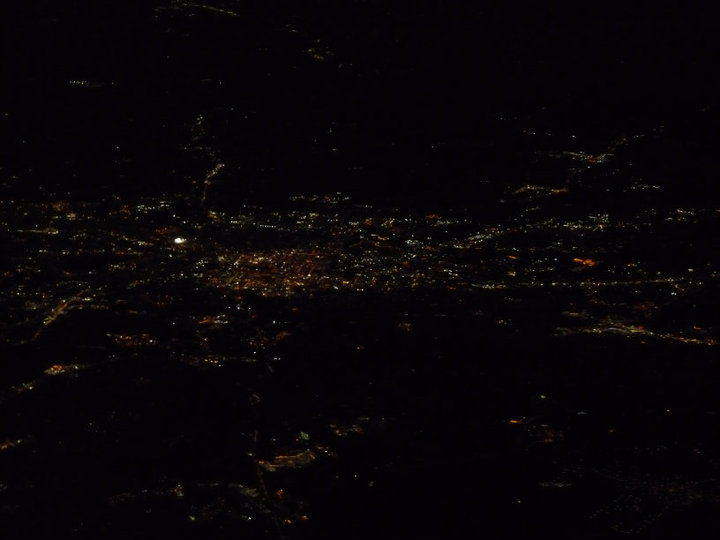
Quick quiz: Can you identify this Midwest American city?
Can you identify the city shown in this photo? Photo by James Darrell, flying to DFW from ATL. (Click for larger view)
Can you identify this Midwest city? The photo was taken about an hour outside of DFW International, flying in from Atlanta Hartsfield. North in on the right side of the photo. My quick guess was Oklahoma City, but that was when I thought the departure city was Milwaukee (it could still be OKC).
Can you shed some light, and tell why you think it’s that city?
Night flying is cool. While I enjoy flying any time, I really enjoy the views from an airplane at night.
Somewhere in the trunk of film-that-may-one-day-be-digitized, I have several photos of smaller cities along the Wasatch Front in Utah, taken during campaigns and business trips in the 1970s and 1980s. At one time I had a list of the cities in the shots, but that list is long gone. I wonder whether I could identify those cities today?
Historically, it would be interesting, since most of those small towns now are sizable suburb cities.
Chicago lays out in an orange grid of glowing citrine gemstones at night. New York City dazzles from 2,000 feet, looking better than any movie you’ve ever seen, and glowing. Dallas presents a colored outline against the black sky when you come in for a landing (or Fort Worth, with more white lights, if you’re on the west side of the aircraft coming in). Salt Lake City sparkles and spreads up the mountains and canyons. St. Louis is neat rows of lighted pathways broken by the snaking Mississippi and Missouri Rivers. Washington, D.C. is a Shining City on a Hill spectacular when the weather is clear, coming down the Potomac River to National (now Reagan).
Which city is this one, above?
Spread the word; friends don't allow friends to repeat history.
One of our more adventurous teachers spent the summer on a Fulbright-Hays program in Senegal, in West Africa.
No, that's not William Adkins. That's his lunch one day in Senegal.
William Adkins’ African adventure blog is here. Mine it for stuff you can use in economics, art, world history, world geography, or anything else. He’ll probably give you free reign to use the photos for classroom presentations.
What did you do on your summer vacation?
Spread the word; friends don't allow friends to repeat history.
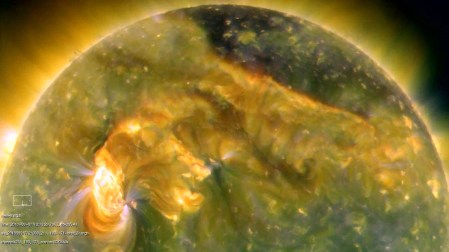
And so the Northern Lights, the Aurora Borealis, returned to the planet in spectacular fashion this week, after more than a year of relative solar dormancy. According to the Christian Science Monitor, outstanding displays of the lights may continue through this week.
Caption from NASA: On August 1st, almost the entire Earth-facing side of the sun erupted in a tumult of activity. There was a C3-class solar flare, a solar tsunami, multiple filaments of magnetism lifting off the stellar surface, large-scale shaking of the solar corona, radio bursts, a coronal mass ejection and more. This extreme ultraviolet snapshot from the Solar Dynamics Observatory (SDO) shows the sun's northern hemisphere in mid-eruption. Different colors in the image represent different gas temperatures ranging from ~1 to 2 million degrees K. Credit: NASA/SDO
Help someone else find the sky:
Spread the word; friends don't allow friends to repeat history.
At a blog called Frugal Café Blog Zone, “Where it’s chic to be cheap… Conservative social & political commentary, with frugality mixed in,” blogger Vicki McClure Davidson headlined the piece:
Cold in winter. They don’t expect it. These warming denialists provide the evidence those crabs need, who wonder whether there shouldn’t be some sort of “common sense test” required to pass before allowing people to vote, or drive, or have children.
Oh, it gets worse:
Another site picked up the post. No, seriously. (Has Anthony Watts seen this yet?)
Voting Female [I am convinced that is a sock puppet site designed to insult women; no woman could be that stupid, could she?]
Earth at northern solstice - Wikimedia image
Spread the word; friends don't allow friends to repeat history.
Tragic accident at a spectacular site in Utah’s desert.
A Scout from Wisconsin attempted a leap from one part of a natural bridge to another, lost his balance and fell to his death. According to the Salt Lake Tribune in Salt Lake City:
A Wisconsin Boy Scout died Saturday after falling 100 feet from Grand County’s Gemini Bridges.
Anthony Alvin, 18, of Green Lake, Wis., was with a Scout group at the Gemini Bridges rock formation, which is on federal land northwest of Moab, deputies wrote in a press statement. At about 9:30 a.m., Alvin tried to jump from one span of the double bridge to the other span, six feet away, when he fell backwards, dropping 100 feet to the bottom of the bridges.
Rescuers rappelled off the bridges and found Alvin had died. His body was lowered down two separate cliffs to the bottom of Bull Canyon, deputies wrote.
Erin Alberty
Anthony Alvin was a member of Troop 630 from Green Lake, Wisconsin, in the Bay Lakes Council, BSA. The Troop has years of experience in high adventure trips. This was a transition trip for Alvin, moving from Scout to leader.
High adventure Scouting takes teens to outstanding places with some risks. Strict safety rules protect Scouts and leaders from most accidents. Jumping the gap between the two natural bridge sections is a leap that experienced rock climbers and Scouters should advise against — and probably did — precisely because of the dangers of minor mishaps, 100 feet or more in the air. A six-foot gap would look eminently leapable to a capable young man.
This is a picture of Gemini Bridges from below:
Gemini Bridges, near Moab, Utah, from below. Image from NaturalArches.org image, photo by Galen Berry.
NaturalArches.org includes details about many of these natural spans in the desert Southwest, in Utah and Arizona. For Gemini Bridges we get this warning note:
These magnificent twin bridges are a popular 4-wheel drive destination on BLM land northwest of Moab, Utah. A few foolhardy individuals have lost their lives here. One person fell to his death while attempting to jump the 10 feet between the two spans, and in October 1999 a jeep and driver fell 160 feet off the outer span.
From atop the bridges, the gap between the two can appear deceptively small — see one view here.
For safety’s sake, no one should attempt to leap the gap without proper rock-climbing safety equipment in place and in use — and frankly, I’m not sure how it could be secured even then, in the sandstone.
Four-wheelers and off-road vehicles frequently climb these trails — despite the dangers, the area offers a huge playground for people out of the jurisdiction of the National Park Service or National Forest Service, each of which discourage excessive vehicular risk taking. Several sites extoll the glories of conquering these deserts with gasoline-power.
Irresponsible jump at Gemini Bridges captured on film, from rockclimbing.com
The photo at the bottom shows a memorial plaque to the four-wheeler who lost his life off of Gemini Bridges in 1999. So long as people make monuments to people who pull daredevil stunts, others who have less experience, or even more sense, will be tempted to try the same daredevil stuff.
Go to these wild and beautiful places. Please remember they are treacherous, however, and stay safe.
Tribute to Beau James Daley, who died when his jeep plunged off of Gemini Bridges, Utah
In a probably-unintentionally humorous way, Eschenbach shows just how desperate grow the anti-warming camp. The purloined e-mails show no wrong-doing, and worse for denialists, no significant errors in the case that global warming occurs and is problematic. Legislation to fight climate change has a chance of passing this Congress. EPA promulgated rules on measuring CO2 and other greenhouse gases, and Alaska Sen. Lisa Murkowski’s resolution to stop EPA failed in the Senate. There was the hoax about the fourth-grade science project claimed to refute Nobel-quality research, and then there was the bungled story that mistakenly claimed a solar-energy company sent a non-working bomb to an economics professor in Spain in revenge for his paper against government support of green energy. One can see how such a string of losses might set back the hopes of even the most delusional denialist.
Either ignorant of Godwin’s Law, or so desperate he thinks it worth the gamble, Eschenbach quoted somebody (did he ever name who?) going on about the Big Lie technique attributed to the Nazis in establishing policy in Germany before and during World War II.
Mike Godwin, discoverer of Godwin's Law - Wikimedia image
Is there a more plaintive or pitiful way to say one is over one’s head and has run out of argumentative gasoline?
Eschenbach’s case is not particularly strong — he pulled temperature data (he said) from the U.S. Historical Climatology Network (USHCN) to make charts showing, Eschenbach claimed, there is no 4°F rise in average New England winter temperatures since 1970.
After a couple of skirmishes to see whether Watts’ watchdogs still prevent my posting, I offered a small rebuttal that, of course, slipped quickly into the abyss of Watts Moderation. It may eventually escape that particular eddy, but in case it doesn’t, here’s the post:
PS Ed Darrell – do you have any evidence refuting the post?
Most claims of someone practicing “big lie” tactics are self-refuting, the opposite of a self-proving document under the law. Is this any exception? Mr. Eschenbach offers no evidence to suggest that a committee of Congress publishes material it knows to be wrong for propaganda effect. (The quotes relating to Hitler comprise a grand rhetorical tactic known as “red herring.” The mere presence of that material, were we to apply Godwin’s law, refutes Mr. Eschenbach’s case.)
There is no evidence to refute.
Mr. Eschenbach offers a few jabs at data that show the effects of warming in New England, but he does not appear to bother to look at the data the committee used. This is a bait-and-switch tactic of argumentation that most rhetoricians would label a spurious. Does Eschenbach rebut or refute the committee’s data? How could anyone tell?
1. The committee claims that average winter temperatures in New England have risen by 4 degrees F since 1970. Eschenbach offers a chart that, so far as I can tell, confirms the committee’s claim — but Eschenbach uses a chart that covers a much longer period of time, and offers it in a way that makes it difficult to determine what temperatures are, let alone what the trend is (IMHO, the trend is up, and easily by 4 degrees in Eschenbach’s chart). Oddly, he illustrates the chart by showing a surfer in a wet suit, surfing in winter in New England. Surfing is generally a warm-weather enterprise, and though the man has a wetsuit, and though the Gulf Current would warm those waters, the picture tends to deny Eschenbach’s claim, doesn’t it? If it’s warm enough to surf in winter, it’s warmer than the Rime of the Ancient Mariner.
And look at the actual numbers — Eschenbach confesses a rise of 2.7 degrees, roughly 9/13 of the rise he intends to deny. Heck, that nearly-three degree rise is enough to cause concern, or should be.
Eschenbach doesn’t contest this in any way. Should we presume this is Eschenbach’s agreement that this claim is not a “big lie” claim?
3. The committee refers to warming oceans, and the potential effects on certain parts of the fishing industry, especially cod and lobster. This is caused by ocean warming, not atmospheric warming — so Eschenbach is again silent on this claim. The committee’s claim tends to undercut Eschenbach’s claim of a “big lie” here, and Eschenbach offers no support for his own argument.
4. The committee refers to greater storm damage due partly to rising sea levels. Eschenbach offers no rebuttal of any sort.
Eschenbach fails to make a prima facie case for his big lie claim, and his rebuttal is restricted solely to one measure of temperature that Eschenbach fuzzes up with an unclear chart.
May I ask, since you style yourself a skeptic, what evidence you found in the post that makes a case at all?
James is home for the weekend, then back to Wisconsin on Sunday for a summer of physics beyond my current understanding. He flew home to wish bon voyage to Kenny, who is off to Crete to learn how to teach English, and then (we hope) to find a position teaching English to non-English speakers somewhere in Europe.
I wondered: What about that volcano erupting in Iceland?
Little worry for the trip over, this weekend. Longer term?
So I turned to the Smithsonian to find a volcano expert, and came up with this video of Smithsonian Geologist Liz Cottrell who explains where the eruption of Eyjafjallajökull fits in history, and maybe some — with a lesson in how to pronounce Eyjafjallajökull’s name.
So:
Can teachers figure out how to use this in geography, and in world history? (Science teachers, you’re on your own.)
Life is a gamble if you live close to a volcano, and sometimes when just happen to be downwind.
In the past couple of hundred years, maybe volcanoes worldwide have been unusually quiet.
As to size of eruptions and the damage potential: We ain’t seen nothin’ recently!
A woman in a hot air balloon realized she was lost. She lowered her altitude and spotted a man in a boat below. She shouted to him, “Excuse me, can you help me? I promised a friend I would meet him an hour ago, but I don’t know where I am.”
The man consulted his portable GPS and replied, “You’re in a hot air balloon, approximately 30 feet above ground elevation of 2,346 feet above sea level. You are at 31 degrees, 14.97 minutes north latitude and 100 degrees, 49.09 minutes west longitude.
“She rolled her eyes and said, “You must be an Obama Democrat.”
“I am,” replied the man. “How did you know?”
“Well,” answered the balloonist, “everything you told me is technically correct. But I have no idea what to do with your information, and I’m still lost. Frankly, you’ve not been much help to me.”
The man smiled and responded, “You must be a Republican.”
“I am,” replied the balloonist. “How did you know?”
“Well,” said the man, “you don’t know where you are or where you are going. You’ve risen to where you are due to a large quantity of hot air. You made a promise you have no idea how to keep, and you expect me to solve your problem. You’re in exactly the same position you were in before we met, but somehow, now it’s my fault.”
The real question you might be asking yourself right now is why was the man in a boat? You understand, as a map savvy person, that 31 degrees 14.97 minutes North and 100 degrees 49.09 minutes West puts the balloon about 20 miles southwest of San Angelo, Texas, probably still in the city limits of Mertzon, Texas, just off U.S. Highway 67. He’s a few miles west of any significant boat-supporting body of water.
Don’t let that detract from the joke. Just consider that the woman was trying to meet up with friends attending the Texas Republican Convention this weekend in Dallas.
Balloon Crash, image from Dave Statter, WUSA9
Spread the word; friends don't allow friends to repeat history.
When considering the political scene of the moment, it is difficult not to see how historical allegory plays an important role in the public spectacle known as the Tea Party movement. From the name itself, an acronym (Taxed Enough Already) that fuses current concerns to a patriotic historical moment, to the oral and written references by some of its members to Stalin and Hitler, the Tea Party appears to be steeped (sorry) in history. However, one has only to listen to a minute of ranting to know that what we really are talking about is either a deliberate misuse or a sad misunderstanding of history.
Misuse implies two things: first, that the Partiers themselves know that they are attempting to mislead, and second, that the rest of us share an understanding of what accurate history looks like. Would that this were true. Unfortunately, there is little indication that the new revolutionaries possess more than a rudimentary knowledge of American or world history, and there is even less reason to think that the wider public is any different. Such ignorance allows terms like communism, socialism, and fascism to be used interchangeably by riled-up protesters while much of the public, and, not incidentally, the media, nods with a fuzzy understanding of the negative connotations those words are supposed to convey (of course some on the left are just as guilty of too-liberally applying the “fascist” label to any policy of which they do not approve). It also allows the Tea Partiers to believe that their situation – being taxed with representation – somehow warrants use of “Don’t Tread On Me” flags and links their dissatisfaction with a popularly elected president to that of colonists chafing under monarchical rule.
While the specifics of the moment (particularly, it seems, the fact of the Obama presidency) account for some of the radical resentment, the intensity of feeling among the opposition these days seems built upon a total lack of historical perspective.
Or, until that account is unsuspended by the forces supporting Donald Trump: Follow @FillmoreWhite, the account of the Millard Fillmore White House Library
We've been soaking in the Bathtub for several months, long enough that some of the links we've used have gone to the Great Internet in the Sky.
If you find a dead link, please leave a comment to that post, and tell us what link has expired.
Thanks!
Retired teacher of law, economics, history, AP government, psychology and science. Former speechwriter, press guy and legislative aide in U.S. Senate. Former Department of Education. Former airline real estate, telecom towers, Big 6 (that old!) consultant. Lab and field research in air pollution control.
My blog, Millard Fillmore's Bathtub, is a continuing experiment to test how to use blogs to improve and speed up learning processes for students, perhaps by making some of the courses actually interesting. It is a blog for teachers, to see if we can use blogs. It is for people interested in social studies and social studies education, to see if we can learn to get it right. It's a blog for science fans, to promote good science and good science policy. It's a blog for people interested in good government and how to achieve it.
BS in Mass Communication, University of Utah
Graduate study in Rhetoric and Speech Communication, University of Arizona
JD from the National Law Center, George Washington University


 Posted by Ed Darrell









 Millard Fillmore's Bathtub