Social studies train wreck at Texas State Board of Education: Live! A Nation at Risk

January 13, 2010

Steve Schafersman will live blog the hearings on social studies standards before the Texas State Board of Education (SBOE) today, at Evo-Sphere.  Schafersman is president of Texas Citizens for Science, and a long-time activist for better education in Texas on all topics.

Rapid updates or live-blogging should be available at the blog of the Texas Freedom Network, TFN Insider.

It’s Item #6 on the SBOE agenda, with a title that tips off the trouble:

Item #6 — Public Hearing Regarding Proposed Revisions to 19 TAC Chapter 113, Texas Essential Knowledge and Skills for Social Studies, and Chapter 118, Texas Essential Knowledge and Skills for Economics with Emphasis on the Free Enterprise System and Its Benefits.

Schafersman e-mailed an introduction to the meeting:

Some say the Social Studies public testimony by the religious right, liberals, etc., then the SBOE debate, motions to amend, votes, etc. is a bigger circus than adopting the science standards. Judge for yourself. You can watch the entire circus, carnival, and sideshow on the webcast video at http://www.texasadm in.com/cgi- bin/tea.cgi

This is Texas democracy in action, when sullen and tight-lipped State Board members listen to public testifiers for 3 minutes each and profoundly ignore them since they already know what they are going to do. But I, at least, feel better after speaking so I don’t later feel responsible for the crappy amendments, changes, and policies that come out of this horrible Board because I did nothing. The proposed Social Studies standards written by the panels composed of teachers and professors are excellent (when have I heard this before), but the SBOE can’t wait to shamelessly impose their own Religious Right agenda on them.

You’ll recall that SBOE has at every possible turn disregarded the advice of famous and serious historians, respected free-market-advocating economists, geographers and educators on these standards.  Economists, for example, want Texas kids to learn about “capitalism,” since that’s what it’s called by economists and policy makers, and colleges.  SBOE thinks “capitalism” sounds too subversive, and wishes instead to require Texas kids to learn about “free enterprise” instead.

‘A rose by any other name’ you think, until you start thinking of how Texas kids do on standardized tests, college admission exams, and the punchline on the joke, about Texas kids being told not to study capitalism.  No siree, no capitalism in the fictional home of J. R. Ewing, never mind the real-life capitalists like T. Boone Pickens or H. Ross Perot (Jr. and Sr.).

In Dallas, the city prepares to name a street after Cesar Chavez, the great Hispanic union organizer and advocate for working Americans.  In Austin, SBOE works to strike all mentions of Chavez, because they dislike the politics of heroes of our ethnic minorities (soon to be a majority in Texas).  In Washington historians and policy-makers follow the legacy of Thurgood Marshall, the great civil rights attorney and first African-American to sit on the U.S. Supreme Court.  In Austin, SBOE thinks Marshall should be left out of history books.  Many of us suspect he’s anathema to the white right-wing in Austin:  A smart, successful and noble man of color.

Mel and Norma Gabler died years ago, but their history lingers in the halls of education policy in Austin.  It’s Shakespearean.

This is a massive battle.  David Barton worked for 30 years to gut history standards nationally to teach a history of America that never was, and as the official religionist appointee of the right-wing SBOE members, he stands on the brink of accomplishing much of the revisionism he’s advocated.  See the Texas Tribune story on the issue, “Hijacking History.”

Generally we shouldn’t negotiate with terrorists, Ronald Reagan said.  At the SBOE, we’ve put the terrorists in charge of history and economic curricula — if not the terrorist themselves, at least the terrorists’ camels’ noses.  Texas’s process has earned flashing red-light, claxon-sounding repeating of the words of Ronald Reagan’s Commission on Excellence in Education:  If a foreign nation did this to us, we’d consider it an act of war [excerpt below the fold].

Make no mistake about it.  SBOE’s goal is to roll back any of the reforms left from Reagan’s Commission’s work.  Our nation is more at risk from foreign competition than ever before.  SBOE plans to give away a bit more of our future to China, this week.

Our saving grace is the general incompetence of SBOE members to make significant reform in Texas’s wounded schools, reeling from unworkable and damaging requirements under the No Child Left Behind Act and a testing program that severely limits what can be taught in any social studies course other than those bastions of learning left in International Baccalaureate programs and Advanced Placement courses (estimates are that between 5% and 10% of Texas high school students can take one of those good courses).  Whatever silliness, craziness or lies SBOE orders to  be taught, it can’t be taught and tested well.  Inertia preventing change works to save America in this case.

In business, most CEOs at least appreciate the value of having good front-line employees who are the ones who really deliver the service or product and produce the profit of the enterprise (even if they don’t treat those employees so well as the employees deserve).  Education may be the last bastion of flogging the horse that should be pulling the cart instead.  In this case, having well-trained teachers in the classroom is the last hope for Texas, Texas parents and Texas students — and Texas’s economic future and future in liberty.  Teachers are the last defense of freedom in Texas.  Today SBOE will make another assault on the ramparts that protect the teachers in their work.

When will the French fleet arrive to lend aid?  Will it arrive at all?  And if it arrives, will Texas kids know better than to shoot at the ships?

Carol Haynes, who claims to have a doctorate in some discipline, told the board how to rewrite the standards to completely change the history of the civil rights movement in their last hearing on the topic.  According to Haynes, apparently, Dr. Martin Luther King, Jr., was opposed to civil rights and Barry Goldwater was in favor — the Board didn’t offer to correct her revisionism, but instead asked her to go beyond her three minutes in fawning acceptance. This appears to be SBOE’s approval of various Other Universe hypotheses offered by Star Trek, allowing any damned thing at all to be taught as history (except the right stuff).  Haynes is scheduled to testify again (#128), probably very late at night, but perhaps in time for the 10:00 p.m. Texas television news broadcasts.  Oy.

Excerpt from the Report of the Commission on Excellence in Education, A Nation at Risk, below the fold.

ae_summer2015mehta_opener-1100x736

Cover of A Nation at Risk: The Imperative for Educational Reform, the 1983 report that started the education reform mess. AFT graphic.

Stand up for your nation, it’s children and future; sound the alarm:

Add to FacebookAdd to NewsvineAdd to DiggAdd to Del.icio.usAdd to StumbleuponAdd to RedditAdd to BlinklistAdd to TwitterAdd to TechnoratiAdd to Furl


Read the rest of this entry »


Trouble at Texas Board of Education: Social studies

January 11, 2010

Here is a news rundown of stories on the Texas State Board of Education, who have been planning for a year now to mess up social studies standards for Texas public schools, this week.

Get on your horse and warn Texans:  The Idiots are coming to get your good schoolbooks:

Add to FacebookAdd to NewsvineAdd to DiggAdd to Del.icio.usAdd to StumbleuponAdd to RedditAdd to BlinklistAdd to TwitterAdd to TechnoratiAdd to Furl


Annals of Global Warming: Black soot and glaciers in Tibet

January 5, 2010

Another in a series on the history of global warming; this comes from the Earth Observatory at NASA (visit that site — the image is more stunning, larger):

tibet_geos5_2009269

Black Soot and the Survival of Tibetan Glaciers

Posted December 15, 2009
Black Soot and the Survival of Tibetan Glaciers

Color bar for Black Soot and the Survival of Tibetan Glaciers
download large image (677 KB, JPEG) acquired September 26, 2009
download large animation image (9 MB, M4V) acquired August 1, 2009 – November 9, 2009

On the Tibetan Plateau, temperatures are rising and glaciers are melting faster than climate scientists would expect based on global warming alone. A recent study of ice cores from five Tibetan glaciers by NASA and Chinese scientists confirmed the likely culprit: rapid increases in black soot concentrations since the 1990s, mostly from air pollution sources over Asia, especially the Indian subcontinent. Soot-darkened snow and glaciers absorb sunlight, which hastens melting, adding to the impact of global warming.

NASA climate scientists combine satellite and ground-based observations of soot and other particles in the air with weather and air chemistry models to study how the atmosphere moves pollution from one place to another. This image is from a computer simulation of the spread of black soot (“black carbon” to climate scientists) over the Tibetan Plateau from August through November 2009. It shows black carbon aerosol optical thickness on September 26, 2009. (Aerosol optical thickness is scale that describes how much pollution was in the air based on how much of the incoming sunlight the particles absorbed.) Places where the air was thick with soot are white, while lower concentrations are transparent purple.

The highest concentrations of black soot are in the right-hand side of the image, over the densely populated coastal plain of China. But high concentrations occur over India, as well, and the black soot spreads across the southern arc of the Tibetan Plateau, which is defined by the towering peaks of the Himalaya Mountains. (Note: Topography has been exaggerated to highlight features that influence air movement). The animation shows how the black carbon pollution from India often circulates at high concentrations for several days against the base of the Himalaya, periodically “sloshing” over the rim of the mountains and spilling northward over the plateau, before being carried away over the Bay of Bengal or the Arabian Sea.

Writing about the implications of the study for the Goddard Institute for Space Studies Website, NASA climate scientist and study co-author James Hansen said, “[C]ontinued, ‘business-as-usual’ emissions of greenhouse gases and black soot will result in the loss of most Himalayan glaciers this century, with devastating effects on fresh water supplies in dry seasons. The black soot arises especially from diesel engines, coal use without effective scrubbers, and biomass burning, including cook stoves. Reduction of black soot via cleaner energies would have other benefits for human health and agricultural productivity. However, survival of the glaciers also requires halting global warming, which depends upon stabilizing and reducing greenhouse gases, especially carbon dioxide.”

NASA image by Gregory Shirah, Goddard Scientific Visualization Studio, based on model simulations from the Goddard Earth Observing System Model, Version 5 (GEOS-5). Caption by Rebecca Lindsey.


Geography quiz: In space, who will accept your teeming masses?

December 3, 2009

Lady Liberty from space, European Space Agency photo

What is this famous landmark?

This could be an interesting geography or history bell ringer.  What are these famous sites pictured above?

Answer below the fold.

Read the rest of this entry »


The unbearable lightness of Palin groupies

November 24, 2009

I’m not sure what to make of this.  No amount of dopeslapping or head:desk banging is going to help these people get a clue.

And while I haven’t read Sarah Palin’s book, I’ll wager they won’t get a clue there, either.  Listening to the interviews one wonders whether they would be able to read Palin’s book.  Most of the kids who work hard to fail my classes look like geniuses next to these people.

And then a horrifying thought bubbles up:  Dear God, these people might actually vote!  They probably view Jay Leno’s “Jaywalking” sequences with astonished looks and great confusion.  They can’t tell what’s wrong with the answers, and they miss the humor.

I found this piece at Canadian Cynic (from whom I stole the headline) — he confessed he could only stand just under two minutes of this torture.

For Palin groupies, here are a couple of issues to consider while watching this video:

  1. While it’s done by New Left Media, it’s astonishing that anyone could find so many babbling idiots at one gathering, anywhere in America.  This was Ohio?   Yeah, Columbus; I know people in Columbus.  I fear for their lives, now.
  2. Palin has never made any particular defense of the First Amendment, nor of any of the five freedoms it enumerates.  When people say she stands for “freedom to speak,” or “freedom of religion,” they are making stuff up.
  3. “Realness” is not a policy.
  4. Tax cutting isn’t generally a great policy when people aren’t making enough to pay any taxes at all.  Tax cutting contributed to our current mess.
  5. Socialism is not “giving away money.”
  6. Obama’s two books do not portray Marxism in a good light.  They don’t mention Marxism as a potential path for any American, anywhere.
  7. “Czar” is a shorter word for a headline than “Administrator of the Environmental Protection Agency,” or “Special Assistant to the President for Energy Policy.”  People who are called “czars” by headline writers do not have any special powers beyond being right when they speak to the president (among many other advisors).  The real power is held by agency heads, like the Secretary of Defense, and the Secretary of Treasury.  The President’s Cabinet is not a wooden device in which he keeps his dinnerware.
  8. One may always question motives, but on the issue of Obama’s “liking” the military, consider:  He’s appointed many former military people to important positions, including U.S. Ambassador to Afghanistan, Lt. Gen. Karl Eikenberry, to get good advice from people who know the military well; Obama is the only president since Johnson, maybe since Lincoln, to go meet victims of war as their caskets come back to their families; Obama is the only sitting president ever to visit the graves of victims of a current conflict at Arlington National CemeteryThe lives and welfare of our men and women in uniform has been a singular focus of this president.
  9. Talk of martial law?  Not from Obama.  Not in the administration.  Not in any agency.  Not in Congress.  Only in wingnut dens.
  10. Illegal aliens cannot be naturalized under current law.  No illegal aliens are being naturalized.  When found, they are being deported.
  11. Obama is an American citizen; even the courts are getting testy about that, tossing the crazy lawsuits out with harsh comments for people who are so gullibly dumb.
  12. It’s 700 miles from Sarah Palin’s home to the nearest point in Russia.  “Seeing Russia from the backyard” is a figure of speech, and not accurate in any way.
  13. The Governor of Alaska is not the first defense against any attack from a foreign nation on the U.S., coming through Alaska.  The U.S. Air Force has jurisdiction, and still patrols that area, along with satellite and radar surveillance.  In an attack, the official role of the Governor of Alaska is to duck and stay out of the way.
  14. The Governor of Alaska has no special security clearance that no other governor has.  I’m not sure that any governor has a security clearance as governor.
  15. People for the Ethical Treatment of Animals (PETA) is not a player in the protection of polar bears, nor any other animal on listed as threatened or endangered.
  16. No proposal is before Congress to change current law on “partial birth” abortion.  Since there is a law on the topic, it would take a new law, passed by Congress, to change current law.  Obama can’t touch it without Congressional action.  (This is basic civics, you know?)
  17. Are you afraid of what’s happening in America?  After you listen to these yahoos, you may have cause to fear what would happen if their views were to carry an election.

Are people still lining up for lobotomies?  Do they directly from the operating table to a Sarah Palin book signing?

We can hope New Left Media edited out all the cogent, intelligent remarks.  I have this nagging fear that they didn’t have to edit at all.

Add to FacebookAdd to NewsvineAdd to DiggAdd to Del.icio.usAdd to StumbleuponAdd to RedditAdd to BlinklistAdd to TwitterAdd to TechnoratiAdd to Furl


Leonid meteor scattered showers

November 18, 2009

Meteors from the Leonid shower could have been good viewing — generally, as I predicted, it was not spectacular.  At least BBC said so.

But if you can make the time, it’s almost always profitable — psychologically and spiritually — to look up at the sky.

Some who did look up got great photographs of the not-spectacular views.

Leonid meteor shower in Grafton Park, Ontario, Canada - Malcolm Park photo

"A fireball seems to shoot right through a house in Grafton, Ontario. Malcolm Park captured the image as he was setting up to photograph meteors on Monday night." (MSNBC caption)

If this isn’t spectacular, can you imagine what would be?


Leonid meteor shower tonight: Don’t wait up in Dallas

November 16, 2009

Space.com’s story on tonight’s Leonid meteor shower doesn’t encourage me to stay up, or get up to watch (tomorrow morning’s meteor shower, really).  A “strong show,” but not spectacular numbers, and our living so close to Dallas will help obscure much of what would be visible normally.

The first cloud of comet dust was released from the nucleus of Tempel-Tuttle back in the year 1567. North America will be turned toward the constellation Leo when these particles begin pelting the upper layers of our atmosphere, some 80 to 100 miles (130 to 160 km.) above us. Earth’s encounter with the comet dust is going to be brief – possibly no more than several hours long.

Unfortunately, we won’t be going directly through the center of cloud, but rather skim through its outer edge on Nov. 17, chiefly between about 4:30 and 10:30 GMT. As a consequence, the meteor rate is not expected to get much higher than 20 or 30 per hour (on average about one meteor sighting every two or three minutes). Still, this is about two to three times the normal Leonid rate.

At the beginning of this window, it will still be dark across Europe and western Africa with Leo high up in the southeast sky, but within an hour the sky will be brightening as sunrise approaches, soon putting an end to meteor watching.

North Americans – especially those living near and along the Atlantic Seaboard – will be able to watch for Leonids from after 1 a.m. local time right on until the first light of dawn, which comes soon after 5 a.m. local time.

I’ll wager more people will be up watching the new movie 2012 about a wholly fictional collision with Earth than will watch the real collisions from parts of an old comet (Tempel-Tuttle).

More data

2008 Leonids, Chris Peterson at Cloudbait

A composite, all-sky image of the 2008 Leonid outburst over Colorado. Credit: Chris Peterson, Cloudbait Observatory. (NASA) This is a composite image of 141 meteors collected over four evenings, November 16-19 UT. Because the images were collected over many hours, the radiant of the shower is spread out. The Moon was present during the peak activity period each night, so only bright meteors have been recorded. The Moon has been removed from the composite image. (Cloudbait)

Add to FacebookAdd to NewsvineAdd to DiggAdd to Del.icio.usAdd to StumbleuponAdd to RedditAdd to BlinklistAdd to TwitterAdd to TechnoratiAdd to Furl


Geography Awareness Week, November 15-21

November 6, 2009

Geography Awareness week is sneaking up — November 15-21.

Got your special lesson plans ready, teachers?


Surely we’ve found everything by now

November 4, 2009

Well, no, we haven’t.  Nice little post by a photographer urging people to go look to see what they can find, with a brilliantly concise set of arguments about big things discovered just in the past few years.

Nice photos, too — go see.


Killer CO2 cloud – the story climate change “skeptics” hope you won’t read

October 14, 2009

From Neat-o-rama: Grazing cattle killed in the 1986 Lake Nyos disaster (Image Credit: Water Encyclopedia)

From Neat-o-rama: Grazing cattle killed in the 1986 Lake Nyos disaster (Image Credit: Water Encyclopedia)

It’s not even secret.  But those propagandists who run advertising claiming that carbon dioxide is natural and, therefore, harmless, hope against hope that you don’t know the true history, that you’ve never heard of Cameroon, that you don’t know about volcanic emissions, and that you forgot the story of the killer CO2 cloud of 1986.

Read it here, “Cameroon:  The Lake of Death.”

More information:

Lake Nyos, in Cameroon, shortly after the 1986 killer CO2 cloud. Image from Neat-o-rama.

Lake Nyos, in Cameroon, shortly after the 1986 killer CO2 cloud. Image from Neat-o-rama.

Help make a cloud of witnesses:

Add to FacebookAdd to NewsvineAdd to DiggAdd to Del.icio.usAdd to StumbleuponAdd to RedditAdd to BlinklistAdd to TwitterAdd to TechnoratiAdd to Furl

Save


Definition of “urbanization”: Glowing Cities Under a Nighttime Sky on Flickr – Photo Sharing

October 2, 2009

Pleasant to watch, this time-lapse composition highlights the light pollution aspect of increasing urbanization across the United States.  The photographer, a Dutch architect, notes that each streak of light represents a city, as he flies across the American Midwest to touchdown in San Francisco (SFO).  It’s a visual definition of urbanization, isn’t it?

On my night time flight back to SF from Amsterdam, I noticed that the lights from cities were making the clouds glow. Really spectacular and ethereal – it was really seeing the impact of urban environments from a different perspective. Each glow or squiggle represents one town or city!

Luckily the flight was half empty, so I was able to set up an improvised stabilizer mound made up of my bags, pillows, and blankets for my camera to sit on.

We were around the midwest at the beginning of the clip, and there were fewer cities once we hit the rockies. the bridge at the end is the san mateo bridge.

Technique: 1600iso; beginning – 1 (30sec) exposure / 45secs; end – 1 (4sec) exposure / 10 secs; total elapsed time: around 3 hours?

Equipment used: Nikon D300 (interval shooting mode), Tokina 12-24mm.

Music: Bloc Party – Signs

Stunning, beautiful and troubling at the same time.

Vodpod videos no longer available.

more about “Definition of “urbanization”: Glowin…“, posted with vodpod

Can you use this in your classroom?

Tip of the old scrub brush to One Man’s Blog.

Share the light with your friends:

Add to FacebookAdd to NewsvineAdd to DiggAdd to Del.icio.usAdd to StumbleuponAdd to RedditAdd to BlinklistAdd to TwitterAdd to TechnoratiAdd to Furl


Best burger in the nation

September 6, 2009

Sophia Dembling wrote about it in today’s Dallas Morning News:  The Owl Burger, from the Owl Café — this one in San Antonio, New Mexico.

It’s the best burger in the world, I think.  It reminds me, and it’s a painful memory.

Back in better younger days, before I’d left American Airlines, Kathryn and I made one last run to Salt Lake City to retrieve the last of the stuff in storage.  It was a motley combination of stuff, mostly hers, that we couldn’t fit into our apartments on Capitol Hill in Washington, and then that we just didn’t need during law school.  The monthly storage bill finally got to be a burr after we’d settled in Dallas, and we had room for the stuff in the house.

We gave the kids a vacation with Grandma and Grandpa, flew to Salt Lake, rented a much-too-large truck (the smaller one we reserved wasn’t in), loaded up and headed out.

A drive from Salt Lake to Dallas can be dull as dishwater, but we worked to add some spice.  “Adventure in Moving,” the old U-Haul slogan ran — and one usually works to avoid such adventures at all costs.  But this was different.  This was planned adventure.  We took the Xtreme Scenic Route™, through Southwestern landscapes that squeeze the creationism out of the most fundamentalist Christians.

The first night we camped in Torrey, Utah, at the edge of Capitol Reef National Park.  Someone recommended a local Mexican restaurant in an old farmhouse, a place that was really top notch, as demonstrated by the autographed photo in thanks from Robert Redford behind the cash register.  Redford knows almost all of the great places to eat, and stop and look, in Utah and much of the Four Corners area (ask me about Redford and Dick Cavett in Farmington, New Mexico, sometime).  Great dinner in a great place.

(Can I remember the name of the restaurant more than 20 years later?  Not at all.  I could drive to it . . . if it’s still there.  Perhaps this is its successor.  If so, it’s gotten a lot fancier, and to me, less charming.  You don’t expect such fine dining in such a small town.)

Coyotes started to howl about 2:00 a.m.  We hadn’t bothered to pitch a tent, the weather being what it almost always is in Utah in the summer.  I don’t know how long I sat up, looked at the stars and listened to the coyotes all around the canyon, next to Kathryn as she slept.  It was one of those nights you remember for the rest of your life.

Coyotes sang til dawn.

Capitol Reef N.P. demands more than one night’s stay — we had both been there before, though, and our task was moving furniture.   From Torrey we drove through Capitol Reef and on to the Moqui Dugway, about an 1,100-foot drop down off the Mogollon Rim, on the way to Monument Valley.

Moqui Dugway, from the rim -- see the road at the bottom, in the middle of the picture

Moqui Dugway, from the rim — see the road at the bottom, in the middle of the picture.  The sign reads “Mokee Dugway Elev. 6,425 Ft. – 1,100 Ft Drop Next 3 Miles”

Remember, this was a big truck.  It was over 20 feet long, but just how much over I don’t remember.  I do remember that when we stopped at the overlook at the top, some guy on a Harley came over to ask if we were going to “try to drive down,” and when we said yes, he said he was betting we would make it, and he had some good money riding on it.  He wished us luck.

A note in the visitor center at Natural Bridges National Monument explains, now:

MOKEE (MOKI, MOQUI) DUGWAY

SAN JUAN COUNTY, UT.

The Mokee Dugway is located on Utah Route 261 just north of Mexican Hat, UT. It was constructed in 1958 by Texas Zinc, a mining company, to transport uranium ore from the “Happy Jack” mine in Fry Canyon, UT. to the processing mill in Mexican Hat. The three miles of unpaved, but well graded, switchbacks descend 1100 feet from the top of Cedar Mesa (on which you are now standing). The State of Utah recommends that only vehicles less than 28 feet in length and 10,000 pounds in weight attempt to negotiate this steep (10% grade), narrow and winding road.

Here’s the Moqui Dugway (or Moki, depending on how much paint the sign maker has):

The Moqui Dugway -- no place for too-big trucks, or trailers - photo from Craig Holl at Midwestroads.com

The Moqui Dugway — no place for too-big trucks, or trailers – photo from Craig Holl at Midwestroads.com

We waited until there was no traffic coming from the bottom for several miles, and started down.  About six switchbacks down we encountered a long, crew-cabbed duelly pickup towing about a 30-foot cabin cruiser boat.  Fortunately we found a wide spot so he could get by, though it took him what seemed like a half-hour to make one turn in the road, and I swear he had wheels spinning in air at one point.

If the motorcycleman did indeed wager on us, he won.

The Mittens, sandstone formations in Monument Valley, Navajoland - Wikipedia image

The Mittens, sandstone formations in Monument Valley, Navajoland – Wikipedia image

We camped again at the Monument Valley Tribal Park, on the Navajo Nation.  The Mittens dominated the skyline; I remember the frustration at being unable to capture the beauty of the place through the lens of a 35-mm SLR on any film.  Images could not be big enough, exposures could not do justice to the color and natural beauty of the place.  In some SUVs and RVs in the campground, people retired to watch television in their vehicles.  They were probably the same ones who pulled out at 6:00 a.m., unable to wait to watch the sunrise complete its glorious stretch across the desert.

The third day we planned to stop and see my widowed Aunt Fay in Farmington, New Mexico.  For a couple of years in college I had the pleasure of doing air pollution research in and around Farmington after the Four Corners Power Plant was in operation, and before the San Juan Power Station came on line.   Uncle Harry Stewart, my mother’s brother, lived there and worked with El Paso Natural Gas.  Weekends I spent with Harry and Fay and their friends the Woodburys.  Harry died a few years earlier — I hadn’t seen Fay in 15 years at least.

But first, I got us stuck in the sand about 50 miles west of Farmington.  We pulled off the road to check the map — off the road meant “into the sand,” though it looked firm from the highway.  Tow trucks were 80 miles away.  A passing woman drove me 40 miles to the home of a Navajo Tribal Policeman, and back; by the time we got back a passing couple from Tucson, Arizona, and a couple of local guys with shovels had dug away feet of sand to hard soil and stone; we gunned it out of the barrow and onto the road.  (How it works today, with cell phones and satellite phones — I hope it works better.)

We had a nice visit with Aunt Fay.

Owl Cafe at night, Albuquerque, New Mexico. Owl Cafe image (?) TripAdvisor

Owl Cafe at night, Albuquerque, New Mexico. Owl Cafe image

There is no way to avoid scenery between Farmington and Albuquerque.  We pulled into the intersection of Interstates 25 and 40 in Albuquerque near 8:00 p.m., found a hotel, and were happy to find a decent-looking café nearby, with an odd, 50-foot owl at one end.  The Owl Cafe.

Who possibly could have guessed?

We seemed to be among the last people there.  It was not crowded.  I probably had a beer.  And I ordered a burger.  “Owl burger?” the waitress asked.  “Made from owls?” I asked back.

She explained it had a touch of a green chile sauce on it.  Sounded good.

She came back.  “I mean, it’s hot.  You’re not from New Mexico, right?”  I stuck with it.

Wow.

I mean, WOW!  It’s made from sirloin — moist and tender, not overcooked.  The bun is fresh, heavy and yeasty.  And I think it was the green chile stuff — heaven!  I told Kathryn I thought it might be the best burger anywhere.

Now, I’ve had some good burgers at roadhouses and fancy restaurants.  I’ve had burgers in the burger outlets near the stockyards of Greeley, Colorado, Fort Worth, Kansas City and Chicago.  I’ve had aged and marinated burgers at little joints around the Saranac Lakes of New York.  I’ve had burgers at restaurants overlooking the cities of Phoenix, San Francisco, Seattle, Indianapolis, New York and Denver.

And if I’ve eaten one Big H from Hires Drive-in in Salt Lake City, I’ve had a hundred (and would like a hundred more).  I used to argue that the Big H was the El Supremo of burgers.

The Owl Burger topped them all.

When I finished the Owl Burger, I ordered apple pie, and I wondered out loud if I should just have another burger instead.

In the morning, we found the place open for breakfast.  I joked about having another Owl Burger for breakfast — and it was on the menu.  But I didn’t.  I had some great egg dish.

Before we got out of Albuquerque, I regretted not having another Owl Burger.  All day long as we drove to Dallas I thought about that burger I didn’t have.

I’ve thought about that burger now for the better part of two decades.  The closest I’ve come to the Owl Café is a couple of passes through Albuquerque’s airport on the way to other places.

I opened the paper this morning, and there was that burger!

Owl Burger, from the Owl Cafe in San Antonio, New Mexico (photo from ABQStyle.com -- not from the online DMN)

Owl Burger, from the Owl Cafe in San Antonio, New Mexico (photo from ABQStyle.com — not from the online DMN)

Alas, according to Dembling in the DMN, management of the Albuquerque Owl Café differs now from the San Antonio Owl Café — can the burger recipes be the same?  Do we now have to make the drive to San Antonio (New Mexico)?

•Owl Bar & Café, State Highway 1 and U.S. Highway 380, San Antonio, N.M.; 575-835-9946. There’s an Owl Café in Albuquerque, but it isn’t under the same management.

The San Antonio site has some history related to development of the atomic bomb and the nearby Trinity bomb site.  One could study history, and have an historic burger at the same time.  I’ve wondered:  If the Germans had had Owl Burgers, would they have gotten the A-bomb first?  It’s that good.

[I did get excited three years ago to read that another Owl was open in San Antonio, Texas — but reading the article, I discerned that the author was unaware of a San Antonio in the Land of Enchantment.  Geographical error, gustatory disappointment.  If any of my students are reading this, that’s why you have to know geography — so you don’t drive to San Antonio, Texas, and find yourself 542 miles off target (thanks to Geobytes for the distance calculation).]

Be polite:  Please share!

Add to FacebookAdd to NewsvineAdd to DiggAdd to Del.icio.usAdd to StumbleuponAdd to RedditAdd to BlinklistAdd to TwitterAdd to TechnoratiAdd to Furl

Save


Poachers kill massive grizzly in Montana

August 24, 2009

Ralph Maughan’s Wildlife News reports that Maximus, an 800-pound grizzly bear thought to be Montana’s second largest, was illegally killed recently.

The poacher shot the bear about four weeks ago.  A reward has been offered for information leading to the capture of the poacher.

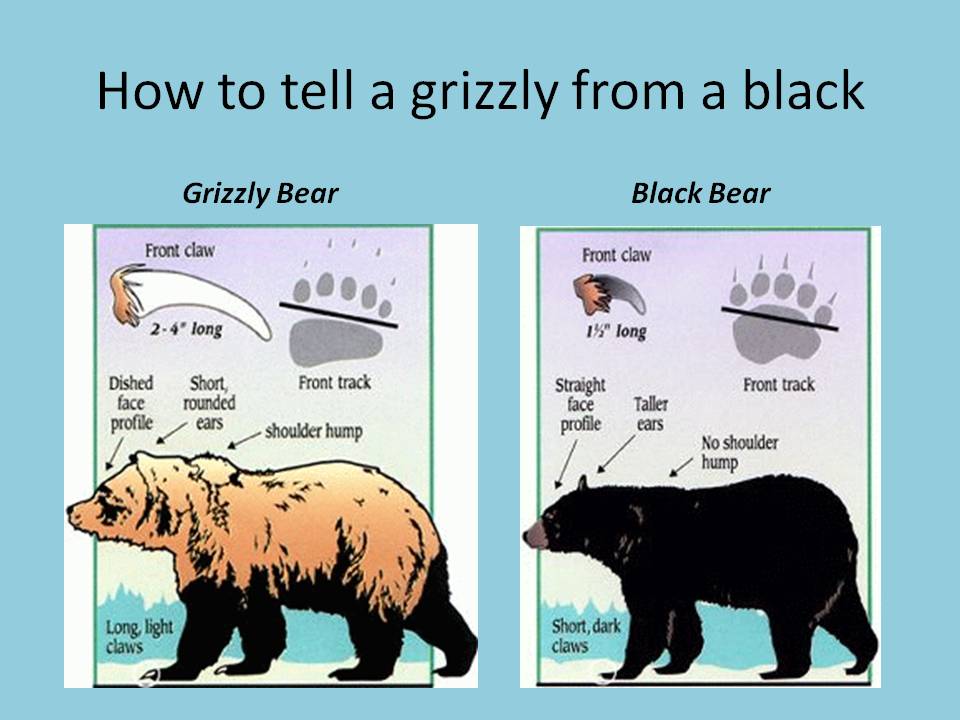
Can you tell a grizzly from a brown bear?  Chart from U.S. Fish and Wildlife Service

Can you tell a grizzly from a brown bear? Chart from U.S. Fish and Wildlife Service

Update, 1-30-2010: The chart linked to above has disappeared in a website redesign.  Below is a crude representation of the chart I made from a U.S. Fish and Wildlife information sheet on grizzlies, here.

How to tell a grizzly from a black (.pdf download)

Grizzly bear/black bear identification chart, adapted from USFWS by Ed Darrell, Millard Fillmore's Bathtub

Grizzly bear/black bear identification chart, adapted from USFWS by Ed Darrell, Millard Fillmore's Bathtub


More evidence of climate change: Arctic methane hydrates evaporating

August 21, 2009

It’s a pretty picture, but it should strike a bit of fear once you know what it is.

New Scientist explains:

Sonar image of methane plumes rising from methane hydrates on the Arctic Ocean floor; image from National Oceanography Centre, Southampton (Britain)

Sonar image of methane plumes rising from methane hydrates on the Arctic Ocean floor; image from National Oceanography Centre, Southampton (Britain)

It’s been predicted for years, and now it’s happening. Deep in the Arctic Ocean, water warmed by climate change is forcing the release of methane from beneath the sea floor.

Over 250 plumes of gas have been discovered bubbling up from the sea floor to the west of the Svalbard archipelago, which lies north of Norway. The bubbles are mostly methane, which is a greenhouse gas much more powerful than carbon dioxide.

The methane is probably coming from reserves of methane hydrate beneath the sea bed. These hydrates, also known as clathrates, are water ice with methane molecules embedded in them.

The methane plumes were discovered by an expedition aboard the research ship James Clark Ross, led by Graham Westbrook of the University of Birmingham and Tim Minshull of the National Oceanography Centre, Southampton, both in the UK.

Fortunately, the methane is not making it out of the water — yet.  The gases are absorbed before they get to the surface — but that increases ocean acidity.  If, and when, the methane hits the atmosphere, it will contribute to greenhouse warming of the planet.  This could create a runaway heat effect:  Warmer waters cause hydrates to release methane to the atmosphere, which causes the atmosphere to warm more, faster.

Scientists have not dismissed all other possibilities, but methane hydrate melting is the most likely cause:

Cohen cautions that the Arctic methane may not be from hydrate, but could be coming from the methane’s primary source, which might be deep within the Earth.

If that was the case, the warming of the West Spitsbergen current may not be to blame.

He says that the large amounts of methane being released make this unlikely, however: “If the methane is all primary, it would be an unprecedented amount.” So the idea that the hydrates are at least partly to blame is more plausible. “It’s not definitively proven, but it’s certainly reasonable,” he says.


Alaska’s salmon go missing. Why?

August 21, 2009

It’s one of those environmental mysteries that would be fun and intrigueing, were it not so worrisome.

Alaska’s King Salmon disappeared from traditional river runs this year.  Again.

From Reuters:  A sockeye salmon scurries through shallow water in the Adams River while preparing to spawn near Chase, British Columbia northeast of Vancouver October 11, 2006.  REUTERS/Andy Clark

From Reuters: "A sockeye salmon scurries through shallow water in the Adams River while preparing to spawn near Chase, British Columbia northeast of Vancouver October 11, 2006. REUTERS/Andy Clark"

Reasons could be one of many, or several:  Changing ocean currents, pollock fishing accidental catches of salmon, plankton blooms, conditions on the rivers, competition from “ranched” salmon.

Consumers may see only the rise in price and a change in labeling in the supermarket.

Effects on employment and food supply in Alaska are huge, and crippling.

Canada fisheries are affected, too.

Climate change probably plays a role, in any scenario anyone poses:

“It’s quite the shocking drop,” said Stan Proboszcz, fisheries biologist at the Watershed Watch Salmon Society. “No one’s exactly sure what happened to these fish.”

Salmon are born in fresh water before migrating to oceans to feed. They return as adults to the same rivers to spawn.

Several theories have been put forward to try to explain the sockeye’s disappearance:

* Climate change may have reduced food supply for salmon in the ocean.

* The commercial fish farms that the young Fraser River salmon pass en route to the ocean may have infected them with sea lice, a marine parasite.

* The rising temperature of the river may have weakened the fish.

The Canadian government doesn’t know what’s killing the fish, but believes the sockeye are dying off in the ocean, not in fresh water, based on healthy out-migrations, said Jeff Grout, regional resource manager of salmon for the Department of Fisheries and Oceans.

In this case, even a small change in climate can have huge effects on ecosystems and specific populations of animals.  It’s one of those climate change issues that climate change skeptics and denialists prefer not to talk about at all.  If, as they allege, concern over climate change is entirely political, driven by bad information and false claims from over-active environmentalists, these problems should not exist at all.

But the problems do exist.  A fishery that had been stable for 50 years previously, the entire time it was tracked so carefully, suddenly becomes fishless.  Watch those rivers and fisheries.

Tip of the old scrub brush to Pamela Bumsted.

Help save the salmon; tell others:

Add to FacebookAdd to NewsvineAdd to DiggAdd to Del.icio.usAdd to StumbleuponAdd to RedditAdd to BlinklistAdd to TwitterAdd to TechnoratiAdd to Furl