When on Earth, Google as the Earthlings do

March 7, 2009

I’m probably way behind the curve, but this looks to me as if it could be developed into a classroom exercise of some sort.

At Geevor Tin Mine Museum’s Weblog, I stumbled onto Whenonge #7 — When on Google Earth #7 (archaeology edition).

These wacky archaeologists!  They get a Google Earth image of some dig, post it, and challenge people to identify the dig and the time in history the site was actually occupied.  The first to identify the site accurately gets to host the next round.

Hey, take a look at these things.  They would make great slides for a presentation, but they’re also just cool.

Mystery image for When on Google Earth #7 (archaeology)

Mystery image for When on Google Earth #7 (archaeology)

Like so much in archaeology, this game comes to us from our methodological cousins in geology. Shawn Graham adopted their game, and modified it for our use at whenonge #1. Chuck Jones had the first correct answer, and then hosted whenonge #2. The mysterious and elusive PDD got #2 right but never claimed his prize, so Chuck struck back with whenonge #2.1. Paul Zimmerman got the correct answer to #2.1 and hosted whenonge # 3. Heather Baker got the correct answer to #3 and hosted whenonge # 4, and Jason Ur won and hosted of whenonge # 5 . Dan Diffendale won that,  #6 was hosted on whenonge #6 and i won this! so here we are… be the first to correctly identify the site above and its major period of occupation in the comments below and you can host your own!

What’s that?  There’s a geology version, too?  Good heavens!  The geologists are past #150!

WoGE #124 - Where on Google Earth #124; I dont know where this is, but it looks cool.

WoGE #124 - Where on Google Earth #124; I don't know where this is, but it looks cool.

It’s the sort of geeky game that airline real estate lawyers could play with airports, football geeks could play with collegiate football stadia, or baseball geeks with Major League Baseball parks.  Hiking, camping and wilderness geeks could do a National Parks and National Monuments version, with real aficianadoes including trails in National Wilderness Areas from the National Forest Service and Bureau of Land Management.

Why not a simple geography version?  Cities with more than 2 million population; national capital cities, state capital cities; Civil War battlefields; famous battlefields; volcanoes; 7 Wonders of the World.

Maybe someone in the Irving, Texas, ISD can get their geography kids to use their computers and put up a website devoted to some of these issues.


Bobby Jindal: Dumb about rocks

February 27, 2009

I couldn’t believe it either.

Remember all the flap about a flurry of earthquakes in the Yellowstone Caldera over the Christmas holidays?  Volcano monitoring is critical to safety in California, Oregon, Washington, Montana, Idaho, Wyoming and Alaska — not to mention Hawaii’s special circumstances — and to all neighboring states or those within downwind striking distance of a volcanic event.

A volcanic field now in southern Idaho erupted a few millions of years ago, spreading ash that killed creatures as far away as Nebraska.  “Neighboring state” covers a lot of territory.

So, Bobby Jindal, in his response to the Obama budget proposal speech, said the U.S. should get out of the volcano monitoring business.  It was not clear whether there were no rocks in his head, but neither was there knowledge about rocks where it should be in his head.

Green Gabbro, a real geologist, couldn’t believe it either.

  1. DID HE SERIOUSLY JUST SAY THE GOVERNMENT SHOULD NOT BE MONITORING VOLCANOES??!?!!!????@#$@!

Ignoring for the sake of argument the value of the basic science that always results from the data collected during routine monitoring – ignoring the general function of increased spending as an economic stimulus to the nation’s earth scientists, instrument manufacturers, etc., – even ignoring all that, volcano monitoring is still a very sensible investment in national security. A $1.5 million investment in monitoring at Pinatubo (near a U.S. air force base) earned a greater than 300-fold return when the volcano erupted explosively in 1991: hundreds of millions of dollars worth of property (mostly airplanes) was saved, as were thousands of lives. That 30,000% figure comes before you attempt to put a value on human life.

But then, Sarah Palin is in one of those areas where a failure to monitor volcanoes might lead to huge disaster.  It’s an unusual way to knock out a political rival, and not certain, but were Sarah Palin to disappear into a volcanic cloud, Bobby Jindal’s path to the Republican nomination for president might be less cluttered.  He’s a Rhodes Scholar — surely he can’t be that stupid about volcanoes, so the evil alternative, that he hopes to get rid of Palin, is the only thing that makes sense, isn’t it?

Is there no one in the Republican Party who will stand up for science and reason?

Resources:


Mapping Africa

February 25, 2009

Here’s a great tool for geography study of Africa.

AfricaMap is based on the Harvard University Geospatial Infrastructure (HUG) platform, and was developed by the Center for Geographic Analysis to make spatial data on Africa easier for researchers to discover and explore.

Harvards Africa Map, sample image, via Google Maps Mania

Harvard's Africa Map, sample image, via Google Maps Mania

It’s an interactive tool.  You can capture images (another add-on might be necessary) — but look at all the different layers you can use, live, on your computer.

Good source for student projects, no?

Tip of the old scrub brush to Google Maps Mania.


Abraham Lincoln, inventor

February 24, 2009

Any visitor to Thomas Jefferson’s home at Monticello knows of Jefferson’s wide-ranging interests, and work in science and invention.  I was rather surprised to discover the depth of George Washington’s inventive work, in a seminar sponsorred by the Bill of Rights Institute at Mount Vernon a few years ago.

Abraham Lincoln, too?

Lincoln lived along the Sangamon River, and he saw development of the river for commercial navigation to be a boon for his district’s economic growth.  Unfortunately, the Sangamon is not deep; boats had difficult times navigating over the many logs and snags, and shallows.

So, Mr. Lincoln offered a technical solution, for which he was granted a patent in 1849.  Details below, from Google Patents:

lincoln-patent-for-buoying_vessels_over_shoals

lincoln-patent-for-boat-buoying-in-jpg


You felt it coming: Hoaxers jump on Yellowstone quake news

January 11, 2009

Oh, yeah, we expected a few religious nuts to claim it was the end times when an interesting, but so far harmless swarm of small earthquakes hit the Yellowstone Caldera again.

But who expected such nuttiness?

Legal action is being taken against a Web site operator who has misrepresented the U.S. Geological Survey in a warning that the area around Yellowstone National Park should be evacuated out of concern that the park’s supervolcano could erupt.

“We started to take action as soon as we found out about it,” said Jessica Robertson of the USGS, adding that the agency was notified on Friday.

The issue has been referred to the USGS’s solicitor’s office which is pursuing charges of impersonating a federal official as well as violation of the agency’s trademark.

“The main issue we have is we don’t want people to believe it’s coming from us,” Robertson said.  [From the Billings (Montana) Gazette]

It’s a hoax, but a very pernicious hoax.  In a world where people believe in all sorts of things that do not happen and take actions that hurt themselves and others as a result, hoaxing is not a good game to play.

(Update, evening of January 11, 2009:  Here’s the site complained about; it appears he’s removed material that would make the site look like a USGS site.)

Was this guy under a belief that what he said was correct?

The issue highlights Nash’s concerns about where people get their news.

“There is a legitimate place to get this information; this is not it,” Nash said of the Web site [ Al Nash, the Yellowstone National Park’s chief of public affairs]. “The Yellowstone Volcano Observatory is out there. You can find it. It is run by three really bright geologists. There’s really good monitoring in the park. Our offices would be the secondary place to go for information.”

Robertson said this isn’t the first time USGS has been falsely used in such claims. She said in June a YouTube video used the agency’s logo to lend legitimacy to a claim about the end of the world.

Earthquakes are very interesting.  The Yellowstone is fascinating.  These are good reasons to study the facts and events of nature.  Hoaxes like this one, urging people to panic, play on the wealth of ignorance about science and nature, and scientists.

The only firm defense is good education and good information.

Resources:

  • From the Billings Gazette’s sidebar on good information:
    Latest quake info
    “According to the latest information from the Yellowstone Volcano Observatory, about 900 earthquakes occurred between Dec. 26 and Jan. 8 in the Yellowstone Lake area.
    “Five hundred of the earthquakes (including all greater than magnitude 2.0) have been reviewed by seismologists. There were 111 earthquakes with magnitudes greater than 2.0 and 18 earthquakes greater than 3.0. About 400 smaller earthquakes have yet to be reviewed.
    “The largest earthquake during the swarm was a magnitude 3.9 on Dec. 28. One of the analyses seismologists use to talk about earthquakes and swarms is the cumulative seismic moment, which is a measure of the earthquake energy. The cumulative moment (the energy from all the analyzed earthquakes in the swarm) for the Yellowstone Lake Swarm is equal to the energy of a single magnitude 4.5 earthquake.
    “Earthquakes with magnitudes less than 3.4 are generally not felt by people unless they are very shallow and you are standing very close to the epicenter. For perspective, earthquakes of magnitude 3.4 to 4.5 are often felt and there were multiple reports of felt earthquakes during this swarm. A magnitude 5 or greater is generally required to produce damage to buildings or other structures.
    “For more information, log onto the observatory’s Web site at: http://volcanoes.usgs.gov/yvo/
  • Powell (Wyoming) Tribune blog, with an e-mail interview with the hoax perpetrator — note the nonchalance with which Chris Sanders, who appears to be the perpetrator, acknowledges his pirating of the USGS log, claims connections to soon-to-be-President Obama, and otherwise suggests he’s the smartest scientist even touching geology in the U.S.
  • Good, solid reporting on the seismology, from the Salt Lake Tribune
  • Bozeman (Montana) Daily Chronicle coverage of the hoax
  • Finding Dulcinea blog
  • Associated Press story of January 9, 2009
  • Also see other posts here at Millard Fillmore’s Bathtub on the Yellowstone Caldera:  Not likely to blow, first post with best links, “swarm finished?” and all Yellowstone posts

Acknowledgement to High Boldtage.


Eye on Yellowstone: Earthquake swarm’s second round

January 10, 2009

More mostly small, less-than-3.0 magnitude earthquakes rumbled the Yellowstone Caldera, with a shift in location.

While not exactly an everyday event, still “not uncommon.”  Scientists are just watching, and they detect no other signs of an imminent eruption.

Here’s the note as of about 5:00 a.m. January 10, Central time, from the Yellowstone Volcano Observatory (YVO):

YELLOWSTONE VOLCANO OBSERVATORY INFORMATION RELEASE
Friday, January 9, 2009 19:44 MST (Saturday, January 10, 2009 02:44 UTC)

YELLOWSTONE VOLCANO (CAVW#1205-01-)
44.43°N 110.67°W, Summit Elevation 9203 ft (2805 m)
Volcano Alert Level: NORMAL
Aviation Color Code: GREEN

Small Earthquake Swarm on 9 January 2009 near northeast corner of Yellowstone Caldera

A currently modest swarm of earthquakes began in the northeast corner of the Yellowstone Caldera, about 10 miles (16 km) NNE of the north end of the Yellowstone Lake swarm that was active in late December and early January. As of 1930 MST, 10 earthquakes had been located by the University of Utah Seismograph Stations, the largest with M= 3.3 and two other events with M >2.0. Located depths are between 2 and 4 km.

Yellowstone Volcano Observatory staff and collaborators are analyzing the data from this and from the earlier Yellowstone Lake swarm and are checking for any changes to the thermal areas located near the epicenters. We will provide further information as it becomes available.

—–
The Yellowstone Volcano Observatory (YVO) is a partnership of the U.S. Geological Survey (USGS), Yellowstone National Park, and University of Utah to strengthen the long-term monitoring of volcanic and earthquake unrest in the Yellowstone National Park region. Yellowstone is the site of the largest and most diverse collection of natural thermal features in the world and the first National Park. YVO is one of the five USGS Volcano Observatories that monitor volcanoes within the United States for science and public safety.

It’s winter in Yellowstone, a great time to go.  It’s the best time to go, my Yellowstone-obsessed brother would say.  A swarm of earthquakes means you’ll have something to talk about at breakfast before taking your camera out to get once-in-a-lifetime shots of nature.

Earthquakes are normal in much of the Rocky Mountains, and in much of the rest of the Intermountain West.  My mother used to enjoy quietly sipping coffee at the stove in her kitchen in Pleasant Grove, Utah, and saying “Oh. We’re having another earthquake.”  She’d watch the power and telephone wires, which formed neat sine waves during quakes.

Experts are watching, and probably sipping their coffee, too.

.”]Image 1. Yellowstone Lake showing location and times of the recent earthquakes from Dec. 27, 2008 (blue) to Jan. 8, 2009 (red). The M 3.0 and greater earthquakes are shown as stars, the smaller earthquakes are shown as circles. During the swarm, the earthquake locations appear to have moved north. For more information on the depths of the earthquakes, see the cross section from X to X below. Click on the image for a full-size version.

See resource lists at earlier MFBathtub posts:


All quiet on the Yellowstone front (almost)

January 6, 2009

Here’s the on-line helicorder view of January 5 — a quiet day at Lake Woebegone Yellowstone.  Click on the image to go to the site and see for yourself (in a larger format, too).

Compare the image below, with the image here, to see the difference a few days makes.

Helicorder data from January 5, 2008, Yellowstone Lake, West Thumb station (YLT)

Helicorder data from January 5, 2008, Yellowstone Lake, West Thumb station (YLT)


Yellowstone earthquake swarm finished?

January 5, 2009

No Few significant quakes recorded at all for January 4, nor so far for January 5 (6:30 a.m. Central) maybe the quakes took a day off in honor of Utah Statehood Day.

Update, January 6, 6:00 a.m. Central: The map now shows 11 quakes magnitude 1 or greater on January 3, 5 on January 4, and one on January 5.  This is significantly less action than the quakes every ten minutes or so when the swarm was at its peak.

Is the swarm done? This is the longest period of no-quake activity in Yellowstone since at least December 27, 2008.

Here’s the USGS data for 11:30 p.m. (Central), January 4:

Update time = Mon Jan 5 5:27:27 UTC 2009

Here are the earthquakes in the Map Centered at 44°N, 110°W area, most recent at the top.
(Some early events may be obscured by later ones.)
Click on the underlined portion of an earthquake record in the list below for more information.

MAG UTC DATE-TIME
y/m/d h:m:s
LAT
deg
LON
deg
DEPTH
km
LOCATION
MAP 2.6 2009/01/03 00:23:22 44.669 -110.163 1.0 43 km ( 26 mi) SSW of Cooke City-Silver Gate, MT
MAP 2.7 2009/01/02 20:33:53 44.553 -110.338 0.9 61 km ( 38 mi) SSW of Cooke City-Silver Gate, MT
MAP 2.2 2009/01/02 20:24:50 44.509 -110.371 0.0 61 km ( 38 mi) ESE of West Yellowstone, MT
MAP 2.7 2009/01/02 20:23:57 44.556 -110.357 1.3 60 km ( 38 mi) SSE of Gardiner, MT

So there was only one quake on January 3, and none on January 4.

Swarms are “not uncommon,” but caldera supereruptions are extremely rare.

Time Magazine tracked down the head of the Yellowstone Volcano Observatory (YVO), Jake Lowenstern:

Jake Lowenstern, Ph.D., YVO’s chief scientist, who also is part of the USGS Volcano Hazards Team, told TIME that a supervolcano event does not appear to be imminent. “We don’t think the amount of magma exists that would create one of these large eruptions of the past,” he said. “It is still possible to have a volcanic eruption comparable to other volcanoes. But we would expect to see more and larger quakes, deformation and precursory explosions out of the lake. We don’t believe that anything strange is happening right now.” Last summer YVO installed new instrumentation in boreholes 500 to 600 ft. deep to better detect ground deformation.  Says Lowenstern: “We have a lot more ability to look at all the data now.” (See an interactive graphic depicting how scientists monitor volcanoes.)

Plan your vacation to Yellowstone now. Transportation will be cheaper (you can fly to Jackson Hole), and if there is any effect of the earthquake swarm, it would be to reduce tourist reservations at local hotels.

Now is the time to book your visit.


Yellowstone ready to blow? Not likely

December 31, 2008

Every science nut is, and quite a few fear mongers are following the story of the swarm of small earthquakes miles beneath the waters of Yellowstone Lake.

They know Yellowstone is in the middle of a supervolcano, and they can’t help but wonder whether the Yellowstone Caldera is ready to blow.

Even Cecil Adams at the Straight Dope wonders in the headline whether Yellowston is ready blow, in what must be one of the best-timed, prepared-in-advance columns in any newspaper in the world in 2008.  (My skiepticism for Cecil Adams’ stuff increased mightily when I noticed he had gotten much wrong on Rachel Carson’s claims about DDT and birds, but I digress.)

So is Yellowstone going to blow?

Not likely.  According to me. (I’m a lawyer and teacher — what authority does my prediction have?)

Serious scientists are being more careful.  I asked Relu Burlacu at the University of Utah Seismograph Station, the group that is the front line in the monitoring of Yellowstone, whether this is The Big One.

“The short answer is,” he said, “we don’t know.”

57 quakes, at least, have been recorded for December 31 so far (15:05 UTC).  Since Saturday, there have been more than 300 quakes (conservative estimate).  Because the quakes are so tightly packed, geographically, but from depths covering several miles underground, some amateurs suggest the quakes suggest magma or water moving up a pipe toward the surface.

The professionals I spoke with today are very circumspect about saying what is going on, stopping far short of making predictions about what will happen.  Most telling, they’re taking tonight and tomorrow off, New Year’s Eve and New Year’s Day.  Oh, someone will be on hand to make sure the machines are working, and if there’s a truly significant event, there will be alerts.  But the current swarm is not something that alarms the monitoring people, nor is it something they have not seen before.

Mr. Berlacu explained — patiently, I must add — that so far, there has been just monitoring.  With so many events, one of the problems is determining when one event ends, and the next begins.  There is a great deal of work to be done pinpointing locations of temblors, triangulating from several different recording stations.

“This is not uncommon,” Berlacu said.  He noted that 1985 had a swarm of quakes that continued for nearly three months, with the swarm just tapering off.

Charts from the earthquake monitoring station on Yellowstone Lake, showing raw data recording by the University of Utah Seismograph Stations, Earthquake Information Center, for December 31, 2008.  These data must be correlated and corroborated with data from other stations in the area to determine locations of geological events, depths, duration, start and end, before complete analysis can be done.

Charts from the earthquake monitoring station on Yellowstone Lake, showing raw data recording by the University of Utah Seismograph Stations, Earthquake Information Center, for December 31, 2008. These data must be correlated and corroborated with data from other stations in the area to determine locations of geological events, depths, duration, start and end, before complete analysis can be done.

Reality is that the scientists who study Yellowstone’s vulcanism expect eruptions in the future. But they expect smaller eruptions, not the massive supervolcano disaster usually portrayed over the last five or ten years.  Yes, a massive eruption is possible.  Yes, it could be an enormous disaster.

In a video explaining the geology of the Yellowstone caldera, Yellowstone National Park Geologist Hank Heasler explains there are three things geologists think will presage a large volcanic event in the caldera:

  1. An increase in earthquakes, or a swarm of earthquakes, plus
  2. Significantly increased ground deformation, such as a rise of several feet or several meters, plus
  3. Increased thermal activity in the thermal features of the Park.

The current swarm lacks the second two features.  Even so, experts note that all three conditions might be met, without any major eruption.

No, it’s not likely to happen in our lifetimes. Read this entertaining piece by Jake Lowenstern in Geotimes, from June 2005. Lowenstern is the director of the Yellowstone Volcanic Observatory (YVO):

Of course, the Yellowstone caldera is a volcano, and it almost certainly will erupt again someday. It’s possible, though unlikely, that future eruptions could reach the magnitude of Yellowstone’s three largest explosive eruptions, 2.1 million, 1.3 million and 640,000 years ago. Smaller eruptions, however, are far more likely, and no eruption seems imminent on the timescale that most people truly care about — their lifetime or perhaps even the next few hundred or thousands of year

Small eruptions do not make for the grand drama desired by television executives and producers.

Instead, the technicians monitor what happens; conclusions, the explanation for what happened, will have to wait for later analysis.

Resources:


News from the Yellowstone Caldera: Earthquakes

December 29, 2008

Yellowstone Lake, site of swarm of earthquakes, December 27-30, 2008

Yellowstone Lake, site of swarm of earthquakes, December 27-30, 2008

Yellowstone National Park holds more than 70% of the world’s geysers, and rumbles with earthquakes and eruptions all the time.  It is, after all, rather in the middle of the great Yellowstone Caldera, a supervolcano that probably will erupt with astounding destruction someday.

Massive, super eruptions in the caldera occur about every 600,000 years (take THAT Don McLeroy!).  The last eruption was about 640,000 years ago, which means that we may be a bit overdue for the sort of eruption that would make the destruction of Krakatoa look like a firecracker compared to a nuclear bomb.

So, of course, some people worried a bit with the cluster of earthquakes under Yellowstone Lake in the past two days. A swarm is a better description, perhaps — 250 little quakes, all under 3.5 on the Richter Scale.

It is unusual in the number, but they are all small.

Watch that space!

(See update for December 31, here: ‘Yellowstone not likely to blow’)

USGS Regional map for earthquakes, Yellowstone Region

USGS Regional map for earthquakes, Yellowstone Region

According to the USGS system, at the time of this post, earthquakes are occurring frequently around Yellowstone, with about 35 in the past 24 hours (I copied the chart to preserve the historical data; click on the link to get more current data):

MAG UTC DATE-TIME
y/m/d h:m:s
LAT
deg
LON
deg
DEPTH
km
LOCATION
MAP 2.4 2008/12/30 00:36:39 44.510 -110.384 0.2 60 km ( 37 mi) ESE of West Yellowstone, MT
MAP 2.4 2008/12/29 21:25:15 44.525 -110.360 2.0 61 km ( 38 mi) ESE of West Yellowstone, MT
MAP 1.6 2008/12/29 21:18:51 44.521 -110.362 2.2 61 km ( 38 mi) ESE of West Yellowstone, MT
MAP 1.8 2008/12/29 21:18:36 44.522 -110.359 2.1 61 km ( 38 mi) ESE of West Yellowstone, MT
MAP 2.9 2008/12/29 20:38:25 44.514 -110.381 2.1 60 km ( 37 mi) ESE of West Yellowstone, MT
MAP 2.3 2008/12/29 20:38:04 44.511 -110.385 2.3 60 km ( 37 mi) ESE of West Yellowstone, MT
MAP 1.0 2008/12/29 20:26:29 44.520 -110.355 2.2 62 km ( 38 mi) ESE of West Yellowstone, MT
MAP 1.9 2008/12/29 20:14:26 44.498 -110.364 2.3 62 km ( 38 mi) ESE of West Yellowstone, MT
MAP 1.4 2008/12/29 20:13:31 44.508 -110.359 2.2 62 km ( 38 mi) ESE of West Yellowstone, MT
MAP 2.2 2008/12/29 19:56:46 44.522 -110.365 1.2 61 km ( 38 mi) ESE of West Yellowstone, MT
MAP 1.2 2008/12/29 19:53:50 44.511 -110.377 2.2 60 km ( 37 mi) ESE of West Yellowstone, MT
MAP 1.1 2008/12/29 19:46:13 44.515 -110.386 2.4 59 km ( 37 mi) ESE of West Yellowstone, MT
MAP 1.7 2008/12/29 19:44:50 44.525 -110.373 0.0 60 km ( 37 mi) ESE of West Yellowstone, MT
MAP 1.7 2008/12/29 19:40:27 44.511 -110.379 2.5 60 km ( 37 mi) ESE of West Yellowstone, MT
MAP 2.4 2008/12/29 19:37:07 44.502 -110.366 1.8 61 km ( 38 mi) ESE of West Yellowstone, MT
MAP 1.2 2008/12/29 19:36:08 44.521 -110.385 2.0 59 km ( 37 mi) ESE of West Yellowstone, MT
MAP 1.7 2008/12/29 19:35:27 44.511 -110.385 2.4 60 km ( 37 mi) ESE of West Yellowstone, MT
MAP 2.9 2008/12/29 19:29:38 44.513 -110.381 0.5 60 km ( 37 mi) ESE of West Yellowstone, MT
MAP 2.5 2008/12/29 19:28:55 44.515 -110.381 0.0 60 km ( 37 mi) ESE of West Yellowstone, MT
MAP 1.8 2008/12/29 19:26:21 44.519 -110.370 2.0 60 km ( 38 mi) ESE of West Yellowstone, MT
MAP 1.5 2008/12/29 19:24:43 44.520 -110.342 2.3 63 km ( 39 mi) ESE of West Yellowstone, MT
MAP 3.3 2008/12/29 19:14:49 44.521 -110.369 1.8 60 km ( 38 mi) ESE of West Yellowstone, MT
MAP 1.2 2008/12/29 18:47:45 44.523 -110.371 2.1 60 km ( 37 mi) ESE of West Yellowstone, MT
MAP 1.4 2008/12/29 18:40:00 44.533 -110.359 4.8 61 km ( 38 mi) ESE of West Yellowstone, MT
MAP 1.1 2008/12/29 16:32:12 44.494 -110.360 2.4 62 km ( 39 mi) ESE of West Yellowstone, MT
MAP 1.6 2008/12/29 16:31:55 44.491 -110.360 2.3 62 km ( 39 mi) ESE of West Yellowstone, MT
MAP 1.2 2008/12/29 16:15:28 44.480 -110.363 2.3 62 km ( 39 mi) ESE of West Yellowstone, MT
MAP 1.5 2008/12/29 14:58:37 44.486 -110.354 1.3 63 km ( 39 mi) ESE of West Yellowstone, MT
MAP 1.7 2008/12/29 10:25:18 44.523 -110.371 2.4 60 km ( 37 mi) ESE of West Yellowstone, MT
MAP 1.8 2008/12/29 09:14:04 44.527 -110.376 0.3 60 km ( 37 mi) ESE of West Yellowstone, MT
MAP 2.4 2008/12/29 08:57:55 44.527 -110.378 0.5 60 km ( 37 mi) ESE of West Yellowstone, MT
MAP 2.4 2008/12/29 08:28:24 44.527 -110.382 0.4 59 km ( 37 mi) ESE of West Yellowstone, MT
MAP 2.0 2008/12/29 05:30:35 44.517 -110.372 1.0 60 km ( 37 mi) ESE of West Yellowstone, MT
MAP 2.3 2008/12/29 05:30:04 44.477 -110.349 6.5 63 km ( 39 mi) ESE of West Yellowstone, MT
MAP 1.7 2008/12/29 05:29:23 44.489 -110.354 4.2 63 km ( 39 mi) ESE of West Yellowstone, MT
MAP 2.4 2008/12/29 05:23:36 44.516 -110.361 6.4 61 km ( 38 mi) ESE of West Yellowstone, MT
MAP 1.9 2008/12/29 04:29:18 44.522 -110.385 1.0 59 km ( 37 mi) ESE of West Yellowstone, MT
MAP 2.8 2008/12/29 04:25:53 44.514 -110.370 0.1 61 km ( 38 mi) ESE of West Yellowstone, MT
MAP 2.6 2008/12/28 23:57:56 44.521 -110.371 1.4 60 km ( 37 mi) ESE of West Yellowstone, MT
MAP 2.0 2008/12/28 23:08:25 44.491 -110.390 1.7 60 km ( 37 mi) ESE of West Yellowstone, MT
MAP 3.1 2008/12/28 19:55:17 44.511 -110.353 0.7 62 km ( 39 mi) ESE of West Yellowstone, MT
MAP 3.0 2008/12/28 19:32:15 44.511 -110.356 2.7 62 km ( 38 mi) ESE of West Yellowstone, MT
MAP 2.8 2008/12/28 15:37:40 44.514 -110.359 0.0 61 km ( 38 mi) ESE of West Yellowstone, MT
MAP 2.2 2008/12/28 09:25:14 44.508 -110.364 1.9 61 km ( 38 mi) ESE of West Yellowstone, MT
MAP 3.2 2008/12/28 09:23:57 44.511 -110.361 0.4 61 km ( 38 mi) ESE of West Yellowstone, MT
MAP 1.9 2008/12/28 07:16:13 44.513 -110.374 2.0 60 km ( 37 mi) ESE of West Yellowstone, MT
MAP 2.5 2008/12/28 07:15:18 44.495 -110.359 0.0 62 km ( 39 mi) ESE of West Yellowstone, MT
MAP 2.5 2008/12/28 06:37:41 44.492 -110.356 2.6 62 km ( 39 mi) ESE of West Yellowstone, MT
MAP 2.0 2008/12/28 06:37:20 44.497 -110.379 2.1 60 km ( 38 mi) ESE of West Yellowstone, MT
MAP 1.9 2008/12/28 05:28:49 44.498 -110.383 2.3 60 km ( 37 mi) ESE of West Yellowstone, MT
MAP 1.9 2008/12/28 05:28:05 44.485 -110.371 2.5 61 km ( 38 mi) ESE of West Yellowstone, MT
MAP 1.8 2008/12/28 05:26:14 44.484 -110.359 2.0 62 km ( 39 mi) ESE of West Yellowstone, MT
MAP 1.2 2008/12/28 05:26:03 44.470 -110.355 5.2 63 km ( 39 mi) ESE of West Yellowstone, MT
MAP 1.3 2008/12/28 05:24:39 44.489 -110.359 4.1 62 km ( 39 mi) ESE of West Yellowstone, MT
MAP 2.8 2008/12/28 05:23:54 44.489 -110.354 2.5 63 km ( 39 mi) ESE of West Yellowstone, MT
MAP 1.9 2008/12/28 05:21:16 44.480 -110.344 4.0 64 km ( 40 mi) ESE of West Yellowstone, MT
MAP 1.7 2008/12/28 05:20:10 44.494 -110.379 2.4 61 km ( 38 mi) ESE of West Yellowstone, MT
MAP 1.6 2008/12/28 05:19:11 44.492 -110.372 2.2 61 km ( 38 mi) ESE of West Yellowstone, MT
MAP 3.9 2008/12/28 05:15:56 44.502 -110.366 0.3 61 km ( 38 mi) ESE of West Yellowstone, MT
MAP 2.6 2008/12/28 00:08:50 44.493 -110.354 0.4 63 km ( 39 mi) ESE of West Yellowstone, MT
MAP 3.3 2008/12/27 22:30:03 44.498 -110.358 4.3 62 km ( 39 mi) ESE of West Yellowstone, MT
MAP 1.5 2008/12/27 22:28:53 44.500 -110.368 2.1 61 km ( 38 mi) ESE of West Yellowstone, MT
MAP 1.8 2008/12/27 22:27:36 44.499 -110.367 2.5 61 km ( 38 mi) ESE of West Yellowstone, MT
MAP 1.0 2008/12/27 21:28:06 44.500 -110.362 3.5 62 km ( 38 mi) ESE of West Yellowstone, MT
MAP 1.6 2008/12/27 21:22:08 44.495 -110.372 2.6 61 km ( 38 mi) ESE of West Yellowstone, MT
MAP 2.1 2008/12/27 21:08:49 44.496 -110.370 2.0 61 km ( 38 mi) ESE of West Yellowstone, MT
MAP 3.2 2008/12/27 20:26:27 44.505 -110.364 2.4 61 km ( 38 mi) ESE of West Yellowstone, MT
MAP 3.5 2008/12/27 20:17:33 44.488 -110.357 4.1 62 km ( 39 mi) ESE of West Yellowstone, MT
MAP 2.3 2008/12/27 18:56:35 44.484 -110.367 0.5 62 km ( 38 mi) ESE of West Yellowstone, MT
MAP 3.0 2008/12/27 18:23:07 44.495 -110.364 2.8 62 km ( 38 mi) ESE of West Yellowstone, MT
MAP 2.0 2008/12/27 18:21:36 44.493 -110.362 7.2 62 km ( 38 mi) ESE of West Yellowstone, MT
MAP 1.2 2008/12/27 17:01:46 44.484 -110.373 2.4 61 km ( 38 mi) ESE of West Yellowstone, MT
MAP 2.7 2008/12/27 17:01:07 44.490 -110.366 1.2 62 km ( 38 mi) ESE of West Yellowstone, MT
MAP 2.6 2008/12/27 16:30:54 44.498 -110.362 2.5 62 km ( 38 mi) ESE of West Yellowstone, MT

At the site of the Deseret News (published in Salt Lake City), one commenter noted he is from Texas, a commented he was safely out of the way.  One might do well to remember that volcanic activity in the Yellowstone often affects life well outside the area.  Ashfall Beds State Historical Park in Nebraska, for example, marks a prehistoric waterhole where dozens of mammals died from ash from a volcano that erupted 10 million to 12 million years ago — a volcano in Idaho, south of the Yellowstone Caldera, and considerably smaller.

While danger is probably slight right now, and this swarm most likely does not presage anything of great note, one should not forget the power of volcanic eruptions from supervolcanoes, like the Yellowstone Caldera.

Update, December 30, 2:20 p.m. Central:

Resources:

Great photo for the heck of it:

Aerial view of Grand Prismatic Spring, Wikimedia photo (all text in caption from Wikimedia); Hot Springs, Midway & Lower Geyser Basin, Yellowstone National Park. The spring is approximately 250 by 300 feet (75 by 91 m) in size.  This photo shows steam rising from hot and sterile deep azure blue water (owing to the light absorbing overtone of an OH stretch which is shifted to 698 nm by hydrogen bonding [1]) in the center surrounded by huge mats of brilliant orange algae and bacteria. The color of which is due to the ratio of chlorophyll to carotenoid molecules produced by the organisms. During summertime the chlorophyll content of the organisms is low and thus the mats appear orange, red, or yellow. However during the winter, the mats are usually dark green, because sunlight is more scarce and the microbes produce more chlorophyll to compensate, thereby masking the carotenoid colors.

(Caption from Wikimedia) Aerial view of Grand Prismatic Spring; Hot Springs, Midway & Lower Geyser Basin, Yellowstone National Park. The spring is approximately 250 by 300 feet (75 by 91 m) in size. This photo shows steam rising from hot and sterile deep azure blue water (owing to the light absorbing overtone of an OH stretch which is shifted to 698 nm by hydrogen bonding) in the center surrounded by huge mats of brilliant orange algae and bacteria. The color of which is due to the ratio of chlorophyll to carotenoid molecules produced by the organisms. During summertime the chlorophyll content of the organisms is low and thus the mats appear orange, red, or yellow. However during the winter, the mats are usually dark green, because sunlight is more scarce and the microbes produce more chlorophyll to compensate, thereby masking the carotenoid colors.


Historic winds of December

December 17, 2008

In English, it’s just one letter difference between “winds” and “wings.”  An encore post, commemorating one historic event from December 17 involving both winds and wings:

December 17, written in the wind

Wright Bros. flyer at Kittyhawk, first flight

Photo from Treasures of the Library of Congress; “First Flight” by John T. Daniels (d. 1948); this is a modern gelatin print from the glass negative.

Ten feet in altitude, 120 feet traveled, 12 seconds long. That was the first flight in a heavier-than-air machine achieved by Orville and Wilbur Wright of Dayton, Ohio, at Kittyhawk, North Carolina, on December 17, 1903.

From the Library of Congress:

On the morning of December 17, 1903, Wilbur and Orville Wright took turns piloting and monitoring their flying machine in Kill Devil Hills, North Carolina. Orville piloted the first flight that lasted just twelve seconds. On the fourth and final flight of the day, Wilbur traveled 852 feet, remaining airborne for 57 seconds. That morning the brothers became the first people to demonstrate sustained flight of a heavier-than-air machine under the complete control of the pilot.

No lost luggage, no coffee, no tea, no meal in a basket, either.

Resources on the Wright Brothers’ first flight:


Waiting for the New President: Doctoring data on global warming

December 16, 2008

ArborDay.org map showing changes in hardiness zones between 1990 and 2006

ArborDay.org map showing changes in hardiness zones between 1990 and 2006, a map climate change denialists wish did not exist.

We need a new category of urban myth or urban legend.  Jan Brunvand’s inventions and development of the study of folk stories that people claim to be true long enough that they become legends, needs to be updated to include internet stupidity that just won’t die.  Especially, we need a good, two-word label for politically-motivated propaganda that should go away, but won’t.

Perhaps I digress.

One might be filled with hope at the prospect of the administration of President Obama. Science issues that have been ignored for too long may once again rise to due consideration.  Friends in health care worry that it will take four or eight terms of diligent work to undo the damage done to medical science by neglect of spending and budgeting during the last eight years.

I take a little hope in this:  Maybe we can get an update of the planting zones maps relied on by farmers, horticulturists, and backyard gardeners.

New maps were delayed through the Bush administration.  The last serious update, officially, was 1990.  Perhaps much has changed in climate in the last generation, and perhaps that is why the new maps were delayed, though they had been painstakingly prepared by the American Horticulture Society.

Why?

Plants cannot be fooled by newspaper reports.  Plants are not partisan in political issues. Plants both respond to and clearly demonstrate climate change.  To those who wished to suppress or deny climate change, suppressing the hardiness zone maps may have seemed like a good way to win a political debate.

Robust discussion based on the facts, a casualty of the past eight years, ready to be resurrected.

Resources:


Snow photos

December 13, 2008

Forecast is 70 degrees in Dallas on Sunday.

Meanwhile, Catherine Sherman has some photos of snow near Kansas City.  Nice stuff. (I don’t have her permission to copy the photo here — go see her blog.)

I particularly like her photo of the river birch tree.  It appeals to the botanist that still survives within me, plus it gives me hope about the proliferation of electronic cameras and the mass recording of things of interest to science.

Sherman writes that Kansas is the only state which has no native pines.  Is that accurate?  Does that count include Hawaii?  (What are the native pines of Hawaii?)

In short, it’s really cool.


Hudson’s Half Moon

November 25, 2008

New Yorkers, Vermonters and Candadians continue to celebrate 400 years since Hudson and Champlain, and 200 years since Robert Fulton brought steam power to the Hudson’s commercial ways.

Tugster: A Waterblog features some nice shots, and a couple of stunning shots, of the reconstruction of Henry Hudson’s ship, Half Moon.  Great stuff for presentations, and he likes to share.

Tugster is an outstanding repository of images of tugboats, ships and other things related to the commerce of Greater New York Harbor, and boats on the water generally.  Tugster’s collection of images should be regular source material for teachers of history, economics, geography and government.

A Waterblog

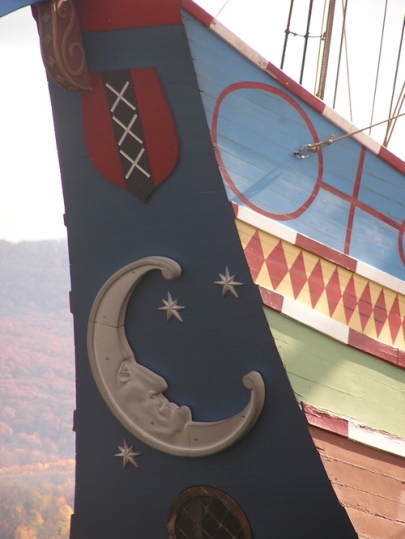
Stern of Half Moon, Henry Hudson's ship; from Tugster: A Waterblog

Notice how the figurehead frightens even the trees to blazing red.

A Waterblog

Bowsprite of Henry Hudson's Half Moon, via Tugster: A Waterblog

Tugster tells us that Henry Hudson himself is blogging, channeling across 400 years — perhaps tired of duckpins with his crew in the Adirondacks (hello, Rip van Winkel!).  Can your students correspond with Henry Hudson?

Resources:


Geography lesson: New York City

November 19, 2008

Bookmark this site, geography teachers:  Farm School is going to New York City for the “American Thanksgiving” holiday.  Check out the long list of rich resources.

Any student or teacher doing a project on modern New York City should send a note of Thanksgiving to Farm School, eh?