As the astrophysicist Neil deGrasse Tyson put it on the Hayden Planetarium website, “Manhattanhenge may just be a unique urban phenomenon in the world, if not the universe.”
Surely there is a phenomenon almost as cool, somewhere in the American Midwest or Mountain West, perhaps, where the good Presbyterian, Lutheran and Mormon pioneers laid out their cities and entire states with clean Cartesian grids . . . anyone got information to correct Dr. Tyson?
Maybe the question to ask, perhaps from Tyson, is how to calculate when an east-west street in your town might get a “henge” moment.
Sunrise at Delicate Arch, Arches National Park, by Alex Savage
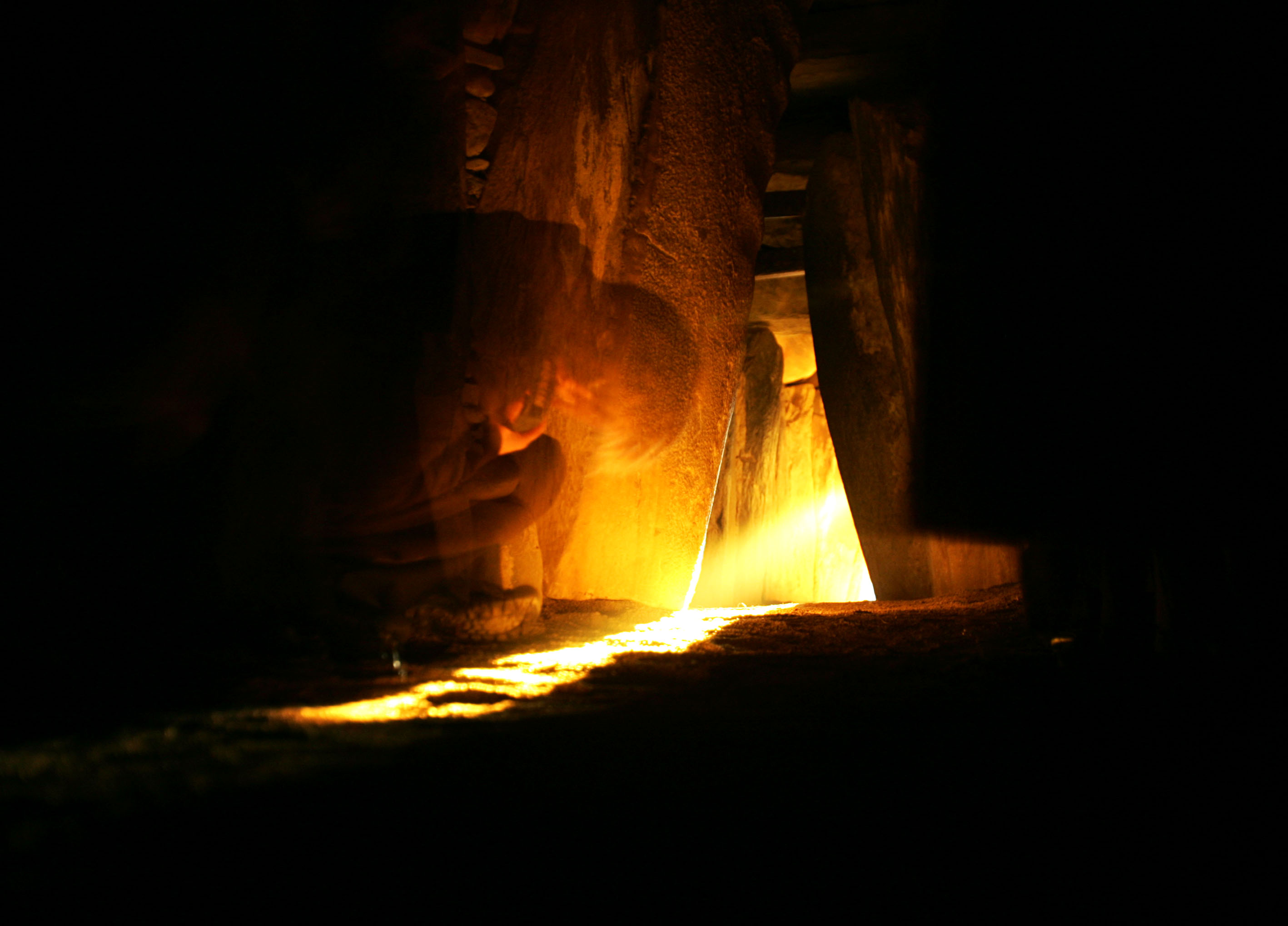
December 20, 2009, solstice sunrise at Newgrange, Ireland – Photograph by Cyril Byrne – courtesy of The Irish Times (Astronomy Picture of the Day, NASA)
From the Deseret News: “Ben Lomond Peak towers above Ogden (Utah). The mountain is believed to have inspired the Paramount movie logo, below, in use since 1914. (Ravell Call, Deseret News)
It’s none of the above because one of Hollywood’s most familiar images — the famous Paramount Pictures logo — was inspired by Weber County’s Ben Lomond Peak.
As such, Ben Lomond — not even the highest summit in Weber County — may be the most famous mountain in the Beehive State.
The peak is given credit for prompting creation of the majestic but fictional mountain in the popular Paramount design, based on two histories of the motion-picture company.
According to Leslie Halliwell’s “Mountain of Dreams,” a biography of Paramount, founder William Hodkinson grew up in Ogden and the logo was “a memory of childhood in his home state of Utah.”
Compare it to the Paramount Pictures logo now:
Paramount Pictures logo
Teachers may want to hustle over to the Deseret News site to capture the story for classroom use — the online version includes a short set of slides of a hike to the top of the peak (it’s a climb most reasonably healthy people can make in a day – “reasonably healthy” to include acclimated to the altitude).
What other geographic features have become commercial logos? How do images of geography affect our culture?
For my money, I still like Timpanogos better, even if the Osmonds did use it.
This image of Mt. Ben Lomond looks more like the Paramount logo, some might say.
For classroom purposes, I wish it didn’t include the names of each location as they go, but surely you can figure out some use for this in geography studies.
Matt hisse’f says:
The cities that didn’t make it into the final cut will be in the outtakes video that we’re putting up soon!
Why does time-lapse photography fascinate me so? It reveals changes over time we too often miss, or don’t stop to appreciate.
Here’s an excerpt from a 1975 film, set to music recently released. Watch closely, you’ll see the shadows of the World Trade Center passing over New York City.
Described at Youtube:
A music video for the gorgeous track “Exercise #3 (Building) by CFCF (Mike Silver). Song is from his upcoming EP titled “Exercises,” which arrives on April 24th via Paper Bag Records.
Footage is from the 1975 short film “Organism,” by Hilary Harris.
Short Wikipedia listing for Hilary Harris; geography and AP human geography teachers may especially appreciate some of Harris’s work, including Highway from 1958, and the 1962 Academy Award Winner Seaward the Great Ships
Perhaps one of the bigest and most listened to advocates of using infographics and data vis in the classroom is Diana Laufinberg, from The Science Leadership Academy. Diana, a History teacher, is a long time user of geographic information systems (GIS). She has recently, however, started helping her students to create their own infographics from complex issues that are part of her course of study and/or part of current events.
I do love the tops of mountains, and I wish I could climb them. Fortunately, there are cameras, people who know how to use them, and people who know how to edit film to tell a story, and put us all in awe.
Plus, living among us are people brave enough and skilled enough to get to the tops of those mountains, people who make the filming possible and worthwhile.
In summer 2010, Lorna Illingworth, Madaleine Sorkin and I spent 25 days in the Cirque of the Unclimbables, Northwest Territories, Canada. Our goal was to free climb the entire 1963 Original Route on the sheer 2000′ Southeast Face of Proboscis, and grants from the American Alpine Club encouraged us to document the adventure. The result: Women at Work (VI 5.12 R).
Geography: Off the Nahanni River, now in the expanded Nahanni National Park, in the Northwest Territories near the border with the Yukon Territory — see maps below.
I continue to like time-lapse photo compilations, and I continue to wonder about how to use them to expand geography teaching. It’s a great circle route, over the Arctic nearing the North Pole. This movie comes from Nate Bolt, who posts his work at Beepshow.
Obviously I’m not the only one who likes it — between the YouTube and Vimeo sites, the movie has more than 4 million viewers.
I shot a photo roughly every two miles between take-off in San Francisco and landing in Paris CDG to make this airplane time lapse. For some reason the Vimeo version of this is more linked to: http://vimeo.com/21822029
Shot with a 5d2, a time-lapse controller, and a 16mm – 35mm, mixed with some iPhone shots. The flight path from SF to Paris goes well over greenland and the arctic circle, where you can see “northern” lights from all sides of the plane, which explains why I could shoot them facing South.
Big thanks to the folks at http://uxlondon.com for inviting me to europe to speak – if it wasn’t for them I wouldn’t have made the trip. The music is a modified template of “Gain” used with permission from DETUNE ltd. denkitribe http://soundcloud.com/denkitribe/gain – I created this arrangement on the Korg iMS20 iPad App, and it’s my first custom score. Edits and pans in After Effects CS5 and iMovie.
The photos during take-off and landing are all computer models and totally rendered because I would never use an electronic device during times when the FAA prohibits them. I did get lucky and have a whole row to myself to setup the tripod and gear.
Thanks to my neighbors for not minding an SLR click every 2 to 30 seconds for 11 hours, and thanks to the whole Air France flight crew for being insanely friendly and allowing me to shoot. Thanks to @ztaylor for showing me the Korg iMS20 iPad App. Thanks to @jayzombie and the #nerdbird on the way to SXSW this year for helping me come up with the idea. Thanks to @somnabulent for the idea of live scoring. Thanks to you for actually reading this far. You are a champion.
Every time I pick up an issue of Boys’ LifeI think how much better students could perform if they just looked that this magazine once a month; you don’t have to be a Scout to subscribe, but why not live the adventures, too?
Will 30-second montages sell more magazines? What more could/should Boys’ Life do on the web?
Here’s an example of the sorts of skills I wish my students had, again from the Boys’ Life YouTube offerings. In “Cache Me If You Can,” these are young Scouts, I’m guessing ages 11 to about 13 from a Troop 6 somewhere in Colorado, out navigating a path through the woods using GPS and hand-held ham radios. I fear most of my 16-18-year-old students would be challenged to do the stuff these younger kids are doing, if they could do it at all.
Of course, while those skills would make them better students more able to understand and use maps and charts, very little of those skills are listed in the Texas Essential Knowledge and Skills. I’m given neither time nor resources to teach them.
More, resources:
A feature at the Boys’ Life site I really like is the “Wayback Machine,” which allows viewing of many issues of the magazine dating back to 1911 — actualy from March 1911 through December 2009. Alas, the features uses Google Books, so viewing at the site is about all you can do — no copying of the great covers by Boy Scouts of America art director Norman Rockwell, no copying of articles with teachable skills for use as illustrations in lessons. This would be a good research site for high school history projects — Scouts in time of war, Scouting and education, map use, youth in exploration, etc.
Spread the word; friends don't allow friends to repeat history.
Rick Perry shooting at the coyote in the sky - Mad Mike's America
Sidney Crosby, Toronto Maple Leafs - Business Insider
_____________
I have it on good authority that Rick Perry will not be taking the Texas Assessment of Knowledge and Skills (TAKS) Exit Level test for juniors this spring. He’s probably not ready for it, according to this report in the New York Times. It may be that no Republican in Iowa is ready for it, either.
Energy: The audiences at Mr. Perry’s events seemed somewhat unmoved by parts of his speech that talked about job creation. But when it came to energy and oil, they perked up.
“Every barrel of oil that comes out of those sands in Canada is a barrel of oil that we don’t have to buy from a foreign source,” Mr. Perry said in Clarinda, earning a loud round of enthusiastic applause.
Later, the audience reacted again to Mr. Perry’s assertion that buying so much energy from foreign countries is “not good policy, it’s not good politics and frankly it’s un-American.”
Seven minutes on the Red River of the southern U.S., the fickle border of Texas and Oklahoma, the river of story and legend. Good for a map study, good for the fun of it — how much do you really know about the Red River?
George Washington did not cross the Red River; George Washington may not have known the river even existed. His loss.
Spread the word; friends don't allow friends to repeat history.
This Anderson cartoon from the Houston Chronicle in 2009 gets the facts right, but sadly, is still accurate
Remember the pathetic, disgusting attempt to derail the climate talks in Durban, just a few days ago? The “climate skeptics”™ dumped a bunch more private e-mails from the scientists who work on climate. (Stolen e-mails, here; be prepared to be bored, with no smoking guns, no cold guns, no guns at all.)
Unless one thinks the self-proclaimed skeptics are James Bond nemesis enough to actually hope for the end of the world (as opposed to just being monumentally, stupidly misled), their train still can’t get back on the tracks. Revealing that someone among them has stolen more e-mails than previously known, didn’t help. Here is a list of just how bad the derailment has been for the denialists:
No great world-changing agreement, but theclimate talks in Durban, South Africa, produced a consensus that a massive treaty is not coming soon, and that action to save the planet can’t wait for guys in suits who defer by people like Ralph Hall to do the right thing. Generally, the comity at Durban is bad for the denialists — Christopher Monckton went into full panic mode, suggesting the language of the agreement available isn’t the whole story and something else — something sinister — is really going on. (One wonders how Monckton can stand to turn out the lights at night.) They can’t tell the difference between their burro and a burrow, and with Ralph Hall leading them they’re likely to find the edge of the cliff and leave it before they realize just how far up they are and how far they have to fall. (Skeptic/denialist Judith Curry carried a rundown of headlines from Durban, with links — remember her bias.)
Skeptics actually completed a research project and prepared it for publication. A group at Berkeley, with funding from conservative warming denialists like the Koch brothers, and featuring the work and cooperation of leading anti-science people like Anthony Watts, took on the challenge of looking at temperatures reported from weather stations, especially in the U.S., and especially those Anthony Watts had targeted as providing unduly warm and inaccurate readings that skewed all of the science of global warming. The not-loudly-mentioned target, of course, was the “hockey stick” graph. Alas for the skeptics, the Berkeley Earth Surface Temperature (BEST) study produced results that verify the accuracy of measurements that show warming, and which suggest the IPCC-published hockey stick is accurate enough that it deserves credence. Anthony Watts promptly disavowed all his own work on the project.
One question we need to be asking is why the incidents around the stolen e-mails are known as “Climategate” in the circles of warming denialists. The thieves in this case came from the ranks of the so-called skeptics, and the release of the e-mails was done on the blogs of those who deny warming, or human causation, or human ability to mitigate at all. (Fox News got it bass ackwards, of course — wondering whether the government is somehow complicit in hiding information, while all the information is public and almost all of the private communication is public. At Fox, they don’t even get Homer Simpson doh! moments of understanding — that’s how bad it is in Denialville.)
So far no one’s listening to the bear on this one — follow the money, and bring the criminals to justice.
It’s really SkepticGate, with a more-than two-year coverup and continuing, and the recent release is SkepticGate II.
Denialists, and even those who question global warming on legitimate grounds, must be frustrated. Nothing they do stops the world from warming. As the massive wave of evidence demonstrating the Earth warms and humans share the blame turns to a tsunami, even policy makers (Ralph Hall excepted) look for solutions to warming problems. It’s so bad for the skeptics that even the old trick of stealing e-mails from the scientists, the trick that helped fog up the Copenhagen proceedings, did almost nothing to the Durban talks. While no treaty came out, none was expected — but the sudden action in the last couple of days of the conference to get action despite the continued interference by climate skeptics and their political allies, must have caught them off guard.
Peter Sinclair comes through with a good explanation of the history of concern about global warming — how the warming trend was discovered.
It wasn’t scientists trying to get government grants. It was the U.S. Air Force, trying to beat the commies and keep America safe for democracy and, ironically, safe for dissent from such applications of science.
9,996
Real history couldn’t be published as fiction, which is one way we can tell real history from the stuff that gets made up. In the story told in this video, note carefully the serendipity of figuring out the CO2 issues: Who could invent a story about warfare leading to the discovery of global warming? As with the coincidence of John Adams and Thomas Jefferson both dying on the 50th anniversary of the Declaration of Independence, no editor of fiction would accept it as believable.
This will strike a note of joy in the heart of every Boy Scout and every orienteer in the world: The U.S. and Japan have teamed up for new, super-accurate topographic maps.
NASA, Japan Release Improved Topographic Map Of Earth
WASHINGTON — NASA and Japan released a significantly improved version of the most complete digital topographic map of Earth on Monday, produced with detailed measurements from NASA’s Terra spacecraft.
The map, known as a global digital elevation model, was created from images collected by the Japanese Advanced Spaceborne Thermal Emission and Reflection Radiometer, or ASTER, instrument aboard Terra. So-called stereo-pair images are produced by merging two slightly offset two-dimensional images to create the three-dimensional effect of depth. The first version of the map was released by NASA and Japan’s Ministry of Economy, Trade and Industry (METI) in June 2009.
“The ASTER global digital elevation model was already the most complete, consistent global topographic map in the world,” said Woody Turner, ASTER program scientist at NASA Headquarters in Washington. “With these enhancements, its resolution is in many respects comparable to the U.S. data from NASA’s Shuttle Radar Topography Mission (SRTM), while covering more of the globe.”
The improved version of the map adds 260,000 additional stereo-pair images to improve coverage. It features improved spatial resolution, increased horizontal and vertical accuracy, more realistic coverage over water bodies and the ability to identify lakes as small as 0.6 miles (1 kilometer) in diameter. The map is available online to users everywhere at no cost.
“This updated version of the ASTER global digital elevation model provides civilian users with the highest-resolution global topography data available,” said Mike Abrams, ASTER science team leader at NASA’s Jet Propulsion Laboratory in Pasadena, Calif. “These data can be used for a broad range of applications, from planning highways and protecting lands with cultural or environmental significance, to searching for natural resources.”
The ASTER data cover 99 percent of Earth’s landmass and span from 83 degrees north latitude to 83 degrees south. Each elevation measurement point in the data is 98 feet (30 meters) apart.
NASA and METI are jointly contributing the data for the ASTER topographic map to the Group on Earth Observations, an international partnership headquartered at the World Meteorological Organization in Geneva, Switzerland, for use in its Global Earth Observation System of Systems. This “system of systems” is a collaborative, international effort to share and integrate Earth observation data from many different instruments and systems to help monitor and forecast global environmental changes.
ASTER is one of five instruments launched on Terra in 1999. ASTER acquires images from visible to thermal infrared wavelengths, with spatial resolutions ranging from about 50 to 300 feet (15 to 90 meters). A joint science team from the United States and Japan validates and calibrates the instrument and data products. The U.S. science team is located at JPL.
NASA, METI, Japan’s Earth Remote Sensing Data Analysis Center (ERSDAC), and the U.S. Geological Survey validated the data, with support from the U.S. National Geospatial-Intelligence Agency and other collaborators. The data are distributed by NASA’s Land Processes Distributed Active Archive Center at the U.S. Geological Survey’s Earth Resources Observation and Science Center in Sioux Falls, S.D., and by ERSDAC in Tokyo.
Users of the new version of the ASTER data products are advised that while improved, the data still contain anomalies and artifacts that will affect its usefulness for certain applications.
Data users can download the ASTER global digital elevation model at:
New topographical map of Earth released October 17, 2011, from the Ministry of Economy, Trade, and Industry (METI) of Japan and the United States National Aeronautics and Space Administration (NASA)
Save
Spread the word; friends don't allow friends to repeat history.
Kathryn sent me the link and said I had to watch it. One learns to listen to one’s Trophy Wife™ if one has any sense.
Louie Schwartzberg’s TEDS appearances are greater than one (“(Louie at TEDS)>1”). When you watch his films, you can understand why he’s popular among the secular wooists, and even among the thinkers and scientists. One might rationally wonder why he’s not invited to speak at a lot of church services, but that would be a rational response. Schwartzberg’s earlier appearance at the Bathtub covered his TEDS presentation on his film, “Pollination.”
This one is more ephemeral, but a lot more human. I hope to see his work in theaters, soon.
What does this film make you feel, and what does it make you think?
How many of the locations on that film did you identify?
Spread the word; friends don't allow friends to repeat history.
Seven-plus minutes of good reason to get your tail to Glacier National Park as soon as you can.
Produced and shot by Joshua Thompson, this is part of an award-winning film made to promote the park and get money for the research that the park hosts.
Grizzly Bears, Bighorn Sheep, spectacular sunsets and more…..
Part 3 of the recently shot Glacier DVD. This 20 min. film recently was nominated for best new nature documentary in the music category as well received an award for photography from the Wildlife Film Festival held in May of 2008. All funds for this project are being donated to the Glacier National Park Fund. For more info: http://www.glaciernationalparkfund.org/cart.php?page=glacier_national_park_fu…
I’ve been there only once. A wise American would get there before turning 35, and return several times.
Spread the word; friends don't allow friends to repeat history.
Or, until that account is unsuspended by the forces supporting Donald Trump: Follow @FillmoreWhite, the account of the Millard Fillmore White House Library
We've been soaking in the Bathtub for several months, long enough that some of the links we've used have gone to the Great Internet in the Sky.
If you find a dead link, please leave a comment to that post, and tell us what link has expired.
Thanks!
Retired teacher of law, economics, history, AP government, psychology and science. Former speechwriter, press guy and legislative aide in U.S. Senate. Former Department of Education. Former airline real estate, telecom towers, Big 6 (that old!) consultant. Lab and field research in air pollution control.
My blog, Millard Fillmore's Bathtub, is a continuing experiment to test how to use blogs to improve and speed up learning processes for students, perhaps by making some of the courses actually interesting. It is a blog for teachers, to see if we can use blogs. It is for people interested in social studies and social studies education, to see if we can learn to get it right. It's a blog for science fans, to promote good science and good science policy. It's a blog for people interested in good government and how to achieve it.
BS in Mass Communication, University of Utah
Graduate study in Rhetoric and Speech Communication, University of Arizona
JD from the National Law Center, George Washington University




 Posted by Ed Darrell







 Millard Fillmore's Bathtub