Millard Fillmore and March 8: Hurrah! and R.I.P.

March 8, 2009

Commodore Matthew C. Perrys squadron in Japan, 1854 - CSSVirginia.org image

The Black Ships — Commodore Matthew C. Perry’s squadron in Japan, 1854 – CSSVirginia.org image from Gleason’s Pictorial Drawing Room Companion, Boston, May 15, 1852 (also, see BaxleyStamps.com); obviously the drawing was published prior to the expedition’s sailing.

On March 8, 1854, Commodore Matthew C. Perry landed for the second time in Japan, having been sent on a mission a year earlier by President Millard Fillmore.  On this trip, within 30 days he concluded a treaty with Japan which opened Japan to trade with the U.S. (the Convention of Kanagawa), and which began a cascade of events that opened Japan to trade with the world.

Commodore Matthew C. Perry in 1852 photograph, Library of Congress via WikiMedia

Commodore Matthew C. Perry in 1852 photograph, Library of Congress via WikiMedia

Within 50 years Japan would come to dominate the seas of the the Western Pacific, and would become a major world power.

1854 japanese woodblock print of U.S. Navy Commodore Matthew C. Perry. Peabody Museum: The characters located across the top read from right to left, A North American Figure and Portrait of Perry. According to the Peabody Essex Museum, this print may be one of the first depictions of westerners in Japanese art, and exaggerates Perrys western features (oblong face, down-turned eyes, bushy brown eyebrows, and large nose).  But compare with photo above, right.  Peabody Museum holding, image from Library of Congress via WikiMedia

1854 japanese woodblock print of U.S. Navy Commodore Matthew C. Perry. Peabody Museum: “The characters located across the top read from right to left, ‘A North American Figure’ and ‘Portrait of Perry.’ According to the Peabody Essex Museum, ‘this print may be one of the first depictions of westerners in Japanese art, and exaggerates Perry’s western features (oblong face, down-turned eyes, bushy brown eyebrows, and large nose).'” But compare with photo above, right. Peabody Museum holding, image from Library of Congress via WikiMedia

Then, 20 years later, on March 8, 1874, Millard Fillmore died in Buffalo, New York.

The Perry expedition to Japan was the most famous, and perhaps the greatest recognized achievement of Fillmore’s presidency.  Fillmore had started the U.S. on a course of imperialistic exploitation and exploration of the world, with other expeditions of much less success to Africa and South America, according to the story of his death in The New York Times:

The general policy of his Administration was wise and liberal, and he left the country at peace with all the world and enjoying a high degree of prosperity. His Administration was distinguished by the Lopez fillibustering expeditions to Cuba, which were discountenanced by the Government, and by several important expeditions to distant lands. The expedition to Japan under Commodore Perry resulted in a favorable treaty with that country, but that dispatched under Lieut. Lynch, in search of gold in the interior of Africa, failed of its object. Exploring expeditions were also sent to the Chinese seas, and to the Valley of the Amazon.

Here we are in 2013, 160 years after the end of Millard Fillmore’s presidency, 159 years after Commodore Perry’s success on the mission to Japan Fillmore sent him on, 139 years after Millard Fillmore’s death, and not yet have we come to grips with Fillmore’s real legacy in U.S. history. Most of that legacy, we don’t even acknowledge in public. Santayana’s Ghost paces nervously.


Bobby Jindal: Dumb about rocks

February 27, 2009

I couldn’t believe it either.

Remember all the flap about a flurry of earthquakes in the Yellowstone Caldera over the Christmas holidays?  Volcano monitoring is critical to safety in California, Oregon, Washington, Montana, Idaho, Wyoming and Alaska — not to mention Hawaii’s special circumstances — and to all neighboring states or those within downwind striking distance of a volcanic event.

A volcanic field now in southern Idaho erupted a few millions of years ago, spreading ash that killed creatures as far away as Nebraska.  “Neighboring state” covers a lot of territory.

So, Bobby Jindal, in his response to the Obama budget proposal speech, said the U.S. should get out of the volcano monitoring business.  It was not clear whether there were no rocks in his head, but neither was there knowledge about rocks where it should be in his head.

Green Gabbro, a real geologist, couldn’t believe it either.

  1. DID HE SERIOUSLY JUST SAY THE GOVERNMENT SHOULD NOT BE MONITORING VOLCANOES??!?!!!????@#$@!

Ignoring for the sake of argument the value of the basic science that always results from the data collected during routine monitoring – ignoring the general function of increased spending as an economic stimulus to the nation’s earth scientists, instrument manufacturers, etc., – even ignoring all that, volcano monitoring is still a very sensible investment in national security. A $1.5 million investment in monitoring at Pinatubo (near a U.S. air force base) earned a greater than 300-fold return when the volcano erupted explosively in 1991: hundreds of millions of dollars worth of property (mostly airplanes) was saved, as were thousands of lives. That 30,000% figure comes before you attempt to put a value on human life.

But then, Sarah Palin is in one of those areas where a failure to monitor volcanoes might lead to huge disaster.  It’s an unusual way to knock out a political rival, and not certain, but were Sarah Palin to disappear into a volcanic cloud, Bobby Jindal’s path to the Republican nomination for president might be less cluttered.  He’s a Rhodes Scholar — surely he can’t be that stupid about volcanoes, so the evil alternative, that he hopes to get rid of Palin, is the only thing that makes sense, isn’t it?

Is there no one in the Republican Party who will stand up for science and reason?

Resources:


Mapping Africa

February 25, 2009

Here’s a great tool for geography study of Africa.

AfricaMap is based on the Harvard University Geospatial Infrastructure (HUG) platform, and was developed by the Center for Geographic Analysis to make spatial data on Africa easier for researchers to discover and explore.

Harvards Africa Map, sample image, via Google Maps Mania

Harvard's Africa Map, sample image, via Google Maps Mania

It’s an interactive tool.  You can capture images (another add-on might be necessary) — but look at all the different layers you can use, live, on your computer.

Good source for student projects, no?

Tip of the old scrub brush to Google Maps Mania.


Yellowstone earthquake swarm finished?

January 5, 2009

No Few significant quakes recorded at all for January 4, nor so far for January 5 (6:30 a.m. Central) maybe the quakes took a day off in honor of Utah Statehood Day.

Update, January 6, 6:00 a.m. Central: The map now shows 11 quakes magnitude 1 or greater on January 3, 5 on January 4, and one on January 5.  This is significantly less action than the quakes every ten minutes or so when the swarm was at its peak.

Is the swarm done? This is the longest period of no-quake activity in Yellowstone since at least December 27, 2008.

Here’s the USGS data for 11:30 p.m. (Central), January 4:

Update time = Mon Jan 5 5:27:27 UTC 2009

Here are the earthquakes in the Map Centered at 44°N, 110°W area, most recent at the top.
(Some early events may be obscured by later ones.)
Click on the underlined portion of an earthquake record in the list below for more information.

MAG UTC DATE-TIME
y/m/d h:m:s
LAT
deg
LON
deg
DEPTH
km
LOCATION
MAP 2.6 2009/01/03 00:23:22 44.669 -110.163 1.0 43 km ( 26 mi) SSW of Cooke City-Silver Gate, MT
MAP 2.7 2009/01/02 20:33:53 44.553 -110.338 0.9 61 km ( 38 mi) SSW of Cooke City-Silver Gate, MT
MAP 2.2 2009/01/02 20:24:50 44.509 -110.371 0.0 61 km ( 38 mi) ESE of West Yellowstone, MT
MAP 2.7 2009/01/02 20:23:57 44.556 -110.357 1.3 60 km ( 38 mi) SSE of Gardiner, MT

So there was only one quake on January 3, and none on January 4.

Swarms are “not uncommon,” but caldera supereruptions are extremely rare.

Time Magazine tracked down the head of the Yellowstone Volcano Observatory (YVO), Jake Lowenstern:

Jake Lowenstern, Ph.D., YVO’s chief scientist, who also is part of the USGS Volcano Hazards Team, told TIME that a supervolcano event does not appear to be imminent. “We don’t think the amount of magma exists that would create one of these large eruptions of the past,” he said. “It is still possible to have a volcanic eruption comparable to other volcanoes. But we would expect to see more and larger quakes, deformation and precursory explosions out of the lake. We don’t believe that anything strange is happening right now.” Last summer YVO installed new instrumentation in boreholes 500 to 600 ft. deep to better detect ground deformation.  Says Lowenstern: “We have a lot more ability to look at all the data now.” (See an interactive graphic depicting how scientists monitor volcanoes.)

Plan your vacation to Yellowstone now. Transportation will be cheaper (you can fly to Jackson Hole), and if there is any effect of the earthquake swarm, it would be to reduce tourist reservations at local hotels.

Now is the time to book your visit.


Waiting for the New President: Doctoring data on global warming

December 16, 2008

ArborDay.org map showing changes in hardiness zones between 1990 and 2006

ArborDay.org map showing changes in hardiness zones between 1990 and 2006, a map climate change denialists wish did not exist.

We need a new category of urban myth or urban legend.  Jan Brunvand’s inventions and development of the study of folk stories that people claim to be true long enough that they become legends, needs to be updated to include internet stupidity that just won’t die.  Especially, we need a good, two-word label for politically-motivated propaganda that should go away, but won’t.

Perhaps I digress.

One might be filled with hope at the prospect of the administration of President Obama. Science issues that have been ignored for too long may once again rise to due consideration.  Friends in health care worry that it will take four or eight terms of diligent work to undo the damage done to medical science by neglect of spending and budgeting during the last eight years.

I take a little hope in this:  Maybe we can get an update of the planting zones maps relied on by farmers, horticulturists, and backyard gardeners.

New maps were delayed through the Bush administration.  The last serious update, officially, was 1990.  Perhaps much has changed in climate in the last generation, and perhaps that is why the new maps were delayed, though they had been painstakingly prepared by the American Horticulture Society.

Why?

Plants cannot be fooled by newspaper reports.  Plants are not partisan in political issues. Plants both respond to and clearly demonstrate climate change.  To those who wished to suppress or deny climate change, suppressing the hardiness zone maps may have seemed like a good way to win a political debate.

Robust discussion based on the facts, a casualty of the past eight years, ready to be resurrected.

Resources:


Hudson’s Half Moon

November 25, 2008

New Yorkers, Vermonters and Candadians continue to celebrate 400 years since Hudson and Champlain, and 200 years since Robert Fulton brought steam power to the Hudson’s commercial ways.

Tugster: A Waterblog features some nice shots, and a couple of stunning shots, of the reconstruction of Henry Hudson’s ship, Half Moon.  Great stuff for presentations, and he likes to share.

Tugster is an outstanding repository of images of tugboats, ships and other things related to the commerce of Greater New York Harbor, and boats on the water generally.  Tugster’s collection of images should be regular source material for teachers of history, economics, geography and government.

A Waterblog

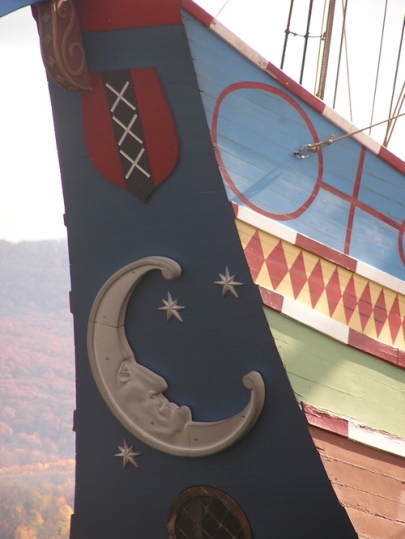
Stern of Half Moon, Henry Hudson's ship; from Tugster: A Waterblog

Notice how the figurehead frightens even the trees to blazing red.

A Waterblog

Bowsprite of Henry Hudson's Half Moon, via Tugster: A Waterblog

Tugster tells us that Henry Hudson himself is blogging, channeling across 400 years — perhaps tired of duckpins with his crew in the Adirondacks (hello, Rip van Winkel!).  Can your students correspond with Henry Hudson?

Resources:


Geography lesson: New York City

November 19, 2008

Bookmark this site, geography teachers:  Farm School is going to New York City for the “American Thanksgiving” holiday.  Check out the long list of rich resources.

Any student or teacher doing a project on modern New York City should send a note of Thanksgiving to Farm School, eh?


Cultural geography mystery – What city is this?

November 12, 2008

I know the city, and I think there are barely enough clues here to figure this one out.  Let me say it is not Los Angeles, though the clues may have led one to figure that out.  I wonder if you can figure this out, or if maybe there are several places that fill this particular bill.

A friend notes in a recent e-mail:

Nothing quite like going into the nearest Vons (right across from the street from campus), hearing French spoken by two guys exiting the store, standing behind two German speakers, East German accent in line to be checked out by a clerk whose first language is Chinese, and hearing two guys rattling away in Russian in the next checkout line.  Oh–and this is after having lunch at the Vietnamese Pho/Banh joint in the same strip mall.
Do you know the city?  Or, do you know another city that fits this bill?
Tell us in comments.
________________
Answer is now in comments.

Atomic history, nuclear future

October 19, 2008

We’re going to see more nuclear power plants in the U.S., it’s a safe bet.  Both presidential candidates support developing alternatives to oil and coal.  Nuclear power is one of the alternatives.

John McCain kept repeating his comfort words, that ‘storage of wastes is not a problem.’ There is not a lot of evidence to support his claims.  With turmoil in financial markets, however, the nuclear power issue has gotten very little serious attention or scrutiny.  From the push to get compensation for radiation victims of atomic weapons and development in the U.S., I learned that the issue is not really whether wastes and other materials can be safely used and wastes stored. The issues are entirely issues of will.

Advantage to Obama, I think.  He’s not claiming that the storage problems are all solved.  A clear recognition of reality is good to have in a president.

Son Kenny sent a link to a history site, Damn Interesting, and it tells the story of the Techa River in the old Soviet Union — a place condemned for generations by the nuclear excesses of the past.

To make the story briefer, in their rush to produce nuclear weapons, the Soviets did nothing to protect Russia from radioactive waste products until it was much too late.  Efforts to reduce radioactive emissions, by storing them in huge underwater containers, resulted in massive explosions that released more radiation than Chernobyl (What?  You hadn’t heard of that, either?).

It’s a reminder that safety and security with peaceful uses of nuclear power depend on humans doing their part, and thinking through the problems before they arise.

Can we deal with radioactive wastes?  We probably have the technology.  Do we have the will? Ask yourself:  How many years has the U.S. studied Yuccan Mountain to make a case to convince Nevadans to handle the waste?  How many more decades will it take?

How is our history of dealing with nuclear contamination issues?  Not good.

Last spring SMU’s history department sponsored a colloquium on a power generation in the southwest, specifically with regard to coal and uranium mining on the Navajo Reservation.   We’ve been there before.

One of the photos used in one of the lectures, by Colleen O’Neill of Utah State, showed two Navajo miners outside a uranium mine during a previous uranium boom.  Neither one had a lick of protective equipment.  Underground uranium mining exposes miners to heave concentrations of radon gas, and if a miner is unprotected by breathing filters at least, there is a nearly 100% chance the miner will get fatal lung cancers.

Of the 150 Navajo uranium miners who worked at the uranium mine in Shiprock, New Mexico until 1970, 133 died of lung cancer or various forms of fibrosis by 1980 ([Ali, 2003] ).

Our Senate hearings on radiation compensation, in the 1970s, produced dozens of pages of testimony that Atomic Energy Commission officials understood the dangers, but did nothing to protect Navajo miners (or other miners, either).  It is unlikely that anyone depicted in those photos is alive today.

AP Photo  (borrowed from ehponline.org)

"Mine memory - Navajo miners work the Kerr-McGee uranium mine, 7 May 1953. Today, uranium from unremediated abandoned mines contaminates nearby water supplies. image: AP Photo" (borrowed from ehponline.org) This photo is very close to the one used by Prof. O'Neill. It may have been taken at nearly the same time. If you know of any survivors from this photo, please advise.

At a refining facility on the Navajo Reservation, highly radioactive wastewater was stored behind an inadequate earthen dam.  The dam broke, and the wastes flowed through a town and into local rivers.  Contamination was extensive.

Attempts to collect for the injuries to Navajo miners and their families were thrown out of court in 1980, on the grounds that the injuries were covered under workers compensation rules (where injury compensation was also denied, generally).

Navajos organized to protest the power plant. One wonders whether they can win it.

Sen. McCain seems cock sure that radioactive wastes won’t kill thousands of Americans in the future as they have in the past.  The uranium mining and uranium tailings issues occurred in Arizona, the state McCain represents.  Does he know?

We regard ourselves in the U.S. as generally morally superior to “those godless communists.”  Can we demonstrate moral superiority with regard to development of peacetime nuclear power, taking rational steps to protect citizens and others, and rationally, quickly and fairly compensating anyone who is injured?

That hasn’t happened yet.

When [uranium] mining [on the Navajo Reservation] ceased in the late 1970’s, mining companies walked away from the mines without sealing the tunnel openings, filling the gaping pits, sometimes hundreds of feet deep, or removing the piles of radioactive uranium ore and mine waste. Over 1,000 of these unsealed tunnels, unsealed pits and radioactive waste piles still remain on the Navajo reservation today, with Navajo families living within a hundred feet of the mine sites. The Navajo graze their livestock here, and have used radioactive mine tailings to build their homes. Navajo children play in the mines, and uranium mine tailings have turned up in school playgrounds (103rd Congress, 1994 ).

Think of the story of Techa River as a warning.

Resources:


“See ya Red States,” and a paean to Texas

October 16, 2008

You’ve seen it before — the letter saying toodle-oo to the red states, as the blue states muster the courage to let them go.  Somebody passed it along, I forwarded it to a few people I thought hadn’t seen it.

A discussion broke out.  Part of the discussion centered on Texas’s second secession from the U.S., and how nasty things can be in Texas (“It’s not the heat and humidity; it’s the hate and stupidity”).

A couple of exchanges in, I started to wince.  God knows Texas has its problems.  I haven’t even started in on the latest three months of lunacy at the State Board of Education where Creationist-in-Chief Don McLeroy is loosening his belt to drop his pants (figuratively, of course) and moon every kid in Texas before he eviscerates science education.

But — you know? — Texas has a couple of things going for it, reasons to smile while you’re stuck here.

Below the fold, the “So long, Red States” letter — but before that, a modest defense of Texas, as I wrote back:

I do regret that [y’all have] had such a difficult and unhappy time in Texas.  Texas is far from my ideal place, especially for the weather and lack of mountains (I appear to be losing the retirement fight – I wanted Jackson Hole, Kathryn wants Kanab.  Red rock wins with the family.)

And Yellowstone is a part of my soul, especially after we (probably illegally) scattered my brother’s ashes there in the last great family reunion before this past summer.

But, you know, Texas has some fine points that shouldn’t get overlooked. Especially, it doesn’t deserve to get every redneck.

Here are some of the great things about Texas:

It’s been a rather miserable 21 years in Texas for us, for a lot of reasons.  There are good things and good people in Texas.  It ain’t all gloomy.

Wildflowers not only do blossom where they grow:  They must blossom there.

Which reminds me, there are a dozen other wildflowers better than bluebonnets, and we haven’t even started on the magnificent grasses like big bluestem, little bluestem and side-oats grama.

(More humor below the fold.)

Read the rest of this entry »


Finding our place in the world

October 2, 2008

The exhibit is gone, but the memory, and the on-line educational features still remain.

Spectacular digital map of Africa, showing current development.  Map copyright by Allan Sluis, courtesy of NAVTEQ and ESRI

Spectacular digital map of Africa, showing current development. Map copyright by Allan Sluis, courtesy of NAVTEQ and ESRI

Geography teachers should explore the on-line version of the Field Museum’s exhibit, “Maps:  Finding Our Place in the World.

This exhibit is by itself an argument for live internet links for students.  Take a few minutes to peruse some fo the interactive features, like the world map that leads to photos of the major exhibit pieces.

We need more material like this, freely available in classrooms.

Also, see especially:


Railroad maps!

September 30, 2008

Atchison, Topeka & Santa Fe Railroad, 1899 - from the Library of Congress

Atchison, Topeka & Santa Fe Railroad, 1899 - from the Library of Congress

American Memory at the Library of Congress features dozens of historic railroad maps of U.S. railroads.

This is a great collection for U.S. history presentations on development of the railroads, or on settlement of the west, in particular.

The Railroad maps represent an important historical record, illustrating the growth of travel and settlement as well as the development of industry and agriculture in the United States. They depict the development of cartographic style and technique, highlighting the achievement of early railroaders. Included in the collection are progress report surveys for individual lines, official government surveys, promotional maps, maps showing land grants and rights-of-way, and route guides published by commercial firms.

Heck, if nothing else, these make great backgrounds for PowerPoint presentations.

Bookmark the site — kids working on projects specific to a state or region should have a field day with these things.


Yeah, I wondered the same thing

September 20, 2008

Bong Recreation Area?”  In Wisconsin?

Sign pointing to Bong Recreation Area, in Wisconsin.  Named after Richard Bong, the pilot.

Sign pointing to Bong Recreation Area, in Wisconsin. Named after Maj. Richard Bong, the pilot.

The Walrus covered it pretty well, three years ago. It’s not what you feared, or hoped.

It’s a recreation area made from a closed U.S. Air Force Base.  Maj. Richard Bong, a native of Wisconsin, was the top fighter ace for the U.S. in World War II.  He is a recipient of the Congressional Medal of Honor.


Road trip!

September 19, 2008

A bit unexpectedly, I’m in the wilds of Wisconsin at the moment and on the road the next couple of days.  Posting is likely to be sparse.

But the American open road is, as always, very interesting.

For example, according to the billboards, somewhere in Wisconsin there is a restaurant named Brisco’s (after Brisco County, Texas?), which claims to feature cuisine (a French word) of a “southwestern” flavor.  What does that mean?

Their billboard features a Wyoming-style cowboy, a saguaro cactus (from 800 miles south of Wyoming) in front of Delicate Arch, the signature arch of Arches National Park, near Moab, Utah, (well out of cattle company and still at least 400 miles from saguaro country).  Only on a billboard in Wisconsin . . .


Rapping physics in the Bathtub

September 3, 2008

Now it’s gone big time, with NPR’s Morning Edition and Pharyngula on the bandwagon, remember you saw the Large Hadron Collider Rap second here at Millard Fillmore’s Bathtub.

You saw it first at Tommaso Dorigo’s A Quantum Diaries Survivor.

Geography teachers, have you figured out how to use this in your classrooms yet?

Related NPR stories: