Creationism vs. Christianity

December 20, 2008

Several weeks ago I responded to a lengthy thread at Unreasonable FaithThe original post was Garry Trudeau’s “Doonesbury” cartoon of the guy in a doctor’s office, just diagnosed with an infection.  The physician asks the guy if he’s a creationist, explaining that if he is, the doc will treat him with old antibiotics in honor of his belief that evolution of bacteria doesn’t occur. [Time passes: You may find the Doonesbury cartoon here, at Nature.com, in an article discussing issues with creationism.]

Point being, of course, that evolution occurs in the real world.  Creationists rarely exhibit the faith of their claims when their life, or just nagging pain, is on the line.  They’ll choose the evolution-based medical treatment almost every time.  There are no creationists in the cancer or infectious disease wards.

At one point I responded to a comment loaded with typical creationist error.  It was a long post.  It covered some ground that I’ve not written about on this blog.  And partly because it took some time to assemble, I’m reposting my comments here.  Of course, without the Trudeau cartoon, it won’t get nearly the comments here.

I’ll add links here when I get a chance, which I lacked the time to do earlier.  See my post, below the fold.

Read the rest of this entry »

Faith and Freedom speaker series: Barbara Forrest at SMU, November 11

November 10, 2008

Update:  Teachers may sign up to get CEU credits for this event.  Check in at the sign-in desk before the event — certificates will be mailed from SMU later.

It will be one more meeting of scientists that Texas State Board of Education Chairman Dr. Don McLeroy will miss, though he should be there, were he diligent about his public duties.

Dr. Barbara Forrest, one of the world’s foremost experts on “intelligent design” and other creationist attempts to undermine the teaching of evolution, will speak in the Faith and Freedom Speaker Series at Southern Methodist University (SMU) in Dallas.   Her evening presentation will serve as a warning to Texas: “Why Texans Shouldn’t Let Creationists Mess with Science Education.”

Dr. Forrest’s presentation is at 6:00 p.m., in the Hughes-Trigg Student Center in the Hughes-Trigg Theatre, at SMU’s Campus. The Faith and Freedom Speaker Series is sponsored by the Texas Freedom Network’s (TFN) education fund.  Joining TFN are SMU’s Annette Caldwell Simmons School of Education and Human Development, Center for Teaching Excellence, Department of Anthropology, Department of Biological Sciences, and Department of Philosophy.

Hughes-Trigg is at 3140 Dyer Street, on SMU’s campus (maps and directions available here).

Seating is limited for the lecture; TFN urges reservations be made here.

Dr. Forrest being interviewed by PBSs NOVA crew, in 2007.  Southeastern Louisiana University photo.

Dr. Forrest being interviewed by PBS's NOVA crew, in 2007. Southeastern Louisiana University photo.

From TFN:

Dr. Barbara Forrest
is Professor of Philosophy at Southeastern Louisiana University. She is the co-author with Paul R. Gross of Creationism’s Trojan Horse: The Wedge of Intelligent Design (2004; 2007), which details the political and religious aims of the intelligent design creationist movement.  She served as an expert witness in the first legal case involving intelligent design, Kitzmiller et al. v. Dover Area School District. She is a member of the Board of Directors for the National Center for Science Education and Americans United for Separation of Church and State. Widely recognized as a leading expert on intelligent design, she has appeared on Larry King Live, ABC’s Nightline, and numerous other television and radio programs.

Also see:


Texas earthquakes! No, really

November 2, 2008

[See report on January 6, 2014 series of earthquakes here.]

30 AM local time at epicenter - epicenter in Las Colinas, Irving, Texas.

Texas earthquake, 2.7 magnitude – Saturday, November 01, 2008 at 11:54:30 (UTC) – Coordinated Universal Time,  Saturday, November 01, 2008 at 06:54:30 AM local time at epicenter – epicenter in Las Colinas, Irving, Texas.

Some Texans hope for a Texas earthquake on Tuesday.  Four years ago Dallas County voters resisted the Red Tide, voting for a Democrat in every judicial race on the ballot where a Democrat was running, electing a Democrat for sheriff, and putting a Democrat in as District Attorney for the first time since Noah disembarked the boat on the mountain in Turkey.

Voters in Dallas County, Harris County (Houston), and Bexar County (San Antonio) seem prepared to do it again.

That would be a virtual earthquake.

Meanwhile, the Dallas area has had a series of real earthquakes over in the end of this week. The biggest was about 3.0 on the Richter Scales, barely detectable to most people.  But this is big stuff around here.  We sit on some of the most geologically stable land in North America.  Earthquakes are rare, and usually small.

We’ve had eight quakes in the past two days.  Despite their low magnitude, a few people are worried.  Students are interested, not least because they worry about a destructive quake.  For people who live in Tornado Alley, fears of earthquakes seem odd, at least to those of us who grew up in more earthquake-prone provinces.

Here’s the list from the U.S. Geological Survey (USGS):

Earthquake List for Map Centered at 33°N, 97°W


Update time = Sun Nov 2 4:00:04 UTC 2008

Here are the earthquakes in the Map Centered at 33°N, 97°W area (go see the map), most recent at the top.  (Some early events may be obscured by later ones.)  Click on the underlined portion of an earthquake record in the list below for more information.

MAG UTC DATE-TIME
y/m/d h:m:s
LAT
deg
LON
deg
DEPTH
km
LOCATION
MAP 2.7 2008/11/01 11:54:30 32.873 -96.968 5.0 3 km ( 2 mi) N of Irving, TX
MAP 2.5 2008/11/01 11:53:46 32.766 -97.035 5.0 6 km ( 4 mi) NNW of Grand Prairie, TX
MAP 2.9 2008/10/31 21:01:01 32.788 -97.028 5.0 8 km ( 5 mi) N of Grand Prairie, TX
MAP 2.9 2008/10/31 20:54:18 32.831 -97.028 5.0 6 km ( 4 mi) WSW of Irving, TX
MAP 2.9 2008/10/31 07:58:23 32.832 -97.012 5.0 5 km ( 3 mi) WSW of Irving, TX
MAP 2.6 2008/10/31 05:33:45 32.871 -96.971 5.0 3 km ( 2 mi) N of Irving, TX
MAP 3.0 2008/10/31 05:01:54 32.836 -97.029 5.0 6 km ( 4 mi) WSW of Irving, TX
MAP 2.6 2008/10/31 04:25:52 32.800 -97.016 5.0 7 km ( 4 mi) SW of Irving, TX

Map of Irving, Texas, showing the epicenter of an earthquake November 1, 2008 - near the development known as Las Colinas

Map of Irving, Texas, showing the epicenter of an earthquake November 1, 2008 – near the development known as Las Colinas

Two fault lines run under the Dallas-Fort Worth area, the Mexia and Balcones faults — but both are said to be “inactive.”  Earthquakes in this area are about as common as Democrats in statewide offices.

Resources, news coverage:

Historically, Texas has not been a hotbed of earthquake activity, between 1973 and 2012.  Texas Seismicity Map from USGS.

Texas Seismicity, 1973-2012. USGS

Texas Seismicity, 1973-2012. USGS


Lookin’ good, for 4.28 billion years old

September 25, 2008

New candidate for “oldest rocks on Earth,” from Canada.  They come in perhaps as old as 4.28 billion years.

They’re older than John McCain!


Crankin the geology stupid past 11 . . .

August 17, 2008

It’s gotta be a virus, and pray to God it isn’t contagious.

Jennifer Marohasy made jaws drop with a stunningly under-informed claim about energy equilibrium and light bulbs, confusing watts as a measure of heat, getting thermodynamics wrong, and generally acting as if her wits temporarily headed to the beach.

And then she came right back with this one [moved to here]:

I have become curious about something. The core of the Earth is alleged to be molten. It’s also a fact that the deeper you dig into the Earth, the warmer it gets. Where is that heat coming from… surely not from the Sun. What’s the possibility that the Earth generates some of it’s own heat from geothermal processes?

The possibility is 100%. Ernest Rutherford had the goods on the issue just after the turn of the 19th to the 20th centuries. He won the Nobel Prize for Chemistry in 1908 for his work on radioactivity, which included calculations on how the planet Earth is heated from within. Some sources say Rutherford identified planetary heating as early as 1896.

Ernest Rutherford, Nobel Foundation photo

Ernest Rutherford, Nobel Foundation photo

Marohasy lives in Australia — is Google disabled for that continent or something?

These are the people who lead the charge for climate change skeptics? Anthony Watts, where are you?

This is a preview of the sort of ignorance that will elbow its way into Texas science if the State Board of Education succeeds in dumbing down Texas science classes, pulling down the intelligence quotient with creationism.

“Alleged to be molten.”

And water is alleged to be wet.


Spectacular waterfall discovered in Peru – adventurers off to document it

August 16, 2008

Gocta was unknown until a few years ago — to the outside world. Local Peruvians knew about it, but said little. Gocta turned out to be the third highest waterfall in the world

Lightning has struck Peru again: A week ago an expedition left paved-road civilization to document another very high waterfall, perhaps higher than Gocta, whose existence was only recently discovered, outside of local residents — who said nothing because they feared the reaction of the outside world, or they just didn’t think that anyone else would be particularly interested. The expedition includes “representatives of the sub-regional direction of Bagua Grande and Utcubamba, from Utcubamba’s National Institute of Culture, a topographer of the provincial municipality and a cameraman.”

Perus Gocta, the third-highest waterfall in the world - Alberto Pintado photo

Peru's Gocta, the third-highest waterfall in the world - Alberto Pintado photo

A local explorer, Obed Cabanillas Silva, who seems to be coordinating local efforts to make the cataract known, said there are “stone structures” on the path to the waterfall. Could there be undiscovered, uncharted ruins of former How does the rest of the world miss a waterfall higher than a 250-story building? Here’s a Google Earth challenge — how many other giant waterfalls are there in Peru, “undiscovered” by the rest of the world? Remember the recent discovery of an impact crater in Australia?

The expedition of “discovery” set off a week ago — can you beat them to the thing, on Google Earth, or with any other LandSat image? (The few pieces of data on the specific location I have are at the bottom of this post.)

Gocta itself came to light in 2005 when a German engineer working on a water project close by, persuaded the Peruvian government to survey the uncharted, unnamed waterfall. When the surveyors came back with a report the thing was 2,532 feet hight, the German, Stefan Ziemandorff, checked his National Geographic Guide, figured it was third largest in the world, and had the good sense to call a press conference to let everyone else know. (Ziemandorff first heard of the cataract in 2002.)

World Waterfall Database is more picky. They rank Gocta at #16 right now — something about free fall, flow amounts, other measures.

The discovery of Gocta produced documentation of other spectacular water features nearby, Catarata Yumbilla (870 m) and Cataratas la Chinata (580 m). One might wonder about what methodical search of the area might find.

Read the rest of this entry »


Institute for Creation Research: Still fraudulent after all these years

August 13, 2008

Sometime in the spring I let a long-running discussion with pastor Joe Leavell taper off. I thought I’d be back to it more quickly. It’s that sort of summer.

In one of his last posts, Joe said he’d been to a lecture by some folks from the Institute for Creation Research, the same bunch that tried to hornswoggle Texas into letting them grant graduate degrees in science education and biology for teaching creationism to their students instead, as a way of injecting creationism into the schools stealthily but still illegally. Texas refused to give them the authorityICR promises to appeal and sue for the privilege.

Joe said:

The response was rather lengthy, but they talked about the research that they have been doing over the past 7-8 years or so and the difference accredited scientists that are working for them. They also claimed that creationists get criticized for not writing peer reviewed articles in journals, but they claimed that they had submitted countless articles over the years and they all get rejected. They simply can’t get printed, was the claim, so they print their own stuff. They also pointed me to the RATE project, which honestly, without knowing a ton about science (though I do know some), is very convincing to me.

Here’s the link:
https://www.icr.org/rate/

The main argument that I found convincing was the presence of helium in the rocks which wouldn’t be there if the rocks were millions of years old. They said they’ve been working on this project about 8 years and have spent $1.5 million on it. They also submitted all of their research to top labs in the country to make sure they weren’t accused of “fudging” the evidence. Check it out (if you have time) and let me know what you come up with.

I’ll be brief in my response here, at least to start: Same old fraud, not even new wineskins.

Dr. Russell Humphreys, a famous creationism crank (to serious geologists and other scientists), claims that the amount of helium he detected in some zircon crystals was so high that the crystals could not be more than a few thousands of years old, rather than the millions of years old all other dating methods by all other scientists produce. Humphreys’ findings have never been submitted to any science journal for publication, but were instead distributed to donors to a creationist ministry.

Oh, Joe: These guys depend on a lack of normal skepticism and a lack of knowledge to perpetrate these frauds on honest Christians. I do wish more Christians would hold their feet to the fire.

A few observations:

First, this project exhibits most of Bob Parks’ seven warning signs of bogus science. Those signs are:

  1. The discoverer pitches the claim directly to the media. In this case, to media and donors.
  2. The discoverer says that a powerful establishment is trying to suppress his or her work. This thread runs through all ICR work. Humphreys’ later attempts at character assassination against his critics specifically for their critiques of the RATE project are exactly the warning sign of bogus science that we should expect, from bogus science. (See the final three paragraphs here.)
  3. The scientific effect involved is always at the very limit of detection. This sign, not so much.
  4. Evidence for a discovery is anecdotal. In place of the usual description of methodologies used so other scientists can replicate the measurement, we get a story about samples for other purposes, purloined for this measurement. Most of the critical references to the conclusion were unpublished, or revealed only in crank science publications.
  5. The discoverer says a belief is credible because it has endured for centuries. See the paper: “Many creationists believed . . .”
  6. The discoverer has worked in isolation. In this case, it’s difficult to know for certain; there is no methodology, no statement of where the work was carried, by whom, and no peer review. No other labs appear to be working on these issues. Dollars to doughnuts this work at government laboratories in Oak Ridge and Los Alamos is not catalogued in the labs’ work records, nor is it reported to Congress. Not only working in isolation, but completely on the sly.
  7. The discoverer must propose new laws of nature to explain an observation. Humphreys had earlier proposed diffusion rates far in excess of anything measured, and in this case, he assumes similar, completely uncorroborated conclusions.

Second, the conclusions have been challenged (“debunked” might be a better description) by scientists who know the subject matter. There’s a thorough discussion on Talk.Origins, by Kevin Henke (at the University of Kentucky); to summarize, there is no reason to think that helium could get out of those zircon crystals at depth, especially under the pressures at the depths the samples were recovered from; plus there are other problems:

Throughout Humphreys (2005), Dr. Humphreys stresses that his YEC conclusions must be correct because his Figure 2 shows a supposedly strong correlation between his “creation model” and vacuum helium diffusion measurements from Humphreys (2003a, 2004). However, Dr. Humphreys’ diagram has little scientific merit. First of all, his helium diffusion experiments were performed under a vacuum rather than at realistic pressures that model the subsurface conditions at Fenton Hill (about 200 to 1,200 bars; Winkler, 1979, p. 5). McDougall and Harrison (1999), Dalrymple and Lanphere (1969) and many other researchers have already shown that the diffusion of noble gases in silicate minerals may decrease by at least 3-6 orders of magnitude at a given temperature if the studies are performed under pressure rather than in a vacuum. Secondly, because substantial extraneous helium currently exists in the subsurface of the Valles Caldera, which is only a few kilometers away from the Fenton Hill site, Dr. Humphreys needs to analyze his zircons for 3He, and quartz and other low-uranium minerals in the Fenton Hill cores for extraneous 4He. Thirdly, chemical data in Gentry et al. (1982b) and Zartman (1979) indicate that Humphreys et al. and Gentry et al. (1982a) may have significantly underestimated the amount of uranium in the Fenton Hill zircons, which could reduce many of their Q/Q0 values by at least an order of magnitude and substantially increase Humphreys et al.‘s “creation dates.” Dr. Humphreys needs to perform spot analyses for 3He, 4He, lead, and uranium on numerous zircons from all of his and R. Gentry’s samples so that realistic Q/Q0 values may be obtained.

The “dating” equations in Humphreys et al. (2003a) are based on many false assumptions (isotropic diffusion, constant temperatures over time, etc.) and the vast majority of Humphreys et al.‘s critical a, b, and Q/Q0 values that are used in these “dating” equations are either missing, poorly defined, improperly measured or inaccurate. Using the best available chemical data on the Fenton Hill zircons from Gentry et al. (1982b) and Zartman (1979), the equations in Humphreys et al. (2003a) provide ridiculous “dates” that range from hundreds to millions of “years” old (average: 60,000 ± 400,000 “years” old [one significant digit and two standard deviations] and not 6,000 ± 2,000 years as claim by Humphreys et al., 2004). Contrary to Humphreys (2005), his mistakes are not petty or peripheral, but completely discredit the reliability of his work.

I think ICR is affect loaded. For years they argued that because there is so little helium in the atmosphere, the Earth cannot be very old. Helium gas floats to the top of the atmosphere and drifts off into space, so there can never be a large accumulation of the stuff in the air. ICR is making a similar argument here: That helium must migrate out of rocks and drift away. Alas, there isn’t much support for the claim that helium cannot be contained in a rock matrix, especially under significantly greater pressures achieved in large rock masses, deep underground. There are a lot of examples of gases being trapped in rocks; that helium in the air drifts away does not mean helium in rock will drift away.

Third, the RATE project tends to rely on disproven or highly questionable claims, rather than solid science. The claims of polonium haloes once were published in a reputable journal, but retracted by the journal after scientists trying to replicate the results discovered that the author had sampled much newer magma intrusions in granite*, and not the base granite at all (* that is, lava that squeezed into cracks in the granite). ICR continues on as if the paper had not been found faulty, as if the results had never been retracted. In any other context, this would be considered academic fraud at best. Were it done as research under a federal grant, it would be a felony.

Fourth, there is the issue of whether RATE can do anything other than fog up the area. One of the original goals of RATE was to date the rocks from Noah’s flood. As you know, claims that such a flood ever occurred are regarded as crank science among geologists. After several years of discussion and meetings, RATE participants announced they had been unable to distinguish which rocks on Earth are pre-flood, and which are post flood. Consequently, dating the rocks of the flood was precluded because they could not be found, reliably (or at all!).

This is long-term scam stuff, Joe. How many little old ladies and upstanding men in how many congregations have given how many millions of dollars to this quackery? Imagine what good could have been done had those dollars gone to honest enterprise among Christians.

Joe, does this stuff make you angry? It should. ICR confesses to have spent $1.5 million in this project over eight years — ostensibly a science project, and yet not one single publishable science paper out of it.

This is academic fraud of the most foul kind, to me. It angers me that ICR carries on these frauds with money contributed by trusting Christians. One has a right to expect better ethics from people who claim to be engaged in ministry for Jesus, I believe.


Disaster at Arches National Park

August 10, 2008

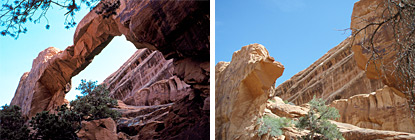
Wall Arch, 12th largest, one of the better-known and most-seen natural arches in Arches National Park, Utah, collapsed.

Wall Arch, before and after collapse - National Park Service photos

Wall Arch, before and after collapse – National Park Service photos

“Not being a geologist, I can’t get very technical but it just went kaboom,” [Arches NP] Chief Ranger Denny Ziemann said. “The middle of the arch just collapsed under its own weight. It just happens.”

Wall Arch, located along the popular Devils Garden Trail, was 71 feet tallwide and 33 1/2 feet widetall, ranking it 12th in size among the known arches inside the park. Lewis T. McKinney first reported and named Wall Arch in 1948.

No one reported observing the arch collapse and there were no visitor injuries, the National Park Service said.

Read the report from the Salt Lake Tribune.

Some tourist on Sunday, August 3, or Monday, August 4, got the last photograph of Wall Arch still standing. Was it you? Were you close? Give us a shout in the comments if so.

Other resources:

x

Other blogs and later reports:


Alpine Loop? Try Utah’s, gentler, prettier than Colorado’s

August 6, 2008

Utah’s canyons have so many pretty spots. Taking visitors through them I always heard about how no one expected such beauty in the desert. So I was excited to see the headline in Sunday’s Dallas Morning News about taking the Alpine Loop.

Autumn aspens in Utahs Alpine Loop - Wikimedia photo

Autumn aspens in Utah's Alpine Loop - Wikimedia photo

Prettiest drive you can make in a day. Start out in American Fork, head up American Fork Canyon, cross over to the backside of Mt. Timpanogos — you’ll see aspen, pines, fir, some of the prettiest streams you’ve ever seen anywhere. Some years back the Utah Travel Council had a spectacular poster showing the colors in the fall — about five shades each of red, gold and green, aspen and cottonwoods against the balsam and Douglas fir and a few scattered pines. Stop and hike up to Timpanogos Cave National Monument. See where the glacier was on the east side of Timpanogos.

End up passing Robert Redford’s Sundance Ski Resort, and down Provo Canyon (when I skied there it was $6.50 for a full-day pass; have the rates gone up?) — finish up with dinner in a good restaurant in Provo (or drive the 36 miles back to Salt Lake City and have world-class sushi at Takashi).

Alas. The article was about Colorado’s Alpine Loop. Who knew Colorado even had one by that name?

I suspect the Colorado version is less-traveled. The author took a four-wheel-drive vehicle.

Utah Travel Council photo of the Alpine Loop showing some of the autumn colors -- not the great shot from the long-ago poster, alas.

Utah Travel Council photo of the Alpine Loop showing some of the autumn colors -- not the great shot from the long-ago poster, alas.

Utah’s Alpine loop is paved the entire way, closed maybe only during a winter of very heavy snow. If you’re just passing through, you can do the drive in three hours or less, easily. If you have a day, grab a picnic, and spend some time stopping to enjoy the mountains.

(Go see Rich Legg’s photos of the east side of Timpanogos, here.)

Some time I’d like to check out the Colorado version. Odds are that I’ll be back in Utah County before then, however, and odds are you’ll be closer to the Utah version than the Colorado version, too.

You know the old saying about “take time to stop and smell the balsam, and ooh and aah at the aspen?” The Alpine Loop is what the aphorist was thinking about. Theodore Roosevelt would have gone there, had he known about it. You know about it now.

Windleys Google map of Utahs Alpine Loop, around Mt. Timpanogos

Windley's Google map of Utah's Alpine Loop, around Mt. Timpanogos


Smoke without fire, in California

August 6, 2008

Geology, geography, meteorology, climatology, chemistry — whatever you call it, reality always trumps fiction.

From the headline, “Ventura County hot spot puzzles experts,” I wondered whether a caldera was sending a telegram. Probably not.*

The ground smokes, but there is no fire. Experts’ best guess: Drought causes the ground to dry out, and crack. Petroleum stuff (in gas form) bubbles up from underground, into the cracked earth. Oxygen from the surface mixes deep. Somewhere underground the hydrocarbons meet the oxygen and the resulting combustion heats the ground to 800° Fahrenheit.

It’s a dry land analog of the methane hydrates warming and bubbling up in the ocean. The waste products contribute to greenhouse gas emissions, but so would the emissions if they didn’t burn first.

Cause or effect of climate change? Significant?

*  The Long Valley Caldera is about 300 miles north of Ventura County.  Ventura County itself is not particularly volcanically active, from what I understand.

The $7 million dogwood blossom

April 29, 2008

Not perfect — there is a brown spot on it; but beautiful, surpassingly rare, a creature of the serendipity of nature, it is a natural dogwood blossom in Dallas County, Texas:

Dogwood blossom in Dogwood Canyon, Texas


What we came to see – the magical dogwood blossoms.

On April 5 Kathryn and I joined David Hurt and a jovial band of hikers for a trip into Dogwood Canyon in Cedar Hill, Texas. The physical formation of Cedar Hill upon which the city of the same name and several others stand, is one of the highest spots between the Mississippi River and the Rocky Mountains. It is an outcropping of chalk, a formation known as the Austin Chalk, that runs from Austin, north nearly to the Oklahoma border.

This rock formation creates a clear physical marker of the boundary between East and West. Dallas is east of the line, Fort Worth, Gateway to the Old West, is 30 miles farther west. On this outcropping is married the plains of the west with the oaks and forests of the east. Within a few miles of the line, the botanical landscape changes, cowboy prairie lands one way, forest lands the other.

On the chalk itself, the soil is thin and alkaline. The alkalinity is a function of the chemical composition of the chalk underneath it.

Dogwoods love the forests of East Texas with their acidic soils. Early spring produces fireworks-like bursts of white dogwood blossoms in the understory of East Texas forests. Dogwoods die out well east of Dallas as the soil changes acidity; driving from Dallas one can count on 30 to 60 miles before finding a dogwood.

Except in Dogwood Canyon. There, where entrepreneur David Hurt originally planned to build a family hideout and getaway, he found a stand of dogwoods defying botanists and the Department of Agriculture’s plant zone maps, blooming furiously in thin alkaline soil atop the Austin Chalk.

(continued below the fold)

Read the rest of this entry »


Geologist finds meteor crater – on Google Earth

April 11, 2008

Geologist Arthur Hickman used Google Earth to look at part of Australia he was studying. In the satellite photos provided by Google Earth, Hickman noticed something no one else had seen: An impact crater.

Hickman Crater, Australia

For his alertness, Hickman had the 270-meter crater named after him.


Baltimore’s orgy of cartography and geography

March 22, 2008

The ad says “Come visit Utopia in Baltimore.” With an orgy of maps like that planned, it should be a Utopia for somebody: Geographers, cartographers, historians, and anyone interested in travel.

Baltimore’s Walters Art Museum hosts an outstanding exhibit of world-changing maps through June 8, a Festival of Maps; the entire town appears to have gone ga-ga on the idea. Baltimore will be Map Central for a few weeks, at least.

The Baltimore Sun (one of the truly great newspapers in America) described some of the cartographic gems on display:

Among the treasures is a huge and beautiful map of the fossil-embedded geological strata that underlie England and Wales. That masterpiece, published in 1815 by a pioneering geologist named William Smith, offered evidence used to support Darwin’s theory of evolution and set the stage for creation-vs.-evolution debates that still rage.

Then there’s the map researched by a doctor named John Snow in the 1850s. It allowed him to trace the source of a cholera outbreak in London to a well used by residents of a single neighborhood.

And there will be charts prepared by geographer Marie Tharp of the Mid-Oceanic Ridge, a mountainous rise in the mid-Atlantic seabed, based on data gathered by American submarines during World War II and later used to provide evidence of how the Earth’s crust has evolved through geological time.

The Smith and Snow maps anchor key events in science, the origin of paleontology and one of the greatest examples of public health sleuthing. To have both of those maps in one exhibition is a great coup for the Walters, and for Baltimore.

The exhibit also features a map of Utopia drawn by Sir Thomas Moore. Other maps were drawn by Benjamin Franklin, J. R. R. Tolkein, and Leonardo da Vinci.

Here’s a video description of one of the more remarkable pieces on view, a map of London, on a glove:

Vodpod videos no longer available. from www.baltimore.org posted with vodpod

♦ ♦ ♦ ♦ ♦ ♦ ♦ ♦ ♦

Surely there is material here for the Strange Maps blog.  Here’s a still of the glove, from the collection of The National Archives, UK:

Glove map, from London's 1851 Exposition

Below the fold, a partial list of some of the other exhibits and events planned in and around Baltimore, which will convince you, I hope, that it is indeed an orgy worth getting a ticket to see.

Baltimore remains one of my favorite towns, despite the loss of my Johnny Unitas-led Colts, despite the Orioles’ recent mediocrity; it’s a place of great history, great neighborhoods, and good food. Crabcakes from several sites, dinner at Sabatino’s, maps in the museums. Utopia indeed.

Read the rest of this entry »


Boost geology, boost science education

March 7, 2008

Kevin Padian’s article in February’s GeoTimes urges improvements in geology in textbooks, as a means of boosting science education and achievement overall.

I don’t want to imply that every geologist should be visiting third-grade classrooms and discussing radiometric dating with the students. That wouldn’t be comfortable for most of us, or most of them. But we can support a strong geological curriculum by getting involved in state and local textbook adoption procedures and curriculum development. Those folks need good scientific advice, and we need to listen to them to see how we can best meet their needs.

I’m actually going to suggest something even easier — something that most of us who teach in colleges and universities do all the time: improve the textbooks we use.

Texas’s state school board is running in exactly the opposite direction, undertaking several initiatives to dumb down science texts, even after approving a requirement for a fourth year of science classes required for graduation.

We can hope Texas’s policy makers will listen to veteran scientist educators like Padian.

Evolution of tetrapods, from Kevin Padian

Click thumbnail for larger chart to view. Evolution of Tetrapods, courtesy of Kevin Padian.

“Padian is a professor of Integrative Biology and curator in the Museum of Paleontology at the University of California at Berkeley, and president of the National Center for Science Education.”