Cat and Mosque, at Dogboy and Mr. Dan

August 19, 2010

Mark Fiore’s latest animated political cartoon won’t be popular with Newt Gingrich.  But then, Fiore won the Pulitzer, not Gingrich.

(This cartoon is not available on Fiore’s YouTube Channel, yet.)

(Oh, and remember:  This is the guy whose app got Apple’s panties in a wad — while you’re there, iPhone users, get the app that Steve Jobs thought mean for ridiculing those who so richly deserve ridicule.  Ain’t the First Amendment grand?)

Tip of the old scrub brush to Jennsmom.


Beloit College’s list: E-mail already passé to freshmen

August 18, 2010

If they knew what “old hat” meant, they might say that e-mail is old hat — but today’s entering college class of 2014 doesn’t regard e-mail as modern enough, nor much of other technology as fast enough.

Beloit College, in Beloit, Wisconsin, began to publish its profile of the cultural world of entering college freshmen in 1998.  The Mindset List originally aimed to help Beloit professors understand the views of incoming freshmen, with some hopes of bridging the ever-widening Generation Gaps between faculty and students.

Among other things, the Mindset List highlights the importance of teaching patient scholarship methods to students who have astonishing access to electronic information, though not necessarily better access to real knowledge; students need to learn the difference between data and information, information and knowledge, and knowledge and wisdom.

The newest Mindset List comes as one of the list’s creators will retire, an interesting footnote in historic attempts to understand rates of cultural change affecting college-bound kids.  Beloit’s public relations chief Ron Nief created the list with Prof. Tom McBride, who teaches modern students about Milton and Shakespeare.  It is unclear whether Nief will be able to retire from compiling or interpreting the annual Mindset List.  O tempora o mores!

We might assume that Nief had a hand in writing the Beloit College press release on the 2014 list:

Beloit, Wis. – Born when Ross Perot was warning about a giant sucking sound and Bill Clinton was apologizing for pain in his marriage, members of this fall’s entering college class of 2014 have emerged as a post-email generation for whom the digital world is routine and technology is just too slow.

Each August since 1998, Beloit College has released the Beloit College Mindset List. It provides a look at the cultural touchstones that shape the lives of students entering college this fall. The creation of Beloit’s Keefer Professor of the Humanities Tom McBride and former Public Affairs Director Ron Nief, it was originally created as a reminder to faculty to be aware of dated references, and quickly became a catalog of the rapidly changing worldview of each new generation. The Mindset List website at http://www.beloit.edu/mindset, the Mediasite webcast and its Facebook page receive more than 400,000 hits annually.

The class of 2014 has never found Korean-made cars unusual on the Interstate and five hundred cable channels, of which they will watch a handful, have always been the norm. Since “digital” has always been in the cultural DNA, they’ve never written in cursive and with cell phones to tell them the time, there is no need for a wrist watch. Dirty Harry (who’s that?) is to them a great Hollywood director. The America they have inherited is one of soaring American trade and budget deficits; Russia has presumably never aimed nukes at the United States and China has always posed an economic threat.

Nonetheless, they plan to enjoy college. The males among them are likely to be a minority. They will be armed with iPhones and BlackBerries, on which making a phone call will be only one of many, many functions they will perform. They will now be awash with a computerized technology that will not distinguish information and knowledge. So it will be up to their professors to help them.  A generation accustomed to instant access will need to acquire the patience of scholarship. They will discover how to research information in books and journals and not just on-line. Their professors, who might be tempted to think that they are hip enough and therefore ready and relevant to teach the new generation, might remember that Kurt Cobain is now on the classic oldies station. The college class of 2014 reminds us, once again, that a generation comes and goes in the blink of our eyes, which are, like the rest of us, getting older and older.

Here is the list of 75 touchstones of cultural change guaranteed to give you twinges of your own aging, even if you were in the class of 2010:

The Beloit College Mindset List for the Class of 2014

Most students entering college for the first time this fall—the Class of 2014—were born in 1992.

For these students, Benny Hill, Sam Kinison, Sam Walton, Bert Parks and Tony Perkins have always been dead.

1. Few in the class know how to write in cursive.

2. Email is just too slow, and they seldom if ever use snail mail.

3. “Go West, Young College Grad” has always implied “and don’t stop until you get to Asia…and learn Chinese along the way.”

4. Al Gore has always been animated.

5. Los Angelenos have always been trying to get along.

6. Buffy has always been meeting her obligations to hunt down Lothos and the other blood-suckers at Hemery High.

7. “Caramel macchiato” and “venti half-caf vanilla latte” have always been street corner lingo.

8. With increasing numbers of ramps, Braille signs, and handicapped parking spaces, the world has always been trying harder to accommodate people with disabilities.

9. Had it remained operational, the villainous computer HAL could be their college classmate this fall, but they have a better chance of running into Miley Cyrus’s folks on Parents’ Weekend.

10. A quarter of the class has at least one immigrant parent, and the immigration debate is not a big priority…unless it involves “real” aliens from another planet.

11. John McEnroe has never played professional tennis.

12. Clint Eastwood is better known as a sensitive director than as Dirty Harry.

13. Parents and teachers feared that Beavis and Butt-head might be the voice of a lost generation.

14. Doctor Kevorkian has never been licensed to practice medicine.

15. Colorful lapel ribbons have always been worn to indicate support for a cause.

16. Korean cars have always been a staple on American highways.

17. Trading Chocolate the Moose for Patti the Platypus helped build their Beanie Baby collection.

18. Fergie is a pop singer, not a princess.

19. They never twisted the coiled handset wire aimlessly around their wrists while chatting on the phone.

20. DNA fingerprinting and maps of the human genome have always existed.

21. Woody Allen, whose heart has wanted what it wanted, has always been with Soon-Yi Previn.

22. Cross-burning has always been deemed protected speech.

23. Leasing has always allowed the folks to upgrade their tastes in cars.

24. “Cop Killer” by rapper Ice-T has never been available on a recording.

25. Leno and Letterman have always been trading insults on opposing networks.

26. Unless they found one in their grandparents’ closet, they have never seen a carousel of Kodachrome slides.

27. Computers have never lacked a CD-ROM disk drive.

28. They’ve never recognized that pointing to their wrists was a request for the time of day.

29. Reggie Jackson has always been enshrined in Cooperstown.

30. “Viewer Discretion” has always been an available warning on TV shows.

31. The first computer they probably touched was an Apple II; it is now in a museum.

32. Czechoslovakia has never existed.

33. Second-hand smoke has always been an official carcinogen.

34. “Assisted Living” has always been replacing nursing homes, while Hospice has always been an alternative to hospitals.

35. Once they got through security, going to the airport has always resembled going to the mall.

36. Adhesive strips have always been available in varying skin tones.

37. Whatever their parents may have thought about the year they were born, Queen Elizabeth declared it an “Annus Horribilis.”

38. Bud Selig has always been the Commissioner of Major League Baseball.

39. Pizza jockeys from Domino’s have never killed themselves to get your pizza there in under 30 minutes.

40. There have always been HIV positive athletes in the Olympics.

41. American companies have always done business in Vietnam.

42. Potato has always ended in an “e” in New Jersey per vice presidential edict.

43. Russians and Americans have always been living together in space.

44. The dominance of television news by the three networks passed while they were still in their cribs.

45. They have always had a chance to do community service with local and federal programs to earn money for college.

46. Nirvana is on the classic oldies station.

47. Children have always been trying to divorce their parents.

48. Someone has always gotten married in space.

49. While they were babbling in strollers, there was already a female Poet Laureate of the United States.

50. Toothpaste tubes have always stood up on their caps.

51.  Food has always been irradiated.

52. There have always been women priests in the Anglican Church.

53. J.R. Ewing has always been dead and gone. Hasn’t he?

54. The historic bridge at Mostar in Bosnia has always been a copy.

55. Rock bands have always played at presidential inaugural parties.

56. They may have assumed that parents’ complaints about Black Monday had to do with punk rockers from L.A., not Wall Street.

57. A purple dinosaur has always supplanted Barney Google and Barney Fife.

58. Beethoven has always been a dog.

59. By the time their folks might have noticed Coca Cola’s new Tab Clear, it was gone.

60. Walmart has never sold handguns over the counter in the lower 48.

61. Presidential appointees have always been required to be more precise about paying their nannies’ withholding tax, or else.

62. Having hundreds of cable channels but nothing to watch has always been routine.

63. Their parents’ favorite TV sitcoms have always been showing up as movies.

64. The U.S, Canada, and Mexico have always agreed to trade freely.

65. They first met Michelangelo when he was just a computer virus.

66. Galileo is forgiven and welcome back into the Roman Catholic Church.

67. Ruth Bader Ginsburg has always sat on the Supreme Court.

68. They have never worried about a Russian missile strike on the U.S.

69. The Post Office has always been going broke.

70. The artist formerly known as Snoop Doggy Dogg has always been rapping.

71. The nation has never approved of the job Congress is doing.

72. One way or another, “It’s the economy, stupid” and always has been.

73. Silicone-gel breast implants have always been regulated.

74. They’ve always been able to blast off with the Sci-Fi Channel.

75. Honda has always been a major competitor on Memorial Day at Indianapolis.

Beloit College ranks among the best small, liberal arts colleges in the U.S.  Beloit College is part of a consortium our family has some fondness for, the 40 colleges in the group Colleges That Change Lives (CTCL).  Every high school student should be aware of this group, and the methods developed to make application to several of these colleges easier (our son chose Lawrence University in Appleton, Wisconsin).

This list highlights areas of potential ignorance teachers need to consider.  Notice there is little on the list about the Cold War, Vietnam, nor popular books.  The skew to technology includes an implicit skew away from some of the traditional ways we have transmitted culture to our children:  Newspapers, magazines, books, Broadway plays and musicals.  Even broadcast television is notable for the pop culture icons, and great changes in television viewing methods and habits.

The class of 2014 graduates a complete century away from the outbreak of World War I.  Their parents may not have known the administrations of John Kennedy and Lyndon Johnson — Richard Nixon and Watergate may have been learned only from history books, by their parents.

How much more distant is the class of 2018, who enter high school as freshmen this year — next Monday, in Texas?

More:


What would George Washington say and do about a mosque in Manhattan? (“To bigotry, no sanction”)

August 17, 2010

Double encore post.  And look at the date

August 17, 1790, found U.S. President George Washington traveling the country, in Newport, Rhode Island.

Washington met with “the Hebrew Congregation” (Jewish group), and congregation leader (Rabbi?) Moses Seixas presented Washington with an address extolling Washington’s virtues, and the virtues of the new nation. Seixas noted past persecutions of Jews, and signalled a hopeful note:

Deprived as we heretofore have been of the invaluable rights of free citizens, we now (with a deep sense of gratitude to the Almighty disposer of all events) behold a government erected by the Majesty of the People–a Government which to bigotry gives no sanction, to persecution no assistance, but generously affording to All liberty of conscience and immunities of Citizenship, deeming every one, of whatever Nation, tongue, or language, equal parts of the great governmental machine.

George Washingtons reply to the Newport, RI, Hebrew congregation, August 17, 1790 - Library of Congress image

George Washington's reply to the Newport, RI, "Hebrew congregation," August 17, 1790 - Library of Congress image

President Washington responded with what may be regarded as his most powerful statement in support of religious freedom in the U.S. — and this was prior to the ratification of the First Amendment:

It is now no more that toleration is spoken of as if it was the indulgence of one class of people that another enjoyed the exercise of their inherent natural rights. For happily, the government of the United States, which gives to bigotry no sanction, to persecution no assistance, requires only that they who live under its protection should demean themselves as good citizens, in giving it on all occasions their effectual support.

Below the fold, more history of the events and religious freedom, from the Library of Congress.

Read the rest of this entry »


Coming Soon: FRONTLINE, “Top Secret America – the top secret world the government created in response to the 9/11 attacks”

August 16, 2010

Coming this fall:

Vodpod videos no longer available.

FRONTLINE: Coming Soon: Top Secret America – th…, posted with vodpod

Where is Frank Church now that we really need him?


We Are Science Probes

August 14, 2010

Still from

Still from “We Are Science Probes.” Full clip of movie below.

In animation, a parable about the dangers of being intentionally ignorant of science. In the not-distant-enough future, a probe from another planet arrives on Earth after the demise of human civilization. Unfortunately, the probes land in Kansas, the land of creationism and woo. The plot thickens.

[My apologies — the version I found did not come with a “pause” button.  It will play automatically when you open this post.  Fortunately, it’s almost perfectly safe-for-work.  If you don’t like the music, turn it off.  There is no spoken dialogue in the cartoon.  If you wish to pause the playing of the cartoon, right click to get to the Adobe Flash Player controls.  To pause the playing click the checkmark next to “play.”]

[Update August 18 — Okay, I give up — 100% of comments I’ve been getting ran against the video without the “start” or “pause” buttons.  You’ll have to go see it at another site — here, for example.]

[Years later, it’s on Youtube!]

Found it at a site called NewGrounds, which includes several other animation pieces.  The piece was created by a group that goes by the handle Billy Blob.

Sure would love this group to turn their creative faculties to hard history — say, the Progressive Movement and Gilded Age.  (Probably less chance of commercialization there, and perhaps less chance of awe-striking art, too.)

Tip of the old scrub brush to P. Z. Myers at Pharyngula.


GM profits, Tea Party turns to gin

August 12, 2010

According to the Associated Press, General Motors turned a profit of $1.33 billion last quarter.  “Billion,” with a b.

Tea Partiers and Republicans have made a run on liquor stores to stock up on gin for the afternoon.  News is turning against them.

First, they argued that the Obama administration was crazy to try to save GM.  Couldn’t be done, won’t work.  Cutting 3 million workers loose in Michigan, Indiana, Illinois, Ohio and Texas would help depress the market for migrant fruit pickers in those states, the Republicans argued implicitly — and that would help reduce immigration troubles, which bug Republicans chiefly because it’s a sign of good economic times for working people.

Second, they argued that Obama had effectively nationalized GM and Chrysler.  Nationalized companies rarely turn profits (except for tin-pot dictators).  The simple reporting of a profit by the company reiterates the point that the GM rescue was not “socialism,” and was no nationalizing of the company.  Obama starts to look like a hero, Tea Party dreams start to look like wet tea leaves.

Third, it means Tea Party self-enrollees may actually have to buy American.  They had hoped to kill off the U.S. auto industry, so no one would complain when they drove Mercedes, Lexus, and the Kia they bought for their nephew.   Now, with Cadillacs, Chryslers and Lincolns still being made, they have no excuse.

Fourth, it means there are three million voters in the American midwest who owe their jobs to Obama.  While at least of million of those people may be convinced to buy the Tea Party Home Lobotomy Kit and vote against Democrats in the fall, the odds of even half of that group being suckered in are slight.

Fifth, and most important, GM’s showing a profit pulls the cloak from the platform of the Tea Partiers, and all that’s left is a naked guy with skinny legs and a sore need for a tanning bed and exercise.   The Tea Party works on being against stuff.  If they had to actually come up with a workable program for anything, they’d quickly be exposed.

So, that gut at the end of the bar finishing the fifth of gin and mumbling a lot?  He’s a Tea Partier, praying for Chrysler to crash.  Tell the bartender he is picking up your tab.

Tip of the old scrub brush to Jim Stanley.


History in photos – great art, good student project?

August 12, 2010

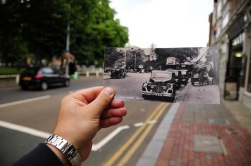
Earlier I found an idea I’ve not been able to incorporate into my classes, but which I still like:  Take historic photos of your town, go to the same place today and see what it looks like.

Comparing historic images with places today

Students could do this: Comparing historic images with places today

A Russian photographer takes the exercise further, and creates sometimes-stunning art.

Sergey Larenkov has photos from Europe in World War II.  He blends parts of those images with photos of the same places today, in cities across Europe. He has images from Berlin, Leningrad, and other cities (crawl over his LiveJournal site — there’s good stuff).

Sergey Larenkov, World War II historic photo overlay on modern shot - Leningrad?

Sergey Larenkov, World War II historic photo overlay on modern shot - is this Leningrad? Whose soldiers, what year?

Sergey Larenkov work, the Siege of Leningrad, and Leningrad today (reverting to the name St. Petersburg)

Sergey Larenkov work, the Siege of Leningrad, and Leningrad today (reverting to the name St. Petersburg)

Ghostly, no?

The photos show the destruction of war, and how far Europe has come since then.  It’s an astounding view of history.  If a picture is worth a thousand words, these photo mashups are worth ten thousand words or more.

Tip of the old scrub brush to Alices’ blog at My Modern Met.

Add to FacebookAdd to NewsvineAdd to DiggAdd to Del.icio.usAdd to StumbleuponAdd to RedditAdd to BlinklistAdd to TwitterAdd to TechnoratiAdd to Furl


Something to toot your horn about: Scouts save Bugling merit badge

August 10, 2010

Boy Scouts of America reviews merit badge offerings from time to time, adding new badges, modifying requirements, retiring badges that are unpopular or outdated.

Recently Bugling was dropped as a separate badge, and made an adjunct of the Music merit badge.  Bugling was a great tradition in Scouts — a music-oriented badge that required only that one be able to memorize and blow recognizable versions of several bugle calls.

Perhaps ironically, Bugling also drew the spotlight as the last merit badge earned by several of those super Scouts who earned every possible merit badge.  For some reason, learning to blow the horn was just the last or toughest thing they could master.

Good news:  Bugling has been reinstated.

Bugling reinstated as separate merit badge

Bugling Have your guys start practicing “Taps,” because Bugling is here to stay.

In early June, we reported that the Bugling merit badge was to be discontinued and its requirements merged into Music merit badge.

That’s no longer the case. Responding to concerns from hundreds of Scouters, the BSA’s Youth Development team has decided to reinstate Bugling as a separate merit badge.

Oddly enough, this means that Bugling will never have officially been part of Music merit badge, because the changes were never reflected in a Boy Scout Requirements book.

Bugling and Music will continue to share a merit badge pamphlet. Requirements and information for both of the badges will be contained within that single booklet.

More:

To the Colors, from USSSP Bugling Merit Badge page

"To the Colors," one of the bugle calls required for the Bugling merit badge. Image from U.S. Scouting Service Project


Republican vs Republican : Rachel Maddow sides with the Republicans, um, I think

August 7, 2010

A more clear demonstration of bad weather vane politics could not be imagined, could it?

Republicans’ relying on focus-groups to determine their positions, instead of doing what is right, is a major problem for us all — but especially in an election year.

As we were saying . . .

Vodpod videos no longer available.

Republican vs Republican : Dispatches from the …, posted with vodpod

One thing should be clear:  You can’t trust the Republicans to follow through on their campaign promises.  Words to the wise.

Tip of the old scrub brush to Ed Brayton at Dispatches from the Culture Wars.


Wow (in metaphor)

August 7, 2010

You should be using this tool, don’t you think?

(WordPress doesn’t support embedding this player — you’ll have to go see for yourself — it’s worth the click.)

One more way to make outstanding presentations; one more way to get students involved in rationally-active, brain-intensive, graphic organizers.

One tool I picked up in a session with Learning.com earlier this week.

(See also “Thoughts on using Prezi as a teaching tool.”)

Add to FacebookAdd to NewsvineAdd to DiggAdd to Del.icio.usAdd to StumbleuponAdd to RedditAdd to BlinklistAdd to TwitterAdd to TechnoratiAdd to Furl


Obama Blows Off the Boy Scouts? – ColbertNation report

August 6, 2010

Vodpod videos no longer available.

Obama Blows Off the Boy Scouts | July 28, 2010 …, posted with vodpod

How was your time at the Jamboree? Did you have time to miss Obama?

If you had time to miss him, you weren’t there.

Here’s Obama’s video address to the Scouts:

Earlier at Millard Fillmore’s Bathtub:

Add to FacebookAdd to NewsvineAdd to DiggAdd to Del.icio.usAdd to StumbleuponAdd to RedditAdd to BlinklistAdd to TwitterAdd to TechnoratiAdd to Furl


Some teachers had great summer experiences

August 6, 2010

One of our more adventurous teachers spent the summer on a Fulbright-Hays program in Senegal, in West Africa.

Lunch in Senegal, William Adkins photo

No, that's not William Adkins. That's his lunch one day in Senegal.

William Adkins’ African adventure blog is here.  Mine it for stuff you can use in economics, art, world history, world geography, or anything else.  He’ll probably give you free reign to use the photos for classroom presentations.

What did you do on your summer vacation?

Add to FacebookAdd to NewsvineAdd to DiggAdd to Del.icio.usAdd to StumbleuponAdd to RedditAdd to BlinklistAdd to TwitterAdd to TechnoratiAdd to Furl


Moral math of climate change, on Speaking of Faith

August 5, 2010

Speaking of Faith is carried on many public radio stations nationally, perhaps on one in your area.  If, as I do, you live in an area where the program is not carried, you can pick up a podcast or .mp3 at the program’s website.  (Here’s a list of stations that carry the broadcast.)

Host Krista Tippett posts a weekly message on the scheduled program — this week, an interview with Bill McKibben, whose book, The End of Nature, was a popular introduction to climate change, when it was published in 1989 (!).

Yes, this program is about woo and how we deal with it in our daily lives.  This particular program looks at how even woo followers may find it to their advantage to pay attention to the science, and act to protect their families and communities as a result.  This is a moral side of climate change that too many people simply deny.

Ms. Tippett wrote:

This week on public radio’s conversation about religion, meaning, ethics, and ideas:

The Moral Math of Climate Change

Bill McKibben’s first book, The End of Nature, was the first popular book on climate change, and he is one of the most insightful figures of our time on ecology and life. We’ll explore his hopeful sense that what is good for the environment also nourishes human relationship. And we’ll seek his perspective on knowledge we can trust as we orient our minds and lives to changing realities of the natural world.

Krista Tippett, host of Speaking of Faith

History Tends to Surprise Us
It’s been striking how, across the past few years, the environment has found its way inside my guests’ reflections on every subject, as they say, under the sun. And we do need fresh vocabulary and expansive modes of reflection on this subject that, we’ve come to realize, is not just about ecology but the whole picture of human life and lifestyle.

Here are some pieces of vocabulary and perspective I’ve loved and used in recent years.

Starting with the basics, Cal DeWitt — a scientist, conservationist, and Evangelical Christian living in Wisconsin — pointed out to me that “environment” was coined after Geoffrey Chaucer used the term “environing.” This was a turning point in the modern Western imagination — the first time we linguistically defined ourselves as separate from the natural world, known up until then as the Creation. This helps explain why the language of “creation care” is so animating for many conservative Christians — as a return to a sacred insight that was lost. But from quantum physics to economics, too, we are discovering new existential meaning in terms like interconnectedness and interdependence.

Many people, but most recently the wonderful geophysicist Xavier le Pichon, have made the simple yet striking observation that climate change is the first truly global crisis in human history. In other words, just as we make newfound discoveries about old realities, they are put to the ultimate test. It is easy to be overwhelmed by the signs that we are not up to this test as a species. So it was helpful for me to have Matthieu Ricard, a biologist turned Buddhist monk, remind me that evolutionary change, which is what we need now in our behavior, always comes precisely at the moment where survival — not just betterment — is at stake.

Such ideas can make the task of integrating, or reintegrating, environmental and human realities sound far away and abstract. But it’s not.

The most redemptive and encouraging commonality of all the people I’ve encountered who have made a truly evolutionary leap is that they have come to love the very local, very particular places they inhabit. They were drawn into environmentalism by suddenly seeing beauty they had taken for granted; by practical concern for illness and health in neighborhood children; by imagining possibilities for the survival of indigenous flora and fauna, the creation of jobs, the sustainability of regional farms. The catchword of many of our most ingenious solutions to this most planetary of crises is “local” — local food, local economies. Ellen Davis and Wendell Berry illuminate this with poetic, biblical wisdom, each in their way reminding us that the health of our larger ecosystem is linked to knowing ourselves as creatures — “placed creatures.”

There is so much in my most recent conversation about all of this with Bill McKibben that will frame and deepen my sense of the nature and meaning of climate change moving forward. Among them is an exceedingly helpful four minutes, a brief history of climate change that we’re making available as a separate podcast. But what has stayed with me most of all, I think, is a stunning equation he is ready to make after two decades of immersion in the scientific, cultural, and economic meaning of our ecological present. He points out that cheap fossil fuels have allowed us to become more privatized, less in need of our neighbor, than ever in human history. And he says that in almost every instance, what is good for the environment is good for human community. The appeal of the farmers market is not just its environmental and economic value but the drama, the organic nature, of human contact.

I also gained a certain bracing historical perspective from my conversation with Bill McKibben. He and I were both born in 1960. He was waking up to the environment in years in which I was in divided Berlin, on the front lines of what felt like the great strategic and moral battle of that age. He published The End of Nature in 1989, the year the Berlin Wall fell. And as I learned from that book, the science of climate change had already begun to emerge at the height of the Cold War. In 1957, two scientists at the Scripps Institution described their findings that humanity initiated an unprecedented “geophysical experiment” that it might not survive.

So I’ve been chewing on this thought lately: If humanity is around to write history in a century or two, what was happening with the climate in 1989 may dwarf what we perceived as the great geopolitical dramas of that time. Living through the fall of the wall and the reunification of Europe emboldened my sense that there is always more to reality than we can see and more change possible than we can begin to imagine. I draw caution as well as hope from the fact that history tends to surprise us. And I draw caution as well as hope from the knowledge that humanity often surprises itself on the edge of survival.

The End of Nature by Bill McKibben I Recommend Reading:
The End of Nature
by Bill McKibben

This was the first book to introduce the notion and science of climate change to a non-scientific audience. It is passionately and beautifully written. And while Bill McKibben’s updated introduction in recent printings adds relevant new knowledge, it also highlights just how prescient and powerful the original book remains.

Add to FacebookAdd to NewsvineAdd to DiggAdd to Del.icio.usAdd to StumbleuponAdd to RedditAdd to BlinklistAdd to TwitterAdd to TechnoratiAdd to Furl


Meanwhile, in Appleton, Wisconsin . . .

August 1, 2010


Grave of Sen. Joe McCarthy, in Appleton, Wisconsin - photo copyright by James Darrell

The world is still safe for fairness.

The world is still safe for fairness.

The world is still safe for fairness.

No resurrection of McCarthyism this year.

Tip of the old scrub brush to James.  Photo of the grave of Sen. Joseph R. McCarthy, from Appleton, Wisconsin, copyright by James Darrell.


Classrooms and technology: Pencil integration, pencil natives

August 1, 2010

Are you reading Tom Johnson’s Adventures in Pencil Integration?

Do you care about technology in your classroom, here in 1897?

You might even laugh.  It’s well written, well worth the read.  See his recent piece, “They’re Still Pencil Natives,” for example.  His piece on the district’s blocking of phonographs is good, too.  It’ll give you a new appreciation for “bandwidth.”