Oh, how things have changed! Birthday wishes for Alexander Hamilton, still!

January 11, 2019

I posted this back on January 11, 2012, a birthday note for Alexander Hamilton. In 2012, most Americans would have simply been puzzled by a request to tell them about the guy on the $10 bill.
Then stardom hit. Lin-Manuel Miranda, who in 2012 had just a couple of songs and an idea about a musical about Hamilton, finished the piece, produced it on Broadway, and set records for attendance and Tony awards, and generally raised Alexander Hamilton’s profile. Here is that post from 2012, with only editing for errors and time.

Today, January 11,  is Alexander Hamilton’s birthday — had he lived so long, he’d be 254 years old today! [261 years, in 2019 — probably]

Alexander Hamilton on the U.S. ten dollar note - Guardian image

Alexander Hamilton on the U.S. ten dollar note – Guardian image

But of course, the bullet from Aaron Burr’s gun cut Hamilton’s life short, after the duel in Weehawken, New Jersey. Hamilton died of the wound on July 12, 1804. He was 47 years old.

Had Hamilton survived the duel, would he have been elected president? Some people think so. In any case, Hamilton’s wise management of the new nation’s finances, and his establishment of the idea that government should have a working bank, and that good government is a key to economic success of a nation, leave a great legacy for the nation, and the world.

Hamilton’s portrait adorns the U.S. $10 bill.

Read Hamilton’s biography from the U.S. National Archives’ feature on “America’s Founding Fathers/Charters of Freedom” exhibit:

Alexander Hamilton

Alexander Hamilton

Hamilton was born in 1757 on the island of Nevis, in the Leeward group, British West Indies. He was the illegitimate son of a common-law marriage between a poor itinerant Scottish merchant of aristocratic descent and an English-French Huguenot mother who was a planter’s daughter. In 1766, after the father had moved his family elsewhere in the Leewards to St. Croix in the Danish (now United States) Virgin Islands, he returned to St. Kitts while his wife and two sons remained on St. Croix.

The mother, who opened a small store to make ends meet, and a Presbyterian clergyman provided Hamilton with a basic education, and he learned to speak fluent French. About the time of his mother’s death in 1768, he became an apprentice clerk at Christiansted in a mercantile establishment, whose proprietor became one of his benefactors. Recognizing his ambition and superior intelligence, they raised a fund for his education.

In 1772, bearing letters of introduction, Hamilton traveled to New York City. Patrons he met there arranged for him to attend Barber’s Academy at Elizabethtown (present Elizabeth), NJ. During this time, he met and stayed for a while at the home of William Livingston, who would one day be a fellow signer of the Constitution. Late the next year, 1773, Hamilton entered King’s College (later Columbia College and University) in New York City, but the Revolution interrupted his studies.

Although not yet 20 years of age, in 1774-75 Hamilton wrote several widely read pro-Whig pamphlets. Right after the war broke out, he accepted an artillery captaincy and fought in the principal campaigns of 1776-77. In the latter year, winning the rank of lieutenant colonel, he joined the staff of General Washington as secretary and aide-de-camp and soon became his close confidant as well.

In 1780 Hamilton wed New Yorker Elizabeth Schuyler, whose family was rich and politically powerful; they were to have eight children. In 1781, after some disagreements with Washington, he took a command position under Lafayette in the Yorktown, VA, campaign (1781). He resigned his commission that November.

Hamilton then read law at Albany and quickly entered practice, but public service soon attracted him. He was elected to the Continental Congress in 1782-83. In the latter year, he established a law office in New York City. Because of his interest in strengthening the central government, he represented his state at the Annapolis Convention in 1786, where he urged the calling of the Constitutional Convention.

In 1787 Hamilton served in the legislature, which appointed him as a delegate to the convention. He played a surprisingly small part in the debates, apparently because he was frequently absent on legal business, his extreme nationalism put him at odds with most of the delegates, and he was frustrated by the conservative views of his two fellow delegates from New York. He did, however, sit on the Committee of Style, and he was the only one of the three delegates from his state who signed the finished document. Hamilton’s part in New York’s ratification the next year was substantial, though he felt the Constitution was deficient in many respects. Against determined opposition, he waged a strenuous and successful campaign, including collaboration with John Jay and James Madison in writing The Federalist. In 1787 Hamilton was again elected to the Continental Congress.

When the new government got under way in 1789, Hamilton won the position of Secretary of the Treasury. He began at once to place the nation’s disorganized finances on a sound footing. In a series of reports (1790-91), he presented a program not only to stabilize national finances but also to shape the future of the country as a powerful, industrial nation. He proposed establishment of a national bank, funding of the national debt, assumption of state war debts, and the encouragement of manufacturing.

Hamilton’s policies soon brought him into conflict with Jefferson and Madison. Their disputes with him over his pro-business economic program, sympathies for Great Britain, disdain for the common man, and opposition to the principles and excesses of the French revolution contributed to the formation of the first U.S. party system. It pitted Hamilton and the Federalists against Jefferson and Madison and the Democratic-Republicans.

During most of the Washington administration, Hamilton’s views usually prevailed with the President, especially after 1793 when Jefferson left the government. In 1795 family and financial needs forced Hamilton to resign from the Treasury Department and resume his law practice in New York City. Except for a stint as inspector-general of the Army (1798-1800) during the undeclared war with France, he never again held public office.

While gaining stature in the law, Hamilton continued to exert a powerful impact on New York and national politics. Always an opponent of fellow-Federalist John Adams, he sought to prevent his election to the presidency in 1796. When that failed, he continued to use his influence secretly within Adams’ cabinet. The bitterness between the two men became public knowledge in 1800 when Hamilton denounced Adams in a letter that was published through the efforts of the Democratic-Republicans.

In 1802 Hamilton and his family moved into The Grange, a country home he had built in a rural part of Manhattan not far north of New York City. But the expenses involved and investments in northern land speculations seriously strained his finances.

Meanwhile, when Jefferson and Aaron Burr tied in Presidential electoral votes in 1800, Hamilton threw valuable support to Jefferson. In 1804, when Burr sought the governorship of New York, Hamilton again managed to defeat him. That same year, Burr, taking offense at remarks he believed to have originated with Hamilton, challenged him to a duel, which took place at present Weehawken, NJ, on July 11. Mortally wounded, Hamilton died the next day. He was in his late forties at death. He was buried in Trinity Churchyard in New York City.

Image: Courtesy of The National Portrait Gallery, Smithsonian Institution
Post mostly borrowed, with express permission, from Mr. Darrell’s Wayback Machine.

Remember to watch for progress on “The Alexander Hamilton Mixtape,” a hip-hop version of Alexander Hamilton’s life by Lin-Manuel Miranda, seen here performing Aaron Burr’s soliloquey, at the White House.

More, added in 2018:

Poster for Lin-Manuel Miranda's musical play,

Poster for Lin-Manuel Miranda’s musical play, “Hamilton.” Wikipedia image.


Happy 219th birthday, Millard Fillmore!

January 7, 2019

Millard Fillmore, future 13th President of the United States, was born on January 7, 1800, in upstate New York.

Victim of one of the most infamous hoaxes in history, Millard Fillmore’s good works are often forgotten.

It’s that hoax that gives the name to this blog, and preventing or stopping other similar hoaxes which is the hope of the author.

In the past 50 years residents of Buffalo revived the reputation of Fillmore, and started a tradition of celebrating his birthday.

Trumpeter plays taps at the grave site of President Millard Fillmore in Buffalo, New York's Forest Lawn Cemetery, with a military honor guard and dignitaries from the University of Buffalo, which traces its founding to Fillmore. This is a Buffalo News photo of an earlier celebration, perhaps 2015.

Trumpeter plays taps at the grave site of President Millard Fillmore in Buffalo, New York’s Forest Lawn Cemetery, with a military honor guard and dignitaries from the University of Buffalo, which traces its founding to Fillmore. This is a Buffalo News photo of an earlier celebration, perhaps 2015.

But so far as I have found, no bathtub races occurred this year.

More:


Utah Statehood Day, 2018

January 4, 2019

President Grover Cleveland signed the proclamation making Utah the 45th state on January 4, 1896. Utah residents should fly the U.S. flag today in commemoration.

A golden pen used by President Grover Cleveland to sign the law setting conditions for statehood in 1894; Utah met the conditions, and Cleveland signed the proclamation of statehood just over a year later, on January 4, 1896. Sources of the photograph do not say who has the pen now, nor where it might be displayed. ILoveHistory.com image

A golden pen used by President Grover Cleveland to sign the law setting conditions for statehood in 1894; Utah met the conditions, and Cleveland signed the proclamation of statehood just over a year later, on January 4, 1896. Sources of the photograph do not say who has the pen now, nor where it might be displayed. ILoveHistory.com image

Flying the U.S. flag is a big deal in Utah. Most families have at least one flag to fly on holidays. But in my decades in the state, I don’t think I saw anyone fly the flag for Utah Statehood day.

Utah’s public officials take their oaths of office on January 4, traditionally. In the past couple of decades, a ball for statehood, a Statehood Dance, is scheduled on a Saturday close to January 4, in the museum in Fillmore, Utah, which once was the territorial capitol building before the capital was moved to Salt Lake City.

Got a U.S. flag, Utahns? Fly ’em if you got ’em.

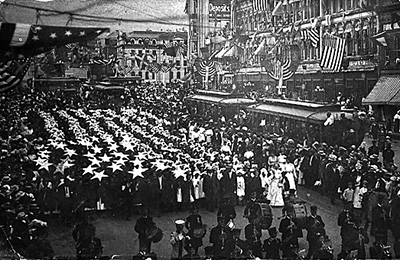
Marchers carrying stars and colored material to make stripes for a flag in a statehood parade in Salt Lake City, 1910. Photo from the University of Utah Marriott Library.

Marchers carrying stars and colored material to make stripes for a flag in a statehood parade in Salt Lake City, 1910. Photo from the University of Utah Marriott Library.

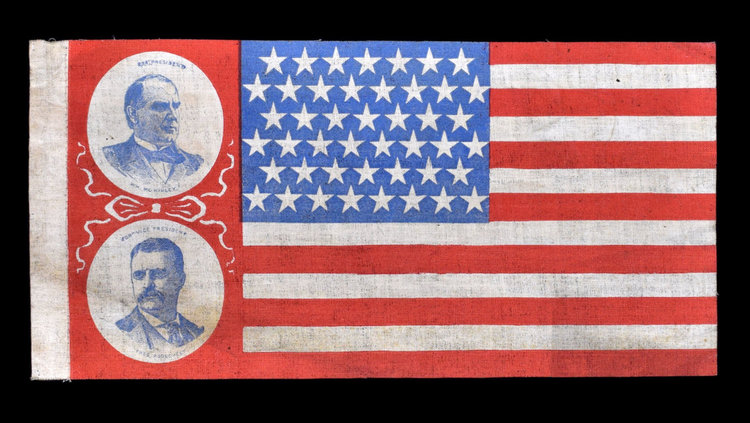
Rare 1900 campaign flag featuring portraits of President William McKinley and Vice President nominee Theodore Roosevelt. Such a display is contrary to the U.S. Flag Code today, but in 1900 there was no flag code, and not really much solid regulation on U.S. flags. Bonsell/Americana image.

Rare 1900 campaign flag featuring portraits of President William McKinley and Vice President nominee Theodore Roosevelt. Such a display is contrary to the U.S. Flag Code today, but in 1900 there was no flag code, and not really much solid regulation on U.S. flags. Bonsell/Americana image.

More:

  • Utah, the 45th star and the largest flag ever made to that time, film from Colonial Flags


December 31 is Bright Idea Day 2018, anniversary of the Day the Lights Went On

December 31, 2018

Between Christmas and New Year’s Day, here at Millard Fillmore’s Bathtub we celebrate a variety of historically holy days. December 31, by tradition, is Bright Idea Day, the anniversary of the day Thomas Edison demonstrated for the public a working light bulb, in 1879.

100,000 people gather in Times Square, New York City (surely not the 2 million predicted by NBC!) tonight, and millions more around the world, in festivities for the new year made possible by the work of Thomas Alva Edison.

Here it is, the invention that stole sleep from our grasp, made clubbing possible, and launched 50,000 cartoons about ideas:

The light bulb Thomas Edison demonstrated on December 31, 1879, at Menlo Park, New Jersey - Wikimedia image

The light bulb Thomas Edison demonstrated on December 31, 1879, at Menlo Park, New Jersey – Wikimedia image (GFDL)

The light bulb. It’s an incandescent bulb.

It wasn’t the first bulb. Edison a few months earlier devised a bulb that worked with a platinum filament. Platinum was too expensive for mass production, though — and Edison wanted mass production. So, with the cadre of great assistants at his Menlo Park laboratories, he struggled to find a good, inexpensive filament that would provide adequate life for the bulb. By late December 1879 they had settled on carbon filament.

Edison invited investors and the public to see the bulb demonstrated, on December 31, 1879.

Thomas Edison in 1878, the year before he demonstrated a workable electric light bulb. Library of Congress image

Thomas Edison in 1878, the year before he demonstrated a workable electric light bulb. CREDIT: Thomas Edison, head-and-shoulders portrait, facing left, 1880. Prints and Photographs Division, Library of Congress. Reproduction number LC-USZ62-98067

Edison’s successful bulb indicated changes in science, technology, invention, intellectual property and finance well beyond its use of electricity. For example:

  • Edison’s Menlo Park, New Jersey, offices and laboratory were financed with earlier successful inventions. It was a hive of inventive activity aimed to make practical inventions from advances in science. Edison was all about selling inventions and rights to manufacture devices. He always had an eye on the profit potential. His improvements on the telegraph would found his laboratory he thought, and he expected to sell the device to Western Union for $5,000 to $7,000. Instead of offering it to them at a price, however, he asked Western Union to bid on it. They bid $10,000, which Edison gratefully accepted, along with the lesson that he might do better letting the marketplace establish the price for his inventions. Other inventive labs followed Edison’s example, such as the famous Bell Labs, but few equalled his success, or had as much fun doing it.  (Economics teachers:  Need an example of the marketplace in action?)
  • While Edison had some financial weight to invest in the quest for a workable electric light, he also got financial support, $30,000 worth, from some of the finance giants of the day, including J. P. Morgan and the Vanderbilts who established the Edison Light Company.
  • Edison didn’t invent the light bulb — but his improvements on it made it commercial. “In addressing the question ‘Who invented the incandescent lamp?’ historians Robert Friedel and Paul Israel list 22 inventors of incandescent lamps prior to Joseph Wilson Swan and Thomas Edison. They conclude that Edison’s version was able to outstrip the others because of a combination of three factors: an effective incandescent material, a higher vacuum than others were able to achieve (by use of the Sprengel pump) and a high resistance lamp that made power distribution from a centralized source economically viable.”
  • Edison’s financial and business leadership acumen is partly attested to by the continuance of his organizations, today — General Electric, one of the world’s most successful companies over the past 40 years, traces its origins to Edison.

Look around yourself this evening, and you can find a score of ways that Edison’s invention and its descendants affect your life. One of the more amusing effects is in cartooning, however. Today a glowing lightbulb is universally accepted as a nonverbal symbol for ideas and inventions. (See Mark Parisi’s series of lightbulb cartoons, “Off the Mark.”)

Even with modern, electricity-saving bulbs, the cartoon shorthand hangs on, as in this Mitra Farmand cartoon.

Fusilli has an idea, Mitra Farmand, Fuffernutter

Brilliant cartoon from Mitra Farmand, Fluffernutter (regrettably, we note this site is no longer there; but with some hope, we find a new site here)

Or see this wonderful animation, a video advertisement for United Airlines, by Joanna Quinn for Fallon — almost every frame has the symbolic lightbulb in it.

Electrification of America, and the consequent spread of electric lighting and electrical machines to make domestic and industrial life more productive, and the spread of great public works to enable these and other inventions to spread, were made possible by a people roughly united in advancing progress, what historians now call “the progressive agenda” and the great advances of the Progressive Era.

Could we get such agreement among workers, corporate bosses and many levels of government today? When we celebrate anniversaries, like the demonstration of the light bulb, we celebrate the united polity that made such things possible, too.

Gee, I wonder who were the dignitaries to whom Edison demonstrated the electric light on that New Years Eve, in 1879. Anyone know? We can safely wager that there were representatives of the Vanderbilts and Morgans there, families who invested in Edison as an inventor.

Other resources:

Patent drawing for Thomas Edison's successful electric lamp. Library of Congress

Thomas Edison’s electric lamp patent drawing and claim for the incandescent light bulb CREDIT: “New Jersey–The Wizard of Electricity–Thomas A. Edison’s System of Electric Illumination,” 1880. Prints and Photographs Division, Library of Congress. Reproduction Number LC-USZ62-97960.

Even More:

This is an encore post.

Yes, this is an encore post. Defeating ignorance takes patience and perseverance.


Christmas 2018 questions: Who invented Santa Claus? Who really wrote the “Night Before Christmas?”

December 19, 2018

An encore post and Millard Fillmore’s Bathtub tradition from 2007, with modifications.

“Today in History from the Associated Press notes, for December 23:

In 1823, the poem “Account of a Visit from St. Nicholas” was published anonymously in the Troy (N.Y.) Sentinel; the verse, more popularly known as “‘Twas the Night Before Christmas,” was later attributed to Clement C. Moore.

Regardless who wrote the poem first published 195 years ago, how did the poem influence America’s view of St. Nicholas, or Santa Claus?  And how much of the Santa Claus story really was invented in America?

Thomas Nast invented Santa Claus? Clement C. Moore didn’t write the famous poem that starts out, “‘Twas the night before Christmas, and all through the house . . . ?”

The murky waters of history from Millard Fillmore’s Bathtub soak even our most cherished ideas and traditions.

Isn’t that part of the fun of history?

Santa Claus delivers to Union soldiers, "Santa Claus in Camp" - Thomas Nast, Harper's Weekly, Jan 3, 1863

In Janaury 1863, Thomas Nast portrayed Santa Claus as he delivered gifts to Union troops a few days earlier in Washington, D.C., wearing a blue, star-spangled coat.

Yes, Virginia (and California, too)! Thomas Nast created the image of Santa Claus most of us in the U.S. know today. Perhaps even more significant than his campaign against the graft of Boss Tweed, Nast’s popularization of a fat, jolly elf who delivers good things to people for Christmas makes one of the great stories in commercial illustration. Nast’s cartoons, mostly for the popular news publication Harper’s Weekly, created many of the conventions of modern political cartooning and modeled the way in which an illustrator could campaign for good, with his campaign against the graft of Tammany Hall and Tweed. But Nast’s popular vision of Santa Claus can be said to be the foundation for the modern mercantile flurry around Christmas.

Nast is probably ensconced in a cartoonists’ hall of fame. Perhaps he should be in a business or sales hall of fame, too.  [See also Bill Casselman’s page, “The Man Who Designed Santa Claus.]

Nast’s drawings probably drew some inspiration from the poem, “Account of a Visit from St. Nicholas,” traditionally attributed to Clement C. Moore, a New York City lawyer, published in 1822. The poem is among the earliest to describe the elf dressed in fur, and magically coming down a chimney to leave toys for children; the poem invented the reindeer-pulled sleigh.

Modern analysis suggests the poem was not the work of Moore, and many critics and historians now attribute it to Major Henry Livingston, Jr. (1748-1828) following sleuthing by Vassar College Prof. Don Foster in 2000. Fortunately for us, we do not need to be partisans in such a query to enjoy the poem (a complete copy of which is below the fold).

The Library of Congress still gives Moore the credit. When disputes arise over who wrote about the night before Christmas, is it any wonder more controversial topics produce bigger and louder disputes among historians?

Moore was not known for being a poet. The popular story is that he wrote it on the spur of the moment:

Moore is thought to have composed the tale, now popularly known as “The Night Before Christmas,” on December 24, 1822, while traveling home from Greenwich Village, where he had bought a turkey for his family’s Christmas dinner.

Inspired by the plump, bearded Dutchman who took him by sleigh on his errand through the snow-covered streets of New York City, Moore penned A Visit from St. Nicholas for the amusement of his six children, with whom he shared the poem that evening. His vision of St. Nicholas draws upon Dutch-American and Norwegian traditions of a magical, gift-giving figure who appears at Christmas time, as well as the German legend of a visitor who enters homes through chimneys.

Again from the Library of Congress, we get information that suggests that Moore was a minor celebrity from a well-known family with historical ties that would make a good “connections” exercise in a high school history class, perhaps (”the link from Aaron Burr’s treason to Santa Claus?”): (read more, below the fold)

Clement Moore was born in 1779 into a prominent New York family. His father, Benjamin Moore, president of Columbia University, in his role as Episcopal Bishop of New York participated in the inauguration of George Washington as the nation’s first president. The elder Moore also administered last rites to Alexander Hamilton after he was mortally wounded in a tragic duel with Aaron Burr.

A graduate of Columbia, Clement Moore was a scholar of Hebrew and a professor of Oriental and Greek literature at the General Theological Seminary in Manhattan. [See comment from Pam Bumsted below for more on Moore.] He is said to have been embarrassed by the light-hearted verse, which was made public without his knowledge in December 1823. Moore did not publish it under his name until 1844.

Tonight, American children will be tucked in under their blankets and quilts and read this beloved poem as a last “sugarplum” before slipping into dreamland. Before they drift off, treat them to a message from Santa, recorded by the Thomas Edison Company in 1922.

Santa Claus Hides in Your Phonograph
By Arthur A. Penn, Performed by Harry E. Humphrey.
Edison, 1922.
Coupling date: 6/20/1922. Cutout date: 10/31/1929.
Inventing Entertainment: The Motion Pictures and Sound Recordings of the Edison Companies

Listen to this recording (RealAudio Format)

Listen to this recording (wav Format, 8,471 Kb)

But Henry Livingston was no less noble or historic. He hailed from the Livingstons of the Hudson Valley (one of whose farms is now occupied by Camp Rising Sun of the Louis August Jonas Foundation, a place where I spent four amazing summers teaching swimming and lifesaving). Livingston’s biography at the University of Toronto site offers another path for a connections exercise (”What connects the Declaration of Independence, the American invasion of Canada, the famous poem about a visit from St. Nick, and George W. Bush?”):

Henry Livingston Jr. was born in Poughkeepsie, New York, on Oct. 13, 1748. The Livingston family was one of the important colonial and revolutionary families of New York. The Poughkeepsie branch, descended from Gilbert, the youngest son of Robert Livingston, 1st Lord of Livingston Manor, was not as well off as the more well-known branches, descended from sons Robert and Philip. Two other descendants of Gilbert Livingston, President George Walker Herbert Bush and his son, President-Elect George W. Bush, though, have done their share to bring attention to this line. Henry’s brother, Rev. John Henry Livingston, entered Yale at the age of 12, and was able to unite the Dutch and American branches of the Dutch Reformed Church. At the time of his death, Rev. Livingston was president of Rutgers University. Henry’s father and brother Gilbert were involved in New York politics, and Henry’s granduncle was New York’s first Lt. Governor. But the law was the natural home for many of Henry’s family. His brother-in-law, Judge Jonas Platt, was an unsuccessful candidate for governor, as was his daughter Elizabeth’s husband, U.S. Supreme Court Justice Smith Thompson. Henry’s grandson, Sidney Breese, was Chief Justice of the Illinois Supreme Court.

Known for his encyclopedic knowledge and his love of literature, Henry Livingston was a farmer, surveyor and Justice of the Peace, a judicial position dealing with financially limited criminal and civil cases. One of the first New Yorkers to enlist in the Revolutionary Army in 1775, Major Henry Livingston accompanied his cousin’s husband, General Montgomery, in his campaign up the Hudson River to invade Canada, leaving behind his new wife, Sarah Welles, and their week-old baby, on his Poughkeepsie property, Locust Grove. Baby Catherine was the subject of the first poem currently known by Major Livingston. Following this campaign, Livingston was involved in the War as a Commissioner of Sequestration, appropriating lands owned by British loyalists and selling them for the revolutionary cause. It was in the period following Sarah’s early death in 1783, that Major Livingston published most of his poems and prose, anonymously or under the pseudonym of R. Ten years after the death of Sarah, Henry married Jane Patterson, the daughter of a Dutchess County politician and sister of his next-door neighbor. Between both wives, Henry fathered twelve children. He published his good-natured, often occasional verse from 1787 in many journals, including Political Barometer, Poughkeepsie Journal, and New-York Magazine. His most famous poem, “Account of a Visit from St. Nicholas,” was until 2000 thought to have been the work of Clement Clarke Moore (1779-1863), who published it with his collected poems in 1844. Livingston died Feb. 29, 1828.

More on Henry Livingston and his authorship of the Christmas poem here.

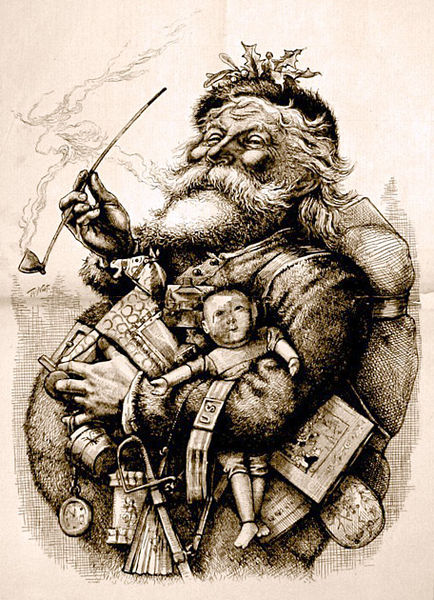
Thomas Nast’s full realization of Santa Claus, “Merry Old Santa Claus,” January 1, 1881. Harper’s Weekly, from the Ohio State University Billy Ireland Cartoon Library and Museum, via Bill Cassellman's site

Thomas Nast’s full realization of Santa Claus, “Merry Old Santa Claus,” January 1, 1881. Harper’s Weekly, from Wikimedia.

Our views of Santa Claus owe a great deal also to Coca-Cola advertising campaigns. Coca-Cola first noted Santa’s use of the drink in a 1922 campaign to suggest Coke was a year-round drink (100 years after the publication of Livingston’s poem). The company’s on-line archives gives details:

In 1930, artist Fred Mizen painted a department store Santa in a crowd drinking a bottle of Coke. The ad featured the world’s largest soda fountain, which was located in the department store of Famous Barr Co. in St. Louis, Mo. Mizen’s painting was used in print ads that Christmas season, appearing in The Saturday Evening Post in December 1930.

1936 Coca-Cola Santa cardboard store display

1936 Coca-Cola Santa cardboard store display


1942 original oil painting - 'They Remembered Me'

1942 original oil painting – ‘They Remembered Me’

Archie Lee, the D’Arcy Advertising Agency executive working with The Coca-Cola Company, wanted the next campaign to show a wholesome Santa as both realistic and symbolic. In 1931, The Coca-Cola Company commissioned Michigan-born illustrator Haddon Sundblom to develop advertising images using Santa Claus — showing Santa himself, not a man dressed as Santa, as Mizen’s work had portrayed him.

For inspiration, Sundblom turned to Clement Clark Moore’s 1822 poem “A Visit From St. Nicholas” (commonly called “‘Twas the Night Before Christmas”). Moore’s description of St. Nick led to an image of Santa that was warm, friendly, pleasantly plump and human. For the next 33 years, Sundblom painted portraits of Santa that helped to create the modern image of Santa — an interpretation that today lives on in the minds of people of all ages, all over the world.

Santa Claus is a controversial figure. Debates still rage among parents about the wisdom of allowing the elf into the family’s home, and under what conditions. Theologians worry that the celebration of Christmas is diluted by the imagery. Other faiths worry that the secular, cultural impact of Santa Claus damages their own faiths (few other faiths have such a popular figure, and even atheists generally give gifts and participate in Christmas rituals such as putting up a decorated tree).

For over 100 years, Santa Claus has been a popular part of commercial, cultural and religious life in America. Has any other icon endured so long, or so well?

Coca-Cola’s film, “The Legend of Coca-Cola and Santa Claus”:

________________________
Below:
From the University of Toronto Library’s Representative Poetry Online

Major Henry Livingston, Jr. (1748-1828)

Account of a Visit from St. Nicholas

1 ‘Twas the night before Christmas, when all thro’ the house,

2 Not a creature was stirring, not even a mouse;

3 The stockings were hung by the chimney with care,

4 In hopes that St. Nicholas soon would be there;

5 The children were nestled all snug in their beds,

6 While visions of sugar plums danc’d in their heads,

7 And Mama in her ‘kerchief, and I in my cap,

8 Had just settled our brains for a long winter’s nap –

9 When out on the lawn there arose such a clatter,

10 I sprang from the bed to see what was the matter.

11 Away to the window I flew like a flash,

12 Tore open the shutters, and threw up the sash.

13 The moon on the breast of the new fallen snow,

14 Gave the lustre of mid-day to objects below;

15 When, what to my wondering eyes should appear,

16 But a miniature sleigh, and eight tiny rein-deer,

17 With a little old driver, so lively and quick,

18 I knew in a moment it must be St. Nick.

19 More rapid than eagles his coursers they came,

20 And he whistled, and shouted, and call’d them by name:

21 “Now! Dasher, now! Dancer, now! Prancer, and Vixen,

22 “On! Comet, on! Cupid, on! Dunder and Blixem;

23 “To the top of the porch! to the top of the wall!

24 “Now dash away! dash away! dash away all!”

25 As dry leaves before the wild hurricane fly,

26 When they meet with an obstacle, mount to the sky;

27 So up to the house-top the coursers they flew,

28 With the sleigh full of Toys — and St. Nicholas too:

29 And then in a twinkling, I heard on the roof

30 The prancing and pawing of each little hoof.

31 As I drew in my head, and was turning around,

32 Down the chimney St. Nicholas came with a bound:

33 He was dress’d all in fur, from his head to his foot,

34 And his clothes were all tarnish’d with ashes and soot;

35 A bundle of toys was flung on his back,

36 And he look’d like a peddler just opening his pack:

37 His eyes — how they twinkled! his dimples how merry,

38 His cheeks were like roses, his nose like a cherry;

39 His droll little mouth was drawn up like a bow.

40 And the beard of his chin was as white as the snow;

41 The stump of a pipe he held tight in his teeth,

42 And the smoke it encircled his head like a wreath.

43 He had a broad face, and a little round belly

44 That shook when he laugh’d, like a bowl full of jelly:

45 He was chubby and plump, a right jolly old elf,

46 And I laugh’d when I saw him in spite of myself;

47 A wink of his eye and a twist of his head

48 Soon gave me to know I had nothing to dread.

49 He spoke not a word, but went straight to his work,

50 And fill’d all the stockings; then turn’d with a jerk,

51 And laying his finger aside of his nose

52 And giving a nod, up the chimney he rose.

53 He sprung to his sleigh, to his team gave a whistle,

54 And away they all flew, like the down of a thistle:

55 But I heard him exclaim, ere he drove out of sight –

56 Happy Christmas to all, and to all a good night.

Online text copyright © 2005, Ian Lancashire for the Department of English, University of Toronto. Published by the Web Development Group, Information Technology Services, University of Toronto Libraries. Be sure to visit this site for more information on this poem, on Maj. Livingston, and on poetry in general.

More:


Damon Runyon, the Wright brothers, Eddie Rickenbacker, illegal flying, and “Silver bells”

December 18, 2018

[This is mostly an encore post, written two years ago, marking an anniversary for December 18]

Spent a day with my aging father-in-law last week. Conversation is difficult, but memories always flow. We watched the movie version of “Guys and Dolls,” with Sinatra and Brando, and Stubby Kaye’s get-up-and-sing version of “Sit Down! You’re Rockin’ the Boat.”

He was happy to see the thing again, though in the first few minutes he said he didn’t think he’d ever seen the film. My fondness for the piece, and for Damon Runyon’s stories, goes back (too many) decades to a production of the play by the Utah Valley Opera Society. They hired our high school drama director, David Larson, to direct. On a lark I auditioned, telling them I couldn’t really sing or dance, and ended up with a lot of lines in a couple of supporting roles, and singing and dancing both in the chorus.

When my father-in-law joined in the movie chorus of “Fugue for Tinhorns,” I knew we had a good couple of hours. We laughed, watched, reminisced, and sang along.

Damon Runyon could tell stories, true stories about real people. Sometimes the names were changed to protect the innocent, or the guilty; sometimes the real names were more entertaining than the fictional names Runyon invented.

Some time ago I stumbled across the story of Runyon’s son, Damon Runyon, Jr., using an early airplane to spread the playwright’s ashes. It’s a story Runyon would have appreciated. It’s appropriate for the day after the anniversary of the Wrights’ first flight; December 18 is the anniversary of the event.

On December 17, Orville and Wilbur Wright got their heavier-than-air flying contraption to actually fly with motor driving it along.

First flight of the Wright Flyer I, December 1...

First flight of the Wright Flyer I, December 17, 1903, Orville piloting, Wilbur running at wingtip. Photo from Wikipedia

On December 18, Damon Runyon, Jr., got Eddie Rickenbacker to fly over Broadway to scatter the ashes of his father, Damon Runyon.

First Lieutenant E. V. [Eddie] Rickenbacker, 9...

First Lieutenant E. V. [Eddie] Rickenbacker, 94th Aero Squadron, American ace, standing up in his Spad plane. Near Rembercourt, France. Photo from Wikipedia. This photo dates near World War I; Rickenbacker remained a hero for a couple of decades. In 1946, he flew a DC-3 over New York City, and illegally scattered the ashes of raconteur Damon Runyon over his beloved Broadwary.

Not exactly the next day. 43 years and one day apart.  The Wrights first flew in 1903; Runyon died in 1946.

Today in Literature, for December 18:

On this day in 1946 Damon Runyon’s ashes were scattered over Broadway by his son, in a plane flown by Eddie Rickenbacker. Runyon was born in Manhattan, Kansas; he arrived at the bigger apple at the age of thirty, to be a sportswriter and to try out at Mindy’s and the Stork Club and any betting window available his crap-shoot worldview: “All of life is six to five against.” Broadway became his special beat, and in story collections like Guys and Dolls he developed the colorful characters — Harry the Horse, the Lemon Drop Kid, Last Card Louie — and the gangster patois that would swept America throughout the thirties and forties.

A lot of history packed in there.  Runyon’s early reportorial career included a lot of that history — he wrote the lead story for United Press on the inauguration of Franklin Roosevelt, for one example.  Runyon found a uniquely American vein of literary ore on Broadway in New York City, and in the ne’er-do-wells, swells, tarts and reformers who flocked to the City that Never Sleeps to seek fame, or fortune, or swindle that fortune from someone else.

As a reporter and essayist, he smoked a lot.  Throat cancer robbed him, first of his voice, then his life at 56.

Runyon’s ashes were spread illegally over Broadway, from a DC-3 piloted by Rickenbacker. Runyon would have liked that.

You couldn’t make this stuff up.

Factoids of history:

  • Twenty movies got crafted from Runyon stories, including “The Lemon Drop Kid” — in two versions, 1934 and 1951. Appropriate to the Christmas season, the 1951 version introduced the song, “Silver Bells” composed by Jay Livingston and Ray Evans. (Great explanation of the movie, and song, here.)
  • Runyon got fame first as a sports writer.  He was inducted into the writer’s wing of the Baseball Hall of Fame in 1967.
  • According to Wikipedia, Jerry Lewis and others owe a great debt to Damon Runyon:  “The first ever telethon was hosted by Milton Berle in 1949 to raise funds for the Damon Runyon Cancer Research Foundation.”
  • One might salivate over the varied fare offered in the theaters of Broadway in 1946, Runyon’s final year, “Annie, Get Your Gun” through Shakespeare, and everything in between and on either side
  • Runyon and H. L. Mencken both covered the trial of Bruno Hauptmann, the accused (then convicted) kidnapper of Charles Lindbergh’s baby son
  • Yes, of course, “Guys and Dolls.” Frank Loesser created it, but not of whole cloth, but from the stories of Damon Runyon; it is a masterpiece, perhaps in several realms.  In homage to Runyon, Adam Gopnik wrote:

    Just as Chandler fans must be grateful for Bogart, Runyon fans have to be perpetually happy that the pure idea of Runyon, almost independent of his actual writings, produced the best of all New York musicals: Frank Loesser’s “Guys and Dolls,” which made its début in 1950 and is just now reopening on Broadway in a lavish and energetic new production. But then “Guys and Dolls” is so good that it can triumph over amateur players and high-school longueurs and could probably be a hit put on by a company of trained dolphins in checked suits with a chorus of girl penguins.

    Your author here, Dear Reader, was once one of those trained dolphins. It was magnificent.

“Silver Bells,” from “The Lemon Drop Kid,” with William Frawley, Virginia Maxwell and Bob Hope (1951 version):

More:

A view of New York City in 1946:

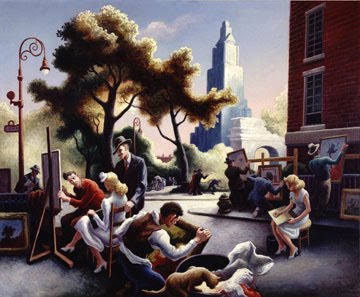
Thomas Hart Benton (1889–1975)

Thomas Hart Benton (1889–1975) “The Artist’s Show, Washington Square,” painted in 1946

Times Square, showing part of Broadway, in November 1946, from the magnificent archives of Life Magazine:

Brownout Time Square.November 1946.© Time Inc.Herbert Gehr - See more at: http://kcmeesha.com/2011/11/29/old-photos-times-square-through-the-years/#sthash.ru9W0F9h.dpuf

Brownout Time Square.November 1946.© Time Inc.Herbert Gehr – See more at: http://kcmeesha.com/2011/11/29/old-photos-times-square-through-the-years/#sthash.ru9W0F9h.dpuf

This is an encore post.

Yes, this is an encore post. Defeating ignorance takes patience and perseverance.

Save

Save


New Jersey flies flags for statehood, December 18, 2018

December 18, 2018

New Jersey's Capitol in Trenton, by Vagabond Voyage. Many complain it's difficult to get a good, nice looking photo of this building due to development around it. This photo is alleged to be one of the better photos possible.

New Jersey’s Capitol in Trenton, by Vagabond Voyage. Many complain it’s difficult to get a good, nice looking photo of this building due to development around it. This photo is alleged to be one of the better photos possible.

December 18 is New Jersey Statehood Day. 131 years ago, New Jersey became the third colony to ratify the Constitution, in 1787.

U.S. Flag Code encourages residents of each state to fly the U.S. flag on their state’s anniversary of statehood. New Jersey won consideration as the Third State, on December 18, 1787, by being the third colony to ratify the U.S. Constitution. Technically the U.S. did not come into existence until six more states ratified, but among the first 13 states, statehood dates are calculated traditionally as the day the colony ratified.

Does anyone in New Jersey celebrate it?

New Jersey's state flag. Just try to find photos of the U.S. flag and New Jersey flag flying together.

New Jersey’s state flag. Just try to find photos of the U.S. flag and New Jersey flag flying together.

New Jersey's Capitol Building and surroundings in Trenton, from across the Delaware River. U.S. flag can be seen flying at the Capitol. Wikipedia image.

New Jersey’s Capitol Building and surroundings in Trenton, from across the Delaware River. U.S. flag can be seen flying at the Capitol. Wikipedia image.

More:

  • Next Fly Your Flag dates: December 28 in Iowa, for Iowa statehood; December 29 in Texas, for Texas statehood.
  • Flags still fly half staff in memory of President George H. W. Bush; tradition and regulations say flags fly half-staff for 30 days after the death of a president, which puts flags at half staff until at least January 2, 2019


Save


115 years ago today, Wright Brothers slipped the surly bonds of Earth

December 17, 2018

Kill Devil Hills monument to theWright Brothers
Wikipedia description: Standing sixty feet (18.3 meters) tall and perched atop a ninety foot (27.4 meters) stabilized sand dune known as Kill Devil Hill, this monument towers over Wright Brothers National Memorial Park in Kill Devil Hills, NC. The park commemorates and preserves the site where the Wright brothers launched the world’s first successful sustained, powered flights in a heavier-than-air machine. The inscription that wraps around the base of the monument states “In commemoration of the conquest of the air by the brothers Wilbur and Orville Wright. Conceived by genius, achieved by dauntless resolution and unconquerable faith.” Photo by Ken Thomas, taken with a Panasonic Lumix DMC-FZ50 in Dare County, NC, USA.

At this site, on December 17, 1903, Wilbur and Orville Wright first achieved flight in a heavier-than-air machine.

“Surly bonds of Earth” refers to that poem written by the Canadian pilot, popular with the Air Force and almost every pilot I’ve ever known, “High Flight” by John Gillespie Magee, Jr.

I am unaware of any proclamation for flag flying today, but you could have, had you wanted to and had you known.

More:

December 14, Alabama flies the flag for 199 years of statehood

December 14, 2018

U.S. and Alabama flags fly with the Moon and a rocket, at the U.S. Space and Rocket Center in Huntsville, Alabama. Photo by Jerry Slaughter, via Pinterest

U.S. and Alabama flags fly with the Moon and a rocket, at the U.S. Space and Rocket Center in Huntsville, Alabama. Photo by Jerry Slaughter, via Pinterest

Alabama joined the union on December 14, 1819, the 22nd state.

Under provisions of the U.S. Flag Code, residents of a state are encouraged to fly the U.S. flag on their respective statehood day.

Does Alabama commemorate its own statehood? Perhaps there are big celebrations planned for statehood day in 2019, the 200th anniversary of statehood.

More: 

Caption from LInn's Stamp News:

The stamp planned for Alabama’s Bicenntennial in 2019. Caption from LInn’s Stamp News: “Alabama Statehood. The 22nd state, Alabama, was admitted into the union on Dec. 14, 1819. The new stamp commemorating this bicentennial shows a photograph by Alabama photographer Joe Miller of sunset in Cheaha State Park, including a view of Talladega National Forest, which surrounds the park.”


Save

Save


Flags fly December 12 for Pennsylvania statehood

December 12, 2018

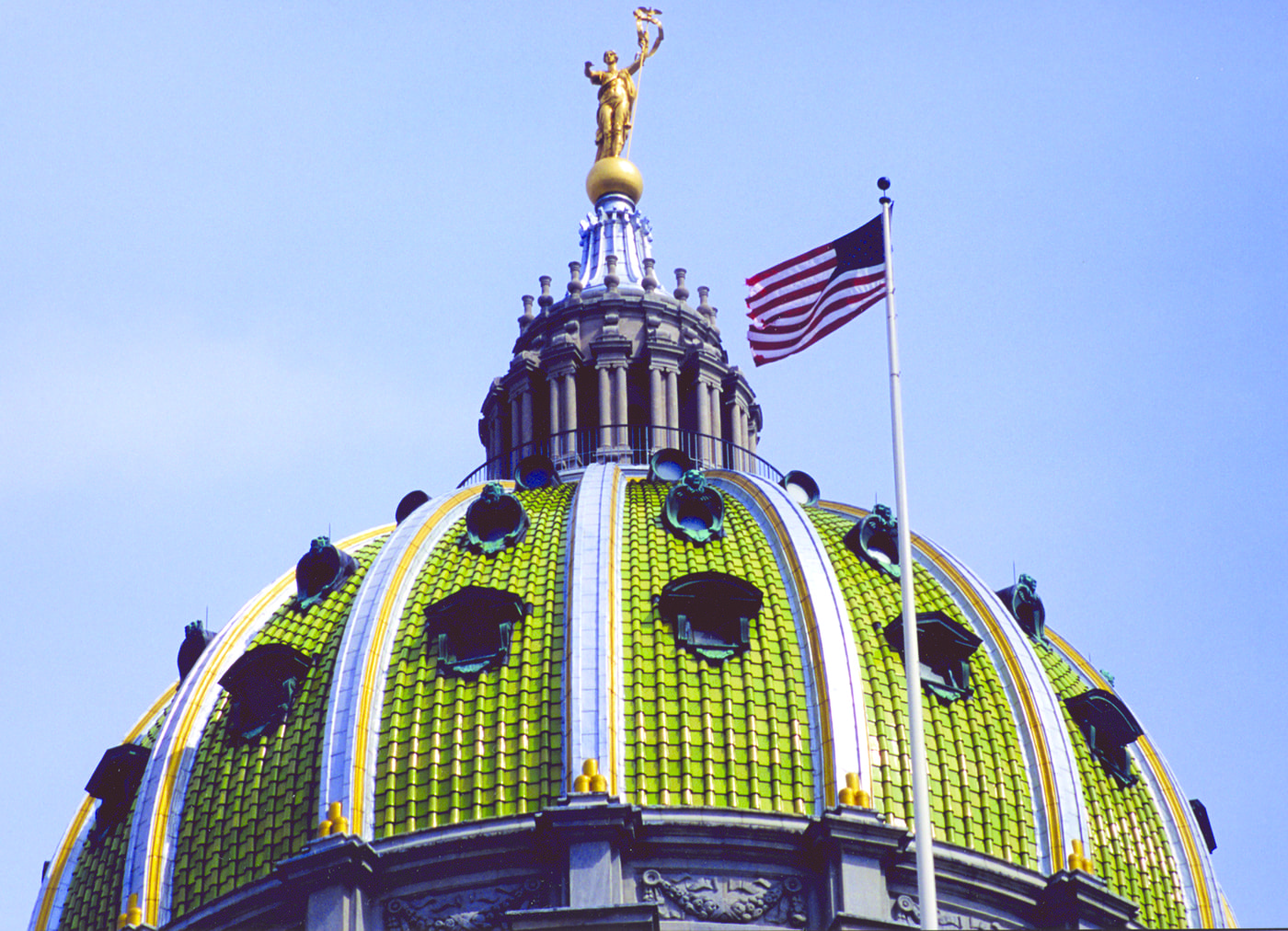
U.S. flag flies from the front portico of the Pennsylvania Capitol Building in Harrisburg, Pennsylvania. The elaborate building was completed in 1906, and dedicated by President Theodore Roosevelt, who called it one of the

U.S. flag flies from the front portico of the Pennsylvania Capitol Building in Harrisburg, Pennsylvania. The elaborate building was completed in 1906, and dedicated by President Theodore Roosevelt, who called it one of the “handsomest buildings I ever saw.” UncoveringPA.com

As the U.S. flag code suggests, flags fly in Pennsylvania today honoring Pennsylvania Statehood.

Pennsylvania’s convention ratified the U.S. Constitution on December 12, 1787, just days after Delaware. Pennsylvania’s ratification was the second of nine states’ required to put the Constitution into effect.

If there is any ceremony or formal celebration planned, I haven’t found it yet. Any Pennsylvanians know?

The capitol building recently underwent an extensive renovation worthy of a more-than-century-old building. Pennlive.com features drone footage of the building now.

Drone operator Matthew Dressler took to the skies recently for PennLive to capture a spectacular, birds-eye view of the Pennsylvania Capitol dome and complex. The Capitol, dedicated in 1906, was built and furnished for a cost of $13 million dollars and features paintings, stained glass and furnishings by some of the best artisans of the day. The exterior is faced with Vermont granite and the roof is made up of green glazed terra cotta tile. The 272-foot, 52 million-pound dome was inspired by Michelangelo’s design for St. Peter’s Basilica in Rome. The Capitol was the tallest building between Philadelphia and Pittsburgh for 80 years.

Newly-renovated Pennsylvania Capitol dome and the U.S. flag. Image from Wohlsen Construction, who performed the renovations.

Newly-renovated Pennsylvania Capitol dome and the U.S. flag. Image from Wohlsen Construction, who performed the renovations.

More:


December 11: Fly the flag for Indiana Statehood, Hoosiers!

December 11, 2018

Indiana won admission to the union on December 11, 1816.

U.S. Flag Code urges residents of each state to fly the U.S. flag on the anniversary of statehood, so flags may be flying in Indiana today.

A giant, 50 X 80 foot flag flies from a 232 foot flagpole at Glenbrook Dodge Chrysler Jeep in Fort Wayne, Indiana. Is it the largest regularly flown in the U.S.? Photo by Christopher Crawford, who sells prints of this giant patriotic display, at ChrisCrawfordPhoto.com

A giant, 50 X 80 foot flag flies from a 232 foot flagpole at Glenbrook Dodge Chrysler Jeep in Fort Wayne, Indiana. Is it the largest regularly flown in the U.S.? Photo by Christopher Crawford, who sells prints of this giant patriotic display, at ChrisCrawfordPhoto.com

Why are the biggest flags in most states flown at car dealerships? Asking for a friend, who notes the Flag Code says flags are not to be flown as advertising devices.

The Glenbrook dealership is proud to fly the flag; details from the dealership website.

The large American flag flying high above our dealership is now an established landmark in the city of Fort Wayne.

We believe this to be one of the largest continuously flying flags in the United States. It was erected in 2001. The flag symbolizes our appreciation to our country and to the many customers we’ve had the pleasure to serve over the years.

This flag measures 50 feet by 80 feet. The flagpole is 43 inches in diameter. The pole weighs 35,600 pounds! The base contains 400,000 lbs of concrete. The flag is made of nylon and weighs 80 pounds. The flag can last anywhere from 2 days to 2 months before it has to be changed.

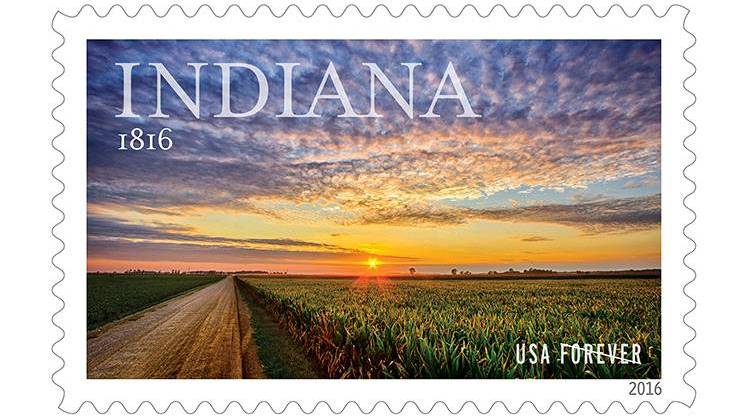
Indiana got a bicentennial stamp in 2016, from a stunning photograph from Indiana native Michael Matti.

Indiana's bicentennial stamp, from a photography by Michael Matti.

Indiana’s bicentennial stamp, from a photography by Michael Matti.

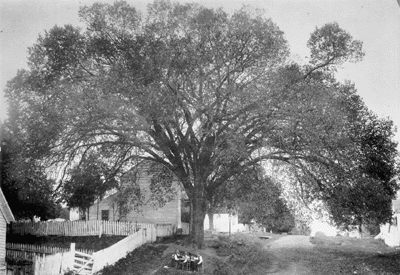
Interesting factoid: Delegates to a convention to create Indiana’s state constitution found the summer of 1816 too hot to stay indoors. So they adjourned most activities outdoors, under a massive elm tree, the Constitution Elm. The mighty tree succumbed to Dutch elm disease in 1925, sadly.

“This photograph of the ‘Constitution Elm’ was taken between 1921 and 1925. Delegates to the June 1816 constitutional convention apparently often worked in the shade of this tree. Although specific reports of dimensions vary, it was enormous with branches that spanned over 100 feet. It died of Dutch Elm Disease in 1925.” Indiana Division, Indiana State Library.

Here’s a story of Indiana’s path to statehood, produced in 2016 for Indiana’s Bicentennial.

Happy statehood day, Hoosiers; fly your flags today.

A barn side flag in Spencer, Indiana. This flag was painted on a shipping pallet. BookCoverPics.

A barn side flag in Spencer, Indiana. This flag was painted on a shipping pallet. BookCoverPics.


Typewriter of the moment: Nelly Sachs

December 10, 2018

2010_sachs-typewriter2

Typewriter of Nelly Sachs. It’s a Mercedes, if I have identified it correctly.

She fled Nazi Germany for Sweden in 1940. In Sweden, she adapted to a new culture. Then she wrote about the experiences of flight, and adaptation.

In 1966 the Nobel organization awarded the Nobel Prize for Literature to Nelly Sachs. Sachs was born December 10, 1891. Google’s Doodle honored her on December 10, 2018, with a short video and image of her typewriter. The animation shows Sachs’ typewriter in a suitcase, an homage

Google explained at YouTube:

December 10th, 2018: Google honors Nelly Sachs. She was a Jewish German-Swedish poet and playwright.

Nelly Sachs was born on 10 December 1891 in Berlin. In 1940 Nelly fled with her aged mother to Sweden. Nelly Sachs and her mother escaped on the last flight.

Her best-known play is: … “Eli – Ein Mysterienspiel vom Leiden Israels” (1950) 1957 she got the Nobel Prize in Literature. Sachs’ poetry is intensely lyrical and reflects some influence by German Romanticism. Happy birthday Nelly Sachs.

* * * * *

Music: “Trio for Piano Violin and Viola” by Kevin MacLeod

Google shows 3 sketches of the doodle.

More about this doodle: “Nelly Sachs 127th birthday” https://www.google.com/doodles/nelly-…

She was also honored by a stamp by German Bundespost in 1991: https://www.briefmarken-bilder.de/brd… #nellysachs #googledoodle

Nelly Sachs Biography (Wikipedia): Born Leonie Sachs in Berlin-Schöneberg, Germany, in 1891 to the wealthy natural rubber and gutta-percha manufacturer Georg William Sachs (1858–1930) and his wife Margarete, née Karger (1871–1950),[1] she was educated at home because of frail health. She showed early signs of talent as a dancer, but her protective parents did not encourage her to pursue a profession. She grew up as a very sheltered, introverted young woman and never married. She pursued an extensive correspondence with, and was friends with, Selma Lagerlöf and Hilde Domin. As the Nazis took power, she became increasingly terrified, at one point losing the ability to speak, as she would remember in verse: “When the great terror came/I fell dumb.” Sachs fled with her aged mother to Sweden in 1940. It was her friendship with Lagerlöf that saved their lives: shortly before her own death Lagerlöf intervened with the Swedish royal family to secure their release from Germany. Sachs and her mother escaped on the last flight from Nazi Germany to Sweden, a week before Sachs was scheduled to report to a concentration camp. They settled in Sweden and Sachs became a Swedish citizen in 1952.

Living in a tiny two-room apartment in Stockholm, Sachs cared alone for her mother for many years, and supported their existence by translations between Swedish and German. After her mother’s death, Sachs suffered several nervous breakdowns characterized by hallucinations, paranoia, and delusions of persecution by Nazis, and she spent a number of years in a mental institution. She continued to write even while hospitalized. She eventually recovered sufficiently to live on her own, though her mental health would always be fragile. Her worst breakdown was ostensibly precipitated by hearing German speech during a trip to Switzerland to accept a literary prize. However, she maintained a forgiving attitude toward a younger generation of Germans, and corresponded with many German-speaking writers of the postwar period, including Hans Magnus Enzensberger and Ingeborg Bachmann. Source: https://en.wikipedia.org/wiki/Nelly_S…

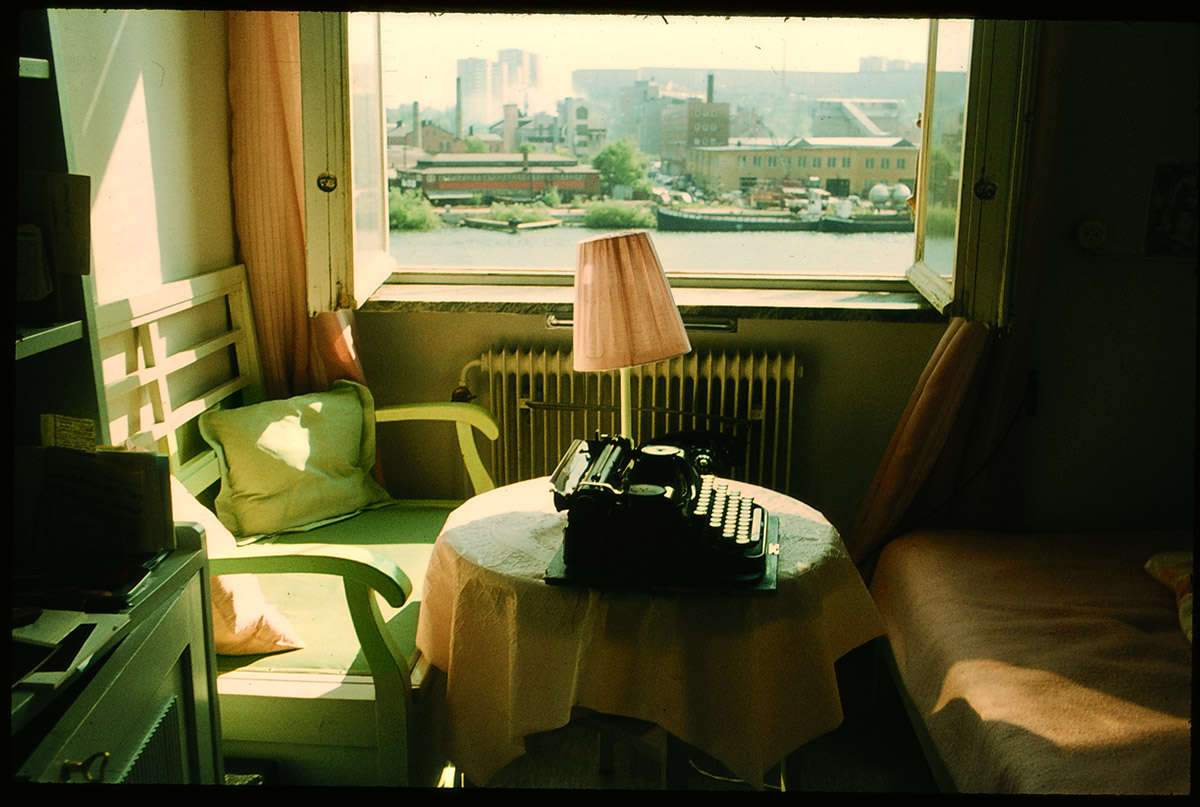
Apartment of Nelly Sachs, with her typewriter, in Stockholm, Sweden. Gewerk.com image.

Apartment of Nelly Sachs, with her typewriter, in Stockholm, Sweden. Gewerk.com image.

More:

Nelly Sachs, undated photo (probably after 1966). Image from Heavy.com

Nelly Sachs, undated photo (probably after 1966). Image from Heavy.com


December 7, 2018: Fly flags for Pearl Harbor Remembrance, and for Delaware statehood — and at half staff

December 7, 2018

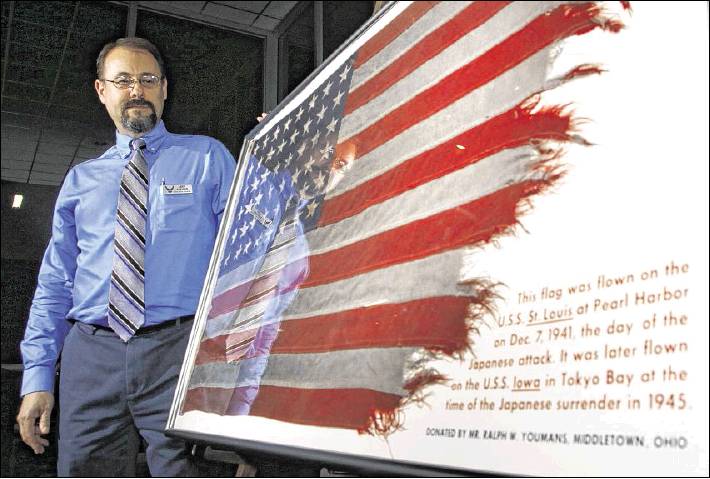
From Dayton Daily News: Jeff Duford, curator for the National Museum of the U.S. Air Force, with a flag that flew on the U.S.S. St. Louis in Hawaii during the attack on Pearl Harbor on Dec. 7, 1941. The same flag flew aboard the U.S.S. Iowa in Tokyo Bay on September 16, 1944, as Japan signed instruments of surrender aboard the U.S.S. Missouri.

From Dayton Daily News: Jeff Duford, curator for the National Museum of the U.S. Air Force, with a flag that flew on the U.S.S. St. Louis in Hawaii during the attack on Pearl Harbor on Dec. 7, 1941. The same flag flew aboard the U.S.S. Iowa in Tokyo Bay on September 16, 1944, as Japan signed instruments of surrender aboard the U.S.S. Missouri. Photo by Ty Greenlees, Dayton Daily News [This flag was displayed for one day at the museum, on Pearl Harbor Remembrance Day 2016.]

December 7 is a two-fer flag-flying day.

By public law, December 7 is Pearl Harbor Remembrance Day, and Americans fly the U.S. flag in memory of those who lost their lives at Pearl Harbor on December 7, 1941. U.S. flags should be flown at half-staff.

As for Delaware, under the U.S. Flag Code, residents of the relevant state should fly their U.S. flag on the date the state joined the union.

In 1787 Delaware quickly and promptly elected delegates to the former colony’s convention to ratify the Constitution proposed at the Philadelphia convention just over three months earlier. The ratification of the Constitution won opposition from strong factions in almost every state. Pols anticipated tough fights in New York, Virginia, and other states with large populations. They also expected other states would wait to see what the bigger states did.

Delaware didn’t wait.  On December 7 Delaware became the first of the former British colonies to ratify the Constitution. Perhaps by doing so, it guaranteed other states would act more favorably on ratification.

Because Delaware was first, it is traditionally granted first position in certain ceremonies, such as the parades honoring newly-inaugurated presidents. Delaware’s nickname is “The First State.”

In Delaware and the rest of the nation, fly your flags on December 7, 2016. If you can, fly your flag at half-staff to honor the dead at Pearl Harbor; if you have a flag on a pole that cannot be adjusted, just fly the flag normally.

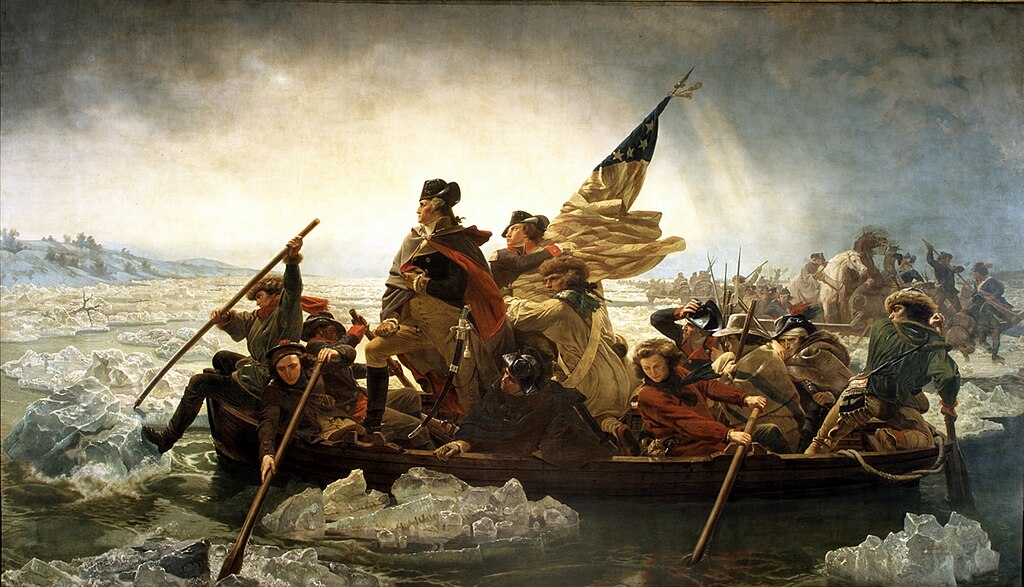
The most famous portrayal of a U.S. flag flying in Delaware is in the painting by Emanuel Leutze (American, 1816–1868).

The most famous portrayal of a U.S. flag flying in Delaware is in the painting by Emanuel Leutze (American, 1816–1868). “Washington Crossing the Delaware,” 1851. The Metropolitan Museum of Art, New York, Gift of John Stewart Kennedy, 1897 (97.34) Among other problems with this portrayal: The flag depicted had not been designated on the date of the crossing, Christmas 1776.

Yes, this is mostly an encore post. Fighting ignorance requires patience.

Yes, this is mostly an encore post. Fighting ignorance requires patience.


World Malaria Report 2018: World looks away as malaria bounces back

December 7, 2018

Covers of the last four World Malaria Reports. World Health Organization (WHO)

Covers of the last four World Malaria Reports. World Health Organization (WHO)

It’s a common tale but true: In any period when nations collaborate to defeat or eradicate malaria, funders of the programs get board and cut funding.

Malaria roars back.

This cycle has nothing to do with pesticides or medicines, mostly. Especially it’s not a problem that can be fixed with more DDT.

When a nation focuses on beating malaria, progress occurs. When nations lose their focus, malaria strikes back.

After great progress reducing malaria infections and malaria deaths between 1999 and 2017, nations including the U.S. lost focus. International donors failed to contribute enough money to keep the fight going.

World Malaria Report 2018 notes the striking back by malaria.

One other thing we can be quite sure of: Almost all mass media will ignore this report.

What will you do to change things?

You can help by donating $10 to a charity that delivers bednets to people who need them in Asia and Africa. You can help by writing letters to your local newspapers, to your Congressional representatives, and to the President. Every little bit helps.

Here’s the press release on World Malaria Report 2018, which was released by the World Health Organization (WHO) on November 19, 2018.

WHO and partners launch new country-led response to put stalled malaria control efforts back on track

19 November 2018
News Release

Maputo/Geneva

Reductions in malaria cases have stalled after several years of decline globally, according to the new World malaria report 2018. To get the reduction in malaria deaths and disease back on track, WHO and partners are joining a new country-led response, launched today, to scale up prevention and treatment, and increased investment, to protect vulnerable people from the deadly disease.

For the second consecutive year, the annual report produced by WHO reveals a plateauing in numbers of people affected by malaria: in 2017, there were an estimated 219 million cases of malaria, compared to 217 million the year before. But in the years prior, the number of people contracting malaria globally had been steadily falling, from 239 million in 2010 to 214 million in 2015.

“Nobody should die from malaria. But the world faces a new reality: as progress stagnates, we are at risk of squandering years of toil, investment and success in reducing the number of people suffering from the disease,” says Dr Tedros Adhanom Ghebreyesus, WHO Director-General. “We recognise we have to do something different – now. So today we are launching a country-focused and -led plan to take comprehensive action against malaria by making our work more effective where it counts most – at local level.”

Where malaria is hitting hardest

In 2017, approximately 70% of all malaria cases (151 million) and deaths (274 000) were concentrated in 11 countries: 10 in Africa (Burkina Faso, Cameroon, Democratic Republic of the Congo, Ghana, Mali, Mozambique, Niger, Nigeria, Uganda and United Republic of Tanzania) and India. There were 3.5 million more malaria cases reported in these 10 African countries in 2017 compared to the previous year, while India, however, showed progress in reducing its disease burden.

Despite marginal increases in recent years in the distribution and use of insecticide-treated bed nets in sub-Saharan Africa – the primary tool for preventing malaria – the report highlights major coverage gaps. In 2017, an estimated half of at-risk people in Africa did not sleep under a treated net. Also, fewer homes are being protected by indoor residual spraying than before, and access to preventive therapies that protect pregnant women and children from malaria remains too low.

High impact response needed

In line with WHO’s strategic vision to scale up activities to protect people’s health, the new country-driven “High burden to high impact” response plan has been launched to support nations with most malaria cases and deaths. The response follows a call made by Dr Tedros at the World Health Assembly in May 2018 for an aggressive new approach to jump-start progress against malaria. It is based on four pillars:

  • Galvanizing national and global political attention to reduce malaria deaths;
  • Driving impact through the strategic use of information;
  • Establishing best global guidance, policies and strategies suitable for all malaria endemic countries; and
  • Implementing a coordinated country response.

Catalyzed by WHO and the RBM Partnership to End Malaria, “High burden to high impact” builds on the principle that no one should die from a disease that can be easily prevented and diagnosed, and that is entirely curable with available treatments.

“There is no standing still with malaria. The latest World malaria report shows that further progress is not inevitable and that business as usual is no longer an option,” said Dr Kesete Admasu, CEO of the RBM Partnership. “The new country-led response will jumpstart aggressive new malaria control efforts in the highest burden countries and will be crucial to get back on track with fighting one of the most pressing health challenges we face.”

Targets set by the WHO Global technical strategy for malaria 2016–2030 to reduce malaria case incidence and death rates by at least 40% by 2020 are not on track to being met.

Pockets of progress

The report highlights some positive progress. The number of countries nearing elimination continues to grow (46 in 2017 compared to 37 in 2010). Meanwhile in China and El Salvador, where malaria had long been endemic, no local transmission of malaria was reported in 2017, proof that intensive, country-led control efforts can succeed in reducing the risk people face from the disease.

In 2018, WHO certified Paraguay as malaria free, the first country in the Americas to receive this status in 45 years. Three other countries – Algeria, Argentina and Uzbekistan – have requested official malaria-free certification from WHO.

India – a country that represents 4% of the global malaria burden – recorded a 24% reduction in cases in 2017 compared to 2016. Also in Rwanda, 436 000 fewer cases were recorded in 2017 compared to 2016. Ethiopia and Pakistan both had estimated decreases of more than  240 000 in the same period.

“When countries prioritize action on malaria, we see the results in lives saved and cases reduced,” says Dr Matshidiso Moeti, WHO Regional Director for Africa. “WHO and global malaria control partners will continue striving to help governments, especially those with the highest burden, scale up the response to malaria.”

Domestic financing is key

As reductions in malaria cases and deaths slow, funding for the global response has also shown a levelling off, with US$ 3.1 billion made available for control and elimination programmes in 2017 including US$ 900 million (28%) from governments of malaria endemic countries.  The United States of America remains the largest single international donor, contributing US$ 1.2 billion (39%) in 2017.

To meet the 2030 targets of the global malaria strategy, malaria investments should reach at least US$6.6 billion annually by 2020 – more than double the amount available today.

Editors note

Download the WHO World malaria report 2018 app for an interactive experience with the report’s country data: App Store (iOS devices) | Google Play (Android devices).


O.K? It’s Martin van Buren’s birthday, December 5

December 5, 2018

Former President Martin van Buren, circa 1855-1888. Matthew Brady photograph (Imperial print of Martin Van Buren. Salted paper print from glass negative. Provenance from W.H. Lowdermilk & Co., Rare Books, 1418 F Street, Washington, DC) Metropolitan Museum image, via Wikimedia

Former President Martin van Buren, circa 1855-1888. Matthew Brady photograph (Imperial print of Martin Van Buren. Salted paper print from glass negative. Provenance from W.H. Lowdermilk & Co., Rare Books, 1418 F Street, Washington, DC) Metropolitan Museum image, via Wikimedia

Martin van Buren was our nation’s 8th president, serving one term, 1837-1841.

This photo is roughly 15 years after van Buren left office, taken in the Washington, D.C., studio of Matthew Brady, whose photography gained fame from his work photographing battle sites during the American Civil War.

Martin van Buren was born December 5, 1782, in Kinderhook, New York. He is the only president to have the first name Martin. He’d be 236 years old today, and still king of the mutton chop sideburns among presidents.

One the grammar school myths of Van Buren is that the initials for his nickname, “Old Kinderhook,” are the origins of the term “O.K.”

Van Buren died on July 24, 1862.

More:

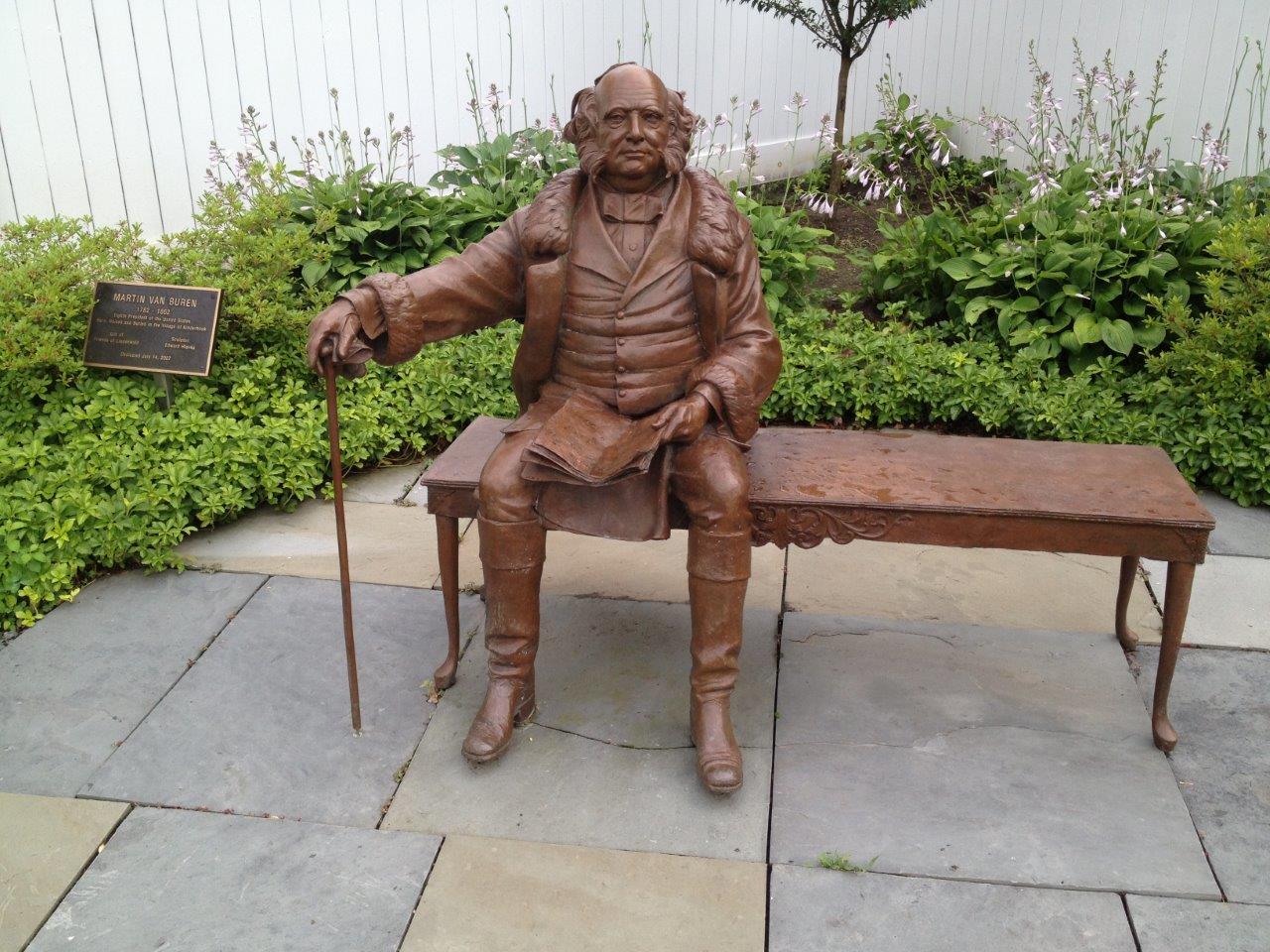
At Broad and Hudson Streets in Kinderhook, New York, one can sit with a statue of Martin Van Buren, and see if one can decipher the newspaper he is reading. PresidentsUSA image

At Broad and Hudson Streets in Kinderhook, New York, one can sit with a statue of Martin Van Buren, and see if one can decipher the newspaper he is reading. PresidentsUSA image