News flash: Texas has a second natural lake!

July 20, 2009

Years ago, in Virginia, I had learned that Virginia had only one natural lake, the Great Dismal Swamp.  Accompanying that chunk of information in that lecture was that Texas had only two natural lakes.

But upon arriving in Texas, I could find reference to only one natural lake, Caddo, and it had ceased being fully natural when its maintenance fell to a dam.

What happened to Texas’s second natural lake?

A Google search right now on “Texas +’natural lake'” produces ten listings on the first page, all of them pointing to the fact that Texas has just one natural lake.  Here are the first five:

I have found a second natural lake in Texas. It’s not a new discovery at all — it’s just a case of people not having the facts, and overlooking how to find the truth.  It’s especially difficult when the lake hides itself.

Our testing coordinator at Molina High School, Brad Wachsmann, spins yarns that belie his youth.  In the middle of one yarn last year, corroborated by other yarns, he mentioned that he has family in Big Lake, Texas; and he described visiting and having relatives urge people to run out and see the lake since it’s rebirth in torrential rains.

“A second natural lake in Texas?” I asked.  Wachsmann knew the drill.  Yes, Big Lake is a natural lake in Texas, and yes, people forget about it.

Texas teachers, listen to your testing coordinators, okay?

All of this came to mind reading the Austin American-Statesman, still a bastion of great journalism despite problems in the newspaper industry.  On Monday, July 7, the paper ran a story and an editorial about the clean up of the oil industry refuse that killed the shoreline of part of the lake; the springs that once fed the lake have mostly gone dry, but that’s likely due to agricultural water mining.

It’s a story of boom and bust, environmental degradation for profit, and eventual recovery we hope.

Looking at the landscape that surrounds the Reagan County seat, you wonder whether the name Big Lake was somebody’s idea of joke. It’s dry and dusty, where the flora sprouts reluctantly and lives precariously.

Yet, the West Texas town of Big Lake got its name from a natural lake that was fed by springs that have long since gone dry. While the area may not fit everyone’s definition of photogenic, it has its own brand of charm – charm that could be enhanced if the damage done to the fragile ecosystem by salt spills were reversed or even minimized.

As the American-Statesman’s Ralph K.M. Haurwitz reported in Monday’s editions, the University of Texas and Texas A&M systems have benefited from the $4.4 billion in royalty payments and mineral income produced by its West Texas acreage since Santa Rita No. 1 well came in on May 28, 1923.

The salt water byproduct of oil and natural gas production, however, contaminated 11 square miles near Big Lake, killing most everything that grows. The lack of vegetation allows wind and water erosion.

Hey, it gets better.  This is real Texas history, real American history — you can’t make this stuff up.  Haurwitz’s article talks about the heritage of Texas education.   Remember that old story about setting aside certain sections of townships to help fund education in lands on the American frontier?  Texas wasn’t a public lands state as farther west, but it still reserved sections of land for the benefit of education.

Rose petals blessed by a priest?  I’ll wager the priest didn’t make the trip to the top of the derrick.  Haurwitz wrote:

BIG LAKE — Investors appealed to the patron saint of impossible causes when oil drilling began on University of Texas System land in 1921. It didn’t hurt.

Santa Rita No. 1 blew in on May 28, 1923, after rose petals blessed by a priest were scattered from the top of the derrick at the behest of some Catholic women in New York who had purchased shares in the Texon Oil and Land Co., which drilled that first well.

Since then, the UT System’s 2.1 million acres in West Texas have produced $4.4 billion in royalty payments and other mineral income for the Permanent University Fund, an endowment that supports the UT and Texas A&M University systems.

But this long-running bonanza for higher education exacted a price from the remote, semiarid landscape where it all began. Millions of barrels of salt water, a byproduct of oil and natural gas production, contaminated 11 square miles, or more than 7,000 acres, killing virtually all vegetation and leaving the land vulnerable to wind and water erosion. Hundreds of mesquite stumps with three feet of exposed roots testify to the dramatic loss of topsoil.
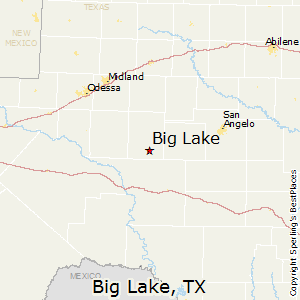
Texas, and Big Lake - from BigLakeTx.com

Where in Texas is Big Lake?

The town of Big Lake is just north of the lake itself, on State Highway 137 running north and south, and U.S. Highway 67 running east and west, approximately 65 miles west of San Angelo.   Big Lake sits about 10 miles north of Interstate 10, and about 75 miles south of Interstate 20.  Big Lake calls itself “the gateway to the Permian Basin.”

Big Lake is the home of Reagan County High School.  Jim Morris was baseball coach for the Reagan High Owls when his team persuaded him to try out for a major league baseball team.  His story was chronicled, with some artistic license, in the Disney movie “Rookie.”

Land managers are working to stop erosion on the often-dry shores of Big Lake using any trick they can find.  One trick:  Plant salt grass.

Salt grass?  Along Texas’s Gulf Coast, there are a few species of grass that, while not halophytes, are at least salt tolerant.  Salt grass.  This grass made it profitable to graze cattle on what would otherwise have been unproductive land in the Texas cattle boom.  This role in Texas history is memorialized in the Salt Grass Steakhouse chain, now found in five states.

And if planting salt grass works to control erosion, it will help clean up a large part of Texas other natural lake, Big Lake.

Big Lake’s being wet or dry is a whim of local climate.  You could say that half of all of Texas’s natural lakes are now dry as a result of continued warming; you could say that two good gully-washers or toad-stranglers could restore water to half of Texas’s natural lakes.
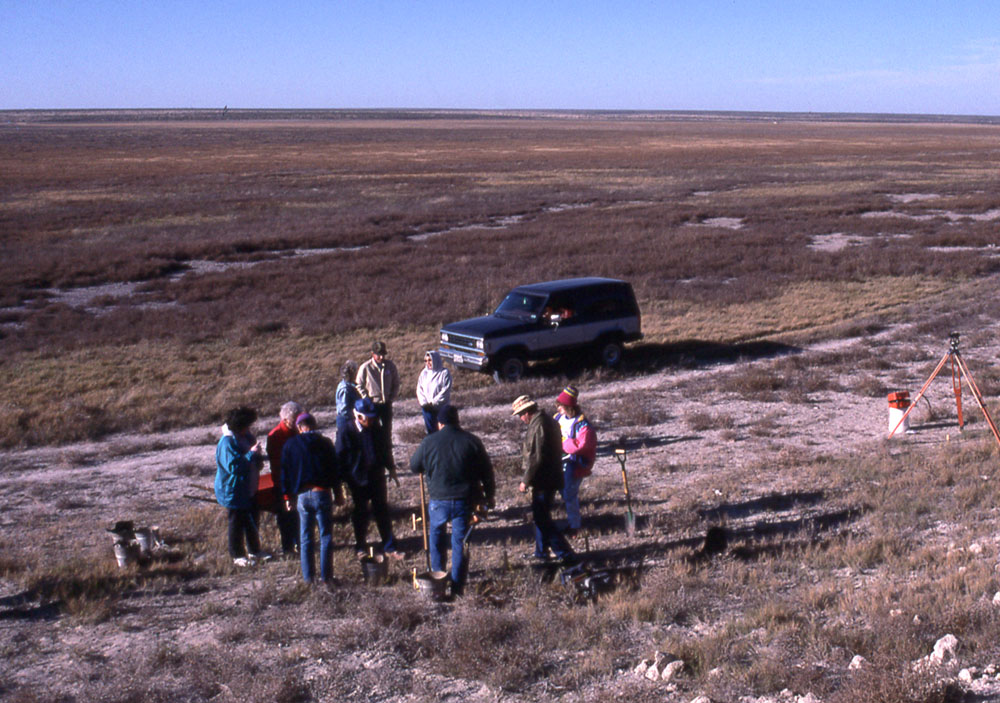
Big Lake Playa, from NightOwl Bakery and Roastery in Big Lake, Texas

Field crew meeting at the outset of the 1992 excavations at the Big Lake Bison Kill site. The dry bed of Big Lake stretches for miles in the background. Big Lake is an intermittent saline lake or playa, an uncommon landform on the Edwards Plateau. Photo by Larry Riemenschneider, Concho Valley Archeological Society.

More details about Big Lake and prehistory, below the fold.

Read the rest of this entry »


Scientist steps in to try to save the day

July 19, 2009

On the one hand, you hope he’s got a good copy of the original cast recording of “Man of La Mancha,” with the late Richard Kiley singing the importance of dreaming the impossible dream.  On the other hand, you hope it’s not an impossible situation at all.

Mathematics Professor Lorenzo Sadun declared his candidacy for the Texas State Board of Education seat representing District 10. He’ll be running against incumbent Cynthia Dunbar in a district that has a history of electing people with little or no education background and a commitment to scorched Earth conservative policies — if Dunbar chooses to run again.  Dunbar has not announced her intentions.

Sadun is professor of mathematics at the University of Texas, in Austin.

Mathematics Prof. Lorenzo Sadun, University of Texas - Daily Texan photo by Mike Paschal

Mathematics Prof. Lorenzo Sadun, University of Texas - Daily Texan photo by Mike Paschal

In the 2006 election, there was no Democratic nominee. Dunbar ran against a Libertarian and won approximately 70 percent of the vote. The 2010 primary election is scheduled for March, and Sadun declared last week that he will seek the Democratic nomination.

The Place 10 seat-holder may become very influential. With the board almost evenly split, a negative or positive vote can greatly affect educational policy and standards.

If Sadun is elected, he will be the only scientist on the board. He said that even though he may encounter opposition from members of the board, he will find a common ground with his colleagues and will pursue agreement without sacrificing the quality of education for Texas students.

“Despite my taking a fairly hard line, I am a conciliator,” Sadun said. “I have not met a person who knew so much I couldn’t teach them something, and I’ve never met someone who knew so little that they couldn’t teach me something.”

District 10 includes 14 counties surrounding Travis County to the east of the county, and the northern part of Travis County.  Travis, home to the Texas state capital Austin and one of Texas’s five supercounties, was split in education board districts to limit the influence of its  highly-educated, more liberal voter population.

District 10, Texas State Board of Education

District 10, Texas State Board of Education

Burnt Orange Report wrote that Dunbar will face opposition if she chooses to run again.

Events in District 10 offer a sign of hope that the era ended when apathy from candidates and voters allowe anti-public education forces to dominate the Texas State Board of Education.  And if Sadun were to win, it would be the first time a working scientist was elected to SBOE.

Who knows?  Sadun could succeed — but if he wins a seat on the SBOE, it’s not likely he’d sing that other song Richard Kiley made famous, “Stranger in Paradise.”  He’s no stranger to quality education, and SBOE isn’t paradise.


Probably not the way to get a good reputation among scientists

July 19, 2009

Tensions between science and religion, and science and business, continue to drag down Texas’s hopes to be known as a major research location.

A hard look shows it’s not just the Deliverance-style local politics at the State Board of Education on science standards.  Texas has trouble in a lot of areas.

For example, imagine a hurricane wiped out the town where one of the state’s major medical schools resides, and in the aftermath, rather than working to preserve the jobs of professors who agree to come back to the damaged buildings and storm-wracked town, the university uses the troubles as an excuse to get rid of faculty — not bad faculty, necessarily, just faculty the administration doesn’t like, or doesn’t know, or just for the heck of it.

This ain’t no way to run a medical school.

The rolling disaster that hit the Universityof Texas Medical Branch in Galveston, starting with Hurricane Ike, continued through unexpected layoffs of faculty on top of the 3,000 people laid off due to storm damage.  The layoffs were unjustified, too, many thought, and so they appealed.  The appeals process seems to have offered only a semblance of justice, to many of those involved, according to an article in The Scientist (free subscription required).

The story hasn’t got much traction in Texas media.


World history sources and images from the Library of Congress

July 19, 2009

World Treasures of the Library of Congress looks like a good source of images and information for world history classes and student projects.

Magna charta cum statutis angliae, (Great Charter with English Statutes). Library of Congress

Magna charta cum statutis angliae, (Great Charter with English Statutes). Library of Congress

These links are to exhibits that are closed, but whose images are still maintained on line.  The Library promises to update exhibits, and on line collections will grow, too.

There really is some remarkable stuff, most of it obscure enough to be really cool, still.

A 16th century miniature pictures Rustam, the hero of the Persian national epic, The Shah Namah, tossed into the sea by the demon Akwan. (Library of Congress, Near East Section).

A 16th century miniature pictures Rustam, the hero of the Persian national epic, The Shah Namah, tossed into the sea by the demon Akwan. (Library of Congress, Near East Section).


Carnival of the Liberals #95, at Neural Gourmet

July 18, 2009

Liberals in America struggle as they try to deal with the little bit of success in the last elections.  Used to sniping from the sidelines for the past eight years, and unused to having a president who doesn’t make them pull their hair out at least once a day, liberals might be excused for breathing a massive sigh of relief and taking a few weeks off.

Oh, but that few weeks’ vacation did serious damage to the liberal presence on the internet.

The Carnival of the Liberals is back in a new and improved constitution, with an eye on working for liberal, patriotic ideals with a majority in the U.S. House of Representatives and the U.S. Senate, and a president who might actually do some of the things that need to be done.

Carnival of the Liberals #95, at Neural Gourmet

Typical liberal concerns, you know:  Taxesfamily values; how to make torture work; waving the flag.

More seriously, there are some good articles there.  Go check it out.  The new format looks promising.  Liberals need to get back to the kicking and shoving that make politics work.


Alas, that’s the way it is: Walter Cronkite dead at 92

July 18, 2009

You can’t explain the influence of Walter Cronkite to a high school kid today.  They don’t have any experience that begins to corroborate what you’d say.

Walter Cronkite in the last decade - Texas Parks and Wildlife photo by Richard Roberts

Walter Cronkite in the last decade - Texas Parks and Wildlife photo by Richard Roberts

Along with Chet Huntley and David Brinkley on NBC, Mr. Cronkite was among the first celebrity anchormen. In 1995, 14 years after he retired from the “CBS Evening News,” a TV Guide poll ranked him No. 1 in seven of eight categories for measuring television journalists. (He professed incomprehension that Maria Shriver beat him out in the eighth category, attractiveness.) He was so widely known that in Sweden anchormen were once called Cronkiters. (from the New York Times)

I’m saddened at the death of Cronkite.  One of the things that saddens me is that he probably could have anchored for at least a decade past when he last signed off.  Nothing against Dan Rather, at least not from me — just that Cronkite was one of a kind.  He won’t be missed by too many people alive today who never had a chance to see him work.

So, go see him work. Media Decoder has a series of YouTube pieces showing what Cronkite could do, what Cronkite did.  It’s history go see.

Other posts on Cronkite at Millard Fillmore’s Bathtub:

More, probably better stuff


Zachary Taylor’s death, and Millard Fillmore’s ascendance to the presidency — in detail

July 17, 2009

Elektratig recounts President Zachary Taylor’s death, and Millard Fillmore’s swearing in as the 13th president, in deeper and more interesting detail than I had.

Bookmark that site, social studies teachers: It’s a great site for details on Millard Fillmore that your students won’t find easily anywhere else — and on Zachary Taylor, and on politics and history in general in the two decades prior to the Civil War.  Go see:  “Zachary Taylor is no more!”


Trouble at the Texas State Board of Education: Social studies curriculum

July 15, 2009

I’m posting on the run from an AP Summer Institute at Texas Christian University, so just the facts.

Today’s Fort Worth Start Telegram featured a story on the social studies curriculum battles in the Texas State Board of Education.  It’s one of those stories that does well in presenting the facts, but for the sake of “objectivity” treats the yahoos of the review committee — David Barton and Peter Marshall in particular — as respected academics.

Of particular note, a very brief summary of the credientials and comments of the “expert” reviewing panel.

Should Texas be worried?

See immediately previous post with the address to listen to live webcasts of the Board’s meetings this week.


80/20 Day: July 15, 1848, birth of Vilfredo Pareto

July 15, 2009

Happy 80/20 Day!

Italian economist, engineer and political activist Vilfredo Pareto was born on July 15, 1848, in Paris, where his father had fled due to political difficulties.

Pareto should be more famous, for his explanation of the 80/20 rule, and for his contribution to making better things, the Pareto chart.  Many economic texts ignore his work almost completely.

Vilifred Pareto, Wikipedia image

Vilfredo Pareto, Wikipedia image

His contributions, as accounted at Wikipedia:

A few economic rules are based on his work:

Resources:


One less blog with history leanings

July 14, 2009

The Necromancer signed offFor several reasons including this informative discussion of dealing with creationism in the classroom, let’s hope the archives stick around online.


Historical anniversary: July 10, 1850, Millard Fillmore succeeds to the presidency

July 10, 2009

Millard Fillmore was elected vice president largely because he was on the ticket with the very popular Gen. Zachary Taylor, hero of the Mexican War.

About 15 months into his presidency, President Taylor took ill  after presiding over July 4 festivities in blazing heat.  He died on July 9, 1850; Vice President Millard Fillmore took the oath as president the next day, and served out the term.

Millard Fillmore in an 1850 lithograph by Francis DAvignon after a photograph by Matthew Brady (unclear if this was before or after his ascending to the presidency) - Library of Congress image

Millard Fillmore in an 1850 lithograph by Francis D'Avignon after a photograph by Matthew Brady (unclear if this was before or after his ascending to the presidency) - Library of Congress image

Taylor had encouraged New Mexico and California to draw up state constitutions, which would have disallowed slavery in those states.  To southern leaders who threatened secession, Taylor promised to personally lead the army that would hold the union together by force, and personally hang those who had proposed rebellion.

Fillmore had presided over the Senate during months of furious debate on issues that always seemed to come down to slavery.  Because he didn’t hold to the views of the Whig Party which had elected the Taylor-Fillmore ticket, even more than Taylor had strayed, the cabinet resigned.  Fillmore appointed Daniel Webster as Secretary of State, and proceeded to push for compromise on issues to avoid war.  His machinations helped get California admitted as a free state, but left New Mexico as a territory.  His support of the Fugitive Slave Act alienated even more Whigs, and by 1852 the Whigs refused to nominate Fillmore for a term of his own.  He left office in 1853, succeded by Franklin Pierce.

Fillmore’s greatest accomplishment as president, perhaps, was his sending a fleet of ships to Japan to force that nation to open up to trade from the U.S.  The political furor over the Fugitive Slave Act, the Missouri Compromise, and other issues around slavery, tend to eclipse the memory of the good that Fillmore did.

Nota bene:  Controversy surrounded the death of Taylor.  Because he had threatened southern secessionists and incurred anger from several other groups, from the time of his death there were rumors he had been poisoned with arsenic.  Officially, the cause of death was gastroenteritis; popular accounts note that he had, in the heat of July, drunk milk and eaten cherries and cucumbers.  Certainly strep, staph or other bacteria in the milk could have created a problem.  In 1991 a team led by George Washington University Law Professor James Starrs exhumed Taylor’s body from his Louisville, Kentucky burial plot, and tested his remains for arsenic at the Oak Ridge National Laboratory.  Analysis presented to the Kentucky medical examiner indicated aresenic levels way too low for a poisoning victim.


David Barton: Mediocre scientists who are Christian, good; great scientists, bad

July 9, 2009

I’m reviewing the reviews of Texas social studies curricula offered by the six people appointed by the Texas State Board of Education.  David Barton, a harsh partisan politician, religious bigot, pseudo-historian and questionable pedagogue, offers up this whopper, about fifth grade standards.:

In Grade 5 (b)(24)(A), there are certainly many more notable scientists than Carl Sagan – such as Wernher von Braun, Matthew Maury, Joseph Henry, Maria Mitchell, David Rittenhouse, etc.

Say what?  “More notable scientists than Carl Sagan . . . ?”  What is this about?

It’s about David Barton’s unholy bias against science, and in particular, good and great scientists like Carl Sagan who professed atheism, or any faith other than David Barton’s anti-science brand of fundamentalism.

David Barton doesn’t want any Texas child to grow up to be a great astronomer like Carl Sagan, if there is any chance that child will also be atheist, like Carl Sagan.  Given a choice between great science from an atheist, or mediocre science from a fundamentalist Christian, Barton chooses mediocrity.

Currently the fifth grade standards for social studies require students to appreciate the contributions of scientists.  Here is the standard Barton complains about:

(24) Science, technology, and society. The student understands the impact of science and technology on life in the United States. The student is expected to:

(A) describe the contributions of famous inventors and scientists such as Neil Armstrong, John J. Audubon, Benjamin Banneker, Clarence Birdseye, George Washington Carver, Thomas Edison, and Carl Sagan;
(B) identify how scientific discoveries and technological innovations such as the transcontinental railroad, the discovery of oil, and the rapid growth of technology industries have advanced the economic development of the United States;
(C) explain how scientific discoveries and technological innovations in the fields of medicine, communication, and transportation have benefited individuals and society in the United States;
(D) analyze environmental changes brought about by scientific discoveries and technological innovations such as air conditioning and fertilizers; and
(E) predict how future scientific discoveries and technological innovations could affect life in the United States.

Why doesn’t Barton like Carl Sagan?  In addition to Sagan’s being a great astronomer, he was a grand populizer of science, especially with his series for PBS, Cosmos.

But offensive to Barton was Sagain’s atheism.  Sagan wasn’t militant about it, but he did honestly answer people who asked that he found no evidence for the efficacy or truth of religion, nor for the existence of supernatural gods.

More than that, Sagan defended evolution theory.  Plus, he was Jewish.

Any one of those items might earn the David Barton Stamp of Snooty-nosed Disapproval, but together, they are about fatal.

Do the scientists Barton suggests in Sagan’s stead measure up? Barton named four:

Wernher von Braun, Matthew Maury, Joseph Henry, Maria Mitchell, David Rittenhouse

In the category of “Sagan Caliber,” only von Braun might stake a claim.  Wernher von Braun, you may recall, was the guy who ran the Nazi’s rocketry program.  After the war, it was considered a coup that the U.S. snagged him to work, first for the Air Force, and then for NASA.  Excuse me for worrying, but I wonder whether Barton likes von Braun for his rocketry, for his accommodation of anti-evolution views, or for his Nazi-supporting roots.  (No, I don’t trust Barton as far as I can hurl the Texas Republican Party Platform, which bore Barton’s fould stamp while he was vice chair of the group.)

So, apart from the fact that von Braun was largely an engineer, and Sagan was a brilliant astronomer with major contributions to our understanding of the cosmos, what about the chops of the other four people?  Why would Barton suggest lesser knowns and unknowns?

Matthew Maury once headed the U.S. Naval Observatory, in the 19th century.  He was famous for studying ocean currents, piggy-backing on the work of Ben Franklin and others.  Do a Google search, though, and you’ll begin to undrstand:  Maury is a favorite of creationists, a scientist who claimed to subjugate his science to the Bible.  Maury claimed his work on ocean currents was inspired at least in part by a verse in Psalms 8 which referred to “paths in the sea.”  Maury is not of the stature or achievement of Sagan, but Maury is politically correct to Barton.

Joseph Henry is too ignored, the first head of the Smithsonian Institution. Henry made his mark in research on magnetism and electricity.  But it’s not Henry’s science Barton recognizes.  Henry, as a largely unknown scientist today, is a mainstay of creationists’ list of scientists who made contributions to science despite their being creationists.  What?  Oh, this is inside baseball in the war to keep evolution in science texts.  In response to the (accurate) claim that creationists have not contributed anything of scientific value to biology since about William Paley in 1802, Barton and his fellow creationists will trot out a lengthy list of scientists who were at least nominally Christian, and claim that they were creationists, and that they made contributions to science.  The list misses the point that Henry, to pick one example, didn’t work in biology nor make a contribution to biology, nor is there much evidence that Henry was a creationist in the modern sense of denying science.  Henry is obscure enough that Barton can claim he was politically correct, to Barton’s taste, to be studied by school children without challenging Barton’s creationist ideas.

Maria Mitchell was an American astronomer, the second woman to discover a comet. While she was a Unitarian and a campaigner for women’s rights, or more accurately, because of that, I can’t figure how she passes muster as politically correct to David Barton.  Surely she deserves to be studied more in American history than she is — perhaps with field trips to the Maria Mitchell House National Historic LandmarkIt may be that Barton has mistaken Mitchell for another creationist scientist. While Mitchell’s life deseves more attention — her name would be an excellent addition to the list of woman scientists Texas children should study — she is not of the stature of Sagan.

David Rittenhouse, a surveyor and astronomer, and the first head of the U.S. Mint, is similarly confusing as part of Barton’s list.  Rittenhouse deserves more study, for his role in extending the Mason-Dixon line, if nothing else, but it is difficult to make a case that his contributions to science approach those of Carl Sagan.  Why is Rittenhouse listed by Barton?  If nothing else, it shows the level of contempt Barton holds for Sagan as “just another scientist.”  Barton urges the study of other scientists, any other scientists, rather than study of Sagan.

Barton just doesn’t like Sagan.  Why?  Other religionists give us the common dominionist or radical religionist view of Sagan:

Just what is the Secular Humanist worldview? First and foremost Secular Humanists are naturalists. A naturalist believes that nature is all that exists. “The Cosmos is all there is, or was, or ever will be.” This was the late Carl Sagan’s opening line on the television series “Cosmos.” Sagan was a noted astronomer and a proud secular humanist. Sagan maintained that the God of the Bible was nonexistent. (Imagine Sagan’s astonishment when he came face to face with his Maker.)

Sagan’s science, in Barton’s view, doesn’t leave enough room for Barton’s religion.  Sagan was outspoken about his opposition to superstition.  Sagan urged reason and the active use of his “Baloney-Detection Kit.” One of Sagan’s later popular books was titled Demon-haunted World:  Science as a candle in the dark.  Sagan argued for the use of reason and science to learn about our world, to use to build a framework for solving the world’s problems.

Barton prefers the dark to any light shed by Sagan, it appears.

More resources on the State Board of Education review of social studies curricula


Justice Ginsburg errs, wonderfully

July 8, 2009

David Bernstein writing at the Volokh Conspiracy corrects Justice Ginsburgh.  She told a reporter for the New York Times that she thought nominee Sonia Sotomayor might be, when confirmed, the first justice who didn’t speak English as a first language at home.

Not so fast, Bernstein said.  In a wonderful and fun display of historical knowledge and research, suggests several justices from earlier appointments who spoke something other than English first.

  • Justice Louis Brandeis, German –
    “I’m not sure what language was primarily spoken in the Brandeis household, but I would guess German, based on the following information: Brandeis’s parents were German-speaking immigrants; Brandeis attended a German-language elementary school, the ‘German and English Academy;’ the school was co-founded by his father, suggesting that his father had great fondness for the German language and culture; and Brandeis spent two of his teenage years studying in Germany.”
  • Maybe Justice Arthur Goldberg, Yiddish –
    “It’s also possible that Arthur Goldberg’s parents, immigrants from a shtetl in Ukraine, spoke Yiddish at home.”
  • Justice Felix Frankfurter almost definitely, German –
    ” . . . a commenter points out that Felix Frankfurter’s family didn’t arrive in the U.S. from Vienna until Frankfurter was twelve years old.”
  • Justice Clarence Thomas, Gullah –
    ” . . . I remembered that Justice Thomas’s first language is Gullah, an Afro-English creole dialect”

Thomas spoke Gullah originally?  When we shared a wall on Senate staff (he on John Danforth’s staff, I on Orrin Hatch’s), we also shared lunch on a few occasions, and meetings on energy and environment issues.  I was struck by his great enunciation, the clear way that he used his nearly baritone voice to make English work.  I wonder whether he can still command Gullah — it’s got to be one of the most minority languages on Earth right now.  Fascinating.

Are there other Supreme Court justices who may have spoken a language other than English, first?  Historians?  Got candidates? Justice Warren Burger’s family was of German descent, and in Minnesota, when he was born, it would not have been uncommon for an entire town to have German as its primary language.  I haven’t found anything to suggest that’s the case, though. Justice William J. Brennan’s parents were Irish immigrants, so there is an outside chance they spoke some Gaelic dialect.

I wouldn’t be surprised if we could find another justice who served between 1840 and 1960 with German as a first language.

How about Cardozo, and a Sephardic dialect, or Portuguese?  Any justices of French descent?  Welsh descent?  Readers, help out!


Robert McNamara, Eagle Scout

July 8, 2009

A few weeks ago I finally got a copy of “Fog of War,” at Half-Price Books.  I’ve watched it three times so far.

DVD box for Fog of War, Errol Morriss Academy Award-winning documentary

DVD box for Fog of War, Errol Morris's Academy Award-winning documentary

For a talking head documentary, it’s compelling, and interesting.  It may be just that I lived through the time, and hearing former Defense Secretary Robert McNamara explain now what was going on at various points . . . “Fog of War” is like a director’s cut DVD of the Vietnam War with Coppola, Scorsese, Spielberg and Wilder all explaining every facet of what the director was doing.

Errol Morris’s interviews over the past few days are good, too.  Morris is the director of the movie.  He reminds us that he was making the movie before, and then in the aftermath of the attacks on the World Trade Center.  Wrong decisions about war were being repeated.

I was looking to find excerpts that might work in world history or U.S. history classes.  I’m not sure there is one, now.  It should be a powerful film for an AP U.S. history class, but probably assigned viewing rather than in-class.

For his part, Robert McNamara was never anything less than brilliant, even when wrong.  We often forget that he rose to his role as Secretary of Defense because of his being right when others were so wrong — at Ford Motor, McNamara was the one who saw the Edsel as a dismal failure and the wrong path, years before the ultimate failure of the marque, the man who saved Lincoln, the man who pushed the small car revolution in the Ford Falcon, the man who pushed safety packages with seatbelts before they were popular, or required. Even at Defense he was more capable that his predecessors, more careful, and more often right.  (Read that Miami Herald piece from Joseph Califano — it reveals the brilliance of Lyndon Johnson, too.)

McNamara’s descriptions of errors in the highest places are also brilliant in their insight.

With the possible exception of Eisenhower’s never-used apology and fault-accepting letter for the failure of D-Day, the Normandy invasion — never used because the invasion worked — have we seen a more forthright mea culpa and warning from any of our warriors about their own mistakes, and how to avoid them?

What drove McNamara to do that?

Learned something else yesterday:  Robert McNamara was an Eagle Scout.

Is that why it seems like he, almost alone among the architects of that horrible conflict, confessed to error in Vietnam? He was a man who could do almost anything, had done much, but at the most important time could not do whatever it was that was required to achieve a just peace, nor even an end to war. We don’t know yet what the right thing to do might have been.

There is much more to know from that chapter, from and about McNamara, than we have learned yet.  Perhaps McNamara’s passing will spur others to find copies of the movie, and study the Eleven Lessons Robert McNamara learned from Vietnam too late; perhaps others can now apply the lessons in time.

Robert McNamara talks about Vietnam to the press - National Archives photo

Robert McNamara talks about Vietnam to the press - National Archives photo

See the Washington Post’s gallery of photos of the life of Robert McNamara.

Tip of the old scrub brush to the discussions at Scouts-L.


Michigan flags at half-staff tomorrow

July 7, 2009

Michigan Gov. Jennifer Granholm continues to notify people when to fly flags at half-staff in honor of Michigan’s fallen soldiers.  Tomorrow, for example, flags in Michigan fly half-staff in honor of Staff Sgt. Timothy A. David, of Gladwin, Michigan; he served in the 2nd Battalion, 5th Cavalry Regiment, 1st Brigade Combat Team, 1st Cavalry Division, Fort Hood, Texas.

(Texas could fly flags at half-staff, too — where are you, Texas Gov. Rick Perry?)

What caught my eye was this:  It was Sgt. David’s sixth tour of duty in war, fourth in Iraq, with two in Afghanistan. This has been a very long period of war for the U.S.

Condolences to his family and friends.  You may fly your flag at half-staff whether you are in Michigan or not.

July 7, 2009

Flags to be Flown Half-Staff Wednesday for Staff Sgt. Timothy A. David of Gladwin

LANSING – Governor Jennifer M. Granholm today ordered United States flags throughout the state of Michigan and on Michigan waters lowered for one day on Wednesday, July 8, 2009, in honor of Staff Sgt. Timothy A. David of Gladwin, who died June 28 in Sadr City, Iraq, while on active duty supporting Operation Iraqi Freedom. Flags should return to full-staff on Thursday, July 9.

Staff Sgt. David, age 28, died from injuries sustained earlier in Baghdad , when an improvised explosive device detonated near his vehicle.  He was assigned to the 2nd Battalion, 5th Cavalry Regiment, 1st Brigade Combat Team, 1st Cavalry Division, Fort Hood, Texas .

This was Staff Sgt. David’s 6th tour of duty, having previously served twice in Afghanistan and was completing his 4th tour of duty in Iraq .  Funeral services will be held at Beaverton High School in Beaverton, Michigan, on Wednesday with burial in St. Andrews Cemetery in Saginaw.  He was the son of Michael and Linda David of Beaverton.

Under Section 7 of Chapter 1 of Title 4 of the United States Code, 4 USC 7, Governor Granholm, in December 2003, issued a proclamation requiring United States flags lowered to half-staff throughout the state of Michigan and on Michigan waters to honor Michigan servicemen and servicewomen killed in the line of duty.  Procedures for flag lowering were detailed by Governor Granholm in Executive Order 2006-10 and included in federal law under the Army Specialist Joseph P. Micks Federal Flag Code Amendment Act of 2007 (Public Law 110-41).

When flown at half-staff or half-mast, the United States flag should be hoisted first to the peak for an instant and then lowered to the half-staff or half-mast position.  The flag should again be raised to the peak before it is lowered for the day.

When a member of the armed services from Michigan is killed in action, the governor will issue a press release with information about the individual(s) and the day that has been designated for flags to be lowered in his or her honor.  The information will also be posted on Governor Granholm’s Website at www.michigan.gov/gov in the section titled “Spotlight.”

# # #
