No attempted political smear like an old attempted political smear

March 30, 2012

This New York Times photo feature is making the e-mail and Facebook rounds of Republicans and anti-Obamaniacs:

Obama carrying Zakaria's book, in 2008 - NY Times photo by Doug Mills

Then-candidate Barack Obama carrying a copy of Fareed Zakaria‘s best-selling book on why America has an optimistic future, The Post-American World, on the campaign trail in 2008

Should have noted, it’s making the rounds yet again.

In the note I got most recently, the sender posted this — probably a copy and paste message:

This picture will stun you

If each person sends this to a minimum of 20 people on their address list, in three days,
all people in The United States of America would have the message.
I believe this is one proposal that really should be passed around.
________________________________________________________________

THIS WILL CURDLE YOUR BLOOD AND CURL YOUR HAIR

Description: cid:image001.jpg@01CCB96D.4D1AFD50

The name of the book Obama is reading is called: The Post-American World, and it was written by a fellow Muslim.

“Post” America means the World After America ! , Please forward this picture to everyone you know, conservative or liberal. , Democrat or Republican, Folks we need to be aware of what our president is thinking–or planning
We must expose Obama’s radical ideas and his intent to bring down our beloved America!

Oy.  Where to begin with the factual corrections?

First, Zakaria is not exactly a Muslim extremistHe was born in India, a secular nation which practices religious diversity by law, his mother a former editor of The Sunday Times of India, his father a member of the popular Indian National Congress, the party of Jawaharlal Nehru, Indira and Rajiv Gandhi, and Manmohan Singh, to mention four famous Prime Ministers of India.

Fareed Zakaria, Editor, Newsweek International...

Fareed Zakaria, [then

Second, Zakaria is a highly-respected journalist with great experience in international affairs.  He’s a former columnist for of Newsweek, and was editor of Newsweek International (is that American enough?).  Currently he has a column in Time, and a regular slot on CNN, Fareed Zakaria GPS, after a program on PBS and assignments for ABC.  You probably know the man by sight, and he doesn’t scare you in your living room.

Third, it’s not about “after” America — it’s about life in the world after several other nations figure out the U.S. secrets to success (freedom and trade), and apply them to become, like the U.S., a world power.  Not the world “after America,” but the world after the domination of America and Pax Americana.  The note in the New York Times said:

Writing in the Book Review a few weeks ago, Joseph Joffe said about Zakaria’s book:

Zakaria’s is not another exercise in declinism. His point is not the demise of Gulliver, but the ”rise of the rest.” After all, how can this giant follow Rome and Britain onto the dust heap of empire if it can prosecute two wars at once without much notice at home? The granddaughters of those millions of Rosie the Riveters who kept the World War II economy going are off to the mall today; if they don’t shop till they drop, it’s because of recession, not rationing.

“Not another exercise in declinism.” Want to bet the people passing the photo around didn’t bother to read Zakaria’s book?  Heck, they didn’t even bother to check it out on Amazon, or Wikipedia.  Anyone who thinks this photo sinister clearly could use a good read of the book — if they can read.

Fourth, Zakaria’s book has an entire chapter on keeping the U.S. from falling into decline — it’s not a book to”bring down our beloved America,” but is instead a book aimed at doing the exact opposite.  Zakaria outlines how the U.S. can maintain influence and power in a world where superpower influence is problematic rather than an enormous advantage at all times, and a world where trade is better than war.

Fifth, The Post-American World got a lot of praise from conservative, Republican- and Libertarian-leaning people when it was published.  The pedestrian Wikipedia explained:

The Post-American World, at 292 pages long, was described as “a book-length essay”[5] and a “thin book that reads like one long, thoughtful essay”.[6] Written with an optimistic tone, it features little new research or reporting, but rather contains insights and identification of trends.[5] The reviewer for The Wall Street Journal described the tone as “infectious (though not naive) sunniness…but without Panglossian simplicity”.[1] The American Spectator reviewer noted that the prose had a journalistic style[7] while the reviewer for The Guardian noticed the writing sometimes displayed “news magazine mannerisms”.[8]

Zakaria’s view on globalisation was said to be similar to journalist and author Thomas Friedman.[9][10] Friedman reviewed The Post-American World and called it “compelling”.[11] The review in American Conservative compared this book with Rudyard Kipling‘s poems “Recessional” and “The White Man’s Burden“, both written at the height of British power and warning against imperial hubris.[12] The American Spectator review listed it as adding to similar themed books, comparing it to Oswald Spengler‘s The Decline of the West (1918), Arnold Toynbee‘s A Study of History, Paul Kennedy‘s The Rise and Fall of the Great Powers (1987), and Robert Kagan‘s The Return of History and the End of Dreams (2008).[7] Kagan labeled The Post-American World as “declinist”;[13] however, Martin Woollacott of The Guardian labeled Zakaria an exceptionalist.[8] The Commentary review added the works of Samuel P. Huntington and Francis Fukuyama to the list of comparisons and suggested there is now a sub-genre of books that consider the decline or demise of American hegemony.[14]

Wall Street Journal, American Spectator, Commentary — any self-respecting, halfway well-read neo-conservative would have all of those sources on her desk today.

Having read Zakaria’s book should be an indication of American patriotism.  Dwight Garner’s comment at Art Beat, a blog of the New York Times, said the photo was a “stylish book-ad,” and he meant it as a compliment.  He closed off his note:

Anyone know what book John McCain is — or should be — carrying around?

Grand question.  I’ll wager McCain knows the book, if he hasn’t read it.

But what about Mitt Romney?  I’ll wager he didn’t bother to read it.  Rick Santorum?  Surely not.  Newt Gingrich probably read it quickly, over-analyzed it, found some minor issue of historical interpretation to disagree with, and pronounced it not worthy of actual citation.

The people who try to raise fears with the photo?  They probably don’t read newspapers, don’t have library cards, and they hope to hell you’re too busy updating your Facebook profile to know anything at all about reality and world history.  Would they send the photo around if they had Clue #1?

Sixth, the book came out in 2008.    Even the paperbacks are in new editions with revisions, it’s been out so long.

How desperate are the Obama-obsessed folk?  They’re so desperate they are recycling hoaxes from 2008.  Worse, they find people willing to be hoaxed all over again, forgetting they got hoaxed back then.

Voter identification?  How about a voter sanity check?  Given a choice, a sane person might say “let illegal aliens vote, instead” — they know more about America and what makes it great than the perps of this hoax.

Is it significant that Zakaria has not been shy about criticizing serious policy errors promulgated by Republican candidates for president?  Nah.

More:

Even More, with help from Zemanta


Quote of moment: Will Rogers on motivating students to learn

March 28, 2012

Thomas Jefferson urged a Constitutional amendment to institutionalize education as a federal function, part of his grander scheme to lift humanity out of the muck with education as the skyhook.

Will Rogers pointing into camera, Will Rogers Museum image

Will Rogers, photo courtesy the Will Rogers Museum

Will Rogers said:

Why don’t they pass a Constitutional Amendment prohibiting anybody from learning anything? If it works as good as Prohibition did, in five years we will have the smartest people on earth.

♥ The Quotable Will Rogers, Joseph H. Carter and Larry Gatlin, Gibbs Smith 2005, page 35.

Rogers probably read Mark Twain a lot, including The Adventures of Tom Sawyer, don’t you think?

Joseph H. Carter heads the Will Rogers Museum in Claremore, Oklahoma.  Larry Gatlin is the performer, who did show on Will Rogers that inspired the book.  This collection of Rogers’ quotes is loaded with information, but citations are not easy to get.  We trust that these two guys would be unlikely to misreport — but I’d still like to get a better citation on this quote.  Among other problems for scholars, in his lifetime Rogers wrote about a newspaper column each day, and he often collected columns into books that sold well but are now out of print.

Perhaps the amazing thing is that more bon mots are not misattributed to Will Rogers, especially the funny ones.

More:

Sculpture of Will Rogers on a horse on the gro...

Sculpture of Will Rogers on horseback, on the grounds of the Will Rogers Museum in Claremore, Oklahoma. This is a nice place to pause for a couple of hours on a drive along Interstate 44, a bit northeast of Broken Arrow. Wikipedia image


Dogwood Canyon amble for the blossoms

March 26, 2012

It was billed as a “hike” that might take 2.5 hours, but David Hurt, the grand benefactor of Dogwood Canyon Audubon Center, was the guide — at the two hour mark we had just ambled to the blossoming trees in their still-semi-secret location.  Amble, not a hike.

Great day to be outside.

The voyage is at least half the fun.

Dogwood Canyon's benefactor David Hurt - 03-25-2012 import 672

After more than a year of serious drought, some of North Texas experienced high rainfall in the past three months. Spring-fed streams and seeps on Cedar Hill and across the Escarpment flow well for the moment, lending hope to wild bird breeding.  On some entangled bank . . .

Poison ivy along the trail, Dogwood Canyon Audubon Center - 03-25-2012 import 697 - Photo by Ed Darrell, use permitted with attribution

Poison ivy along the trail. Keep away.

David Hurt demonstrates differences in oaks, 03-25-2012 import 694 - photo by Ed Darrell

Is it eastern red oak, or something else? How to tell?

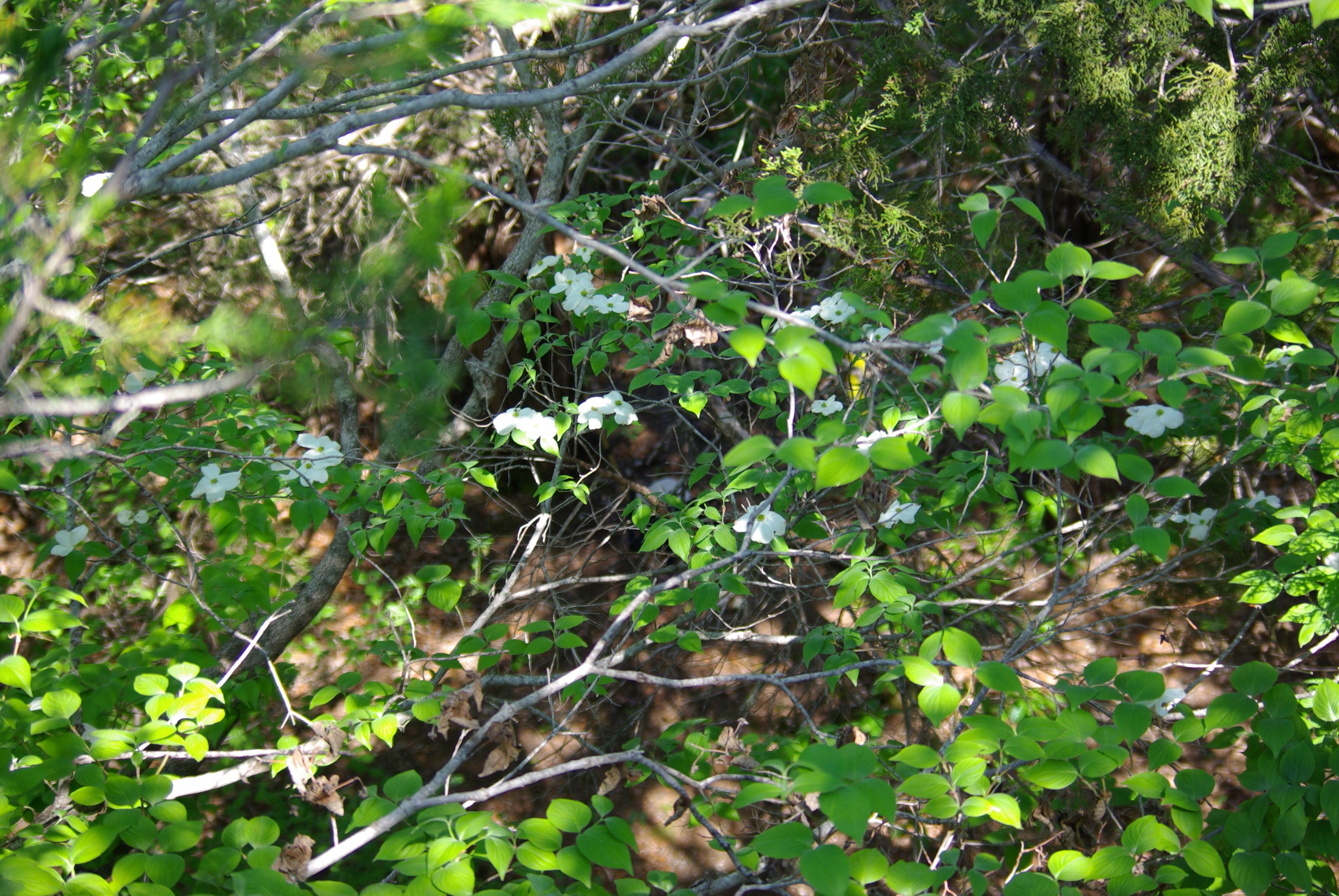
Dogwood blossom at Dogwood Canyon, Cedar Hill, Texas 03-25-2012 import 737 - Photo by Ed Darrell, use permitted with attribution

The dogwoods in bloom! An early spring, and lots of water, pushed the trees to leaf out before blossoming started — usually the blossoms come first. The drought last year probably hurts blossoming this year. Blossoms are not yet at their peak.

Dogwood blossoms, Dogwood Canyon Audubon Center 03-25-2012 import 744 - phot by Ed Darrell

Exquisite aroma and beauty from the dogwood blossoms – not the carpet of white we saw in a previous year. Still just the shock of finding these little beauties in Dallas County adds to their splendor. Dogwoods do well in East Texas, where it is wetter and the soil is acid. Here on the escarpment it is generally dry, hotter, and the soil is thin and alkaline. That the blossoms show up at all is a stunning oddity, a stroke of fortune emblematic of the unique place that is Dogwood Canyon.

Guided hikes — the only way to get to see the blossoms — are planned for Wednesday and Saturday this week.  Hikes are limited to 20 people, with two planned for Wednesday, and one for Saturday, March 31.  For reservations call Dogwood Canyon Audubon Center at (469) 526-1980.

Previously in Millard Fillmore’s Bathtub:


Annals of DDT: Canada’s Earth Tones on the history of DDT’s harms

March 26, 2012

Earth Tones, a Canadian science program, covered the history of DDT control.

[Below the fold, because it plays automatically.  Grrrr.]

Read the rest of this entry »


Odd site to defend Peter Gleick’s exposing of Heartlandgate, citing the law that will let him skate

March 18, 2012

Much angst among Heartlandgate perpetrators over the increasingly obvious fact that Peter Gleick not only shouldn’t be prosecuted, but can’t be prosecuted under federal law, for duping Heartland employees into revealing their true intentions, to lie about global warming so people won’t “believe” it and support solutions.

Peter Gleick - World Economic Forum Annual Mee...

Peter Gleick, lifetime of informing the public accurately at a researcher's greatly diminished salary; Heartland Institute is spending thousands of dollars to convince people he changed suddenly. Who to believe? Here's Gleick at the World Economic Forum Annual Meeting Davos 2009 (Photo credit: World Economic Forum)

But this odd site cut through the clutter and posted the words of the relevant law, establishing Peter Gleick’s lack of criminality:

18 U.S.C. 1343:
Whoever, having devised or intending to devise any scheme or artifice to defraud, or for obtaining money or property by means of false or fraudulent pretenses, representations, or promises, transmits or causes to be transmitted by means of wire, radio, or television communication in interstate or foreign commerce, any writings, signs, signals, pictures, or sounds for the purpose of executing such scheme or artifice, shall be fined under this title or imprisoned not more than 20 years, or both….

Did you catch that, Dear Reader?  Gleick would be guilty of federal wire fraud had he asked the perpetrators of Heartlandgate to send him money or property.

But all Gleick asked for was a copy of their agenda for a meeting, and the supporting data.  No money, no property.  Nothing of value.  Nor did he intend to use, nor could he use, any of that information to get money or property.

You noted, of course, the site is one promulgated by the Heartland Institute itself.

(Did they really mean it that way?  Probably not.)

(By the way — you may want to read the actual law from an authoritative source like the Cornell University Law Library’s Legal Information Institute (LII), and not a version filtered by people who deny global warming, nor its severity, nor its causes, or who don’t work to hoodwink gullible politicians.)

Peter Gleick:  Deep Throat of the climate denial scandals.

How can you tell whether you should be concerned, Dear Reader?

For example, if you’re a teacher, should you be concerned that in Heartlandgate, the Heartland Institute reveals itself to be working to “dissuade” science teachers from teaching science?  Or, if you’re just a concerned citizen, should you be concerned that you’ve heard precious little about the analysis of the documents released, from major news outlets?

If you are in any degree confused about who to believe in this issue, or worse, if you are convinced that there is a pattern of skirting of the laws by scientists (contrary to the evidence), you should be concerned that you’re not getting the full story.

More, Resources, Further reading:


Vote Irish for the presidency in 2012: O’Bama it is!

March 17, 2012

I’d forgotten about the birthers’ greatest nightmare — Obama’s got Irish blood in him!

Democratic Underground features a series of photos of President Obama with an Irish cousin at one of my favorite old haunts in Washington, the Dubliner.

President Barack Obama drinks a Guinness with his ancestral cousin from Moneygall Ireland Henry Healy, center, and the owner of the pub in Moneygall Ireland, Ollie Hayes, right, at The Dubliner Restaurant and Pub and Restaurant on St. Patrick's Day, Saturday, March 17, 2012, in Washington (Official White House Photo by Pete Souza)

President Barack Obama drinks a Guinness with his ancestral cousin from Moneygall Ireland Henry Healy, center, and the owner of the pub in Moneygall Ireland, Ollie Hayes, right, at The Dubliner Restaurant and Pub and Restaurant on St. Patrick’s Day, Saturday, March 17, 2012, in Washington (Official White House Photo by Pete Souza)

Many great memories of the Dubliner.

In 1974, when I interned at the Senate, it was just a small bar on the first floor of the Commodore Hotel.  Rocky Johnson of Sen. Mike Gravel‘s office, one of my roommates, introduced me to Guinness.  The Dubliner was the most reliable source in D.C. at the time.  The bartender was a guy named Paddy.  It was never crowded — and they had good fish and chips with a fine, imported malt vinegar. I wasn’t exactly a regular, but I made several visits.

Ironically, for my summer job that year with the Louis August Jonas Foundation, we had a trip to D.C. planned with about 16 “boys from abroad” and the designated hotel was the Commodore — it was cheap and met our needs, being close to the Capitol.  I was asked to chaperone, and happily went.   So Freddy Jonas, the great benefactor of the foundation and Camp Rising Sun, and I could sneak down to the Dubliner for a nightcap.  Michael Greene, the foundation’s executive director, warned me that Freddy would always ask if you wanted a second drink, but Freddy would not take one himself — and so, of course, neither should staffers.

One night while Freddy and I were capping off the evening we ran into a friend from my interning, Avis Ortner, a former rodeo barrel rider who had starred in a Kodak commercial series, and who worked in a Washington law firm.  She and Freddy struck it off very nicely.  I was surprised at how much Freddy knew about horses, and the questions he had about rodeo riding.  At some point in the evening he asked me if I were going to have a second drink, and of course I declined.  “Well, you only live once.  Avis and I are having a second one, and you should join us.”  People who knew Freddy well still don’t believe me when I tell them the story.  But it’s true.  It’s the magic of the Dubliner.  [Is Avis still cleaning up at bridge in D.C.? [Yes!]]

I was back in D.C. in 1975, again with the Jonas Foundation bunch, and again at the Commodore.  The Dubliner had a successful year, and had taken over the small cafe/dining room next door to bar.

In 1976 I visited again, and after a very successful year the Dubliner kicked out the gift shop of the hotel and opened a second bar there.  It was crowded on weekends.

In 1979 I moved to D.C.  Within a couple of years the Dubliner bought out the Commodore.  You couldn’t get a seat at the bar most nights.  St. Patrick’s Day 1980 the line wrapped around the block, and though the place never had a great stage, the live act was the Clancy Brothers with Tommy Makem, if I recall correctly.

Reconstruction and massive redecorating made the hotel into a great stop.  Eventually the bar company sold the hotel, but kept the location.  After Kathryn and I got married, we’d walk over to the Dubliner for lunch at least a couple of times a month, and the fish and chips at the Dubliner got better.  I may have done in half the cod from the Grand Banks all by myself.

We’ve been in Texas now since 1987.  I miss the Dubliner.  Obama’s lucky he could get in, on St. Patrick’s Day.  I hope he appreciates his luck.

(Kenny’s in Baltimore tonight — more irony.  Girl Talk on Federal Hill (I think it’s an outdoor concert performance).  Better than waiting in line at the Dubliner.  Go when the crowds aren’t there, and you can savor the place.)


Belated birthday wishes to Albert Einstein!

March 15, 2012

Did you do what I did yesterday?  I got so wrapped up in Pi Day festivities that I forgot to offer birthday wishes to Albert Einstein.

So, an encore post.

E=mcc - logo from AIP
Einstein’s famous formula. “E” is energy. “m” is mass of the particle or particles; “c” is the speed of light, or a fantastically large number. Energy equals the mass multiplied by the speed of light squared. Accidentally very accurate, the equation notes the idea that matter and energy are the same thing, and can be converted one to the other. (Image from PBS)

Happy Einstein Day (a day late)! Almost fitting that he was born on π Day, no? I mean, is there an E=mc² Day?

Albert Einstein was born on March 14, 1879, in Ulm, Germany, to Hermann and Pauline Einstein. 26 years later, three days after his birthday, he sent off the paper on the photo-electric effect; that paper would win him the Nobel Prize in Physics in another five years, in 1921. In that same year of 1905, he published three other papers, solving the mystery of Brownian motion, describing what became known as the Special Theory of Relativity and solving the mystery of why measurements of the light did not show any effects of motion as Maxwell had predicted, and a final paper that noted a particle emitting light energy loses mass. This final paper amused Einstein because it seemed so ludicrous in its logical extension that energy and matter are really the same stuff at some fundamental point, as expressed in the equation demonstrating an enormous amount of energy stored in atoms, E=mc².

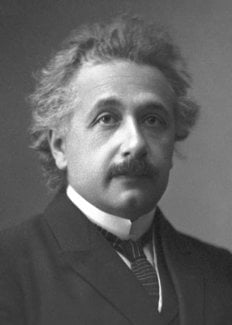
Albert Einstein as a younger man - Nobel Foundation image
Einstein in 1921, the year he was awarded the Nobel Prize in Physics for the photoelectric effect.

Any one of the papers would have been a career-capper for any physicist. Einstein dashed them off in just a few months, forever changing the field of physics. And, you noticed: Einstein did not win a Nobel for the Special Theory of Relativity, nor for E=mc². He won it for the photo electric effect. Irony in history.

106 years later Einstein’s work affects us every day. Relativity theory at some level I don’t understand makes possible the use Global Positioning Systems (GPS), which revolutionized navigation and mundane things like land surveying and microwave dish placement. Development of nuclear power both gives us hope for an energy-rich future, and gives us fear of nuclear war. Sometimes, even the hope of the energy rich future gives us fear, as we watch and hope nuclear engineers can control the piles in nuclear power plants damaged by earthquakes and tsunami in Japan.

If Albert Einstein was a genius at physics, he was more dedicated to pacifism. He resigned his German citizenship to avoid military conscription. His pacifism made the German Nazis nervous; Einstein fled Germany in the 1930s, eventually settling in the United States. In the U.S., he was persuaded by Leo Szilard to write to President Franklin Roosevelt to suggest the U.S. start a program to develop an atomic weapon, because Germany most certainly was doing exactly that. But Einstein refused to participate in the program himself, sticking to his pacifist views. Others could, and would, design and build atomic bombs. (Maybe it’s a virus among nuclear physicists — several of those working on the Manhattan Project were pacifists, and had great difficulty reconciling the idea that the weapon they worked on to beat Germany, was deployed on Japan, which did not have a nuclear weapons program.)

Einstein was a not-great father, and probably not a terribly faithful husband at first — though he did think to give his first wife a share of a Nobel Prize should he win it in the divorce settlement. Einstein was a good violinist, a competent sailor, an incompetent dresser, and a great character. His sister suffered a paralyzing stroke. For many months Albert spent hours a day reading to her the newspapers and books of the day, convinced that mute and appearing unconscious, she would benefit from hearing the words. He said he did not hold to orthodox religions, but could there be a greater show of faith in human spirit?

Einstein in 1950, five years before his death
Einstein in 1950, five years before his death.

When people hear clever sayings, but forget to whom the bon mots should be attributed, Einstein is one of about five candidates to whom all sorts of things are attributed, though he never said them. (Others include Lincoln, Jefferson, Mark Twain and Will Rogers). Einstein is the only scientist in that group. So, for example, we can be quite sure Einstein never claimed that compound interest was the best idea of the 20th century. This phenomenon is symbolic of the high regard people have for the man, even though so few understand what his work was, or meant.

A most interesting man. A most important body of work. He deserves more study and regard than he gets.

More, Resources:


If Stalin said America is “a healthy body,” why can’t anyone find the source?

March 14, 2012

Joseph Stalin, via Chicago Boyz

Joseph Stalin would have to have been drunk to call the U.S. “healthy,” and to have complimented America’s patriotism, morality and spiritual life. Even then, it would be unlikely. Why does this quote keep circulating?

This has been floating around Tea Party and other shallow venues for a while, but I’ll wager Stalin did not say it:

“America is like a healthy body and its resistance is threefold:  Its patriotism, its morality, and its spiritual life.  If we can undermine these three areas, America will collapse from within.”

I can’t find any source for it; it’s mostly quoted on right-wing sites where people marvel over what a prophet Stalin was.  All requests for a citation in five or six different forums I’ve checked, are unanswered.  Nothing like it appears at the often-checked Wikiquote.  The Stalin Archive holds nothing close to the claimed quote.

Perhaps more telling:  Is it likely that Joe Stalin ever would have called the U.S. “a healthy body?”  Stalin was of a school that claimed capitalism was diseased, and America was infested with a soon-to-be terminal case.  If he called America “diseased” by patriotism and religion, it would be consistent with other statements, but his calling America healthy for patriotism and spiritual life, it’s inconsistent with other claims he made, about America and about capitalism (see Stalin’s 1929 remonstrance to the U.S. Communist Party, for example).

So, Dear Readers, my request to you:  Can you offer the source of this quote, Joseph Stalin or not?

Why would a false claim from Stalin get such a life on the internet?

Update, March 15, 2012:  I’m calling this one:  It’s a bogus quote.  Joseph Stalin didn’t say it.  Not as many comments here as e-mails and comments on other discussion boards and Facebook — no one has come even close to anything like the line above from Stalin.  No source quoting the line even bothers to give a decade, let alone a year, a location, and a citation that would pass muster in a sophomore high school English class.  Tea Partiers, you’ve tried to twist history again — stop it.

Update March 1, 2013: If you’re checking in here studying for a DBQ for an AP class, please tell us in comments, which AP class, and what city you’re in.  Thanks.


Annals of Global Warming: Dramatic Links Found Between Climate Change, Elk, Plants, and Birds

March 14, 2012

Understanding the physics of the Earth’s atmosphere poses great problems — it is an astonishingly dynamic, fluid environment.  Understanding the relationships between species in ecosystems is no less complex, and no less vexing.

Wise followers of science recognize that when findings in biology, chemistry and physics, point the same direction, something powerful creates the convergence, and is not to be ignored.

So it is with these findings from the University of Montana and the U.S. Geological Survey, demonstrating clear links between climate change and the changing life patterns of large animals like elk, small animals like birds, and the plants the animals live in and consume.  This study is so complex that climate denialists haven’t figured out which part to deny, yet.  (This press release came out in January.)

From the USGS, with no adornment from the Bathtub, a press release on a letter in Nature Climate Change:

Dramatic Links Found Between Climate Change, Elk, Plants, and Birds

Released: 1/9/2012 11:30:00 AM

U.S. Department of the Interior, U.S. Geological Survey
Office of Communications and Publishing

In partnership with the University of Montana

Missoula, MT – Climate change in the form of reduced snowfall in mountains is causing powerful and cascading shifts in mountainous plant and bird communities through the increased ability of elk to stay at high elevations over winter and consume plants, according to a groundbreaking study in Nature Climate Change.

Red-faced warbler in Arizona, photo by Tom Martin, USGS

Red-faced warblers are one of the species affected by climate change in the form of reduced snowpack in the Arizona Mountains, according to a USGS Montana Cooperative Wildlife Research Unit study. Photo by Tom Martin, USGS, May 1998, in the Coconino National Forest

The U.S. Geological Survey and University of Montana study not only showed that the abundance of deciduous trees and their associated songbirds in mountainous Arizona have declined over the last 22 years as snowpack has declined, but it also experimentally demonstrated that declining snowfall indirectly affects plants and birds by enabling more winter browsing by elk. Increased winter browsing by elk results in trickle-down ecological effects such as lowering the quality of habitat for songbirds.

The authors, USGS Montana Cooperative Wildlife Research Unit scientist Thomas Martin and University of Montana scientist John Maron, mimicked the effects of more snow on limiting the ability of elk to browse on plants by excluding the animals from large, fenced areas. They compared bird and plant communities in these exclusion areas with nearby similar areas where elk had access, and found that, over the six years of the study, multi-decadal declines in plant and songbird populations were reversed in the areas where elk were prohibited from browsing.

Hermit thrushes in the Coconino National Forest, Arizona - 2005 photo by Tom Martin, USGS

Hermit thrushes are a songbird species that was strongly affected by plant community changes in mountains because of reduced snowpack and cascading ecological effects, according to a USGS Montana Cooperative Wildlife Research Unit study. 2005 photo by Tom Martin, USGS, in the Coconino National Forest

“This study illustrates that profound impacts of climate change on ecosystems arise over a time span of but two decades through unexplored feedbacks,” explained USGS director Marcia McNutt. “The significance lies in the fact that humans and our economy are at the end of the same chain of cascading consequences.”

The study demonstrates  a classic ecological cascade, added Martin. For example, he said, from an elk’s perspective, less snow means an increased ability to freely browse on woody plants in winter in areas where they would not be inclined to forage in previous times due to high snowpack. Increased overwinter browsing led to a decline in deciduous trees, which reduced the number of birds that chose the habitat and increased predation on nests of those birds that did choose the habitat.

Elk excluded, aspen growth increases - photo by Tom Martin, USGS, Coconino National Forest

When elk are excluded, aspen growth dramatically increases - Climate change in the form of reduced snowfall in mountains is causing powerful and cascading shifts in montane plant and bird communities through the increased ability of elk to stay at high elevations over winter and consume plants. Here, you can see an example of the difference in aspen growth inside versus outside a fence that excludes elk. Photo by Tom Martin, USGS, in Coconino National Forest

“This study demonstrates that the indirect effects of climate on plant communities may be just as important as the effects of climate-change-induced mismatches between migrating birds and food abundance because plants, including trees, provide the habitat birds need to survive,” Martin said.

The study, Climate impacts on bird and plant communities from altered animal-plant interactions, was published online on Jan. 8 in the journal Nature Climate Change.

Elk in winter at Camp Creek Feed Ground, Northwestern Wyoming - USGS photo

Elk in winter at Camp Creek Feed Ground, Northwestern Wyoming - USGS photo

More:


Flash mobs for cultural literacy, history and heritage, and a little fun

March 12, 2012

What happens when you take a 20th century rock song (from U2), contemporary dancers, a church choir, an ancient but beautiful language, battery-powered amps for buskers, and use digital personal communications to mash them all up on Grafton Street in Dublin?

Great stuff:  “A Language That Will Never Die” from PBO

More:


The anti-teacher, anti-lawyer, anti-education, anti-math, anti-civil rights truth behind “Kill all the lawyers”

March 10, 2012

Mostly an encore post — something we shouldn’t have to repeat, but thoughts that deserve a place in everyone’s mind in an election year.  I originally posted this back in 2006.

Poster from Michael Boyd's 2000 production of Henry VI, Part II, at Stratford

All this murder of lawyers, teachers, accountants, education and civil rights, is bloody business. Poster from Michael Boyd’s 2000 production of Henry VI, Part II, at Stratford; PBS image via Wikipedia

In an otherwise informative post about a controversy over alternative certification for school administrators, at EdWize, I choked on this:

The Department leaders, Klein, Seidman and Alonso, lawyers all (perhaps Shakespeare was correct), are rigid ideologues who have alienated their work force as well as the parents of their constituents

Did you catch that? Especially the link to the Shakespeare line, “The first thing we do, let’s kill all the lawyers?”

This is not exactly history we’re fisking here — it’s drama, I suppose. Still, it falls neatly into the category of debunkings, not too unlike the debunking of the story of Millard Fillmore’s bathtub.

The line from Shakespeare is accurate. It’s from Henry VI, Part II. But it’s not so much a diatribe against lawyers as it is a part of a satirical indictment of those who would overthrow government, and oppress the masses for personal gain.

It is Dick the Butcher who says the line. Jack Cade has just expressed his warped view that he should be king, after having attempted a coup d’etat and taken power, at least temporarily. Cade starts in with his big plans to reform the economy — that is, to let his friends eat cheap or free, while other suffer and starve.

Dick chimes in to suggest that in the new regime, the lawyers ought to be the first to go — they protect rights of people and property rights, and such rights won’t exist in Cade’s imagined reign. Cade agrees. The purpose of killing the lawyers, then, is to perpetuate their rather lawless regime.

At that moment others in Cade’s conspiracy enter, having captured the town Clerk of Chatham. The man is put on trial for his life, accused of being able to read and keep accounts. Worse, he’s been caught instructing young boys to read.

There is no saving the poor Clerk at that point.  Cade orders the Clerk to be hanged, “with his pen and inkhorn around his neck” (even the pen was considered dangerous!).

Thus Shakespeare relates how terrorists of old steal government and rights, by killing the lawyers, the educated, and especially the teachers.

It’s still true today. Those who would steal rights from people, those who would oppress others, assault the rule of law, education, and those who spread learning. Beware those who urge death to law and learning; they are related to Dick the Butcher, philosophically, at least.  (No offense to honest butchers, I hope — especially to members of the UFCW.  Dick the Butcher was not a member of any butcher’s union.)

Here is the text, from the site “William Shakespeare — the Complete Works”:

CADE
Be brave, then; for your captain is brave, and vows
reformation. There shall be in England seven
halfpenny loaves sold for a penny: the three-hooped
pot; shall have ten hoops and I will make it felony
to drink small beer: all the realm shall be in
common; and in Cheapside shall my palfrey go to
grass: and when I am king, as king I will be,–

ALL
God save your majesty!

CADE
I thank you, good people: there shall be no money;
all shall eat and drink on my score; and I will
apparel them all in one livery, that they may agree
like brothers and worship me their lord.

DICK
The first thing we do, let’s kill all the lawyers.

CADE
Nay, that I mean to do. Is not this a lamentable
thing, that of the skin of an innocent lamb should
be made parchment? that parchment, being scribbled
o’er, should undo a man? Some say the bee stings:
but I say, ’tis the bee’s wax; for I did but seal
once to a thing, and I was never mine own man
since. How now! who’s there?

(Enter some, bringing forward the Clerk of Chatham)

Smith the Weaver and Dick the Butcher seize the Clerk of Chatham, Bunbury print of Henry VI, Part II scene

Smith the Weaver and Dick the Butcher seize the Clerk of Chatham, in Act IV, scene ii of Henry VI, Part II. Engraving by Henry William Bunbury, from collection of the Folger Shakespeare Library; original published by Thos. Macklin Poets Gallery, London, 1795

SMITH
The clerk of Chatham: he can write and read and
cast accompt.

CADE
O monstrous!

SMITH
We took him setting of boys’ copies.

CADE
Here’s a villain!

SMITH
Has a book in his pocket with red letters in’t.

CADE
Nay, then, he is a conjurer.

DICK
Nay, he can make obligations, and write court-hand.

CADE
I am sorry for’t: the man is a proper man, of mine
honour; unless I find him guilty, he shall not die.
Come hither, sirrah, I must examine thee: what is thy name?

CLERK
Emmanuel.

DICK
They use to write it on the top of letters: ’twill
go hard with you.

CLERK
Sir, I thank God, I have been so well brought up
that I can write my name.

ALL
He hath confessed: away with him! he’s a villain
and a traitor.

CADE
Away with him, I say! hang him with his pen and
ink-horn about his neck.

>Exit one with the Clerk

More, Resources (some from Zemanta):


Alfre Woodard channels Sojourner Truth, “Ain’t I a woman?”

March 9, 2012

We should be grateful for Sojourner Truth, we should be grateful for the women’s suffrage movement, we should be grateful for Howard Zinn‘s preservation and telling of history, and we can be grateful for inspired readings of original works by great performers like Alfre Woodard.

Alfre Woodard reads “Ain’t I a Woman?“, a speech delivered by abolitionist Sojourner Truth at the Women’s Convention in 1851. Part of a reading from Voices of A People’s History of the United States (Howard Zinn and Anthony Arnove,)February 1, 2007 at All Saints Church in Pasadena, CA.

In my year at the University of Arizona I had the joy of working with David Williams’ speech department students in readers theatre.  We had a couple of performers whose readings of Sojourner Truth stirred audiences greatly (Martha Isom, where are you?).  This is a piece one does best to absorb from oral performance.  It is a piece that one should hear repeatedly, to understand.

Woodard nails this one well, I think.

Ms. Truth’s speech needs careful reflection.  She was not just speaking for women’s rights, but was lecturing the suffragists as well on their having overlooked the plight of women of color and working women, and women in poverty.  She’s talking to you, and to me, and asking us to confront our stereotypes of what women are and what women do, to recognize that women are humans, deserving of full respect for that reason alone.

Tip of the old scrub brush to the folks at MoveOn.org.

More, resources:


Berryman’s cartoons on campaigns and campaigning, from the National Archives exhibit

March 6, 2012

Clifford Berryman drew some of the best and most famous political cartoons ever, for newspapers in Washington, D.C., over a career of more than 50 years. Berryman drew the cartoon of Teddy Roosevelt and the bear cub TR refused to shoot, that caused the story of TR and the bear to become famous, which led to the creation of the “Teddy bear” stuffed animal we all know today, for one example.

Our National Archives featured an exhibit of Berryman cartoons on running for office. The exhibit is long gone, but the materials from the exhibit live on, on line, waiting for students to study, and teachers to use for presentations, assignments, and tests.

Go check it out. Great resources. There’s a piece that describes some of the symbols and symbolism used in Berryman’s cartoons.

Some of the cartoons seem awfully prescient to today:

Nearing the End of the Primaries, May 3, 1920; cartoon by Clifford Berryman

"Nearing the End of the Primaries," cartoon by Clifford Berryman published May 3, 1920. Caption from the Archives: "Today candidates usually secure their party’s nomination during the primary season, and the nominating convention merely provides the party’s official stamp of approval. In 1920, however, when the primary process was still new, it did not produce a clear winner for the Republican Party. As the Republican convention neared, there was no front-runner for the G.O.P. Presidential nomination. This cartoon shows the frazzled Republican elephant surrounded by conflicting newspaper headlines while the Democratic donkey makes pressing inquiries. Warren G. Harding was eventually chosen as the Republican nominee. U.S. Senate Collection Center for Legislative Archives"

Borrowed with express permission from Mr. Darrell’s Wayback Machine.


GFBrandenburg shows “value-added” teacher measures cannot work

March 4, 2012

You wanted evidence that Michelle Rhee’s plans in Washington, D.C., were not coming to fruition, that the entire scheme was just one more exercise in “the daily flogging of teachers will continue until morale improves?”

G. F. Brandenburg ran the numbers. It isn’t pretty.

Click the top line, which should be highlighted in your browser, to see the original post; or click here.

See more, next post.

gfbrandenburg's avatarGFBrandenburg's Blog

It all makes sense now.

At first I was a bit surprised that Bill Gates and Michelle Rhee were opposed to publicizing the value-added data from New York City and other cities.

Could they be experiencing twinges of a bad conscience?

No way.

That’s not it. Nor do these educational Deformers think that value-added mysticism is nonsense. They think it’s wonderful and that teachers’ ability to retain their jobs and earn bonuses or warnings should largely depend on it.

The problem, for them, is that they don’t want the public to see for themselves that it’s a complete and utter crock. Nor to see the little man behind the curtain.

I present evidence of the fallacy of depending on “value-added” measurements in yet another graph — this time using what NYCPS says is the actual value-added scores of all of the many thousands of elementary school teachers for whom they have…

View original post 255 more words


Typewriter of the moment: Tom Hanks’s 1969 Royal Apollo 10 Electric

March 3, 2012

Some indications on Twitter that actor Tom Hanks may be turning into a collector of these historic items:

Typewriter - Tom Hanks Royal Apollo 10 1969 - Photo by Tom Hanks at WhoSay

Tom Hanks found a vintage 1969 typewriter (circa Apollo 13 mission), a Royal Apollo 10, and Tweeted this picture - Photo by Tom Hanks at WhoSay

In his Tweet, captured at WhoSay, Hanks wrote:

Typewriter of the day. Royal ‘Apollo 10’ model from 1969. Electric that got us to the moon! It’s noisy but types fine. Hanx

Do you think there’s a movie about typewriters coming?

Confess, Dear Reader — are you taken in by the magic, charm and dinging carriage-return bell of these old typewriters?  Do you remember the machine you used to use?  Do you still use a typewriter?  Minds soaking in the Bathtub want to know.

Grateful tip of the old scrub brush to Judy Crook @Jude2004.