More Iceland than Aurora. Not necessarily bad. Great timelapse photos.
You have my permission to turn down the music volume.
Filmmaker Anna Possberg wrote:
Iceland has become a popular destination since the singer Björk made her island famous by her songs. Yet few people know Iceland during wintertime. And I am sure that they miss a beautiful part of the island: the snow covered rocks, the magic arctic light and especially the phantastic aurora borealis dancing in the sky. The days spent at the Jokülsarlon glacial lake were one of the most beautiful and peaceful Christmas time I remember.
Jökulsárlón, a glacial lake in Iceland. To the right, the mouth of the glacier Vatnajökull. Wikipedia photo
Loren Holmes photograph straight up of Aurora borealis over Eureka, Alaska, on March 13, 2013. AlaskaDispatch.com
I love fireworks. Kathryn and I have been known to drive a couple hundred miles to see a good show. Fireworks in honor of the guy who gave us the Constitution and the First Amendment (and much more), seems a great idea to me.
But no one did it . . .
Sometimes the Sun, Moon, stars and planets conspire.
Here’s one of the best, most inspiring five minutes you’ll spend this week. Look what the Sun sent us, filmed in time-lapse glory above Eureka, Alaska, on March 16, 2013, the anniversary of James Madison’s birthday; from AlaskaDispatch.com:
A timelapse of the Aurora Borealis, Northern Lights, over Eureka, Alaska on March 16, 2013. Taken with a Canon 5D Mark III and 24mm f/1.4 and 70-200 f/2.8 lenses. Compiled from 3800 images, with exposures between 2 seconds and 30 seconds.
The past two evenings, when it was supposed to be visible, we couldn’t find it. Maddeningly, others have great photos of the thing.
Here’s a photo of where it was supposed to be the evening of March 12. Nice sliver of a Moon.
A view to the west over south Grand Prairie, Texas, showing the sliver of the new Moon, but a no-show Comet Pan-STARRS, March 12, 2013. Photo by Ed, Kathryn and Peanut.
We watched for over an hour, from just after the Sun’s winking out in a blaze of orange (Texas dust and DFW smog). We were shooting without a tripod, and so it was difficult to capture just how thin was the line of the Moon for a long time. It was not a clear crescent, with mountains of the Moon providing jagged lines that glistened like a crystal glass necklace. Longer exposures revealed the comet to other observers in other places, but not to us. Perched as we were right on the edge of the Austin Chalk Escarpment, we were joined by a dozen or so others who hoped to see the comet, or who were just putting their BMX bikes away.
A more detailed, and grainy, shot of the Moon (with no comet):
Eventually the Moon stated its presence, but still no Comet Pan-STARRS, on March 12, 2013. Looking west over Grand Prairie, Texas. (Yeah, probably would have been a much better photo if not handheld.)
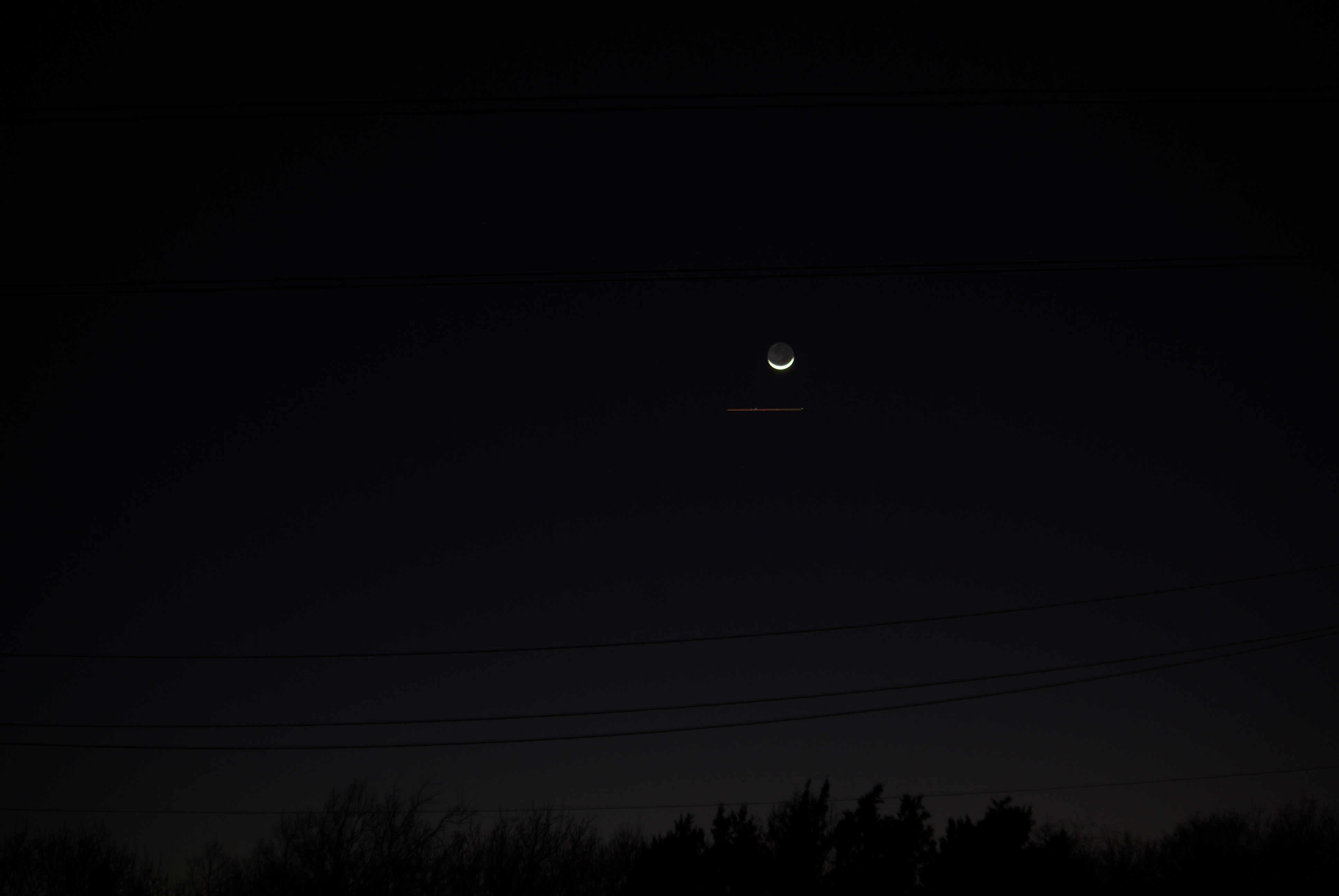
Here’s a photo of where it was supposed to be last night, the evening of March 13.
On March 13, Comet Pan -STARRS rode directly underneath the Moon; it’s invisible in this longer exposure, though you can see the streaking lights of a jetliner flying out of DFW International Airport under the Moon.
Quoting from SamuellBeckett.net: ESTRAGON: People are bloody ignorant apes. He rises painfully, goes limping to extreme left, halts, gazes into distance off with his hand screening his eyes, turns, goes to extreme right, gazes into distance. Vladimir watches him, then goes and picks up the boot, peers into it, drops it hastily. VLADIMIR: Pah!He spits. Estragon moves to center, halts with his back to auditorium. ESTRAGON: Charming spot. (He turns, advances to front, halts facing auditorium.)
Inspiring prospects. (He turns to Vladimir.)
Let’s go. VLADIMIR: We can’t. ESTRAGON: Why not? VLADIMIR: We’re waiting for Godot. ESTRAGON: (despairingly). Ah! (Pause.) You’re sure it was here? VLADIMIR: What? ESTRAGON: That we were to wait. VLADIMIR: He said by the tree. (They look at the tree.) Do you see any others? ESTRAGON: What is it? VLADIMIR: I don’t know. A willow. ESTRAGON: Where are the leaves? VLADIMIR:
It must be dead.
Other photographers found Comet Pan-STARRS. This photo comes via SpaceWeather.com. ” Brian Klimowski sends this picture from the countryside near Flagstaff, Arizona . . . ‘Beautiful show this evening!’ says Klimowski. ‘I took the photo from an altitude of about 9500 feet in the San Francisco Peaks near Flagstaff. A 1-second exposure with my Canon digital camera easily revealed the comet.'” Photo details: Canon 7D, 125 mm, 1s @ F/5.6. ISO 1250
Spread the word; friends don't allow friends to repeat history.
No, he’s not particularly gold — but this is winter, and if he’s going to get his breeding plumage, it will come in a couple of weeks.
We’ve had Niger thistle seed feeders out for years; this year one goldfinch (Spinus tristis) finally started to visit. We’ve had as many as four at a time — but they’re probably headed north soon.
Here’s a shot of our first guest, from a couple of weeks ago.
A goldfinch male, checking out the feeder before bringing in his buddies — we hope.
If you’re north of Dallas, and you see this guy at your feeder this summer, tell him “hello” from us.
The non-breeding plumage isn’t so flashy as the bright yellow of the breeding males. Some of the finches settle in to a beautiful, smooth olive-drab livery for much of the winter. Close up, they look like good pen-ink-drawings by a master artist.
Horsetail Fall flows over the eastern edge of El Capitan in Yosemite Valley. It’s a small waterfall that many people don’t notice, but it has gained popularity as more and more people have noticed it can glow orange during sunset in mid to late February. The most popular place to see Horsetail Fall seemingly afire is El Capitan picnic area, west of Yosemite Lodge and east of El Capitan (see map below). The “firefall” effect generally happens during the second half of February. A clear sky is necessary for the waterfall to glow orange. Photo: Bethany Gediman, NPS
People living close to National Parks are lucky to do so; people who work in them luckier still, in the lifetime sweepstakes for seeing breathtaking sites. NPS employee (Ranger?) Bethany Gediman caught this image of Horsetail Fall in Yosemite National Park.
Many people come to Yellowstone to see the fantastic landscapes. Wise visitors also come to experience the amazing soundscapes. This video provides some insight into the value of natural sounds in wild places and how the park is monitoring those sounds as well as the sounds created by humans.
Nothing matches the sound of a western river, to my mind. I love the sound of the tumbling waters, and it was on one of those roaring creeks that we scattered the ashes of my Yellowstone-loving oldest brother Jerry Jones.
Classic, vintage poster for Yellowstone National Park, Wyoming/Montana, USA (Photo credit: Wikipedia)
Other sounds will captivate you. The rush and gush of the geysers, and the gurgle and plop of heated pools rivets you for a while. Once you hear the chuff of an interested grizzly bear, you don’t forget it. And while it can be scary if you’re relatively alone on the trail, the howl of the wolf tells you about the wilderness in a way no other sound ever can. The honks of the geese, the trumpets of the swans, the grunts of the bison, the scolding of the many different squirrels and chipmunks, the slap of a trout jumping out of the river — these are all worth making the trip.
After you go, these sounds will lovingly haunt your life. You’ll smile when you remember them.
I hope you can go soon. (I hope I can go, soon.)
Sad note: Only 1,553 people have watched this video since last July. Can you spread the word a bit?
The white dove was a short-lived interlude; the white-winged doves seem to be with us constantly.
One family in 2011; two families in 2012 — and our yard isn’t that big.
A very early version of the birds who visited, befriended, and plagued Snoopy — this drawing, while faithful to Shultz’s work, was done by another artist.
Earlier this week I looked out, and it looked like the early “Peanuts” comic strip when Snoopy opened his dog house to a group of pigeon-like birds for their poker game. The birds took advantage of Snoopy’s largesse, and nearly over-ran him. (Woodstock was a product of that flock of birds, the last remaining vestige by Charles Shultz‘s death.)
At least they didn’t drink our beer and try to make off with the Picasso.
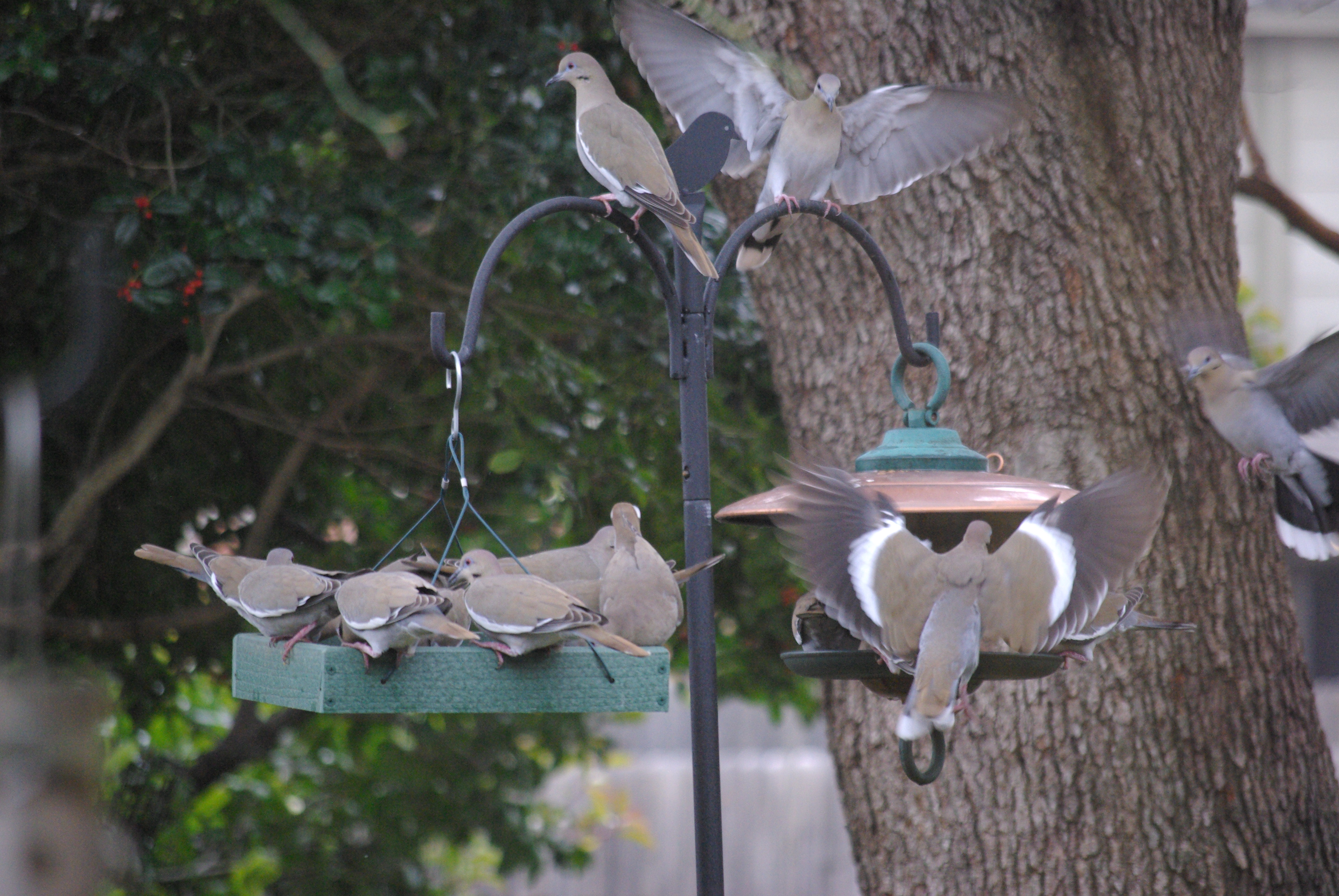
White-winged doves are really too big for any of our feeders — but what are you going to tell a rampaging herd of them? Photos by Ed Darrell – use encouraged with attribution.
Enough doves to frighten Alfred Hitchcock — Two of these birds is too many for either side of this feeding station. How many do you see here?
Not enough room for all, and so they jostle and push each other off the feeders. See the display of the white stripe on the wings of one of our subjects here, from which the species gets its name.
Blue jays enforce the “too-long-or-too-many-at-the-feeder” rules here, but they can be distracted by peanuts put out by neighbors. In any case, they were absent when we needed them.
We used to have mourning doves, but at some point in the last five years this bunch pushed them out. We may be the only ones on the block who noticed. (Yes, it’s “mourning” dove; Duncanville’s having misspelled it on “Morning Dove Lane” is their error.)
East Coast son Kenny sent this video, noting his reaction was the same as the guy in the film; an encounter with a golden eagle in a Montreal park:
You can take the eagle out of the wild, but you can’t take the wild out of the eagle.
Looks mostly like a golden eagle to me — anyone want to make the case it’s a different bird?
What’s going on in Montreal, I wonder, that would make a golden eagle think a human baby might make a good meal? (No, I don’t think the bird was trying to give the kid a thrill.)
Other reports of similar incidents around Montreal?
Update: WHAT? IT’S FAKED? Thoughtful reader Luisa in comments refers us to Chris Clarke’s Original Blog™ Coyote Crossing, which updates from expert birder Kenn Kauffman who says, as I wondered, it’s not a golden eagle, and other things look hoaxed. (While you’re looking around, check out Luisa’s Crow and Raven; bird photos that will make you jealous.) You’d think an incident like that would have made it to the newspapers and television stations in Montreal, but I’ve found nothing — have you?)
Update, December 19, 2012: Now the CBC covers the tale, noting that it is most likely a hoax. The film’s maker or YouTube poster has not defended it that I can find. Watch carefully — the “baby” doesn’t move during the time it’s on the ground, through the bird’s plucking it up and dropping it. There’s plenty of time to swap a dummy out with a real kid in the stroller while the camera is pointed away. CBC found a Montreal ornithologist who claims it looks more like an osprey than an eagle. I’ll buy that.
If you were disappointed with the meager showing put on by this year’s Leonid Meteor Shower, don’t fret. What potentially will be the best meteor display of the year is just around the corner, scheduled to reach its peak on Thursday night, Dec. 13: the Geminid Meteors.
The Geminids get their name from the constellation of Gemini, the Twins. On the night of this shower’s maximum the meteors will appear to emanate from a spot in the sky near the bright star Castor in Gemini.
The Geminid Meteors are usually the most satisfying of all the annual showers, even surpassing the famous Perseids of August. Studies of past displays show that this shower has a reputation for being rich both in slow, bright, graceful meteors and fireballs as well as faint meteors, with relatively fewer objects of medium brightness. Geminids typically encounter Earth at 22 miles per second (35 kilometers per second), roughly half the speed of a Leonid meteor. Many appear yellowish in hue. Some even appear to travel jagged or divided paths.
EarthSky.org said the show starts as soon as Gemini rises — soon after sunset in the nothern middle latitudes. Look east to the constellation Gemini, toward the star Castor. (I’m using my iPhone NightSky app; wish I had my old Android and Google Sky.) Get a coat. Get your binoculars, your tripod and camera (you’ll want time exposures, yes?). Maybe take some gloves, and a Thermos of hot chocolate. Out of the city, out where the sky is dark. The Moon is in a new phase, and shouldn’t be visible when the meteor watching is hot.
Faithful stargazers may already have spotted a few shooting stars from this year’s Leonid shower. Best estimates are that the peak will come the night of Saturday, November 17.
A meteor streaks across the sky during the 2009 Leonid meteor shower. (Navicore / Wikimedia Commons via Los Angeles Times)
The next meteor shower is the Leonids on the night of November 17
The best viewing for this year’s Leonid meteor shower will be several hours before dawn on November 17. The shower should produce perhaps a dozen or so “shooting stars” per hour. The best view comes in the wee hours of the morning, as your part of Earth turns most directly into the meteor stream.
* * * * *
What is a meteor shower?
A meteor shower is a spike in the number of meteors or “shooting stars” that streak through the night sky.
Most meteor showers are spawned by comets. As a comet orbits the Sun it sheds an icy, dusty debris stream along its orbit. If Earth travels through this stream, we will see a meteor shower. Although the meteors can appear anywhere in the sky, if you trace their paths, the meteors in each shower appear to “rain” into the sky from the same region.
Meteor showers are named for the constellation that coincides with this region in the sky, a spot known as the radiant. For instance, the radiant for the Leonid meteor shower is in the constellation Leo. The Perseid meteor shower is so named because meteors appear to fall from a point in the constellation Perseus.
What are shooting stars?
“Shooting stars” and “falling stars” are both names that describe meteors — streaks of light across the night sky caused by small bits of interplanetary rock and debris called meteoroids vaporizing high in Earth’s upper atmosphere. Traveling at tens of thousands of miles an hour, meteoroids quickly ignite from the searing friction with the atmosphere, 30 to 80 miles above the ground. Almost all are destroyed in this process; the rare few that survive and hit the ground are known as meteorites.
When a meteor appears, it seems to “shoot” quickly across the sky, and its small size and intense brightness might make you think it is a star. If you’re lucky enough to spot a meteorite (a meteor that makes it all the way to the ground), and see where it hits, it’s easy to think you just saw a star “fall.”
How can I best view a meteor shower?
Get away from the glow of city lights and toward the constellation from which the meteors will appear to radiate.
For example, drive north to view the Leonids. Driving south may lead you to darker skies, but the glow will dominate the northern horizon, where Leo rises. Perseid meteors will appear to “rain” into the atmosphere from the constellation Perseus, which rises in the northeast around 11 p.m. in mid-August.
After you’ve escaped the city glow, find a dark, secluded spot where oncoming car headlights will not periodically ruin your sensitive night vision. Look for state or city parks or other safe, dark sites.
Once you have settled at your observing spot, lie back or position yourself so the horizon appears at the edge of your peripheral vision, with the stars and sky filling your field of view. Meteors will instantly grab your attention as they streak by.
How do I know the sky is dark enough to see meteors?
If you can see each star of the Little Dipper, your eyes have “dark adapted,” and your chosen site is probably dark enough. Under these conditions, you will see plenty of meteors.
What should I pack for meteor watching?
Treat meteor watching like you would the 4th of July fireworks. Pack comfortable chairs, bug spray, food and drinks, blankets, plus a red-filtered flashlight for reading maps and charts without ruining your night vision. Binoculars are not necessary. Your eyes will do just fine.
Here’s a good demonstration of why you don’t need PhotoShop, but a decent camera and a steady hand instead.
Utah’s Mt. Timpanogos in snow, by Craig Clyde, 2012 (rights probably reserved). Click for larger version.
Craig Clyde took this photo of Utah Valley‘s Mt. Timpanogos, probably from Saratoga Springs, on the west side of Utah Lake, after one of the first snows of 2012. (This area had a few farm fields when I grew up there.) It’s a great photo for several reasons.
It’s a formerly unusual view, there being so few people on the west side of the lake until recent development. It pictures all of Timpanogos, with American Fork Canyon on the left, Mahogany Mountain, Big Baldy, and Provo Canyon on the right. It’s an afternoon shot, you can tell from the angle of the sun (the mountain runs on a north-south axis), and the darkness on the lower mountains may be caused by the Sun’s setting behind the mountain range on the west side of the lake. Timpanogos in white, in the afternoon sunshine, is one of the greatest images of a mountain you’ll ever see.
Tip of the old scrub brush to Craig Clyde. Mr. Clyde and I attended high school together — haven’t seen him in more than 30 years; not sure, but I don’t think he’s the same Craig Clyde in the movie business.
Did the PhotoShopper add anything of value to the picture? Of what use is a gilded lily?
(Please help — the original photo is identified as an award winner in 2003 — do you know the original photographer? We should give credit appropriately; I’ve not found the person’s name, yet.)
If you go today, vote before you go. This is one of the areas to be opened to energy exploration — oil and gas drilling or other mining — under Mitt Romney’s “energy plan” and the GOP National Platform.
Or, until that account is unsuspended by the forces supporting Donald Trump: Follow @FillmoreWhite, the account of the Millard Fillmore White House Library
We've been soaking in the Bathtub for several months, long enough that some of the links we've used have gone to the Great Internet in the Sky.
If you find a dead link, please leave a comment to that post, and tell us what link has expired.
Thanks!
Retired teacher of law, economics, history, AP government, psychology and science. Former speechwriter, press guy and legislative aide in U.S. Senate. Former Department of Education. Former airline real estate, telecom towers, Big 6 (that old!) consultant. Lab and field research in air pollution control.
My blog, Millard Fillmore's Bathtub, is a continuing experiment to test how to use blogs to improve and speed up learning processes for students, perhaps by making some of the courses actually interesting. It is a blog for teachers, to see if we can use blogs. It is for people interested in social studies and social studies education, to see if we can learn to get it right. It's a blog for science fans, to promote good science and good science policy. It's a blog for people interested in good government and how to achieve it.
BS in Mass Communication, University of Utah
Graduate study in Rhetoric and Speech Communication, University of Arizona
JD from the National Law Center, George Washington University


 Posted by Ed Darrell









 Millard Fillmore's Bathtub
