Dick Feynman taught in Rio de Janeiro for a while. He was frustrated at the way Brazilian students of that day learned physics by rote, instead of in labs. In a lecture he looked out from the classroom to the sun dancing on the waves of the Atlantic, and he realized it was a beautiful, brilliant demonstration of light refraction, the topic of the day. Sadly, the students didn’t understand that the beauty before them was a physics problem. (Was that story in Surely You’re Joking, Mr. Feynman, or What Do You Care What Others Think?)
Here, a marriage of physics, moonlight, spring runoff over a cliff, and modern photography, in Yosemite. If you don’t gasp, call your physician and find a new sensei:
(Programs and maintenance of this park are threatened by Republican budget writers, BTW.)
Spread the word; friends don't allow friends to repeat history.
Photographer Timothy H. O’Sullivan toured the western territories — not yet states — for either the U.S. Army Corps of Engineers or the U.S. Geological Survey, around 1868 and 1869. Color photography hadn’t been perfected. His plates were black and white only.
He had been one of the photographers who captured parts of the Civil War on film, with particularly poignant photos of the battlefield at Gettysburg, Pennsylvania, within hours after the battle ended on July 4, 1863.
O’Sullivan’s photos appear in the collection at the Library of Congress, and at the George Eastman House (Eastman was the founder of Kodak, as you know).
In this post we compare O’Sullivan’s photo up what he called “Great Cottonwood Canon of the Wahsatch,” what is today one of the beautiful canyons leading out of Salt Lake City, Big Cottonwood, in the Wasatch Front. O’Sullivan took a shot up the canyon, then very much unroaded, at an enormous block of granite that came to be known as Storm Mountain.
In 1869:
"Great Cottonwood Canyon, Wahsatch Mountains," 1869 photo by Timothy H. O'Sullivan - USGS photo from Eastman collection
Rich Legg of Salt Lake City captured the same mountain in 2006, and graciously consented to let us use it here for comparison. This is Storm Mountain, now:
Big Cottonwood Canyon, Utah, 2006 - photo by Rich Legg, copyright and rights reserved; image here by express permission
Note from LeggNet blog: This recent capture was made in Big Cottonwood Canyon just outside of Salt Lake City. The striking shadows along with the jagged ridges create a dramatic lighting effect.
Legg’s camera and film allowed a quicker shot, I’ll wager (if he used film at all — it may be an electronic image).
The granite didn’t change much. Storm Mountain is literally a fraction of a mile outside the city limits of Salt Lake City. A photo the other way would show dramatic change. A photo of Storm Mountain, which consists chiefly of naked granite, appears almost unchanged in over a century. It’s difficult even to find places where the vegetation has changed.
In the past 20 years we have seen comparisons of America’s and the world’s glaciers, from photos through the late 19th and 20th centuries, compared to photos of today. The archives of landscape photos held by groups like the George Eastman House offer opportunities for historians and land managers and policy makers to compare American lands from more than a century ago, to those same lands today. Much of those older photo archives are available on line, at least for searching. Will scholars make methodical use of these resources?
Spread the word; friends don't allow friends to repeat history.
Happy Einstein Day! Almost fitting that he was born on π Day, no? I mean, is there an E=mc² Day?
Albert Einstein was born on March 14, 1879, in Ulm, Germany, to Hermann and Pauline Einstein. 26 years later, three days after his birthday, he sent off the paper on the photo-electric effect, the paper that would win him the Nobel Prize in Physics five years later, in 1921. In that same year of 1905, he published three other papers, solving the mystery of Brownian motion, describing what became known as the Special Theory of Relativity and solving the mystery of why measurements of the light did not show any effects of motion as Maxwell had predicted, and a final paper that noted a particle emitting light energy loses mass. This final paper amused Einstein because it seemed so ludicrous in its logical extension that energy and matter are really the same stuff at some fundamental point, as expressed in the equation demonstrating an enormous amount of energy stored in atoms, E=mc².
Albert Einstein as a younger man - Nobel Foundation image
Any one of the papers would have been a career-capper for any physicist. Einstein dashed them off in just a few months, forever changing the field of physics. And, you noticed: Einstein did not win a Nobel for the Special Theory of Relativity, nor for E=mc². He won it for the photo electric effect. Irony in history.
106 years later Einstein’s work affects us every day. Relativity theory at some level I don’t understand makes possible the use Global Positioning Systems (GPS), which revolutionized navigation and mundane things like land surveying and microwave dish placement. Development of nuclear power both gives us hope for an energy-rich future, and gives us fear of nuclear war. Sometimes, even the hope of the energy rich future gives us fear, as we watch and hope nuclear engineers can control the piles in nuclear power plants damaged by earthquakes and tsunami in Japan.
If Albert Einstein was a genius at physics, he was more dedicated to pacifism. He resigned his German citizenship to avoid military conscription. His pacifism made the German Nazis nervous; Einstein fled Germany in the 1930s, eventually settling in the United States. In the U.S., he was persuaded by Leo Szilard to write to President Franklin Roosevelt to suggest the U.S. start a program to develop an atomic weapon, because Germany most certainly was doing exactly that. But Einstein refused to participate in the program himself, sticking to his pacifist views. Others could, and would, design and build atomic bombs. (Maybe it’s a virus among nuclear physicists — several of those working on the Manhattan Project were pacifists, and had great difficulty reconciling the idea that the weapon they worked on to beat Germany, was deployed on Japan, which did not have a nuclear weapons program.)
Einstein was a not-great father, and probably not a terribly faithful husband at first — though he did think to give his first wife a share of a Nobel Prize should he win it in the divorce settlement. Einstein was a good violinist, a competent sailor, an incompetent dresser, and a great character. His sister suffered a paralyzing stroke. For many months Albert spent hours a day reading to her the newspapers and books of the day, convinced that mute and appearing unconscious, she would benefit from hearing the words. He said he did not hold to orthodox religions, but could there be a greater show of faith in human spirit?
Einstein in 1950, five years before his death
When people hear clever sayings, but forget to whom the bon mots should be attributed, Einstein is one of about five candidates to whom all sorts of things are attributed, though he never said them. (Others include Lincoln, Jefferson, Mark Twain and Will Rogers). Einstein is the only scientist in that group. So, for example, we can be quite sure Einstein never claimed that compound interest was the best idea of the 20th century. This phenomenon is symbolic of the high regard people have for the man, even though so few understand what his work was, or meant.
A most interesting man. A most important body of work. He deserves more study and regard than he gets.
Here’s another way to drive creationists absolutely up the wall: Lift a glass of champagne today in tribute to Edwin Hubble and his great discovery.
Ultraviolet image of the Andromeda Galaxy, first known to be a galaxy by Edwin Hubble on December 30, 1924 - Galaxy Evolution Explorer image courtesy NASA
Today is a good day to celebrate the universe in all it’s glory – December 30.
On December 30, 1924, Edwin Hubble announced he’d discovered other galaxies in distant space. Though it may not have been so clear at the time, it meant that, as a galaxy, we are not alone in the universe (whether we are alone as intelligent life is a separate question). It also meant that the universe is much, much bigger than most people had dared to imagine.
Hubble was the guy who showed us the universe is not only bigger than we imagined, it’s probably much bigger and much more fantastic than we can imagine. Hubble is the guy who opened our imaginations to the vastness of all creation.
How does one celebrate Hubble Day? Here are some suggestions:
Easier than Christmas cards: Send a thank-you note to your junior high school science teacher, or whoever it was who inspired your interest in science. Mrs. Hedburg, Mrs. Andrews, Elizabeth K. Driggs, Herbert Gilbert, Mr. Willis, and Stephen McNeal, thank you.
Rearrange your Christmas/Hanukkah/Eid/KWANZAA lights in the shape of the Andromeda Galaxy — or in the shape of any of the great photos from the Hubble Telescope (Andromeda Galaxy pictured above; Hubble images here)
A few of the images from the Hubble Telescope
Go visit your local science museum; take your kids along – borrow somebody else’s kids if you have to (take them along, too)
Spend two hours in your local library, just looking through the books on astronomy and the universe
Anybody got a good recipe for a cocktail called “The Hubble?” “The Andromeda?” Put it in the comments, please
In 1924, he announced the discovery of a Cepheid, or variable star, in the Andromeda Nebulae. Since the work of Henrietta Leavitt had made it possible to calculate the distance to Cepheids, he calculated that this Cepheid was much further away than anyone had thought and that therefore the nebulae was not a gaseous cloud inside our galaxy, like so many nebulae, but in fact, a galaxy of stars just like the Milky Way. Only much further away. Until now, people believed that the only thing existing outside the Milky Way were the Magellanic Clouds. The Universe was much bigger than had been previously presumed.
Later Hubble noted that the universe demonstrates a “red-shift phenomenon.” The universe is expanding. This led to the idea of an initial expansion event, and the theory eventually known as Big Bang.
Hubble’s life offered several surprises, and firsts:
Hubble was a tall, elegant, athletic, man who at age 30 had an undergraduate degree in astronomy and mathematics, a legal degree as a Rhodes scholar, followed by a PhD in astronomy. He was an attorney in Kentucky (joined its bar in 1913), and had served in WWI, rising to the rank of major. He was bored with law and decided to go back to his studies in astronomy.
In 1919 he began to work at Mt. Wilson Observatory in California, where he would work for the rest of his life. . . .
Hubble wanted to classify the galaxies according to their content, distance, shape, and brightness patterns, and in his observations he made another momentous discovery: By observing redshifts in the light wavelengths emitted by the galaxies, he saw that galaxies were moving away from each other at a rate constant to the distance between them (Hubble’s Law). The further away they were, the faster they receded. This led to the calculation of the point where the expansion began, and confirmation of the big bang theory. Hubble calculated it to be about 2 billion years ago, but more recent estimates have revised that to 20 billion years ago.
An active anti-fascist, Hubble wanted to joined the armed forces again during World War II, but was convinced he could contribute more as a scientist on the homefront. When the 200-inch telescope was completed on Mt. Palomar, Hubble was given the honor of first use. He died in 1953.
“Equipped with his five senses, man explores the universe around him and calls the adventure Science.”
(Does anyone have a suitable citation for that video? Where did it come from? Who produced it? Is there more somewhere?)
Happy Hubble Day! Look up!
Resources:
Journey to Palomar site (production currently being broadcast on PBS affiliates – wonderful story of George Ellery Hale and the origins of modern astronomy at Palomar; that’s where Hubble worked)
Lightism is just a theory — an atheistic belief based on arbitrary presuppositions. No one has ever seen a so-called “electron,” and no one really knows what causes light bulbs to function as they do.
In an incredible, Sisyphean effort, he pushes it uphill from there. Seriously. Go read.
Spread the word; friends don't allow friends to repeat history.
Um, also there is disturbing news for Kermit the Frog.
They are x-rays. Are they still too risqué for use in, say, a senior physics class? Let’s stipulate that the images are sexist (did they do any nude males?). Could they serve any educational purpose? If a physics teacher used some of these in a presentation on x-rays, would the principal and school board complain? Would they get students — males students, especially — interested in studying x-rays?
Maybe the best way to get kids interested, in the best Tom Sawyer fashion, would be to tell them not to go to A Quantum of Knowledge to look at the x-rays. Does your school’s filtering block these pictures?
A Quantum of Knowledge found out about the pictures from Phil Plait at Bad Astronomy. Phil asks the question, “Are they racy?”
Look at the comments there — it sort of boils down to the shoes, doesn’t it? Well, that, and the series of the poses. Any one of the poses might be clinically interesting as an x-ray, but together, they spell “pornography.”
Do they?
In the comments at Bad Astronomy: A discussion of footbinding in China, complete with x-rays; links to more x-rays of feet (presumably female) in stiletto heels; a discussion about whether the calendar photos from EIZO might be photo-shopped or otherwise edited, and not straight up x-rays.
It really is that bad. Climate science denialists now attack any information simply for not being what they want it to be. Lysenko’s Ghost smiles broadly.
Anthony Watts is just the most prominent of the bloggers making hoax charges of error and worse in the fourth report from the Intergovernmental Panel on Climate Change (IPCC), because of a footnote that cites a rock climbing magazine.
Here’s the trouble for Watts: There is no indication that the citation is in error in any way. Watts’s move is more fitting of King George III’s campaign against Ben Franklin’s lightning rods, the prosecution of John Peter Zenger, the pre-World War II campaign against Einstein’s work because he was born a Jew, or the hoary old Red Channels campaign against Texas history told by John Henry Faulk. It’s as bad as the Texas State Board of Education’s attack on Brown Bear, Brown Bear, What Do You See?Watts’ and others’ complaint is simply that Climbing magazine’s story on the worldwide retreat of glaciers suitable for climbing is not published in a juried science journal.
In other words, they indict the science, not because it’s wrong — they have no evidence to counter it — but because it’s too American PatriotcorrectJewishleftTexanmistakenly thought to be political well-known, too accessible, (small “d”) democratically-reported.
And of course, any comment that points that out at Watts’s blog goes into long-term “moderation,” keeping it from the light of day in the best tradition of the Crown’s defense of Gov. Cosby’s misadministration of New York (see “John Peter Zenger”). Watts said in a quote that should have been attributed to the Daily Telegraph:
The IPCC’s remit is to provide an authoritative assessment of scientific evidence on climate change.
In its most recent report, it stated that observed reductions in mountain ice in the Andes, Alps and Africa was being caused by global warming, citing two papers as the source of the information.
However, it can be revealed that one of the sources quoted was a feature article published in a popular magazine for climbers which was based on anecdotal evidence from mountaineers about the changes they were witnessing on the mountainsides around them.
The other was a dissertation written by a geography student, studying for the equivalent of a master’s degree, at the University of Berne in Switzerland that quoted interviews with mountain guides in the Alps.
The revelations, uncovered by The Sunday Telegraph, have raised fresh questions about the quality of the information contained in the report, which was published in 2007.
It comes after officials for the panel were forced earlier this month to retract inaccurate claims in the IPCC’s report about the melting of Himalayan glaciers.
By those standards, Watts’s own readers should eschew his blog — it’s not peer reviewed science by any stretch, and Watts isn’t an established authority in climate science (he’s not even working for an advanced degree). Consistency isn’t a virtue or concern among climate change denialists. Watt’s entire modus operandi is much more anecdotal than the story in Climbing, which was written by a physicist/climber who studies climate change in the world’s mountains.
And did you notice? They’re whining about research done by a scientist in pursuit of a degree, complaining about the second citation. That’s the exaclty kind of research that they claim the magazine article is not. Their complaint is, it appears, that a scientist in pursuit of education is not the right “kind” of person to do climate research. It’s the chilling sort of bigotry that we spent so much time in the 20th century fighting against. In the 21st century, though, it appears one can still get away with demonizing knowledge, education and research, part of the campaign to indict “elitism,” the same sort of elitism aspired to by America’s founders. Too much of the criticism against scientists involved in documenting global warming is the cheap bigotry the critics claim to find in science, falsely claimed in my view.
Topsy-turvy.
And the glaciers? Yeah, the evidence tends to show they are in trouble. Those Himalayan glaciers? The IPCC report was accurate in everything except the speed at which the glaciers decline — they should be with us for another three centuries, not just 50 years, if we can reduce warming back to 1990s levels (oddly, denialists rarely deal with the facts of accelerating warming, preferring to point to a local snowstorm as a rebuttal of all knowledge about climate).
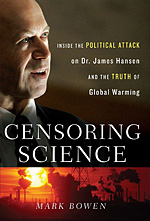
I’ll wager Watts hasn’t read the article in Climbing, and didn’t know who Bowen was when he launched his attack, though. The denials of bias coming out of the denialists’ camp will be interesting to watch.
Let the denialists roll out the rope far enough, they’ll inevitably hang themselves.
Ultraviolet image of the Andromeda Galaxy, first known to be a galaxy by Edwin Hubble on December 30, 1924 - Galaxy Evolution Explorer image courtesy NASA
On December 30, 1924, Edwin Hubble announced he’d discovered other galaxies in distant space. Though it may not have been so clear at the time, it meant that, as a galaxy, we are not alone in the universe (whether we are alone as intelligent life is a separate question). It also meant that the universe is much, much bigger than most people had dared to imagine.
Hubble was the guy who showed us the universe is not only bigger than we imagined, it’s probably much bigger and much more fantastic than we can imagine. Hubble is the guy who opened our imaginations to the vastness of all creation.
How does one celebrate Hubble Day? Here are some suggestions:
Easier than Christmas cards: Send a thank-you note to your junior high school science teacher, or whoever it was who inspired your interest in science. Mrs. Hedburg, Mrs. Andrews, Elizabeth K. Driggs, Herbert Gilbert, Mr. Willis, and Stephen McNeal, thank you.
Rearrange your Christmas/Hanukkah/Eid/KWANZAA lights in the shape of the Andromeda Galaxy — or in the shape of any of the great photos from the Hubble Telescope (Andromeda Galaxy pictured above; Hubble images here)
A few of the images from the Hubble Telescope
Go visit your local science museum; take your kids along – borrow somebody else’s kids if you have to (take them along, too)
Spend two hours in your local library, just looking through the books on astronomy and the universe
Anybody got a good recipe for a cocktail called “The Hubble?” “The Andromeda?” Put it in the comments, please
In 1924, he announced the discovery of a Cepheid, or variable star, in the Andromeda Nebulae. Since the work of Henrietta Leavitt had made it possible to calculate the distance to Cepheids, he calculated that this Cepheid was much further away than anyone had thought and that therefore the nebulae was not a gaseous cloud inside our galaxy, like so many nebulae, but in fact, a galaxy of stars just like the Milky Way. Only much further away. Until now, people believed that the only thing existing outside the Milky Way were the Magellanic Clouds. The Universe was much bigger than had been previously presumed.
Later Hubble noted that the universe demonstrates a “red-shift phenomenon.” The universe is expanding. This led to the idea of an initial expansion event, and the theory eventually known as Big Bang.
Hubble’s life offered several surprises, and firsts:
Hubble was a tall, elegant, athletic, man who at age 30 had an undergraduate degree in astronomy and mathematics, a legal degree as a Rhodes scholar, followed by a PhD in astronomy. He was an attorney in Kentucky (joined its bar in 1913), and had served in WWI, rising to the rank of major. He was bored with law and decided to go back to his studies in astronomy.
In 1919 he began to work at Mt. Wilson Observatory in California, where he would work for the rest of his life. . . .
Hubble wanted to classify the galaxies according to their content, distance, shape, and brightness patterns, and in his observations he made another momentous discovery: By observing redshifts in the light wavelengths emitted by the galaxies, he saw that galaxies were moving away from each other at a rate constant to the distance between them (Hubble’s Law). The further away they were, the faster they receded. This led to the calculation of the point where the expansion began, and confirmation of the big bang theory. Hubble calculated it to be about 2 billion years ago, but more recent estimates have revised that to 20 billion years ago.
An active anti-fascist, Hubble wanted to joined the armed forces again during World War II, but was convinced he could contribute more as a scientist on the homefront. When the 200-inch telescope was completed on Mt. Palomar, Hubble was given the honor of first use. He died in 1953.
“Equipped with his five senses, man explores the universe around him and calls the adventure Science.”
(Does anyone have a suitable citation for that video? Where did it come from? Who produced it? Is there more somewhere?)
Happy Hubble Day! Look up!
Resources:
Journey to Palomar site (production currently being broadcast on PBS affiliates – wonderful story of George Ellery Hale and the origins of modern astronomy at Palomar; that’s where Hubble worked)
The guest poster is Willis Eschenbach. His argument? Well, rivers don’t run straight to the sea; they meander. Ergo, water doesn’t run downhill in a complex system. Consequently, no global warming. In another place he argues that humans are not metal, therefore, no global warming.
I mean — sweet Mother of Pearl! — this guy even denies the existence of the Army Corps of Engineers, and river straightening:
The results of changes in such a flow system are often counterintuitive. For example, suppose we want to shorten the river. Simple physics says it should be easy. So we cut through an oxbow bend, and it makes the river shorter … but only for a little while. Soon the river readjusts, and some other part of the river becomes longer. The length of the river is actively maintained by the system. Contrary to our simplistic assumptions, the length of the river is not changed by our actions.
No wonder they place all their bets on stealing e-mails from scientists. Somebody show that man the South Platte River through Denver, Colorado, or the Los Angeles River through Los Angeles, or the Mississippi from Arkansas to the Gulf. Somebody give that man a paddle!
Here are a couple of clues: First, water always runs downhill — capillary action being the exception. Eschenbach doesn’t propose capillary action as a driver of river meandering. Any hydrologist will tell you, however, that even a meandering river runs downhill. Second, human beings don’t conduct heat like metal blocks. Even a dead human won’t conduct heat like a copper block, but especially a living human will radiate heat away through several different paths, so that heating the feet of a human will not cause a concomitant rise in temperature of the head. But, heck, if you soak the human’s head in hot water, it won’t warm like a block of steel, either. The examples offered in this piece get pushed past the brink of absurdity. It’s impossible for me to believe that Eschenbach — or Watts — fails to understand the physics so greatly. I can only imagine that they are driven by a fanatic devotion to an idea of the result they hope to see, and that blinds them to the errors they make.
Finally, water’s flow, downhill or up with capillary action, doesn’t negate global warming. Human conductivity affects warming not at all, also.
(No, “constructal theory” doesn’t have much to do with it. Constructal theory generally doesn’t apply to atmospheric conditions, since the air is, technically, not alive, but a dynamic fluid system already highly evolved for these purposes. Even for those cases in which contructal ideas apply to non-living systems, constructal theory does not claim that laws of physics are suspended or held in abeyance, as Eschenbach claims at Watts’s blog. The idea of constructal theory is that systems not in equilibrium, will, over time, figure out (evolve) more efficient means to get into equilibrium. This has nothing to do with the fact of CO2 acting as a greenhouse gas. Constructal theory would only suggest that, over time, the atmosphere would develop systems to get heat distributed better despite CO2, which means that warming would not be held in abeyance at all, but spread out further and farther.)
Watts is already hot that I posted science links at his place on another post. Go see what other commenters can get away with. Can the camel’s nose of real science push into the WUWT tent?
Share the lightness:
Spread the word; friends don't allow friends to repeat history.
"Construct complex fractals out of light using a few shiny Christmas tree ornaments. Who says the holidays aren't exciting?"
All you need is a camera and some imagination — oh, and some Christmas ornaments. In this case, four silver ornaments ($5 at Target, the guy says), a piece of Scotch tape, and the colored lights. The photo above comes from four ornaments, stacked. Go see how he does it (lots of photos), and check out his Flickr stream.
How about looking at the Christmas tree through the light of this knowledge? Here is some food for thought:
We know more planets beyond the solar system than there are Christmas balls on your tree. The current count is at 358 exoplanets, and growing;
If the planet was [shrunk] to the size of a Christmas ball, it would be the smoothest ball of the tree. The Mount Everest (8 km) or the Marianas Trenchr (11km) are small imperfections relative to the planet’s 12,000 km diameter. It’s an imperfection of less than 0,01%;
“Earth is not spherical, it’s an oblate spheroid”, some Grinch may say. Indeed, our planet wider in the equator, but even this deviation from a perfect sphere is of less than 0,04%;
If an 8 centimeters Christmas ball represented Earth and the nearest ball represented the nearest known exoplanet – Epsilon Eridani b, 10.5 light-years away – then the distance between them should be around 630,000 km. Almost twice the actual distance from Earth to the Moon. Epsilon Eridani b is quite far from here
Now, if the star at the top of the tree represented our Sun, 1,392,000 km in diameter, and the star at the top of your neighbor’s tree – say, 50 meters away – represented the nerest star system, Alpha Centauri at 4 light-years of distance; then the size of our Sun-star to be on the same scale it would have to be 0,74 micrometers large. From 1,4 million kilometers to more than 100 times smaller than the width of a hair, that’s how small the star should be for it to be in the same scale as the distance between it and the neighbor’s Christmas star.
Here’s another example of where historians show their value in science debates.
Naomi Oreskes delivered this lecture a few years ago on denialism in climate science. Among other targets of her criticism-by-history is my old friend Robert Jastrow. I think her history is correct, and her views on the Marshall Institute and denial of climate change informative in the minimum, and correct on the judgment of the facts.
You’ll recognize some of the names: Jastrow, Frederick Seitz, S. Fred Singer, and William Nierenberg.
Oreskes details the intentional political skewing of science by critics of the serious study of climate warming. It’s just under an hour long, but well worth watching. Dr. Oreskes is Professor of History in the Science Studies Program at the University of California at San Diego. The speech is titled “The American Denial of Global Warming.”
If Oreskes is right — and I invite you to check her references thoroughly, to discover for yourself that her history and science are both solid — Lord Monckton is a hoaxster. Notice especially the references after the 54 minute mark to the tactic of claiming that scientists are trying to get Americans to give up our sovereignty.
Nothing new under the sun.
“Global warming is here, and there are almost no communists left,” Oreskes said.
Nudge your neighbor:
Spread the word; friends don't allow friends to repeat history.
If you do not read Robert Park regularly, you should. His weekly missive on September 4 succinctly deals with the two big climate change stories of the week, with vim and vigor:
1. CLIMATE CHANGE: HOTTEST ARCTIC SUMMER IN 2,000 YEARS.
A major study published in today’s Science marks a seminal advance in Sediments from Arctic lakes were used to compile proxy for the last 2000 years. Arctic summer temperature declined for thousands of years due to a shift in Earth’s orbit. Although the orbital shift has been going on for 8000 years and will continue, an increase in greenhouse gases produced by the overpowered the cooling trend. The warming has been more rapid since about 1950. Moreover, thawing permafrost will release methane into the atmosphere, accelerating warming. The latest study comes just months after scientists at NOAA warned that within the next 30 years Arctic sea ice could vanish completely during the summer; that will further accelerate warming due to decline in reflective ice cover.
2. CLIMATE SOLUTIONS: IN THE LONG RUN, THERE IS ONLY ONE.
Even as the study on Arctic warming was making its way into print, a group at the controversial Center proposed a quick geo-engineered solution to. The group is headed by statistician Bjorn Lomborg, a follower of the late Julian Simon, the libertarian economist at the University of Maryland, who believed there are no limits. Lomborg proposes puffing lots of white clouds into the atmosphere to reflect sunlight. It would be the perfect job for Lomborg, who has been puffing clouds of obscurantism since he wrote (Cambridge, 2001). Presumably we should just keep puffing out bigger white clouds to compensate for the ever growing population.
White clouds of vapor indeed. Park is a great fog-cutter.
3. SCOPES REDUX: LOBBYISTS MAY BE NOSTALGIC FOR DAYTON.
Newspapers around the country have carried the story of the US Chamber of Commerce, the top US lobbying group, calling for the EPA to hold a Scopes- like hearing on the evidence that climate change is man-made. The EPA dismisses such a stunt as a “waste of time,” but that’s the least of its problems. Having lost the contest over scientific peer review of journal articles, the global warming deniers are accused have cooked up a Hollywood stunt.
Global warming deniers are steamed, and may just stew.
More:
“Recent Warming Reverses Long-Term Arctic Cooling,” Science 4 September 2009: Vol. 325. no. 5945, pp. 1236 – 1239 DOI: 10.1126/science.1173983 (abstract; full text available with subscription)
Darrell S. Kaufman,1,* David P. Schneider,2 Nicholas P. McKay,3 Caspar M. Ammann,2 Raymond S. Bradley,4 Keith R. Briffa,5 Gifford H. Miller,6 Bette L. Otto-Bliesner,2 Jonathan T. Overpeck,3 Bo M. Vinther,7 Arctic Lakes 2k Project Members
“The temperature history of the first millennium C.E. is sparselydocumented, especially in the Arctic. We present a synthesisof decadally resolved proxy temperature records from polewardof 60°N covering the past 2000 years, which indicates thata pervasive cooling in progress 2000 years ago continued throughthe Middle Ages and into the Little Ice Age. A 2000-year transientclimate simulation with the Community Climate System Model showsthe same temperature sensitivity to changes in insolation asdoes our proxy reconstruction, supporting the inference thatthis long-term trend was caused by the steady orbitally drivenreduction in summer insolation. The cooling trend was reversedduring the 20th century, with four of the five warmest decadesof our 2000-year-long reconstruction occurring between 1950and 2000.”
I wait in vain for a condemnation of Newton’s laws of motion, since they account for so many deaths in virtue of their description of how bullets, speeding automobiles, and the like generate so much energy of impact. F=MA must be immoral.
Why is it Darwin gets all the flack from fundamentalists, when it was Newton who pushed the angels out of the heavens, Hubble who peeked into the universe’s running without gods?
Evan at Two Dishes but to One Table provides some salient commentary on the New York Regents test and practical math skills, with a little bit of Henny Youngman thrown in. Though, I must admit my physics chops are rusty: How many newtons to a chicken egg? I’m almost clueless.
Warning to dilettentes: Link to actual released Regents test included.
Spread the word; friends don't allow friends to repeat history.
Tattoo of Alison, a high-school physics teacher - from Carl Zimmer's Collection, at the Loom
Can’t tell which equation is the Mandelbrot Set, which the hydrostatic equation, which the description of entropy? Can’t figure out why the delta, and otherwise confused? Alison explains it all, at Carl Zimmer’s blog, The Loom.
It’s relatively clear that she didn’t get the tats to use them to cheat on any exams.
Spread the word; friends don't allow friends to repeat history.
Or, until that account is unsuspended by the forces supporting Donald Trump: Follow @FillmoreWhite, the account of the Millard Fillmore White House Library
We've been soaking in the Bathtub for several months, long enough that some of the links we've used have gone to the Great Internet in the Sky.
If you find a dead link, please leave a comment to that post, and tell us what link has expired.
Thanks!
Retired teacher of law, economics, history, AP government, psychology and science. Former speechwriter, press guy and legislative aide in U.S. Senate. Former Department of Education. Former airline real estate, telecom towers, Big 6 (that old!) consultant. Lab and field research in air pollution control.
My blog, Millard Fillmore's Bathtub, is a continuing experiment to test how to use blogs to improve and speed up learning processes for students, perhaps by making some of the courses actually interesting. It is a blog for teachers, to see if we can use blogs. It is for people interested in social studies and social studies education, to see if we can learn to get it right. It's a blog for science fans, to promote good science and good science policy. It's a blog for people interested in good government and how to achieve it.
BS in Mass Communication, University of Utah
Graduate study in Rhetoric and Speech Communication, University of Arizona
JD from the National Law Center, George Washington University


 Posted by Ed Darrell







 Millard Fillmore's Bathtub