Does “Twitchy” really just mean “knee jerk?” Correcting the record, deflecting the hoaxes, propaganda and Mau-Mauing about Rachel Carson and DDT

June 1, 2014

Or is there any “knee” in that at all? Maybe it’s just jerk.

You know the drill. Someone says something nice about Rachel Carson’s great work. Someone on the right can’t stand that a scientist gets spoken of well, comes unglued, and spills every lie about Rachel Carson anyone can find, including the big lie, that “millions of kids died unnecessarily because DDT was banned because Rachel Carson lied about DDT, which is really a lot like sugar water to humans and all other living things.”

For the record, each of those claims is false; in reverse order:

  1. DDT is toxic to almost all living things, a long-lived and potent poison (which is why DDT was used to kill harmful insects and other vermin). While bed bugs and mosquitoes have evolved resistance and total immunity to the stuff, few other creatures have.
  2. Rachel Carson told all the truth about DDT that was known at the timeHer accuracy was confirmed by a panel of the nation’s top scientists, who reviewed her work for errors, and federal policy for usefulness and safety.  Since the 1962 publication of Silent Spring, and since Carson’s untimely death from cancer in 1964, we’ve learned that DDT is a carcinogen (though, we hope, a weak one); we’ve learned that DDT is an endocrine disruptor that fouls up sex organs and sexual maturity in more animals than anyone can count, including humans; and we’ve learned that  DDT causes birds to lay eggs with shells so thin the chicks cannot survive, even if the DDT doesn’t kill the chick outright.
  3. Carson didn’t urge a ban on DDT, nor did it happen until eight years after her death.  As I explain below, Carson fought to stop DDT abuses, to preserve DDT’s utility in the fight against disease.  She lost that fight, and as a resul tof DDT abuse by DDT advocates, the World Health Organization (WHO) had to scrap it’s ambitious program to eradicate malaria from the Earth — just as the campaign got to tropical areas of Africa.  DDT was banned for crops in the U.S. (health uses have never been banned here), after two different federal courts ordered EPA to do something because under the existing law they’d be required to ban DDT completely if EPA didn’t act, and after a rather adversary administrative law hearing that lasted nine months, featured testimony and document submissions from more than 30 DDT manufacturers, and compiled a record of DDT’s benefits and harms nearly 10,000 pages long.  It was science that got DDT banned, not Rachel Carson’s great writing.
  4. Almost every year since EPA banned DDT use on crops in the U.S., worldwide malaria deaths dropped, from peak-DDT use years (circa 1958-1963) levels of approximately 4 million deaths per year, to 2013’s approximately 627,000 deaths.  It’s unfair and grotesquely inaccurate to claim a reduction in deaths of about 84% is, instead, an increase.  Malaria was not close to eradication in 1965 when WHO stopped its campaign on the ground, nor in 1969 when WHO officially abandoned eradication as a goal, nor in 1972 when the U.S. banned DDT use in the U.S., and dedicated all U.S. production of DDT to export, mostly for fighting insects that cause disease.

In short, Rachel Carson is exactly as the history books present her, a very good scientist with a special gift for communicating science issues.

That’s exactly the stuff that galls the hell out of self-proclaimed conservatives, especially those who know they are the smartest person in any room, even an internet chat room with a few million people in it.  Say something good about a scientist, and they know that statement must be false, and what’s more  “. . .  let’s see, there should be something bad about this guy on Google . . . um, yeah . . . yessss! here, Lyndon Larouche’s magazine has some guy I’ve never heard of, but he’s smarter than any librul because he agrees with my bias! Take THAT you scurvy dog!”  And in short order they’ve scooped up all five or six nuts who said bad stuff about Rachel Carson and cross-cited each other, and they’ve copied the links to the three articles on the internet that obscure groups like CEI and AEI and Heritage have paid to raise in the Google searches, and . . .

Done deal.  “Good scientist!  Heh! No one will listen to old Rachel Carson any more!”

Unless good people stand up to the reputation lynch mobs, and stop them.  That’s why I’m telling you, so you’ll have the stuff you need to stand up.  I’m hoping you will stand up.

Shortly after dawn on May 27, Twitchy rose out of the mucky water and lobbed some mud balls at Google and especially Rachel Carson.  Twitchy is an interesting site.  It’s mostly composed of Tweets that support conservative causes and are snarky enough earn a snicker.  In short, there is no fact checking, and biases are preferred — whatever is the imagined conservative bias of the day (oddly enough, never is conservation of soil, water, nor human life ever a conservative-enough issue . . . but I digress).

It’s the nervous twitch of a knee-jerk mind and knee-jerk political mentality.

Twitchy opened up with a straightforward salvo from IowaHawk.

Note that, above, and again below, WHO records show that there were no “millions of malaria victims” of Rachel Carson.  IowaHawk, David Burge,  assumes — without a whit of real information — that DDT was the key to beating malaria, and so after the EPA ban on DDT, malaria must have risen, and so there must have been millions who died unnecessarily. Challenge the guy to put evidence to any part of that chain, and he’ll demur, probably suggest you’re mentally defective, and cast aspersions on what he assumes your political stand to be.  Or, he’ll ignore the challenge in hopes everybody will forget.   And another person will retweet Burge’s disinformative bit of propaganda — no facts, but what sounds like a nasty charge at someone who is presumed to be a liberal.  Burge’s erroneous Tweet had 504 retweets when I wrote this on June 1, great impact.

Eh. Truth wins in a fair fight, Ben Franklin said.  [I’m pretty sure it was Franklin; I’m still sourcing it, and if you have a correction, let me know!]

At length, more people chime in . . . and the level of misinformation in that discourse makes me crazy.

Occasionally I’ll drop in a correction, often a link to contrary information.  Then the abuse is astonishing. This conservative “hate information” machine is ugly.

CDC image of a child sleeping under an insecticide treated bednet (ITN) to prevent bites from malaria-carrying mosquitoes.

CDC image and caption: How do insecticide-treated nets work? People sleep under ITNs during the time when the mosquitoes that spread malaria like to feed. The insecticide on the nets helps reduce the numbers of mosquitoes that enter the house and works to kill the ones that do enter. In this way, the ITN protects the person or people sleeping under the net. If large numbers of people in the community sleep under an ITN, the numbers of mosquitoes, as well as their lifespan, will be reduced. When this happens, all members of the community receive some protection, whether or not they own or use an ITN.

From the Wellcome Trust malaria page, an explanation for why it's so important to stop bites in the home, at night, and why it's generally not necessary to kill mosquitoes out of doors, in daylight.

[Image link failed] From the Wellcome Trust malaria page, an explanation for why it’s so important to stop bites in the home, at night, and why it’s generally not necessary to kill mosquitoes out of doors, in daylight.

Sometimes I unload.  I was on hold for a more than an hour on a couple of phone calls that day.  Some guy working the handle OmaJohn took great exception to something I said — I think his complaint was that thought I knew what I was talking about — and of course, he knew better!  How dare I refer to facts!

Here’s my response.  I think OmaJohn may have gotten the message, or rethought the thing.

But others haven’t.

I list his statements, indented; my responses are not indented.  Links will be added as I can.  All images are added here.

Rachel Carson is still right, still a great scientist and an amazing writer.  DDT is still poisonous, still banned for agricultural use in the U.S., and still not the answer to “how do we beat malaria.”

OmaJohn said (double indent), and I responded (single indent):

Always with the crow’s lofty view to try and cherry-pick facts to paint a valid conclusion.

I wouldn’t know, Mr. Corvus. I’ve been looking at DDT professionally for science and policy, and as a hobby, and for law and history courses, for more than 30 years. I’m rather drowning in studies and statistics. A crow might be able to find some information that contradicts Rachel Carson’s writings and EPA’s rulings — but it’s not evident in this data ocean. You see some of those cherries? Do they outweigh the ocean they float in?

I do like how you use blogs to justify your condescension, though. [He complaining that I offered links to answers here, at this blog; how brazenly wrong of me to study an issue!]

I think your denigration of people who actually study a subject is ill-advised behavior. Research papers are printed on paper, just like comic books. It’s up to us to use the information to form cogent ideas about history, science, and make good policy as a result. The blogs I cite are often written by experts in the field — see especially Bug Girl, Tim Lambert and John Quiggen — and they most often provide links to the original sources.

(I gather you didn’t bother to read to see what was actually there. Your loss.)

I don’t like what appears to be your view that your non-informed opinion of something you really know little about is as valid as the work of people who devote their lives to getting the facts right. In the long run, your life depends on their winning that game, and always has.

Without having read a lot, I took a gander at a few of the folks ‘on the other side’ on this, and I was Jack’s complete lack of surprise to see you in here with your head high, throwing around blog references and talking down to people.

Much as you are talking down to me, from your position has head muckraker? I see.

I’m not sure what you mean by “folks on the other side.” If you mean on the other side of Rachel Carson, please note that in 52 years not a single science source she listed has ever been found to be in error, or fading as a result of changing science. Discover Magazine took a look at this issue in 2007, concluding Carson was right, and DDT use should be restricted as it was then and remains. The author wrote this, about claims that Carson erred on damage to birds from DDT:

In fact, Carson may have underestimated the impact of DDT on birds, says Michael Fry, an avian toxicologist and director of the American Bird Conservancy’s pesticides and birds program. She was not aware that DDT—or rather its metabolite, DDE—causes eggshell thinning because the data were not published until the late 1960s and early 1970s. It was eggshell thinning that devastated fish-eating birds and birds of prey, says Fry, and this effect is well documented in a report (pdf) on DDT published in 2002 by the Department of Health and Human Services’ Agency for Toxic Substances and Disease Registry (ATSDR). The report, which cites over 1,000 references, also describes how DDT and its breakdown products accumulate in the tissues of animals high up on terrestrial and aquatic food chains—a process that induced reproductive and neurological defects in birds and fish.

Don’t take my word for it. Go read for yourself. Check out PubMed, and read the first 50 citations you find on DDT and birds, the first 20 on DDT and human health, the first 50 on DDT and malaria. Check out the recent good books on the issue — William Souder’s great biography of Carson last year, On a Farther Shore, or Sonia Shah’s wonderful biography of malaria, [The Fever, How malaria has ruled humankind for 500,000 years].

Get real facts, in other words. Don’t talk down to people who might know what they’re talking about.

You wrote:

DDT use was officially stopped in most countries (perhaps all, I’ve not read anything I’d tout as even remotely conclusive, but I’ve not spent a substantial amount of time on this issue), but quickly (within a decade) was brought back to common use.

You should compost that, but it’s too green to do anything but foul things up indoors, here.

DDT was banned first in Sweden in 1971, then in the U.S. in 1972 — the U.S. ban was on crop use, only. About the only use that actually fell under that ban was cotton crops.

A few other European nations banned DDT.

DDT has never been banned in China, India, nor most of Asia, nor in any nation in Africa. Some African nations stopped using it when it stopped being effective; some African nations stopped using it when DDT runoff killed off food fishes and several thousands starved to death.

The World Health Organization never stopped using DDT, though its dramatic decline in effectiveness, especially in Africa, was key to the collapse and abandonment of WHO’s campaign to eradicate malaria. WHO stopped that campaign in 1965, and officially killed it off at the 1969 WHO meetings. You’ll note that was years before the 1972 ban in the U.S. — so the claims that the U.S. ban prompted a WHO to act is also false just on calendar terms.

If you check with the Wellcome Trust, they have several papers and PowerPoint presentations on the problems with malaria in Mexico, Central and South America — where DDT has been used constantly since 1948, with no ban. Unfortunately, malaria came back. Resistance to DDT in mosquitoes is real, and if malaria is not cured in the humans while the populations are temporarily knocked down, when the mosquitoes come back, they will find those humans with malaria, withdraw some of the parasites from that human, incubate them to the next part of the life cycle, and start a plague within a couple of weeks.

So, no, DDT was never banned in most places. There is a treaty, the Persistent Organic Pollutants Treaty (POPs), which names DDT as one of the dirtiest pollutants in the world. Though every other pollutant on the list is severely restricted or completely banned, DDT has a special carve out (Addenda D, if I recall correctly) which says DDT may be used by any nation to fight any vector-borne disease.

All a nation need do is send a letter to WHO explaining that it plans to use DDT, and when.

And, no, DDT was not brought back in haste to make up for a lack of the stuff.

Not sure where you’re getting your history, but it’s not exactly square with what’s happened.

That’s a pretty huge, expensive policy shift — twice.

Would have been, had it been done as you described. Not so.

There was a lot of pressure to make those changes.

So in the fight on Malaria, I think that scientists and bureaucrats generally agree that DDT plays an important role, particularly after seriously slowing or stopping use for a substantial amount of time.

Read the POPs treaty — go to the WHO site and you can still get some of the deliberative papers.

For almost all uses, DDT has much better alternatives available today.

Malaria is a special case because humans screwed up the eradication campaign, first, by abusing DDT and creating DDT resistance in the mosquitoes, and second, by completely abandoning most other parts of the program when DDT crapped out.

DDT doesn’t cure malaria. All it does is temporarily knock down the mosquitoes that carry the parasite through part of its life cycle. Better medical care is a very important part of beating the disease, and as in the U.S., improving housing cuts malaria rates dramatically, especially with windows that are screened roughly from sundown to early morning.

DDT is one of 12 chemicals WHO approves for use in Indoor Residual Spraying (IRS), in areas where there are outbreaks of the disease. If any one chemical were used alone, it would be ineffective within months, or weeks.

When tobacco farmers in Uganda sued to stop DDT spraying in the early years of the 21st century, WHO issued a press release saying it still believes in DDT. Well, WHO always did. But as of 2010, DDT’s effectiveness is even less, and many nations use only the other 11 chemicals for IRS against malaria.

DDT is still there, if it works, and if it helps; bednets alone are more than double the effectiveness of DDT in preventing malaria. We could probably phase out DDT completely without anyone noticing. DDT is not a panacea. There is no shortage of DDT anywhere today. No one dies for a lack of DDT — though many may die from a lack of bednets or appropriate medical care, problems DDT cannot touch

I believe that Rachel Carson championed her cause very successfully. I believe there was sizeable, if not perfectly tangible, fallout that would only be measurable in human livesand misery thanks to her efforts. And in the end, things were as they should have been, despite her best efforts to force them where they
shouldn’t be.

I see. You don’t know what Rachel Carson said about DDT.

Carson said that DDT was — in 1962 — a pesticide without a clear replacement. She said it was absolutely critical to the then-existing WHO campaign to fight malaria.

And because of that, she urged that use of DDT on crops, or to kill cockroaches, or to kill flies at picnic sites, be stopped — because unless it were stopped, the overuse could not fail to leak into the rest of the ecosystem. Mosquitoes would quickly develop resistance to DDT — that had been a key problem in Greece in 1948, and Carson cites several other places where anti-typhus and anti-malaria campaigns were scuttled when the insects started eating DDT — and once that resistance developed, Carson said, beating malaria would be set back decades at a minimum, and maybe centuries.

She wrote that in 1962.

Fred Soper was the super mosquito fighter in the employ of the Rockefeller Foundation who developed the DDT-based malaria eradication program. He was loaned to WHO to take the campaign worldwide. Soper thought Carson was too tough on DDT in her book, but he had already calculated that DDT resistance would develop by 1975. He had just more than a dozen years to eliminate malaria, he wrote. (This is chronicled in Malcom McDowell’s 2001 profile of Soper in The New Yorker; you can read it at McDowell’s website.)

WHO’s campaign had mopped up pockets of malaria left in temperate zone nations; he had massive successes in sub-tropical nations, and he was poised to strike at the heart of malaria country, in equatorial Africa, in 1963.

The first campaign launched there fizzled completely. When they captured some mosquitoes, they found the mosquitoes were highly resistant to DDT already. Turns out that farmers in Africa wanted spotless fruit, too, and were using tons of DDT to get it.

For the health workers, what that meant was they had no tool at all to knock down mosquitoes even temporarily, to then finish the medical care, housing improvement and education components of the malaria eradication campaign.

It is also true that many of those nations had unstable governments. Soper’s formula required that 80% of the homes in an affected area be treated. That required highly trained, very devoted workers, and a willing population. Those things were difficult to find in nations with unstable governments, or worse, civil war. So there were other complicating factors. But Soper had faced those, and beaten them, behind the Iron Curtain, in Asia, in the Pacific and in South America.

When DDT quit on him, as Carson predicted it would without official action to save its potency, Soper called it quits.

Soper ended his campaign without approaching most of equatorial Africa in 1965. WHO officially ended the program in 1969.

Carson died in 1964. She would have been saddened that DDT stopped working in the malaria fight so early. She had written about it occurring in some future year — she probably knew of Soper’s calculation in the 1970s.

The public relations smear campaign against Carson, costing the chemical companies $500,000, generated some doubt among the public, but the President’s Science Advisory Council published its report saying Carson was accurate on the science, and calling for immediate action against DDT — in 1963.

It was 7 years after her death that EPA was organized, and 8 years before EPA moved against DDT.

Carson pleaded for a dramatic reduction in unnecessary DDT use — to make spotless apples, for example — in order to save people from malaria.

What did you think she said? What things were back where they should have been — poor kids dying of malaria is as it should be?

We could have done better, had we listened to Rachel Carson in 1962.

You’ve offered nothing that logically refutes those conclusions.

You should have read those blogs.

More:

  • David Burge, Iowahawk, whose post started the Twitchy twitches, several years ago revealed that a young boy his family had been sponsoring in Africa through a private charity, had died from malaria.  Death from malaria is a tragic reality.  Burge urged people to speak out for more DDT, and to donate money to Africa Fighting Malaria.  Readers of my blog may recall that AFM is the astro-turf organization founded by Roger Bate years ago, from all appearance to pay Roger Bate to say nasty things about Rachel Carson.  We could find on their IRS 990 form no evidence that the organization does anything to fight malaria, anywhere.  One might wonder how much anti-malaria activity Roger Bate’s $100,000/year salary would have purchased, in any of the several years he headed the non-help group, or since.  Adding insult to tragedy, Burge noted at his blog that “environmental groups” opposed Indoor Residual Spraying in Africa, and especially the use of DDT.  But it turns out that the chief opposition at that time came from tobacco growers and tobacco organizations — the groups from whom Roger Bate solicited money to start up AFM.  Wouldn’t it be easier just to stick with the facts?
  • If you want to do something, to save a life from malaria, send $10 to Nothing But Nets.  In stark contrast to AFM, NbN sends almost all its money to buy bednets to give away to people in malaria-endemic areas of Africa.  While AFM ridicules nets, they are much more effective at preventing malaria than IRS, especially IRS with DDT alone.  Nets are much cheaper, too.  NbN acts in partnership with the NBA and the United Methodist Church in the United States, and is one of the most upstanding charities anywhere.  They do not say nasty things about Rachel Carson — probably wouldn’t if they thought to, because they are so busy fighting malaria.

Another conservation success: Bearded vulture returns to the Alps

May 31, 2014

Do conservation efforts pay off?  Yes, they do.

Film comes from the European-based Vulture Conservation Foundation.

Since the film, more of these majestic animals have been released.  Here are photos from the release on Friday, May 30:

Workers and volunteers from the Vulture Conservation Foundation, climbing the Alps to release to the wild another captive-raised bearded vulture.

Workers and volunteers from the Vulture Conservation Foundation, climbing the Alps to release to the wild another captive-raised bearded vulture. (We might assume the vulture is in the box.)

One must respect these volunteers, climbing such tors simply to watch a bird fly away.

The line of hiking Vulture Conservation Foundation volunteers stretched across an alpine mountain for a release on May 30, 2014.

The line of hiking Vulture Conservation Foundation volunteers stretched across an alpine mountain for a release on May 30, 2014.

You can tell

Not ready for his (her?) close up, this bearded vulture may be wildly happy, or sad to leave those who raised it.  Vultures, it may be said, are often inscrutable.  Vulture Conservation Foundation photos.

Not ready for his (her?) close up, this bearded vulture may be wildly happy, or sad to leave those who raised it. Vultures, it may be said, are often inscrutable. Vulture Conservation Foundation photos.

Tip of the old scrub brush to bird conservationist Amanda Holland.


Yes, malaria is still a plague; it’s not Rachel Carson’s fault, and your saying so probably kills kids

May 30, 2014

May 27’s Google Doodle honoring Rachel Carson brought out a lot of those people who have been duped by the anti-Rachel Carson hoaxers, people who are just sure their own biased views of science and the politics of medical care in the third world are right, and Carson, and the people who study those issues, are not.

So comes “The Federalist,” what appears to me to be a reactionary site, which yesterday got great readership for a story from Bethany Mandel.  Mandel tells a story of a child in Cambodia suffering from malaria.  The suffering is horrible and the child most likely died.  It’s a tragic story of poverty and lack of medical care in the third world.

Erroneously, Mandel up front blames the suffering all on Rachel Carson, in a carp about the Google Doodle.

Here was my quick response between bouts in the dentist’s chair yesterday [links added here]:

[Bethany Mandel wrote:] Using faulty science, Carson’s book argued that DDT could be deadly for birds and, thus, should be banned. Incredibly and tragically, her recommendations were taken at face value and soon the cheap and effective chemical was discontinued, not only in the United States but also abroad. Environmentalists were able to pressure USAID, foreign governments, and companies into using less effective means for their anti-malaria efforts. And so the world saw a rise in malaria deaths.

Don’t be evil?

Start by not telling false tales.

1.  Carson presented a plethora of evidence that DDT kills birds.  This science was solid, and still is.

2.  Carson did not argue DDT should be banned.  She said it was necessary to fight disease, and consequently uses in the wild, requiring broadcast spraying, should be halted immediately.

3.  Scientific evidence against DDT mounted up quickly; under US law, two federal courts determined DDT was illegal under the Federal Insecticide, Fungicide, and Rodenticide Act; they stayed orders to ban the chemical pending hearings under a new procedure at the new Environmental Protection Agency.

EPA held hearings, adversary proceedings, for nine months. More than 30 DDT manufacturers were party to the hearings, presenting evidence totaling nearly 10,000 pages.  EPA’s administrative law judge ruled that, though DDT was deadly to insects, arachnids, fish, amphibians, reptiles, birds and mammals, the labeled uses proposed in a new label (substituted at the last moment) were legal under FIFRA — indoor use only, and only where public health was concerned.  This labeling would allow DDT to remain on sale, over the counter, with few penalties for anyone who did not follow the label.  EPA took the label requirements, and issued them as a regulation, which would prevent sales for any off-label uses.  Understanding that this would be a severe blow to U.S. DDT makers, EPA ordered U.S. manufacture could continue, for the export markets — fighting mosquitoes and malaria being the largest export use.

This ruling was appealed to federal courts twice; in both cases the courts ruled EPA had ample scientific evidence for its rule.  Under U.S. law, federal agencies may not set rules without supporting evidence.

4.  DDT was banned ONLY for agriculture use in the U.S.  It was banned in a few European nations.  [Addition, December 30, 2014: In fact, the U.S. action against DDT by EPA specifically called for DDT use in any fight against a vector borne disease, like malaria.]

5.  DDT has never been banned in Africa or Asia.

6.  USAID’s policy encouraged other nations to use U.S.-made DDT, consistent with federal policy to allow manufacture for export, for the benefit of U.S. business.

7.  U.S. exports flooded markets with DDT, generally decreasing the price.

Fred Soper, super malaria fighter, whose ambitious campaign to erase malaria from the Earth had to be halted in 1965, before completion, when DDT abuse bred mosquitoes resistant and immune to DDT.

Fred Soper, super malaria fighter, whose ambitious campaign to erase malaria from the Earth had to be halted in 1965, before completion, when DDT abuse bred mosquitoes resistant and immune to DDT.

8.  Although WHO had been forced to end its malaria eradication operation in 1965, because DDT abuse had bred mosquitoes resistant to and immune to DDT, and though national and international campaigns against malaria largely languished without adequate government funding, malaria incidence and malaria deaths declined.  Especially after 1972, malaria continued a year-over-year decline with few exceptions.

Note that the WHO campaign ended in 1965 (officially abandoned by WHO officials in 1969), years before the U.S. ban on DDT.

Every statement about DDT in that paragraph of [Mandel’s] article, is wrong.

Most important, to the purpose of this essay, malaria did not increase.  Malaria infections decreased, and malaria deaths decreased.

I’m sure there are other parts of the story that are not false in every particular.  But this article tries to make a case against science, against environmental care — and the premise of the case is exactly wrong.  A good conclusion is unlikely to follow.

Mandel was hammered by the full force of the anti-Rachel Carson hoaxers.  I wonder how many children will die because people thought, “Hey, all we have to do is kill Rachel Carson to fix malaria,” and so went off searching for a gun and a bullet?

You are not among them, are you?

Update: This guy, a worshipper of the Breitbart, seems to be among those who’d rather rail against a good scientist than lift a finger to save a kid from malaria. If you go there, Dear Reader, be alert that he uses the Joe Stalin method of comment moderation:  Whatever you say, he won’t allow it to be posted.  Feel free to leave comments here, where we practice First Amendment-style ethics on discussion.


Rachel Carson, star of Google Doodle on her 107th birthday

May 27, 2014

Have you been to Google today for a general search?  Did you catch the Doodle?

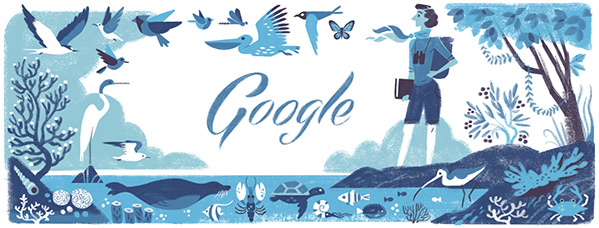
Google Doodle for May 27, 2014, honors scientist and writer Rachel Carson on what would have been her 107th birthday.

Google Doodle for May 27, 2014, honors scientist and writer Rachel Carson on what would have been her 107th birthday.

Perhaps even more remarkable, if you click the Doodle (any Doodle) it takes you to a Google search on that subject.  The search you get today is all positive about Carson.  Considering the money being spent to soil her reputation, 50 years after her death, one might wonder if Google adjusted the search or the algorithm for the results to do that.

If they monkeyed with it, give them bonus points for accuracy and thoroughness.

If they didn’t monkey with it, take great hope that Ben Franklin was right, and truth does indeed win in a fair fight.

Here’s page 1 of the search result I got (not an image, so the links stay hot for you):

Rachel Carson – Wikipedia, the free encyclopedia

en.wikipedia.org/wiki/Rachel_Carson

Wikipedia

Rachel Louise Carson (May 27, 1907 – April 14, 1964) was an American marine biologist and conservationist whose book Silent Spring and other writings are …


    1. The Independent ‎- by Linda Sharkey ‎- 3 hours ago
      Tomorrow marks the 107th anniversary of the birth of Rachel Louise Carson, the environmentalist whose research led to the banning of harmful …

    More news for Rachel Louise Carson


Rachel Carson left a great and powerful legacy.  52 years after the publication of her most important, most read, and most criticized book, not a single piece of science she cited has been disproven by subsequent research.  Discover Magazine did a literature search some years ago and found more than 1,000  research projects had been done on DDT’s harm to birds, and every one that was published came back to support the claims Carson had made.

Apart from her extreme care for the science and great accuracy, Carson’s words today can still inspire.  She was a helluva writer.  Carson made clear that biological research in the wild is really ecology.  Today more than ever before range botanists and zoologists, to take one example, work closely with each other, and with geneticists, molecular biologists, entomologists, chemists, physicists, climatologists, geologists and geographers, and anyone else who wants to chime in, to present clear understandings the ripple effects damage or benefit to one species may have on many others.

Before Rachel Carson, any graduate study programs in ecology were few and far between, often not even called ecology.

Those methods help to save birds, and also every other form of life on the planet.

Blinded, angry and malicious opposition to the facts Carson laid out, and later scientists still lay out, remains the bigger problem.

Chemical manufacturers spent more than $500,000 in 1962 to smear Carson and her work.  The smears largely did not work, instead forcing scientists to look at her work (which they found solid in science).  But since then, tobacco companies with the Tobacco Institute, perfected the techniques of raising doubts about good science among policymakers and the public.  Today companies spend billions to impugn scientific works in climate change, air and water pollution, and health care.  They are joined by an unpaid mob of internet-savvy malcontents to impugn the integrity of the U.S. space program, vaccinations, and even meteorologists who note that airplane exhaust creates condensation trails at high altitudes. (Yes, it’s water vapor.)

This blog’s seeming obsession with Carson was prompted by such an exquisite act of denialism in Congress, seven years ago, when I learned that Utah Congressman Rob Bishop was bragging about blocking the naming of a post office for Carson, based on false claims that Carson had written false or faulty science, that the U.S. ban on DDT use on crops had extended far outside the jurisdiction of the U.S., and that a shortage of DDT meant malaria had come roaring back from near extinction to unnecessarily kill millions. (The post office was eventually named for Carson, but Bishop and other deluded critics have never repented nor apologized.)

(The facts:  Malaria deaths and infection rates both continued to drop, worldwide, after the U.S. stopped spraying DDT on cotton. Many tens of millions fewer people died of malaria after the U.S. banned it.  The U.S. ban covered only the U.S., but let DDT makers keep cranking the stuff out for export, multiplying the amount of DDT available to fight malaria.  Unfortunately, as Carson feared, abuse of DDT in the third world quickly created DDT-resistant and immune mosquitoes; in 1965, the World Health Organization abandoned its malaria eradication campaign because of DDT’s declining effectiveness, a full seven years before the U.S. banned DDT.)

Truth wins in a fair fight, Ben; but as in colonial America, it is necessary for brave citizens to work hard to keep the fight fair.

Because of Rachel Carson, the bald eagle is off the endangered species list, and proliferating in the lower 48 states of the U.S. — as indeed are the peregrine falcon, osprey, and brown pelicans.  DDT continues to hammer many creatures in the wild, however, including the still-endangered  California condor.  Our national policies now require, by law, that significant federal projects consider the environmental effects of those actions, and mitigate the more severe effects or not proceed.  The U.S. now has an agency whose sole job is to consider the safety of chemicals and substances we use in the wild, with power to regulate air and water cleanups — and to clean up more than 400 DDT-contaminated sites on the EPA Priority List, or Superfund.  Among the great successes of this agency was the elimination of lead from gasoline in the U.S., reducing chronic lead poisoning in tens of millions of Americans, and literally raising the national average IQ with elimination of the brain-killing effects of lead.  Lake Erie is cleaner.  The Potomac River, though with its problems, is once again clean enough for humans to swim and boat, as are a hundred other waterways in America, from the Raritan River in New Jersey to the Willamette in Oregon.

Very powerful legacy indeed.

Happy birthday, Rachel Carson; Earth is lucky to have had you, even for such a brief period.

More: 


Why World Turtle Day 2014?

May 23, 2014

English: Turtles. Français : Tortoises. Deutsc...

English: Turtles. Français : Tortoises. Deutsch: Schildkröten. Griechische Schildkröte (Testudo graeca). ¼. Klappschildkröte (Cinosternum pensylvanicum). ¼. Sumpfschildkröte (Cistudo lutaria). ¼. Matamata (Chelys fimbriata). 1/16. Großkopfschildkröte (Platysternum megalocephalurn). ¼. Lederschildkröte (Dermatochelys coriacea). 1/20. Karettschildkröte (Chelone imbricata). 1/20. (Photo credit: Wikipedia)

May 23 is World Turtle Day.  In fact, this is the 14th World Turtle Day.

No grand pronouncements from Congress, probably — American Tortoise Rescue picked a day, and that was that.  Their press release for 2014:

American Tortoise Rescue Celebrates World Turtle Day 2014 on May 23rd

Be sure to follow us on Facebook for fun contests and recipes! https://www.facebook.com/WorldTurtleDay

Suggested Tweet:  Celebrate #WorldTurtleDay on May 23 with @TortoiseRescue 

Malibu, CA – May 14, 2014 –  American Tortoise Rescue (ATR) (www.tortoise.com), a nonprofit organization established in 1990 for the protection of all species of tortoise and turtle, is sponsoring its 14th annual World Turtle Day on May 23rd.  The day was created as an observance to help people celebrate and protect turtles and tortoises and their disappearing habitats around the world.  Susan Tellem and Marshall Thompson, founders of ATR, advocate humane treatment of all animals, including reptiles.  Since 1990, ATR has placed about 3,000 tortoises and turtles in caring homes.  ATR assists law enforcement when undersized or endangered turtles are confiscated and provides helpful information and referrals to persons with sick, neglected or abandoned turtles.

“We launched World Turtle Day to increase respect and knowledge for the world’s oldest creatures,” said Tellem. “These gentle animals have been around for 200 million years, yet they are rapidly disappearing as a result of smuggling, the exotic food industry, habitat destruction, global warming and the cruel pet trade,” says Tellem. “We are seeing smaller turtles coming into the rescue meaning that older adults are disappearing from the wild thanks to the pet trade, and the breeding stock is drastically reduced.  It is a very sad time for turtles and tortoises of the world.”  (See slide show here.)

Tellem added, “We are thrilled to learn that organizations and individuals throughout the world now are observing World Turtle Day, including those in Pakistan, Borneo, India, Australia, the UK and many other countries.” She recommends that adults and children do a few small things that can help to save turtles and tortoises for future generations:

  • Never buy a turtle or tortoise from a pet shop as it increases demand from the wild.
  • Never remove turtles or tortoises from the wild unless they are sick or injured.
  • If a tortoise is crossing a busy highway, pick it up and send it in the same direction it was going – if you try to make it go back, it will turn right around again.
  • Write letters to legislators asking them to keep sensitive habitat preserved or closed to off road vehicles, and to prevent off shore drilling that can lead to endangered sea turtle deaths.
  • Report cruelty or illegal sales of turtles and tortoises to your local animal control shelter.
  • Report the use of tiny turtles as prizes at carnivals and other events.  It’s illegal.
  • Report the sale of any turtle or tortoise of any kind less than four inches.  This is illegal to buy and sell them throughout the U.S.

“Our ultimate goal is to stop the illegal trade in turtles and tortoises around the world.  Our first priority here in the U.S. is to ask pet stores and reptile shows to stop the sale of hatchling tortoises and turtles without proper information for the buyer,” says Thompson.  “For example, many people buy sulcata tortoises as an impulse buy because they are so adorable when they are tiny.  The breeders and pet stores frequently do not tell the buyers that this tortoise can grow to 100 pounds or more and needs constant heat throughout the year since they do not hibernate.”

He added, “We also need to educate people and schools about the real risk of contracting salmonella from water turtles.  Wash your hands thoroughly every time you touch a turtle or its water, and do not bring turtles into homes where children are under the age of 12.”

For answers to questions and other information visit American Tortoise Rescue online at http://www.tortoise.com or send e-mail to info@tortoise.com; on Twitter @tortoiserescue; “Like” American Tortoise Rescue on Facebook; and follow World Turtle Day on Facebook. 

Here’s to you Freddie, the Western Box Tortoise from Idaho, and Truck, the desert tortoise from Southern Utah, the friends of my youth.  And all you others.

Red-eared sliders, turtles at Texas Discovery Gardens - photo by Ed Darrell

Red-eared sliders cluster together to catch the sun on a spring day at Texas Discovery Gardens at Fair Park in Dallas. Photo by Ed Darrell, 2010

More, from 2013:


Poster for World Turtle Day (May 23, 2014)

May 23, 2014

World Turtle Day, Share the Roads!

Nice reminder, featuring an Eastern Box Tortoise (I think). Image from Conscious Companion.

A poster from last year.  Still accurate for World Turtle Day 2014.

Have a great World Turtle Day!  Go do something nice for your neighborhood turtles and tortoises.

Other views:

From there, it’s turtles all the way down!


More:


Catch some falling stars (with help from NASA and USA Today)

May 20, 2014

USA Today does some great graphics from time to time.

This set comes as a preview to a special meteor shower — maybe — this weekend.

USA Today chart of meteor showers left in 2014, with star map of how to find Camelopardalid Shower this weekend.

USA Today chart of meteor showers left in 2014, with star map of how to find Camelopardalid Shower this weekend.

And just for this weekend:

Night of Shooting Stars, New meteor shower influenced by Jupiter's gravity -- USA Today starmap showing best place to look for meteoroids this weekend, the Camelopardalid Meteor Shower (first ever).

Night of Shooting Stars, New meteor shower influenced by Jupiter’s gravity — USA Today starmap showing best place to look for meteoroids this weekend, the Camelopardalid Meteor Shower (first ever).

So, early Saturday morning, or early Sunday morning, we could be in for a meteor shower display more intense than we’ve seen in a long time, experts say.

Or maybe not.

NASA’s explanation should help you find them (we found this video via Space.com):


Annals of Global Warming: Significant events for U.S. April 2014.

May 13, 2014

National Overview - April 2014, from NOAA's National Climatic Data Center

National Overview – April 2014, from NOAA’s National Climatic Data Center

NOAA publishes these data monthly.  We tend to ignore them, as background noise.

But click over to NOAA’s site, look at the charts and click to follow links.  Ponder the story being told.

This is the snapshot for April 2014.

Major climate events NOAA is closely monitoring:

  • Drought in the West, Central and Southern Plains, and Midwest. Long- and short-term dryness will increase wildfire risk and continue to have impacts on water resources and agriculture.
  • El Niño development likely this summer or autumn. According to NOAA’s Climate Prediction Center, there is a greater than 65 percent chance of El Niño conditions developing later this year, which could have significant impacts on temperature and precipitation patterns across the U.S. More information is available from the Climate Prediction Center.

Supplemental April 2014 Information


  • Climate Highlights — April
  • The average temperature for the contiguous U.S. during April was 51.7°F, which was 0.7°F above the 20th century average. This was the 46th warmest April in the 120-year period of record.
  • Much of the contiguous U.S. had April temperatures near the 20th century average. Above-average temperatures were scattered along the West Coast and in the Southwest, the Southern Plains, and across parts of the Ohio Valley and the Southeast. Below-average temperatures were observed across parts of the Upper Midwest and Northern Plains. No state had April temperatures among their 10 warmest or coolest.
  • Alaska had the 12th warmest April of its 96-year period of record, with a temperature 3.8°F above the 1971-2000 average. This was the warmest April for Alaska since 2007. Much of the warmth was situated in western Alaska, where Nome had its fourth warmest April since local records began in 1907. The April precipitation total in Alaska was 23.3 percent below the 1971-2000 average, the 23rd driest April on record. Anchorage had its fifth driest April with only nine percent of normal monthly precipitation.
  • The April contiguous U.S. precipitation total of 2.83 inches was 0.31 inch above the 20th century average and the 30th wettest April on record.
  • Above-average precipitation in the Upper Midwest resulted in Wisconsin having its third wettest April and Minnesota its eighth wettest. Heavy precipitation across the Southeast, particularly near the end of the month, caused Alabama to have its fifth wettest April, Georgia its seventh wettest, and Florida its ninth wettest.
  • On April 29th and 30th, torrential rain fell across the Southeast, Mid-Atlantic and Northeast causing significant flash flooding. The Gulf Coast of Alabama and the Florida panhandle bore the brunt of the heavy rains. At the Pensacola Regional Airport, in Florida, the two-day precipitation total was 20.47 inches, with 15.55 inches of the total falling on the 29th, breaking both one-day and two-day precipitation records; local records date back to 1879. On the 29th, Mobile, Alabama received 11.24 inches of rain, the third greatest calendar day rainfall total for the city since local records began in 1871. According to the 2014 National Climate Assessment released on May 6th, the amount of heavy precipitation falling in single events has increased by 27 percent across the Southeast since 1958. This event is consistent with projections of increases in the frequency and intensity of extreme precipitation events across the U.S. as the world warms.
  • Below-average precipitation was observed across parts of the West, the central Rockies, and the Central and Southern Plains. Oklahoma had its 12th driest April on record, with 50 percent of average precipitation. Parts of Texas were also particularly dry, where San Angelo observed just 30 percent of normal monthly precipitation.
  • According to the April 29thU.S. Drought Monitor report, 38.4 percent of the contiguous U.S. was in drought, nearly the same as the beginning of April, with both improvement and degradation of drought conditions on regional scales. Beneficial rain improved drought conditions across the Upper Midwest and Southeast during the month, while drought conditions worsened in parts of the West and across portions of the Central and Southern Plains.
  • Drought conditions improved in Hawaii during April due in part to heavy rainfall at the end of March and the beginning of April. Only 0.7 percent of the state was experiencing drought conditions on April 29th, down from 14.4 percent at the beginning of the month. This was the smallest drought footprint for Hawaii since April 2008, and the first time since June 2008 that no part of the state was experiencing severe drought. Most of the drought improvement occurred across the Big Island, with central Molokai still experiencing moderate drought conditions.
  • A severe weather outbreak on April 27-29 spawned at least 38 tornadoes from Nebraska to North Carolina, according to preliminary estimates from NOAA’s Storm Prediction Center. At least 32 fatalities were blamed on the tornadoes, with Arkansas and Mississippi being the hardest hit. An EF-4 tornado in Pulaski and White counties in Arkansas resulted in 15 fatalities, while an EF-4 in Winston County, Mississippi resulted in nine fatalities.
  • Based on NOAA’s Residential Energy Demand Temperature Index (REDTI), the contiguous U.S. temperature-related energy demand during April was 28 percent below average and the 37th lowest in the 1895-2014 period of record.
  • During April, there were about 75 percent more cold daily temperature records (1,419 cold maximum temperature records, 1,380 cold minimum temperature records; 2,799 total) than warm daily temperature records (544 warm maximum temperature records, 1,039 warm minimum temperature records; 1,583 total).
  • Climate Highlights — year-to-date (January – April)
  • For the first four months of 2014, the contiguous U.S. temperature was 38.7°F, 0.4°F below the 20th century average, and the 46th coldest January-April on record. This was the coldest four-month start to a year since 1993.
  • Below-average temperatures were widespread across the eastern U.S. where 13 states had January-April temperatures among their 10 coldest on record. The coldest departures from average occurred across the Midwest. No state had its coldest January-April on record.
  • Warm conditions were observed across a large portion of the West. Arizona and California were both record warm, with four-month temperatures 4.5°F and 5.2°F above their 20th century average, respectively. Nevada, Oregon and Utah each had one of their five warmest January-April periods on record.
  • The year-to-date precipitation total for the contiguous U.S. was 8.79 inches, 0.68 inch above the 20th century average and the 33rd driest January-April on record.
  • Below-average four-month precipitation totals were widespread across the Southwest and the Central and Southern Plains. Arizona, Kansas, New Mexico, Oklahoma, and Texas each had January-April precipitation totals that ranked among their 10 driest on record. Oklahoma had its second driest January-April on record, with less than half of average precipitation; 1936 was the driest. The dry conditions across Oklahoma decimated much of the winter wheat crop in the state, with estimates of the lowest harvested yield since 1957. In west Texas, precipitation deficits that date back to 2010 have been unprecedented in the observational record, with nearly every major reservoir in the region at less than 40 percent of capacity.
  • The U.S. Climate Extremes Index (USCEI) for the year-to-date was the 14th highest on record for the period at 145 percent of average. Elements that contributed to the above-average USCEI included the spatial extent of cold maximum and minimum temperatures, warm maximum temperatures and the spatial extent of drought. The USCEI is an index that tracks extremes (falling in the upper or lower 10 percent of the record) in temperature, precipitation and drought across the contiguous U.S.
  • Based on REDTI, the contiguous U.S. temperature-related energy demand during January-April was 27 percent above average and the 29th highest in the 1895-2014 period of record.

Galileo may have put it like this:  Eppure, lei si scalda!


Insta-Millard: Look alive, kids, Fuego is lurking!

May 12, 2014

One way to get the kids out of their sleeping bags in the morning, no?  Just alert them to the passing California condor, looking for something that doesn’t move, to eat.

USFWS PacificSouthwest:

USFWS PacificSouthwest: “Now that is up close and personal! Melissa Galieti snapped this picture of #Condor 470 ‘Fuego,’ May 5 in Big Sur, California. pic.twitter.com/QKvURadqaV

Only way to get closer to these majestic birds is to do what our cousin Amanda Holland did, and work with the Condor recovery project.

Might be a life’s work in there somewhere.


Feynman Day comes Sunday; celebrate with your mother, and fly the flag!

May 9, 2014

No, we’re not joking.

May 11 is the anniversary of the birth of Richard Feynman (born 1918, died 1988).

Richard Feynman

Richard Feynman. Borrowed from Luciano’s Tumblr, LikeaPhysicist

In 2014, his birthday falls on Sunday, Mothers Day.  Mothers Day is one of the designated-by-law days to fly the U.S. flag — so fly your flag!  You can tell your mother it’s for her — but it’s also for Richard Feynman.

Why Feynman Day?  To celebrate invention, physics, interesting characters, and that essential, American quality of je ne sais quoi.

In addition to his winning the Nobel Prize for Quantum Electrodynamics (QED), Feynman popularized the critique of science and other enterprises with what we now call Cargo Cult science, or education, or whatever, where people follow the dance steps, but without the rhythm and music.

Those two things alone would make him a remarkable man.  But, like a product offered for $19.95 as a good buy in a 2:00 a.m. infomercial, with Feynman, there’s more.  With Feynman, there is always more.

I got alerted to Feynman in the first days of the old Quality Paperback Book Club, when they featured his new memoir, Surely You’re Joking, Mr. Feynman!  QPBC was hot on the book, and with a title like that, how could I resist?  When I got the book a week or so later, I read it within two days, while attending law school and working full time.  I remember Feynman.

Norton published the book — and their description, alone, should make you want to read it:

A New York Times bestseller—the outrageous exploits of one of this century’s greatest scientific minds and a legendary American original.

In this phenomenal national bestseller, the Nobel Prize­-winning physicist Richard P. Feynman recounts in his inimitable voice his adventures trading ideas on atomic physics with Einstein and Bohr and ideas on gambling with Nick the Greek, painting a naked female toreador, accompanying a ballet on his bongo drums and much else of an eyebrow-raising and hilarious nature.

All true, and that’s not even the half of the outrageousness, all done with great good humor, about a life lived in great good humor through what should have been a memorable age, but often was just terrifying.

I think sometimes that Feynman’s calm, alone, borne of that great good humor and insatiable curiosity,  may have gotten us through the birth of the atomic age and the Cold War.

Feynman was a giant, and we don’t revere him enough.  Consider:

  • Feynman’s high school sweetheart, Arlene, came down with tuberculosis.  He married her, and took her with him to New Mexico to make the atom bombs.  The stories of her confinement to a hospital, and the laborious trekking he had to make between Los Alamos and her bedside in Santa Fe, are touching, and heartbreaking.  It is one of the great love stories of the 20th century, certainly, and perhaps for all time.  It also provided the title for his second memoir, What Do You Care What Other People Think?
  • Every single, college-age man should read Feynman’s stories of how to date, and how to seduce women.  His approach was unique, and endeared him to women — in legend, to many women.  Feynman’s dating must have been part of the inspiration for the comedy series, “Big Bang Theory.”  Feynman’s stories are better.  (Heck, it’s even the subject of a popular, classic XKCD comic — probably only Feynman and Einstein among Nobel-winning physicists have made so much money for so many cartoonists.)
US postage stamp featuring Richard Feynman

US postage stamp featuring Richard Feynman

  • Yeah, he’s already been featured on a postage stamp, see at right.  That’s not good enough for Feynman, though — the U.S. Postal Service created a special cancellation stamp for Feynman, featuring a version of his Feynman Diagrams.

    A special postal cancel was authorized by the USPS (United States Postal Service) to honor the 80th birthday of Richard Feynman. This cancel was used in Lake Worth, Florida. For this special day the post office was renamed “Feynman Station.”

    Feynman Commemorative Cancel Feynman Diagram

    The Feynman Diagram used for the postal cancel on this envelope depicts what is known as a “bubble process.” It shows a high energy particle, for example, a cosmic ray (a) from a distant supernova, which emits a high energy photon, for example, a gamma ray (b). The photon, in turn, creates a particle (c) and an anti-particle (d) that exists for a brief moment and then recombines.

    As Feynman liked to point out, an anti-particle is the same thing as a particle with negative energy traveling backward in time (which is why the arrow at (d) points backwards, i.e. to the left). So you could say the photon created only one particle that, at first, traveled forward in time (the bottom semi-circle) and then reversed and went back in time (the top semi-circle) and annihilated itself! By inventing diagrams like this, Richard Feynman made it much easier to understand what is going on in the interactions between sub-atomic particles without getting lost in tremendous amounts of tedious math

  • Working at Los Alamos on the Manhattan Project, Feynman developed a keen appreciation for bureaucracy and all its follies.  His vexations for the security managers are also legendary.  Here’s a quick version of one story — he asked friends and family to write to him in code, but to not include a key to the code, so he’d have to crack the code to read the letter.  Feynman could do it, but the security people couldn’t.  Hilarity ensued.
  • Feynman developed a love for the still-relatively unknown, landlocked Asian nation of Tannu Tuva.  It’s just the sort of place to appeal to a character like Feynman — so obscure most atlases didn’t, and don’t, show it at all — seemingly consumed by the Soviet Union, but held in a special status.  Home of throat singing — and almost impossible to get to.  During the Cold War, Feynman struck up correspondence with people in Tuva, to the concern of Soviet and American intelligence agencies, who seemed not to understand someone might do such thing out of curiosity.  Feynman hoped to travel there to visit new friends, but his final bouts of cancer took him before it was possible.  Tuva, famous among philatelists only, perhaps, honored Feynman with postage stamps and postcards.
  • Just try to find a photo of Feynman not smiling. The man was a joy to be around, for most people, most of the time.
  • Quantum electro dynamics?  No, I can’t explain it, either — but his work had a lot to do with how particles wobble.  I remember that because, according to Feynman, he got the inspiration for the work for which he won the Nobel while spinning plates, like a Chinese acrobat on the Ed Sullivan Show, to the delight of students in the Cornell University cafeteria, and the shock and horror of the food service people.  Who else has yet confessed to such an inspiration for a Nobel?

There’s more — a lot more.  Feynman outlined our current generation of computer memory devices — in 1959.  No, he didn’t patent the idea.  He did patent an idea for a nuclear-powered spacecraft.  Another delightful story.

Feynman in an Apple ad

Feynman was featured in print and broadcast ads for Apple — not one, but two (did anyone else get that honor from Apple?). “Think Different.” This is one of Apple Computer’s most successful advertising campaigns. The theme of the campaign is one that celebrates figures in history who changed the world by thinking differently. Richard Feynman was among the chosen figures.

Feynman served on the board that approved science books for the California school system — his stories of that work will shock some, but it will make others shake their heads as they recognize the current crop of cargo-cultists and political bullies who dominate textbook approval processes, knowing nothing at all about what they are doing, or why.

No, I didn’t forget his brilliant work on the commission that studied the Challenger disaster, for NASA. There’s so much stuff to glorify!

In history, Feynman should be remembered much as we remember Thomas Jefferson, as a renaissance man in his time, a man who put great intellect to great work for his nation and all humanity.

Feynman's second Apple ad

The second Apple ad featuring Richard Feynman. An excerpt from Apple Computer’s campaign commercial: “Here’s to the crazy ones, the misfits, the rebels, the troublemakers, the round pegs in the square holes, the ones who see things differently. They’re not fond of rules and they have no respect for the status quo. You can quote them, disagree with them, glorify or vilify them… about the only thing you can’t do is ignore them, because they change things, they push the human race forward; and while some may see them as the crazy ones, we see genius, because the people who are crazy enough to think they can change the world are the ones who do.”

The sages say we shouldn’t have regrets, but I do have one.  When the Challenger Commission was meeting in Washington, D.C., I was working on another commission up the street.  I knew Feynman was ill, but our work was important, and we’d heard his disease was in remission.  I didn’t goof off a day and go to any of the hearings to see him, to get an autograph, to meet the man.  I though I’d have other opportunities to do that.  Now I regret not having met him in person.

In print, and in film, I know him well.  In our family, reading Feynman is something everybody does.  Feynman’s memoir was one of the last books I read to our son, Kenny, as he was growing up, and growing into reading on his own.  Even reading about Feynman, together, was an adventure.  Our son, James, took us into the real physics of Feynman, and though I struggle with it more than James, we still read Feynman, for humor, and physics.

What would be appropriate ways to mark Feynman’s birth?  At some future date, I hope we’ll have public readings of his books, showings of the documentaries about him, recreations of his lectures, perhaps.  And then everyone can get in a circle, beating drums and singing about getting some orange juice, before sending postcards to our friends in Tuva.

Richard Feynman, we still need you, and miss you dearly.

Tannu Tuva

Tuva’s capital is the delightfully-named Kyzyl. From this map, can you figure out where Tuva is, or how to get there — without Google, or Bing?

Tuva postcard honoring Richard Feynman

Tuva postcard, in honor of Richard Feynman — who loved to drum.

There will always be “More” about Richard Feynman, if we’re lucky:

Have a great Feynman Day!

Much of this is an encore post.


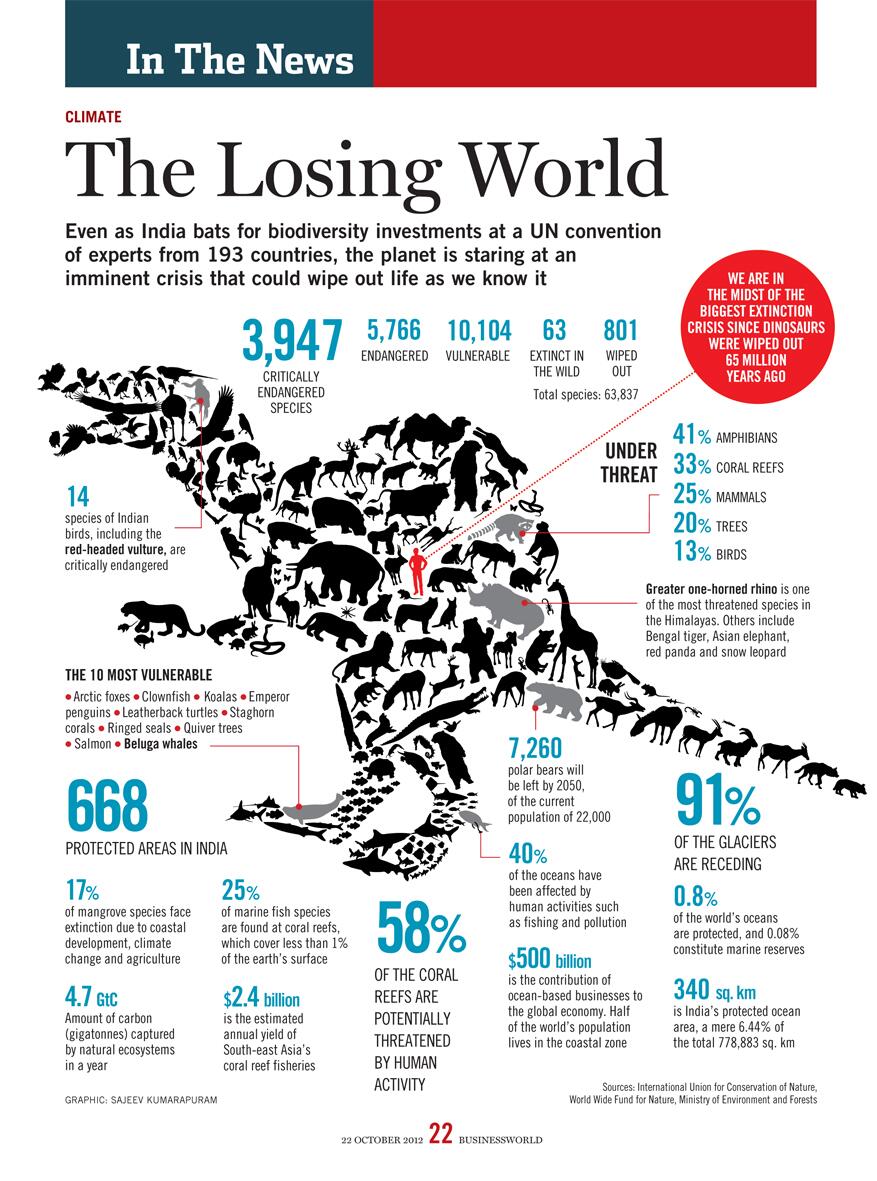
Losing the fight for biodiversity: An infographic

April 28, 2014

BusinessWorld infographic

BusinessWorld infographic

From BusinessWorld, a publication in India:

Even as India bats for biodiversity investments at a UN convention of experts from 193 countries, the planet is staring at an imminent crisis that could wipe out life as we know it.

Compiled by Yashodhara Dasgupta

Click Here To Download Infographic

Sources: International Union for Conservation of Nature,
World Wide Fund for Nature, Ministry of Environment and Forests

Graphic: Sajeev Kumarapuram

(This story was published in Businessworld Issue Dated 22-10-2012)
– See more at: http://www.businessworld.in/news/business/environment/the-losing-world/570570/page-1.html#sthash.mmSk4DDw.dpuf

This would be a good poster for geography, biology, general science and world history courses. Can your drafting class print this out for you in poster format?

When all of the “coal mine canaries” on Earth die out, how much longer have humans left to live on Earth?

What hope have we, with yahoos like this leading us in Congress?

ven as India bats for biodiversity investments at a UN convention of experts from 193 countries, the planet is staring at an imminent crisis that could wipe out life as we know it.Compiled by Yashodhara Dasgupta – See more at: http://www.businessworld.in/news/business/environment/the-losing-world/570570/page-1.html#sthash.mmSk4DDw.dpuf

ven as India bats for biodiversity investments at a UN convention of experts from 193 countries, the planet is staring at an imminent crisis that could wipe out life as we know it.Compiled by Yashodhara Dasgupta

Click Here To Download Infographic


Sources: International Union for Conservation of Nature,

World Wide Fund for Nature, Ministry of Environment and ForestsGraphic: Sajeev Kumarapuram

(This story was published in Businessworld Issue Dated 22-10-2012)

– See more at: http://www.businessworld.in/news/business/environment/the-losing-world/570570/page-1.html#sthash.mmSk4DDw.dpuf

ven as India bats for biodiversity investments at a UN convention of experts from 193 countries, the planet is staring at an imminent crisis that could wipe out life as we know it.Compiled by Yashodhara Dasgupta

Click Here To Download Infographic


Sources: International Union for Conservation of Nature,

World Wide Fund for Nature, Ministry of Environment and ForestsGraphic: Sajeev Kumarapuram

(This story was published in Businessworld Issue Dated 22-10-2012)

– See more at: http://www.businessworld.in/news/business/environment/the-losing-world/570570/page-1.html#sthash.mmSk4DDw.dpuf


Dark Sky Week, Lyrid meteor shower – get outside!

April 23, 2014

From the Arches National Park Facebook page:  photo of Pine Tree Arch by Andy Porter)

From the Arches National Park Facebook page: photo of Pine Tree Arch and meteoroid by Andy Porter)

A few minutes before 9:00 p.m. Central on Tuesday, I saw a sizable fireball falling north to south, appearing from my vantage on the top of Cedar Hill to be over south Grand Prairie, Texas.  Best meteoroid I’ve seen for a while.

Part of the Lyrid Meteor Shower, perhaps?  The Lyrids coincide with Dark Sky Week this year.  Dark Sky Week’s egalitarian origins should inspire all of us to go outside and look up, no?  The celebration was invented by a high school student, Jennifer Barlow, in 2003.

I want people to be able to see the wonder of the night sky without the effects of light pollution. The universe is our view into our past and our vision into the future . . . I want to help preserve its wonder.” – Jennifer Barlow

The International Dark Sky Association promotes activities worldwide to encourage star-gazing and sky-watching.

Go out tonight, and look up!

More: 


2014: STILL, again, Earth Day/Lenin hoax trotted out: Earth Day honors Earth, our majestic home — not Lenin

April 22, 2014

This is mostly an encore post, repeated each year on April 22 — sad that it needs repeating.

You could write it off to pareidolia, once. Like faces in clouds, some people claimed to see a link. The first Earth Day, on April 22, 1970, coincided with Lenin’s birthday. There was no link — Earth Day was scheduled for a spring Wednesday. Now, years later, with almost-annual repeats of the claim from the braying right wing, it’s just a cruel hoax.

No, there’s no link between Earth Day and the birthday of V. I. Lenin:

One surefire way to tell an Earth Day post is done by an Earth Day denialist: They’ll note that the first Earth Day, on April 22, 1970, was an anniversary of the birth of Lenin.

Coincidentally, yes, Lenin was born on April 22 (new style calendar; it was April 10 on the calendar when he was born — one might accurately note that Lenin’s mother always said he was born on April 10).

It’s a hoax. There is no meaning to the first Earth Day’s falling on Lenin’s birthday — Lenin was not prescient enough to plan his birthday to fall in the middle of Earth Week, a hundred years before Earth Week was even planned.

About.com explains why the idea of a link between Earth Day and Lenin is silly:

Does Earth Day Promote Communism?
Earth Day 1970 was initially conceived as a teach-in, modeled on the teach-ins used successfully by Vietnam War protesters to spread their message and generate support on U.S. college campuses. It is generally believed that April 22 was chosen for Earth Day because it was a Wednesday that fell between spring break and final exams—a day when a majority of college students would be able to participate.

U.S. Sen. Gaylord Nelson, the guy who dreamed up the nationwide teach-in that became Earth Day, once tried to put the whole “Earth Day as communist plot” idea into perspective.

“On any given day, a lot of both good and bad people were born,” Nelson said. “A person many consider the world’s first environmentalist, Saint Francis of Assisi, was born on April 22. So was Queen Isabella. More importantly, so was my Aunt Tillie.”

April 22 is also the birthday of J. Sterling Morton, the Nebraska newspaper editor who founded Arbor Day (a national holiday devoted to planting trees) on April 22, 1872, when Lenin was still in diapers. Maybe April 22 was chosen to honor Morton and nobody knew. Maybe environmentalists were trying to send a subliminal message to the national subconscious that would transform people into tree-planting zombies. One birthday “plot” seems just about as likely as the other. What’s the chance that one person in a thousand could tell you when either of these guys were born.

My guess is that only a few really wacko conservatives know that April 22 is Lenin’s birthday (was it ever celebrated in the Soviet Union?). No one else bothers to think about it, or say anything about it, nor especially, to celebrate it.

Gaylord Nelson, Living Green image

Inventor of Earth Day teach-ins, former Wisconsin Governor and U.S. Senator Gaylord Nelson

Wisconsin’s U.S. Sen. Gaylord Nelson, usually recognized as the founder and father of Earth Day, told how and why the organizers came to pick April 22:

Senator Nelson chose the date in order to maximize participation on college campuses for what he conceived as an “environmental teach-in.” He determined the week of April 19–25 was the best bet; it did not fall during exams or spring breaks, did not conflict with religious holidays such as Easter or Passover, and was late enough in spring to have decent weather. More students were likely to be in class, and there would be less competition with other mid-week events—so he chose Wednesday, April 22.

In his own words, Nelson spoke of what he was trying to do:

After President Kennedy’s [conservation] tour, I still hoped for some idea that would thrust the environment into the political mainstream. Six years would pass before the idea that became Earth Day occurred to me while on a conservation speaking tour out West in the summer of 1969. At the time, anti-Vietnam War demonstrations, called “teach-ins,” had spread to college campuses all across the nation. Suddenly, the idea occurred to me – why not organize a huge grassroots protest over what was happening to our environment?

I was satisfied that if we could tap into the environmental concerns of the general public and infuse the student anti-war energy into the environmental cause, we could generate a demonstration that would force this issue onto the political agenda. It was a big gamble, but worth a try.

At a conference in Seattle in September 1969, I announced that in the spring of 1970 there would be a nationwide grassroots demonstration on behalf of the environment and invited everyone to participate. The wire services carried the story from coast to coast. The response was electric. It took off like gangbusters. Telegrams, letters, and telephone inquiries poured in from all across the country. The American people finally had a forum to express its concern about what was happening to the land, rivers, lakes, and air – and they did so with spectacular exuberance. For the next four months, two members of my Senate staff, Linda Billings and John Heritage, managed Earth Day affairs out of my Senate office.

Five months before Earth Day, on Sunday, November 30, 1969, The New York Times carried a lengthy article by Gladwin Hill reporting on the astonishing proliferation of environmental events:

“Rising concern about the environmental crisis is sweeping the nation’s campuses with an intensity that may be on its way to eclipsing student discontent over the war in Vietnam…a national day of observance of environmental problems…is being planned for next spring…when a nationwide environmental ‘teach-in’…coordinated from the office of Senator Gaylord Nelson is planned….”

Nelson, a veteran of the U.S. armed services (Okinawa campaign), flag-waving ex-governor of Wisconsin (Sen. Joe McCarthy’s home state, but also the home of Aldo Leopold and birthplace of John Muir), was working to raise America’s consciousness and conscience about environmental issues.

Lenin on the environment? Think of the Aral Sea disaster, the horrible pollution from Soviet mines and mills, and the dreadful record of the Soviet Union on protecting any resource. Lenin believed in exploiting resources, not conservation.

So, why are all these conservative denialists claiming, against history and politics, that Lenin’s birthday has anything to do with Earth Day?

Can you say “propaganda?”  Can you say “political smear?”

2014 Resources and Good News:

2013 Resources and Good News:

Good information for 2012:

Good information from 2011:

Good information from 2010:

2014’s Wall of Shame:

2013 Wall of Shame:

Wall of Lenin’s Birthday Propaganda Shame from 2012:

Wall of Lenin’s Birthday Propaganda Shame from 2011:

Wall of Lenin’s Birthday Propaganda Shame from 2010:

Spread the word.  Have you found someone spreading the hoax, claiming Earth Day honors Lenin instead?  Give us the link in comments.


Darwin’s death, April 19, 1882, and his legacy today

April 19, 2014

This is an encore post.

We shouldn’t pass April 19 — a day marked by significant historic events through the past couple hundred years — without remembering that it is also the anniversary of the death of Darwin.

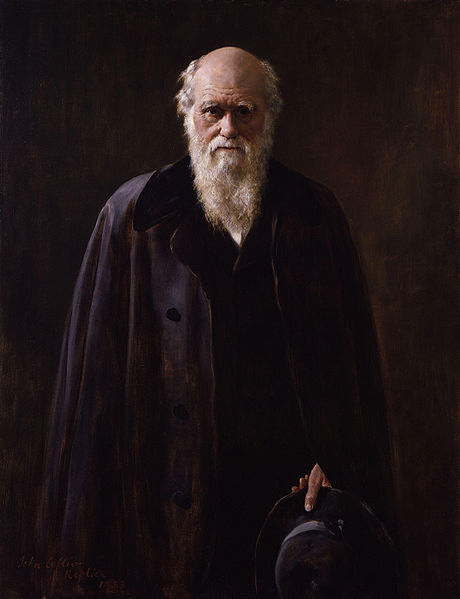
Charles Darwin in 1881, by John Collier

Charles Darwin in 1881, portrait by John Collier; after a Collier painting hanging in the Royal Society

Immortality?  Regardless Darwin’s religious beliefs (I’ll argue he remained Christian, thank you, if you wish to argue), he achieved immortality solely on the strength of his brilliant work in science. Of course he’s best known for being the first to figure out that natural and sexual selection worked as tools to sculpt species over time, a theory whose announcement he shared with Alfred Russel Wallace, who independently arrived at almost exactly the same theory but without the deep evidentiary backup Darwin had amassed.

But had evolution turned out to be a bum theory, Darwin’s other works would have qualified him as one of the greatest scientists of all time, including:

Darwin's theory set out a sequence of coral re...

Darwin’s theory set out a sequence of coral reef formation around an extinct volcanic island, becoming an atoll as the island and ocean floor subsided. Courtesy of the U.S. Geological Survey (Photo credit: Wikipedia)

US Geological Survey graphic demonstrating how coral atolls form on the sinking remains of old volcanic sea mounts, as Darwin described. Wikimedia commons image

  • World’s greatest collector of biological samples:  During his five years’ voyage on HMS Beagle, Darwin collected the largest collection of diverse plant and animal life ever by one person (I believe the record still stands); solely on the strength of his providing actual examples to the British Museum of so much life in so many different ecosystems worldwide, before he was 30 Darwin won election to the Royal Society.  (His election was engineered partly by friends who wanted to make sure he stayed in science, and didn’t follow through on his earlier plan to become a preacher.)
  • Geology puzzle solver:  Coral atolls remained a great geological mystery.  Sampling showed coral foundations well below 50 feet deep, a usual limit for coral growth.  In some cased old, dead coral were hundreds of feet deep.  In the South Pacific, Darwin looked at a number of coral atolls, marvelous “islands” that form almost perfectly circular lagoons.  Inspired partly by Lyell’s new encyclopedic review of  world geology, Darwin realized that the atolls he saw were the peaks of volcanic mounts.  Darwin hypothesized that the volcanoes grew from the ocean floor to the surface, and then the islands were colonized by corals.  The round shape of the volcano gave the atoll its shape.  Then the volcanic mounts eroded back, or sank down, and corals continued to grow on the old foundations.  It was a perfectly workable, natural explanation for a long-standing geologic puzzle.  (See Darwin’s monograph, Structure and Distribution of Coral Reefs.)
  • Patient watcher of flowers:  Another great mystery, this time in biology, concerned how vines twined themselves onto other plants, rocks and structures.  Darwin’s genius in designing experiments shone here:  He put a vine in his study, and watched it.  Over several hours, he observed vine tendrils flailing around, until they latched on to something, and then the circular flailing motion wrapped the tendril around a stick or twig. Simple observation, but no one had ever attempted it before.  (See On the Movements and Habits of Climbing Plants.)
  • Champion of earthworms, and leaf mould:  Darwin suspected the high fertilizer value of “leaf mould” might be related to the action of earthworms.  Again, through well-designed experiments and simple observation, Darwin demonstrated that worms moved and aerated soil, and converted organic matter into even richer fertilizer. (See The Formation of Vegetable Moulds Through the Action of Worms.)
  • Creation of methodological science:  In all of this work, Darwin explained his processes for designing experiments, and controls, and made almost as many notes on how to observe things, as the observations themselves.  Probably more than any other single man, Darwin invented and demonstrated the use of a series of processes we now call “the scientific method.”  He invented modern science.

Any of those accomplishments would have been a career-capping work for a scientist.  Darwin’s mountains of work still form foundations of geology and biology, and are touchstones for genetics.

Born within a few hours of Abraham Lincoln on February 12, 1809, Darwin survived 17 years longer — 17 extremely productive years.  Ill through much of his life with mystery ailments, perhaps Chaga’s Disease, or perhaps some other odd parasite or virus he picked up on his world travels, Darwin succumbed to heart disease on April 19, 1882.

More:


Cross seas: Nature, or design?

April 16, 2014

Here’s just exactly the sort of thing that happens in nature that drives creationists nuts.  How could this happen without God personally working to confuse and/or delight the photographer?  Not to mention the physicist and mathematician.

Photo from the Twitter feed of Science Porn:

Photo from the Twitter feed of Science Porn: “Go home waves you’re drunk. This is called cross sea btw pic.twitter.com/5Cv1UUo8QX”

Where? Somewhere in France, one might gather from the flag on the structure (lighthouse?).

Turns out to be a Wikipedia photo, with this intriguing caption:

Crossing swells, consisting of near-cnoidal wave trains. Photo taken from Phares des Baleines (Whale Lighthouse) at the western point of Île de Ré (Isle of Rhé), France, in the Atlantic Ocean. The interaction of such near-solitons in shallow water may be modeled through the Kadomtsev–Petviashvili equation.

Oh, you remember that one, don’t you?  The Kadomtsev–Petviashvili equation?

At least we confirmed it was taken in France.

They do everything differently in France, don’t they?

Update:Got an e-mail suggestion that I include the equation itself.  You may certainly click to Wikipedia to find it; here’s what it says over there:

In mathematics and physics, the Kadomtsev–Petviashvili equation – or KP equation, named after Boris Borisovich Kadomtsev and Vladimir Iosifovich Petviashvili – is a partial differential equation to describe nonlinearwave motion. The KP equation is usually written as:

\displaystyle \partial_x(\partial_t u+u \partial_x u+\epsilon^2\partial_{xxx}u)+\lambda\partial_{yy}u=0

where \lambda=\pm 1. The above form shows that the KP equation is a generalization to two spatial dimensions, x and y, of the one-dimensional Korteweg–de Vries (KdV) equation. To be physically meaningful, the wave propagation direction has to be not-too-far from the x direction, i.e. with only slow variations of solutions in the y direction.

Like the KdV equation, the KP equation is completely integrable. It can also be solved using the inverse scattering transform much like the nonlinear Schrödinger equation.

Certainly the longest equation ever published at Millard Fillmore’s Bathtub.

Save