Happy Hubble Day! Look up

December 30, 2008

Ultraviolet image of the Andromeda Galaxy, first known to be a galaxy by Edwin Hubble on December 30, 1924 - Galaxy Evolution Explorer image courtesy NASA

Ultraviolet image of the Andromeda Galaxy, first known to be a galaxy by Edwin Hubble on December 30, 1924 - Galaxy Evolution Explorer image courtesy NASA

Today is a good day to celebrate the universe in all it’s glory – December 30. Below, mostly an encore post.

This year for Hubble Day, Wired picked up on the story (with a gracious link to last year’s post here at the Bathtub).  Wired includes several links to even more information, a good source of information.

Hubble was the guy who showed us the universe is not only bigger than we imagined, it’s probably much bigger and much more fantastic than we can imagine. Hubble is the guy who opened our imaginations to the vastness of all creation.

How does one celebrate Hubble Day?  Here are some suggestions:

  • Easier than Christmas cards:  Send a thank-you note to your junior high school science teacher, or whoever it was who inspired your interest in science.  Mrs. Hedburg, Mrs. Andrews, Elizabeth K. Driggs, Herbert Gilbert, Mr. Willis, and Stephen McNeal, thank you.
  • Rearrange your Christmas/Hanukkah/KWANZAA lights in the shape of the Andromeda Galaxy — or in the shape of any of the great photos from the Hubble Telescope (Andromeda Galaxy pictured above; Hubble images here)

    A few of the images from the Hubble Telescope

    A few of the images from the Hubble Telescope

  • Go visit your local science museum; take your kids along – borrow somebody else’s kids if you have to (take them along, too)
  • Spend two hours in your local library, just looking through the books on astronomy and the universe
  • Anybody got a good recipe for a cocktail called “The Hubble?”  “The Andromeda?”  Put it in the comments, please

The encore post, from last year:

December 30, 1924, Edwin Hubble announced the results of his observations of distant objects in space.

PBS

Edwin Hubble - source: PBS

In 1924, he announced the discovery of a Cepheid, or variable star, in the Andromeda Nebulae. Since the work of Henrietta Leavitt had made it possible to calculate the distance to Cepheids, he calculated that this Cepheid was much further away than anyone had thought and that therefore the nebulae was not a gaseous cloud inside our galaxy, like so many nebulae, but in fact, a galaxy of stars just like the Milky Way. Only much further away. Until now, people believed that the only thing existing ouside the Milky Way were the Magellanic Clouds. The Universe was much bigger than had been previously presumed.

Later Hubble noted that the universe demonstrates a “red-shift phenomenon.” The universe is expanding. This led to the idea of an initial expansion event, and the theory eventually known as Big Bang.

Hubble’s life offered several surprises, and firsts:

Hubble was a tall, elegant, athletic, man who at age 30 had an undergraduate degree in astronomy and mathematics, a legal degree as a Rhodes scholar, followed by a PhD in astronomy. He was an attorney in Kentucky (joined its bar in 1913), and had served in WWI, rising to the rank of major. He was bored with law and decided to go back to his studies in astronomy.

In 1919 he began to work at Mt. Wilson Observatory in California, where he would work for the rest of his life. . . .
Hubble wanted to classify the galaxies according to their content, distance, shape, and brightness patterns, and in his observations he made another momentous discovery: By observing redshifts in the light wavelengths emitted by the galaxies, he saw that galaxies were moving away from each other at a rate constant to the distance between them (Hubble’s Law). The further away they were, the faster they receded. This led to the calculation of the point where the expansion began, and confirmation of the big bang theory. Hubble calculated it to be about 2 billion years ago, but more recent estimates have revised that to 20 billion years ago.

An active anti-fascist, Hubble wanted to joined the armed forces again during World War II, but was convinced he could contribute more as a scientist on the homefront. When the 200-inch telescope was completed on Mt. Palomar, Hubble was given the honor of first use. He died in 1953.

“Equipped with his five senses, man explores the universe around him and calls the adventure Science.”

That news on December 30, 1924, didn’t make the first page of the New York Times. The Times carried a small note on February 25, 1925, that Hubble won a $1,000 prize from the American Academy for the Advancement of Science.

(Does anyone have a suitable citation for that video?  Where did it come from?  Who produced it?  Is there more somewhere?)

Happy Hubble Day!  Look up!

Resources:


News from the Yellowstone Caldera: Earthquakes

December 29, 2008

Yellowstone Lake, site of swarm of earthquakes, December 27-30, 2008

Yellowstone Lake, site of swarm of earthquakes, December 27-30, 2008

Yellowstone National Park holds more than 70% of the world’s geysers, and rumbles with earthquakes and eruptions all the time.  It is, after all, rather in the middle of the great Yellowstone Caldera, a supervolcano that probably will erupt with astounding destruction someday.

Massive, super eruptions in the caldera occur about every 600,000 years (take THAT Don McLeroy!).  The last eruption was about 640,000 years ago, which means that we may be a bit overdue for the sort of eruption that would make the destruction of Krakatoa look like a firecracker compared to a nuclear bomb.

So, of course, some people worried a bit with the cluster of earthquakes under Yellowstone Lake in the past two days. A swarm is a better description, perhaps — 250 little quakes, all under 3.5 on the Richter Scale.

It is unusual in the number, but they are all small.

Watch that space!

(See update for December 31, here: ‘Yellowstone not likely to blow’)

USGS Regional map for earthquakes, Yellowstone Region

USGS Regional map for earthquakes, Yellowstone Region

According to the USGS system, at the time of this post, earthquakes are occurring frequently around Yellowstone, with about 35 in the past 24 hours (I copied the chart to preserve the historical data; click on the link to get more current data):

MAG UTC DATE-TIME
y/m/d h:m:s
LAT
deg
LON
deg
DEPTH
km
LOCATION
MAP 2.4 2008/12/30 00:36:39 44.510 -110.384 0.2 60 km ( 37 mi) ESE of West Yellowstone, MT
MAP 2.4 2008/12/29 21:25:15 44.525 -110.360 2.0 61 km ( 38 mi) ESE of West Yellowstone, MT
MAP 1.6 2008/12/29 21:18:51 44.521 -110.362 2.2 61 km ( 38 mi) ESE of West Yellowstone, MT
MAP 1.8 2008/12/29 21:18:36 44.522 -110.359 2.1 61 km ( 38 mi) ESE of West Yellowstone, MT
MAP 2.9 2008/12/29 20:38:25 44.514 -110.381 2.1 60 km ( 37 mi) ESE of West Yellowstone, MT
MAP 2.3 2008/12/29 20:38:04 44.511 -110.385 2.3 60 km ( 37 mi) ESE of West Yellowstone, MT
MAP 1.0 2008/12/29 20:26:29 44.520 -110.355 2.2 62 km ( 38 mi) ESE of West Yellowstone, MT
MAP 1.9 2008/12/29 20:14:26 44.498 -110.364 2.3 62 km ( 38 mi) ESE of West Yellowstone, MT
MAP 1.4 2008/12/29 20:13:31 44.508 -110.359 2.2 62 km ( 38 mi) ESE of West Yellowstone, MT
MAP 2.2 2008/12/29 19:56:46 44.522 -110.365 1.2 61 km ( 38 mi) ESE of West Yellowstone, MT
MAP 1.2 2008/12/29 19:53:50 44.511 -110.377 2.2 60 km ( 37 mi) ESE of West Yellowstone, MT
MAP 1.1 2008/12/29 19:46:13 44.515 -110.386 2.4 59 km ( 37 mi) ESE of West Yellowstone, MT
MAP 1.7 2008/12/29 19:44:50 44.525 -110.373 0.0 60 km ( 37 mi) ESE of West Yellowstone, MT
MAP 1.7 2008/12/29 19:40:27 44.511 -110.379 2.5 60 km ( 37 mi) ESE of West Yellowstone, MT
MAP 2.4 2008/12/29 19:37:07 44.502 -110.366 1.8 61 km ( 38 mi) ESE of West Yellowstone, MT
MAP 1.2 2008/12/29 19:36:08 44.521 -110.385 2.0 59 km ( 37 mi) ESE of West Yellowstone, MT
MAP 1.7 2008/12/29 19:35:27 44.511 -110.385 2.4 60 km ( 37 mi) ESE of West Yellowstone, MT
MAP 2.9 2008/12/29 19:29:38 44.513 -110.381 0.5 60 km ( 37 mi) ESE of West Yellowstone, MT
MAP 2.5 2008/12/29 19:28:55 44.515 -110.381 0.0 60 km ( 37 mi) ESE of West Yellowstone, MT
MAP 1.8 2008/12/29 19:26:21 44.519 -110.370 2.0 60 km ( 38 mi) ESE of West Yellowstone, MT
MAP 1.5 2008/12/29 19:24:43 44.520 -110.342 2.3 63 km ( 39 mi) ESE of West Yellowstone, MT
MAP 3.3 2008/12/29 19:14:49 44.521 -110.369 1.8 60 km ( 38 mi) ESE of West Yellowstone, MT
MAP 1.2 2008/12/29 18:47:45 44.523 -110.371 2.1 60 km ( 37 mi) ESE of West Yellowstone, MT
MAP 1.4 2008/12/29 18:40:00 44.533 -110.359 4.8 61 km ( 38 mi) ESE of West Yellowstone, MT
MAP 1.1 2008/12/29 16:32:12 44.494 -110.360 2.4 62 km ( 39 mi) ESE of West Yellowstone, MT
MAP 1.6 2008/12/29 16:31:55 44.491 -110.360 2.3 62 km ( 39 mi) ESE of West Yellowstone, MT
MAP 1.2 2008/12/29 16:15:28 44.480 -110.363 2.3 62 km ( 39 mi) ESE of West Yellowstone, MT
MAP 1.5 2008/12/29 14:58:37 44.486 -110.354 1.3 63 km ( 39 mi) ESE of West Yellowstone, MT
MAP 1.7 2008/12/29 10:25:18 44.523 -110.371 2.4 60 km ( 37 mi) ESE of West Yellowstone, MT
MAP 1.8 2008/12/29 09:14:04 44.527 -110.376 0.3 60 km ( 37 mi) ESE of West Yellowstone, MT
MAP 2.4 2008/12/29 08:57:55 44.527 -110.378 0.5 60 km ( 37 mi) ESE of West Yellowstone, MT
MAP 2.4 2008/12/29 08:28:24 44.527 -110.382 0.4 59 km ( 37 mi) ESE of West Yellowstone, MT
MAP 2.0 2008/12/29 05:30:35 44.517 -110.372 1.0 60 km ( 37 mi) ESE of West Yellowstone, MT
MAP 2.3 2008/12/29 05:30:04 44.477 -110.349 6.5 63 km ( 39 mi) ESE of West Yellowstone, MT
MAP 1.7 2008/12/29 05:29:23 44.489 -110.354 4.2 63 km ( 39 mi) ESE of West Yellowstone, MT
MAP 2.4 2008/12/29 05:23:36 44.516 -110.361 6.4 61 km ( 38 mi) ESE of West Yellowstone, MT
MAP 1.9 2008/12/29 04:29:18 44.522 -110.385 1.0 59 km ( 37 mi) ESE of West Yellowstone, MT
MAP 2.8 2008/12/29 04:25:53 44.514 -110.370 0.1 61 km ( 38 mi) ESE of West Yellowstone, MT
MAP 2.6 2008/12/28 23:57:56 44.521 -110.371 1.4 60 km ( 37 mi) ESE of West Yellowstone, MT
MAP 2.0 2008/12/28 23:08:25 44.491 -110.390 1.7 60 km ( 37 mi) ESE of West Yellowstone, MT
MAP 3.1 2008/12/28 19:55:17 44.511 -110.353 0.7 62 km ( 39 mi) ESE of West Yellowstone, MT
MAP 3.0 2008/12/28 19:32:15 44.511 -110.356 2.7 62 km ( 38 mi) ESE of West Yellowstone, MT
MAP 2.8 2008/12/28 15:37:40 44.514 -110.359 0.0 61 km ( 38 mi) ESE of West Yellowstone, MT
MAP 2.2 2008/12/28 09:25:14 44.508 -110.364 1.9 61 km ( 38 mi) ESE of West Yellowstone, MT
MAP 3.2 2008/12/28 09:23:57 44.511 -110.361 0.4 61 km ( 38 mi) ESE of West Yellowstone, MT
MAP 1.9 2008/12/28 07:16:13 44.513 -110.374 2.0 60 km ( 37 mi) ESE of West Yellowstone, MT
MAP 2.5 2008/12/28 07:15:18 44.495 -110.359 0.0 62 km ( 39 mi) ESE of West Yellowstone, MT
MAP 2.5 2008/12/28 06:37:41 44.492 -110.356 2.6 62 km ( 39 mi) ESE of West Yellowstone, MT
MAP 2.0 2008/12/28 06:37:20 44.497 -110.379 2.1 60 km ( 38 mi) ESE of West Yellowstone, MT
MAP 1.9 2008/12/28 05:28:49 44.498 -110.383 2.3 60 km ( 37 mi) ESE of West Yellowstone, MT
MAP 1.9 2008/12/28 05:28:05 44.485 -110.371 2.5 61 km ( 38 mi) ESE of West Yellowstone, MT
MAP 1.8 2008/12/28 05:26:14 44.484 -110.359 2.0 62 km ( 39 mi) ESE of West Yellowstone, MT
MAP 1.2 2008/12/28 05:26:03 44.470 -110.355 5.2 63 km ( 39 mi) ESE of West Yellowstone, MT
MAP 1.3 2008/12/28 05:24:39 44.489 -110.359 4.1 62 km ( 39 mi) ESE of West Yellowstone, MT
MAP 2.8 2008/12/28 05:23:54 44.489 -110.354 2.5 63 km ( 39 mi) ESE of West Yellowstone, MT
MAP 1.9 2008/12/28 05:21:16 44.480 -110.344 4.0 64 km ( 40 mi) ESE of West Yellowstone, MT
MAP 1.7 2008/12/28 05:20:10 44.494 -110.379 2.4 61 km ( 38 mi) ESE of West Yellowstone, MT
MAP 1.6 2008/12/28 05:19:11 44.492 -110.372 2.2 61 km ( 38 mi) ESE of West Yellowstone, MT
MAP 3.9 2008/12/28 05:15:56 44.502 -110.366 0.3 61 km ( 38 mi) ESE of West Yellowstone, MT
MAP 2.6 2008/12/28 00:08:50 44.493 -110.354 0.4 63 km ( 39 mi) ESE of West Yellowstone, MT
MAP 3.3 2008/12/27 22:30:03 44.498 -110.358 4.3 62 km ( 39 mi) ESE of West Yellowstone, MT
MAP 1.5 2008/12/27 22:28:53 44.500 -110.368 2.1 61 km ( 38 mi) ESE of West Yellowstone, MT
MAP 1.8 2008/12/27 22:27:36 44.499 -110.367 2.5 61 km ( 38 mi) ESE of West Yellowstone, MT
MAP 1.0 2008/12/27 21:28:06 44.500 -110.362 3.5 62 km ( 38 mi) ESE of West Yellowstone, MT
MAP 1.6 2008/12/27 21:22:08 44.495 -110.372 2.6 61 km ( 38 mi) ESE of West Yellowstone, MT
MAP 2.1 2008/12/27 21:08:49 44.496 -110.370 2.0 61 km ( 38 mi) ESE of West Yellowstone, MT
MAP 3.2 2008/12/27 20:26:27 44.505 -110.364 2.4 61 km ( 38 mi) ESE of West Yellowstone, MT
MAP 3.5 2008/12/27 20:17:33 44.488 -110.357 4.1 62 km ( 39 mi) ESE of West Yellowstone, MT
MAP 2.3 2008/12/27 18:56:35 44.484 -110.367 0.5 62 km ( 38 mi) ESE of West Yellowstone, MT
MAP 3.0 2008/12/27 18:23:07 44.495 -110.364 2.8 62 km ( 38 mi) ESE of West Yellowstone, MT
MAP 2.0 2008/12/27 18:21:36 44.493 -110.362 7.2 62 km ( 38 mi) ESE of West Yellowstone, MT
MAP 1.2 2008/12/27 17:01:46 44.484 -110.373 2.4 61 km ( 38 mi) ESE of West Yellowstone, MT
MAP 2.7 2008/12/27 17:01:07 44.490 -110.366 1.2 62 km ( 38 mi) ESE of West Yellowstone, MT
MAP 2.6 2008/12/27 16:30:54 44.498 -110.362 2.5 62 km ( 38 mi) ESE of West Yellowstone, MT

At the site of the Deseret News (published in Salt Lake City), one commenter noted he is from Texas, a commented he was safely out of the way.  One might do well to remember that volcanic activity in the Yellowstone often affects life well outside the area.  Ashfall Beds State Historical Park in Nebraska, for example, marks a prehistoric waterhole where dozens of mammals died from ash from a volcano that erupted 10 million to 12 million years ago — a volcano in Idaho, south of the Yellowstone Caldera, and considerably smaller.

While danger is probably slight right now, and this swarm most likely does not presage anything of great note, one should not forget the power of volcanic eruptions from supervolcanoes, like the Yellowstone Caldera.

Update, December 30, 2:20 p.m. Central:

Resources:

Great photo for the heck of it:

Aerial view of Grand Prismatic Spring, Wikimedia photo (all text in caption from Wikimedia); Hot Springs, Midway & Lower Geyser Basin, Yellowstone National Park. The spring is approximately 250 by 300 feet (75 by 91 m) in size.  This photo shows steam rising from hot and sterile deep azure blue water (owing to the light absorbing overtone of an OH stretch which is shifted to 698 nm by hydrogen bonding [1]) in the center surrounded by huge mats of brilliant orange algae and bacteria. The color of which is due to the ratio of chlorophyll to carotenoid molecules produced by the organisms. During summertime the chlorophyll content of the organisms is low and thus the mats appear orange, red, or yellow. However during the winter, the mats are usually dark green, because sunlight is more scarce and the microbes produce more chlorophyll to compensate, thereby masking the carotenoid colors.

(Caption from Wikimedia) Aerial view of Grand Prismatic Spring; Hot Springs, Midway & Lower Geyser Basin, Yellowstone National Park. The spring is approximately 250 by 300 feet (75 by 91 m) in size. This photo shows steam rising from hot and sterile deep azure blue water (owing to the light absorbing overtone of an OH stretch which is shifted to 698 nm by hydrogen bonding) in the center surrounded by huge mats of brilliant orange algae and bacteria. The color of which is due to the ratio of chlorophyll to carotenoid molecules produced by the organisms. During summertime the chlorophyll content of the organisms is low and thus the mats appear orange, red, or yellow. However during the winter, the mats are usually dark green, because sunlight is more scarce and the microbes produce more chlorophyll to compensate, thereby masking the carotenoid colors.


Want to poison Boise? Apply within

December 23, 2008

Ada County, Idaho, is home to the state capital, Boise.

As with most county governments in the U.S., a lot of work is delegated to groups that are governed or advised by citizen boards.  Volunteers make up these boards.  In many municipalities, it’s difficult to recruit good citizens to do the work.

Perhaps Ada County is having difficulty getting volunteers to worry about mosquito abatement. Maybe that’s why the advertisement at the city’s unofficial “City Smart”  website urges unnecessary DDT poisoning of the town.

Tell Ada County What to Do

The Ada County Courthouse, in Boise Idaho.  HPB photo by LCA Architects

The Ada County Courthouse, in Boise Idaho. HPB photo by LCA Architects

Feeling disenfranchised? Not happy with how the elections turned out? Well, there is still a way for you to impact the body politic in Ada County—the County Board of Commissioners is calling for volunteers to serve as advisors on a number of boards.

The County Commissioners, Paul Woods, Rick Yzaguirre, and Fred Tilman, made the appeal for volunteer advisors in the most recent edition of Ada County’s monthly newsletter.

“The county has numerous volunteer boards and advisory committees that help the Ada County Board of Commissioners in policy development and general operations in areas ranging from housing, planning and zoning, social work and recreation. The unpaid volunteer positions give citizens a unique, insider look at county government while they roll up their sleeves to help their local community. While each board has its own bylaws and varying terms of service, interested parties are always encouraged to apply for a position on any volunteer board,” the county said.

The county went on to describe eight examples of boards that rely on volunteer participation, I’ve profiles the three coolest boards here.

Historic Preservation Council—Are you one of those folks that loves to see historical photos from Ada County’s storied past? Would you love to help identify sites of historical significance or help with education efforts? When then consider helping out with the Ada County Historic Preservation Council where, according to the county, “members must demonstrate an interest, competence, or knowledge in history or historic preservation” and can have a positive effect on how the county coordinates its preservation activities.

Mosquito Abatement Advisory Board—I’m a huge advocate for bringing back DDT (dichloro-diphenyl-trichloroethane) that insecticide extraordinaire which got a bad rap in the 1960’s when it was panned in Rachel Carson’s inaccurate book, Silent Spring. Turns out that DDT is safe for humans and Silent Spring, “contains certain statements at variance with the facts as we now understand them”, as Cecil Adams so eloquently put it in his The Straight Dope column from December 13, 2002. If you feel like I do about slaughtering mosquitoes and ending West Nile Virus in Idaho, then consider volunteering for the Ada County Mosquito Abatement Advisory Board wherein you can meet to discuss our collective war on these blood-sucking bugs. If you are a mosquito-lover who thinks bugs are people too, I would not recommend this board for you. [emphasis added]

Board of Community Guardians—Finally, if you have a heart for the disabled or the mentally ill, you might be the right sort of volunteer for this important board. According to the county, “The Board of Community Guardians manages the Community Guardian Program, which assists individuals who cannot make decisions for themselves because of mental and/or physical impairments or disabilities. These individuals, who are either legally incapacitated or destitute with no financial security or family support., can be determined a ward of the county, and court-appointed volunteers oversee those wards.

If you are interested in volunteering for any of these advisory boards contact:

Board of Ada County Commission office

200 W. Front St., Third Floor, Boise.

Even the vaunted Cecil Adams writes a clunker from time to time, and his agreement with the wholly unsupportable claim that Rachel Carson was wrong is one of those clunkers (but his description of Lyndon Larouche will make you smile).  The facts differ from the claim in this ad:

  1. DDT’s “bad rap” was well deserved.  In the past three years dozens of news articles matched the science journals commemorating the recovery of bald eagles, brown pelicans, osprey and pergrine falcons — recoveries made possible by ending the use of DDT in the wild.  DDT kills entire ecosystems, starting with the predators at the top.  It’s dangerous stuff.
  2. Rachel Carson’s book, Silent Spring, pioneered the use of good, hard scientific data in popular writing.  In its 53 pages of footnotes to scientific studies, science journals and correspondence, critics have been unable to find inaccuracies.  Especially on the issue of DDT’s effects on wildlife, more than a thousand follow-up studies vindicated Carson.  I have not found a contrary study, not one.
  3. DDT is NOT the pesticide of choice for West Nile, in any case.  It’s almost like arguing that DDT is the pharmaceutical of choice to use against malaria — confusing the pesticides used to kill insects with the pharmaceuticals used to treat disease in humans.  DDT is unsuitable for outdoor use, illegal for outdoor use under the 1958 Federal Insecticide, Fungicide and Rodenticide Act (FIFRA) and its subsequent amendments because it is “uncontrollable.”  DDT kills non-target species, often better than it kills target species. For mosquito abatement, DDT kills mosquito predators much more effectively than it kills mosquitoes. Plus, it sticks around for years, and it bioaccumulates up food chains, multiplying poison doses to predators, sometimes millions of times.
    West Nile mosquitoes can be effectively treated as larva, if their water homes are known; but DDT is particularly ill-suited for use in water. DDT works best when its spread can be confined indoors, which is where malaria-carrying mosquitoes usually bite. West Nile carriers live and bite outdoors.

I hope Ada County gets volunteers for the mosquito abatement board who know a little bit more about DDT, or who are open to listening to the mosquito abatement experts.


Creationism vs. Christianity

December 20, 2008

Several weeks ago I responded to a lengthy thread at Unreasonable FaithThe original post was Garry Trudeau’s “Doonesbury” cartoon of the guy in a doctor’s office, just diagnosed with an infection.  The physician asks the guy if he’s a creationist, explaining that if he is, the doc will treat him with old antibiotics in honor of his belief that evolution of bacteria doesn’t occur. [Time passes: You may find the Doonesbury cartoon here, at Nature.com, in an article discussing issues with creationism.]

Point being, of course, that evolution occurs in the real world.  Creationists rarely exhibit the faith of their claims when their life, or just nagging pain, is on the line.  They’ll choose the evolution-based medical treatment almost every time.  There are no creationists in the cancer or infectious disease wards.

At one point I responded to a comment loaded with typical creationist error.  It was a long post.  It covered some ground that I’ve not written about on this blog.  And partly because it took some time to assemble, I’m reposting my comments here.  Of course, without the Trudeau cartoon, it won’t get nearly the comments here.

I’ll add links here when I get a chance, which I lacked the time to do earlier.  See my post, below the fold.

Read the rest of this entry »

Holy Pythagoras! Creationists are targeting math

December 20, 2008

They complain that they shouldn’t be compared to the Taliban in Afghanistan, but then creationists do what the Taliban do.

Watch out.  Creationists appear to be targeting mathematics, in addition to their misaimed criticisms of biology.  You remember the “God centered” math courses at Castle Hills First Baptist School, in San Antonio.

So, when I came across this post, at Joe Carter’s Home for Wayward Evangelicals, I thought it time to sound an alarm.  See “Mathematics and Religiously-based Explanations.

Did Leibniz’s religion seriously affect his mathematics?  Is it time to call in the men in white, with the nets?

Mark at Pseudo-Polymath adds to the discussion — it’s difficult to tell if he’s writing in parody or not.


Waiting for the New President: Doctoring data on global warming

December 16, 2008

ArborDay.org map showing changes in hardiness zones between 1990 and 2006

ArborDay.org map showing changes in hardiness zones between 1990 and 2006, a map climate change denialists wish did not exist.

We need a new category of urban myth or urban legend.  Jan Brunvand’s inventions and development of the study of folk stories that people claim to be true long enough that they become legends, needs to be updated to include internet stupidity that just won’t die.  Especially, we need a good, two-word label for politically-motivated propaganda that should go away, but won’t.

Perhaps I digress.

One might be filled with hope at the prospect of the administration of President Obama. Science issues that have been ignored for too long may once again rise to due consideration.  Friends in health care worry that it will take four or eight terms of diligent work to undo the damage done to medical science by neglect of spending and budgeting during the last eight years.

I take a little hope in this:  Maybe we can get an update of the planting zones maps relied on by farmers, horticulturists, and backyard gardeners.

New maps were delayed through the Bush administration.  The last serious update, officially, was 1990.  Perhaps much has changed in climate in the last generation, and perhaps that is why the new maps were delayed, though they had been painstakingly prepared by the American Horticulture Society.

Why?

Plants cannot be fooled by newspaper reports.  Plants are not partisan in political issues. Plants both respond to and clearly demonstrate climate change.  To those who wished to suppress or deny climate change, suppressing the hardiness zone maps may have seemed like a good way to win a political debate.

Robust discussion based on the facts, a casualty of the past eight years, ready to be resurrected.

Resources:


Typewriter of the moment: Rachel Carson

December 14, 2008

From the library of Life Magazine images available for sale through an agreement with Google:  “Marine biologist and author Rachel Carson, 1952.”  Photo by Hank Walker.  [Photo no longer available at that site; this is the same image, I believe]

Rachel Carson in 1952.  Life Magazine photo by Hank Walker

This photo was taken about the time Carson left the U.S. Fish and Wildlife Service, about the time her best-selling book The Sea Around Us was a hit.  This was a decade before the publication of her most famous work, Silent Spring, and 12 years prior to her death from cancer in 1964.


Snow photos

December 13, 2008

Forecast is 70 degrees in Dallas on Sunday.

Meanwhile, Catherine Sherman has some photos of snow near Kansas City.  Nice stuff. (I don’t have her permission to copy the photo here — go see her blog.)

I particularly like her photo of the river birch tree.  It appeals to the botanist that still survives within me, plus it gives me hope about the proliferation of electronic cameras and the mass recording of things of interest to science.

Sherman writes that Kansas is the only state which has no native pines.  Is that accurate?  Does that count include Hawaii?  (What are the native pines of Hawaii?)

In short, it’s really cool.


A rationalist on climate change

December 7, 2008

Interesting voice on climate change, at Greenfyre.  For teachers, there are interesting sources that should work well in presentations.

If Anthony Watts slams the site, we’ll know it’s good.


Texas soon to follow?

December 3, 2008

An entire nation has expunged evolution from its school curricula:  Romania.

Maybe it’s a preview.  Which state in the U.S. wants to be like Romania?

Resources:


Anniversary of evolution

December 2, 2008

Almost let one slip by — Larry Moran at Sandwalk remembered it, though, and probably better than I could here.

November 24 was the 149th anniversary of the publication of Charles Darwin’s “big book,” On the Origin of Species. If history studies turning points, that’s one date that needs to be remembered.

Even better, David Quammen published a copy of Darwin’s first edition, supplemented with historic illustrations – the layout of the Beagle, some of the plants and animals Darwin saw, the people who went along, and more.  See Moran’s post, check out the book.

David Quammens new version of Darwins Origin of Species, illustrated

David Quammen's new version of Darwin's Origin of Species, illustrated


Mark Twain and Nikola Tesla

November 29, 2008

I like this photo of Mark Twain.

November 30 is the anniversary of the birth of Mark Twain, born 1835 (a year of an appearance of Halley’s Comet).  The photo was taken in the spring of 1894 in the laboratory of inventor Nikola Tesla, and originally published to illustrate an article in the legendary Century Magazine, by T.C. Martin called “Tesla’s Oscillator and Other Inventions,” in the April 1895 issue.

Mark Twain, in the laboratory of Nikola Tesla, 1894 - photo in public domain to the best of my knowledge

Mark Twain, in the laboratory of his friend, the inventor Nikola Tesla, 1894 - photo in public domain to the best of my knowledge (See Wikimedia)

Who is that to Twain’s right in the photo?  Tesla?


Remembering Love Canal, 30 years ago

November 26, 2008

Hell-raising site called Red State Rebels remembers that the Love Canal disaster came to a head 30 years ago, with the evacuation of the homes surrounding the toxic dump site.

Your students probably don’t know about it, and the textbooks will do the story no justice, if they mention it at all.  While this article is written from a biased perspective, it’s a solid recounting of the history — and your AP kids need to read stuff with viewpoints, anyway.

Adeline Levine, a sociologist who wrote a book about Love Canal, described to me the scene she had witnessed exactly 30 years earlier, on Aug. 11, 1978. “It was like a Hitchcock movie,” she said, “where everything looks peaceful and pleasant, but something is slumbering under the ground.”

That “something” was more than 21,000 tons of chemical waste. The mixed brew contained more than 200 different chemicals, many of them toxic. They were dumped into the canal — which was really more of a half-mile-long pond — in the 1940s and 1950s by the Hooker Electrochemical Co. In 1953, the canal was covered with soil and sold to the local school board, and an elementary school and playground were built on the site. A working-class neighborhood sprang up around them.

“The neighborhood looked very pleasant,” says Levine, who was a sociology professor at the State University of New York, Buffalo, in 1978. “There were very nice little homes, nicely kept, with gardens and flowers and fences and kids’ toys, and then there were young people who were rushing out of their homes with bundles and packing up their cars and moving vans.”

Love Canal was in the midst of an all-out panic when Levine arrived; just nine days earlier, the state health commissioner had declared an emergency and recommended that pregnant women and children under the age of two evacuate the neighborhood. A week after that, the state and federal governments agreed to buy out homes next to the canal.

See the entire piece.

Resources:


Hudson’s Half Moon

November 25, 2008

New Yorkers, Vermonters and Candadians continue to celebrate 400 years since Hudson and Champlain, and 200 years since Robert Fulton brought steam power to the Hudson’s commercial ways.

Tugster: A Waterblog features some nice shots, and a couple of stunning shots, of the reconstruction of Henry Hudson’s ship, Half Moon.  Great stuff for presentations, and he likes to share.

Tugster is an outstanding repository of images of tugboats, ships and other things related to the commerce of Greater New York Harbor, and boats on the water generally.  Tugster’s collection of images should be regular source material for teachers of history, economics, geography and government.

A Waterblog

Stern of Half Moon, Henry Hudson's ship; from Tugster: A Waterblog

Notice how the figurehead frightens even the trees to blazing red.

A Waterblog

Bowsprite of Henry Hudson's Half Moon, via Tugster: A Waterblog

Tugster tells us that Henry Hudson himself is blogging, channeling across 400 years — perhaps tired of duckpins with his crew in the Adirondacks (hello, Rip van Winkel!).  Can your students correspond with Henry Hudson?

Resources:


Good Interred With Their Bones Dept.: Michael Crichton

November 24, 2008

https://i.ytimg.com/vi/9qtgQXtrl4Q/hqdefault.jpg

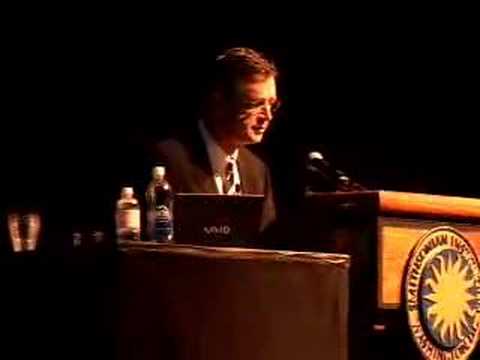
Author Michael Crichton railing against environmental protection and science he politically disagreed with, at the Smithsonian Institution, about the same time as his Commonwealth Club presentation.

One of my news grabbers found an article on environmentalism and religion at a Live Journal site, an answer to a speech by Michael Crichton on environmentalism as religion.  Crichton’s speech was delivered in 2003 to the Commonwealth Club in San Francisco, a venerable old institution for giving a soap box to doers and thinkers. [Note, April 2015: If that link doesn’t work, find Crichton’s speech here.]

Crichton’s speech started out with promise:

I have been asked to talk about what I consider the most important challenge facing mankind, and I have a fundamental answer. The greatest challenge facing mankind is the challenge of distinguishing reality from fantasy, truth from propaganda. Perceiving the truth has always been a challenge to mankind, but in the information age (or as I think of it, the disinformation age) it takes on a special urgency and importance.

We must daily decide whether the threats we face are real, whether the solutions we are offered will do any good, whether the problems we’re told exist are in fact real problems, or non-problems. Every one of us has a sense of the world, and we all know that this sense is in part given to us by what other people and society tell us; in part generated by our emotional state, which we project outward; and in part by our genuine perceptions of reality. In short, our struggle to determine what is true is the struggle to decide which of our perceptions are genuine, and which are false because they are handed down, or sold to us, or generated by our own hopes and fears.

As an example of this challenge, I want to talk today about environmentalism.

The promise was short-lived.

Crichton described his learnings from studying anthropology, including an observation that religions always arise, and cannot be stamped out.  From there he makes an astounding leap, to claim that environmentalism is religion.  From that failed leap, the speech rapidly deteriorates.  He adopts tenets of American Christian and political fundamentalism, rapidly following up with a disavowal of fundamentalism, as if to try to hide what he’s done, or deny it, at least for himself:

So I can tell you some facts. I know you haven’t read any of what I am about to tell you in the newspaper, because newspapers literally don’t report them. I can tell you that DDT is not a carcinogen and did not cause birds to die and should never have been banned. I can tell you that the people who banned it knew that it wasn’t carcinogenic and banned it anyway. I can tell you that the DDT ban has caused the deaths of tens of millions of poor people, mostly children, whose deaths are directly attributable to a callous, technologically advanced western society that promoted the new cause of environmentalism by pushing a fantasy about a pesticide, and thus irrevocably harmed the third world. Banning DDT is one of the most disgraceful episodes in the twentieth century history of America. We knew better, and we did it anyway, and we let people around the world die and didn’t give a damn.

I can tell you that second hand smoke is not a health hazard to anyone and never was, and the EPA has always known it. I can tell you that the evidence for global warming is far weaker than its proponents would ever admit. I can tell you the percentage the US land area that is taken by urbanization, including cities and roads, is 5%. I can tell you that the Sahara desert is shrinking, and the total ice of Antarctica is increasing. I can tell you that a blue-ribbon panel in Science magazine concluded that there is no known technology that will enable us to halt the rise of carbon dioxide in the 21st century. Not wind, not solar, not even nuclear. The panel concluded a totally new technology-like nuclear fusion-was necessary, otherwise nothing could be done and in the meantime all efforts would be a waste of time. They said that when the UN IPCC reports stated alternative technologies existed that could control greenhouse gases, the UN was wrong.

I can, with a lot of time, give you the factual basis for these views, and I can cite the appropriate journal articles not in whacko magazines, but in the most prestigious science journals, such as Science and Nature. But such references probably won’t impact more than a handful of you, because the beliefs of a religion are not dependent on facts, but rather are matters of faith. Unshakeable belief.

From the promising start of claiming we must be skeptical and carefully sort out what is true from what is not true, he rapidly plunges from the stratosphere into the depths of the ocean of misinformation.  Count the errors:

  1. Newspapers have been regular carriers of claims that restrictions on DDT are unnecessary.  You won’t find such claims in science journals, in fact — they appear almost without exception in newspapers.  Crichton is wrong about where you’d learn that DDT is harmless.  You can’t learn it from people who know.
  2. DDT is a “probable human carcinogen” listed by every cancer-fighting agency on Earth.  Fortunately for humans, it appears to be weakly carcinogenic.  Recent studies indicate it’s devious in its carcinogenicity, too — it gives cancers not to the people who were exposed, but to their children.  Research into this path is only about a decade old.  Recent studies confirm carcinogenicity in humans.  Carcinogenicity in almost every other animal exposed has been long known.  It is highly unlikely that a compound known to cause cancer in every mammal tested, would not be carcinogenic in humans.  Again, you can’t learn this stuff in science journals.  You’ll have to learn it as dogma from cranks and crackpots.
  3. DDT’s links to the deaths of young birds is rock solid.  The links were clear by 1962, and no study has been done since 1962 to question those conclusions.  In fact, more than 1,000 studies have been done on the links, and published in peer-review journals.  Each one supports Rachel Carson’s conclusions that DDT is deadly to young birds.  The mechanisms are now known by which DDT causes eggshell-thinning, which increases the chick mortality.  Recovery of the bald eagle, osprey, and brown pelican correlate exactly with the decline of DDT in the tissues of the birds.  No scientist who has studied the matter doubts that DDT kills birds.
  4. DDT was banned because it disrupts eco-systems.  In the wild, it is uncontrollable.  Yes, it kills pests.  But it also kills all the pest predators, too.  The pests use reproduction as a survival tool, and outreproduce predators, and even DDT.  An application of DDT, then, kills off the predators that protect an ecosystem from the pests, and the pests come roaring back, unchecked by nature.  The poison is magnified as it rises through the food chain (trophic levels, if you want the science term).  By the time an eagle or predator fish eats, it gets a crippling dose of the stuff.  By the mid-1960s, insects and arachnid pests around the world had begun to show resistance and even immunity to DDT (bedbugs demonstrated resistance by 1950; some are completely immune to DDT; almost all mosquitoes now carry multiple copies of a gene which allows mosquitoes to digest DDT as a nutrient, doing no harm).  The restrictions on DDT had nothing to do with human cancers, but everything to do with saving crops and forests, and the wildlife that lives there.  Crichton pulls an old bait-and-switch when he claims regulators knew DDT “wasn’t carcinogenic and banned it anyway.”  The regulators knew it might be a weak carcinogen, but they did not know it spreads through the environment and lasts almost forever, contaminating even human breast milk for at least six decades after application.  But this was not their concern.  The dangers of carcinogenicity were on top of the concerns about agriculture and forests and prairies.  Regulators acted to save the world we live in, and noted that such action also produced a minor reduction in cancer risk.
  5. DDT use in Africa never reached the nations where most malaria victims die today, at least not by 1972.  The ban on spraying DDT on cotton has nothing to do with malaria rates today, except that contrary to Crichton’s claim, it was the DDT use that aided malaria, not its cessation.  So for Crichton to claim that stopping the use of DDT on U.S. cotton crops led to a rise in malaria in Africa is a stretch of evidence way, way beyond any logical link.  Chaos theory only jokingly suggests the butterfly’s fluttering in Beijing last month affects weather in New York this month.  Boll weevils in the U.S. don’t carry malaria anyway, let alone fly to Africa to infect children there.
  6. Crichton dogmatically insists smoke is not a health hazard to non-smokers.  You won’t find much research to back his claim.  It’s another claim he makes religiously, on belief, not on evidence.  He can tell us second-hand smoke is not dangerous, but he can’t back the claim with evidence.  (Dangers of second-hand smoke have been well known since the 1970s; when Orrin Hatch got the law passed to switch to four, rotating warnings on cigarette packages, the debate was whether to include a fifth warning of second-hand smoke.)
  7. Urbanization figures cited by Crichton are low, and do not consider the damage done by urbanization to non-urban lands.  Low?  In one study, planners looked at Tippecanoe County, Indiana.  Recently, urban land use there rose from 8% to 12% — starting from a baseline larger than Crichton allows.  Crichton might argue that counties in North Dakota lose people, but the pollution and erosion from the urbanization in West LaFayette, Indiana, cannot be offset by relatively stable rural areas 600 miles away (I’m plucking a figure out of my hat), in a completely different watershed, in a completely different airshed, in a completely different climate, in a different economy.  Any soldier  or farmer can tell you that concentrating activities of people in a smaller area multiplies the impacts.  If you have 40 cows roaming over 6 acres, you don’t need to worry so much about where they leave their pies, or the concentration of ammonia in their urine.  If you put those same 40 cows in one small pen, however, you’ve just created a runoff problem, and health problems for the cows and the people who handle them.  Wholly apart from the numbers games, the facts show that urbanization increases the need for green and wild space for the people who move into the citiesTwo different presidential commissions reporting 25 years apart noted the needs, and the needs are only more fierce now (the link is to an article by Charles Jordan, who was one of the commissioners on the President’s Commission on Americans Outdoors which reported in 1987, the second of the two studies referred to — see Jordan’s article for full details).
  8. If the Sahara is shrinking, that doesn’t help much.  South of the Sahara, in Niger, an area the size of Luxembourg is lost to desertification every year.  Deserts are advancing in Arizona, California, China (both the Gobi and the Taklamakan), and across the rest of Central Asia to Africa.  If the Sahara is shrinking, that’s probably good.  It’s not enough to suggest that desertification is not a problem, even in North Africa.  Ultimately, it’s not how much land is affected, but rather it is the effects themselves, and how they affect humans.  Desertification — which is defined by international agencies as the degradation of land — affects 16.5 million people in Europe alone.  According to the UN, desertification threatens the lives and livlihoods of about out of every six people on Earth — 1.2 billion people total.  How does the Sahara’s shrinking help them?  Is Crichton just pulling another bait-and-switch?
  9. The total ice on Antarctica is increasing because the waters around the icy continent are warming — “lake effect” increases snowfall when increased evaporation from warmer waters is carried by the air over land.  The rather dramatic increases in ice pack on parts of Antarctica are stark testimony to the ill effects of global warming.
  10. If Crichton is right, and no existing technology will allow us to reduce carbon emissions, then we need to hit the panic button, not the snooze button.

Those are just the factual errors in two paragraphs.  Environmentalism as religion?  Maybe that would be a good idea, if the religion honored accuracy and truth telling, rather than fictional accounts of what is going on on Dear Old Planet Earth.

I enjoyed Michael Crichton’s writing, and I hope his stories inspire kids to work at a life in science.  But, as with Caesar, as Antony noted, the bad stuff people do lives on past them.  Let’s change that for Crichton – kill the bad stuff, keep the good stuff.

The evil that men do lives after them;
The good is oft interred with their bones.

William Shakespeare
Julius Caesar, Act III, Scene 2

Update, April 4, 2013:  American Elephants, a blog that isn’t about elephants, isn’t about their conservation, and in my view, isn’t much about America, either, fell victim to Crichton’s errors, all these months later. Plenty of time to get the story right since 2008, but American Elephants couldn’t do it.  American Elephants is too often an example of the Dunning Kruger effect, alas.

Other sites that still get it wrong, five and six years later:
