2017 North Dakota and South Dakota statehood days – fly your flags

November 2, 2017

North Dakota's commemorative quarter depicts the American bison, perhaps the quintessential prairie symbol.

North Dakota’s commemorative quarter depicts the American bison, perhaps the quintessential prairie symbol.

South Dakota's commemorative quarter interestingly focuses on human alterations to the area -- the carved presidential busts on Mt. Rushmore, wheat introduced by immigrant farmers, and the Chinese pheasant, an exotic species introduced for hunting.

South Dakota’s commemorative quarter interestingly focuses on human alterations to the area — the carved presidential busts on Mt. Rushmore, wheat introduced by immigrant farmers, and the Chinese pheasant, an exotic species introduced for hunting.

Residents of North Dakota and South Dakota should fly their U.S. flags today in honor of their states’ being admitted to the union, on November 2, 1889.

Most sites note simply that both states were admitted on the same day; some sites, especially those that lean toward North Dakota, claim that state is Number 39, because President Harrison signed their papers first, after shuffling to avoid playing favorites.

Does anyone really care?

How much do you really know about the Dakotas?

Dakotans, fly your flags today in honor of statehood.

More:

Yes, this is mostly an encore post. Fighting ignorance requires patience.

Yes, this is mostly an encore post. Fighting ignorance requires patience. And, confess: Do you remember this post from last year?

Save

Save


Colorado Day 2017! Coloradans fly the flag for statehood

August 1, 2017

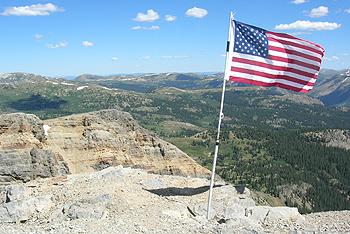
U.S. flag on American Flag Mountain, near Taylor Park, Colorado. Photo from Hobo Jeepers.

U.S. flag on American Flag Mountain, near Taylor Park, Colorado. Photo from Hobo Jeepers.

August 1 is Colorado’s statehood day. Unlike many other states, Colorado actually celebrates the day.

More accurately, people of Colorado celebrate the day. It seems most Colorado residents are happy to be there, and take any excuse to celebrate their good fortune.

#ColoradoDay even trended on Twitter for time today.

Under the provisions of the U.S. Flag Code, residents of a state are invited to fly the U.S. flag on their state’s day of statehood. Colorado came into the Union on August 1, at the declaration of President U. S. Grant, in 1876. People of Colorado tend to favor Colorado’s flag for most displays, on Colorado Day.

How are others celebrating? Free admission to Colorado State Parks, for one.


https://twitter.com/CaseyJPorter/status/892488499911426049


https://twitter.com/VegucationMama/status/892485902995304448


https://twitter.com/dwphotosco/status/892483447649779712


https://twitter.com/elieze_garner/status/892477389015527428


https://twitter.com/BriandaQuinones/status/892473969760141312

https://twitter.com/railfan4christ/status/892472012655927296

Well, yes, every other state has a statehood day, but don’t look for this effusive outpouring of state pride for many others, including Texas.

https://twitter.com/Jimbofoxman/status/892467827269140481

https://twitter.com/walkershow/status/892467003415552005


Save

Save

Save

Save


July 26, 2017, New York flies U.S. flags for statehood

July 26, 2017

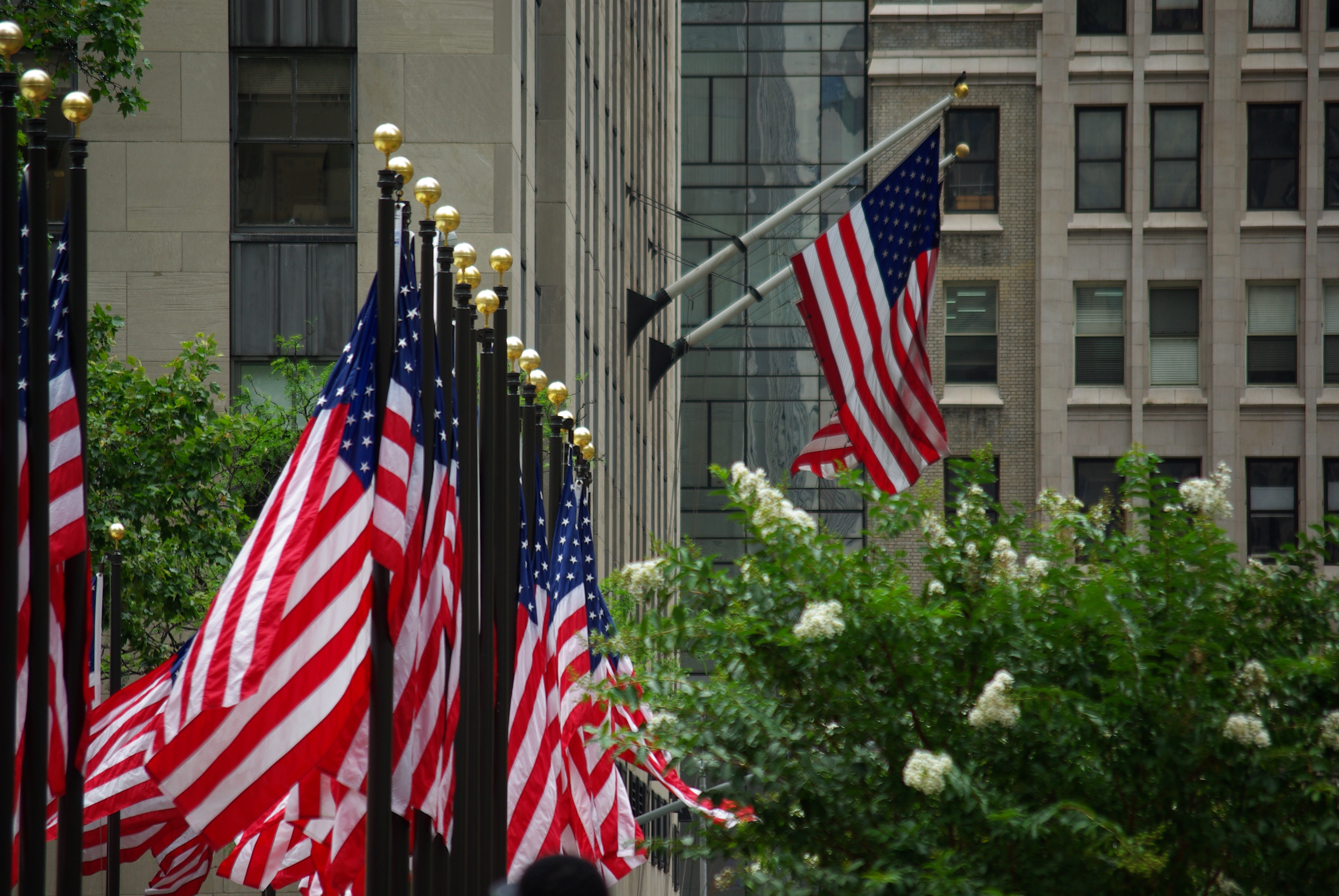
Flags fly in July at Rockefeller Center, New York City. Photo by Ed Darrell; please use, with attribution.

Flags fly in July 2016 at Rockefeller Center, New York City. Photo by Ed Darrell; please use, with attribution.

New York became a state, historians say, on July 26, 1788, when the Constitution Ratification Convention for the colony approved the U.S. Constitution. Technically the nation did not yet exist, but in flag circles, we use the ratification date as the statehood day for the 18 original states.

Following the guide of the U.S. Flag Code, New Yorkers fly their U.S. flags today in honor of New York’s statehood.

More: 

  • Next date to fly Old Glory: July 27 (tomorrow!) for Korean War Veterans Armistice Day.

Save

Save

Save


June 20, 2017: Fly the flag for West Virginia Statehood, and remembering Muhammad Ali

June 20, 2017

Homemade West Virginia Statehood U.S. flag with 35 stars. Image from RareFlags.com

Homemade West Virginia Statehood U.S. flag with 35 stars. Image from RareFlags.com

On June 20, 1863, West Virginia joined the fractured union as the 35th state.

Yes, that was during the Civil War.  Yes, West Virginia had been the northwestern counties of Virginia.  No, I’m not sure of the history of how Congress decided Virginia had consented to be divided.

In any case, per the guidelines in the U.S. Flag Code, West Virginians should fly the U.S. flag today in honor of their statehood, 154 years ago.  West Virginia no doubt has lots of celebrations, reenactments, and general festive events planned.

West Virginia's State Capitol in Charleston, West Virginia, on December 11, 2011

West Virginia’s State Capitol in Charleston, West Virginia, on December 11, 2011 — built in 1931. From O Palsson’s Flickr collection: “As I was traveling through Charleston, the capital of West Virgina, during blue hour (my favorite time of day) a couple of days after Thanksgiving, I happened upon this beautiful sight of the State Capitol Building reflected in the Kanawha River flowing by in total stillness, so I just had to stop and capture the scene. I didn’t have a tripod handy, so this is not a long-exposure nightshot, just a regular hand-held shot accomplished by bumping up the ISO as much as I dared to get correct exposure at acceptable shutter speed (ended up being 1/40 sec) and doing my best to keep the camera steady.”

Sunday I had a visit with a fellow who was born in western Virginia, went to school at Virginia Tech, and knew the New River geography (which was how we got into the conversation). He said the New River emptied into a river whose name he could never pronounce. Took a few minutes to realize he meant the Kanawha River, shown in the photo above. Pronouncing the river, and the county correctly is an interesting exercise. We once thought about living along the Kanawha, and I appreciated the frustration of our Virginia friend.

It’s usually pronounced in two syllables, ka-NAH; when locals have more time for a slower-paced conversation, it may become ka-NAH-uh — but they’ll look at you funny if they hear a “w” in your pronunciation. (Your mileage may vary; tell about it in comments.)

Kathryn and I have a few fond memories of Charleston on the banks of the Kanawha River.  Then-West Virginia Attorney General Charlie Brown was one of the few with enough wisdom to offer me a job, when I graduated from the National Law Center at George Washington University as an older student.  Brown promised to clean up West Virginia politics, and he had a lively, very young crew of attorneys fighting coal companies, oil companies, loggers, shady real estate people, and corrupt city, county and state officials.  One fellow in the office complained that he’d “had to argue eight cases” at the State Supreme Court that year, in his first year out of law school.

But the corrupt officials knew what they were doing.  Brown could only offer $25,000 a year, and in Charleston it was unlikely we’d be able to find any work for Kathryn.  Tough to attract crime fighters at less-than crime-fighting rates. It would have been a more than 75% cut in income.  We made a trip there to mull it over, baby on the way (pre-digital photographs buried in the archives).  Brown got a special dispensation to offer me $5,000 more.

Great tour of the Capitol, great interviews with the office lawyers.  Kathryn and I sat for a long while in the deserted West Virginia Supreme Court (sort of tucked into an attic of the Capitol) discussing how in the world we could afford to move the Charleston and take on the work.  We drove around the city, looking at houses for sale and rent; we gazed at the Kanawha River and discussed the future for the city.

We went to dinner in a tiny restaurant touted as Charleston’s finest, which was a long way from good eateries in D.C.  We discussed with our host the cultural pickings in Charleston.  We could give up the symphony but get back to fishing and practice fly fishing . . .

A few tables over, the maitre ‘d brought in a few extra chairs, and then seated Muhammad Ali and his party.  Our waiter asked that we not make a scene.

I don’t remember for what charitable purpose Ali was in Charleston, but the event was over and his hosts took him out to the good restaurant in Charleston, too.

Ali was a slower, sedate and gentle version of the fiery fighter he’d been.  Parkinson’s disease already had him in its grip.  His voice, soft as it could be at times, was still strong enough to carry across a table.  There was a young boy with the group, under five years old.  Ali had lost steps, but not spirit.  He produced a couple of balls from a pocket and proceeded to dazzle the kid with sleight-of-hand magic tricks.  He picked one of the balls from behind the kid’s ear, and the kid giggled wonderfully.  Balls appeared here, disappeared there — I remember thinking how much easier those tricks could be with hands that big; but Ali also had difficulty dealing with a knife and fork.  Working magic tricks pulled years away from Ali, and he seemed much younger, much more deft than he really was.  The little boy laughed and giggled through the meal.  It was a happy affair.

Our dinners finished about the same time.  As we got up, Ali looked over at us and said, “You wonder why I spend so much time with children?  They are the future.”

I turned down the offer from West Virginia.  A job I’d hoped for at American Airlines fell through, but a position opened up at the Office of Educational Research and Improvement (OERI) at Bill Bennett’s Department of Education.  A year or so later I saw small item in the Washington Post that Charlie Brown had been indicted on some charge.  Coal companies still have a lot of clout in West Virginia.

This is an anniversary day for Ali, too:  June 20, 1967, Muhammad Ali was convicted in Houston, Texas, of evading the draft.  That conviction was overturned by the U.S. Supreme Court.

Fly those flags in West Virginia.

More:

Yes, this is mostly an encore post. Fighting ignorance requires patience.

Yes, this is mostly an encore post. Fighting ignorance requires patience.

Save

Save

Save

Save


Fly your flags May 11 in Minnesota: 159th Minnesota Statehood Day

May 11, 2017

Flag etiquette following the U.S. Flag Code urges Americans to fly U.S. flags on the day of statehood for the state in which you reside.

Minnesota joined the Union on May 11, 1858.

Minnesota Capitol Chandelier, lit for Statehood Day, May 11.

Caption from the Minneapolis Star-Tribune: The Minnesota Capitol chandelier was illuminated May 10, 2013 in celebration of Statehood Day. It has 92 bulbs surrounded by 40,000 crystal beads strung together and was recently painstakingly cleaned and refurbished. The fixture is traditionally lit once per year on Statehood Day. Minnesota became a part of the United States as Minnesota Territory in 1849, and became the 32nd U.S. state on May 11, 1858.

At the Library of Congress’s outstanding American Memory site, a much more detailed history of Minnesota statehood is featured on “Today in History,” reproduced here in its entirety:

The Star of the North

Dome of the Minnesota Capitol. Pinterest image.

Dome of the Minnesota Capitol. Pinterest image.

Capitol Building, exterior, St. Paul, MN
American Landscape and Architectural Design, 1850-1920

On May 11, 1858, Minnesota became the 32nd state admitted into the Union. Minnesota’s application for statehood was submitted to President James Buchanan in January, but became entangled with the controversial issue of Kansas statehood, delaying it for several months until it was finally approved by Congress.

Known as the “Land of 10,000 Lakes,” or “Star of the North,” Minnesota is the northern terminus of the Mississippi River’s traffic and the westernmost point of an inland waterway which extends through the Great Lakes and, with the St. Lawrence Seaway, to the Atlantic Ocean.

The Ojibwa (Chippewa) and Dakota (Sioux) were among the tribal peoples who first made this land their home. For them state borders were non-existent, and their territory extended far beyond what is today Minnesota. The French claimed this region from the mid-1600s to the mid-1700s, developing a strong fur trade but ceding lands east of the Mississippi to Britain. The U.S. acquired the area and its rich natural resources through the Treaty of Paris (1783), and the Louisiana Purchase (1803).

U.S. administration of the northwest lands formally began with the 1787 passage of the Northwest Ordinance. The ordinance, one of the most important pieces of legislation passed by the Continental Congress, set out the requirements for a territory to become a state. The American Memory collection Continental Congress and the Constitutional Convention, 1774-1789 features a discussion of the Incorporation of the Western Territories. For additional information on England’s yielding of land west of the Appalachian Mountains, see the Today in History feature on the Surrender of Fort Sackville. A representation of Fort Sackville is accessible on The George Rogers Clark National Historic Park site.

From the 1820s on, protected the growth of the area now called Minnesota. During the Civil War, the fort served as a training center for thousands of young Minnesota volunteers who joined the Union Army. Twenty-four thousand soldiers who trained at the fort fought in the Union Army, serving gallantly at Gettysburg or during the Indian Outbreak. Once a military outpost at the edge of a small settlement, Fort Snelling is now located at the center of Minnesota’s “Twin Cities”—Minneapolis and St. Paul.

Wheat stack in Minnesota, circa 1910

Horse powered threshing rig, Blue Earth Minnesota, 1898 Courtesy Fred Hultstrand History in Pictures Collection, NDIRS-NDSU, Fargo - See more at: http://www.lakesnwoods.com/BlueEarthGallery.htm#sthash.i9zmvAlC.dpuf

Horse powered threshing rig, Blue Earth Minnesota, 1898. Colorized.  Courtesy Fred Hultstrand History in Pictures Collection, NDIRS-NDSU, Fargo – See more at: http://www.lakesnwoods.com/BlueEarthGallery.htm#sthash.i9zmvAlC.dpuf

Horse powered threshing rig, Blue Earth, Minnesota, 1898.
The Northern Great Plains, 1880-1920

Until the second half of the nineteenth century, immigration into Minnesota was slow. However, as the value of the state’s woodlands and fertile prairie was realized, settlers poured into the region with New England lumbermen leading the way. Between 1850 and 1857, the state population skyrocketed from 6,077 to over 150,000. As a large state with land for homesteading, Minnesota attracted immigrants from Norway, Sweden, Finland, and those seeking to own land in the United States. An 1878 brochure published by the Minnesota State Board of Immigration, describes the many reasons for moving to the state.

19th century advertisements to get people to move to Minnesota. Library of Congress images

19th century advertisements to get people to move to Minnesota. Library of Congress images; see description and link details below

Northern Line Packet Co.,
Advertisement for a steamship company in The Minnesota Guide. A Handbook of Information for the Travelers, Pleasure Seekers and Immigrants…, 1869.
Pioneering the Upper Midwest: Books from Michigan, Minnesota, and Wisconsin, ca. 1820-1910

Still a leader in farming, lumbering, milling, and medical research, Minnesota is also an important center for the printing industry and a major producer of iron ore. Its largest city, Minneapolis, is home to the University of Minnesota, numerous museums, and theaters such as the Tyrone Guthrie Theater and the Walker Arts Center, and the world’s largest cash grain market.

St. Paul is the state capital.

Bird's eye view of Duluth Minnesota, 1914, via Library of Congress
Bird’s Eye View of Duluth, Minnesota, copyright 1914.
Taking the Long View, 1851-1991

More:

U.S. and Minnesota flags flying together. Minnesota state flag photo by AlexiusHoratius - Own work. Licensed under Creative Commons, via Wikipedia

U.S. and Minnesota flags flying together. Minnesota state flag photo by AlexiusHoratius – Own work. Licensed under Creative Commons, via Wikipedia

Yes, this is mostly an encore post. Fighting ignorance requires patience.

Yes, this is mostly an encore post. Fighting ignorance requires patience.

Save

Save


January 9, 2017 – Connecticut flies U.S. flags for statehood

January 9, 2017

Carol Highsmith photo of Connecticut's Hall of Flags

Love this photo: Hall of Flags in the Connecticut State Capitol Building; photo by the great photo-historian Carol Highsmith, from the Library of Congress collection; the statue is Connecticut’s Civil War Governor, William A. Buckingham (1804-1875), honored for his personal contributions to the equipping of Connecticut’s men fighting in the Civil War.

Technically, states didn’t exist at all, yet.

But on January 9, 1788, Connecticut became the fifth of the 13 colonies to ratify the proposed Constitution for the United States of America, and by that action set the date we count as Connecticut’s entery into the union.

Within 12 months, four more colonies ratified the document, totaling nine ratifications required to put the Constitution into effect.  When the government of the new nation started functioning in 1789, Connecticut was counted as the fifth state.

Connecticut capitol building, Hartford

Capitol building for Connecticut in Hartford; this photo is from the rear of the building, so the U.S. flag is flying correctly on its own right. The building was completed in 1878. The dome is covered in gold. Image from Wikimedia Commons

To avoid political scheming by anti-federalist colony governors, especially Patrick Henry in Virginia, in September 1787 James Madison proposed that the draft constitution be ratified not by legislatures in the colonies, but instead by a specially-called convention of the people of the colony.  Connecticut’s convention met first on January 3, 1788. With six days of discussion and debate, the convention passed a resolution of ratification on January 9.

So by tradition, January 9 is Connecticut’s statehood anniversary.  According to U.S. law, the Flag Code and tradition, citizens and residents of a state fly their flags on statehood anniversaries.

Happy birthday Connecticut, 228 years old.

Next date to fly the U.S. flag is January 16, 2016, to honor the birth of the Rev. Dr. Martin Luther King, Jr. January 16 is the official holiday; January 19 is the actual birthday. You may fly your colors on both dates.

More:


U.S. flag on the McPolin Barn, Park City, Utah (It’s Utah Statehood Day!)

January 4, 2017

Most Utah citizens regard themselves as patriots. It’s a state where almost every home has at least one U.S. flag, and where many neighborhoods will be festooned with them on any U.S. holiday.

January 4 is Utah’s statehood day. I ran across this photo of the picturesque McPolin Barn in Park City, Utah, up in the Wasatch Mountains in ski country.

For Utah Statehood day, I pass it along:

U.S. flag displayed on the McPolin Barn, Park City, Utah. Date unknown, photographer unknown (if you can identify the photographer, please do!)

U.S. flag displayed on the McPolin Barn, Park City, Utah. Date unknown, photographer unknown (if you can identify the photographer, please do!)

Save

Save


Utah flies U.S. flags on January 4 for statehood: 121 years in 2017 – old enough to drink

January 4, 2017

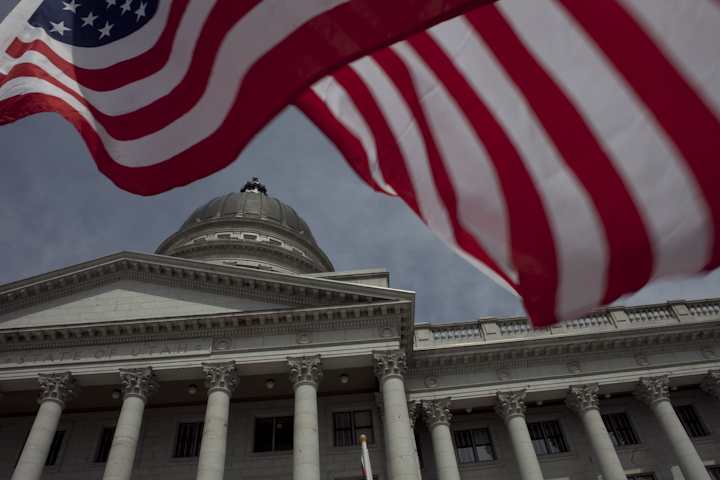
U.S. flag flying in front of the Utah State Capitol. Utah State Capitol image.

U.S. flag flying in front of the Utah State Capitol. Utah State Capitol image.

U.S. flags fly in Utah today in honor of Utah statehood. It’s also the day that new, elected state officers take their oaths and take their offices. Utah is 121 years in the union — as a state, it’s old enough to drink, though you may have difficulty finding a drink there among the teetotaling Mormons.

Utah joined the Union on January 4, 1896.  It had been a 49-year slog to statehood for Deseret, the Mormon settlement in the Desert.  The size had been pared down, so it would not be the biggest state, incorporating parts of what is now Nevada, Arizona, Oregon, Idaho, Colorado and New Mexico.  New capitals had been tried and cast aside (Fillmore, Utah).  Democratic Party rule was broken when LDS church authorities went door-to-door, calling every other family to the Republican Party, and party parity.  The Mormon Church abandoned polygamy, and adopted a state constitution that gave the vote to women.

Finally, Utah became the 45th state.

You may fly your U.S. flag today for Utah statehood, especially if you’re in Utah.

Happy birthday, Utah!  121 years old today.

Big dance in Fillmore to celebrate, Saturday:

Next federal flag-flying date: January 6, in honor of New Mexico’s statehood.

More:

One of my favorite Utah photos: U.S. flag at the south end of Mount Timpanogos; photo from Orem, Utah, by Bob Walker.

One of my favorite Utah photos: U.S. flag at the south end of Mount Timpanogos; photo from Orem, Utah, by Bob Walker.

Yes, this is mostly an encore post. Fighting ignorance requires patience.

Yes, this is mostly an encore post. Fighting ignorance requires patience.

Save

Save


58 years ago, January 3, 1959: Welcome, Alaska, and the 49-star flag

January 3, 2017

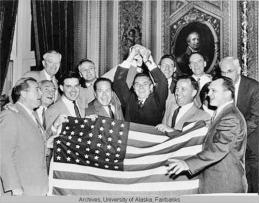
Alaska Territorial Gov. Bob Bartlett in center, with the 49-star flag (Bartlett was one of Alaska's first U.S. senators).

Alaska Territorial Gov. Bob Bartlett in center, with the 49-star flag (Bartlett was one of Alaska’s first U.S. senators).

The great service at the New York Times site, the Learning Network, notes the 1959 Dwight Eisenhower proclamation of Alaska as the 49th state, and the unveiling of the 49-star flag:

On Jan. 3, 1959, President Dwight Eisenhower signed a proclamation admitting Alaska to the Union as the 49th state. The New York Times noted that the signing included the unveiling of the new 49-star American flag.

The land that became Alaska came into U.S. possession in 1867, when William Seward, secretary of state under President Andrew Johnson, negotiated a deal to buy the 586,000-square-mile area from Russia for $7.2 million, less than 2 cents per acre. Seward’s decision was ridiculed in the American press, who saw no potential in the vast, inhospitable and sparsely populated area.

For decades after its purchase, Alaska was derided as “Seward’s folly” or “Seward’s icebox.” This opinion changed in 1896 with the discovery of gold in the neighboring Yukon Territory, which spurred tens of thousands of people to head to Alaska in search of gold. The gold rush also brought about a boom in mining, fishing and trapping.

Though the first statehood bill had been presented to Congress in 1916, there was little desire in either Alaska or Washington for Alaskan statehood until after World War II. During the war, the U.S. established multiple military bases to resist Japan’s attacks on Alaska’s Aleutian Islands and prevent a potential invasion of the mainland. The military activity, along with the completion of a major highway from Montana, led to a large population growth.

In 1946, Alaskans voted in favor of statehood in a referendum and Alaskan delegates began to lobby Congress for statehood. After years of debate, Congress voted in June 1958 to admit Alaska.

Eight months after Alaska’s admission, on Aug. 21, 1957 [should be 1959, no?], Hawaii became the 50th state. The 49-star remained in place until the following July 4, when it was replaced by the now-familiar 50-star flag.

49-star flags were produced only until August 1959, so there are few of them around.  I love this photo of the unveiling of the flag with President Eisenhower:

President Eisenhower and Quartermaster General MG Andrew T. McNamara, with 49-star flag - image from QM foundation

“Quartermaster General MG Andrew T. McNamara and President Eisenhower examine new 49 star flag” – image and caption from the Quartermaster Foundation. Photo by Bob Schutz, Associated Press (Who are the other two people?  The guy on the right looks to me a bit like is Pennsylvania’s Sen. Hugh Scott.)

It had been about 47 years since the previous state admission (Arizona); people became aware that no law set what the flag should look like.  President Eisenhower issued a directive.

How did the nation survive for 170 years without firm, decisive and conclusive orders on what the U.S. flag should look like?  Isn’t it a great story that we went so long without law setting the requirements?

Alaska's state flag design came from 13-year old Benny Benson.

Alaska’s state flag design came from 13-year old Benny Benson. Benny Benson holding the Alaska flag at the Jesse Lee Home, Seward, Alaska. ASL-P01-1921, Alaska State Library-Historical Collections.


Alaska’s state flag came from the imagination of a 13-year-old Aleut, Benny Benson, winning a contest to design the state’s flag.  Alaska’s flag stands out in any display of U.S. state flags.

Alaska's flag as it was approved by the state legislature, and still flies today. Image from the Ninilchik Natives Association, Inc (NNAI).

Alaska’s flag as it was approved by the state legislature, and still flies today. Image from the Ninilchik Natives Association, Inc (NNAI).


Yes, this is mostly an encore post. Fighting ignorance requires patience.

Yes, this is mostly an encore post. Fighting ignorance requires patience.

Save

Save

Save

Save

Save


Texans fly U.S. flags today in honor of Texas statehood

December 29, 2016

First class postage stamp showing U.S. and Texas flags together, issued for the Texas Statehood Centennial, in 1945. Yes, first class postage was three cents. Wikipedia image.

First class postage stamp showing U.S. and Texas flags together, issued for the Texas Statehood Centennial, in 1945. Yes, first class postage was three cents. Wikipedia image.

Congress approved Texas’s petition to join the union on December 29, 1845. Texas joined the United States of America 171 years ago today.

KWTX Channel 10 News described the process in 1845:

On December 29, 1845—171 years ago today—the U.S. Congress voted to annex Texas, eight years after statehood was first proposed. In June 1845 the Texas Congress voted in favor of annexation and on July 4, 1845, a convention of elected delegates followed suit. A popular vote in October ratified the document, which the U.S. Congress accepted on December 29, 1845, making Texas the 28th state. Texas President Anson Jones handed over control of the new state government to Gov. James Pinckney Henderson on February 19, 1846.

Engraving of Texas President Anson Jones lowering the flag of the Republic of Texas, to be replaced with the flag of the United States, on December 29, 1845, after Congress accepted the annexation of Texas into the Union. Texas State Library image.

Engraving of Texas President Anson Jones lowering the flag of the Republic of Texas, to be replaced with the flag of the United States, on December 29, 1845, after Congress accepted the annexation of Texas into the Union. Texas State Library image.

More:


Iowa entered the union on December 28, 1846; fly your flags, Hawkeyes!

December 28, 2016

Iowans may fly their flags today in celebration of the anniversary of Iowa statehood.  Iowa’s admission to the Union came on December 28, 1846; Iowa was the 29th state admitted.

“Millions of acres. Iowa and Nebraska. Land for sale on 10 years credit by the Burlington & Missouri River R. R. Co. at 6 per ct interest and low prices.” Poster advertising land in Iowa, circa 1872, from the Burlington & Missouri River Railroad Co. – Library of Congress Printed Ephemera Collection; Portfolio 134, Folder 13; via Wikipedia

The Flag Code, 4 USC §6 (d), notes that the U.S. flag may be flown on “the birthdays of States (date of admission),” in addition to the other score of dates specifically written into law.

Stars and Stripes were impossible to miss at University of Iowa's Kinnick Stadium in November 2014. Photos by Tim Schoon.

Sometimes we excuse parts of the Flag Code if the display otherwise stirs great patriotism. Stars and Stripes were impossible to miss at University of Iowa’s Kinnick Stadium in November 2014. Photos by Tim Schoon.

More:

Yes, this is mostly an encore post. Fighting ignorance requires patience.

Yes, this is mostly an encore post. Fighting ignorance requires patience.

Save

Save


Flags in New Jersey flying for statehood, December 18

December 18, 2016

New Jersey's Capitol in Trenton, by Vagabond Voyage. Many complain it's difficult to get a good, nice looking photo of this building due to development around it. This photo is alleged to be one of the better photos possible.
New Jersey’s Capitol in Trenton, by Vagabond Voyage. Many complain it’s difficult to get a good, nice looking photo of this building due to development around it. This photo is alleged to be one of the better photos possible.

December 18 is New Jersey Statehood Day.

U.S. Flag Code encourages residents of each state to fly the U.S. flag on their state’s anniversary of statehood. New Jersey won consideration as the Third State, on December 18, 1787, by being the third colony to ratify the U.S. Constitution. Technically the U.S. did not come into existence until six more states ratified, but among the first 13 states, statehood dates are calculated traditionally as the day the colony ratified.

Does anyone in New Jersey celebrate it?

New Jersey's state flag. Just try to find photos of the U.S. flag and New Jersey flag flying together.
New Jersey’s state flag. Just try to find photos of the U.S. flag and New Jersey flag flying together.
New Jersey's Capitol Building and surroundings in Trenton, from across the Delaware River. U.S. flag can be seen flying at the Capitol. Wikipedia image.
New Jersey’s Capitol Building and surroundings in Trenton, from across the Delaware River. U.S. flag can be seen flying at the Capitol. Wikipedia image.

More:

  • Next Fly Your Flag dates: December 28 in Iowa, for Iowa statehood; December 29 in Texas, for Texas statehood.

Save


December 14, Alabama flies the flag for statehood

December 14, 2016

U.S. and Alabama flags share a pole at the Alabama Capitol Building in Montgomery. USFlagStore.com image.

U.S. and Alabama flags share a pole at the Alabama Capitol Building in Montgomery. USFlagStore.com image.

Alabama joined the union on December 14, 1819, the 22nd state.

Under provisions of the U.S. Flag Code, residents of a state are encouraged to fly the U.S. flag on their respective statehood day.

Does Alabama commemorate its own statehood?

More: 


U.S. and Alabama flags flying together. Liberty Flagpoles image.

U.S. and Alabama flags flying together. Liberty Flagpoles image.

Save

Save


December 7, 2016: Fly your flags for Pearl Harbor Remembrance, and for Delaware statehood — and at half staff

December 7, 2016

Flag flies at half-staff over the USS Utah, in Pearl Harbor (2004 photo – Pearl Harbor, Hawaii (May 31, 2004) – Sailors assigned to ships based at Pearl Harbor bring the flag to half-mast over the USS Utah Memorial on Ford Island in honor of Memorial Day May 31, 2004. U.S. Navy photo)

Flag flies at half-staff over the USS Utah, in Pearl Harbor (2004 photo – Pearl Harbor, Hawaii (May 31, 2004) – Sailors assigned to ships based at Pearl Harbor bring the flag to half-mast over the USS Utah Memorial on Ford Island in honor of Memorial Day May 31, 2004. U.S. Navy photo)

December 7 is a two-fer flag-flying day.

By public law, December 7 is Pearl Harbor Remembrance Day, and Americans fly the U.S. flag in memory of those who lost their lives at Pearl Harbor on December 7, 1941. U.S. flags should be flown at half-staff.

Under the U.S. Flag Code, residents of the relevant state should fly their U.S. flag on the date the state joined the union.

In 1787 Delaware quickly and promptly elected delegates to the former colony’s convention to ratify the Constitution proposed at the Philadelphia convention just over three months earlier. The ratification of the Constitution won opposition from strong factions in almost every state. Pols anticipated tough fights in New York, Virginia, and other states with large populations. They also expected other states would wait to see what the bigger states did.

Delaware didn’t wait.  On December 7 Delaware became the first of the former British colonies to ratify the Constitution. Perhaps by doing so, it guaranteed other states would act more favorably on ratification.

Because Delaware was first, it is traditionally granted first position in certain ceremonies, such as the parades honoring newly-inaugurated presidents. Delaware’s nickname is “The First State.”

In Delaware and the rest of the nation, fly your flags on December 7, 2016.

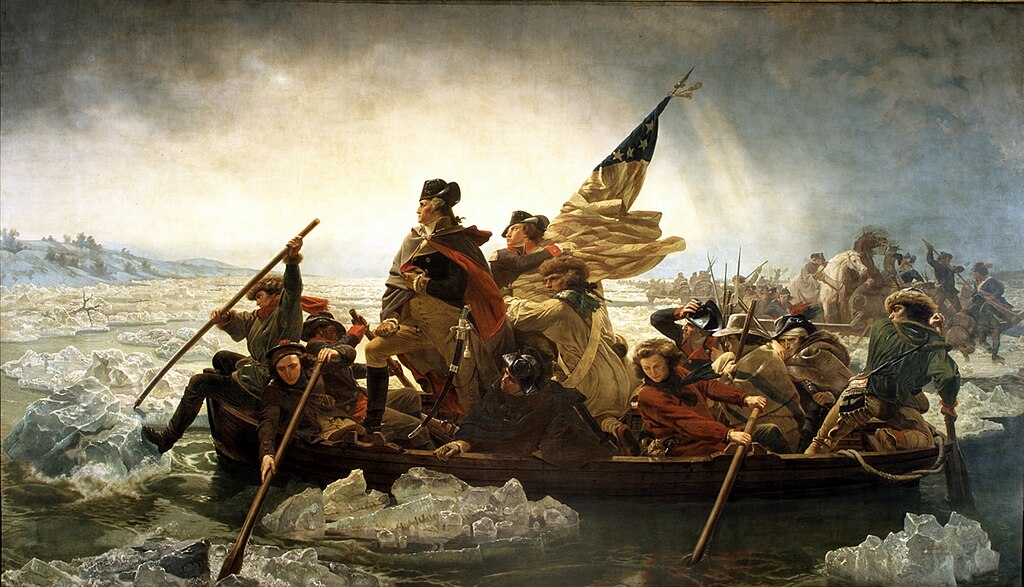
The most famous portrayal of a U.S. flag flying in Delaware is in the painting by Emanuel Leutze (American, 1816–1868).

The most famous portrayal of a U.S. flag flying in Delaware is in the painting by Emanuel Leutze (American, 1816–1868). “Washington Crossing the Delaware,” 1851. The Metropolitan Museum of Art, New York, Gift of John Stewart Kennedy, 1897 (97.34) Among other problems with this portrayal: The flag depicted had not been designated on the date of the crossing, Christmas 1776.

Yes, this is mostly an encore post. Fighting ignorance requires patience.

Yes, this is mostly an encore post. Fighting ignorance requires patience.

Save

Save


Oklahoma statehood, November 16, 1907; Oklahomans fly your flags today

November 16, 2016

U.S. Flag Code urges citizens of states to fly the U.S. flag on the anniversary of statehood.

President Theodore Roosevelt signed the Oklahoma statehood proclamation on November 16, 1907. Oklahoma became the 46th state, with New Mexico and Arizona to come later to fill out the contiguous 48 states.

Mike Wimmer's 2003 painting of President Theodore Roosevelt's signing of the proclamation that made Oklahoma a member of the union. Oklahoma Arts Council image.

Mike Wimmer’s 2003 painting of President Theodore Roosevelt’s signing of the proclamation that made Oklahoma a member of the union. Oklahoma Arts Council image.

Oklahoma’s pre-history is long, complex and fascinating; the road to statehood is similarly complex and winding, lined with broken promises to Native Americans, tragedy and other drama. Does the state require Oklahoma history be taught in public schools?

Fly your flags today, Sooners!

More: 

Front page of the Daily Oklahoman on November 16, 1907, anticipating President Roosevelt's proclamation to come that morning. Daily Oklahoman image.

Front page of the Daily Oklahoman on November 16, 1907, anticipating President Roosevelt’s proclamation to come that morning. Daily Oklahoman image.


From Jeff R. Bridgman Antiques: 46 star American national flag, made in the period between 1907 and 1912, in small and desirable scale. The 46th state, Oklahoma, joined the Union on November 16th, 1907, during Teddy Roosevelt’s presidency. Roosevelt had many friends in the Oklahoma Territory from his Rough Rider days, and pushed it through to statehood. The 46 star flag became official on July 4th, 1908 and remained so until July 3rd, 1912. Many 46 star flags were made earlier, however, in great anticipation of the future addition of the state, which had previously been appointed to Native Americans.

From Jeff R. Bridgman Antiques: 46 star American national flag, made in the period between 1907 and 1912, in small and desirable scale. The 46th state, Oklahoma, joined the Union on November 16th, 1907, during Teddy Roosevelt’s presidency. Roosevelt had many friends in the Oklahoma Territory from his Rough Rider days, and pushed it through to statehood. The 46 star flag became official on July 4th, 1908 and remained so until July 3rd, 1912. Many 46 star flags were made earlier, however, in great anticipation of the future addition of the state, which had previously been appointed to Native Americans.

Save

Save

Save

Save