2009 Poets Forum – October 15 – 17, in New York City

August 3, 2009

This sounds like fun, actually.  I wonder if they offer Continuing Education Units?

Shouldn’t schools make sure all English teachers get to make this pilgrimage at least once every four years?  Principals, are you listening?

Poets Forum Update:
New Events and More Participants Announced for 2009
Discounted passes available for a limited time at poets.org/poetsforum

Participants include Frank Bidart, Rita Dove, Lyn Hejinian,Edward Hirsch, Haryette Mullen, Sharon Olds, Ron Padgett, Carl Phillips, Robert Pinsky, Kay Ryan, Gerald Stern, Susan Stewart, Jean Valentine, Ellen Bryant Voigt, and many more.

The Academy of American Poets invites you to join us in New York City for the annual Poets Forum, a series of events exploring the landscape of contemporary poetry in America.

This year’s Poets Forum includes new talks and discussions with an array of distinguished poets, readings, publication parties, and an expanded selection of literary walking tours, led by poets, through Manhattan and Brooklyn.

“In only three years, the Poets Forum has become the poetry event of the fall, as poets (and fans of poetry) of all aesthetics celebrate and learn about what they all have in a common: a desire to give life itself a shape through language.”
– Carl Phillips

Poets Forum Reading
Thursday, October 15
7 p.m.
Join us for an unforgettable evening as some of the most acclaimed poets of our day come together on one stage to read from their latest work. Featured readers include Frank Bidart, Rita Dove, Lyn Hejinian, Edward Hirsch, Sharon Olds, Ron Padgett, Carl Phillips, Robert Pinsky, Kay Ryan, Gerald Stern, Susan Stewart, and Ellen Bryant Voigt.
The Times Center
242 West 41st Street

Poetry Walking Tours
Friday, October 16
10:30 a.m. & 2 p.m.
Take a trip down the same streets traversed by Walt Whitman, Marianne Moore, E. E. Cummings, Langston Hughes, George Oppen, and countless other poets. Walking tours will explore the literary history of Brooklyn, Harlem, the Museum of Modern Art, the West Village, and SoHo. Tour guides include poets Anselm Berrigan, Jordan Davis, Bob Holman, Katy Lederer, Greg Pardlo, Tom Thompson, and Mónica de la Torre.
Meeting locations throughout New York City.
TOURS ARE RESERVED FOR ALL-EVENTS PASS HOLDERS ONLY

NEW: Poets & Place Talk
Friday, October 16
2 p.m.
“Show Me Your Environment, and I Will Tell You Who You Are”:  Place, Pathos, and the Problems of Identity
David Baker discusses the relationship between poets and their environment.
Philoctetes Center
247 East 82nd Street
Co-sponsored by the Philoctetes Center
RESERVED FOR ALL-EVENTS PASS HOLDERS ONLY

Poets Awards Ceremony Friday, October 15 7 p.m. Celebrate contemporary poetry and recipients of the premier collection of awards for poetry in the United States. The night will include readings and presentations by Linda Gregg, Jennifer K. Sweeney, J. Michael Martinez, Harryette Mullen, James Richardson, Avi Sharon, Jean Valentine, and many others. A reception will follow.
Tishman Auditorium
The New School
66 West 12th Street
Co-sponsored by the New School Creative Writing Program

Poets Forum Discussions Saturday, October 17 10 a.m. – 4 p.m. 6 Sessions Examine the issues central to contemporary poetry as we present a day of engaging and intimate conversations with some of the most renowned poets of our time, including Frank Bidart, Rita Dove, Lyn Hejinian, Edward Hirsch, Harryette Mullen, Sharon Olds, Ron Padgett, Carl Phillips, Robert Pinsky, Kay Ryan, Gerald Stern, Susan Stewart, Jean Valentine, Ellen Bryant Voigt and other special guests.
Tishman Auditorium
The New School
66 West 12th Street
Co-sponsored by The New School Creative Writing Program

“This public forum on American Poetry is the first of its kind for our brave, wild world of poesy. We will leave no stone unturned to address all the voices and all the thoughts that beset, overwhelm, confuse, delight, and alarm us.”
– Gerald Stern

American Poet Publication Party
Saturday, October 17
7 p.m.
Reading and reception for the new fall issue of American Poet, the journal of the Academy of American Poets. Noelle Kocot, Robert Polito, and Brian Teare will read from their work. Ico Art and Music Gallery
606 West 26th Street (at 11th Avenue)
Co-sponsored by the Ico Gallery

Ticket Information
All-Events Pass: $85 before Sept 15 / $110 after
Saturday-Only Tickets: $60
Students (with current ID): Student rates are available by by phone.
Contact: Jennifer Kronovet, (212) 274-0343, ext.10.

Purchase tickets online at poets.org/poetsforum or by phone,(212) 274-0343, ext.10.

All times are subject to change. Contact Jennifer Kronovet at jkronovet@poets.org with further questions.
Academy of American Poets
584 Broadway, Suite 604
New York, NY 10012

212-274-0343


Blue jay, purple pepper

July 23, 2009

We’ve been bumping around 100° F for about a month now.  It’s Texas.  It’s hot.

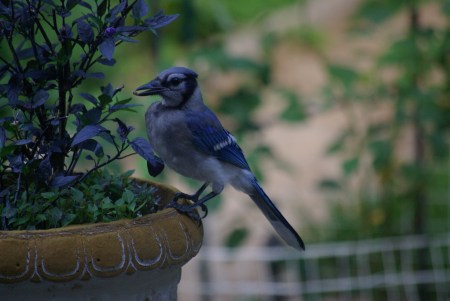
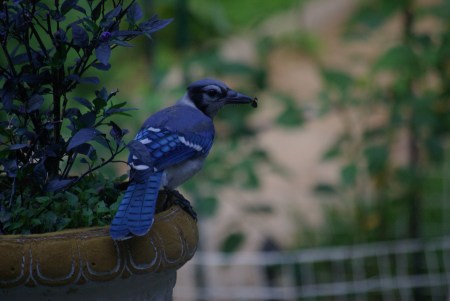
Sometimes the blue jays do all they can to stay out of the sun — like this guy, who was bent on getting some of Kathryn’s weird purple peppers.

Blue jay working to get a purple pepper

Blue jay working to get a purple pepper

Considering these shots were done in the shade, with just a 200 mm zoom, through a foggy window, they came out pretty well.

Blue Jay wrestles the pepper from the plant

Blue Jay wrestles the pepper, or something, from the plant.

The peppers eventually grow to be the size of a Bing cherry — too big for the jays, then.  They go after these peppers before they mature, and after they dry.

With her prize, the blue jay heads for its dining area in the live oak.

With her prize, the blue jay heads for its dining area in the live oak.

Mary K left us with her old bird feeder when she moved.  This year we’ve kept feeders in both the front and back yards.  Blue jays appear to have recovered from their West Nile devastation three years ago — we had one family nesting in the live oak earlier, in the spring — and Kathryn learned that the jays like peanuts still in the shell.

It’s been a good year for watching birds in our yard.  Still haven’t captured that little green hummer in a camera, though.


News flash: Texas has a second natural lake!

July 20, 2009

Years ago, in Virginia, I had learned that Virginia had only one natural lake, the Great Dismal Swamp.  Accompanying that chunk of information in that lecture was that Texas had only two natural lakes.

But upon arriving in Texas, I could find reference to only one natural lake, Caddo, and it had ceased being fully natural when its maintenance fell to a dam.

What happened to Texas’s second natural lake?

A Google search right now on “Texas +’natural lake'” produces ten listings on the first page, all of them pointing to the fact that Texas has just one natural lake.  Here are the first five:

I have found a second natural lake in Texas. It’s not a new discovery at all — it’s just a case of people not having the facts, and overlooking how to find the truth.  It’s especially difficult when the lake hides itself.

Our testing coordinator at Molina High School, Brad Wachsmann, spins yarns that belie his youth.  In the middle of one yarn last year, corroborated by other yarns, he mentioned that he has family in Big Lake, Texas; and he described visiting and having relatives urge people to run out and see the lake since it’s rebirth in torrential rains.

“A second natural lake in Texas?” I asked.  Wachsmann knew the drill.  Yes, Big Lake is a natural lake in Texas, and yes, people forget about it.

Texas teachers, listen to your testing coordinators, okay?

All of this came to mind reading the Austin American-Statesman, still a bastion of great journalism despite problems in the newspaper industry.  On Monday, July 7, the paper ran a story and an editorial about the clean up of the oil industry refuse that killed the shoreline of part of the lake; the springs that once fed the lake have mostly gone dry, but that’s likely due to agricultural water mining.

It’s a story of boom and bust, environmental degradation for profit, and eventual recovery we hope.

Looking at the landscape that surrounds the Reagan County seat, you wonder whether the name Big Lake was somebody’s idea of joke. It’s dry and dusty, where the flora sprouts reluctantly and lives precariously.

Yet, the West Texas town of Big Lake got its name from a natural lake that was fed by springs that have long since gone dry. While the area may not fit everyone’s definition of photogenic, it has its own brand of charm – charm that could be enhanced if the damage done to the fragile ecosystem by salt spills were reversed or even minimized.

As the American-Statesman’s Ralph K.M. Haurwitz reported in Monday’s editions, the University of Texas and Texas A&M systems have benefited from the $4.4 billion in royalty payments and mineral income produced by its West Texas acreage since Santa Rita No. 1 well came in on May 28, 1923.

The salt water byproduct of oil and natural gas production, however, contaminated 11 square miles near Big Lake, killing most everything that grows. The lack of vegetation allows wind and water erosion.

Hey, it gets better.  This is real Texas history, real American history — you can’t make this stuff up.  Haurwitz’s article talks about the heritage of Texas education.   Remember that old story about setting aside certain sections of townships to help fund education in lands on the American frontier?  Texas wasn’t a public lands state as farther west, but it still reserved sections of land for the benefit of education.

Rose petals blessed by a priest?  I’ll wager the priest didn’t make the trip to the top of the derrick.  Haurwitz wrote:

BIG LAKE — Investors appealed to the patron saint of impossible causes when oil drilling began on University of Texas System land in 1921. It didn’t hurt.

Santa Rita No. 1 blew in on May 28, 1923, after rose petals blessed by a priest were scattered from the top of the derrick at the behest of some Catholic women in New York who had purchased shares in the Texon Oil and Land Co., which drilled that first well.

Since then, the UT System’s 2.1 million acres in West Texas have produced $4.4 billion in royalty payments and other mineral income for the Permanent University Fund, an endowment that supports the UT and Texas A&M University systems.

But this long-running bonanza for higher education exacted a price from the remote, semiarid landscape where it all began. Millions of barrels of salt water, a byproduct of oil and natural gas production, contaminated 11 square miles, or more than 7,000 acres, killing virtually all vegetation and leaving the land vulnerable to wind and water erosion. Hundreds of mesquite stumps with three feet of exposed roots testify to the dramatic loss of topsoil.

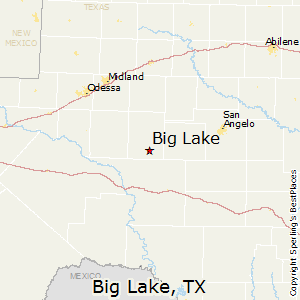
Texas, and Big Lake - from BigLakeTx.com

Where in Texas is Big Lake?

The town of Big Lake is just north of the lake itself, on State Highway 137 running north and south, and U.S. Highway 67 running east and west, approximately 65 miles west of San Angelo.   Big Lake sits about 10 miles north of Interstate 10, and about 75 miles south of Interstate 20.  Big Lake calls itself “the gateway to the Permian Basin.”

Big Lake is the home of Reagan County High School.  Jim Morris was baseball coach for the Reagan High Owls when his team persuaded him to try out for a major league baseball team.  His story was chronicled, with some artistic license, in the Disney movie “Rookie.”

Land managers are working to stop erosion on the often-dry shores of Big Lake using any trick they can find.  One trick:  Plant salt grass.

Salt grass?  Along Texas’s Gulf Coast, there are a few species of grass that, while not halophytes, are at least salt tolerant.  Salt grass.  This grass made it profitable to graze cattle on what would otherwise have been unproductive land in the Texas cattle boom.  This role in Texas history is memorialized in the Salt Grass Steakhouse chain, now found in five states.

And if planting salt grass works to control erosion, it will help clean up a large part of Texas other natural lake, Big Lake.

Big Lake’s being wet or dry is a whim of local climate.  You could say that half of all of Texas’s natural lakes are now dry as a result of continued warming; you could say that two good gully-washers or toad-stranglers could restore water to half of Texas’s natural lakes.

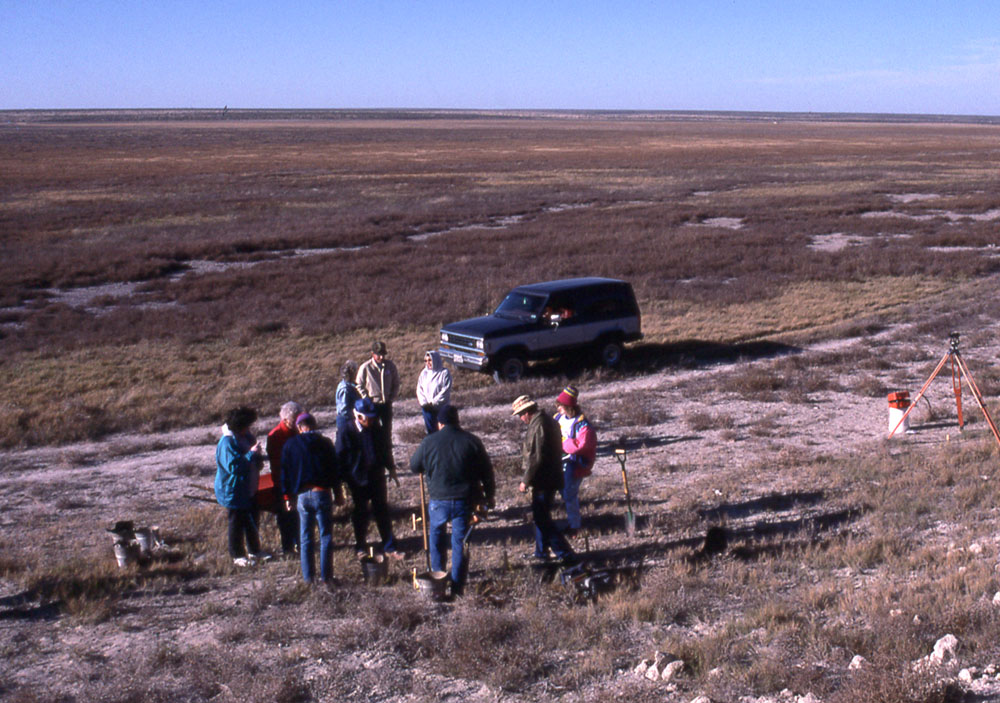
Big Lake Playa, from NightOwl Bakery and Roastery in Big Lake, Texas

Field crew meeting at the outset of the 1992 excavations at the Big Lake Bison Kill site. The dry bed of Big Lake stretches for miles in the background. Big Lake is an intermittent saline lake or playa, an uncommon landform on the Edwards Plateau. Photo by Larry Riemenschneider, Concho Valley Archeological Society.

More details about Big Lake and prehistory, below the fold.

Read the rest of this entry »


American Airlines welcomes pets, at JFK Airport

July 15, 2009

Old buddy Jack Keady writes:

I swear – I don’t make this stuff up:

Cats and Dogs Welcome (and comfortable) at JFK
American Airlines has installed a new Pet Relief Area at the JFK International Airport in New York. More»

Is this important?  Ask anyone who travels with a beloved four-legged critter.  Well, we don’t have to ask — AA vet Dennis Crosby tells the story:

I think it is a great idea.  Every time we take our dog to Ft. Myers, airport palm trees get irrigated immediately upon arrival.

Could have really used this at DFW about 3 years ago.  On the way home to Chicago via a connection, my family and I experienced an air interruption about 30 minutes out of DFW. Back at the gate in front of Dickey’s barbeque, we were advised that we would leave in 4 hours at 515 PM.  Went to the Admirals Club and tried to keep an eye on updates.  Final check revealed that the flight had left in 2 hours , 10 minutes before I checked for the third time with the folks at the reception desk. Given that it was on a January 3, our options were  few – they finally put us on a positioning 777 five hours later. Needless to say, we could not keep our pup, whose vet prescribed sedative had worn off much earlier, inside his soft sided carry on bag.  The zipper broke and out burst Marshall, our Bichon Frise.  He is a nice dog, and he eventually made friends with everyone in the Admirals Club when he slipped out of his leash.  At that point, I was beyond caring.

Anyway, about an hour before departure, I took little Marshall to the men’s room and did my best to show him what to do.  I am sure that image must be quite horrific to most of you.  Marshall elected to ignore me and make friends with the other folks there as well.

As departure time came, we realized that the zipper on Marshall’s bag was irreparably broken.  My wife Patti took the shoelace out of one of her tennis shoes and we literally “stitched” him back in.  And then we flew home to Chicago, looking at that point very much like the Clampett family.  After a missed approach in icy fog at ORD, we finally got to the claim area 16 hours after our initial flight had left FLL.  Nature being what it is, Marshall had an immediate explosive decompression of his own, right there in the claim area of my alma mater.  Luckily, most of the folks pushing through the claim area did not notice – or at least did not notice until sometime later.

Great idea at JFK.  I urge AA to build one at ORD too. I know Marshall would be grateful.

O’Hare used to have large ficus trees throughout its terminals, and small flocks of resident sparrows who blundered in through open doors or ramp doors.  One crowded winter night I watched a guy sneak his pup up into the large pot holding one of the trees to irrigate it.  When he caught me laughing he explained the dog had been cooped up for more than eight hours, four of them stranded on some runway waiting for Air Traffic Control clearance.

I pointed out to him that American had far more trees in its area than United did, and he should have been glad to be flying American.  He said he would watch for trees in other terminals.

Too bad that guy doesn’t read this blog.

Tip of the old scrub brush to Jack Keady.  Keep us posted on all the important stuff, Jack!


Fireworks in Washington, D.C.

July 6, 2009

President Barack Obama and First Lady Michelle Obama watch the fireworks over the National Mall from the White House on July 4, 2009. (Official White House photo by Pete Souza)

President Barack Obama and First Lady Michelle Obama watch the fireworks over the National Mall from the White House on July 4, 2009. (Official White House photo by Pete Souza) (White House caption)

July 4 in Washington was always a lot of fun, and I always found myself without the right film or the right lens, or knowledge about how to make the exposure work.  Several times I tried to get good shots of the fireworks from the Capitol lawn — no success.  Once we walked the Mall and sat under the fireworks going off, near the Lincoln Memorial (Kathryn won’t let me forget that one).  Bad angle for photos, and for viewing.  Once I tried from the Virginia side of the Potomac.  Not a single good shot.

One of the great joys of electronic photography is getting more of these kinds of shots.

Still, this photograph shows great skill on Souza’s part — lens selection, exposure, and composition come together just right.

Some restrictions apply to use of this photograph.  See notes here.


A rainbow fell on Brooklyn

June 30, 2009

Stars on Alabama, a rainbow fell on Brooklyn — somebody ought to write a song about it.

Rainbow over Brooklyn, June 29, 2009 - photo by JOKelly

Rainbow over Brooklyn, June 29, 2009 - photo by JOKelly

Photo by JimmyOKelly.  Go see the stuff Kelly has posted at FLICKR, before he gets famous.  Poetry in photography.  Nice collection of others’ shots, too.


Grand Canyon airplane disaster, June 30, 1956

June 30, 2009

This is completely an encore post from a year ago today; still thinking about those airplanes and the Grand Canyon.

[2008] Today’s the 52nd [53rd] anniversary of a horrendous accident in the air over the Grand Canyon. Two airliners collided, and 128 people died.

In 1956 there was no national radar system. When commercial flights left airports, often the only contact they had with any form of air traffic control was when the pilots radioed in for weather information, or for landing instructions. Especially there was no system to avoid collisions. As this 2006 story in the Deseret News (Salt Lake City) relates, the modern air traffic control system was spurred mightily by this tragedy.

About 9 a.m. Saturday, June 30, [1956], the TWA flight bound for Kansas City, Mo., and the United flight bound for Chicago left Los Angeles International Airport within three minutes of each other. The TWA flight, carrying 70 people, filed a flight plan to cruise at 19,000 feet. The United flight, with 58 people on board, planned to cruise at 21,000 feet.

About 20 minutes into the flight, TWA pilot Capt. Jack Gandy requested permission to climb to 21,000 feet. An air traffic controller in Salt Lake City turned down Gandy’s request. Then Gandy asked to fly “1,000 on top,” meaning at least a thousand feet above the clouds, which that morning were billowing as high as 30,000 feet. That request was granted.

By the time both planes were over the Grand Canyon, the pilots were flying in and out of the clouds, on visual flight rules and off their prescribed flight plans, apparently typical in those days as pilots veered off course to play tour guide.

No one knows exactly what happened.

It was the last big accident before instigation of the “black box,” so investigators had to piece together details from debris on the ground.

They decided that the left wing and propeller of the United plane hit the center fin of the TWA’s tail and cut through the fuselage, sending Flight 2 nose-first into the canyon, two miles south of the juncture of the Colorado and Little Colorado rivers. The United DC- 7, which had lost most of its left wing, began spiraling down. Capt. Robert Shirley radioed Salt Lake City a garbled message that controllers understood only after they slowed down the recording: “Salt Lake, ah, 718 . . . we are going in.” Flight 718 smashed into a cliff on Chuar Butte.

The accident plays a key role in a Tony Hillerman mystery, Skeleton Man — Hillerman writes about two Navajo Nation policemen.

I’m thinking of the crash today for two reasons. I’m off for a tour of canyons, including both rims of the Grand Canyon, in the next two weeks. The last time I was there was 1986, with the President’s Commission on Americans Outdoors. We flew in on a Twin Otter, coming up from Phoenix, over the Roosevelt Dam, up over the Mogollon Rim, over the Glen Canyon Recreation area and stopping it Page. From Page to Grand Canyon, we took full advantage of the huge windows in the Otter — seeing first hand the sights that the controversial tourist flights were designed to reveal. Safety was a key concern, and we talked about it constantly with the pilots.

A few weeks later, on June 18, 1986, that DeHavilland Twin Otter collided with a Bell Jet Ranger helicopter over the Canyon. 25 people died in that crash.

I have flown over the Canyon a dozen times since then — no longer will airliners dip down to give passengers a better view, not least because airliners cruise tens of thousands of feet higher now than they did then. I think of those airplane accidents every time I see the Canyon.

We’re driving in. We’ll spend a day and a half on the South Rim, and another couple of nights on the North Rim. We’re taking our time on the ground. But if we had time, and we could afford it, I’d love to get up in an airplane or helicopter to see the Canyon from the air again.

Updates, 2009:


Typewriter of the moment: Alistair Cooke for the BBC

June 19, 2009

Alistair Cookes typewriter, displayed at BBC headquarters, Bush House, in London - Photo by Jeff Zycinski

Alistair Cooke's typewriter, displayed at BBC headquarters, Bush House, in London - Photo by Jeff Zycinski

Alas, our students now are too young to remember Alistair Cooke’s hosting of “Masterpiece Theater” on PBS, and of course, back then the BBC America service — if it existed — was available only to shortwave fanatics or people  who traveled a lot to the British Isles.

Perhaps more than anyone else other than Winston Churchill, and maybe the Beatles, Alistair Cooke tied England and America together tightly in the 20th century.  BBC’s other writers are good to brilliant, but even their obituary for Cooke (March 30, 2004) doesn’t quite do him justice:

For more than half a century, Alistair Cooke’s weekly broadcasts of Letter from America for BBC radio monitored the pulse of life in the United States and relayed its strengths and weaknesses to 50 countries.

His retirement from the show earlier this month after 58 years, due to ill health, brought a flood of tributes for his huge contributing to broadcasting.

Perhaps for Cooke, from Cooke’s broadcasts, we could develop a new variation of the Advanced Placement document-based question:  Broadcast-based questions. Heaven knows his Letter From America provided profound material on American history:

BBCs famous broadcaster Alistair Cooke, painted by June Mendoza (copyright Mendoza - www.junemendoza.co.uk)

BBC's famous broadcaster Alistair Cooke, painted by June Mendoza (copyright Mendoza - http://www.junemendoza.co.uk)


Miller Field time in Milwaukee

June 11, 2009

What do you do with an afternoon in Milwaukee before the game?

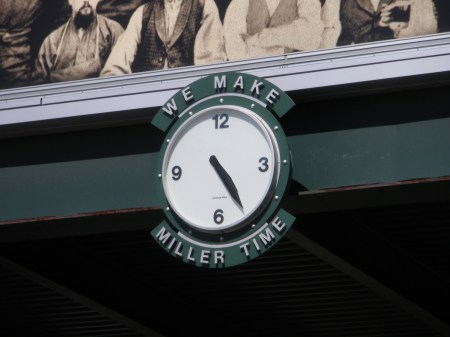
You tour the Miller Brewing plant.  Free tours, off of State Street (where is Plank Road?).

The gift shop and start of the tour have a good timeline of Miller’s history, which now should be a simple case study in an business history text.  There’s a lot more corporate maneuverings that brewing in Miller’s history.  One guy on the tour seemed unhappy that Miller is South African-owned.

Gotta run.  Maybe a story about the fight at the game later — among the fans, not on the field  (Brewers lost).

Clock on State Street, Miller Valley, Milwaukee, Wisconsin

Clock on State Street, Miller Valley, Milwaukee, Wisconsin


Millard Fillmore and March 8: Hurrah! and R.I.P.

March 8, 2009

Commodore Matthew C. Perrys squadron in Japan, 1854 - CSSVirginia.org image

The Black Ships — Commodore Matthew C. Perry’s squadron in Japan, 1854 – CSSVirginia.org image from Gleason’s Pictorial Drawing Room Companion, Boston, May 15, 1852 (also, see BaxleyStamps.com); obviously the drawing was published prior to the expedition’s sailing.

On March 8, 1854, Commodore Matthew C. Perry landed for the second time in Japan, having been sent on a mission a year earlier by President Millard Fillmore.  On this trip, within 30 days he concluded a treaty with Japan which opened Japan to trade with the U.S. (the Convention of Kanagawa), and which began a cascade of events that opened Japan to trade with the world.

Commodore Matthew C. Perry in 1852 photograph, Library of Congress via WikiMedia

Commodore Matthew C. Perry in 1852 photograph, Library of Congress via WikiMedia

Within 50 years Japan would come to dominate the seas of the the Western Pacific, and would become a major world power.

1854 japanese woodblock print of U.S. Navy Commodore Matthew C. Perry. Peabody Museum: The characters located across the top read from right to left, A North American Figure and Portrait of Perry. According to the Peabody Essex Museum, this print may be one of the first depictions of westerners in Japanese art, and exaggerates Perrys western features (oblong face, down-turned eyes, bushy brown eyebrows, and large nose).  But compare with photo above, right.  Peabody Museum holding, image from Library of Congress via WikiMedia

1854 japanese woodblock print of U.S. Navy Commodore Matthew C. Perry. Peabody Museum: “The characters located across the top read from right to left, ‘A North American Figure’ and ‘Portrait of Perry.’ According to the Peabody Essex Museum, ‘this print may be one of the first depictions of westerners in Japanese art, and exaggerates Perry’s western features (oblong face, down-turned eyes, bushy brown eyebrows, and large nose).'” But compare with photo above, right. Peabody Museum holding, image from Library of Congress via WikiMedia

Then, 20 years later, on March 8, 1874, Millard Fillmore died in Buffalo, New York.

The Perry expedition to Japan was the most famous, and perhaps the greatest recognized achievement of Fillmore’s presidency.  Fillmore had started the U.S. on a course of imperialistic exploitation and exploration of the world, with other expeditions of much less success to Africa and South America, according to the story of his death in The New York Times:

The general policy of his Administration was wise and liberal, and he left the country at peace with all the world and enjoying a high degree of prosperity. His Administration was distinguished by the Lopez fillibustering expeditions to Cuba, which were discountenanced by the Government, and by several important expeditions to distant lands. The expedition to Japan under Commodore Perry resulted in a favorable treaty with that country, but that dispatched under Lieut. Lynch, in search of gold in the interior of Africa, failed of its object. Exploring expeditions were also sent to the Chinese seas, and to the Valley of the Amazon.

Here we are in 2013, 160 years after the end of Millard Fillmore’s presidency, 159 years after Commodore Perry’s success on the mission to Japan Fillmore sent him on, 139 years after Millard Fillmore’s death, and not yet have we come to grips with Fillmore’s real legacy in U.S. history. Most of that legacy, we don’t even acknowledge in public. Santayana’s Ghost paces nervously.


Eye on Yellowstone: Earthquake swarm’s second round

January 10, 2009

More mostly small, less-than-3.0 magnitude earthquakes rumbled the Yellowstone Caldera, with a shift in location.

While not exactly an everyday event, still “not uncommon.”  Scientists are just watching, and they detect no other signs of an imminent eruption.

Here’s the note as of about 5:00 a.m. January 10, Central time, from the Yellowstone Volcano Observatory (YVO):

YELLOWSTONE VOLCANO OBSERVATORY INFORMATION RELEASE
Friday, January 9, 2009 19:44 MST (Saturday, January 10, 2009 02:44 UTC)

YELLOWSTONE VOLCANO (CAVW#1205-01-)
44.43°N 110.67°W, Summit Elevation 9203 ft (2805 m)
Volcano Alert Level: NORMAL
Aviation Color Code: GREEN

Small Earthquake Swarm on 9 January 2009 near northeast corner of Yellowstone Caldera

A currently modest swarm of earthquakes began in the northeast corner of the Yellowstone Caldera, about 10 miles (16 km) NNE of the north end of the Yellowstone Lake swarm that was active in late December and early January. As of 1930 MST, 10 earthquakes had been located by the University of Utah Seismograph Stations, the largest with M= 3.3 and two other events with M >2.0. Located depths are between 2 and 4 km.

Yellowstone Volcano Observatory staff and collaborators are analyzing the data from this and from the earlier Yellowstone Lake swarm and are checking for any changes to the thermal areas located near the epicenters. We will provide further information as it becomes available.

—–
The Yellowstone Volcano Observatory (YVO) is a partnership of the U.S. Geological Survey (USGS), Yellowstone National Park, and University of Utah to strengthen the long-term monitoring of volcanic and earthquake unrest in the Yellowstone National Park region. Yellowstone is the site of the largest and most diverse collection of natural thermal features in the world and the first National Park. YVO is one of the five USGS Volcano Observatories that monitor volcanoes within the United States for science and public safety.

It’s winter in Yellowstone, a great time to go.  It’s the best time to go, my Yellowstone-obsessed brother would say.  A swarm of earthquakes means you’ll have something to talk about at breakfast before taking your camera out to get once-in-a-lifetime shots of nature.

Earthquakes are normal in much of the Rocky Mountains, and in much of the rest of the Intermountain West.  My mother used to enjoy quietly sipping coffee at the stove in her kitchen in Pleasant Grove, Utah, and saying “Oh. We’re having another earthquake.”  She’d watch the power and telephone wires, which formed neat sine waves during quakes.

Experts are watching, and probably sipping their coffee, too.

.”]Image 1. Yellowstone Lake showing location and times of the recent earthquakes from Dec. 27, 2008 (blue) to Jan. 8, 2009 (red). The M 3.0 and greater earthquakes are shown as stars, the smaller earthquakes are shown as circles. During the swarm, the earthquake locations appear to have moved north. For more information on the depths of the earthquakes, see the cross section from X to X below. Click on the image for a full-size version.

See resource lists at earlier MFBathtub posts:


Typewriter of the moment: Australian journalist Ron Boland, OBE

December 27, 2008

1930s era typewriter that accompanied Australian journalist Ron Boland through his journalistic career - State Library of South Australia (on loan from Jasin Boland)

1930s era typewriter that accompanied Australian journalist Ron Boland through his journalistic career, a Remington Portable - State Library of South Australia (on loan from Jasin Boland)

Ron Boland played an important role in the expansion and maturation of Australian newspaper journalism in the 20th century — in the era before Rupert Murdoch, mostly – though Boland worked for Murdoch and could be said to have created the style that made Murdoch rich — in an era when newspapers still set the pace of the Information Age.  He retired in 1977, the year Altair was a top computer name, the year RadioShack almost got the TRS-80 to market, the year Jobs and Wozniak started work on the Apple II (before Macintosh).

For nearly 50 years, this typewriter was the peak of technology, for a world class journalist.

Boland’s life and timeline could make for some interesting projects or study assignments — see Boland’s campaign for topless swimming on Australia’s beaches.  Topless swimming for men.

Boland’s work is probably mostly invisible to American students, but it should provide some good enrichment for students of world history.

The case for Australian journalist Ron Bolands Remington Portable typewriter, testifying to the globe trotting done by the typewriter, and Boland.  State Library of South Australia

The case for Australian journalist Ron Boland's Remington Portable typewriter, testifying to the globe trotting done by the typewriter, and Boland. State Library of South Australia

Resources

Read the rest of this entry »


Historic winds of December

December 17, 2008

In English, it’s just one letter difference between “winds” and “wings.”  An encore post, commemorating one historic event from December 17 involving both winds and wings:

December 17, written in the wind

Wright Bros. flyer at Kittyhawk, first flight

Photo from Treasures of the Library of Congress; “First Flight” by John T. Daniels (d. 1948); this is a modern gelatin print from the glass negative.

Ten feet in altitude, 120 feet traveled, 12 seconds long. That was the first flight in a heavier-than-air machine achieved by Orville and Wilbur Wright of Dayton, Ohio, at Kittyhawk, North Carolina, on December 17, 1903.

From the Library of Congress:

On the morning of December 17, 1903, Wilbur and Orville Wright took turns piloting and monitoring their flying machine in Kill Devil Hills, North Carolina. Orville piloted the first flight that lasted just twelve seconds. On the fourth and final flight of the day, Wilbur traveled 852 feet, remaining airborne for 57 seconds. That morning the brothers became the first people to demonstrate sustained flight of a heavier-than-air machine under the complete control of the pilot.

No lost luggage, no coffee, no tea, no meal in a basket, either.

Resources on the Wright Brothers’ first flight:


Typewriter of the moment: Sheryl Oring, and “the next president”

December 14, 2008

Sheryl Oring at her typewriter, collecting messages from Americans to the next president.

Sheryl Oring at her typewriter, collecting messages from Americans "to the next president."

Remember Sheryl Oring?  In the spring of 2008 she was wandering the nation with her typewriter and portable table in tow, typing out postcards to “the next president” from people she found in public spaces willing to share their hopes for the next presidential administration.

Five weeks away from the inauguration of Barack Obama, I wonder what Oring’s postcards could tell us?  Where is she now?

Check out her website, I Wish to Say.  Maybe your classroom could support a similar project from your students.  What do these cards tell us about Americans?  What do they tell us about our electoral process?  What do they tell us about our hopes and fears?  DBQ, anyone?

One of several thousand postcards from Americans, collected by Sheryl Oring (and typed by her) to send to the next president -- who we now know will be Barack Obama.

Two of several hundred postcards from Americans, collected by Sheryl Oring (and typed by her) to send to "the next president" -- who we now know will be Barack Obama.

Many of the postcards will be on display through January 25, 2009, at the McCormick Foundation‘s Freedom Museum in Chicago.  Admission is free.

In comments, tell us what you would have told Oring to put on a postcard from you.

Resources:


Snow photos

December 13, 2008

Forecast is 70 degrees in Dallas on Sunday.

Meanwhile, Catherine Sherman has some photos of snow near Kansas City.  Nice stuff. (I don’t have her permission to copy the photo here — go see her blog.)

I particularly like her photo of the river birch tree.  It appeals to the botanist that still survives within me, plus it gives me hope about the proliferation of electronic cameras and the mass recording of things of interest to science.

Sherman writes that Kansas is the only state which has no native pines.  Is that accurate?  Does that count include Hawaii?  (What are the native pines of Hawaii?)

In short, it’s really cool.