Ike, armadilloes, and a Texas send off

September 14, 2008

Younger son James is on his way to Wisconsin and college.  Assuming Texas is as sad as his mother about it, it has some odd ways of showing it.

Some time Wednesday or Thursday an armadillo, the quintessential Texas critter,  crawled into the bushes and undergrowth outside the front door, and died.  By Thursday night it had made its presence known.

James mowed the lawn in one last show of good deeds before he left, but in order to survive that section of the yard the ‘dillo influenced, he had to find and dispose of the corpse.  A dead armadillo (wounded by an auto?) isn’t the same as a horse’s head in your bed, but it makes you wonder.

Then, James and his mother drove out Saturday morning, just after the first arms of Hurricane Ike reached our area.  They drove in rain all day, but most of the rain was from a Pacific tropical depression.  They had left Ike behind, they hoped.

This morning they awoke in St. Louis to discover Ike had caught up with them.  For most of their drive to Appleton, Wisconsin, they’ll have Hurricane Ike cleaning the windshield for them.

James is the only native-born Texan in the family.  What is Texas trying to say?


Happy birthday, H. L. Mencken

September 12, 2008

Born in Baltimore, Maryland, September 12, 1880:  Henry Louis Mencken.

H. L. Mencken at his piano, 1942.  Photo from the Library of Congress collection

H. L. Mencken at his piano, 1942. Photo from the Library of Congress, via Gibbons

Mencken is the guy who invented the Millard Fillmore bathtub hoax.

As a quintessential curmudgeon, Mencken took a cynical pose on many issues.  Why?  His creed explains:

Mencken’s Creed

I believe that religion, generally speaking, has been a curse to mankind – that its modest and greatly overestimated services on the ethical side have been more than overcome by the damage it has done to clear and honest thinking.
I believe that no discovery of fact, however trivial, can be wholly useless to the race, and that no trumpeting of falsehood, however virtuous in intent, can be anything but vicious.
I believe that all government is evil, in that all government must necessarily make war upon liberty…
I believe that the evidence for immortality is no better than the evidence of witches, and deserves no more respect.
I believe in the complete freedom of thought and speech…
I believe in the capacity of man to conquer his world, and to find out what it is made of, and how it is run.
I believe in the reality of progress.
I – But the whole thing, after all, may be put very simply. I believe that it is better to tell the truth than to lie. I believe that it is better to be free than to be a slave. And I believe that it is better to know than be ignorant.

The Mencken Society in Baltimore plans a commemoration of Mencken at the Enoch Pratt Free Library, on Saturday, September 13, 2008, starting at 10:00 a.m.

It would be a great day to be in Baltimore.


Frozen North economics: Where supply, demand and distribution are important problems

September 6, 2008

Especially you economics teachers, look at this very carefully:

Six cans of juice, at a store on Baffin Island - photo from Tales from the Arctic

Six cans of juice, at a store on Baffin Island - photo from Tales from the Arctic

How much do you pay for juice at your local market?

“The High Cost of Northern Living” at Arctic Economics points to Tales from the Arctic and “Believe me now?”

How much per ounce?

Kennie (at Tales from the Arctic) features a bunch of unbelievable prices.  Getting goods to towns in the far north of North America, in Canada and Alaska, is a major production.  Transportation and handling kick prices up a bit.

We’ll find out how alert Sarah Palin is when somebody asks her the price of a gallon of milk . . .

More seriously, economics teachers might find some object lessons in these photos, and a good presentation on supply and demand, and the costs of distribution.

Milk at $8.50 a gallon? Even in Canadian currency, that burns.

I wonder:  Do prices like these make economics any easier to teach to high school kids?  Does the urgency of high prices make the subject more relevant?

Tip of the frozen scrub brush to Arctic Economics, of course.


Rapping physics in the Bathtub

September 3, 2008

Now it’s gone big time, with NPR’s Morning Edition and Pharyngula on the bandwagon, remember you saw the Large Hadron Collider Rap second here at Millard Fillmore’s Bathtub.

You saw it first at Tommaso Dorigo’s A Quantum Diaries Survivor.

Geography teachers, have you figured out how to use this in your classrooms yet?

Related NPR stories:


Lost expedition? Where’s the photos of the “new” Peruvian waterfall?

August 28, 2008

You’d think someone like National Geographic Society would hustle down there to find it.

Whatever happened to the expedition that took off on the trek to photograph what was rumored to be a world-class waterfall newly discovered in Peru?  The cataract was rumored to be among the world’s tallest.

Perhaps a reader who reads Spanish might find some news in the South American newspapers.  Has anyone seen any news?


Typewriter of the moment: Will Rogers

August 25, 2008

Will Rogers and his typewriter, WillRogers.com

Will Rogers and his Remington typewriter, Will Rogers Memorial Museums, Claremore-Oolagah, Oklahoma

Caption from the Will Rogers Museums:

Daily writing
It didn’t matter where Will Rogers was when it was time to type his daily telegram. He just pulled out his trusty typewriter — in the car, on the movie set or in his home office overlooking the mountains of his Santa Monica ranch.

Rogers’ newspaper columns were carried by newspapers across America — 500 of them. His influence as an observer of the American condition was wide and deep.

See also this previous post about Will Rogers, for more resources.


Yo! History and geography teachers: Free state maps!

August 23, 2008

In the summer of my 8th year, after my uncle, Roland Christian*, sent me his collection of “official” state maps from his latest cross-country drive, several of us kids tried to collect maps of all 50 states. Considering we were in Burley, Idaho, it’s amazing that we could accumulate 36 different states, just by our badgering local gasoline stations for the free ones. We got on our bicycles and visited the stations, one after the other.

Free educational materials: A memory from a distant past.

I haven’t seen a free map from a gas station in years, maybe two decades. My love of geography, my love of chasing odd city names, strange routes, great sights, and history, was spurred by that map collection, I’m sure.

Today, though oil companies have gotten out of the tourism and driving promotion business, state tourism offices, or state road departments typically issue free maps. How to find them all?

To the rescue comes Less Than a Shoestring, with a list of the places to ask in each state, to get a free road map of the state. These maps are great helps for students doing a “project” on a different state. For the history class on your own state, if your school offers such a course, I think such maps are indispensable.

We teach Texas state history and geography in 7th grade. When I taught that course, one of the best classroom aids I had was a collection of the official map of Texas — a year old, but I got a couple dozen copies from the state’s tourism promotion group. They were anxious to get rid of the old maps, and I was very happy to have them.

Here’s something curious: The site, Less Than a Shoestring,  doesn’t list a place to get a map from the District of Columbia — Washington, D.C. You’d think that a town that depends so much on tourism would have an office to promote tourism that would pass out maps to make tourists’ trips easier. Is this just an indication of the great dysfunction of the D.C. government, or did we miss finding the site? Let me know in comments.

Tip of the old scrub brush to the Business Blog @ Capital Active.

____________________________

* Uncle Roland was a minister for the 7th-Day Adventists, and he traveled to preach around the country. Stuck in a small Idaho town for my first nine years, I thought Roland was a great world traveler. He always stopped to spend a night when he was within a state or two — he was a minister trying to travel on a shoestring, after all — and with his wonderful, deep, preacher’s voice, he had wonderful stories to tell. I miss him still, more than two decades after his death. Which of your nieces and nephews can you influence as Roland did?

Read the rest of this entry »


Spectacular waterfall discovered in Peru – adventurers off to document it

August 16, 2008

Gocta was unknown until a few years ago — to the outside world. Local Peruvians knew about it, but said little. Gocta turned out to be the third highest waterfall in the world

Lightning has struck Peru again: A week ago an expedition left paved-road civilization to document another very high waterfall, perhaps higher than Gocta, whose existence was only recently discovered, outside of local residents — who said nothing because they feared the reaction of the outside world, or they just didn’t think that anyone else would be particularly interested. The expedition includes “representatives of the sub-regional direction of Bagua Grande and Utcubamba, from Utcubamba’s National Institute of Culture, a topographer of the provincial municipality and a cameraman.”

Perus Gocta, the third-highest waterfall in the world - Alberto Pintado photo

Peru's Gocta, the third-highest waterfall in the world - Alberto Pintado photo

A local explorer, Obed Cabanillas Silva, who seems to be coordinating local efforts to make the cataract known, said there are “stone structures” on the path to the waterfall. Could there be undiscovered, uncharted ruins of former How does the rest of the world miss a waterfall higher than a 250-story building? Here’s a Google Earth challenge — how many other giant waterfalls are there in Peru, “undiscovered” by the rest of the world? Remember the recent discovery of an impact crater in Australia?

The expedition of “discovery” set off a week ago — can you beat them to the thing, on Google Earth, or with any other LandSat image? (The few pieces of data on the specific location I have are at the bottom of this post.)

Gocta itself came to light in 2005 when a German engineer working on a water project close by, persuaded the Peruvian government to survey the uncharted, unnamed waterfall. When the surveyors came back with a report the thing was 2,532 feet hight, the German, Stefan Ziemandorff, checked his National Geographic Guide, figured it was third largest in the world, and had the good sense to call a press conference to let everyone else know. (Ziemandorff first heard of the cataract in 2002.)

World Waterfall Database is more picky. They rank Gocta at #16 right now — something about free fall, flow amounts, other measures.

The discovery of Gocta produced documentation of other spectacular water features nearby, Catarata Yumbilla (870 m) and Cataratas la Chinata (580 m). One might wonder about what methodical search of the area might find.

Read the rest of this entry »


Government and civics class manipulables

August 13, 2008

Be sure to check out the customer comments, too.

I was looking for lesson plan ideas for government class. With my background in airline and airport management, this one just jumped out at me.

If only it were just fantasy for kids.

If only it were just fantasy for kids.

It may be useful for customer service classes and corporate training, too.

Big, wet and bubbly tip of the old scrub brush to This One Goes to Eleven.


Leonidas and the 300: died August 11, 480 B.C.

August 12, 2008

300 popped up on some channel last night, and we got a time delay recording to watch it, which I did, mostly.  Interesting stylization.  Cartoonish characterizations, which one should expect from a movie intended as homage to the graphic novel that directly spawned it.

A monument to Leonidas I - Inscription, Molon Lave, which roughly translates to Come and get it!

A monument to Leonidas I - Inscription, "Molon Lave," which roughly translates to "Come and get it!"

Several sources dated the climax of the battle as August 11, 480 B.C. — 2488 years ago yesterday. (The battle is said to have occurred during the Olympics that year, too.)

World history classes dig through that period of history in the first semester.  Teachers, it’s time to think about how we’re going to facilitate this history this year.  As always, some bright student will wave a hand in the air and ask, “Mr. Darrell!  How do they know what happened if no one survived, and nobody had their Sony videocorder?”

At least one other student in the course of the day will be surprised to discover the movie wasn’t a filmed-on-the-spot documentary.  But apart from that, how do we know the events well enough to pin it down to one day?  And, since the Greeks surely didn’t use the Gregorian calendar, since it wasn’t invented until the 18th century — how do we know the date?

The short answer is “Herodotus.”  The longer answer may resonate better:  This is one dramatic battle in a year-long fight for the history of the world.  The Greeks were understandably and justifiably proud that they had turned back Xerxes’s armies and navy (The Battle of Salamis, a bit after Thermopylae).  So, these events were preserved in poetry, in the chronicles, in song, in sculpture, and in every other medium available to the Greeks.  Your AP English students will probably tell you the movie reminds them of The Iliad.  There’s an entré for discussion.

Turning points in history:  Had Xerxes succeeded in avenging his father’s, Darius’s, defeats, and subjugated the Greeks, history would be much different.  The culture the Romans built on, the trading patterns from east to west and around the Mediterranean, the technologies, the myths, and the stories of the battles, would be different. (Remember, one of Darius’s defeats was at the Battle of Marathon, from which we get the modern marathon racing event, the traditional close of the modern Olympics.)

How do we know?

How do you handle that question?  Tell us in comments, please.

Resources and commentary on Thermopylae, Leonidas, and the 300:


In the Utah desert, a GPS is no substitute for common sense

August 10, 2008

A cardinal rule of driving the western U.S. is this: Don’t head off through the mountains or desert without knowing how you’re going to get back, or get to the next smattering of civilization.

Why? Old friend Peter B. Pope once trekked a chunk of Wyoming with another friend, and they had a bit of an altitude sickness scare. After three days above 9,000 feet, they realized they needed to get down, and that was a problem — miles of hiking. Help?

They picked that area of Wyoming to hike because the USGS topographical map showed no roads at all in that section. Real adventure territory. The only way to get help was to get out, and what they needed, really, was just to get out.

Or, consider the sign that used to greet travelers leaving Green River, Utah, going west on U.S. Highway 50: “No services for next 140 miles.” I once stopped to help a guy who had run out of gas 42 miles into that stretch. He confessed he’d seen the sign, but thought a bit less than a quarter-tank of gas in his old gas guzzler would do it. It hadn’t occurred to him it also meant no food or water, or towns, or telephones (I wonder if that road has cell coverage now). He was thinking of walking back for gas. 42 miles. It was well over 100°. I’m sure the highway patrol could have found him before he died.

Maps help. A compass is good. Having the skills of a First Class Boy Scout to use the map and compass together also benefits travelers.

If you have a compass, you still need a map; if you have a GPS, you still need to know whether the roads are passable. In short, you need to know where you’re going, how to get there, and whether you have the equipment to make the trip.

Comes this story from the Associated Press, in USA Today, about a “convoy” of people who thought they’d use a GPS to navigate the back country from Bryce Canyon National Park to the Grand Canyon. The only appropriate response is the one Will Smith’s character gave the woman whose husband had been killed so his skin could be used as a disguise by a giant interstellar cockroach in “Men In Black.” He said: “I mean . . . damn!”

Old friend, John Hollenhorst’s story of the incident on KSL-TV (Channel 5) carries pictures and maps that show just how foolish is the assumption that “a GPS and a cell phone are all they need to get by.”

Vodpod videos no longer available.

more about “ksl.com – Deputies rescue tourists lo…“, posted with vodpod

(KSL ought to let Hollenhorst play the expert on this story — he’s an Eagle Scout and once was an accomplished outdoorsman himself, perhaps still is.)

The group took off heading south from Grosvenor Arch, a natural arch south of the National Geographic-named Kodachrome Basin State Park. To get to Kodachrome Basin, you travel ten miles on unpaved roads. Going south out of Kodachrome Basin to Grosvenor Arch, you find the roads get less well-maintained. The maps show nothing but dirt roads, though some maps show a rather major dirt road that connects with Highway U.S. 89 east of Kanab, Utah, on the way to Page, Arizona. Most highway maps probably don’t convey the reality of the situation. This is the landscape you find:

White Cliffs in the Grand Staircase/Escalante National Monument (BLM photo)

White Cliffs in the Grand Staircase/Escalante National Monument (BLM photo)

It’s not exactly friendly to non-four-wheel-drive vehicles. It’s not friendly to any vehicle.

You don’t see a lot of roads in the 50 or 70 miles you can see, either. Roads that go through that area are unpaved, often unauthorized, and shouldn’t be on any map. Hollenhorst painted the scene:

The Californians ventured into one of the roughest and most remote landscapes in the United States. They believed their GPS unit would lead them back to a paved highway. They wound up desperately calling relatives in California in the middle of the night.

Yes, Virginia — and New York, and California — there really are places like that in America.

One relative, Esther Lahiji, said, “They ran out of gas and they lost their way. It was dark at night. And thank God they could charge their cell phones in their cars.”

The convoy of four vehicles, containing 13 adults and 10 children, had visited Bryce Canyon and Kodachrome Basin. But it left pavement to visit Grosvenor Arch. Using a GPS unit, they tried to reconnect to a paved road far to the south. But they got lost in a network of dirt roads, which Kane County Sheriff Lamont Smith says often lead nowhere.

“Those little spurs, those little dirt sandy spurs go out to the cliffs and dead-end,” he said.

With one vehicle stuck in sand and others running out of gas, they couldn’t go back. And heat was an issue, especially for the children.

The group stumbled into an area with cell phone coverage skipping from a distant tower — an area of accidental coverage (weather can change such coverage patterns — they are hit and miss, at best). They were able to phone for help.

After they called for help by cell phone, rescuers delivered food, water and gasoline and escorted them out.

Sheriff Smith says tourists just shouldn’t rely on a GPS unit in such rugged country.

“If you go off the pavement, you either need to ask the locals where the road goes or which roads to take, or else just stay on the paved roads, because a lot of these roads just don’t go anywhere,” he said.

Need we say it? Out there, one may not find locals to talk to. Last time Kathryn and I visited Kodachrome Basin, there were no other parties camping there — in August, at the height of the tourist season. South of the park? Are you serious? (We didn’t visit Kodachrome this summer.)

From Grosvenor Arch, to get to the Grand Canyon, go north back to Utah State Road 12; it’s about 20 miles. Then go east, through Tropic, Utah, and past the entrance to Bryce Canyon National Park to U.S. Highway 89 (about 30 miles). Highway 89 south to Kanab is another of the most spectacular drives in America, through miles and miles of millions of years of petrified sand dunes — white, red, ochre, maroon, purple and chocolate cliffs, juniper-pinyon desert, pink sands, green cottonwoods, and nice paved roads.

You can stop for coffee in Kanab, in the afternoon at a book/outdoors outfitter/coffee shop, Willow Canyon Outdoor (we stopped three different days — it’s a great cup of good coffee in an area more than 200 miles from the nearest Starbucks; which Starbucks may have the New York Times, Willow Canyon will have the latest High Country News to read; we picked up a couple of CDs of Beethoven for the drive, and had I had more sense, I could have gotten some good trekking poles there).

From Willow Canyon Outdoor, it’s about 40 miles to where that dirt road from Bryce Canyon enters U.S 89, if you survive the drive. It’ll take you two to three hours to make the drive and get coffeed up on paved road if you take the long way — this group from California spent several times that amount of time, and risked their lives.

Paved roads, great scenery, good coffee, nice drive, or you can eat dust and threaten your life. You choose.

Resources:


Disaster at Arches National Park

August 10, 2008

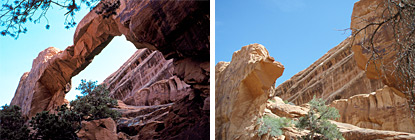
Wall Arch, 12th largest, one of the better-known and most-seen natural arches in Arches National Park, Utah, collapsed.

Wall Arch, before and after collapse - National Park Service photos

Wall Arch, before and after collapse – National Park Service photos

“Not being a geologist, I can’t get very technical but it just went kaboom,” [Arches NP] Chief Ranger Denny Ziemann said. “The middle of the arch just collapsed under its own weight. It just happens.”

Wall Arch, located along the popular Devils Garden Trail, was 71 feet tallwide and 33 1/2 feet widetall, ranking it 12th in size among the known arches inside the park. Lewis T. McKinney first reported and named Wall Arch in 1948.

No one reported observing the arch collapse and there were no visitor injuries, the National Park Service said.

Read the report from the Salt Lake Tribune.

Some tourist on Sunday, August 3, or Monday, August 4, got the last photograph of Wall Arch still standing. Was it you? Were you close? Give us a shout in the comments if so.

Other resources:

x

Other blogs and later reports:


63rd anniversary: Hiroshima, August 6; Nagasaki, August 9

August 9, 2008

63 years ago, U.S. military action brought a quick close to hostilities without an invasion of Japan, with the detonation of two atomic bombs, one over Hiroshima on August 6, 1945, and one over Nagasaki on August 9.

Daily Yomiuri Online carried a description of memorial events in Hiroshima today, from Yomiuri Shimbun:

NAGASAKI–The Nagasaki municipal government held a ceremony Saturday marking the 63rd anniversary of the atomic bombing of the city, at which participants called for the abolition of all nuclear weapons.

A total of 5,650 A-bomb survivors, representatives of victims’ families from around the nation and Nagasaki citizens participated in the ceremony. Prime Minister Yasuo Fukuda also attended the ceremony, which was held in Nagasaki Peace Park near ground zero.

Nagasaki Mayor Tomihisa Taue read out the Nagasaki Peace Declaration, which urges the worldwide abolition of nuclear weapons.

“Human beings have no future unless nuclear weapons are eliminated. We shall clearly say no to nuclear weapons,” Taue said.

The ceremony started at 10:40 a.m. Three books listing the names of 3,058 people confirmed to have died as a result of the bombing in the past year were placed inside a memorial box in front of the Peace Statue.

The total number of books listing the names of the deceased is 147, and the number of names is 145,984.

Representatives of surviving victims, bereaved families, the prime minister and Hiroshima Mayor Tadatoshi Akiba placed flowers at the site.

At 11:02 a.m., the time the atomic bomb struck, ceremony participants offered a silent prayer. At the same time, local high school students rang the Bells of Nagasaki.

In the peace declaration, Taue read from an academic paper written by four people, including a former U.S. secretary of state, which promoted a new policy for developing nuclear weapons. The proposal encouraged countries to ratify the Comprehensive Test Ban Treaty. The mayor said world nuclear powers “should sincerely fulfill their responsibility of nuclear disarmament,” and urged the government to pass the three nonnuclear principles into law.

This year also marks the 100th anniversary of the birth of Takashi Nagai, a medical doctor who helped rescue of victims after the bombing.

The mayor referenced one of the doctor’s remarks, saying: “There are no winners or losers in a war. There is only destruction.”

Shigeko Mori, 72, representing survivors of the bombing, read out an oath for peace that said Japan should promote its Constitution and the three nonnuclear principles to the rest of the world to prevent nuclear proliferation.

Fukuda gave a speech, saying, “Japan should play a responsible role in the international community as a nation cooperating for peace.”

(Aug. 10, 2008)

Other information:

Other related posts at Millard Fillmore’s Bathtub:


Alpine Loop? Try Utah’s, gentler, prettier than Colorado’s

August 6, 2008

Utah’s canyons have so many pretty spots. Taking visitors through them I always heard about how no one expected such beauty in the desert. So I was excited to see the headline in Sunday’s Dallas Morning News about taking the Alpine Loop.

Autumn aspens in Utahs Alpine Loop - Wikimedia photo

Autumn aspens in Utah's Alpine Loop - Wikimedia photo

Prettiest drive you can make in a day. Start out in American Fork, head up American Fork Canyon, cross over to the backside of Mt. Timpanogos — you’ll see aspen, pines, fir, some of the prettiest streams you’ve ever seen anywhere. Some years back the Utah Travel Council had a spectacular poster showing the colors in the fall — about five shades each of red, gold and green, aspen and cottonwoods against the balsam and Douglas fir and a few scattered pines. Stop and hike up to Timpanogos Cave National Monument. See where the glacier was on the east side of Timpanogos.

End up passing Robert Redford’s Sundance Ski Resort, and down Provo Canyon (when I skied there it was $6.50 for a full-day pass; have the rates gone up?) — finish up with dinner in a good restaurant in Provo (or drive the 36 miles back to Salt Lake City and have world-class sushi at Takashi).

Alas. The article was about Colorado’s Alpine Loop. Who knew Colorado even had one by that name?

I suspect the Colorado version is less-traveled. The author took a four-wheel-drive vehicle.

Utah Travel Council photo of the Alpine Loop showing some of the autumn colors -- not the great shot from the long-ago poster, alas.

Utah Travel Council photo of the Alpine Loop showing some of the autumn colors -- not the great shot from the long-ago poster, alas.

Utah’s Alpine loop is paved the entire way, closed maybe only during a winter of very heavy snow. If you’re just passing through, you can do the drive in three hours or less, easily. If you have a day, grab a picnic, and spend some time stopping to enjoy the mountains.

(Go see Rich Legg’s photos of the east side of Timpanogos, here.)

Some time I’d like to check out the Colorado version. Odds are that I’ll be back in Utah County before then, however, and odds are you’ll be closer to the Utah version than the Colorado version, too.

You know the old saying about “take time to stop and smell the balsam, and ooh and aah at the aspen?” The Alpine Loop is what the aphorist was thinking about. Theodore Roosevelt would have gone there, had he known about it. You know about it now.

Windleys Google map of Utahs Alpine Loop, around Mt. Timpanogos

Windley's Google map of Utah's Alpine Loop, around Mt. Timpanogos


Montauk “monster?” No, it’s a raccoon

August 5, 2008

Darren Naish at Tetrapod Zoology did the scientific work any RKSI person ought to do, and identified the carcass that washed up on a beach in Montauk, New York, as a poor old raccoon.  (“RKSI?”  Road Kill Scene Investigator — though maybe this should be “Beach Kill.”)

Raccoon, Tennessee Department of Health Photo

Raccoon, Procyon lotor, Tennessee Department of Health photo

Beaches of Montauk, New York, appear to be safe.

Religionists often accuse me of having “faith” in science, and to a small degree that is accurate.  I do have faith that, much of the time, there is a rational explanation for things that at first appear magical, or to verify stories of monsters, goblins, or Republican platform planks.  Naish uses his experience in watching decomposing critters on the beach to show how to identify the creature in Montauk.  This is a powerful demonstration of the power of scientific methods:  Naish worked the issue from 3,470 miles away (about 5,585 km).

With a bit of luck the popularity of this monster story, and the resolution of the mysteries by Naish and other like-minded scientists, might inspire a few people to do the CSI-style thing, to actually study science.  One might study animal anatomy, as Naish has done, or one might apply to the University of Tennessee’s Forensic Anthropology program at the Knoxville campus.

Naish said:

Like all of these sorts of mysteries, this one was fun while it lasted, but the photos that really clinched it for a lot of people weren’t (so far as I can tell) released on the same day as the initial, tantalizing mystery photo (the one shown at the very top). And I don’t mind this sort of thing too much: we get to see a lot of dumbass speculation, sure, but the immense interest that these stories generate show that people – even those not particularly interested in zoology or natural history – have a boundless appetite for mystery animals. If only there were some clever way of better utilizing this fascination.

The truth is out there. Sometimes it helps to have a good university library and some scientific knowledge to flush it out, and flesh it out.  Students, you can become the bearer of answers you seek.

Word of the day:  Taphonomy (beyond the usual, “one more science creationists don’t do”)

Other resources:

Tip of the old scrub brush to Pharyngula, once again (so many tips there, it’s probably soaked).