Typewriter of the moment: William Faulkner in California

December 19, 2008

I love this photo.

William Faulkner (1897-1962) reclines in a chair in front of typewriter in Hollywood, California, December 1942.  Alfred Eriss/Pix Inc./Time Life Pictures/Getty Images

William Faulkner (1897-1962) reclines in a chair in front of typewriter in Hollywood, California, December 1942. Alfred Eriss/Pix Inc./Time Life Pictures/Getty Images

Read more about Faulkner at The American Masters site at PBS.

Resources:


Typewriter of the moment: Muckraker Upton Sinclair

December 17, 2008

Without typewriter, however.*

A journalist and novelist, labeled by President Theodore Roosevelt as a “muckraker,” Upton Sinclair. The caption to the Associated Press photo said it was Sinclair working on his first movie screenplay in 1943, part of his generally forgotten life in California. In fact, several of his works were made into movies.

Upton Sinclair, Los Angeles Times

Upton Sinclair, from the Los Angeles Times

* I had difficulty getting the images to work in this post.  Odd stuff kept popping up.  Then, as a reader Michael Todd gently noted, I discovered I’d used a picture of Sinclair Lewis in place of Upton Sinclair.

In working to correct the problem, I discovered no photos of Upton Sinclar with his typewriter.  So, here we have Upton Sinclair, without typewriter.  How embarrassing.


Typewriter of the moment: Sheryl Oring, and “the next president”

December 14, 2008

Sheryl Oring at her typewriter, collecting messages from Americans to the next president.

Sheryl Oring at her typewriter, collecting messages from Americans "to the next president."

Remember Sheryl Oring?  In the spring of 2008 she was wandering the nation with her typewriter and portable table in tow, typing out postcards to “the next president” from people she found in public spaces willing to share their hopes for the next presidential administration.

Five weeks away from the inauguration of Barack Obama, I wonder what Oring’s postcards could tell us?  Where is she now?

Check out her website, I Wish to Say.  Maybe your classroom could support a similar project from your students.  What do these cards tell us about Americans?  What do they tell us about our electoral process?  What do they tell us about our hopes and fears?  DBQ, anyone?

One of several thousand postcards from Americans, collected by Sheryl Oring (and typed by her) to send to the next president -- who we now know will be Barack Obama.

Two of several hundred postcards from Americans, collected by Sheryl Oring (and typed by her) to send to "the next president" -- who we now know will be Barack Obama.

Many of the postcards will be on display through January 25, 2009, at the McCormick Foundation‘s Freedom Museum in Chicago.  Admission is free.

In comments, tell us what you would have told Oring to put on a postcard from you.

Resources:


Typewriter of the moment: Poet Edgar Guest

November 21, 2008

Poet and columnist Edgar Guest, in Detroit, 1939; photo for Life Magazine by Bernard Hoffman

Poet and columnist Edgar Guest, in Detroit, 1939; photo for Life Magazine by Bernard Hoffman

Archives of Life Magazine have been opened and made available for purchase, on Google, by Time-Warner.  The archives contain nice surprises like this photograph of popular poet Edgar Guest, at his typewriter in Detroit, in 1939. (You may browse the archives on Google by searching for a topic, and inserting into your search line, “source:life.”)

Guest published his first poem in the Detroit Free Press in 1898.  Between then and his death in 1959, he wrote and published more than 11,000 poems, syndicated to hundreds of newspapers.

Tip of the old scrub brush to Pseudo-Polymath.


Typewriter of the moment: Will Rogers

August 25, 2008

Will Rogers and his typewriter, WillRogers.com

Will Rogers and his Remington typewriter, Will Rogers Memorial Museums, Claremore-Oolagah, Oklahoma

Caption from the Will Rogers Museums:

Daily writing
It didn’t matter where Will Rogers was when it was time to type his daily telegram. He just pulled out his trusty typewriter — in the car, on the movie set or in his home office overlooking the mountains of his Santa Monica ranch.

Rogers’ newspaper columns were carried by newspapers across America — 500 of them. His influence as an observer of the American condition was wide and deep.

See also this previous post about Will Rogers, for more resources.


Typewriter of the moment: Ian Fleming, the man with the golden typewriter

July 30, 2008

Ian Fleming at his typewriter

Ian Fleming at his typewriter

[Apologies.  Several of the links in this post simply don’t work any more.  I’ve tried to make sure the photos are there. Watch for an updated post — and be sure to read the comments.]

Ian Fleming, the creator of secret agent James Bond, at his typewriter, the gold-plated one:

Gold-plated?  According to IanFlemingCentre.com:

Ian Fleming’s first biographer, John Pearson, has identified 15 January 1952 as the “birth date” of James Bond and reports that CASINO ROYALE was finished on 18 March. Andrew Lycett’s IAN FLEMING points out that Ian “may have completed the job in an even shorter time”.

Ian Fleming married Ann Rothermere on Monday 24 March in that same year and often joked that he wrote CASINO ROYALE to take his mind off the forthcoming wedding. Whatever the timing, he had left his time working in naval intelligence with the determination to write “the spy story to end all spy stories”. He was forty three, about to marry and have his first child; his ambition and his experience came together at this moment in the creation of James Bond. He rewarded himself by buying a custom-made typewriter – plated in gold.

There you have it.

Is this a close-up of that typewriter? From AtomicMartinis.com:

Ian Flemings gold-plated typewriter

Ian Fleming’s gold-plated typewriter (Formerly at Atomic Martini; James Bond Shop)

I first saw a James Bond movie in 1964, “Goldfinger.”  I spent the rest of the summer reading all the James Bond books then in paperback.  Bond adventures reflected the attitudes, tone and tension of the Cold War.  They also provided great escape for a teenager with a summer of little else to do in central Utah.

The books proved much better than the movies.  While I’ve seen most of the movies as they’ve come along, I encourage people to read the books.  The stories are different from the movies, especially the movies coming after “Goldfinger.”  The gadgets are less spectacular, but the characters and travelogues are more spectacular.

Mostly the stuff is just fun.  Bond was sort of a Harry Potter for slightly older kids, and still can be.

I have not read any of the post-Fleming Bond novels.  Does anyone recommend them?

Other Resources:


Typewriter of the moment: Douglas Adams

July 26, 2008

Here’s a typewriter you can buy. NV Books in Great Wolford, Warwickshire, offers a first edition copy of Douglas Adams’ masterpiece, The Hitch Hiker’s Guide to the Galaxy, together with the autographed typewriter upon which he wrote it:

Douglas Adams's typewriter, a Hermes Standard 8, used to write the novel, The Hitch Hiker's Guide to the Galaxy

Douglas Adams’s typewriter, a Hermes Standard 8, used to write the novel, The Hitch Hiker’s Guide to the Galaxy

It’s yours, for just $25,112.92 (Today. Exchange rates may make the price wobble a bit). Abe Books in Denver lists the advertisement in the U.S.

THE HITCH HIKER’S GUIDE TO THE GALAXY, First Edition in FINE Condition. Sold together with DOUGLAS ADAMS’ TYPEWRITER owned by Adams (whilst writing ‘Hitch Hikers’) and SIGNED IN THICK FELT PEN BY THE AUTHOR across the original casing

Description: First Edition Hardback. A mouthwatering copy of this modern classic, the dustwrapper retains all of the notoriously fugitive blue and is wholly unfaded. The front image and lettering are bright and sharp and the book overall is in exceptional condition. Sold together with A UNIQUE ARTEFACT owned by Douglas Adams in the late 1970s, his Hermes Standard 8 typewriter. This is a thrilling object to possess with a fascinating history. It is as certain as can be that Adams wrote his most famous work ‘The Hitch Hikers Guide To The Galaxy’ on this Hermes Standard 8. Aside from the supporting provenance, it still contains much evidence of his ownership and regular use. It bears an anti-apartheid sticker on one side of the object and is boldly signed across the front casing by Adams in his unmistakeable hand. It comes housed in its cardboard box which Adams used to transport it, namely packaging from Simon and Schuster, originally containing copies of Adams and Terry Jones’ collaboration ‘Starship Titanic’. An address label to Adams’ office at the Digital Village, London, remains stuck on the box too. The typewriter itself is in attractive condition to display, but is entirely unrestored and as precisely as it was when it was owned by Adams. It is frequently mentioned by all who knew him that writing was often a torment for him and as such his lateness was legendary. He once said ‘I love deadlines. I love the whoosing sound they make as they fly by’, and such was his difficulty in producing work on time that in a well-documented act of desperation his publishers once locked him in a hotel room until he typed enough pages to be let out! The keys of his typewriter all still bear the marks of Adams’ tortured labour. Significantly, the ‘x’ key is particularly discoloured. A unique piece of literary history then and a fabulous talking point, and simply the ultimate possession for a Douglas Adams fan. It is almost superfluous to mention that it is also a very secure investment for the future. A little bit about its subsequent history: Adams signed and donated the typewriter to a wildlife charity auction in 1998, and it was then kept in private hands for several years before being sold on. Adams was passionate about wildlife and in keeping with his memory (and his original intention for this item), a donation will be made to Rhino Recovery with this sale. ABOUT US: It is our philosophy at N V to provide the astute collector with high quality books for pleasure and investment, whilst offering a service that is always friendly and helpful. EVERY listing has a sharp digital image of the EXACT item(s) that you are perusing – with more photographs available on request. The accompanying description is meticulous and we guarantee that all items are authentic. Nevertheless, you are welcome to call us FREE on (0800) 083 0281 with any queries, or on +44 (1608) 674181 from overseas. In the meantime we wish you every success with your collecting. Bookseller Inventory # 000002

I can’t improve on Boing Boing’s commentary. Steampunk beat me to the story, too. (The typewriter was sold as a benefit for RHINO by Christie’s on November 30, 2005, for £2,400, about $4,100.)

Your students may not know who Douglas Adams was — Adams died prematurely in 2001, at 49, of a sudden and unexpected heart attack. He was working on the movie adaptation for Hitch Hiker’s Guide.

Douglas Adams, photo by Chris Ogle; DouglasAdams.com

Douglas Adams, photo by Chris Ogle; DouglasAdams.com

Hitch Hiker’s Guide started out as a BBC4 radio series, airing in 1978. The book version appeared shortly after that — I think I first read it in 1979, an interim year when I really lit up small corners of Utah. The book was immensely funny, very witty, and self-conscious in a way that most pure humor writing isn’t. Adams appeared to be familiar with science deeply. The jokes work on several levels. The book was popular with friends in public broadcasting who had heard the BBC4 series, and with scientists in laboratories.

One of the NPR stations in Washington, D.C., ran the series shortly after I moved there (WAMU? WETA? I forget which). Use of an Eagles instrumental for the theme caught my ear. Eagles? This series seemed blessed with the best wit, best writing, and best music.

Not so with special effects in the television series. The script was inspired, the narrative effects were fine, but special effects were of the cheesy, early-Dr. Who variety — which was okay, because it put the focus on the script and the story. And the story was the thing.

Through much of that time I was deeply involved in land management issues. We worked on wilderness, the old RARE II wilderness designation process, and segued into the Sagebrush Rebellion, where I found myself deep into rebel territory when the fighting broke out (think of Jackie Vernon’s story of being in Japan when World War II broke out; saying he didn’t really know what to do, he “became a kamikaze copilot”). Hitch Hiker’s Guide opens with Arthur Dent protesting the demolition of his house to make a path for a new thruway, with the authorities telling Dent that he had plenty of time to protest since the notice of demolition was posted in a town only a few miles away, and since he missed the protest period, he shouldn’t complain. He is “rescued” from this situation by a friend named Ford Prefect — like the little European Ford auto — who tells Arthur not to worry about the house; Ford turns out to be an alien, and he knows the Earth is about to be destroyed to make way for an inter-galactic thruway. The destruction crew notes with no irony to the Earthlings that the notice of destruction was posted on a nearby planet, and Earth simply missed the protest period. Ah. A good summary of many land management decisions.

We found comradeship with people who understood that, once a decision had been made, often the best thing to do was remember not to panic, pick up one’s towel and hitch a ride to the next venue. I would not have been much surprised to turn to the appendices of an official BLM report and see that BLM had determined the answer to be “42,” and that a study group had been appointed for further study.

42. 42 is the answer.

The Answer to Life, the Universe, and Everything is numeric in Douglas Adams‘ series The Hitchhiker’s Guide to the Galaxy. In the story, a “simple answer” to The Ultimate Question is requested from the computer Deep Thought, specially built for this purpose. It takes Deep Thought 7½ million years to compute and check the answer, which turns out to be 42. Unfortunately, The Ultimate Question itself is unknown, suggesting on an allegorical level that it is more important to ask the right questions than to seek definite answers.

Others have wondered about the number.

In the original series, Arthur Dent has a Scrabble™ game with him. At some point it mystically spells out, “What do you get if you multiply six by nine? Forty-two.”

6 times 9 is 42 — except in base-13. But as Adams himself said, he did not write jokes in base-13

I have not seen the movie.

Douglas Adams, perhaps pondering the meaning of life, and everything

Douglas Adams, perhaps pondering the meaning of life, and everything

“So long, and thanks for the fish.”

Big tip of the old scrub brush to Dr. Pamela Bumsted, who pointed this out to me.


Typewriter of the moment: Blythe Church embroiders on the theme

July 6, 2008

typewriter, originally uploaded by blueblythemonster.

Don’t have an antique Underwood? Make your own. That’s what Blythe Church did.

Her typewriter will never be used to write a novel, but it’s novel enough on its own to merit a look. It’s made from custom-dyed felt, and embroidery.

A soft answer turneth away wrath? Here’s your source of soft words, then, eh?

You can see other works by Ms. Church at her website.

Tip of the old scrub brush to boing-boing.


Typewriter of the moment: Hunter Thompson

July 2, 2008

Yes, it’s Hunter Thompson.  Yes, it’s an IBM Selectric.  No, I don’t have any other information on this photograph.


Typewriter of the moment: W. H. Auden at Swarthmore

June 25, 2008

Poet W. H. Auden taught students at Swarthmore for three years, 1942-1945. Swarthmore’s library started rather early to collect Auden’s manuscripts and other materials, including the typewriter he used there — an Underwood, as you can see, below.

Auden's typewriter during his Swarthmore years (1942-1945).

Auden’s typewriter during his Swarthmore years (1942-1945).

The library has a detailed, on-line exhibit of Auden’s work and associations with the college, material useful for student research and in-class presentations related to his work.

Auden’s poetry was contemporary, and it reflected the fears and passions of lovers, and lovers of liberty, in the face of the fascist threat of World War II.  Auden died, aged by tobacco, alcohol and barbituates, in 1973, aged 67.

Resources:

Add to FacebookAdd to NewsvineAdd to DiggAdd to Del.icio.usAdd to StumbleuponAdd to RedditAdd to BlinklistAdd to TwitterAdd to TechnoratiAdd to Furl

Save

Save

Save

Save


Typewriter of the moment: Mencken and the 1948 conventions

June 10, 2008


Mencken at 1948 Democratic Convention

Mencken at 1948 Democratic Convention

Photo from the collection of the School of Journalism and Mass Communication, at the Park Library, University of North Carolina.

H. L. Mencken at one of the 1948 political conventions (Thomas Dewey was the Republican nominee, Harry S. Truman was the Democratic nominee). Obviously the photo is a copy from the National Press Club Library. The Park Library site describes the photo and Mencken:

H. L. Mencken (1880-1956) was a familiar figure at many national political conventions. This photo, taken at the one in 1948, was his last political convention. He is well known for his attacks on American taste and culture, or the lack of same. His magnum opus, The American Language: An Inquiry into the Development of English in the United States, was first published in 1919 and remains a classic. From 1906 to 1941, he worked chiefly as a reporter, editor, and columnist for the Baltimore Sun. (Photo courtesy of the Baltimore Sun Library.)

Assuming Mencken covered both conventions, this photo was taken at the Democratic convention in Philadelphia in mid-July, 1948. We know it was taken in Philadelphia since both parties held their conventions there that year, the Republicans from June 21 to June 26, and the Democrats from July 12 to July 14.

Republicans nominated New York Gov. Thomas J. Dewey and California Gov. Earl Warren for president and vice president.

After a contentious convention that saw Minneapolis Mayor Hubert H. Humphrey propose a civil rights plank that got South Carolina Gov. Strom Thurmond to walk out of the convention and found his own States’ Rights (Dixiecrat) Party (with himself as the nominee for president), and former Vice President Henry Wallace walk out because the party platform was too conservative (Wallace ran on the Socialist Progressive Party ticket), Democrats nominated President Harry S Truman and Kentucky Sen. Alben W. Barkley for president and vice president. Truman narrowly defeated Georgia Sen. Richard B. Russell for the nomination. Had Thurmond not walked out, Truman may well have lost the nomination of his own party.

And the rest of the story?

  • Truman had a contentious second term, and was defeated in the New Hampshire primary in 1952 by Sen. Estes Kefauver; Truman ended his campaign for a second full term shortly after.
  • Earl Warren was appointed Chief Justice of the Supreme Court by Truman’s successor, President Dwight D. Eisenhower, in late 1953. Warren is remembered for engineering the 9-0 decision in Brown vs. Topeka Board of Education which ruled “separate but equal” school systems to violate the Constitution’s equal protection clause, and for his chairing the commission that investigated the assassination of President John F. Kennedy.
  • Hubert Humphrey moved on to the U.S. Senate, served as Vice President to Lyndon Johnson, and won the Democratic nomination for president in another contentious convention in 1968 in Chicago. Humphrey lost the election to Richard Nixon, and returned to the U.S. Senate two years later.
  • Strom Thurmond won election to the U.S. Senate in 1954, switching parties to Republican in 1964, and serving until his death in 2003.
  • Russell, who had served as Georgia’s senator since 1933, continued to serve to his death on January 21, 1971; he was a key member of the Warren Commission that investigated the assassination of President John F. Kennedy. The Russell Senate Office Building is named in his honor, the oldest of the three Senate office buildings.
  • Barkley was the oldest vice president ever inaugurated, aged 71. He remarried in his first year as vice president (his first wife died in 1947). Barkley’s nephew suggested that he should be called “the veep” because “Mr. Vice President” was too long. The title was seized up on by headline writers. Considered too old to run for the presidency in 1952, Barkley won a U.S. Senate seat from Kentucky in the 1954 elections, serving from 1955 to his death in 1956. Barkley Dam on the Cumberland River is named in his honor, as is the lake behind it, Lake Barkley.
  • Henry Wallace finished a distant fourth in the 1948 election, behind Dewey and Thurmond. His political career was essentially over due to his inability or unwillingness to disavow communist support. He achieved success as a chicken breeder. In a daramatic turnabout, he wrote a book, Where I Was Wrong, disavowing communism and critical of Joseph Stalin, and endorsed Republican candidates in 1956 and 1960. He died of Amyotrophic Lateral Sclerosis (ALS, or Lou Gehrig’s Disease) in 1965.
  • Dewey returned to his law practice. In 1952, Dewey helped engineer the nomination of Eisenhower over his old political nemesis Sen. Robert Taft of Ohio, pushed Richard Nixon as the Vice Presidential nominee, and in 1956 first convinced Ike to run again, and then to keep Nixon on the ticket. Dewey politely refused offers of offices, including refusing a nomination to the U.S. Supreme Court, sticking to his law practice which made him very wealthy. He died suddenly of a heart attack in 1971, at age 68.
  • Mencken suffered a stroke later in 1948 that left him unable to speak, or read, or write for a time. He spent much of the rest of his life working to organize his papers, and died in 1956. His epitaph, on his tombstone and on a plaque in the lobby of the Baltimore Sun, reads: “If, after I depart this vale, you ever remember me and have thought to please my ghost, forgive some sinner, and wink your eye at some homely girl.”

Typewriter of the moment: Linowriter

April 4, 2008

Linowriter, in the collection of International Printing Museum, Carson, CA

This curious machine is in the collection of the International Museum of Printing in Carson, California. I’ve never been to the museum myself.

The museum’s website describes the machine:

Linowriter, Circa 1920

This typewriter with a linotype keyboard arrangement was sold by the Empire Typefoundry, Buffalo. Very few of these machines were made and today their exact purpose is obscure. Possibly this kind of typewriter was intended for the small newspaper office where the editorial staff also operated the linotype.
(9.5 inches high)

The Linotype machine was the device that mechanically set the type to print the newspaper, generally a very large, noisy machine that mechanically assembled lead slugs of letters, and then cast a lead plate that could be used to print the page.

I wonder:  Do you know of any linotype machines still in use?


Typewriter of the moment: Flannery O’Connor

December 18, 2007

Flannery O'Connor's typewriter at her farm Andalusia, near Milledgeville, GA - NY Times photo

Photo by Susana Raab for The New York Times; caption: “The writer Flannery O’Connor’s desk and typewriter in her bedroom at Andalusia, her farm near Milledgeville, Ga. She was a master of the Southern Gothic.”

From the Travel section article of the New York Times, February 4, 2007, by Lawrence Downes:

I was met at the door by Craig R. Amason, the executive director of the Flannery O’Connor-Andalusia Foundation, the nonprofit organization set up to sustain her memory and preserve her home. When the affable Mr. Amason, the foundation’s sole employee, is not showing pilgrims around, he is raising money to fix up the place, a project that is a few million dollars short of its goal. The foundation urgently wants to restore the house and outbuildings to postcard-perfection, to insure its survival. Last year the Georgia Trust for Historic Preservation placed Andalusia on its list of most endangered places in the state.

For now, the 21-acre property is in a captivating state of decay.

There is no slow buildup on this tour; the final destination is the first doorway on your left: O’Connor’s bedroom and study, converted from a sitting room because she couldn’t climb the stairs. Mr. Amason stood back, politely granting me silence as I gathered my thoughts and drank in every detail.

This is where O’Connor wrote, for three hours every day. Her bed had a faded blue-and-white coverlet. The blue drapes, in a 1950’s pattern, were dingy, and the paint was flaking off the walls. There was a portable typewriter, a hi-fi with classical LPs, a few bookcases. Leaning against an armoire were the aluminum crutches that O’Connor used, with her rashy swollen legs and crumbling bones, to get from bedroom to kitchen to porch.

There are few opportunities for so intimate and unguarded a glimpse into the private life of a great American writer. Mr. Amason told me that visitors sometimes wept on the bedroom threshold.


Typewriter and quote of the moment: David McCullough

December 17, 2007

I bought my Royal Standard typewriter in 1965. It was secondhand. I have written everything I’ve ever had published on it, and there is nothing wrong with it.

Giambarba photo of historian David McCullough and his typewriter

  • Pulitzer-winner David McCullough, defending his refusal to write on a computer during a Dallas book-signing.

(Found in Dallas Morning News, Alan Peppard, “Salutations, Year in Review, Local Celebrities,” December 17, 2007, page 1E, in graphic on page 4E)

More from McCullough on typing, and on writing, reading and understanding history, below the fold.

Read the rest of this entry »


Typewriter of the moment: White House, Rosemary Woods

October 22, 2007

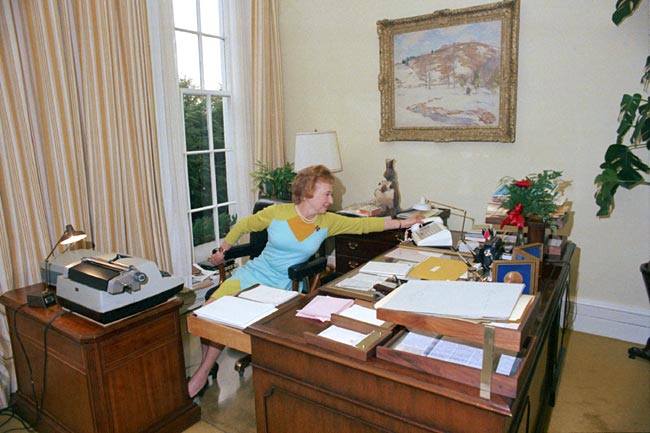
Rosmary Woods shows how she might have erased Nixon tapes

President Richard Nixon’s secretary, Rosemary Woods, demonstrates how she thought she might have accidentally erased 18-1/2 minutes of tape, when she reached to answer her phone and her foot extended to the “erase” footpedal, in 1974.

Ms. Woods’s typewriter is an electric, as best I can make out, an IBM. (Update, May 21, 2008: Ben Batchelor of etypewriters.com dropped by in comments to say it’s an IBM Model D Executive. Thanks, Ben!)

Good resource discovered in getting this image: The Watergate Files, presented by the Gerald R. Ford Presidential Library (at the University of Texas site). Image from the Gerald R. Ford Presidential Library.

Tip of the old scrub brush to Dr. Pamela Bumsted.