A depiction of Bugs Bunny’s evolution through the years. Regardless how Bugs looks, he usually reflects some of the more popular views of the day. Wikipedia image
Spread the word; friends don't allow friends to repeat history.
Our move to Texas in 1987 offered as one amenity, local roadrunners.
Camp Wisdom road was mostly two lanes then — it’s six, now. Clark Road was two lanes. It’s expanded to six, with a direct link to the freeway Spur 408. Wheatland Road was two lanes. You guessed it: Six now.
Not sure about baseball fields any more, but with roads, if you build ’em, people will come. The empty prairie and cedar forests favored by golden-cheeked warblers, and favorable to lizard-eating roadrunners, gave way to bulldozers putting up apartment complexes, strip shopping centers (still mostly vacant), self-storage businesses, and more roads. Roads bring automobiles, and autos provide collision courses for roadrunners.
In the summer, I used to see a roadrunner at least weekly at the intersection of Camp Wisdom and Clark; once watched one hunt down a very large Texas fence lizard and dash off with the lizard dangling from either side of its beak. In the era before electronic cameras.
All that development takes the habitat of roadrunners, and that is the slow death of much wildlife. Roadrunners dwindled down. About 2009 we discussed how rare they were. In 2011 Kathryn and I saw one lone roadrunner along Old Clark Road in Cedar Hill, precariously living in a 50-yard swath between two roads (which are slated to be widened), sharing a railroad track. Nothing since.
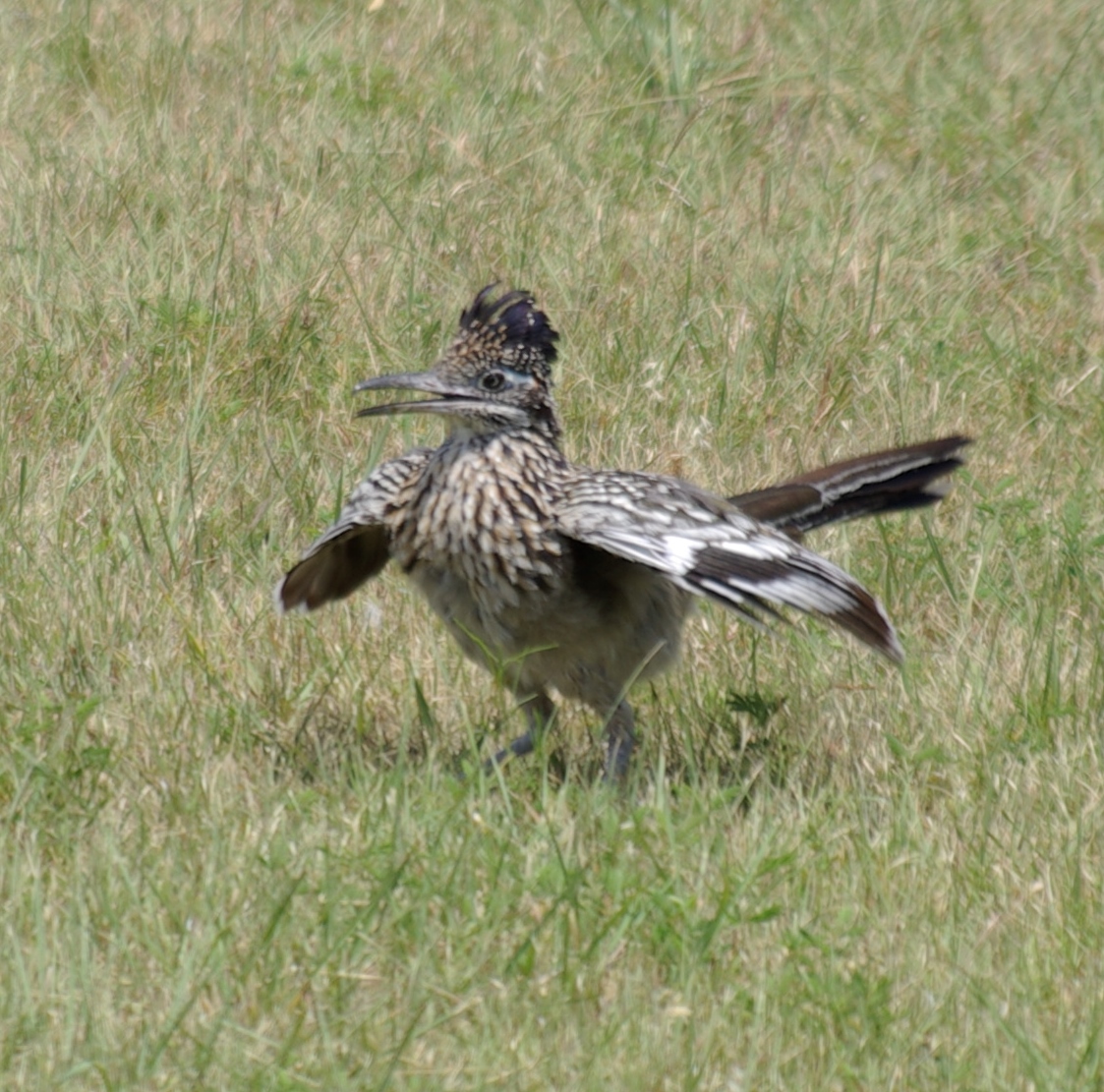
Mama roadrunner gives me the eyeball from the safety of the cedar tree, while the chick grooms. Is it safe to go out into the sun?
Until two weeks ago. Kathryn called me, excited that she’d seen a roadrunner crossing Mountain Creek Parkway, where Wheatland Road dead-ends into it. It’s good roadrunner weather. We were happy to know at least one survived.
Then, last Thursday I was driving along Old Clark Road. I brought along the Pentax K10D because I was hopeful of catching the hawk family living a block off of Wheatland and Cedar Ridge Roads. A roadrunner dashed across the road from a small ranchette into a “vacant” field of wild prairie grasses dotted with Ashe cedars. My experience is they are reclusive, and don’t like to be watched. I grabbed the camera and got a couple of shots of the bird, running under a tree and meeting up with another, smaller one — a chick!
I doubled back and u-turned, hoping they might at least dash. The larger one danced on the edge of the shadow of the tree for a minute, then uncharacteristically strutted out, hunting something to eat. She got something that looked like a lizard, or a fantastically large grasshopper, and a few other tidbits from the grass. She strutted around, and headed back to the shade, and to the younger one.
Mama Roadrunner flaps happily after ingesting a large something.
Roadrunners, the greater roadrunner, Geococcyx californianus (which means “Californian Earth-cuckoo,” a description of many politicians in the Golden State, perhaps).
I shot stills, with a 50-200 mm telephoto zoom, and I got a bunch of shots. I strung them together in Windows Moviemaker.
Are the roadrunners doing okay? Not really. They’re not gone, but much of their old habitat disappeared from this hill, the highest point in Texas between the Louisiana border and the Rockies — swallowed by human development, homes, suburban shopping, and the roads that go with that development.
Millard Fillmore was elected vice president largely because he was on the ticket with the very popular Gen. Zachary Taylor, hero of the Mexican War.
About 15 months into his presidency, President Taylor took ill after presiding over July 4 festivities in blazing heat. He died on July 9, 1850; Vice President Millard Fillmore took the oath as president the next day, and served out the term. 163 years ago today, Millard Fillmore served his first day as President.
Millard Fillmore in an 1850 lithograph by Francis D’Avignon after a photograph by Matthew Brady (unclear if this was before or after his ascending to the presidency) – Library of Congress image
Taylor had encouraged New Mexico and California to draw up state constitutions, which would have disallowed slavery in those states. To southern leaders who threatened secession, Taylor promised to personally lead the army that would hold the union together by force, and personally hang those who had proposed rebellion.
Fillmore had presided over the Senate during months of furious debate on issues that always seemed to come down to slavery. Because he didn’t hold to the views of the Whig Party which had elected the Taylor-Fillmore ticket, even more than Taylor had strayed, the cabinet resigned. Fillmore appointed Daniel Webster as Secretary of State, and proceeded to push for compromise on issues to avoid war. His machinations helped get California admitted as a free state, but left New Mexico as a territory. His support of the Fugitive Slave Act alienated even more Whigs, and by 1852 the Whigs refused to nominate Fillmore for a term of his own. He left office in 1853, succeeded by Franklin Pierce.
Fillmore’s greatest accomplishment as president, perhaps, was his sending a fleet of ships to Japan to force that nation to open up to trade from the U.S. The political furor over the Fugitive Slave Act, the Missouri Compromise, and other issues around slavery, tend to eclipse the memory of the good that Fillmore did.
Nota bene: Controversy surrounded the death of Taylor. Because he had threatened southern secessionists and incurred anger from several other groups, from the time of his death there were rumors he had been poisoned with arsenic. Officially, the cause of death was gastroenteritis; popular accounts note that he had, in the heat of July, drunk milk and eaten cherries and cucumbers. Certainly strep, staph or other bacteria in the milk could have created a problem. In 1991 a team led by George Washington University Law Professor James Starrs exhumed Taylor’s body from his Louisville, Kentucky burial plot, and tested his remains for arsenic at the Oak Ridge National Laboratory. Analysis presented to the Kentucky medical examiner indicated arsenic levels way too low for a poisoning victim.
“An Available Candidate: The One Qualification for a Whig President”. Political cartoon about the 1848 presidential election which refers to Zachary Taylor or Winfield Scott, the two leading contenders for the Whig Party nomination in the aftermath of the Mexican-American War. Published by Nathaniel Currier in 1848, digitally restored. (Photo credit: Wikipedia) Despite the cynicism of many , Zachary Taylor won the Whig Party nomination, and the presidency. Taylor died just over a year after his inauguration.
Spread the word; friends don't allow friends to repeat history.
Grant Snider’s “American Art, exploring a country through its paintings”
In the course of a junior-level, high school U.S. history class, students should experience each of these works, and many others. This is one whimsical way to work with serious and uplifting material, no?
Since that formative vacation, the art museum is always one my of first stops in visiting a new city. In the comic above, I’ve curated my ideal collection of 20th-century American art. Here’s a list of works in order of appearance:
From Smithsonian Magazine: The Colorado River Runs Dry A boat casts a forlorn shadow in a dry river channel 25 miles from the river’s historical end at the Gulf of California. Photo by Peter McBride (Go see the entire slide show; spectacular and troubling images)
Join us and stand up for reality. http://climaterealityproject.org – This film exposes the parallels between Big Tobacco‘s denial of smoking’s cancer-causing effects and the campaign against the science of climate change — showing that not only are the same strategies of denial at work, but often even the same strategists.
If you watched that all the way through, odds are high you’re not a denier. If you can’t watch it, you really should think about it, hard.
(This is not a place to bolster creationist ideas. This is real science, looking at God’s handiwork first hand.)
A North Carolina university makes field trips to Yosemite? I’d love to take that class!
Watching this film, you get a sense of how important it can be to the education of our children to travel in the summers, to take vacations to our National Parks, and to places like Yosemite.
Where are you taking your kids this summer? Kids, where are you going?
Enjoy it. Geology lessons are often fun, and this one, on film, is more fun than most.
Since 1970, Arizona has warmed at a rate 0.72 degrees per decade, the fastest among the 50 states, based on an analysis of temperature data by Climate Central, an independent organization that researches and reports on climate. Even as the temperatures have leveled off in many places around the world in the past decade, the Southwest has continued to get hotter.
“The decade of 2001 to 2010 in Arizona was the hottest in both spring and the summer,” said Gregg Garfin, a professor of climate, natural resources and policy at the University of Arizona and the executive editor of a study examining the impact of climate change on the Southwest.
Warmer winters mean less snowfall. More of the winter precipitation falls as rain, which quickly flows away in streams instead of seeping deep underground.
The soils then dry out earlier and more quickly in May and June. “It’s the most arid time of year,” Dr. Garfin said. “It’s windy as well.”
The growing season also starts earlier, so there is more to burn.
“The fire season has lengthened substantially, by two months, over the last 30 years,” said Craig D. Allen, a research ecologist at the United States Geological Survey station at Bandelier National Monument in New Mexico.
The fire potential is exacerbated by the past policy, beginning around 1900, of putting out all fires. Fires are a natural way of clearing out the underbrush. With that natural rhythm disrupted, the flammable material piled up, so when it did catch fire, it ignited a giant fire that burned hotter and wider.
This total-suppression policy began to ease as early as the 1950s, when scientists began to see fire’s role in ecosystems. It was completely abandoned nearly two decades ago.
But in the 1970s, the Southwest entered a wet period, part of a climate cycle that repeats every 20 to 30 years. “That wet period helped keep a lid on fires,” Dr. Allen said. “And it also allowed the forests to fluff up.”
Since 1996, the climate pattern, known as the Pacific decadal oscillation, has swung to the dry end of the spectrum, and the region is caught in a long-term drought.
Stephen J. Pyne, one of the nation’s leading fire historians and a professor at Arizona State University, said, “How we live on the land, what we decide we put on public and private lands, how we do things and don’t do things on the land, changes its combustibility.”
In many landscapes, he added, “you’ve enhanced the natural combustibility” by building hundreds of thousands of homes in fire-prone areas, and for years suppressing natural fires, allowing a buildup of combustible materials like the “slash” debris left behind by logging.
The article explains how this is the dry phase of the Pacific Decadal Oscillation; so we can hope the wet phase will be wet enough to suppress fires. However, the simple fact of additional effects brought on by PDO does not mean warming goes away when the PDO switches phases. Note especially the lengthening fire season over three decades; incrementally, warming is making these well-known cycles, warmer, and too often, destructive or more destructive.
More:
Sign welcoming visitors to Yarnell, Arizona, with wildfire in the background: “Elevation 4,850 ft., ‘Where the desert breeze meets the mountain air.'” Sedonaeye.com image
Monthly values for the Pacific decadal oscillation index, 1900 – 2010 Black line:121-month smooth Data source: http://jisao.washington.edu/pdo/PDO.latest (Photo credit: Wikipedia)
Spread the word; friends don't allow friends to repeat history.
David Barton’s “Wallbuilders” website featured John Adams’s description of July 2 — but conveniently edited out Adams’s own words, to make it appear as something else. Barton misses the history! What sort of anti-American cuts the words of John Adams when Adams defends liberty’s heritage?
Other groups make the same error as David Barton’s Wallbuilders, but without obvious cover ups, restricting their comments to “Independence Day.” Accuracy helps, always.
Faithful readers, and good students of history know that John Adams thought, in 1776, that July 2 would be celebrated as Independence Day. Why? July 2, 1776, was the day the 2nd Continental Congress voted to declare the colonies independent of Britain, and no longer under the rule of the Crown or Parliament.
The Declaration of Independence — the press release explaining Richard Henry Lee’s resolution for independence — sat ready to be discussed. The Congress did not adopt the Declaration until two days later, on July 4.
Our Independence Day celebration falls on the date of the adoption of the Declaration, not the date of the actual resolution declaring independence.
That’s interesting. It’s inspiring to know these august figures, near-gods in the American pantheon of the 21st century, got things wrong. It’s humorous. It’s good history.
What in the hell was David Barton thinking?
What evil purpose is he trying to serve by hiding real history, in such a bizarrely petty way? Why create a hoax when the words themselves support the point you’re wishing to make, that John Adams thought Americans should celebrate independence?
Screenshot of David Barton’s webpage, showing his bizarre butchery of Adams’s words.
Sheesh! He comes so close to getting something accurate, but he can’t resist monkeying with the words of the Founders. David Barton reminds me of the guy who cheated at golf so much that, one day when he hit a hole-in-one, he wrote “0!” on the scorecard. A man who will lie to us about one of the most famous letters in American history will lie about anything, for fun.
‘David Barton said what?’ By the time this portrait was painted, Adams knew Americans would celebrate the 4th, and not the 2nd; he seems to be glaring right at David Barton, to tell Barton to quit jerking around with history – John Adams, ca 1816, by Samuel F.B. Morse (Brooklyn Museum) Wikipedia image
Spread the word; friends don't allow friends to repeat history.
It’s a day of tradition — oddly enough, since we are in reality a very new nation, and Lee’s resolution to declare independence from Britain came on July 2.
A soak in Millard Fillmore’s Bathtub is nothing if not a steeping in tradition. Fly your flag today, to celebrate the independence of the American colonies of Britain.
At the White House, traditionally, new citizens are sworn in — often people who joined our armed forces and fought for our nation, before even getting the privileges of citizenship. Fireworks on the Capital Mall will be grand, with the White House hosting a few thousand military people and their families from some of the best views. Traditionally, five photographers, chosen by lottery, get to shoot photos of the fireworks from the windows of the Washington Monument; will that occur, with the Monument shut down from public view for repair from the earthquake?
There will be great fireworks also in Baltimore Harbor over Fort McHenry, the fort whose siege inspired Francis Scott Key to write the “Star-spangled Banner” from his boat in the harbor, in 1814. Firworks will frighten the bluebirds nesting at Yorktown National Battlefield. I suspect there will be a grand display at Gettysburg, on the 150th anniversary of the end of that battle. July 4, 1863, also marked the end of the Siege of Vicksburg; tradition holds that Vicksburg did not celebrate the 4th of July for 83 years after that. I’ll wager there will be fireworks there tonight. In Provo, Utah, the city poobahs will have done all they can to try to live up to their self-proclaimed reputation as having the biggest Independence Day celebration in the nation. The celebration in Prescott, Arizona, is muted by the tragic deaths of 19 Hot Shot firefighters last week; will drought halt the fireworks, too? There will be fireworks around the Golden Gate Bridge, in Anchorage, Alaska, reflecting on the waters of Pearl Harbor, and probably in Guam, American Samoa, and the Northern Marianas Islands.
This is mostly an encore post, but I so love that photo of the flag with the Earth in the distance.
Happy birthday, Kathryn!
Fireworks in Duncanville, Texas, for July 4 — Kathryn Knowles’s birthday. We’re always happy the town chimes in with the celebratory spirit.
Tip of the old scrub brush to Thomas Jefferson, Richard Henry Lee, John Adams, Benjamin Franklin, Roger Sherman, Robert Livingston, and the cast of thousands of patriots including George Washington.
Spread the word; friends don't allow friends to repeat history.
Cover of Newsweek Magazine, from March 4, 1957; notice this concern about U.S. science competency came seven months before Sputnik was launched by the Soviet Union. Science deniers then delayed action until after the Soviets demonstrated clearly that the U.S. was behind. (Image from Computer History.org)
Spread the word; friends don't allow friends to repeat history.
Amanda Holland with one of her research subjects, in South Carolina
Kathryn’s cousin, Amanda Holland, moved from researching condors in California, to buzzards in Georgia and South Carolina (for the University of Georgia, I think).
Here she is with one of her research subjects. Much lore is out there about handling carrion-eating birds for research — they vomit on you only if they like you, for example — but wholly apart from that, how great is this photo of a scientist at work?
I told her to copyright the photo (it is), and to hand on to the meme. Can’t you see a character in Game of Thrones, or some other fantasy, who carries her own vultures to clean up after she devastates some other army in battle?
Eagles and falcons and owls are okay, but what other bird could conceal the results of the battle, so the warrior princess could move on in stealth?
Science field work looks like great stuff. My experience is that it’s tiring, and sometimes lonely (though in very beautiful locations) — but the psychic rewards of actually increasing knowledge keep a lot of scientists going. There’s not a lot of money in it.
Look at the friends you could make!
Spread the word; friends don't allow friends to repeat history.
“The Second Day of July 1776 will be the most memorable Epocha, in the History of America. . . . It ought to be solemnized with Pomp and Parade, with Shews, Games, Sports, Guns, Bells, Bonfires, and Illuminations from one End of this Continent to the other from this Time forward forever more.” — John Adams to Abigail Adams, July 3, 1776
Scene of the crime — Independence Hall in Philadelphia, where the Second Continental congress approved the resolution to declare the colonies independent from Britain – (Photo credit: diablodale)
Two days later, that same Congress approved the wording of the document Thomas Jefferson had drafted to announce Lee’s resolution to the world.
Today, we celebrate the date of the document Jefferson wrote, and Richard Henry Lee is often a reduced to a footnote, if not erased from history altogether.
Who can predict the future?
(You know, of course, that Adams and Jefferson both died 50 years to the day after the Declaration of Independence, on July 4, 1826. In the 50 intervening years, Adams and Jefferson were comrades in arms and diplomacy in Europe, officers of the new government in America, opposing candidates for the presidency, President and Vice President, ex-President and President, bitter enemies, then long-distance friends writing almost daily about how to make a great new nation. Read David McCullough‘s version of the story, if you can find it.)
The Lee Resolution, passed by the Second Continental Congress on July 2, 1776 – Wikipedia image (Wait a minute: Are those numbers added correctly? What are they?)
Spread the word; friends don't allow friends to repeat history.
The Seeger Family, 1921 Pete Seeger, the now-93 year-old folk singer, is sitting on his father’s lap. Pete’s father was musicologist Charles Louis Seeger, Jr.; his mother was the violinist Constance de Clyver Edson. The other two children are probably Pete’s older brothers Charles, III, and John. This photo probably was taken while Charles and Constance toured the American south to teach music, after his having to leave UCLA because of his pacifist stance during World War I.
Judy Collins and Pete Seeger, photo by the preservationist David Rocco, at the Clearwater Festival in Hudson, New York, June 15, 2013. (We think that’s Pete’s wife, Toshi, on the far right edge of the photo.)
Ta-ta, Google Reader. There are other Translating Fish in the Sea.
A lot of readers subscribed to Millard Fillmore’s Bathtub through Google Reader. Alas for them, and for reading at this blog, Google Reader will close down on July 1, 2013.
After trying out fifteen or twenty alternatives out there, including the new Digg Reader, I have yet to find a service that I think is a great replacement.
However, there’s no value in letting the “perfect be the enemy of the good.”
I’ve finally determined that Feedly is my primary alternative — with a caveat.
I really like Mr. Reader, which is only an iPad app. However, it “syncs” with Feedly. So I’ll be using Feedly on my desktop and on my iPhone, but Mr. Reader on my iPad.
I hope you’ll continue to follow, after the Google Reader shutdown.
On the right side of this blog you’ll find a button for RSS subscriptions, and to follow me on Twitter. You can find me on Google Plus, but I generally don’t post everything there (I should consider it, I know). You can subscribe to this blog on e-mail — again, with a button on the right side.
Are there other feeds, or other ways to follow that you think I should use? Please let me know in comments.
Or, until that account is unsuspended by the forces supporting Donald Trump: Follow @FillmoreWhite, the account of the Millard Fillmore White House Library
We've been soaking in the Bathtub for several months, long enough that some of the links we've used have gone to the Great Internet in the Sky.
If you find a dead link, please leave a comment to that post, and tell us what link has expired.
Thanks!
Retired teacher of law, economics, history, AP government, psychology and science. Former speechwriter, press guy and legislative aide in U.S. Senate. Former Department of Education. Former airline real estate, telecom towers, Big 6 (that old!) consultant. Lab and field research in air pollution control.
My blog, Millard Fillmore's Bathtub, is a continuing experiment to test how to use blogs to improve and speed up learning processes for students, perhaps by making some of the courses actually interesting. It is a blog for teachers, to see if we can use blogs. It is for people interested in social studies and social studies education, to see if we can learn to get it right. It's a blog for science fans, to promote good science and good science policy. It's a blog for people interested in good government and how to achieve it.
BS in Mass Communication, University of Utah
Graduate study in Rhetoric and Speech Communication, University of Arizona
JD from the National Law Center, George Washington University


 Posted by Ed Darrell








 Millard Fillmore's Bathtub