Quote of the moment: President asks the Senate Majority Leader for help on the debt ceiling issue, in 1983

July 7, 2011

In a letter to the Majority Leader of the U.S. Senate, the President wrote:

This letter is to ask for your help and support, and that of your colleagues, in the passage of an increase in the limit on the public debt.

As [the Treasury Secretary] has told you, the Treasury’s cash balances have reached a dangerously low point.  Henceforth the Treasury Department cannot guarantee that the Federal Government will have sufficient cash on any one day to meet all of its mandated expenses, and thus the United States could be forced to default on its obligations for the first time in history.

This country now possesses the strongest credit in the world.  The full consequences of a default — or even the serious prospect of default — by the United States are impossible to predict and awesome to contemplate.  Denigration of the full faith and credit of the United States would have substantial effects on the domestic financial markets and on the value of the dollar in exchange markets.  The Nation can ill afford to allow such a result.  The risks, the costs, the disruptions, and the incalculable damage lead me to but one conclusion:  the Senate must pass this legislation before the Congress adjourns.

I want to thank you for your immediate attention to this urgent problem, and for your assistance in passing an extenstion of the debt ceiling.

Sincerely,

         Ronald Reagan

True then.  Still true now.

Letter from President Ronald Reagan to Senate Majority Leader Sen. Howard Baker, R-Tennessee, November 16, 1983.  The Treasury Secretary at the time was Donald Regan.

Tip of the old scrub brush to mainstream media pillar, The Washington Post, where a .pdf of the letter is available.


Full Moon, waterfalls in Yosemite, modern cameras: Voila! Moonbows!

July 7, 2011

Dick Feynman taught in Rio de Janeiro for a while.  He was frustrated at the way Brazilian students of that day learned physics by rote, instead of in labs.  In a lecture he looked out from the classroom to the sun dancing on the waves of the Atlantic, and he realized it was a beautiful, brilliant demonstration of light refraction, the topic of the day.  Sadly, the students didn’t understand that the beauty before them was a physics problem.  (Was that story in Surely You’re Joking, Mr. Feynman,  or What Do You Care What Others Think?)

Here, a marriage of physics, moonlight, spring runoff over a cliff, and modern photography, in Yosemite.  If you don’t gasp, call your physician and find a new sensei:

(Programs and maintenance of this park are threatened by Republican budget writers, BTW.)


Stroll through history: 100th History Carnival

July 6, 2011

The Century edition, 100th Carnival of History is up on the internet, over at Walking the Berkshires.  Well worth the stroll.

Who says history isn’t sexy or exciting?  Tim Abbott, in the text discussing entrants to the 100th History Carnival, tossed off this gem:

And then we have certain minted pneumismatic artifacts of scholarly interest blogged about at Hypervocal.  Be forewarned that these may be considered NSFW in some quarters.  Are they ancient Roman brothel tokens, or possibly pornographic gaming pieces?  At right, a proposed design for a modern token, suitable for use by disgraced US Congressmen in exchange for sexting services, appropriately priced at “sex asses”, if I remember my High School Latin.

You’ll have to go read it there if you don’t know immediately what he’s talking about.

Other pointers to great posts, with more that I haven’t mentioned:

Now:  Is there some way to sneak a copy of the 100th History Carnival into the e-mail of every member of the Texas Lege?


Cicada killers, 2011 edition

July 6, 2011

It’s slower population growth than in the past, but earlier, too.

In earlier years we’ve had cicada killer wasps — cicada hawks, in some parlance — as early as July 7.  Rains fell all spring in 2010, which discouraged the emergence of cicadas and their predators.  First certified sighting in our backyard did not occur until July 18.

Cicada Killer, with cicada - photo by Ronald F. Billings, Texas Forest Service, Bugwood.org

Cicada Killer, with cicada - photo by Ronald F. Billings, Texas Forest Service, Bugwood.org, via University of Delaware Cooperative Extension

We had modified a planter, and that may have killed some of the larvae.  Generally 2010 was a slow year for the large wasps.  My guess is that they were less active locally because the ground remained wet through July and into August.  I still get e-mails asking about how to get rid of them, and I still recommend watering the spots you want them to leave.  The females sting and paralyze a cicada, then plant that cicada in a tunnel underground with one wasp egg.  The young wasp hatches and feeds on the cicada, emerging usually the next summer to carry on the cycle (in a long summer, there may be a couple of hatchings, I imagine).  Females do not like to tunnel in wet ground, partly because it collapses on them, and I suspect wet ground is conducive to fungi and other pests that kill the eggs or hatchlings. Our wet weather kept them away last year.

I waited to say anything this year because I wanted more, but we saw the first cicada killer wasps this year on June 27, 2011, the earliest date we recorded here.  I had hoped to get a good photo, but that hasn’t happened yet.

Down at Colorado Bend State Park, the cicada killers greeted our arrival, much to the panic of the little kids in the campsite next door.  They were happy to learn the wasps don’t aim to sting them, and the kids actually watched them at work.  One of the wasps reminded me of just how much they like dry ground — she kept tunneling into the fire pit, unused now because of the fire bans that cover 252 of Texas’s 254 counties.  Covering the holes, putting objects over the holes, nothing could dissuade her from using that site.  I hope for the sake of the larvae that they hatch soon, and get out, before someone builds a fire in the pit.  Some of the cicadas in that area hit 110 decibels at least, and they badly need the discipline of a force of cicada killers, if you ask me.

Prowling the yard this morning I found two more emergence holes.  The wasps leave a smaller hole than the cicadas, so I’m pretty sure they are back in force.

Nature, red in tooth and claw, the poets say.  Or in this case, moist in sting.

It’s summer.  By the weather, it’s late summer.   Hello, cicada killers, Sphecius speciosa.

Earlier at Millard Fillmore’s Bathtub:

More:


Watching the drought roll in at Colorado Bend State Park

July 6, 2011

It took me a couple of tries to figure it out — last week when I told people Kathryn and I were off to Colorado Bend State Park to spend time on the river, several people commented about how much cooler it would be there.

What?  West of Killeen about an hour, ten miles of dusty road outside of Bend, Texas (population 1,637), Colorado Bend is not cooler than Dallas.  It was over 100° F every day we were there, stayed well above 90° most  of the nights.

Kathryn Knowles checking wildflowers, Colorado River, Texas

Kathryn studied wildflowers at a spring at the side of the Colorado River during a break from kayaking; this spring's flow was reduced, but still moist enough to create a near-oasis.

Our well-wishers were geographically confused.  They thought we were headed to the Colorado River in Colorado, not the Colorado River in Texas, which is not the same river at all.  I didn’t bother to check the temperatures in Colorado, but one might be assured that it was cooler along the Colorado River in Colorado than it was along the Colorado River in Texas.

It was a return trip.  We stumbled into the park 16 years ago with the kids, for just an afternoon visit.  The dipping pools  in the canyon fed by Spicewood Springs captivated us.  It took a while to get back, and then the kids were off doing their own thing.

So, just a quick weekend of hiking/camping/kayaking/soaking/stargazing/bird watching/botanical and geological study.   Park officials closed the bat caves to human traffic in hope of keeping White Nose Syndrome from the bats; we didn’t bother to sign up for the crawling cave tour through another.

Ed Darrell at Colorado Bend State Park, Texas

The author, still working to master that Go-Pro camera on the hat -- some spectacular shots, but I don't have the movie software to use it all; you know it's hot when SPF 75 sunscreen is not enough.

What did we see?  Drought has a firm grip on Texas, especially in the Hill Country, especially outside of Dallas.  The Colorado River  is mostly spring fed; many of the springs are dry.  No water significant water flowed through the park while we  were there — kayak put-ins have been reduced to the downriver-most ramp, and the bottom of the boat launch ramp is three feet above water.  Gorman Falls attracts visitors and scientists, but the springs feeding it are about spent this year — just a few trickles came over the cliff usually completely inundated with mineral-laden waters.

Drought produces odd things.  The forest canopy around the park — and through most of the Hill Country we saw — is splattered with the gray wood of dead trees, many of which at least leafed out earlier this spring.  The loss to forests is astonishing.  Deer don’t breed well in droughts; deer around the campsites boldly challenge campers for access to grasses they’d ignore in other seasons.  One ranger said he hadn’t seen more than about three fawns from this past spring, a 75% to 90% reduction in deer young (Eastern White Tail, the little guys).  Raccoons are aggressively seeking food from humans, tearing into tents and challenging campers for food they can smell (lock your food in the car!).  Colorado Bend is famous for songbirds, including the endangered Golden Cheeked Warbler, and the elusive, spectacular painted bunting.  But the most commonly-sighted birds this year are turkey vultures, dining on the young that didn’t make it healthy into the summer and won’t survive until fall.

Warming denialists’ claims of “not so bad a drought” ring out as dangerous, wild delusion.  (By actual measurement, Texas average rainfall the past nine months was 8.5 inches, the driest ever recorded in Texas, shattering the old record drought of 1917).

Great trip.  Kathryn’s menu planning was spectacular.  The old Coleman stove  — a quarter century old, now, with fuel almost that old — performed like a champ even without the maintenance it needs (later this week).  Other than the hot nights, it was stellar.

Stellar.  Yeah.  Stars were grand.  It was New Moon, a happy accident.  A topic for another post, later.  Think, “Iridium.”

So posting was slow over the weekend.  How far out in the Hill Country were we?  Neither one of us could get a bar on our phones.  We were so far out the Verizon Wireless guy was using smoke signals.

Thoreau was right, you know.


That flag you flew yesterday — want to burn it today?

July 5, 2011

Some of the more astute students in our high school classes ask questions about everything.  For example, they ask:  “What does the Pledge of Allegiance mean, when it says, ‘ . . . and to the Republic for which it stands?'”

Is the Pledge all that important?  Is the flag all that important?

Maybe.  How would you answer that question, really?

Penn and Teller offer a demonstration:

What do you think?  Did they burn a flag?  Should that sort of performance be legal?

What if Penn and Teller burned a flag in the White House?

An exercise in ambiguity:  A fictional drama about a sleight of hand, illusionary performance.  (Best line:  The answer to the question, “Did you go to law school?”  For the record, yes, I did go to law school.  I’m an amateur clown.)

Did you fly your  flag yesterday?


July 4, 2011 – Fly your flag today

July 3, 2011

Fourth of July: NPR has already read the Declaration of Independence, PBS broadcast the Capitol Fourth concert  last night (maybe a rebroadcast is available — check your local listings), your town has a parade somewhere this weekend, and fireworks are everywhere.

Remember to put your flag up today.

Astronaut Eugene Cernan and the U.S. Flag -- Apollo 17 on the Moon (NASA photo)

Last flag on the Moon: Astronaut Eugene Cernan and the U.S. Flag -- Apollo 17 on the Moon (NASA photo)

Also:

Lunar Reconnaissance Orbiter photo of Apollo 17 landing site

Lunar Reconnaissance Orbiter photo of Apollo 17 landing site

This is mostly an encore post, but I so love that photo of the flag with the Earth in the distance.

Happy birthday, Kathryn!


Little Rock’s Central High School, monument for civil rights

July 1, 2011

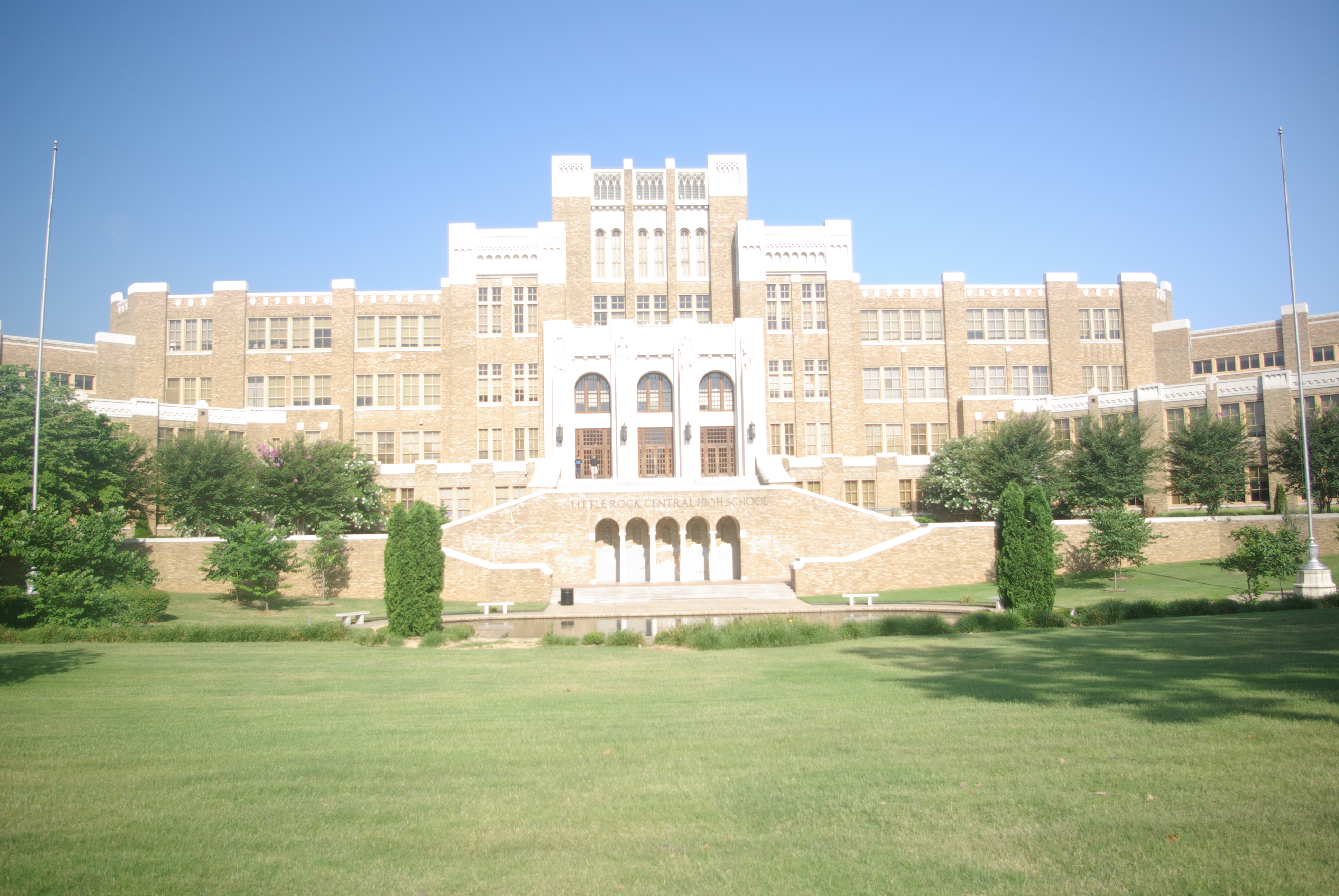
On the way out of Little Rock, Arkansas, after our day at the William Jefferson Clinton Presidential Library and Museum, we stopped at the Little Rock Central High School National Historic Site.

Little Rock Central High School in 2011, photo by Ed Darrell - use permitted with attribution

Little Rock Central High School in 2011, photo by Ed Darrell - use permitted with attribution

In 1957 nine African American kids tried to enroll at the school, breaking high school segregation in Little Rock.  After assuring President Dwight Eisenhower that the Arkansas National Guard would preserve the peace, Gov. Orval Faubus ordered the Guard to keep the students out.  Eisenhower called up the Guard to federal duty, and sent in the 101st Airborne from the regular U.S. Army to enforce the desegregation rules.  (Imagine any president doing that today!)

Pre-Art Deco front of Little Rock Central High School, built in 1927 - photo 2011 by Ed Darrell, use permitted with attribution

Pre-Art Deco front of Little Rock Central High School, built in 1927

Eventually Little Rock closed down all the schools for more than a year, and then federal courts ordered the schools opened, but desegregated.  One black student graduated that first year, Ernest Green.  The other eight all graduated, but from other schools around the world.

Today, it’s history, even in Little Rock.

Little Rock Central High remains in use today.  The National Park Service maintains a visitor center across the intersection from the school, with the old Magnolia Oil gas station, restored, on another corner, and a monument to the Little Rock Nine and civil rights on the remaining corner  (Magnolia Oil was absorbed into Mobil, which took on Magnolia’s flying horse emblem).  Our Dallas Independent School District, Teaching American History Grant group visited in mid-June.  Classes were out.   The visitor center remains open year around.

I was particularly curious to see whether and how the historical events, and the commemoration of them, affect the school itself.
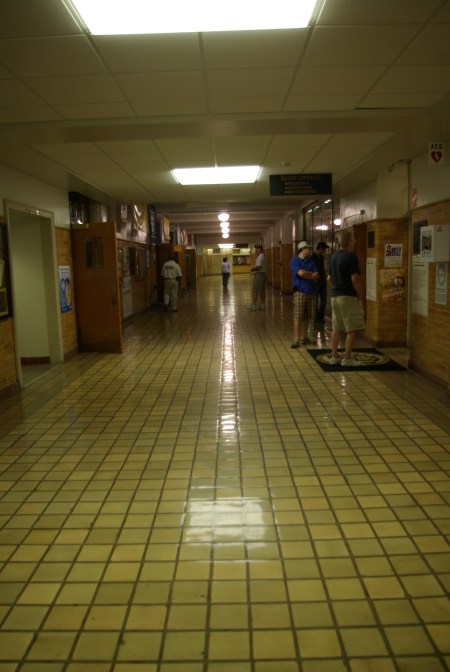
Hallway inside Little Rock Central High School, photo by Ed Darrell, use permitted with attribution

The hallway outside the auditorium on the main floor of Little Rock Central High School.

On the inside, it’s a normal American high school — though in a grand building (I’d compare this to Ogden, Utah’s Ogden High School, a WPA-style project of a decade later’s construction, and a grand old building students and citizens have come to love).

Walls bear posters from student clubs.  Signs direct students to classes, or the auditorium, or the lunchroom.  The office looks more like the 1970s than the 1930s — I suspect it has been updated.  Ceilings have been redone since 1927, with newer fluorescent lighting and acoustic ceiling tiles, which only brings the architecture of 1927 down to 1970s box-style building standards.

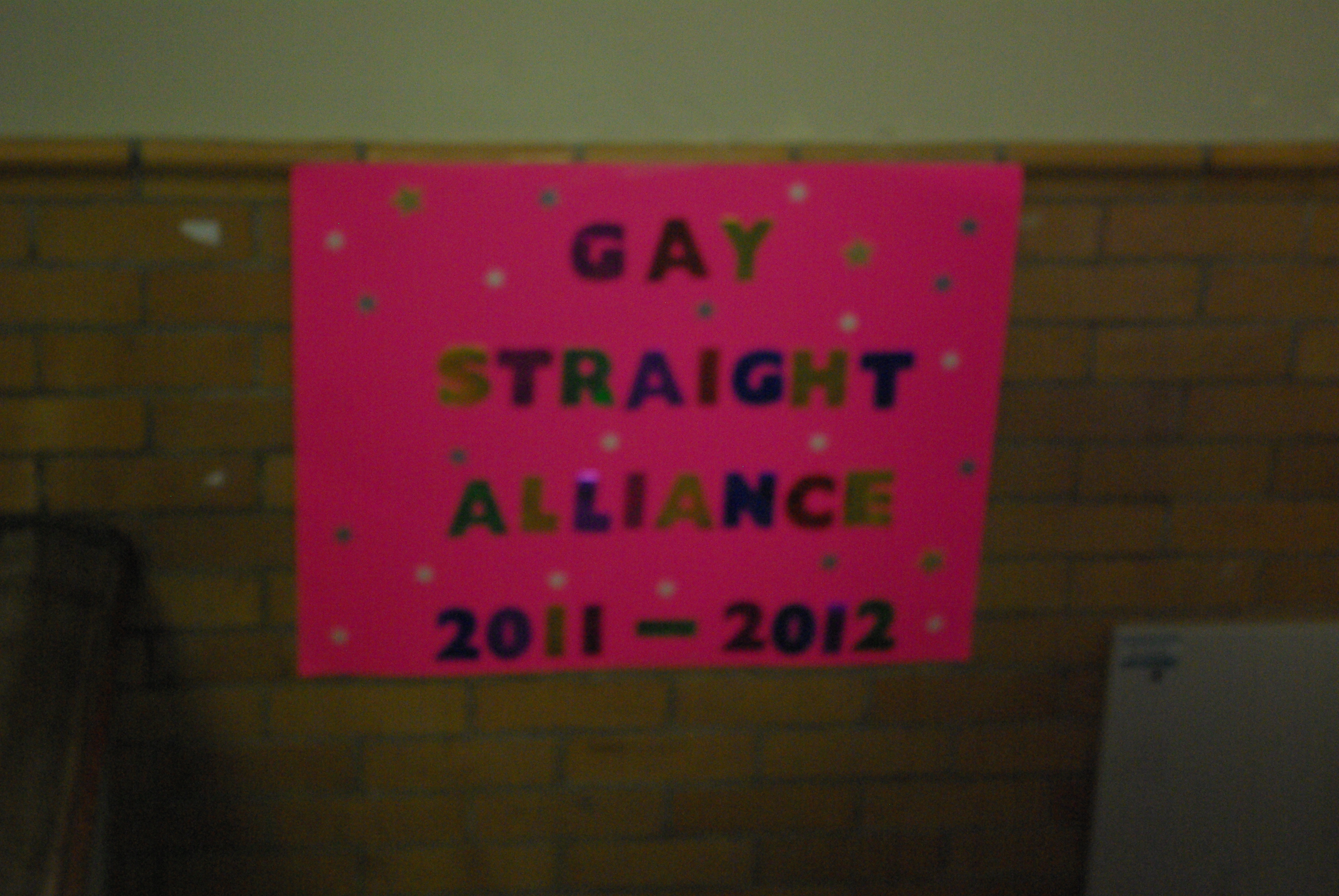
Sign announcing a club meeting, Little Rock Central High School, 2011 - photo by Ed Darrell, use permitted with attribution

Walls of Little Rock Central carry notices of club meetings, much as in 1957. Some of the clubs have changed; the Gay-Straight Alliance probably was not active in LIttle Rock in 1957. Changes in U.S. culture in the 54 years since the Little Rock Nine, are reflected in the citizens and their actions, and not necessarily in the physical buildings.

It’s a working school, and not a monument on a pedestal frozen in time in any sense.

The school opened 30 years before it became an icon in the struggle for civil rights.   It is a massive structure, intended perhaps as a sort of monument to Little Rock and to Education.  NPS describes it at their website:

Built in 1927 as Little Rock Senior High School, Central was named “America’s Most Beautiful High School” by the American Institute of Architects.

Designed as a mix of Art Deco and Collegiate Gothic architectural styles, the building is two city blocks long and includes 150,000 square feet of floor space. More than 36 million pounds of concrete and 370 tons of steel went into the building’s construction. It cost $1.5 million to construct in 1927. The school received extensive publicity upon its opening. An article in the Arkansas Gazette said, “we have hundreds of journalists in our fair city for the dedication” of the new high school.

At its construction, Central’s auditorium seated 2,000 people and included a 60 x 160 ft. stage that doubled as the gymnasium. A new library was built in 1969 and named for longtime principal Jess W. Matthews.  In 1953 the school’s name was changed to Little Rock Central High School, in anticipation of construction of a new high school for white students, Hall High School in Pulaski Heights.

Computer classroom at Little Rock Central High, June 2011 - photo by Ed Darrell; use premitted with attribution

Computer classroom at Little Rock Central High - Historic preservation cannot prevent the updating of classroom technology. Wiring these classroomms for computer networks must be quite difficult.

I thought it interesting that the original construction did not include a library.  The auditorium’s doubling as a basketball gymnasium explains the massive stage — suitable for Las Vegas, really.  “Multi-purpose” building for schools originated much earlier than the 1970s as I had imagined.  The 1927 plans included neither the tendency to overbuild fschools for athletics, nor today’s pre-occupation with making schools appear as academic enclaves.

Visiting the site you can learn that the $1.5 million cost consumed the entire building budget for the district in 1927.  In keeping with the separate but equal doctrine of the times (see Plessy v. Ferguson), the Little Rock district “planned” to build a high school for blacks at the same time.  No money remained for either design or construction.

City leaders — I would imagine black city leaders, without much help from whites, but I may be too cynical — raised money to pay the same architects to create a complementary design for the school that would be called Dunbar.  Private funding paid for construction, too.  Exactly this sort of discrimination against blacks roiled across America from 1896 into the 1950s — only 16 states banned discrimination by race, with laws that were not always enforced.  These issues were key to several of the cases rolled into the Supreme Court appeal that we usually call simply The Brown Decision — facilities were involved in the cases in Topeka, Kansas, Prince Edward County, Virginia, Delaware, and Washington, D.C.

Looking at Little Rock Central High School today one can see the physical manifestation of the insidious separate but equal doctrine, and understand perhaps why it collided with the drive for rights in Little Rock, at the corner of 14th Street and South Park Street.  The school’s address is listed as 1500 South Park.  14th Street, running along the north edge of campus, has been renamed Daisy L. Gatson Bates Drive, in honor of the NAACP organizer who provided wise counsel, sage advice, a ride to school on most mornings and friendship to the students who made up the Little Rock Nine.

A large amount of history resides in Little Rock.

Ha! — You don’t need to rely on my photos at all.  Turns out NPS has a photo slide show at their website.  Note how my ideas paralleled theirs — and honest, I didn’t see that before our tour.  Actually, the auditorium curtains were closed, nor did we get into the balcony — the photo from NPS is much better than any I got.

Nota bene: The intense, three-year program of study of U.S. history for this three dozen or so teachers is made possible by a grant from the U.S. Department of Education, a Teaching American History Grant.  Such grants fund the study of American history for teachers across the nation, to spur better teaching from greater understanding and knowledge of history.  These grants generally float at the top of the pool of programs to be cut first when the budget axes fall.  We are grateful to the Department of Education.  And while my writings here do not necessarily reflect the views of any of my employers, past or present, they should — and the Senate, Department of Education and others in the stream of funding would be well-advised to continue these grants.


Quote of the moment: John Adams, celebrating the 2nd of July

July 1, 2011

“The Second Day of July 1776 will be the most memorable Epocha, in the History of America. . . . It ought to be solemnized with Pomp and Parade, with Shews, Games, Sports, Guns, Bells, Bonfires, and Illuminations from one End of this Continent to the other from this Time forward forever more.”
John Adams to Abigail Adams, July 3, 1776

1776 filled the calendar with dates deserving of remembrance and even celebration.  John Adams, delegate from Massachusetts to the Second Continental Congress, wrote home to his wife Abigail that future generations would celebrate July 2, the date the Congress voted to approve Richard Henry Lee’s resolution declaring independence from Britain for 13 of the British colonies in America.

Two days later, that same Congress approved the wording of the document Thomas Jefferson had drafted to announce Lee’s resolution to the world.

Today, we celebrate the date of the document Jefferson wrote, and Richard Henry Lee is often a reduced to a footnote, if not erased from history altogether.

Who can predict the future?

(You know, of course, that Adams and Jefferson both died 50 years to the day after the Declaration of Independence, on July 4, 1826.  In the 50 intervening years, Adams and Jefferson were comrades in arms and diplomacy in Europe, officers of the new government in America, opposing candidates for the presidency, President and Vice President, ex-President and President, bitter enemies, then long-distance friends writing almost daily about how to make a great new nation.  Read David McCullough‘s version of the story, if you can find it.)

Update, July 4, 2013: You may want to check the updated version of this post, with more links, and even more history.

2015 edition, with more links for teachers and historians, here.


Teachers, look! Cheaper, fun way to get giant whiteboards

June 30, 2011

It’s a great idea, but I didn’t even dare think it possible

We’ve had blackboard paint for at least a century.  Teachers at our school sometimes paint their closet doors, or part of a wall, to use as a chalkboard.

I prefer whiteboards, though.

Watching Neil deGrasse Tyson on Nova:  Science Now, I caught a reference to a researcher whose lab walls are all painted with “dry-erase” paint.  (The NOVA piece is the episode on how the brain works; this segment deals with researcher David Eagleman.)

Is that even possible?

Vodpod videos no longer available.

Quick answer: Yes!

Check out applications ideas at IdeaPaint’s blog.

Lowe’s carries IdeaPaint, the stuff displayed in the graphic above.  It isn’t as cheap as other paint, but compared to the cost of a whiteboard, it’s pretty good.  RustOleum manufactures a version available at Home Depot and other outlets.  It’s advertised as cheap as $20 per kit online, but runs as high as $40.  One kit covers about 49 square feet (7 feet by 7 feet).  I’ve found at least five different manufacturers of the stuff, with different features.

I haven’t calculated prices (at about $3.25/square foot), but there are also dry-erase skins which can be applied to any wall — with the added advantage that the product claims to be erasable for virtually any marker, including Sharpies® and other permanent markers.   One manufacturer offers skins in clear, to allow underlying paint colors to show through, and white, and says it will match colors on a whole-roll basis (pricey, I’ll wager).

Uses for math and writing should be obvious — think about those mural-sized wall maps in a geography or history class, covered with clear, dry-erase paint . . .

Wouldn’t it be great if school districts had architects, or instruction coaches, who knew about this stuff and could help us keep up in the technology and tool wars/sweepstakes?

More, resources:  

  • Dry-erase painting at Charlestown (state? Massachusetts?) schools:
  • Case study from Milford High, Milford, Massachusetts
  • Case study, Dever-McCormack School, Boston school district
  • Evernote software teams with IdeaPaint . . . look at the video

Why is the Texas Chainsaw Massacre so popular?

June 29, 2011

And, why do people so very, very much, want that story to be true and not fictional?

Here’s the list of stories from this blog that were most popular over the past seven days; the top two stories hold about those ranks week in and week out:

Top Posts (the past week)

Based on a true story — except, not Texas. Not a chainsaw. Not a massacre. 530 views

28 poems on living life to the fullest, today 425 views

True story: Yellow Rose of Texas, and the Battle of San Jacinto 167 views

News flash: Texas has a second natural lake! 136 views

Nuclear power plant incident in Nebraska?

“When we’re telling whoppers about Obama and government, please don’t pester us with the facts” Department

Hoaxed Nebraska nuclear plant crisis update

Quote of the moment: John F. Kennedy, “We choose to go to the Moon”

Someone somewhere is discussing whether the story behind the Texas Chainsaw Massacre movies is real or fictional.  I can’t find that discussion, alas.

Either that, or we have a lot of prurient interests out there.

Interesting mix of story viewings, otherwise.


PestAway: Exterminator deals with DDT, honestly

June 29, 2011

Here’s a cool breeze:  Pest Away Exterminators in New York explains, patiently, that DDT no longer works against bedbugs, and is otherwise ill-advised in most applications.

Try to find an error in this short post:

DDT

The truth about DDT…

  • It was highly effective when it was first introduced.
  • It nearly wiped out bed bugs in America.
  • It is NO LONGER effective in treating bed bugs.
  • It is more dangerous than people realized.

In 1939, DDT (Dichloro-Diphenyl-Trichloroethane) was introduced as the “miracle pesticide.” It was effectively used in military and civilian arenas to control lice, malaria, mosquitoes and bed bugs. It nearly wiped out all bed bugs in an allegedly “safe” method, but by the 1960’s, bed bugs had built up a resistance and potential immunity to DDT.

In 1962, Rachel Carson wrote Silent Spring, which essentially demonized DDT and helped launch the environmental movement. By 1972, DDT was banned in the USA, but DDT is still used very effectively in other countries to control Malaria. Although there is a public outcry to bring DDT back, it’s very unlikely that it would have any meaningful effect on controlling bed bugs.

Jeff Eisenberg founded the company in 1991, after a career with a large accounting firm.  It appears his training on the importance of accuracy in numbers, and honesty in facing tough situations, carried over to his new business.  Good on him.


Meanwhile, in the evolution debates, where we find the Mother of All Denialism . . .

June 29, 2011

Other fronts in the War on Education may have earned more attention here in the Bathtub, lately — and in state legislatures.  Threats from the dilution and elimination of good, hard science courses continue to pose problems, especially from creationists and their shyer, camouflage troops from the Chapel of Intelligent Design.

We need to stay aware of the creationist/creationism threat.  At its heart, creationism requires adherents to reject the facts of science, to reject the workings of science, and to reject the functions of debate about what is real, and what is not.  It is to me a rather simple discussion of the quality of evidence.

Eugenie Scott and her colleagues from the National Center for Science Education provide a great update in what is going on, with a great video, and an informative and troubling explanation of the links between creationism and the “unbelievers” in climate change.

Be sure to watch the first ten minutes, to see the video update on the fight to keep good science education in schools, especially the teaching of evolution.


Memphis Public Library assembling history of 2011 floods

June 28, 2011

Here’s a good idea:  The Memphis Public Library is putting together an archive on the 2011 floods in the area, we learn from the Memphis Daily News:

St. Mary’s Senior Helps Library Build Flood Archive

St. Mary’s Episcopal School student Ellery Ammons is devoting her summer break to helping the Memphis Public Library & Information Center build an archive documenting the Mid-South floods of 2011.

Ammons, an employee of the Shelby Forest General Store owned by her parents, is also a Girl Scout, working toward her Gold Award.

Recognizing the need to document this year’s historic deluge, the high school senior decided to take on the tasks of soliciting, cataloging and archiving community photos to create the 2011 Flood Collection.

She plans to create a digital archive of flood photographs to provide future generations with an accurate record of the floods that ensued when the Mississippi and its tributaries overflowed in Memphis and the surrounding areas this past spring.

Library digital projects manager Sarah Frierson said she’s delighted to have the extra hands in the history department, saying the collection “will be a wonderful complement to the library’s existing Mid-South Flood Collection, which documents the floods of 1927 and 1937.”

The Benjamin L. Hooks Central Library, 3030 Poplar Ave., is seeking photo donations to add to the 2011 Flood Collection. Donations, which will become part of the library’s permanent collection, can be brought to the history department on the main library’s fourth floor or e-mailed to Flood2011.Photography@gmail.com.

– Aisling Maki


UFOs? Obama-ordered news blackouts? No: Brain failures

June 28, 2011

Come on, you can figure out how this applies to those stories about Obama’s secret orders — or more accurately, the lack of those orders.  From Neil deGrasse Tyson and the argument from ignorance, presented at St. Petersburg College, Florida, 2007:

Tip of the old scrub brush to Neil deGrasse Tyson, and his Tweet.