Birthers: “We choose to wallow in the gutter”

July 25, 2009

It’s a stark contrast to the matter-of-fact, good-for-America views of John Kennedy.

One of the Birth-Certificate-Obsessed (BCO), blogging at I Took the Red Pill, lays out the hoax-induced hysteria in a comment at his blog; I’ll take a few minutes and explain the problems.  Maybe one or more of the BCOs will come to their senses.  [This guy at least allows contrary views on his blog; he’s a regular at Texas Darlin’, which means his views are certifiably nuts on issues he posts about at Texas Darlin’.  But I digress.]

Heh.  Maybe pigs will fly to the Moon.

I Took the Red Pill (Pill) said:

This issue will not go away.

Only because of defects in the actions of BCOs.  As Woody Allen’s script once noted, nothing wrong here that couldn’t be cured with Prozac and a polo mallet.

This issue is pathological in every regard.

Quite to the contrary, every day more and more people are realizing that the document produced at the Obama Camapaign Headquarters in Chicago is merely a hardcopy of the photoshopped forgery that first appeared on Daily KOS.

Wow.  Where to begin, when the force of denial is so strong in the BCOs?

You can view the document’s images here, and here.  It is a certified document from the State of Hawaii.  It bears the Seal of the State of Hawaii as authentic.  No one has produced any scintilla of evidence to suggest that the document is false. or not exactly what Hawaii swears it is with the attachment of the State Seal.

That’s a powerful attestation from the State of Hawaii — as the law sees it.  If a certified document under seal is not acceptable to the BCOs, one wonders what sort of documentation would be — there isn’t anything more trustworthy under the law.

Check the Federal Rules of Evidence, for example:

Rule 902. Self-authentication

Extrinsic evidence of authenticity as a condition precedent to admissibility is not required with respect to the following:

(1) Domestic public documents under seal. A document bearing a seal purporting to be that of the United States, or of any State, district, Commonwealth, territory, or insular possession thereof, or the Panama Canal Zone, or the Trust Territory of the Pacific Islands, or of a political subdivision, department, officer, or agency thereof, and a signature purporting to be an attestation or execution.

. . . (4) Certified copies of public records. A copy of an official record or report or entry therein, or of a document authorized by law to be recorded or filed and actually recorded or filed in a public office, including data compilations in any form, certified as correct by the custodian or other person authorized to make the certification, by certificate complying with paragraph (1), (2), or (3) of this rule or complying with any Act of Congress or rule prescribed by the Supreme Court pursuant to statutory authority.[courtesy of the Legal Information Institute at Cornell University’s Library]

Got that?  Under federal evidence rules, that document is self-proving, self-authenticating.  What evidence have the BCOs to contradict it?  Absolutely nothing.

The State of Hawaii has never verified that authenticity of that forgery.

The governor and the head of vital records said it’s NOT a forgery, if that’s what you mean.  In other words, they said the document is accurate in what it says:  Barack Obama, Jr., was born in Honolulu in 1961.

The State of Hawaii has never released any documentation of Obama’s birth.

Well, yeah, they did.  They sent to Barack Obama the certified document you claim is a forgery.

Moreover, in 1961, when Barack Obama was just a few days old and, we might assume, both physically and mentally unable to start a conspiracy to cover up the facts of his birth, the State of Hawaii released to the Hawaiian newspapers the records of births in Hawaii, including Obama’s — and those records were published in the newspaper.  Such documentation, contemporary with the events and extremely unlikely to be falsified, are valid in court.

Oh, and remember those Federal Rules of Evidence?  Look at what they say about such newspaper records:

Rule 902. Self-authentication

Extrinsic evidence of authenticity as a condition precedent to admissibility is not required with respect to the following:

. . . (6) Newspapers and periodicals. Printed materials purporting to be newspapers or periodicals.

So we have two releases of documentation from the State of Hawaii, vouched for by the Republican governor. What gives you the right that every state of the union is denied, to claim this documentation doesn’t exist?  These are legal documents that make legal statements.  You can’t just handwave them away.  Pixie dust can’t cover them up, and the pixie dust of the BCOs isn’t all that powerful anyway.  The courts cannot wave away this sort of evidence, nor can the BCOs.

The mere existence of the newspaper account is legal evidence vouching for Obama’s claim. BCOs must produce extraordinary evidence of fraud or mistake in order to overcome the legal presumption that newspaper account provides.  BCOs have no extraordinary evidence to counter the documents.  BCOs have no evidence at all.

The State of Hawaii has never claimed that Obama was “born in Honolulu”, even though the Associated Press and Fact Check.org lied and claimed that Dr. Fukino had said that.

The State of Hawaii put its seal on such a statement, and it states Obama was born in Honolulu (see “place of birth”).  BCOs’ completely unevidenced and off-the-wall claim that the document was forged is evidence of BCO insanity, not Hawaii’s failure to act.

A newspaper announcement is circumstantial evidence that is not admissible as “proof” of his birth in Hawaii. Can you imagine a new employee trying to use a newspaper clipping as proof of their U.S. citizenship? It’s laughable. If that won’t work to get you a job at McDonalds, it’s certainly not acceptable for the highest office in this country.

It’s a business record, actually.  When you get to your law school class on evidence, you’ll learn that contemporary accounts from unbiased sources which are difficult to fake and easy to corroborate are, indeed, acceptable in a court of law.  In this case, the published account of the vital records entries corroborates exactly the information provided by the State of Hawaii under seal.

And, as I noted above, it’s a self-authenticating piece of evidence under the Federal Rules of Evidence. Pill is simply dead wrong on the acceptability of newspaper accounts.

So we have a document certified as authentic and accurate by the State of Hawaii, so solid that the state backs it with their seal, the most sacred authenticating device in a state’s arsenal of authenticating devices, supported by a valid contemporary business record published in a general circulation newspaper where the record cannot be tampered with and which U.S. courts and agencies accept as valid.

But BCOs dismiss all the official, legal evidence, and BCOs claim, without any evidence or corroboration, without ever having looked at the documents, that the official documents are forgeries.

Liar, pants, fire.

Every Member of Congress swore an Oath of office to “support and defend the Constitution of the United States”. The Constitution explicitly requires that a President be a Natural Born Citizen. It is the responsibility of Congress to honor their oath and verify the eligibility of the man who would be President.

I’ve sworn that oath myself, four times.  I regard it as a sacred trust.  One is never relieved of that oath, by the way.  That oath requires that we follow the law, the Constitutional law, the Constitution.  Barack Obama has presented clear  and convincing evidence of his eligibility by right of birth on U.S. soil.  The evidence is absolutely uncontradicted, plus it is corroborated by all legally-acceptable accounts.

Every member of Congress has a duty to stand up and tell the BCOs to take a chill pill and shut up. The courts have reviewed these bogus claims from BCOs more than a dozen times.  Not once has any BCO offered any evidence to contradict the legal records.  Not once.

Be careful what you wish for, Pill.  If Congress takes their oath seriously, BCOs are in for a lot of woe.

Every member of Congress failed to uphold their oath of office. They “outsourced” their Constitutional responsibility to an unaccountable, unelected, untrustworthy third party who demonstrably lied.

I’m convinced Pill wouldn’t know a lie if it bit him on the nose.  Here he’s peddling such a lie, instead of standing up for the truth.

Go to the link Pill provides, and you’ll see he claims that the certified, under seal document from the State of Hawaii should be disregarded because all it does is state what the official record is — he wants a hand-written document, as if hand-written provides some legal magic that the State Seal of the Great State of Hawaii cannot.

Look, if he won’t take the word of a self-proving document issued under seal, he’s not going to believe any document at any time.

Hawaii didn’t claim they put the State Seal on the original autograph copy; the State of Hawaii looked at the autograph and swore that the information they provided, all that is required, is accurate, is the same information that is on the original autograph.

For all legal purposes possible for Obama, the document whose image he released is THE document.  The document itself, under seal, swears that the information it presents is accurate:  Obama was born in Honolulu.  That’s it.  The end.

Two things are required to put this to rest:

1) A Supreme Court ruling on the definition of “Natural Born Citizen”. Can someone who was born with citizenship of another country (as Obama admits that he was) be considered a “Natural Born Citizen” of the United States?

The Supreme Court has spoken on this issue.  A baby born on U.S. soil is a citizen with full rights of citizens, period.  A baby born on U.S. soil is a natural-born citizen of the U.S.  Plus, a baby born to a U.S. citizen (as was Obama’s mother), is a natural-born citizen regardless of place of birth.  Obama qualifies on two separate counts.  There is not an iota of evidence from the BCOs nor any other source to contradict either of those valid claims on eligibility.

But here we see the weasel ways of the BCOs:  ” . . . born with citizenship of another country (as Obama admits he was) . . .”

Obama didn’t say he was a citizen of another country.  He said his father was a citizen of the British Commonwealth, and under British law, he could have claimed dual-citizenship.  Under U.S. law, dual citizenship would not invalidate U.S. citizenship.

In order for this to have been a problem for Obama’s eligibility, Obama would have had to have claimed exclusive British citizenship at some point — which he never did.

So this is not a new question.  There is no new issue here that the courts and the Supreme Court have not looked at in the past.  There is no legal argument, no case in controversy on the issue of Obama’s citizenship.

There is nothing for any court to decide.  And that’s why the challenges to Obama’s eligibility have all failed.

2) If the Supreme Court finds that persons born with foreign citizenship can still be considered a “Natural Born Citizen” of the United States, then Congress needs to inspect an officially certified birth certificate for Barack Obama, delivered under seal from the State of Hawaii, just as they did with their inspection of the Certificate from the Hawaiian Secretary of State for the certification of the Electoral College vote.

That document, “delivered under seal form the State of Hawaii,” has been provided.  BCOs claim, without any documentation, it’s a forgery.  BCOs need to get their eyes examined.

And, if they are found to be not blind, they need to get their heads examined.

Please share this post if you find the information valuable.

Add to FacebookAdd to NewsvineAdd to DiggAdd to Del.icio.usAdd to StumbleuponAdd to RedditAdd to BlinklistAdd to TwitterAdd to TechnoratiAdd to Furl


Fun in merchandising

July 25, 2009

HEMA is a department store in the Netherlands.  Like all other businesses, it now has on-line shopping.

Inside a HEMA store in the Netherlands - Wikimedia image

Inside a HEMA store in the Netherlands - Wikimedia image

But it’s online with a diffference.  Load this page, and then wait a few seconds . . .

(Can you tell whether this is a real HEMA page, or just a good parody?  Anyone?)

(And, what kind of software does one need to do that kind of animation?  Is there any classroom use for this?)


Quote of the moment: John F. Kennedy, “We choose to go to the Moon”

July 24, 2009

John F. Kennedy at Rice University, Houston, Texas, Sept 12, 1962 - photo from NASA

John F. Kennedy at Rice University, Houston, Texas, Sept 12, 1962 – photo from NASA

There is no strife, no prejudice, no national conflict in outer space as yet. Its hazards are hostile to us all. Its conquest deserves the best of all mankind, and its opportunity for peaceful cooperation many never come again. But why, some say, the moon? Why choose this as our goal? And they may well ask why climb the highest mountain? Why, 35 years ago, fly the Atlantic? Why does Rice play Texas?

We choose to go to the moon. We choose to go to the moon in this decade and do the other things, not because they are easy, but because they are hard, because that goal will serve to organize and measure the best of our energies and skills, because that challenge is one that we are willing to accept, one we are unwilling to postpone, and one which we intend to win, and the others, too.

President John F. Kennedy, September 12, 1962, at Rice University, Houston, Texas

Why this speech in Houston?  There’s more here than just a speech in a football stadium.  Kennedy was working to save the space initiative, and to make America more secure.

In this quest, Kennedy lays out the reasons we need strong science research programs funded by our federal government, and strong science educational achievement in all of our schools.

From the White House History Association:

Race to the Moon

President John F. Kennedy (1961-1963) awoke on April 12, 1961, to the news that the Soviet Union had won the race to put a man into space. Kennedy immediately met with Vice President Lyndon Johnson in the White House to discuss the embarrassment of the Soviets beating America again. “Can we put a man on the moon before them?” Kennedy asked. A few weeks later, Kennedy challenged the nation to “commit itself to achieving the goal, before this decade is out, of landing a man on the moon and returning him safely to earth.”

Kennedy challenged Congress and the imaginations of all Americans a few weeks later, when on May 25, in a special Joint Session of Congress, he proposed a Moon exploration program.  In a speech outlining defense and foreign policy needs to make the U.S. secure and safe against threats from Soviet communism, or any other nation or faction, Kennedy spoke openly about the space race that had been waged since October 4, 1957, when the Soviet Union became the first nation on Earth to orbit an artificial satellite, Sputnik.

Kennedy told Congress in that part of the speech:

Finally, if we are to win the battle that is now going on around the world between freedom and tyranny, the dramatic achievements in space which occurred in recent weeks should have made clear to us all, as did the Sputnik in 1957, the impact of this adventure on the minds of men everywhere, who are attempting to make a determination of which road they should take. Since early in my term, our efforts in space have been under review. With the advice of the Vice President, who is Chairman of the National Space Council, we have examined where we are strong and where we are not, where we may succeed and where we may not. Now it is time to take longer strides–time for a great new American enterprise–time for this nation to take a clearly leading role in space achievement, which in many ways may hold the key to our future on earth.

I believe we possess all the resources and talents necessary. But the facts of the matter are that we have never made the national decisions or marshalled the national resources required for such leadership. We have never specified long-range goals on an urgent time schedule, or managed our resources and our time so as to insure their fulfillment.

Recognizing the head start obtained by the Soviets with their large rocket engines, which gives them many months of leadtime, and recognizing the likelihood that they will exploit this lead for some time to come in still more impressive successes, we nevertheless are required to make new efforts on our own. For while we cannot guarantee that we shall one day be first, we can guarantee that any failure to make this effort will make us last. We take an additional risk by making it in full view of the world, but as shown by the feat of astronaut Shepard, this very risk enhances our stature when we are successful. But this is not merely a race. Space is open to us now; and our eagerness to share its meaning is not governed by the efforts of others. We go into space because whatever mankind must undertake, free men must fully share.

I therefore ask the Congress, above and beyond the increases I have earlier requested for space activities, to provide the funds which are needed to meet the following national goals:

First, I believe that this nation should commit itself to achieving the goal, before this decade is out, of landing a man on the moon and returning him safely to the earth. No single space project in this period will be more impressive to mankind, or more important for the long-range exploration of space; and none will be so difficult or expensive to accomplish. We propose to accelerate the development of the appropriate lunar space craft. We propose to develop alternate liquid and solid fuel boosters, much larger than any now being developed, until certain which is superior. We propose additional funds for other engine development and for unmanned explorations–explorations which are particularly important for one purpose which this nation will never overlook: the survival of the man who first makes this daring flight. But in a very real sense, it will not be one man going to the moon–if we make this judgment affirmatively, it will be an entire nation. For all of us must work to put him there.

(Here’s a link to an audio excerpt of that speech, from the Kennedy Library.)

The race was on.  The Soviet Union’s massive rocket engines gave them a decided advantage.  Kennedy’s challenge captured the imagination of Americans and America.  Necessary money flowed from Congress, but not in a completely free flow.  Some opposed the nation’s efforts in space exploration because they thought spending on space exploration detracted from the nation’s defense efforts.  Kennedy continued to stress the connection between space exploration and defense.  He was backed by successes — Navy Commander Alan Shepard, Jr., had successfully launched into space and returned safely; and on February 20, 1962, pilot Marine Capt. John Glenn orbited the Earth three times, catching the U.S. up almost to where the Soviet Union was in manned space exploration.

Kennedy understood that constant attention, constant selling of the space program would be necessary.  So in September 1962 he found himself in Houston, the newly-designated home of the manned space program, and he took the opportunity to cast the American goals in the space race as peaceful, good for all mankind, and definitely worth the massive costs.

Notice in how he casts putting a human on the Moon in league with other great achievements of civilization.  Kennedy was truly shooting for the stars.

Notice also how he relates space exploration to practical applications then in existence, such as communication, navigation of ships at sea, and weather forecasting.  This was years before geosynchronus satellites were used for everyday telephone conversations, years before quantum theory was harnessed for Global Positioning Systems (GPS) and digital personal, handheld telephones, and before the newly-invented printed circuits were miniaturized to make computer calculating a possibility in space — the Moon landing was done with slide rules and hand calculations.

Just over 14 months later Kennedy would die in Texas, in Dallas, on November 22, 1963.  On July 20, 1969, Neil Armstrong and Buzz Aldrin landed the Eagle Lunar Module on the Moon, at the Sea of Tranquility.  A few hours later, on July 21, they stepped out on the Moon.  From Kennedy’s speech to Congress, the task had taken 8 years, one month and 26 days.

More resources:

Tip of the old scrub brush for inspiration to “Anything You Ever Wanted to Know” at KERA-FM 90.1 in Dallas, on July 24, 2009.

Buzz Aldrin on the Moon, with Neil Armstrong, the U.S. flag, and the Eagle Lunar Module reflected in his helmet visor, July 21, 1969 - NASA photo via Wikimedia

Buzz Aldrin on the Moon, with Neil Armstrong, the U.S. flag, and the Eagle Lunar Module reflected in his helmet visor, July 21, 1969 – NASA photo via Wikimedia

Please share.

Add to FacebookAdd to NewsvineAdd to DiggAdd to Del.icio.usAdd to StumbleuponAdd to RedditAdd to BlinklistAdd to TwitterAdd to TechnoratiAdd to Furl


Gray hair, Sonic Youth, Fender guitars

July 24, 2009

Am I the only one who sees a whiff of hopeful irony in a guitarist from Sonic Youth being gray?

From Fender:  Thurston Moore + Lee Ranaldo. Jazzmaster guitars slung across seminal shoulders. In the hands of both men, the sound of Sonic Youth is the sound of that guitar used as part paintbrush and part cluster bomb. Introducing the new Thurston Moore Jazzmaster and the Lee Ranaldo Jazzmaster guitars from Fender, releasing July 1st.

From Fender: "Thurston Moore + Lee Ranaldo. Jazzmaster guitars slung across seminal shoulders. In the hands of both men, the sound of Sonic Youth is the sound of that guitar used as part paintbrush and part cluster bomb. Introducing the new Thurston Moore Jazzmaster and the Lee Ranaldo Jazzmaster guitars from Fender, releasing July 1st." Photo from the Fender site.

That’s Lee Ranaldo on the right, with the teal guitar and gray hair.

Leon Anderson played a then-vintage Fender blond-neck Stratocaster in our bands back in Utah County, and it was a beautiful machine (and he an underappreciated guitarist).  I never could afford a Fender-brand bass.  I played two Vox devices, one of which I still own — but they played through an almost-original Fender Bassman amplifier, whose demise I still mourn.

Fender blonde-neck Stratocaster, a lot like the one Leon Anderson played - Guitar Village photo

Fender blonde-neck Stratocaster, a lot like the one Leon Anderson played, except Leon's wasn't nearly so beat up - Guitar Village photo

Watching the Fender company bend, dodge and run with the trends over the years has been a lot of fun.  One of my ex-brothers-in-law did the accounting and corporate legal work for Leo Fender way back when; as an indication of how stuffy the brother-in-law was, consider that he didn’t have any Fender guitars — or any guitars — when I knew him.  How could one work with a master like Leo Fender and not get hooked on the guitars?

Ultimately the guitars are the legacy and history of the company.  As with Stradivarius instruments, the music made on the guitars and the instruments themselves outshine the makers and any corporate entity required to get the instruments manufactured.  Corporate owners of the Fender name and legacy don’t drive that car, but only hold on for the ride and try to keep the moving parts lubricated and clean.

Any Sonic Youth fans out there?

Tip of the old scrub brush to Ufghanistan.


NBC on the Obama birth certificate issue

July 23, 2009

Embedding the video from NBC escapes me — but go here to see NBC’s four-minute report on the Obama birth certificate crazies.

Here’s the full video of the BCOs going crazy at a Congressman’s town meeting.

It’s really a form of mass hysteria, isn’t it?

For months the birthers, or Birth Certificate Obsessed (BCOs), have pleaded for mainstream media to take a look at this issue.  NBC did just that.

Is it any surprise that this morning the crazies say “NBC lied?”

BCOs fell hard to the hoax about Obama not being eligible, and now they deny all evidence that they fell for a hoax.

BCOs/birthers?  Can we have our country back, now that you’re done?

Other notes:

Be sure to see earlier material here at Millard Fillmore’s Bathtub:

Here’s a large dose of facts, including David Maraniss’s article in the Washington Post about Obama’s early life.  Note that it describes details that would be impossible to fake, were the story not accurate:

Please share good information:

Add to FacebookAdd to NewsvineAdd to DiggAdd to Del.icio.usAdd to StumbleuponAdd to RedditAdd to BlinklistAdd to TwitterAdd to TechnoratiAdd to Furl


Blue jay, purple pepper

July 23, 2009

We’ve been bumping around 100° F for about a month now.  It’s Texas.  It’s hot.

Sometimes the blue jays do all they can to stay out of the sun — like this guy, who was bent on getting some of Kathryn’s weird purple peppers.

Blue jay working to get a purple pepper

Blue jay working to get a purple pepper

Considering these shots were done in the shade, with just a 200 mm zoom, through a foggy window, they came out pretty well.

Blue Jay wrestles the pepper from the plant

Blue Jay wrestles the pepper, or something, from the plant.

The peppers eventually grow to be the size of a Bing cherry — too big for the jays, then.  They go after these peppers before they mature, and after they dry.

With her prize, the blue jay heads for its dining area in the live oak.

With her prize, the blue jay heads for its dining area in the live oak.

Mary K left us with her old bird feeder when she moved.  This year we’ve kept feeders in both the front and back yards.  Blue jays appear to have recovered from their West Nile devastation three years ago — we had one family nesting in the live oak earlier, in the spring — and Kathryn learned that the jays like peanuts still in the shell.

It’s been a good year for watching birds in our yard.  Still haven’t captured that little green hummer in a camera, though.


Moving Civil War Memory. No, I mean, it’s really moving.

July 22, 2009

Civil War Memory said:

This past weekend I mentioned that there are some big changes to Civil War Memory on the horizon.  Well, today is the day that I announce that Civil War Memory is moving to WordPress.org.  All the posts and comments have been moved to the new site, which can be found at http://cwmemory.com/.   Please update your blogroll as soon as possible.  In about a month I will unveil a brand new theme for the blog.


Warning: Universal coverage will save lives, money and pain

July 22, 2009

Utah Savage tells the story:

My friend Z is doing amazingly well, considering. She is complying with her oncologists. But now that the radiation is burning her throat, and the chemo is making her queazy, the doctors are prescribing drugs that will alleaviate these problems. But Z doesn’t believe in Western medicine and when it came time to sign up for Medicare she assumed that she would never get sick enough to ever need the part A, B and D of Medicare coverage. Now she needs them all and the enrollment period won’t come around again until November. It is part D that would have paid for her drugs. It is part D that would make a drug that costs $150 at most $3.50. I audibly gasped when she told me that she didn’t have part D. I couldn’t help myself. I said, “But you need part D.” She was furious and shouted, “Don’t tell me what I should have done. That doesn’t help me now.” And of course she’s right. Now that it’s too late, it doesn’t help to tell her what she should have done.

If you’re healthy, you never think you’re going to need insurance and prescription drug coverage. And if you’re young you never think your going to get ill. But everyone needs insurance. That is why the healthcare debate is so terribly important. We need a public option. Please call your Congressional Representative and lobby for a public option for healthcare. We need you healthy. We need you paying attention to the issues that will make a difference in all our lives.

We are not allowed to drive a car without insurance and we don’t think twice about that. But we are so careless when it comes to insurance for our own health. It should be mandatory that everyone is covered with health insurance.

Does your mileage differ?  Tell us in comments.


I’d give the kid a good grade, I think

July 22, 2009

Can any teacher recognize genius in the classroom?  Especially when I taught in alternative programs, I was frequently astounded by the great work students did that was just enough off the mark of the assignment that it might have gotten a zero were it not so brilliant, and had I not had a few extra minutes to grade (thanks to smaller classes).

Wee Mousie’s Cinema Burlesque — what do you do with stuff like that?

This is the stuff Creative Commons is made for, by the way.


Maggie rose

July 22, 2009

Exquisite blooms of the "Maggie" rose (bourbon class) - in Kathryn Knowles' garden, summer 2009

Exquisite blooms of the "Maggie" rose (bourbon class) - in Kathryn Knowles' garden, summer 2009

Yes, I intended to leave the spent blossom there.  This is a real garden, where the flowers grow and fade.

Maggie is a “found” rose, robust in much of Texas, and a favorite of my wife’s.  The blossoms tend to glow, even at mid-day.  It will blossom all summer when it’s happy.  Maggie’s fragrance earns it a spot in Kathryn’s garden.

Maggie was one of five roses designated by Texas A&M’s horticulturists in 2005 for testing as one of a handful of roses easy to grow (read:  “difficult to kill, really”) in Texas.  Many rose varieties do not do well in southern heat and humidity — Maggie is one exception.

Maggie is a “found” Bourbon rose. It was collected in Louisiana by Dr. William Welch, Extension horticulturist from College Station. Maggie reaches 8 feet in height and 4 feet in width. Its flowers are medium red, very double, very fragrant, and it is a repeat bloomer. Researchers have found Maggie does best when trained on a pillar or fence. It is designated for zones 6-9.

“Arethusa, Jaune Desprez and Maggie are winter hardy throughout the entire state,” George said. “Bon Silene and Comtesse du Cayla, however, are winter hardy across most of the state except for Amarillo and the northern Panhandle area.”


Our nation’s first man in space

July 20, 2009

Our first man in space got there by a route most people can’t guess:  Balloon.

Joe Kittinger recounted his adventures to the CBS Morning Show, how he leaped from a balloon at the edge of space for the Air Force, to prove that humans could survive a fall from such distances, in the event of an emergency that required an astronaut to bail out.

Kittinger bailed out of the balloon at over 102,000 feet, nearly three times the height of Mt. Everest into the atmosphere.

But Elton John never wrote a song about “Balloon Man.”


News flash: Texas has a second natural lake!

July 20, 2009

Years ago, in Virginia, I had learned that Virginia had only one natural lake, the Great Dismal Swamp.  Accompanying that chunk of information in that lecture was that Texas had only two natural lakes.

But upon arriving in Texas, I could find reference to only one natural lake, Caddo, and it had ceased being fully natural when its maintenance fell to a dam.

What happened to Texas’s second natural lake?

A Google search right now on “Texas +’natural lake'” produces ten listings on the first page, all of them pointing to the fact that Texas has just one natural lake.  Here are the first five:

I have found a second natural lake in Texas. It’s not a new discovery at all — it’s just a case of people not having the facts, and overlooking how to find the truth.  It’s especially difficult when the lake hides itself.

Our testing coordinator at Molina High School, Brad Wachsmann, spins yarns that belie his youth.  In the middle of one yarn last year, corroborated by other yarns, he mentioned that he has family in Big Lake, Texas; and he described visiting and having relatives urge people to run out and see the lake since it’s rebirth in torrential rains.

“A second natural lake in Texas?” I asked.  Wachsmann knew the drill.  Yes, Big Lake is a natural lake in Texas, and yes, people forget about it.

Texas teachers, listen to your testing coordinators, okay?

All of this came to mind reading the Austin American-Statesman, still a bastion of great journalism despite problems in the newspaper industry.  On Monday, July 7, the paper ran a story and an editorial about the clean up of the oil industry refuse that killed the shoreline of part of the lake; the springs that once fed the lake have mostly gone dry, but that’s likely due to agricultural water mining.

It’s a story of boom and bust, environmental degradation for profit, and eventual recovery we hope.

Looking at the landscape that surrounds the Reagan County seat, you wonder whether the name Big Lake was somebody’s idea of joke. It’s dry and dusty, where the flora sprouts reluctantly and lives precariously.

Yet, the West Texas town of Big Lake got its name from a natural lake that was fed by springs that have long since gone dry. While the area may not fit everyone’s definition of photogenic, it has its own brand of charm – charm that could be enhanced if the damage done to the fragile ecosystem by salt spills were reversed or even minimized.

As the American-Statesman’s Ralph K.M. Haurwitz reported in Monday’s editions, the University of Texas and Texas A&M systems have benefited from the $4.4 billion in royalty payments and mineral income produced by its West Texas acreage since Santa Rita No. 1 well came in on May 28, 1923.

The salt water byproduct of oil and natural gas production, however, contaminated 11 square miles near Big Lake, killing most everything that grows. The lack of vegetation allows wind and water erosion.

Hey, it gets better.  This is real Texas history, real American history — you can’t make this stuff up.  Haurwitz’s article talks about the heritage of Texas education.   Remember that old story about setting aside certain sections of townships to help fund education in lands on the American frontier?  Texas wasn’t a public lands state as farther west, but it still reserved sections of land for the benefit of education.

Rose petals blessed by a priest?  I’ll wager the priest didn’t make the trip to the top of the derrick.  Haurwitz wrote:

BIG LAKE — Investors appealed to the patron saint of impossible causes when oil drilling began on University of Texas System land in 1921. It didn’t hurt.

Santa Rita No. 1 blew in on May 28, 1923, after rose petals blessed by a priest were scattered from the top of the derrick at the behest of some Catholic women in New York who had purchased shares in the Texon Oil and Land Co., which drilled that first well.

Since then, the UT System’s 2.1 million acres in West Texas have produced $4.4 billion in royalty payments and other mineral income for the Permanent University Fund, an endowment that supports the UT and Texas A&M University systems.

But this long-running bonanza for higher education exacted a price from the remote, semiarid landscape where it all began. Millions of barrels of salt water, a byproduct of oil and natural gas production, contaminated 11 square miles, or more than 7,000 acres, killing virtually all vegetation and leaving the land vulnerable to wind and water erosion. Hundreds of mesquite stumps with three feet of exposed roots testify to the dramatic loss of topsoil.

Texas, and Big Lake - from BigLakeTx.com

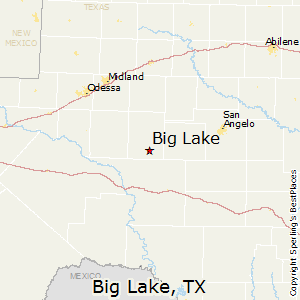
Where in Texas is Big Lake?

The town of Big Lake is just north of the lake itself, on State Highway 137 running north and south, and U.S. Highway 67 running east and west, approximately 65 miles west of San Angelo.   Big Lake sits about 10 miles north of Interstate 10, and about 75 miles south of Interstate 20.  Big Lake calls itself “the gateway to the Permian Basin.”

Big Lake is the home of Reagan County High School.  Jim Morris was baseball coach for the Reagan High Owls when his team persuaded him to try out for a major league baseball team.  His story was chronicled, with some artistic license, in the Disney movie “Rookie.”

Land managers are working to stop erosion on the often-dry shores of Big Lake using any trick they can find.  One trick:  Plant salt grass.

Salt grass?  Along Texas’s Gulf Coast, there are a few species of grass that, while not halophytes, are at least salt tolerant.  Salt grass.  This grass made it profitable to graze cattle on what would otherwise have been unproductive land in the Texas cattle boom.  This role in Texas history is memorialized in the Salt Grass Steakhouse chain, now found in five states.

And if planting salt grass works to control erosion, it will help clean up a large part of Texas other natural lake, Big Lake.

Big Lake’s being wet or dry is a whim of local climate.  You could say that half of all of Texas’s natural lakes are now dry as a result of continued warming; you could say that two good gully-washers or toad-stranglers could restore water to half of Texas’s natural lakes.

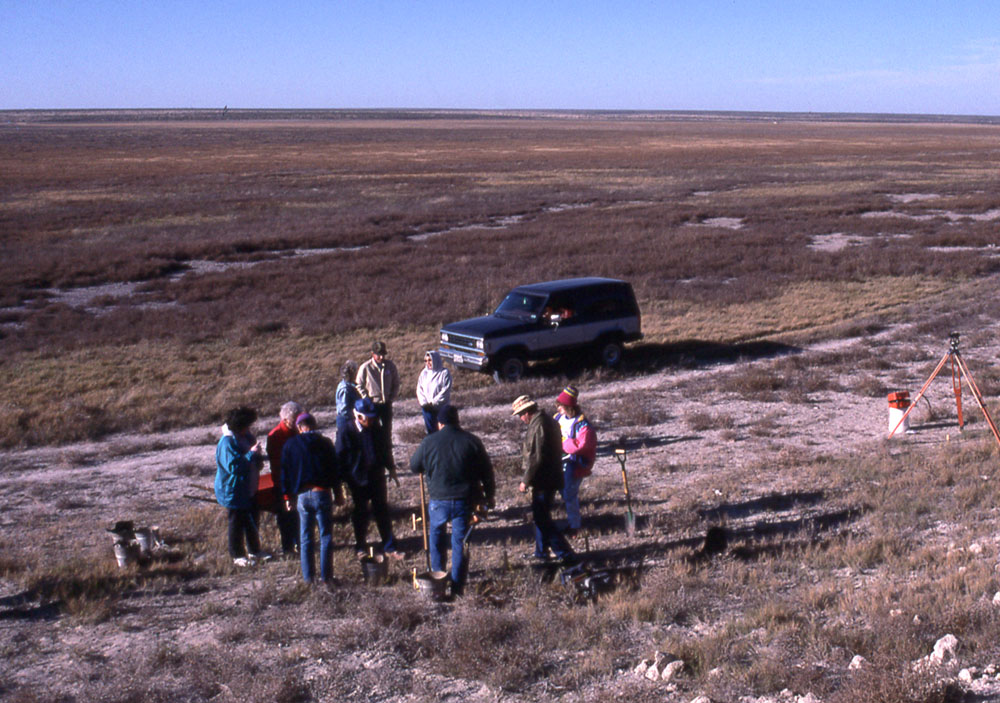
Big Lake Playa, from NightOwl Bakery and Roastery in Big Lake, Texas

Field crew meeting at the outset of the 1992 excavations at the Big Lake Bison Kill site. The dry bed of Big Lake stretches for miles in the background. Big Lake is an intermittent saline lake or playa, an uncommon landform on the Edwards Plateau. Photo by Larry Riemenschneider, Concho Valley Archeological Society.

More details about Big Lake and prehistory, below the fold.

Read the rest of this entry »


Wiley Drake is an illegal alien

July 19, 2009

Wiley Drake cannot show us his green card, and so, by his standards, he is an illegal alien.

What’s that you say?  Drake was born in the U.S.?  So was Obama, and it doesn’t stop Drake from claiming Obama illegal.  The only criterion Drake offers is that Obama doesn’t have a green card.  On that criterion, Drake is also an illegal alien, since he has no green card, either.

As God is our witness, we could not make this stuff up.

Do  you think Drake is part of the reason California is having such great fiscal difficulties?

Seriously, Wiley Drake does not speak for God, nor even for other Christians.  That was a shameful performance on Drake’s part not least because he didn’t have a clue how shameful it was.  The Bible says Christian elders have an obligation to rebuke false doctrine, false preachers and hooey.  Consider Drake rebuked.

Not that Drake would ever listen to a Christian elder.

Tip of the old scrub brush to Savior Breath posting at Pharyngula.


Scientist steps in to try to save the day

July 19, 2009

On the one hand, you hope he’s got a good copy of the original cast recording of “Man of La Mancha,” with the late Richard Kiley singing the importance of dreaming the impossible dream.  On the other hand, you hope it’s not an impossible situation at all.

Mathematics Professor Lorenzo Sadun declared his candidacy for the Texas State Board of Education seat representing District 10. He’ll be running against incumbent Cynthia Dunbar in a district that has a history of electing people with little or no education background and a commitment to scorched Earth conservative policies — if Dunbar chooses to run again.  Dunbar has not announced her intentions.

Sadun is professor of mathematics at the University of Texas, in Austin.

Mathematics Prof. Lorenzo Sadun, University of Texas - Daily Texan photo by Mike Paschal

Mathematics Prof. Lorenzo Sadun, University of Texas - Daily Texan photo by Mike Paschal

In the 2006 election, there was no Democratic nominee. Dunbar ran against a Libertarian and won approximately 70 percent of the vote. The 2010 primary election is scheduled for March, and Sadun declared last week that he will seek the Democratic nomination.

The Place 10 seat-holder may become very influential. With the board almost evenly split, a negative or positive vote can greatly affect educational policy and standards.

If Sadun is elected, he will be the only scientist on the board. He said that even though he may encounter opposition from members of the board, he will find a common ground with his colleagues and will pursue agreement without sacrificing the quality of education for Texas students.

“Despite my taking a fairly hard line, I am a conciliator,” Sadun said. “I have not met a person who knew so much I couldn’t teach them something, and I’ve never met someone who knew so little that they couldn’t teach me something.”

District 10 includes 14 counties surrounding Travis County to the east of the county, and the northern part of Travis County.  Travis, home to the Texas state capital Austin and one of Texas’s five supercounties, was split in education board districts to limit the influence of its  highly-educated, more liberal voter population.

District 10, Texas State Board of Education

District 10, Texas State Board of Education

Burnt Orange Report wrote that Dunbar will face opposition if she chooses to run again.

Events in District 10 offer a sign of hope that the era ended when apathy from candidates and voters allowe anti-public education forces to dominate the Texas State Board of Education.  And if Sadun were to win, it would be the first time a working scientist was elected to SBOE.

Who knows?  Sadun could succeed — but if he wins a seat on the SBOE, it’s not likely he’d sing that other song Richard Kiley made famous, “Stranger in Paradise.”  He’s no stranger to quality education, and SBOE isn’t paradise.


Probably not the way to get a good reputation among scientists

July 19, 2009

Tensions between science and religion, and science and business, continue to drag down Texas’s hopes to be known as a major research location.

A hard look shows it’s not just the Deliverance-style local politics at the State Board of Education on science standards.  Texas has trouble in a lot of areas.

For example, imagine a hurricane wiped out the town where one of the state’s major medical schools resides, and in the aftermath, rather than working to preserve the jobs of professors who agree to come back to the damaged buildings and storm-wracked town, the university uses the troubles as an excuse to get rid of faculty — not bad faculty, necessarily, just faculty the administration doesn’t like, or doesn’t know, or just for the heck of it.

This ain’t no way to run a medical school.

The rolling disaster that hit the Universityof Texas Medical Branch in Galveston, starting with Hurricane Ike, continued through unexpected layoffs of faculty on top of the 3,000 people laid off due to storm damage.  The layoffs were unjustified, too, many thought, and so they appealed.  The appeals process seems to have offered only a semblance of justice, to many of those involved, according to an article in The Scientist (free subscription required).

The story hasn’t got much traction in Texas media.