Moon, stars, Earth, all conspire to produce astonishing beauty in Hawaii

November 5, 2013

It’s a composite of 11 photographs to get the whole panoramic view — which just demonstrates that in photography it’s great to be lucky, but it usually takes great skill to get that amount of luck.

How much processing was involved, really?

Don’t worry, just check out the photo.

Double Moonbow, lava glow and fading Lunar Halo; 11-picture Panoramic taken on the rim of Kilauea's Caldera On the Last Super Moon. Sean King, Atmospheric Phenomena

Double Moonbow, lava glow and fading Lunar Halo; 11-picture Panoramic taken on the rim of Kilauea’s Caldera On the Last Super Moon. Sean King, Atmospheric Phenomena

See the Facebook page for Hawaii Stargazing Adventures.

Click thumbnail for a larger image.  Kilauea and double Moonbow - Sean King - 736169_10201694350153369_1176409460_o


GOP debacle swells: Texas voter ID law blocks aged, World War II veterans from voting

November 3, 2013

It’s difficult to figure out a headline for this story, one that accurately describes just how bolloxed the Republicans have made voting in Texas.

You can’t make this stuff up.

Friday was the last day of early voting for Tuesday’s elections in Texas.  Some local offices, and about 2,000 amendments to the Texas Constitution.  Okay, a half-dozen amendments to the Constitution.  Texas’s Constitution is the greatest patch-work legal document on Earth, perhaps in our galaxy, and we’ve got a bunch of amendments this time, too.

Texas’s Kommissar of State Prosecutions, Greg Abbott, took advantage of federal court decisions and imposed the clumsy Texas Jim Crow/Diego Cuervo voting laws for this election.  Although eligibility for voting, including citizenship, is checked when voters register, the new law requires that every voter present a state-issued voter identification card with a photo, again at the polls.

The law was originally targeted by Republican legislators to stop African Americans and Hispanics from voting, with a bonus that it stops senior citizens who may not have valid drivers licenses.

A lot of other people are getting snagged, too.  A state judge was required to vote provisionallyState Sen. Wendy Davis, the leading candidate for the Democratic nomination for next year’s gubernatorial race, had to file a conditional ballot — she is within striking distance of Kommissar Abbott in current polls (he’s running for the Republican nomination).  About a third of white women in Texas don’t have photo identification that matches their voting registration, due to moving, marriage, divorce, etc.

And Friday, in Fort Worth . . .  well, you can’t make this stuff up.

You cannot make this stuff up.

No one questioned who he was.  He just can’t vote with the ID he has.

If Jim Wright can’t easily get an ID to vote, who can?

If any other veterans of World War II don’t have personal assistants from their Congressional retirement benefits, who will help them vote?

From the Fort Worth Star-Telegram:

By Terry Evans and Anna M. Tinsley

tevans@star-telegram.com atinsley @star-telegram.com

FORT WORTH — Former House Speaker Jim Wright was denied a voter ID card Saturday at a Texas Department of Public Safety office.

“Nobody was ugly to us, but they insisted that they wouldn’t give me an ID,” Wright said.

The legendary Texas political figure says that he has worked things out with DPS and that he will get a state-issued personal identification card in time for him to vote Tuesday in the state and local elections.

But after the difficulty he had this weekend getting a proper ID card, Wright, 90, expressed concern that such problems could deter others from voting and stifle turnout. After spending much of his life fighting to make it easier to vote, the Democratic Party icon said he is troubled by what he’s seeing happen under the state’s new voter ID law.

“I earnestly hope these unduly stringent requirements on voters won’t dramatically reduce the number of people who vote,” Wright told the Star-Telegram. “I think they will reduce the number to some extent.”

Wright and his assistant, Norma Ritchson, went to the DPS office on Woodway Drive to get a State of Texas Election Identification Certificate. Wright said he realized earlier in the week that the photo identifications he had — a Texas driver’s license that expired in 2010 and a TCU faculty ID — do not satisfy requirements of the voter ID law, enacted in 2011 by the Legislature. DPS officials concurred.

But Wright and Ritchson will return to the office Monday with a certified copy of Wright’s birth certificate, which the DPS employees assured them would be good enough for the Texas personal identification card, designed specifically for people who do not drive.

“It can be used for anything, not just voting,” Ritchson said.

Photo ID alone doesn’t work.  Legal identification cards don’t work.  It has to be the magic, let’s hope you ain’t got one, kind of ID.

Former Speaker of the U.S. House of Representatives Jim Wright shows the voter identification card issued to him by his home county — not enough to allow him to vote under new Texas voter ID laws. The World War II veteran was denied a photo identification card on Friday. Fort Worth Star-Telegram photo by Terry Evans

Former Speaker of the U.S. House of Representatives Jim Wright shows the voter identification card issued to him by his home county — not enough to allow him to vote under new Texas voter ID laws. The World War II veteran was denied a photo identification card on Friday. Fort Worth Star-Telegram photo by Terry Evans

Former Speaker of the U.S. House of Representatives Jim Wright shows the voter identification card issued to him by his home county -- not enough to allow him to vote under new Texas voter ID laws.  The World War II veteran was denied an identification card on Friday.  Fort Worth Star-Telegram photo by Terry Evans

Former Speaker of the U.S. House of Representatives Jim Wright shows the voter identification card issued to him by his home county — not enough to allow him to vote under new Texas voter ID laws. The World War II veteran was denied a photo identification card on Friday. Fort Worth Star-Telegram photo by Terry Evans

More:


Aussie’s view of America; can you do as well for Australia?

November 2, 2013

An Aussie's attempt to label the state of the U.S.  Don't laugh -- how well can you do labeling a map of Australia?  From Texas Hill Country's Facebook feed, and unknown origin past that.

An Aussie’s attempt to label the state of the U.S. Don’t laugh — how well can you do labeling a map of Australia? From Texas Hill Country’s Facebook feed, and unknown origin past that.

Found this at the Facebook site of Texas Hill Country.  A little rough for high school geography, especially if it’s ninth grade geography (surely you can moderate this a bit, teachers), but a good idea for a quiz?

How well can your students do labeling the U.S.?  Will they find this person’s obvious anguish and creative non-answers amusing?  Can they do better?

Now turn the tables:  How well can your students in the U.S. do labeling a map of Australia?  Canada?  Mexico?

Ask your students:  Is it important to know such stuff?  Why?

And you, Dear Reader: What do you think?

Here you go, a map of Australia to practice with:

Unlabeled map of Australia to label!  Royalty free produce of Bruce Jones Design, Inc., copyright 2010

Unlabeled map of Australia to label! Royalty free produce of Bruce Jones Design, Inc., copyright 2010


Clay Bennett: The Flat

November 2, 2013

Brilliant cartoon by Clay Bennett at the Chattanooga Times-Free Press.  It’s a perfect summary of GOP policies on everything, and why those policies won’t work.

“The Flat.”

Clay Bennett cartoon in the Chattanooga Times-Free Press, September 12, 2013

Clay Bennett cartoon in the Chattanooga Times-Free Press, September 12, 2013

I love Bennett’s clean lines, and acid commentary.


Jonathan Gruber explaining ObamaCare a year ago: The Comic Book

November 1, 2013

THERE MUST BE A BETTER WAY: Some 2,700 people lined up in July for free medical treatment at the Virginia-Kentucky Fairgrouds, in 2009. Inc. Magazine photo

THERE MUST BE A BETTER WAY: Some 2,700 people lined up in July for free medical treatment at the Virginia-Kentucky Fairgrouds, in 2009. Inc. Magazine photo

Description from PBS NewsHour:

Published on Jun 8, 2012

Health correspondent Betty Ann Bowser talks with Jonathan Gruber, the author of “Health Care Reform,” the comic book. The MIT economist and professor of economics hopes the graphic layout of his book will help more Americans understand the complex law and its implications.

Read more about Gruber’s book and the health care reform law on the NewsHour’s Health Page: http://www.pbs.org/newshour/topic/hea….

Be sure to see what’s going on more than a year later, in the immediately previous post, “Winners and losers.”


Winners and losers in ObamaCare

November 1, 2013

Chart based on Jonathan Gruber’s calculations here, in The New Yorker.  Gruber was on PBS’s NewsHour a few days ago, opposite a cranky old man from the Heritage Foundation who seems to be offended that he gets a fat paycheck.  Transcript and much more information, here.  Video of entire segment (including report on House hearings on the “glitches”), below.

Jonathan Gruber, a professor in MIT's Department of Economics Photo: M. Scott Brauer

Jonathan Gruber, a professor in MIT’s Department of Economics Photo: M. Scott Brauer

Gruber was interviewed by economics reporter Paul Solman earlier, and that appeared on NewsHour’s blog, on October 1; that transcript is here.

More:


October 31, also the anniversary of the sinking of the Reuben James

October 31, 2013

U.S.S. Reuben James (D-245) on the Hudson River in April 1939, over two years before she was sunk in the Battle of the Atlantic.

U.S.S. Reuben James (DD-245) on the Hudson River in April 1939, over two years before she was sunk in the Battle of the Atlantic. Photo from the Ted Stone Collection, Marines Museum, Newport News, Virginia, via Wikipedia

It was a tragedy in 1941, but before the U.S. could develop a serious policy response to Germany’s action, Japan attacked Pearl Harbor.  Within a week after that, our policy towards Germany was set by Germany’s declaration of war on the U.S.

It’s important history for a couple of reasons.

  • The sinking was part of the massive, years-long Battle of the Atlantic, which the Allies won only by building ships faster than Germany could sink them.  Had the Allies lost this battle, the war would have been lost, too.
  • While the USS Reuben James was a Navy destroyer, the key weapons of the Battle of the Atlantic were Merchant Marine cargo ships, carrying goods and arms to Britain and other Allied nations.  “Civilians” played a huge role in World War II, supplying the soldiers, armies, navies and air forces.
  • Recently, politicians took to making claims that the U.S. declared war on Germany without any hostile action having passed between them, without Germany having perpetrated any hostilities toward the U.S.  Look at the dates, it’s not so.
  • Woody Guthrie wrote a song about the event, giving us a touchstone to remember.

Millard Fillmore’s Bathtub covered the event with longer, detailed articles in past years, including these, which you should see especially if you are a student in a history class or a teacher of one:

Europe has changed. The world has changed.  The U.S. has changed.  War has changed.  We should remember, especially those people who died defending the merchants who defended the idea of the Four Freedoms.

More:


No, Congress did not “overreact” to DDT

October 30, 2013

Looking for something else, I restumbled on the Constitution Club, where they continue to club the Constitution, its better principles, and especially the great nation that the document creates.

And one of those grotesquely inaccurate posts blaming liberals for everything sprang up — bedbugs, this time.  If only those liberals had let the good DDT manufacturers poison the hell out of the entire planet, the blog falsely claims, there would be no concern for bedbugs surging in hotels worldwide today, and especially not in Charlotte, North Carolina, back during the Democratic National Convention.

A meeting of a chapter of Constitution clubs? Wikipedia image

A meeting of a chapter of Constitution clubs? Wikipedia image

Looking through the archives, I now recall I dealt with most of this issue on this blog before.

The post’s author made a response I hadn’t seen.  God help me these idiots do need a trip to the intellectual woodshed.  He said “Congress overreacted on DDT, I think. It likes to do that.”

In reality, Congress did nothing at all, other than pass the law regulating pesticides, if we stick to the real history. The U.S. Environmental Protection Agency (EPA) issued the rule on DDT, which still stands today.  Over react?  Two federal courts had to twist EPA’s arm to get any action at all, and after delaying for nearly two years, EPA’s rule didn’t ban DDT except for outdoor use on crops, which by that time meant cotton in a handful of states in the U.S. — DDT has never been banned in Africa nor Asia, Persistent Organic Pollutants Treaty notwithstanding.

Oh, hell. Put it on the record.

I wrote:

Did Congress ever “react” to DDT?

EPA was tasked by the 1950s’s FIFRA to check out safety of pesticides, and did.  FIFRA had recently been amended to give EPA (USDA, before) power to ban a pesticide outright. Two federal courts found DDT eminently worthy of such an outright ban, but refrained from ordering it themselves as they saw the law to require, on the promise of EPA to conduct a thorough scientific review.  At some length, and irritation to the Eisenhower appointees to the courts, EPA got around to an administrative law hearing — several months and 9,000 pages.  In a panic, the DDT manufacturers proposed a new label for DDT before the hearings got started, calling DDT dangerous to wildlife, and saying it should be used only indoors to control health-threats.  Alas, under the law, if DDT were allowed to stay for sale over the counter, anyone could buy it and abuse it.  The hearing record clearly provided proof that DDT killed wildlife, and entire ecosystems.  But, it was useful to fight diseases, used as the proposed label suggested . . .

Administrator William Ruckelshaus took the cue the DDT manufacturers offered.  He issued a rule banning DDT from outdoor use on agricultural crops except in emergencies with a permit from EPA.  But he specifically allowed U.S. manufacturers to keep making the stuff for export to fight malaria in distant nations, and to allow DDT makers to keep making money.

“Over-reacted” on DDT?  Not Congress, and not EPA.  The rule was challenged in court, twice.  The appellate courts ruled that the scientific evidence, the mountains of it, fully justified the rule, and let it stand.  (Under U.S. law, agencies may not act on whim; if they over-react, they’ve violated the law.)

How bedbugs react to DDT today. Articulate.com

How bedbugs react to DDT today. Articulate.com

No study conducted carefully and judiciously, and passed through the gauntlet of peer review, since that time, has questioned the science conclusions of that rule in any significant way — if any study questioned the science at all (there are famous urban legends, but most of them lead back to people who didn’t even bother to do research, let alone do it well and publish it).

But so-called conservatives have faith that if Congress will just repeal the law of gravity, pigs can fly.  In the real world, things don’t work that way.

How bedbugs view DDT in the 21st century.

How bedbugs view DDT in the 21st century.

I’ve captured most of the earlier exchanges below the fold; one can never trust so-called conservatives to conserve a record of their gross errors.  They’re there for the record, and for your use and edification.

Read the rest of this entry »


The mighty pen, revisited

October 30, 2013

Before we completely forget about October 29, and events that occurred on that day of the calendar, let’s pause for a moment to remember the introduction of the ballpoint pen.  We do this because the ballpoint pen was such a symbol of modernity after World War II.  And we do this because hand writing utensils seem to be losing fashion, as does handwriting itself.

Let’s not lose all the history.  I wrote this first back in 2006, commemorating the ballpoint.

2006 was the 100th anniversary of the Mont Blanc company, the company that made fountain pens a luxury item even while fountain pens were still the state of the art of pens.

A Reynolds rocket; this is claimed to be the first version of the ballpoint pen sold, on October 29, 1945, in Gimbel's Department Store in New York City.

A Reynolds rocket; this is claimed to be the first version of the ballpoint pen sold, on October 29, 1945, in Gimbel’s Department Store in New York City.

October 29 is the 68st anniversary (according to CBS “Sunday Morning”) or 69th anniversary (see Wikipedia) of the introduction of the ballpoint pen in the U.S., at Gimbel’s Department Store, in New York City. (I go with 1945.)  It was based on a design devised in 1938 by a journalist named László Bíró. Biro produced his pen in Europe, and then in Argentina. But in the U.S., a businessman named Reynolds set up the Reynolds International Pen Company and rushed to market in the U.S. a pen based on several Biros he had purchased in Buenos Aires.

On October 29, 1945 (or 1946), you could purchase a “Reynolds Rocket” at Gimbel’s for $12.50 — about $130 today, adjusted for inflation.

1946 Reynolds Rocket ballpoint pen, from the collection of James P. Reynolds

1946 Reynolds Rocket ballpoint pen, from the collection of James P. Reynolds

Today I continue my search for a ballpoint or rollerball that will write in green, reliably, for grading.  (Turns out red marks panic a lot of kids; some write in blue, so blue won’t work, nor will black; green is a great grading color.)

I use a Waterman Phileas ballpoint, a Cross Radiance fountain pen, a Cross Radiance rollerball (Radiance was discontinued about a year ago), a full set of Cross Century writing implements, a lot of Sanford Uniballs in various colors, and a lot of Pentel Hybrid K-178 gel-rollers, and some Pilot G-2 gel pens (though the green ink versions are unreliable). I also keep several Marvy calligraphic pens for signing things with a flourish. I have a box of $0.10 ballpoints in a briefcase for students who fail to bring a writing utensil.  (Since 2006, I’ve added a Cross pencil similar to the old Radiance design, and another Cross ballpoint in black (the Waterman is blue); the most reliable green-ink pen I’ve found is a Pilot Bravo, but they are tough to find these days in any color, and green is even togher; plus, they are bold-line instruments.)

Jefferson probably wrote the Declaration of Independence with quills he trimmed himself. Lincoln probably used a form of fountain pen to write the Gettysburg Address, but he had no writing utensil with him when he was assassinated at Ford’s Theatre on April 14, 1865. President Johnson made famous the practice of using many pens to sign important documents, such as the Civil Rights Act of 1964; he made gifts of the pens to people who supported the legislation and worked to get it made into law.

And, who said it? Brace yourself.

Beneath the rule of men entirely great,
The pen is mightier than the sword.

Edward Bulwer-Lytton, Baron Lytton, wrote that, in Richelieu, act II, scene ii, a play he wrote in 1839.

Yes, he is the same Bulwer-Lytton who wrote the novel Paul Clifford in 1840, whose opening line is, “It was a dark and stormy night.”

The first ballpoint pen was sold in the United States on October 29, 1945, a few weeks after the surrender of Japan that ended completely the hostilities of World War II.  It was a good year, and a good time to be writing.  Still is, today.

More:


Quote of the Moment, October 29, 1941: Churchill, ‘never give in’

October 29, 2013

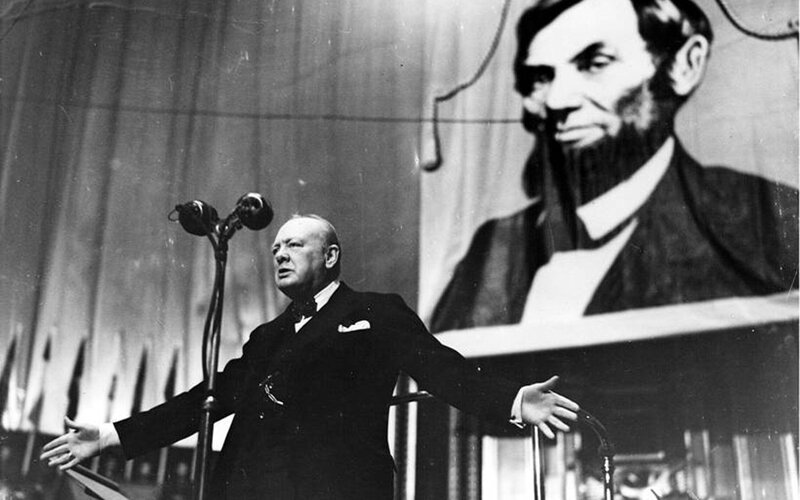
 Churchill speaking at the Albert Hall in London, 1944, at an American Thanksgiving Celebration.  Churchill Centre image

Churchill speaking at the Albert Hall in London, 1944, at an American Thanksgiving Celebration. Churchill Centre image

Never give in, never give in, never, never, never, never — in nothing, great or small, large or petty — never give in except to convictions of honour and good sense!

Winston S. Churchill, address to the boys of Harrow School, October 29, 1941.

More:

(This version may be a re-enactment of the vocal delivery.]

This is much an encore post, from 2007, with material added.


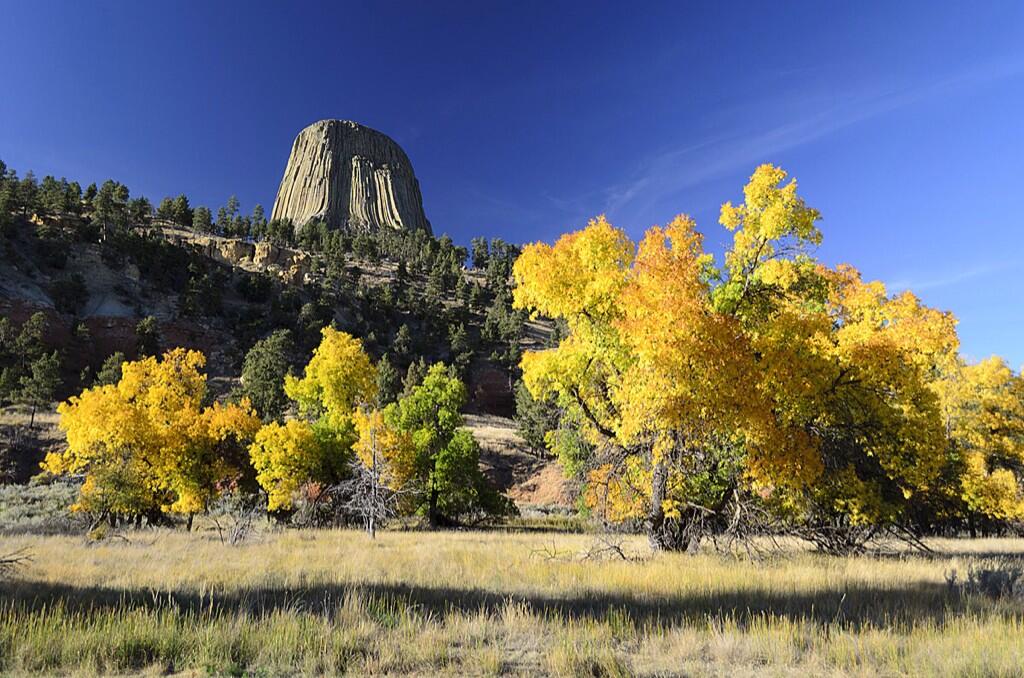
Devils Tower is beautiful in autumn

October 25, 2013

Or any other time of year.

From the Department of Interior Twitter feeds:

 Devils Tower NM. pic.twitter.com/YRo1U8DSMQ

US Dept of Interior ‏@Interior 16h Is there any doubt fall is best enjoyed in America’s great outdoors? Here’s great example from Devils Tower NM. pic.twitter.com/YRo1U8DSMQ

What do you think Richard Dreyfus thinks when he sees that?  Stephen Spielberg?

Devils Tower NM” means “National Monument,” not New Mexico.  This volcano remnant stands in Wyoming.

Old friend, painter and photographer Nancy Christensen Littlefield offers a more close-up view.

Devil's Tower on a July morning.  Photo by Nancy Christensen LIttlefield.

Devil’s Tower on a July morning. Photo by Nancy Christensen LIttlefield.

And looking even closer, you spy Richard Dreyfus never-wanna-bes:

Climbers on Devil's Tower. Photographer Nancy Littlefield

Climbers on Devils Tower. Photographer Nancy Littlefield said: “There were Native American prayer bundles along the trail around the base. It really is awe inspiring. Early morning gives you the best light to photograph it by.”

Devils Tower is the plug of an old volcano.  What’s left is the magma that hardened, and what we see is left after the softer cone eroded away.

More:


Is your science class as smart as a U-Haul truck?

October 23, 2013

We had to fight to keep this stuff in Texas science books.

Then, out on the street, I see a U-Haul truck.

U-Haul truck features geographic information, and geology information

U-Haul truck features geographic information, and geology information, about Arkansas and its Crater of Diamonds State Park.

Detail:  U-Haul truck features a graphic description of the geology and information about Arkansas's Crater of Diamonds State Park.

Detail: U-Haul truck features a graphic description of the geology and information about Arkansas’s Crater of Diamonds State Park.

Well played, U-Haul.  Can Texas catch up?

Update, October 24, 2013:  Turns out U-Haul has a website that features all of the graphics they use on their trucks.  I sense a geography or state history assignment in here, somewhere, social studies teachers.  Reminds me of the animals that used to (still do?) grace the tails of Frontier Airlines airplanes, the Native American on the tails of Alaska Airlines, and other specific destination promoting tricks businesses have used over the years.  Wish more businesses would do that.

http://twitter.com/SuperGraphic/status/393408729388834816

More:


October 22, 1913: Dawson mine disaster killed 263 in New Mexico

October 22, 2013

Albuqurque Journal photo and caption: Iron crosses dot the Dawson Cemetery in Colfax County, the site of a once bustling coal mining region. The Dawson mines produced millions of tons of coal in the first half of the 20th century, but also took the lives of many miners. On Oct. 22, 1913, 263 miners were killed in an explosion. On Feb. 8, 1923, another Dawson mine explosion killed 123 miners. (Journal File)

Albuquerque Journal photo and caption: Iron crosses dot the Dawson Cemetery in Colfax County, the site of a once bustling coal mining region. The Dawson mines produced millions of tons of coal in the first half of the 20th century, but also took the lives of many miners. On Oct. 22, 1913, 263 miners were killed in an explosion. On Feb. 8, 1923, another Dawson mine explosion killed 123 miners. (Journal File)

Who remembers, today?

In our recent history, a disaster in one small town or one company that killed 263 people would stand out.  But the Dawson, New Mexico, coal mine explosion of October 22, 1913, is mostly forgotten today.

100 years later, all ten of the town’s mines are closed, victim to increasing use of petroleum as fuel in the U.S.  The town itself is a ghost town, though once its schools produced scholars from children of immigrants, and state champions on the athletic fields.  A strike by miners in Colorado may have contributed to the explosion, as corporate executives tried to goose coal production in Dawson to cover shortfalls from mines closed by the strikes.  Unions then grew to major influence in American life, including increasing safety in coal mining.  But unions, today, hold waning influence generally.

Many or most of those who died didn’t speak English.  Instead, they spoke the languages of their native lands, Italy, Greece, Germany, and other European nations.  Despite its location in New Mexico, there were few Native Americans, or residents or immigrants of Hispanic origins.

Today’s anniversary should be a departure point for rich discussion of many threads in American history, the rise of industrialization, the changing industries of the cowboy frontier towns, the changing ownership of lands from Native Americans to big corporations, the changing nature of work and union influence, the dramatically different views of government and government regulation, the role of immigration and immigrants.

In your state’s standards, Common Core State Standards or not, can a teacher intrigue students with real history in any of those ways?

The Albuquerque Journal remembered the disaster in an article in Sunday’s edition:

The second-deadliest coal mining disaster in U.S. history occurred 100 years ago this week in a northern New Mexico town that no longer exists, save for the small cemetery bearing the remains of many of the 263 miners killed in a massive explosion on the afternoon of Oct. 22, 1913.

Though the town of Dawson and the Stag Canyon No. 2 coal mine are mere footnotes in history to most people, the men who died there a century ago – mostly Italian and Greek immigrants lured to the coal fields by decent-paying jobs and all the amenities a company town like Dawson could offer – are far from forgotten.

In ceremonies today at the Raton Museum, the miners killed in what has become known as the Dawson Mining Disaster will be remembered by descendents, historians and New Mexico’s Italian and Greek communities.

“I think it’s important to honor these men, and all immigrants who helped build America,” said Nicki Panagopoulos, a member of St. George Greek Orthodox Church in Albuquerque.

A second disaster a decade later killed another 123 miners.

Who remembers? How should we study these events in our history classes?  Do we study such events at all?

More:

English: Main Street of Dawson, New Mexico. Ta...

Main Street of Dawson, New Mexico. Taken in 1916. Though once an active community of 9,000 residents supporting ten coal mines, it is now a ghost town, shut down by Phelps Dodge Corporation in 1950, and bulldozed. Wikipedia image


Signs: “Check caching”

October 21, 2013

Utah has a Cache County, which includes most of the Cache Valley.  In 7th grade Utah history, if not before, Utah kids learn that the name came from the old Mountain Men, French-descended fur trappers who plied the area well before the Mormon pioneers and even John C. Fremont.

A trapper could collect a half-ton of beaver pelts in a season, to sell to a large corporation to export to Europe to be made into felt.  He wouldn’t want to carry that weight around with him.  So trappers would make a place to hide their furs until trading time — a “cache” in fractured French, from the word “cacher,” which means “to hide,” in this case. (See also Colorado’s Cache la Poudre River.)

Utah’s Cache Valley at least one year hosted the grand rendezvous of fur trappers and their hosting corporate suppliers and buyers, and for much of a decade or longer was a place where fur trappers hid their furs awaiting the rendezvous — great American explorers and pioneers like Jedediah Smith, Jim Bridger, James Beckwourth, Peter Skene Ogden and Thomas Fitzpatrick.

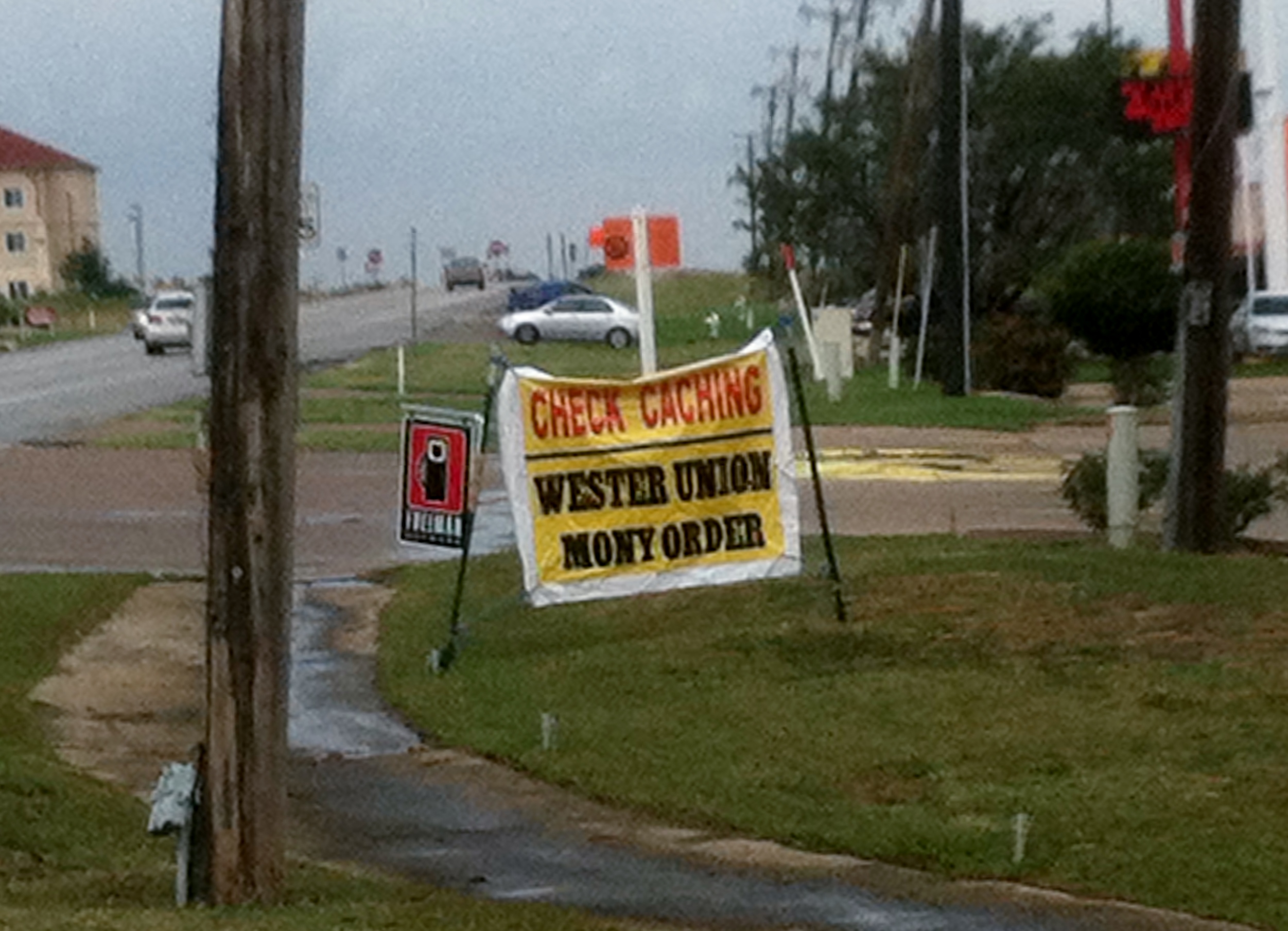
Maybe the people who made this sign didn’t know that history.  I found it in Alvarado, Texas, after all.

There is a world of difference between “cashing a check” and “caching a check,” though.  Surely there is an Abbott and Costello-style comedy routine in this sign:

Check caching in Alvarado, Texas?

Check caching in Alvarado, Texas?

Six words on that sign.  Three of them are misspelled, 50%.

I imagine someone entering the store to cash a check, handing it to the clerk who promptly drops it into a slot in a mysterious box and says, “All cached.”  “Where’s my check?” the customer demands.  Abbott and Costello enter from the back room.

Then I got stuck with an ugly earworm for the next few miles, with Tommy James infecting my brain.  But for the want of an “e” it could have been the Beatles or Pink Floyd.

I hope the merchant got a heckuva discount from the sign maker.  At least 50% off.

Camp near the head of Cache Valley, Utah - NAR...

Cache Valley, Utah, in the late 19th or early 20th century; camp near the head of Cache Valley – NARA – 516657 via Wikipedia

Cache Valley, Utah, today, after an infusion of cash. Jim Bridger wouldn't recognize the place.  Wikipedia image

Cache Valley, Utah, today, after an infusion of cash. Jim Bridger wouldn’t recognize the place. Wikipedia image


Again: Motivation 101 – How NOT to

October 18, 2013

This is an encore post, mostly.

“A Swift Kick in the Butt $1.00,” A daily strip of the cartoon series “Calvin and Hobbes,” by Bill Watterson. Watterson appears to have an instinctual understanding of what motivation is not. It’s a topic he returned to with some frequency.

Educators don’t know beans about motivation I think. I still see courses offered on “how to motivate” students to do X, or Y, or Z — or how to motivate faculty members to motivate students to do X.

This view of motivation is all wrong, the industrial psychologists and experience say. A student must motivate herself.

A teacher can remove barriers to motivation, or help a student find motivation. But motivation cannot be external to the person acting.

Frederick Herzberg wrote a classic article for The Harvard Business Review several years back: “One More Time: How Do You Motivate Employees?” Herzberg would get a group of managers together and ask them, “If I have six week-old puppy, and I want it to move, how do I get it to move?” Inevitably, one of the wizened managers of people would say, “Kick him in the ass!” Is that motivation? Herzberg would ask? Managers would nod “yes.”

Frederick Herzberg, 1923-2000

Frederick Herzberg, 1923-2000

Then, Herzberg would ask what about dealing with the pup six months later. To get the older pup to move, he’d offer a doggie yum, and the dog would come. “Is that motivation?” Herzberg would ask. Again, the managers would agree that it was motivation. (At AMR’s Committing to Leadership sessions, we tried this exercise several hundred times, with roughly the same results. PETA has changed sensitivities a bit, and managers are fearful of saying they want to kick puppies, but they’ll say it in different words.)

Herzberg called this “Kick In The Ass” theory, or KITA, to avoid profanity and shorten the phrase.

Herzberg would then chastise the managers. Neither case was motivation, he’d say. One was violence, a mugging; the other was a bribe. In neither case did the dog want to move, in neither case was the dog motivated. In both cases, it was the manager who was motivated to make the dog move.

Motivation is the desire to do something, the desire and drive to get something done.

Motivating employees is getting them to share the urgency a manager feels to do a task, to go out and do it on their own without being told how to do each and every step along the way.

Motivation is not simply coercing someone else to do what you want, on threat of pain, virtual or real.

Herzberg verified his theories with research involving several thousands of employees over a couple of decades. His pamphlet for HBR sold over a million copies.

Education is wholly ignorant of Herzberg’s work, so far as I can tell. How do I know?

See this, at TexasEd Spectator:

Death threat as a motivation technique

May 23rd, 2008
Education | MySanAntonio.com

The sad part about this is that I bet if a mere, ordinary teacher were to have made some similar statement, he or she would be treated more like the student rather than the principle.

Now imagine if some student at the school had said something along the same lines in a writing assignment. We would be hearing about zero tolerance all over the place. The student would be out of the regular classroom so fast it would make your head spin.

No charges will be brought against New Braunfels Middle School Principal John Burks for allegedly threatening to kill a group of science teachers if their students’ standardized test scores failed to improve, although all four teachers at the meeting told police investigators Burks made the statement.

Kick in the ass, knife in the back, knife in the heart — that ain’t motivation.

As God is my witness, you can’t make this stuff up.

I’m not sure who deserves more disgust, the principal who made the threat and probably didn’t know anything else to do, or the teachers who didn’t see it as a joke, or treat it that way to save the principal’s dignity — or a system where such things are regarded as normal.

Bill Watterson returned to the

Bill Watterson returned to the “Swift Kick in the Butt, $1.00” strip, but this time with the more lively Hobbes Calvin interacted with most often. What would motivate a cartoonist to do that? Watterson is said to have observed, “People will pay for what they want, but not what they need.” Can school administrators even figure out what teachers and students need?  Which version do you prefer? Which one motivates you?

More: