Lift a glass of champagne today in tribute to Edwin Hubble and his great discovery. Not sure what to call it — Hubble Day, Looking Up Day, Endless Possibilities Day — whatever, this is the anniversary of Edwin Hubble’s announcement that he had discovered the universe is much, much larger than anyone had imagined, containing far more stars than anyone had dared guess.
It’s a big universe out there.
Ultraviolet image of the Andromeda Galaxy, first known to be a galaxy by Edwin Hubble on December 30, 1924 - Galaxy Evolution Explorer image courtesy NASA
So, today is a good day to celebrate the universe in all it’s glory – December 30.
On December 30, 1924, Edwin Hubble announced he’d discovered other galaxies in distant space. Though it may not have been so clear at the time, it meant that, as a galaxy, we are not alone in the universe (whether we are alone as intelligent life is a separate question). It also meant that the universe is much, much bigger than most people had dared to imagine.
Hubble was the guy who showed us the universe is not only bigger than we imagined, it’s probably much bigger and much more fantastic than we can imagine. Hubble is the guy who opened our imaginations to the vastness of all creation.
How does one celebrate Hubble Day? Here are some suggestions:
Easier than Christmas cards: Send a thank-you note to your junior high school science teacher, or whoever it was who inspired your interest in science. Mrs. Hedburg, Mrs. Andrews, Elizabeth K. Driggs, Herbert Gilbert, Mr. Willis, and Stephen McNeal, thank you.
Rearrange your Christmas/Hanukkah/Eid/KWANZAA lights in the shape of the Andromeda Galaxy — or in the shape of any of the great photos from the Hubble Telescope (Andromeda Galaxy pictured above; Hubble images here)
A few of the images from the Hubble Telescope
Go visit your local science museum; take your kids along – borrow somebody else’s kids if you have to (take them along, too)
Spend two hours in your local library, just looking through the books on astronomy and the universe
Write a letter to your senators and congressman; tell them space exploration takes a minuscule portion of our federal budget, but it makes us dream big; tell them we need to dream big, and so they’d better make sure NASA is funded well. While you’re at it, put in a plug for funding Big Bird and the rest of public broadcasting, too. Science education in this nation more and more becomes the science shows on NPR and PBS, watched by kids who learned to read and think by watching Big Bird.
Anybody got a good recipe for a cocktail called “The Hubble?” “The Andromeda?” Put it in the comments, please. “The Hubble” should have bubbles in it, don’t you think? What was it the good monk said? He was working to make great wine, but goofed somewhere, and charged the wine with another dose of yeast. When he uncorked the very first bottle of what would come to be called champagne, Benedictine Monk Dom Pierre Perignon said “I am drinking stars!” Only in French. In any case, a Hubble cocktail should have bubbles, some of Perignon’s stars.
In 1924, he announced the discovery of a Cepheid, or variable star, in the Andromeda Nebulae. Since the work of Henrietta Leavitt had made it possible to calculate the distance to Cepheids, he calculated that this Cepheid was much further away than anyone had thought and that therefore the nebulae was not a gaseous cloud inside our galaxy, like so many nebulae, but in fact, a galaxy of stars just like the Milky Way. Only much further away. Until now, people believed that the only thing existing outside the Milky Way were the Magellanic Clouds. The Universe was much bigger than had been previously presumed.
Later Hubble noted that the universe demonstrates a “red-shift phenomenon.” The universe is expanding. This led to the idea of an initial expansion event, and the theory eventually known as Big Bang.
Hubble’s life offered several surprises, and firsts:
Hubble was a tall, elegant, athletic, man who at age 30 had an undergraduate degree in astronomy and mathematics, a legal degree as a Rhodes scholar, followed by a PhD in astronomy. He was an attorney in Kentucky (joined its bar in 1913), and had served in WWI, rising to the rank of major. He was bored with law and decided to go back to his studies in astronomy.
In 1919 he began to work at Mt. Wilson Observatory in California, where he would work for the rest of his life. . . .
Hubble wanted to classify the galaxies according to their content, distance, shape, and brightness patterns, and in his observations he made another momentous discovery: By observing redshifts in the light wavelengths emitted by the galaxies, he saw that galaxies were moving away from each other at a rate constant to the distance between them (Hubble’s Law). The further away they were, the faster they receded. This led to the calculation of the point where the expansion began, and confirmation of the big bang theory. Hubble calculated it to be about 2 billion years ago, but more recent estimates have revised that to 20 billion years ago.
An active anti-fascist, Hubble wanted to joined the armed forces again during World War II, but was convinced he could contribute more as a scientist on the homefront. When the 200-inch telescope was completed on Mt. Palomar, Hubble was given the honor of first use. He died in 1953.
“Equipped with his five senses, man explores the universe around him and calls the adventure Science.”
(Does anyone have a suitable citation for that video? Where did it come from? Who produced it? Is there more somewhere?)
Happy Hubble Day! Look up!
Resources:
Journey to Palomar site (production currently being broadcast on PBS affiliates – wonderful story of George Ellery Hale and the origins of modern astronomy at Palomar; that’s where Hubble worked)
Great pictures from NASA’s Solar Dynamics Observatory.
A newly-discovered comet, Comet Lovejoy, orbited dangerously close to the Sun for a ball of ice. Experts predicted it would be the last trip for the little planetoid.
But, then Lovejoy zoomed out from the other side of our home star. Amazing.
See it for yourself:
How surprising was this? Look at this earlier piece, inviting people to watch the end of the comet:
Dec. 16, 2011: This morning, an armada of spacecraft witnessed something that many experts thought impossible. Comet Lovejoy flew through the hot atmosphere of the sun and emerged intact.
“It’s absolutely astounding,” says Karl Battams of the Naval Research Lab in Washington DC. “I did not think the comet’s icy core was big enough to survive plunging through the several million degree solar corona for close to an hour, but Comet Lovejoy is still with us.”
The comet’s close encounter was recorded by at least five spacecraft: NASA’s Solar Dynamics Observatory and twin STEREO probes, Europe’s Proba2 microsatellite, and the ESA/NASA Solar and Heliospheric Observatory. The most dramatic footage so far comes from SDO, which saw the comet go in (movie) and then come back out again (movie).
In the SDO movies, the comet’s tail wriggles wildly as the comet plunges through the sun’s hot atmosphere only 120,000 km above the stellar surface. This could be a sign that the comet was buffeted by plasma waves coursing through the corona. Or perhaps the tail was bouncing back and forth off great magnetic loops known to permeate the sun’s atmosphere. No one knows.
“This is all new,” says Battams. “SDO is giving us our first look1 at comets travelling through the sun’s atmosphere. How the two interact is cutting-edge research.”
“The motions of the comet material in the sun’s magnetic field are just fascinating,” adds SDO project scientist Dean Pesnell of the Goddard Space Flight Center. “The abrupt changes in direction reminded me of how the solar wind affected the tail of Comet Encke in 2007 (movie).”
Comet Lovejoy was discovered on Dec. 2, 2011, by amateur astronomer Terry Lovejoy of Australia. Researchers quickly realized that the new find was a member of the Kreutz family of sungrazing comets. Named after the German astronomer Heinrich Kreutz, who first studied them, Kreutz sungrazers are fragments of a single giant comet that broke apart back in the 12th century (probably the Great Comet of 1106). Kreutz sungrazers are typically small (~10 meters wide) and numerous. The Solar and Heliospheric Observatory sees one falling into the sun every few days.
At the time of discovery, Comet Lovejoy appeared to be at least ten times larger than the usual Kreutz sungrazer, somewhere in the in the 100 to 200 meter range. In light of today’s events, researchers are re-thinking those numbers.
This coronagraph image from the Solar and Heliospheric Observatory shows Comet Lovejoy receding from the sun after its close encounter. The horizontal lines through the comet’s nucleus are digital artifacts caused by saturation of the detector; Lovejoy that that bright! [movie]
“I’d guess the comet’s core must have been at least 500 meters in diameter; otherwise it couldn’t have survived so much solar heating,” says Matthew Knight. “A significant fraction of that mass would have been lost during the encounter. The remains are probably much smaller.”
SOHO and NASA’s twin STEREO probes are monitoring the comet as it recedes from the sun. It is still very bright and should remain in range of the spacecrafts’ cameras for several days to come.
What happens next is anyone’s guess.
“There is still a possibility that Comet Lovejoy will start to fragment,” continues Battams. “It’s been through a tremendously traumatic event; structurally, it could be extremely weak. On the other hand, it could hold itself together and disappear back into the recesses of the solar system.”
“It’s hard to say,” agrees Knight. “There has been so little work on what happens to sungrazing comets after perihelion (closest approach). This continues to be fascinating.”
Author:Dr. Tony Phillips| Production editor: Dr. Tony Phillips | Credit: Science@NASA
More Information
Footnote:1“When SDO was launched we thought we would see nothing besides the Sun and the dark disks of the Moon, Earth, Venus, and Mercury in our images,” says SDO project scientist Dean Pesnell of GSFC. “No other bright object would be visible because our instruments are designed to look at the Sun. Now we are measuring the mass and composition of comets by turning the comet inside out.”
Spread the word; friends don't allow friends to repeat history.
Wikipedia describes this old woodcut: "The most famous depiction of the 1833 actually produced in 1889 for the Adventist book Bible Readings for the Home Circle - the engraving is by Adolf Vollmy based upon an original painting by the Swiss artist Karl Jauslin, that is in turn based on a first-person account of the 1833 storm by a minister, Joseph Harvey Waggoner on his way from Florida to New Orleans."
There are a few spectacular shots of the Leonid meteors this year — got one you want to share?
It took me a couple of tries to figure it out — last week when I told people Kathryn and I were off to Colorado Bend State Park to spend time on the river, several people commented about how much cooler it would be there.
What? West of Killeen about an hour, ten miles of dusty road outside of Bend, Texas (population 1,637), Colorado Bend is not cooler than Dallas. It was over 100° F every day we were there, stayed well above 90° most of the nights.
Kathryn studied wildflowers at a spring at the side of the Colorado River during a break from kayaking; this spring's flow was reduced, but still moist enough to create a near-oasis.
Our well-wishers were geographically confused. They thought we were headed to the Colorado River in Colorado, not the Colorado River in Texas, which is not the same river at all. I didn’t bother to check the temperatures in Colorado, but one might be assured that it was cooler along the Colorado River in Colorado than it was along the Colorado River in Texas.
It was a return trip. We stumbled into the park 16 years ago with the kids, for just an afternoon visit. The dipping pools in the canyon fed by Spicewood Springs captivated us. It took a while to get back, and then the kids were off doing their own thing.
So, just a quick weekend of hiking/camping/kayaking/soaking/stargazing/bird watching/botanical and geological study. Park officials closed the bat caves to human traffic in hope of keeping White Nose Syndrome from the bats; we didn’t bother to sign up for the crawling cave tour through another.
The author, still working to master that Go-Pro camera on the hat -- some spectacular shots, but I don't have the movie software to use it all; you know it's hot when SPF 75 sunscreen is not enough.
What did we see? Drought has a firm grip on Texas, especially in the Hill Country, especially outside of Dallas. The Colorado River is mostly spring fed; many of the springs are dry. No water significant water flowed through the park while we were there — kayak put-ins have been reduced to the downriver-most ramp, and the bottom of the boat launch ramp is three feet above water. Gorman Falls attracts visitors and scientists, but the springs feeding it are about spent this year — just a few trickles came over the cliff usually completely inundated with mineral-laden waters.
Drought produces odd things. The forest canopy around the park — and through most of the Hill Country we saw — is splattered with the gray wood of dead trees, many of which at least leafed out earlier this spring. The loss to forests is astonishing. Deer don’t breed well in droughts; deer around the campsites boldly challenge campers for access to grasses they’d ignore in other seasons. One ranger said he hadn’t seen more than about three fawns from this past spring, a 75% to 90% reduction in deer young (Eastern White Tail, the little guys). Raccoons are aggressively seeking food from humans, tearing into tents and challenging campers for food they can smell (lock your food in the car!). Colorado Bend is famous for songbirds, including the endangered Golden Cheeked Warbler, and the elusive, spectacular painted bunting. But the most commonly-sighted birds this year are turkey vultures, dining on the young that didn’t make it healthy into the summer and won’t survive until fall.
Warming denialists’ claims of “not so bad a drought” ring out as dangerous, wild delusion. (By actual measurement, Texas average rainfall the past nine months was 8.5 inches, the driest ever recorded in Texas, shattering the old record drought of 1917).
Great trip. Kathryn’s menu planning was spectacular. The old Coleman stove — a quarter century old, now, with fuel almost that old — performed like a champ even without the maintenance it needs (later this week). Other than the hot nights, it was stellar.
Stellar. Yeah. Stars were grand. It was New Moon, a happy accident. A topic for another post, later. Think, “Iridium.”
So posting was slow over the weekend. How far out in the Hill Country were we? Neither one of us could get a bar on our phones. We were so far out the Verizon Wireless guy was using smoke signals.
Thoreau was right, you know.
Spread the word; friends don't allow friends to repeat history.
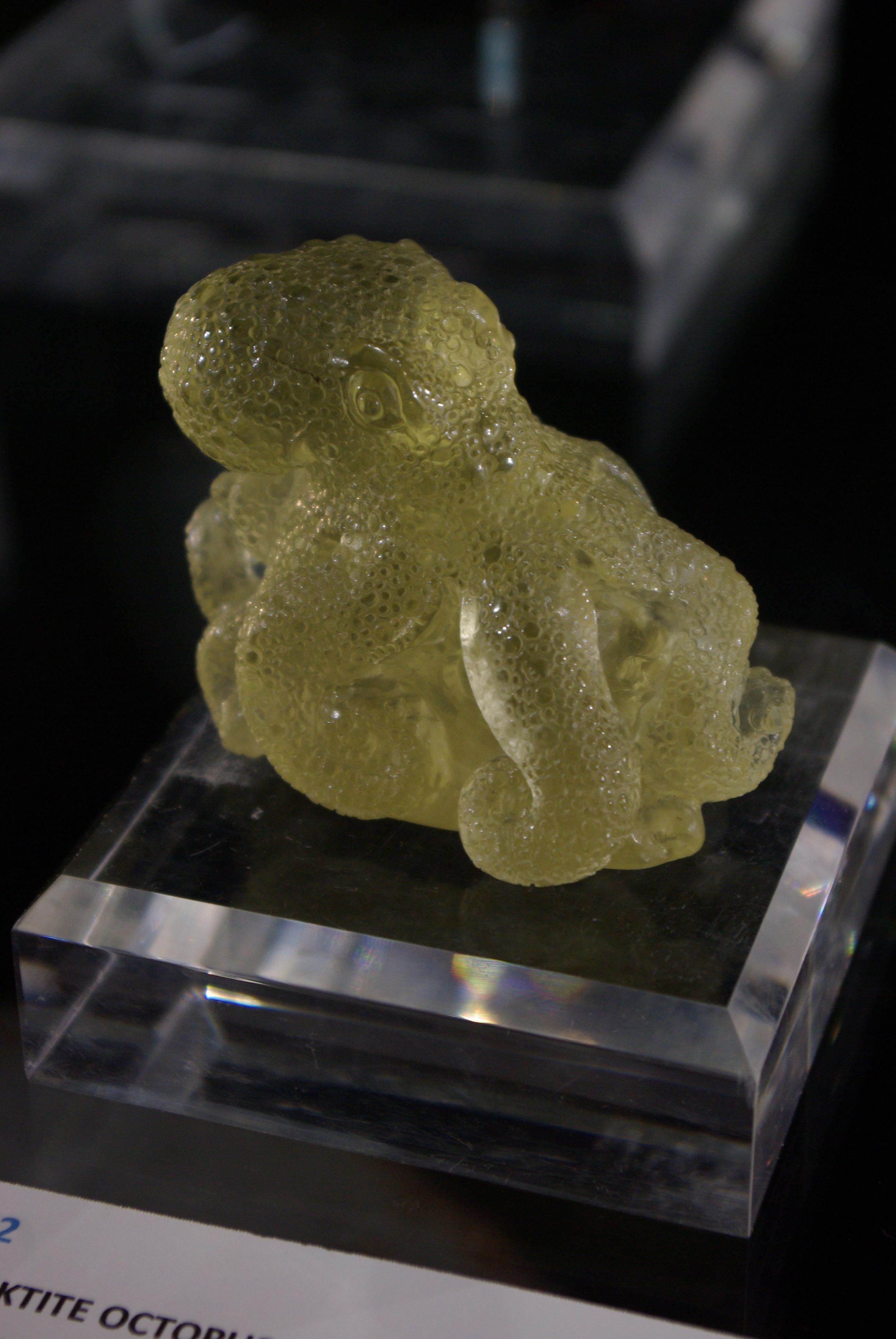
According to the catalogue from Heritage Auctions, this piece of glass was formed in what is now the Libyan Sahara 29 million years ago when a meteoroid struck the sand, creating massive heat that fused sand into glass. This light lemonade colored glass comes from only a small part of the Libyan sands. Tektite is collectible by itself. Some craftsman (unidentified and unplaced in time by Heritage Auctions) carved this piece into a cephalopod.
Taking an uncommonly large and clear specimen, the master lapidarist has carved the form of a malevolent-looking octopus, with superb rugose skin texture and a mass of curling tentacles. With a gorgeous translucence and lovely delicate green/yellow color, this exceptional sculpture measures 2¾ x 2 x 1¾ inches. Estimate: $2,800 – $3,200.
Compared to the giant articulated dinosaurs about 50 feet away from the display, one could easily overlook this little gem. Still, bidding online looked to be pretty active. Is P.Z. still in the British Isles? Is he bidding by internet? Is his Trophy Wife™ planning a Father’s Day surprise?
Tektites should pique your interest, Dear Reader. Glass formed only when interplanetary objects smash into the planet, providing clues to the makeup of our solar system and universe, dating back well before recorded time, found in only a few fields around the Earth. They are the perfect marriage-merger of geology, astronomy, geography, natural history, history and, in this case, art. They are popular among collectors. Who walks away with this one this afternoon?
Spread the word; friends don't allow friends to repeat history.
Old Sol spoke out this week: Huge solar flare on June 7.
For scientists, it was a cool deal — especially since the flair was on the side of the Sun facing us, and there were cameras of various types trained on the action.
But just watch: The internet will light up with concerns about 2012, and those who deny warming occurs or that humans cause it, will find some reason to claim the solar flare shows that Al Gore is fat and Rachel Carson is a mass murderer, plus Darwin was the inspiration for Adolf Hitler.
If the Sun knew it would get such a reception, would it bother?
Take a look:
Still shot of the June 7, 2011 solar flare -- NASA/SDO via PopSci
Here’s a pixillated video of the event in UV at 304 Angstroms — it runs under 30 seconds, but the time covered is about two-and-a-half hours; from SOHO – SDO via TheSunToday.org:
Here’s another way to drive creationists absolutely up the wall: Lift a glass of champagne today in tribute to Edwin Hubble and his great discovery.
Ultraviolet image of the Andromeda Galaxy, first known to be a galaxy by Edwin Hubble on December 30, 1924 - Galaxy Evolution Explorer image courtesy NASA
Today is a good day to celebrate the universe in all it’s glory – December 30.
On December 30, 1924, Edwin Hubble announced he’d discovered other galaxies in distant space. Though it may not have been so clear at the time, it meant that, as a galaxy, we are not alone in the universe (whether we are alone as intelligent life is a separate question). It also meant that the universe is much, much bigger than most people had dared to imagine.
Hubble was the guy who showed us the universe is not only bigger than we imagined, it’s probably much bigger and much more fantastic than we can imagine. Hubble is the guy who opened our imaginations to the vastness of all creation.
How does one celebrate Hubble Day? Here are some suggestions:
Easier than Christmas cards: Send a thank-you note to your junior high school science teacher, or whoever it was who inspired your interest in science. Mrs. Hedburg, Mrs. Andrews, Elizabeth K. Driggs, Herbert Gilbert, Mr. Willis, and Stephen McNeal, thank you.
Rearrange your Christmas/Hanukkah/Eid/KWANZAA lights in the shape of the Andromeda Galaxy — or in the shape of any of the great photos from the Hubble Telescope (Andromeda Galaxy pictured above; Hubble images here)
A few of the images from the Hubble Telescope
Go visit your local science museum; take your kids along – borrow somebody else’s kids if you have to (take them along, too)
Spend two hours in your local library, just looking through the books on astronomy and the universe
Anybody got a good recipe for a cocktail called “The Hubble?” “The Andromeda?” Put it in the comments, please
In 1924, he announced the discovery of a Cepheid, or variable star, in the Andromeda Nebulae. Since the work of Henrietta Leavitt had made it possible to calculate the distance to Cepheids, he calculated that this Cepheid was much further away than anyone had thought and that therefore the nebulae was not a gaseous cloud inside our galaxy, like so many nebulae, but in fact, a galaxy of stars just like the Milky Way. Only much further away. Until now, people believed that the only thing existing outside the Milky Way were the Magellanic Clouds. The Universe was much bigger than had been previously presumed.
Later Hubble noted that the universe demonstrates a “red-shift phenomenon.” The universe is expanding. This led to the idea of an initial expansion event, and the theory eventually known as Big Bang.
Hubble’s life offered several surprises, and firsts:
Hubble was a tall, elegant, athletic, man who at age 30 had an undergraduate degree in astronomy and mathematics, a legal degree as a Rhodes scholar, followed by a PhD in astronomy. He was an attorney in Kentucky (joined its bar in 1913), and had served in WWI, rising to the rank of major. He was bored with law and decided to go back to his studies in astronomy.
In 1919 he began to work at Mt. Wilson Observatory in California, where he would work for the rest of his life. . . .
Hubble wanted to classify the galaxies according to their content, distance, shape, and brightness patterns, and in his observations he made another momentous discovery: By observing redshifts in the light wavelengths emitted by the galaxies, he saw that galaxies were moving away from each other at a rate constant to the distance between them (Hubble’s Law). The further away they were, the faster they receded. This led to the calculation of the point where the expansion began, and confirmation of the big bang theory. Hubble calculated it to be about 2 billion years ago, but more recent estimates have revised that to 20 billion years ago.
An active anti-fascist, Hubble wanted to joined the armed forces again during World War II, but was convinced he could contribute more as a scientist on the homefront. When the 200-inch telescope was completed on Mt. Palomar, Hubble was given the honor of first use. He died in 1953.
“Equipped with his five senses, man explores the universe around him and calls the adventure Science.”
(Does anyone have a suitable citation for that video? Where did it come from? Who produced it? Is there more somewhere?)
Happy Hubble Day! Look up!
Resources:
Journey to Palomar site (production currently being broadcast on PBS affiliates – wonderful story of George Ellery Hale and the origins of modern astronomy at Palomar; that’s where Hubble worked)
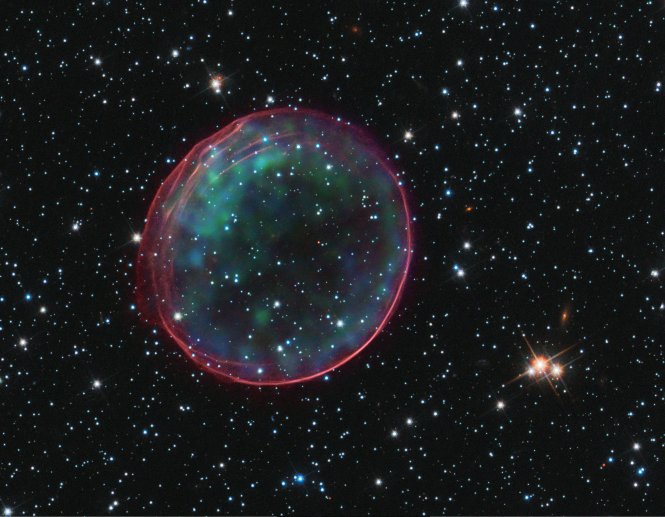
Supernova SNR 0509-67.5, image a composite of Hubble Space Telescope and CHANDRA X-ray Observatory images - image from NASA (click on image for larger view)
This colorful creation was made by combining data from two of NASA’s Great Observatories. Optical data of SNR 0509-67.5 and its accompanying star field, taken with the Hubble Space Telescope, are composited with X-ray energies from the Chandra X-ray Observatory. The result shows soft green and blue hues of heated material from the X-ray data surrounded by the glowing pink optical shell which shows the ambient gas being shocked by the expanding blast wave from the supernova. Ripples in the shell’s appearance coincide with brighter areas of the X-ray data.
The Type 1a supernova that resulted in the creation of SNR 0509-67.5 occurred nearly 400 years ago for Earth viewers. The supernova remnant, and its progenitor star reside in the Large Magellanic Cloud (LMC), a small galaxy about 160,000 light-years from Earth. The bubble-shaped shroud of gas is 23 light-years across and is expanding at more than 11 million miles per hour (5,000 kilometers per second).
Data from Hubble’s Advanced Camera for Surveys, taken in 2006 with a filter that isolates light from glowing hydrogen were combined with visible-light images of the surrounding star field that were imaged with Hubble’s Wide Field Camera 3 in 2010. These data were then merged with X-ray data from the Chandra X-ray Observatory taken with the Advanced CCD Imaging Spectrometer (ACIS) in 2000 and 2007.
Credits: X-ray: NASA/CXC/SAO/J.Hughes et al, Optical: NASA/ESA/Hubble Heritage Team (STScI/AURA)
Spread the word; friends don't allow friends to repeat history.
December 27 is one of those days — many of us are off work, but it’s after Boxing Day, and it’s not yet on to New Year’s Eve or Day. We should have celebrated, maybe.
We should celebrate it as a day of portent: A good embarkation, and a good, safe end to a nation-encouraging trip to almost touch the Moon.
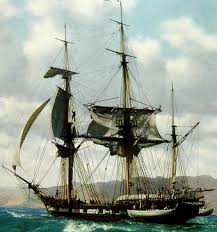
HMS Beagle, on a voyage of discovery
On December 27, 1831, Charles Darwin and H.M.S. Beagle set sail on an around-the-world voyage of discovery that would change all of science, and especially biology, forever.
December 27 1831
After a few delays, H.M.S. Beagle headed out from Plymouth with a crew of 73 under clear skies and a good wind. Darwin became sea-sick almost immediately.
Darwin never fully overcame his seasickness, but he fought it well enough to become the single greatest collector of specimens in history for the British Museum and British science, a distinction that won him election to science societies even before his return from the trip — and cemented his life in science, instead of in the church. Darwin’s discoveries would have revolutionized biology in any case. In analyzing what he had found, a few years later and with the aid of experts at the British Museum, Darwin realized he had disproved much of William Paley’s hypotheses about life and its diversity, and that another, more basic explanation was possible. This led to his discovery of evolution by natural and sexual selection.
Mini-sheet from the Royal Mail in 2009 honoring Darwin's discoveries in the Galapagos Islands
On December 27, 1968, Apollo 8 splashed down after a successful and heartening trip to orbit the Moon. The three crewmen, Commander Frank Borman, James A. Lovell, Jr., and William A. Anders, had orbited the Moon, a very important milestone in the methodological race to put humans on the Moon (which would be accomplished seven months later). 1968 was a terrible year for the U.S., with the North Korean capture of the U.S.S. Pueblo, assassinations of Rev. Martin Luther King, Jr., and Sen. Robert F. Kennedy during the presidential campaign, riots in dozens of American cities, nasty political conventions with riots at the Democratic Convention in Chicago, a contentious and bitter election making sore the nation’s divide over Vietnam policy, and other problems. On Christmas Eve, Borman, Lovell and Anders broadcast from orbit around the Moon, a triumphant and touching moment for the Apollo Program and Americans around the world. Their safe return on December 27 raised hopes for a better year in 1969.
In 1968, NASA engineers were scrambling to meet President Kennedy’s challenge to land a man on the moon by decade’s end. Because delays with the lunar module were threatening to slow the Apollo program, NASA chose to change mission plans and send the crew of Apollo 8 all the way to the moon without a lunar module.
Exactly 42 years ago, the three astronauts of Apollo 8 became the first humans to orbit another celestial object. As they came around the dark side for the third time, Frank Borman, the commander, finally turned their capsule around. And then they saw the Earth.
Borman: Oh my God! Look at that picture over there! Here’s the Earth coming up. Wow, is that pretty.
Anders: Hey, don’t take that, it’s not scheduled.
Borman: (laughing) You got a color film, Jim?
Anders: Hand me that roll of color quick, will you…
One of the resulting photos taken by Anders on a Hasselblad camera became one of the world’s most iconic images.
As Bill Anders recalls it:
I just happened to have one with color film in it and a long lens. All I did was to keep snapping… It’s not a very good photo as photos go, but it’s a special one. It was the first statement of our planet Earth and it was particularly impressive because it’s contrasted against this startling horizon… After all the training and studying we’d done as pilots and engineers to get to the moon safely and get back, [and] as human beings to explore moon orbit, what we really discovered was the planet Earth.
Yeah, we missed toasting it on time in 2010. Plan to raise a glass on December 27, 2011, to Good Trip Day for the human race. December 27 is a day we should remember, for these achievements.
Spread the word; friends don't allow friends to repeat history.
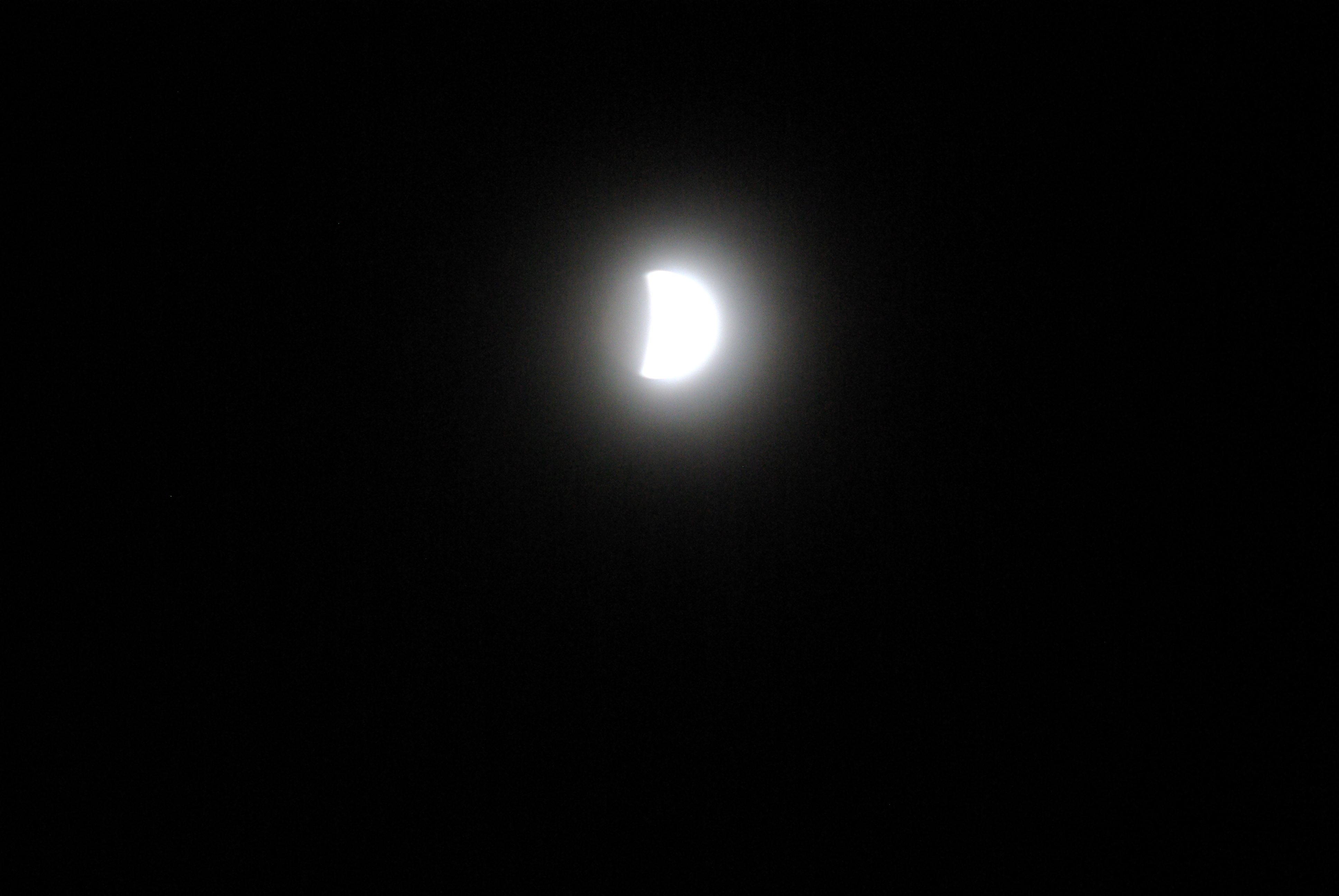
A long eclipse — more than an hour of almost-total coverage of the Moon’s disk. Clouds came and went, with a few good viewing times. With the naked eye, the view was spectacular. Through the 200 mm Pentax zoom, not quite as spectacular, even with the tripod mount. Photographing eclipses takes some skill that I don’t yet possess.
Clouds took a break
Eclipse totality
Eclipse nearing its end
Near the end of totality, where the shadow slips away from the full Moon, a bright white light provides a dazzlying view that confounds the light meters.
Celestial orange, tinged in silver
Step back, see a few of the starts, even from inside Dallas city limits
To every Earth shadow, there's a silver lining to confuse the built-in light meter
Blood-tinge gone, Earth's shadow retreats (all photos by Ed Darrell)
Santa Monica, California, August 27, 2010 /PRNewswire/ — The Eames Office announces with pleasure the Tenth Annual International Powers of Ten Day on October 10, 2010 (10/10/10). Powers of Ten Day promotes and encourages Powers of Ten Thinking, a form of rich, cross-disciplinary thought that approaches ideas from multiple interrelated perspectives, ranging from the infinitesimal to the cosmic—and the orders of magnitude in between.
Powers of Ten Day is inspired by the classic film Powers of Ten by designers Charles and Ray Eames. The film, a nine-minute visual journey of scale, takes the viewer from a picnic out to the edge of space and then back to a carbon atom in the hand of the man sleeping at the picnic. Every 10 seconds the view is from 10 times further away. In all, more than 40 Powers of Ten are visualized seamlessly. One of the most widely seen short films of all time—at the Smithsonian Air and Space Museum for decades and still widely used in schools around the world—Powers of Ten has influenced pop culture from The Simpsons to the rock band Coldplay, from Hummer commercials to the movie Men in Black. But Powers of Ten received perhaps the ultimate accolade in 1998 when the Library of Congress selected it, along with Easy Rider, Bride of Frankenstein, and Tootsie, for the National Film Registry—one of the 25 films of great cultural value chosen each year.
And the film’s importance only grows. Scale is not precisely just size, it is the relative size of things. As Eames Demetrios, director of the Eames Office, has said: “Scale is the new geography. So many of our challenges today are ultimately matters of scale. To be a good citizen of the world and have a chance to make it a better place, a person must have a real understanding of scale.”
Powers of Ten Day is for teachers, librarians, architects, designers, store owners, webmasters, business people, scientists, filmmakers, meditation gurus, parents, kids, and anyone wanting to extend the boundaries of their thinking. Participating can be as simple as watching the video (showing online throughout October [the tenth month] at www.powersof10.com), or putting together a screening of the film for friends or co-workers—at home, in a school, or at a library. Our goal is for as many people as possible to watch or share the film on that day. Some will be seeing it for the first time. Some will be revisiting a favorite classic. Everyone can be part of the conversation.
Powers of Ten Day can also be a lot more. Activities are happening worldwide throughout October. With the help of the DVD Scale is the New Geography as well as a Powers of Ten Box Kit, individuals (teachers in the broadest sense) can lead engaging workshops for kids and/or adults that let participants create their own scale journeys. Although those materials may be purchased at www.eamesoffice.com, as Eames Office Education Director Carla Hartman notes, “We’ve set aside some sets to be available at no charge for inquiring schools and teachers.” Those supplies are limited—and some are already being put to use. To inquire about availability of Powers of Ten supplies at no charge, email info@eamesoffice.com.
The Eames Office also encourages you to create and share your contributions. Over the years art has been created, music shared, global pilgrimages performed, and more. But most of all there has been hands-on learning. Events can be registered, and photographs, drawings, and writings uploaded. Sorted by power and by event, these will serve as inspiration and fodder for other events around the world—more than 1,000, possibly 10,000.
Anyone living in or visiting Southern California is welcome to visit the Powers of Ten Exhibition at the Eames Office in Santa Monica from now until the end of the year. There will be an event each day the exhibition is open during the month of October. Many more fun and thought-provoking activities will be available at www.powersof10.com by the end of the summer. The exhibit includes such things as a box that can hold 1 million pennies; as of mid-August, there were already 250,000! All the pennies collected will be given to TreePeople, an environmental nonprofit that unites the power of trees, people and technology to grow a sustainable future for Los Angeles.
Powers of Ten Thinking extends beyond this unique date of 10/10/10. As Demetrios says, “There is a little bit of the numerologist in all of us, so we love celebrating this date, but empowering people to explore and make connections between scales is a year-round goal of ours.” The Eames Office looks forward to tracking and inspiring another decade’s worth of Powers of Ten events. Towards that end, a map of the Earth on the website (and at the Office) will track events around our world.
The Powers of Ten Exhibition is open from 11 to 6, Wednesday through Saturday at the Eames Office, 850 Pico Boulevard, Santa Monica, CA 90405; 310/396-5991.
Powers of Ten Day is generously sponsored by IBM Corporation with additional support from Herman Miller Inc., Vitra, and Penfolds.
Your school should have one of the Eames versions of the film in the school library (they did more than one). This is truly a classic, and it should be a good discussion starter for several different topics — map reading, map scaling, environmentalism, existentialism, transcendentalism, and more.
Jack Horkheimer, the guy who worked for more than 30 years to acquaint people with the fine old tradition of naked-eye astronomy, died in Miami Friday. He was 72.
Jack Horkheimer, America's Star Gazer, at home in a television production studio - Photo by Bill Wisser, first published in Astronomy, January 2006
Jack Horkheimer, Public Television’s “Star Gazer,” died Friday afternoon of a respiratory ailment, according to a spokesman for the Miami Museum of Science and Space Transit Planetarium.
Born June 11, 1938, he was 72.
In an e-mail to staff, museum officials said they were “very saddened to have just learned that our resident Star Gazer, Jack Horkheimer, passed away today after being ill for quite some time.
“Jack was executive director of [the] Planetarium for over 35 years and was an internationally recognized pioneer in popularizing naked-eye astronomy. He was also a recognized media celebrity, often being the foremost commentator on all astronomy related happenings nationwide.
Horkheimer was best known as the creator, writer and host of public television’s “Star Gazer,” the 30-year weekly TV series on naked eye astronomy. Seen on PBS stations nationwide, “Star Gazer” reached millions of people, helping create a love of the stars for several generations of enthusiasts.”
Many of my best opportunities to watch stars come when I’ve far away from optics to improve the sighting. Horkheimer’s practical advice on how to eyeball the sky delighted me from the start.
Horkheimer was a media guy, not an astronomer or scientist in any strict sense. He was a great popularizer of astronomy. Star Gazer may be the single most effective educational program on astronomy in history, by viewers and by total effect.
From a photo caption at the Astronomy profile — such perfect pitch from Horkheimer, a perhaps unwitting poet:
“I’ve got to make people laugh and smile.” Due to a congenital lung ailment called
bronchiectasis, Horkheimer has been close to death on several occasions. He’s already
erected a tombstone for himself next to his mother’s and father’s at a tiny cemetery in
Randolph, Wisconsin. True to Horkheimer’s irreverent sense of humor, the epitaph reads,
“‘Keep looking up’ was my life’s admonition. I can do little else in my present position.”
Spread the word; friends don't allow friends to repeat history.
And so the Northern Lights, the Aurora Borealis, returned to the planet in spectacular fashion this week, after more than a year of relative solar dormancy. According to the Christian Science Monitor, outstanding displays of the lights may continue through this week.
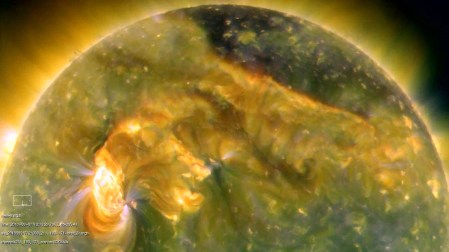
Caption from NASA: On August 1st, almost the entire Earth-facing side of the sun erupted in a tumult of activity. There was a C3-class solar flare, a solar tsunami, multiple filaments of magnetism lifting off the stellar surface, large-scale shaking of the solar corona, radio bursts, a coronal mass ejection and more. This extreme ultraviolet snapshot from the Solar Dynamics Observatory (SDO) shows the sun's northern hemisphere in mid-eruption. Different colors in the image represent different gas temperatures ranging from ~1 to 2 million degrees K. Credit: NASA/SDO
Help someone else find the sky:
Spread the word; friends don't allow friends to repeat history.
The International Astronomical Union (IAU) recently approved the name Rachmaninoff for an intriguing double-ring basin on Mercury. This basin, first imaged in its entirety during MESSENGER’s third Mercury flyby, was quickly identified as a feature of high scientific interest, because of its fresh appearance, its distinctively colored interior plains, and the extensional troughs on its floor. The basin’s name honors the Russian composer, pianist and conductor, Sergei Rachmaninoff (1873-1943).
IAU names craters on Mercury after “deceased artists, musicians, painters and authors who have made outstanding or fundamental contributions to their field and have been recognized as art historically significant figures for more than 50 years.” The process of proposing a new crater name includes gathering fundamental information about the crater, such as the crater’s central latitude, central longitude, and diameter. Justification is provided as to why the crater is of sufficient scientific importance to be named, and details are provided about the name choice, including sources that support the worthy contributions made by that individual. Ten newly named craters join 42 others named since MESSENGER’s first Mercury flybyin January 2008.
Image Credit: NASA/Johns Hopkins University Applied Physics Laboratory/Carnegie Institution of Washington
Tip of the old scrub brush to Eric Koenig.
Spread the word; friends don't allow friends to repeat history.
Or, until that account is unsuspended by the forces supporting Donald Trump: Follow @FillmoreWhite, the account of the Millard Fillmore White House Library
We've been soaking in the Bathtub for several months, long enough that some of the links we've used have gone to the Great Internet in the Sky.
If you find a dead link, please leave a comment to that post, and tell us what link has expired.
Thanks!
Retired teacher of law, economics, history, AP government, psychology and science. Former speechwriter, press guy and legislative aide in U.S. Senate. Former Department of Education. Former airline real estate, telecom towers, Big 6 (that old!) consultant. Lab and field research in air pollution control.
My blog, Millard Fillmore's Bathtub, is a continuing experiment to test how to use blogs to improve and speed up learning processes for students, perhaps by making some of the courses actually interesting. It is a blog for teachers, to see if we can use blogs. It is for people interested in social studies and social studies education, to see if we can learn to get it right. It's a blog for science fans, to promote good science and good science policy. It's a blog for people interested in good government and how to achieve it.
BS in Mass Communication, University of Utah
Graduate study in Rhetoric and Speech Communication, University of Arizona
JD from the National Law Center, George Washington University


 Posted by Ed Darrell












 Millard Fillmore's Bathtub