Geographic literacy and logic become victims in Republican presidential campaign in Iowa

January 3, 2012

Rick Perry shooting at the coyote in the sky - Mad Mike's America

Rick Perry shooting at the coyote in the sky - Mad Mike's America

Sidney Crosby, Toronto Maple Leafs  - Business Insider

Sidney Crosby, Toronto Maple Leafs - Business Insider

_____________

I have it on good authority that Rick Perry will not be taking the Texas Assessment of Knowledge and Skills (TAKS) Exit Level test for juniors this spring.  He’s probably not ready for it, according to this report in the New York Times.  It may be that no Republican in Iowa is ready for it, either.

Energy: The audiences at Mr. Perry’s events seemed somewhat unmoved by parts of his speech that talked about job creation. But when it came to energy and oil, they perked up.

“Every barrel of oil that comes out of those sands in Canada is a barrel of oil that we don’t have to buy from a foreign source,” Mr. Perry said in Clarinda, earning a loud round of enthusiastic applause.

Later, the audience reacted again to Mr. Perry’s assertion that buying so much energy from foreign countries is “not good policy, it’s not good politics and frankly it’s un-American.”

I wonder if it’s un-Canadian.

See also:


A study in geography: The Red River of Texas – film from Texas Parks & Wildlife

December 26, 2011

Seven minutes on the Red River of the southern U.S., the fickle border of Texas and Oklahoma, the river of story and legend.  Good for a map study, good for the fun of it — how much do you really know about the Red River?

George Washington did not cross the Red River; George Washington may not have known the river even existed.  His loss.


SkepticGate II: Fizzled assault on science

December 19, 2011

Skepticgate cartoon from the Houston Chronicle, 2009

This Anderson cartoon from the Houston Chronicle in 2009 gets the facts right, but sadly, is still accurate

Remember the pathetic, disgusting attempt to derail the climate talks in Durban, just a few days ago?  The “climate skeptics”™ dumped a bunch more private e-mails from the scientists who work on climate. (Stolen e-mails, here; be prepared to be bored, with no smoking guns, no cold guns, no guns at all.)

Unless one thinks the self-proclaimed skeptics are James Bond nemesis enough to actually hope for the end of the world (as opposed to just being monumentally, stupidly misled), their train still can’t get back on the tracks.  Revealing that someone among them has stolen more e-mails than previously known, didn’t help.  Here is a list of just how bad the derailment has been for the denialists:

  1. No great world-changing agreement, but the climate talks in Durban, South Africa, produced a consensus that a massive treaty is not coming soon, and that action to save the planet can’t wait for guys in suits who defer by people like Ralph Hall to do the right thing.  Generally, the comity at Durban is bad for the denialists — Christopher Monckton went into full panic mode, suggesting the language of the agreement available isn’t the whole story and something else — something sinister — is really going on.  (One wonders how Monckton can stand to turn out the lights at night.)  They can’t tell the difference between their burro and a burrow, and with Ralph Hall leading them they’re likely to find the edge of the cliff and leave it before they realize just how far up they are and how far they have to fall.  (Skeptic/denialist Judith Curry carried a rundown of headlines from Durban, with links — remember her bias.)
  2. British authorities raided the digs of a skeptic blogger, seizing his computer upon which he got the first round of stolen e-mails.  It’s unlikely the raidee is guilty of much beyond making the stolen stuff public (is that a crime in Britain?), but one hopes Britain’s crime fighters have access to cyber trackers who may be able to learn more from the signatures on the posts.  Searches have been noticed for other bloggers, including Jeff Id at the Air Vent, but warrants and actual searches haven’t taken place yet.
  3. One paper in climate science was officially retracted — alas for the denialists, it was one of theirs.  Plagiarism and rank error in the so-called Wegman Report to a committee of the U.S. House of Representatives prompted the call-back.  John Mashey’s gumshoe work in the libraries of academe lent a new shine to the word “scholarship.”  Republicans have yet to admit the paper’s errors.  (
  4. Texas Congressman Ralph Hall granted a rare interview, and spoke out about climate change.  He revealed that he doesn’t know much about one of the hottest issues facing the committee he chairs, and what little he knows, is wrong.  Cue the Kin Hubbard/Mick Jagger duet.
  5. Skeptics actually completed a research project and prepared it for publication.  A group at Berkeley, with funding from conservative warming denialists like the Koch brothers, and featuring the work and cooperation of leading anti-science people like Anthony Watts, took on the challenge of looking at temperatures reported from weather stations, especially in the U.S., and especially those Anthony Watts had targeted as providing unduly warm and inaccurate readings that skewed all of the science of global warming.  The not-loudly-mentioned target, of course, was the “hockey stick” graph.  Alas for the skeptics, the Berkeley Earth Surface Temperature (BEST) study produced results that verify the accuracy of measurements that show warming, and which suggest the IPCC-published hockey stick is accurate enough that it deserves credence.  Anthony Watts promptly disavowed all his own work on the project.
  6. Meanwhile, warming continued unabated by almost every measure.  Galileo could say:  Eppure, lei si scalda!

One question we need to be asking is why the incidents around the stolen e-mails are known as “Climategate” in the circles of warming denialists.  The thieves in this case came from the ranks of the so-called skeptics, and the release of the e-mails was done on the blogs of those who deny warming, or human causation, or human ability to mitigate at all.  (Fox News got it bass ackwards, of course — wondering whether the government is somehow complicit in hiding information, while all the information is public and almost all of the private communication is public.  At Fox, they don’t even get Homer Simpson doh! moments of understanding — that’s how bad it is in Denialville.)

Not climategate, but skepticgate -- follow the money cartoon

So far no one’s listening to the bear on this one — follow the money, and bring the criminals to justice.

It’s really SkepticGate, with a more-than two-year coverup and continuing, and the recent release is SkepticGate II.

Denialists, and even those who question global warming on legitimate grounds, must be frustrated.  Nothing they do stops the world from warming.  As the massive wave of evidence demonstrating the Earth warms and humans share the blame turns to a tsunami, even policy makers (Ralph Hall excepted) look for solutions to warming problems.  It’s so bad for the skeptics that even the old trick of stealing e-mails from the scientists, the trick that helped fog up the Copenhagen proceedings, did almost nothing to the Durban talks.  While no treaty came out, none was expected — but the sudden action in the last couple of days of the conference to get action despite the continued interference by climate skeptics  and their political allies, must have caught them off guard.

Now the cops are after them, too.

Happy Hanukkah, Merry Christmas, Cool KWAANZA, Ebullient Edwin Hubble Looking Up Day, Happy New Year!


Annals of Global Warming: It didn’t start with the hockey stick . . .

December 12, 2011

Peter Sinclair comes through with a good explanation of the history of concern about global warming — how the warming trend was discovered.

It wasn’t scientists trying to get government grants.  It was the U.S. Air Force, trying to beat the commies and keep America safe for democracy and, ironically, safe for dissent from such applications of science.


9,996

Real history couldn’t be published as fiction, which is one way we can tell real history from the stuff that gets made up.  In the story told in this video, note carefully the serendipity of figuring out the CO2 issues:  Who could invent a story about warfare leading to the discovery of global warming?  As with the coincidence of John Adams and Thomas Jefferson both dying on the 50th anniversary of the Declaration of Independence, no editor of fiction would accept it as believable.

More:

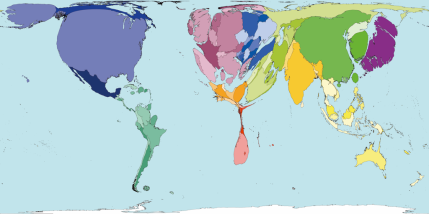
Why we worry, why policy makers are involved:  Carbon Emissions, 2000 – from WorldMapper, with a serendipitous tip of the old scrub brush to Petra Tschakert at Penn State.

Carbon emissions 2000, from worldmapper.org - creative commons license

Carbon Emissions 2000, from worldmapper.org - creative commons license

Carbon Emissions 2000 © Copyright 2006 SASI Group (University of Sheffield) and Mark Newman (University of Michigan). “We welcome use of our maps under the Creative Commons conditions by educational, charitable and other non-profit organisations.”

Japan and U.S. team up on new topographic map of the world

December 9, 2011

This will strike a note of joy in the heart of every Boy Scout and every orienteer in the world:  The U.S. and Japan have teamed up for new, super-accurate topographic maps.

Here’s the NASA press release:

RELEASE : 11-351

NASA, Japan Release Improved Topographic Map Of Earth

WASHINGTON — NASA and Japan released a significantly improved version of the most complete digital topographic map of Earth on Monday, produced with detailed measurements from NASA’s Terra spacecraft.

The map, known as a global digital elevation model, was created from images collected by the Japanese Advanced Spaceborne Thermal Emission and Reflection Radiometer, or ASTER, instrument aboard Terra. So-called stereo-pair images are produced by merging two slightly offset two-dimensional images to create the three-dimensional effect of depth. The first version of the map was released by NASA and Japan’s Ministry of Economy, Trade and Industry (METI) in June 2009.

“The ASTER global digital elevation model was already the most complete, consistent global topographic map in the world,” said Woody Turner, ASTER program scientist at NASA Headquarters in Washington. “With these enhancements, its resolution is in many respects comparable to the U.S. data from NASA’s Shuttle Radar Topography Mission (SRTM), while covering more of the globe.”

The improved version of the map adds 260,000 additional stereo-pair images to improve coverage. It features improved spatial resolution, increased horizontal and vertical accuracy, more realistic coverage over water bodies and the ability to identify lakes as small as 0.6 miles (1 kilometer) in diameter. The map is available online to users everywhere at no cost.

“This updated version of the ASTER global digital elevation model provides civilian users with the highest-resolution global topography data available,” said Mike Abrams, ASTER science team leader at NASA’s Jet Propulsion Laboratory in Pasadena, Calif. “These data can be used for a broad range of applications, from planning highways and protecting lands with cultural or environmental significance, to searching for natural resources.”

The ASTER data cover 99 percent of Earth’s landmass and span from 83 degrees north latitude to 83 degrees south. Each elevation measurement point in the data is 98 feet (30 meters) apart.

NASA and METI are jointly contributing the data for the ASTER topographic map to the Group on Earth Observations, an international partnership headquartered at the World Meteorological Organization in Geneva, Switzerland, for use in its Global Earth Observation System of Systems. This “system of systems” is a collaborative, international effort to share and integrate Earth observation data from many different instruments and systems to help monitor and forecast global environmental changes.

ASTER is one of five instruments launched on Terra in 1999. ASTER acquires images from visible to thermal infrared wavelengths, with spatial resolutions ranging from about 50 to 300 feet (15 to 90 meters). A joint science team from the United States and Japan validates and calibrates the instrument and data products. The U.S. science team is located at JPL.

NASA, METI, Japan’s Earth Remote Sensing Data Analysis Center (ERSDAC), and the U.S. Geological Survey validated the data, with support from the U.S. National Geospatial-Intelligence Agency and other collaborators. The data are distributed by NASA’s Land Processes Distributed Active Archive Center at the U.S. Geological Survey’s Earth Resources Observation and Science Center in Sioux Falls, S.D., and by ERSDAC in Tokyo.

Users of the new version of the ASTER data products are advised that while improved, the data still contain anomalies and artifacts that will affect its usefulness for certain applications.

Data users can download the ASTER global digital elevation model at:

https://lpdaac.usgs.gov/or

http://www.ersdac.or.jp/GDEM/E/4.html

For more information about NASA’s Terra mission, visit:

http://www.nasa.gov/terra

– end –

New topographical map of Earth from Ministry of Economy, Trade, and Industry (METI) of Japan and the United States National Aeronautics and Space Administration (NASA)

New topographical map of Earth released October 17, 2011, from the Ministry of Economy, Trade, and Industry (METI) of Japan and the United States National Aeronautics and Space Administration (NASA)

Save


Louie Schwartzberg’s “Gratitude” at TEDS

November 26, 2011

Kathryn sent me the link and said I had to watch it. One learns to listen to one’s Trophy Wife™ if one has any sense.

Louie Schwartzberg’s TEDS appearances are greater than one (“(Louie at TEDS)>1”).  When you watch his films, you can understand why he’s popular among the secular wooists, and even among the thinkers and scientists.  One might rationally wonder why he’s not invited to speak at a lot of church services, but that would be a rational response.  Schwartzberg’s earlier appearance at the Bathtub covered his TEDS presentation on his film, “Pollination.”

This one is more ephemeral, but a lot more human.  I hope to see his work in theaters, soon.

What does this film make you feel, and what does it make you think?

How many of the locations on that film did you identify?


Glories of Glacier N.P.

November 6, 2011

Seven-plus minutes of good reason to get your tail to Glacier National Park as soon as you can.

Produced and shot by Joshua Thompson, this is part of an award-winning film made to promote the park and get money for the research that the park hosts.

Grizzly Bears, Bighorn Sheep, spectacular sunsets and more…..

Part 3 of the recently shot Glacier DVD. This 20 min. film recently was nominated for best new nature documentary in the music category as well received an award for photography from the Wildlife Film Festival held in May of 2008. All funds for this project are being donated to the Glacier National Park Fund. For more info: http://www.glaciernationalparkfund.org/cart.php?page=glacier_national_park_fu…

I’ve been there only once.  A wise American would get there before turning 35, and return several times.


7 billion people on Earth?

October 25, 2011

Exponential growth’s potential to rapidly change the numbers of a situation tends to fall out of the thoughts of most people, who don’t see such things occur in daily life.

You should stop and think about this one for a minute:  World population will tip to over 7 billion people soon, maybe in the next week, but most assuredly by next spring.

A very large crowd in a stadium

Seven billion people? Really?  Are the concessions adequate?  The restrooms?

Joel E. Cohen wrote about the event in Sunday’s New York Times:

ONE week from today, the United Nations estimates, the world’s population will reach seven billion. Because censuses are infrequent and incomplete, no one knows the precise date — the Census Bureau puts it somewhere next March — but there can be no doubt that humanity is approaching a milestone.

The first billion people accumulated over a leisurely interval, from the origins of humans hundreds of thousands of years ago to the early 1800s. Adding the second took another 120 or so years. Then, in the last 50 years, humanity more than doubled, surging from three billion in 1959 to four billion in 1974, five billion in 1987 and six billion in 1998. This rate of population increase has no historical precedent.

Can the earth support seven billion now, and the three billion people who are expected to be added by the end of this century? Are the enormous increases in households, cities, material consumption and waste compatible with dignity, health, environmental quality and freedom from poverty?

(Joel E. Cohen, a mathematical biologist and the head of the Laboratory of Populations at Rockefeller University and Columbia University, is the author of “How Many People Can the Earth Support?”)

We’re in for some dramatic shifts in concentrations of people, if not shifts in how we think of the world (thinking is always slower than reality).

While the bulge in younger people, if they are educated, presents a potential “demographic dividend” for countries like Bangladesh and Brazil, the shrinking proportion of working-age people elsewhere may place a strain on governments and lead them to raise retirement ages and to encourage alternative job opportunities for older workers.

Even in the United States, the proportion of the gross domestic product spent on Social Security and Medicare is projected to rise to 14.5 percent in 2050, from 8.4 percent this year.

The Population Reference Bureau said that by 2050, Russia and Japan would be bumped from the 10 most populous countries by Ethiopia and the Democratic Republic of Congo.

I’m not ready, and neither are most other people, I’ll wager.  How about you?

More: 


Sky islands in Yosemite National Park

September 19, 2011

Nature Notes #16 from the good people at Yosemite National Park:  Sky Islands.

Throughout the Sierra Nevada, high flat plateaus are found at elevations around twelve and thirteen thousand feet. These isolated sky islands are the home to unique plant communities that are found nowhere else.


Channeling Monty Python: “The border between India and Pakistan is closed for the day”

September 7, 2011

BBC map showing location of Wagah and Punjab

BBC map showing location of Wagah and Punjab, divided between Pakistan and India, south of Kashmir

Written accounts cannot possibly do justice to the ceremonies that mark the daily close of business at the border between India and Pakistan.  I had understood it was quite a good show, rivaling the changing of the guard at Buckingham Palace.

But, you don’t expect Monty Python to break out at these affairs, do you? Here’s a video of the ceremony as it was conducted prior to July 2010, I believe, which I found at Wimp.com.  It’s a video clip from BBC Worldwide, narrated by comedian Sanjeev Bhaskar.

Vodpod videos no longer available.

(If that one doesn’t work, try this one — a bit lower quality video):

(Or, here’s a shorter, YouTube version of Baskar’s film.)

Where in the world is this?  It’s in a town and area called Wagah, in Punjab, divided between India and Pakistan since the 1947 independence of those nations (links to Wikipedia left in for your convenience).

Wagah (Punjabi: ਵਾਘਾ, Hindi: वाघा, Urdu: واہگہ) is the only road border crossing between India and Pakistan[1], and lies on the Grand Trunk Road between the cities of Amritsar, India and Lahore, Pakistan. Wagah itself is a village through which the controversial Radcliffe Line was drawn. The village was divided by independence in 1947. Today, the eastern half of the village remains in the Republic of India while the western half is in Pakistan.

While both nations and local residents fully recognize the silliness, it also stands as a symbol of the deep divisions between the two nations.

The Wagah border, often called the “Berlin wall of Asia”,[2] is a ceremonial border on the India–Pakistan Border where each evening there is a retreat ceremony called ‘lowering of the flags’,[3] which has been held since 1959.[4] At that time there is an energetic parade by the Border Security Force (B.S.F) of India and the Pakistan Rangers soldiers. It may appear slightly aggressive and even hostile to foreigners but in fact the paraders are imitating the pride and anger of a Cockerel.[1][5][6] Troops of each country put on a show in their uniforms with their colorful turbans.[7] Border officials from the two countries sometimes walk over to the offices on the other side for day to day affairs. The happenings at this border post have been a barometer of the India-Pakistan relations over the years.[1]

Did someone say “Pythonesque?”

Here’s Michael Palin narrating another view of the ceremony for one of his BBC enterprises, Himalaya with Michael Palin:

Would you be surprised to hear that local people refer to this as “the dance of the roosters?”

Events at this crossing reflect some minor easing of tension between the two nations in the last decade, and in 2010 both nations announced they would tone down the retreat ceremonies. Surely some scholar has analyzed this retreat ceremony and its history, to determine whether it helped ease the tension, or increased the conflict between the two nations.  Could soldiers who participate in such goings-on actually shoot at each other?

Has anyone got a more recent viewing of the ceremony?

How will you explain this to your sophomore world history class?  Is there anything sillier than humans in conflict?

Video via VodPod.

An astonished tip of the old scrub brush to Judith Shields.

More:


Yosemite Nature Notes extra: Time lapse of people visiting

September 4, 2011

Among other things one might observe from this film, one might note that Yosemite National Park’s beauty is so great that it looks good from almost any angle, even with tourists plastered all over it.

This was released between Yosemite Nature Notes #14 and #15, and I find no other description.  This remains a wonderful series showing off the geography and natural phenomena of Yosemite.  I wish there were similar programs for Yellowstone, Glacier, Denali, Grand Canyon, Zion, Bryce, Big Bend, Great Smoky Mountains, and for the Adirondack State Park in New York, among many others.


Sideshow of DDT and malaria

August 23, 2011

Not exactly a DDT/Malaria carnival.  Just enough for a sideshow.

First, the controversy over use of DDT in Uganda continues, even as DDT is applied daily there.  This demonstrates that DDT remains freely available for use in Africa.  It also demonstrates that Africans are not clamoring for more DDT.

Uganda offers a key proving ground for the propaganda campaign against environmentalists, against scientist, against medical care officials, and for DDT.  Though malaria plagues Uganda today and has done so for the past 200 years at least, it was not a target of the World Health Organization’s (WHO) campaign to eradicate malaria in the 1950s and 1960s, because the nation lacked the governmental structures to mount an effective campaign.  DDT was used to temporarily knock down mosquito populations, so that medical care could be improved quickly and malaria cured among humans.  Then, when the mosquitoes came roaring back as they always do with DDT, there would be no pool of the disease in humans from which the mosquitoes could get infected.  End of malaria problem.

Plus, for a too-long period of time, Uganda was ruled by the brutal dictator Idi Amin.  No serious anti-malaria campaigns could be conducted there, then.

Uganda today exports cotton and tobacco.  Cotton and tobacco interests claim they cannot allow any DDT use, because, they claim, European Union rules would then require that the tobacco and cotton imports be banned from Europe.  I can’t find any rules that require such a ban, and there are precious few incidents that suggest trace DDT residues would be a problem, but this idea contributes to the political turmoil in Uganda.  Businessmen there sued to stop the use of even the small amounts of DDT used for indoor residual spraying (IRS) in modern campaigns.  They lost.  DDT use continues in Uganda, with no evidence that more DDT would help a whit.

Malaria campaign posters from World War II, South Pacific - Mother Jones compilation

Much of the anti-malaria campaign aimed at soldiers, to convince them to use Atabrine, a preventive drug, or to use nets, or just to stay covered up at night, to prevent mosquito bites. Mother Jones compilation of posters and photos.

Second, the website for Mother Jones magazine includes a wonderful 12-slide presentation on DDT in history.  Malaria took out U.S. troops more effectively than the Japanese in some assaults in World War II.  DDT appeared to be a truly great miracle when it was used on some South Pacific islands.  Particularly interesting are the posters trying to get soldiers to help prevent the disease, some done by the World War II-ubiquitous Dr. Seuss.  Good history, there.  Warning:  Portrayals of Japanese are racist by post-War standards.

Third, a new book takes a look at the modern campaigns against malaria, those that use tactics other than DDT.  These campaigns have produced good results, leading some to hope for control of malaria, and leading Bill Gates, one of the biggest investors in anti-malaria campaigns, to kindle hopes of malaria eradication again.  Here is the New York Times  review of  Alex Perry’s Lifeblood: How to Change the World One Dead Mosquito at a Time (PublicAffairs, $25.99).   Perry is chief Africa correspondent for Time Magazine.

This little gem of a book heartens the reader by showing how eagerly an array of American billionaires, including Bill Gates and the New Jersey investor Ray Chambers (the book’s protagonist), are using concepts of efficient management to improve the rest of the world. “Lifeblood” nominally chronicles the global effort to eradicate malaria, but it is really about changes that Mr. Chambers, Mr. Gates and others are bringing to the chronically mismanaged system of foreign aid, especially in Africa.

These three snippets of reporting, snapshots of the worldwide war on malaria, all diverge dramatically from the usual false claims we see that, but for ‘environmentalist’s unholy and unjust war on DDT,’ millions or billions of African children could have been saved from death by malaria.

The real stories are more complex, less strident, and ultimately more hopeful.


Floating over our problems

August 19, 2011

Do you ever dream of flying?

Natsumi Hayashi, a woman in Tokyo, Japan, posts a photo every day of herself, levitating nonchalantly around town and through life.

Great blog, great photos, fun stuff at YowaYowaCamera:

Photo by Natsumi Hayashi, Tokyo - levitating through the day

Natsumi Hayashi of Tokyo flies through the day, and has the photos to prove it at her blog, YowaYowaCamera.

Can you pick out locations from any of those photos?  Is there a good geography exercise in here somewhere?

More: 


Climate denialists on Texas weather 2011: Ain’t no heat wave, on average

August 8, 2011

You couldn’t make this stuff up.

In defense of his claim that Texas has not warmed over the last century (“Texas temperatures not rising; Wisconsin temperatures not rising”) and, therefore, Texas does not suffer from global warming, and therefore there is no global warming and no ill effects from warming, Steve Goddard posted this today:

Year-To-Date In Texas

Posted on August 7, 2011 by stevengoddard

Almost as warm as 1927, 1925 and 1953. Only a degree cooler than 1911.

http://www.ncdc.noaa.gov/oa/climate/research/cag3/tx.html

It’s heading for 105°, but since it was 15° one day in February, that averages to 60°, so Texas is okay, according to Goddard.  In their drive to fuzz up the facts and surround policy debates with snark, the denialists will deny anything, leave no weather record untwisted, and deny the sweat on the nose on their face.  According to Goddard, snow in the Great Basin means no drought in Las Vegas, as shown by there being no drought affecting Lake Powell.

Remember Straight Dope’s Cecil Adams’s old line?  “Fighting ignorance since 1973 (it’s taking longer than we thought.)”  Yeah, that applies to climate denialists in quantity.

Here’s what’s going on in Texas right now:

Vodpod videos no longer available.

  •  Texas A&M says the drought of 2011 is the worst ever 1-year drought in Texas history; note how their press release describes the event, and the increasing heat:

    Preliminary reports from the National Climatic Data Center indicate that July 2011 was the warmest month ever recorded statewide for Texas, with data going back to 1895, [State Climatologist John] Nielsen-Gammon reports. The average temperature of 87.2 degrees broke the previous record of 86.5 degrees set in 1998. The June average temperature of 85.2 was a record for that month and now ranks fifth warmest overall.

    Rainfall totals were also unusually light across the state. The July monthly total of 0.72 inches ranks third driest, surpassed by the 0.69 inches recorded in both 1980 and 2000. This is the fifth consecutive month in which precipitation totals were among the 10 driest for that month, says the Texas A&M professor.

Drought and searing heat in Texas.  Caused by climate change?  That’s difficult to say, difficult to trace.  Made worse by climate change?  Most likely.

Dallas media track the consecutive days over 100° F.  It’s a form of misery index — people can recover from a day or two over the century mark.  But more than a couple of days and the heat begins to take a heavier toll on people, on plants and animals, on houses, on cars, on crops, on everything we do in Texas.  It’s difficult to make news make sense on weather stories.  Tracking the number of days over 100° gives a quick graphic for television news, and puts the story into the vein of a sports record story, a narrative people know.

Here’s how things stack up in Dallas, in terms of days over 100°:

Rank Year Consecutive 100° days
1 1980 42
2 2011 37 (and counting)
3 1998 29
4 1952 25
5 1999 24
6 1954 20
7 2006 19
8 2010 18
8 1978 18
10 1956 17

If one looks at the heat streaks, one cannot help but notice that all of the top ten streaks have come since 1952, and that three are in the last decade, five since 1998.  Brutal heat streaks appear to be coming more frequently, many close on the heels of previous heat streaks, and with greater severity.

That is what one would expect from global warming.

Moreover, the recent streaks show greater oscillations.  2011 also saw snow and freezing weather in Dallas, a rarity.  Greater oscillations in weather also would be expected from global warming.

Goddard offers a comparison of January to June temperatures — the coolest part of the calendar year, and leaving out most of the heat-streak days — and on that basis of a half-comparison, he suggests (doesn’t say — he doesn’t want to be caught lying outright) that there isn’t a warming problem in Dallas in 2011.

Heat stroke?  It’s a figment of your socialist imagination.  14 dead?  They probably were smokers.  Global warming?   Not if Steve Goddard can find a statistic somewhere that can be manipulated to appear to deny it.

What do his charts show for July and August of those years?

Finally, there is this:   Assume for a moment that there has been no significant warming in Texas as a complete landmass over the past 100 years:  Does that mean Texas is not battered by any warming that occurs elsewhere?

Of course not.  The current drought in Texas is thought to be triggered in no small part by the La Niña effect, a chilling of the surface of the Pacific in a broad band that stretches west of Peru for about 5,000 miles to the far South Pacific.  La Niña is a counterpart to El Niño, a warming of the same band of water that produces different, not-average weather effects.  The cycles are not well understood as to cause — there are good hypotheses being tested — but it has been observed that, especially in the latter part of the 20th century and the first decade of the 21st, these cycles are speeding up.  The best, not-disproven hypothesis is that these cycles react and speed up due to global warming.

So, to the best of our hypothesizing today, the Texas drought is a function of global warming, in timing, frequency and severity.

This demonstrates the ultimate problem with using a local temperature readings to make authoritative statements about global warming, even averaged over about a hundred million acres like Texas:  Problems of global warming are not always simply problems of temperature, and non-local causes may cause local effects that will not show up in temperature, especially local effects in precipitation, in timing and amounts.

Botanists, foresters, range scientists and biogeographers noticed effects of warming 50 years ago, with the migration of species northward, and up mountainsides.  Wildlife managers noticed altered migrations of game birds and non-game birds about the same time, migration alterations that continue to today.  Plant zones used by farmers and gardeners demonstrate a good deal of change, generally favoring warming, over the past century.  Evidence for warming is quite solid without a single temperature reading.

A bastion of average temperature non-increases, if Texas is one, may still be hammered by warming and its effects in the Pacific, and especially in the Gulf of Mexico.  Is it fair to say the entire system shows no signs of warming?

So we should ask:  Are temperatures and precipitation averages, frequencies, timing and totals, about average for the last century or two?  Then  the case for global warming is a bit weaker.

Dallas will eclipse the previous record string of 100° F days in the next week.  All of Texas is in severe drought, and most of the state is in extreme drought.  Sounds as if there is something going on with the climate.

Last year the denialism sites lit up with a report that a fourth grade student in South Texas had a science project that disproved global warming, and which won an award from the National Science Foundation.  It was a sad hoax.  The speed with which these sites pounced on the report should have warned us that a school of thought devoid of practical results from the lab bench or observation in nature gets too desperate for results, and will cut corners to claim them.  Goddard’s reports repeat the bad methodology of that hoax.

Richard Feynman once wrote, wryly, “Science is the belief in the ignorance of experts.”  Goddard and other denialists appear to read that wrongly, thinking that experts are not to be trusted, and that all experts are ignorant of all things, and therefore stupid.

Politics and especially the politics of science cry out for someone to read Feynman — actually read what he wrote.  Feynman said we should not assume all scientists are infallible.  He did not write that all scientists are fallible and wrong.


Hopewell Rocks and 45-foot tides at the Bay of Fundy

August 4, 2011

Great time-lapse video of the tides at Hopewell Rocks, Bay of Fundy, New Brunswick.

Teachers, can you get a decent geography warm-up with this video?  Every high school kid should know about the Bay of Fundy, one of nature’s greater phenomena.

More: 

Another time-lapse video of the tides at Fundy, taken at Halls Harbour, a different perspective:

5,869
3,340