A lawyer complains in the Wall Street Journal that the plan from the U.S. Fish and Wildlife Service (USFWS) intended to help the endangered spotted owl should be dismissed because, well, the spotted owl is still endangered, and after all, didn’t the spotted owl personally shut down the entire lumber industry in the Northwest?
The U.S. Fish and Wildlife Service today released a final revised recovery plan for the threatened northern spotted owl, stepping up actions that so far have helped stem but not reverse the old-growth forest raptor’s decline. The revised plan identifies three main priorities for achieving spotted owl recovery: protecting the best of its remaining habitat, actively managing forests to improve forest health, and reducing competition from barred owls, a native of eastern North America that has progressively moved into the spotted owl’s range in Washington, Oregon, and northern California.
“For more than 20 years, northern spotted owl recovery has been a focal point of broader forest conservation efforts in the Pacific Northwest,” said Robyn Thorson, the U.S. Fish and Wildlife Service’s Pacific Northwest Regional Director. “This revised recovery plan is based on sound science and affirms that the best things we can do to help the spotted owl turn the corner are conserving its habitat, managing the barred owl, and restoring vitality to our forests.”
The U.S. Fish and Wildlife Service will use the recovery plan to work with land managers in the Pacific Northwest such as the U.S. Forest Service and Bureau of Land Management, as well as other federal and non-federal landowners, to advise them on habitat management activities that can benefit the spotted owl and contribute to improved forest health.
Because about 20 million acres of U.S. Forest Service lands and about 2 million acres of Bureau of Land Management lands are potentially affected by recovery plan recommendations, the three agencies worked together on key recommendations related to forest management. Both agencies provided formal letters of support for the plan’s recovery goals.
“This recovery plan is a welcome update to the state of the science surrounding the northern spotted owl,” said Cal Joyner, Deputy Regional Forester for the Pacific Northwest Region of the U.S. Forest Service. “The plan will help us implement a mix of actively managing and protecting habitat to best contribute to conservation and recovery.”
“The recovery plan provides space to develop ecological forestry principles and to actively manage our public forests to achieve the twin goals of improving ecological conditions and supplying timber,” said Ed Shepard, Oregon/Washington State Director for the Bureau of Land Management. “We look forward to continuing our close cooperation with the Fish and Wildlife Service as we put the science from the recovery plan to work in our planning, in evaluating proposed timber projects, and in improving forest health.”
Overarching recommendations in the revised plan include:
Conservation of spotted owl sites and high-value spotted owl habitat across the landscape. This means the habitat protections provided under land use plans on federal land will continue to be a focus of recovery, but protection of other areas is likely needed to achieve full success (including some of the lands previously slated for potential timber harvest on federal lands, and possibly non-federal lands in certain parts of the owl’s range where federal lands are limited).
Active management of forests to make forest ecosystems healthier and more resilient to the effects of climate change and catastrophic wildfire, disease, and insect outbreaks. This involves an “ecological forestry” approach in certain areas that will restore ecosystem functioning and resiliency. This may include carefully applied prescriptions such as fuels treatment to reduce the threat of severe fires, thinning, and restoration to enhance habitat and return the natural dynamics of a healthy forest landscape. The U.S. Fish and Wildlife Service recommends this approach in areas where it promotes ecosystem function and is in the best long-term interest of spotted owl recovery. The agency also strongly affirms adaptive management principles to continually evaluate and refine active forest management techniques.
Management of the encroaching barred owl to reduce harm to spotted owls. Most of the recovery actions the U.S. Fish and Wildlife Service has carried out since finalizing the spotted owl’s 2008 recovery plan deal with the barred owl threat. A major part of this is developing a proposal for experimental removal of barred owls in certain areas to see what effect that would have on spotted owls, and then to evaluate whether or not broad scale removal should be considered. This portion of the 2008 plan was not significantly revised.
“While the new recovery plan has been refined and improved from the 2008 version, the U.S. Fish and Wildlife Service continues to implement the most important recommendations,” said Acting U.S. Fish and Wildlife Service Director Rowan Gould. “We have begun to address the barred owl threat, improved survey protocols, and developed incentives for private landowners to voluntarily participate in recovery actions. We look forward to expanding conservation partnerships to contribute to the spotted owl’s recovery.”
Since the northern spotted owl was listed as threatened under the Endangered Species Act (ESA) 21 years ago, the U.S. Fish and Wildlife Service and recovery partners are benefitting from far more information on what factors most affect its survival and productivity. This includes a broader body of scientific knowledge on the species itself and forest ecosystem dynamics — including variables such as climate change and the role of natural disturbances such as wildfire. Recovery partners also are taking advantage of new science and technology to develop more precise tools for analyzing how different strategies can contribute to recovery.
In addition, land managers have made significant strides in advancing active forest management techniques to promote the health and resilience of forest ecosystems. The recovery plan emphasizes the concept of adaptive management to apply new knowledge and science to those techniques on an ongoing basis. This is a more mainstream approach today than in 1994 when the Northwest Forest Plan was created to address the needs of several forest-dependent species, including the spotted owl, and the region’s timber industry.
The U.S. Fish and Wildlife Service developed a final recovery plan specific to the spotted owl for the first time in 2008. As the agency and recovery partners moved forward in implementing many recommendations in the 2008 plan, the U.S. Fish and Wildlife Service initiated a targeted scientific revision to some portions of that plan after facing legal challenges and critical reviews from leading scientific organizations in the conservation community.
The U.S. Fish and Wildlife Service tapped the knowledge and perspectives of public and private sector experts over the last two years in developing this revised plan, the draft of which was released in September 2010. The agency held more than 30 workshops and meetings with public and private partners throughout the spotted owl’s range to share information, evaluate options, and incorporate valuable input during the revised plan’s development. The U.S. Fish and Wildlife Service accepted public comments on the draft revised plan for a 90-day period and received more than 11,700 comments. In April 2011, the agency released an updated Appendix C, relating to a new habitat modeling tool, for an additional 30-day public comment period and received about 20 public comments.
The revised recovery plan does not include recommendations from the 2008 plan for a new habitat conservation network of “Managed Owl Conservation Areas.” Rather than creating a potentially confusing new land classification, the plan identifies the scientific rationale and parameters for habitat protection and will revise the spotted owl’s designated critical habitat to reflect the latest scientific information about areas essential for the owl’s recovery. Identifying this habitat through the critical habitat process — as the ESA intended — will be more efficient and provide land managers and the public with additional opportunities for review and comment.
For a recovery timeline, Frequently Asked Questions, related information, and the recovery plan itself, visit www.fws.gov/oregonfwo.
America’s fish, wildlife and plant resources belong to all of us, and ensuring the health of imperiled species is a shared responsibility. The Service is working to actively engage conservation partners and the public in the search for improved and innovative ways to conserve and recover imperiled species. To learn more about the Service’s Endangered Species program, go to http://www.fws.gov/endangered/.
The mission of the U.S. Fish and Wildlife Service is working with others to conserve, protect and enhance fish, wildlife, plants and their habitats for the continuing benefit of the American people. We are both a leader and trusted partner in fish and wildlife conservation, known for our scientific excellence, stewardship of lands and natural resources, dedicated professionals and commitment to public service. For more information on our work and the people who make it happen, visit www.fws.gov. Connect with our Facebook page at www.facebook.com/usfws, follow our tweets at www.twitter.com/usfwshq, watch our YouTube Channel at http://www.youtube.com/usfws and download photos from our Flickr page at http://www.flickr.com/photos/usfwshq.
-FWS-
Stay tuned for the response, and my response to the response.
He has set the photography against the music of a band named Conjure One, an edited version of their recording “Manic Star.”
Certainly there is copyright, at least a Creative Commons license — you should attribute this film to Mr. Lee and the music to Conjure One.
Can you identify these sites? Can your students? Can they map out a plan to visit these sites as one exercise? Can you and your students identify any of the constellations on view? (List of sites, from Mr. Lee, below the fold.)
Have you, or your students, ever visited any of those sites, and gazed at the stars? Why not?
It took me a couple of tries to figure it out — last week when I told people Kathryn and I were off to Colorado Bend State Park to spend time on the river, several people commented about how much cooler it would be there.
What? West of Killeen about an hour, ten miles of dusty road outside of Bend, Texas (population 1,637), Colorado Bend is not cooler than Dallas. It was over 100° F every day we were there, stayed well above 90° most of the nights.
Kathryn studied wildflowers at a spring at the side of the Colorado River during a break from kayaking; this spring's flow was reduced, but still moist enough to create a near-oasis.
Our well-wishers were geographically confused. They thought we were headed to the Colorado River in Colorado, not the Colorado River in Texas, which is not the same river at all. I didn’t bother to check the temperatures in Colorado, but one might be assured that it was cooler along the Colorado River in Colorado than it was along the Colorado River in Texas.
It was a return trip. We stumbled into the park 16 years ago with the kids, for just an afternoon visit. The dipping pools in the canyon fed by Spicewood Springs captivated us. It took a while to get back, and then the kids were off doing their own thing.
So, just a quick weekend of hiking/camping/kayaking/soaking/stargazing/bird watching/botanical and geological study. Park officials closed the bat caves to human traffic in hope of keeping White Nose Syndrome from the bats; we didn’t bother to sign up for the crawling cave tour through another.
The author, still working to master that Go-Pro camera on the hat -- some spectacular shots, but I don't have the movie software to use it all; you know it's hot when SPF 75 sunscreen is not enough.
What did we see? Drought has a firm grip on Texas, especially in the Hill Country, especially outside of Dallas. The Colorado River is mostly spring fed; many of the springs are dry. No water significant water flowed through the park while we were there — kayak put-ins have been reduced to the downriver-most ramp, and the bottom of the boat launch ramp is three feet above water. Gorman Falls attracts visitors and scientists, but the springs feeding it are about spent this year — just a few trickles came over the cliff usually completely inundated with mineral-laden waters.
Drought produces odd things. The forest canopy around the park — and through most of the Hill Country we saw — is splattered with the gray wood of dead trees, many of which at least leafed out earlier this spring. The loss to forests is astonishing. Deer don’t breed well in droughts; deer around the campsites boldly challenge campers for access to grasses they’d ignore in other seasons. One ranger said he hadn’t seen more than about three fawns from this past spring, a 75% to 90% reduction in deer young (Eastern White Tail, the little guys). Raccoons are aggressively seeking food from humans, tearing into tents and challenging campers for food they can smell (lock your food in the car!). Colorado Bend is famous for songbirds, including the endangered Golden Cheeked Warbler, and the elusive, spectacular painted bunting. But the most commonly-sighted birds this year are turkey vultures, dining on the young that didn’t make it healthy into the summer and won’t survive until fall.
Warming denialists’ claims of “not so bad a drought” ring out as dangerous, wild delusion. (By actual measurement, Texas average rainfall the past nine months was 8.5 inches, the driest ever recorded in Texas, shattering the old record drought of 1917).
Great trip. Kathryn’s menu planning was spectacular. The old Coleman stove — a quarter century old, now, with fuel almost that old — performed like a champ even without the maintenance it needs (later this week). Other than the hot nights, it was stellar.
Stellar. Yeah. Stars were grand. It was New Moon, a happy accident. A topic for another post, later. Think, “Iridium.”
So posting was slow over the weekend. How far out in the Hill Country were we? Neither one of us could get a bar on our phones. We were so far out the Verizon Wireless guy was using smoke signals.
Thoreau was right, you know.
Spread the word; friends don't allow friends to repeat history.
In West Berlin, President John F. Kennedy delivers the famous speech in which he declares, “Ich bin ein Berliner.” Meaning literally “I am a citizen of Berlin,” the statement shows U.S. solidarity with democratic West Berlin, surrounded by communist territory.
Kennedy’s entire speech was good. It was well drafted and well delivered, taking advantage of the dramatic setting and the dramatic moment. John Kennedy well understood how to give a speech, too.
Below is most of the speech, nearly five minutes’ worth, from a YouTube file — another indication that schools need to open up their filters to allow at least some of the best YouTube material through:
I am proud to come to this city as the guest of your distinguished Mayor, who has symbolized throughout the world the fighting spirit of West Berlin. And I am proud to visit the Federal Republic with your distinguished Chancellor who for so many years has committed Germany to democracy and freedom and progress, and to come here in the company of my fellow American, General Clay, who has been in this city during its great moments of crisis and will come again if ever needed.
Two thousand years ago the proudest boast was “civis Romanus sum.” Today, in the world of freedom, the proudest boast is “Ich bin ein Berliner.”
I appreciate my interpreter translating my German!
There are many people in the world who really don’t understand, or say they don’t, what is the great issue between the free world and the Communist world. Let them come to Berlin. There are some who say that communism is the wave of the future. Let them come to Berlin. And there are some who say in Europe and elsewhere we can work with the Communists. Let them come to Berlin. And there are even a few who say that it is true that communism is an evil system, but it permits us to make economic progress. Lass’ sie nach Berlin kommen. Let them come to Berlin.
Freedom has many difficulties and democracy is not perfect, but we have never had to put a wall up to keep our people in, to prevent them from leaving us. I want to say, on behalf of my countrymen, who live many miles away on the other side of the Atlantic, who are far distant from you, that they take the greatest pride that they have been able to share with you, even from a distance, the story of the last 18 years. I know of no town, no city, that has been besieged for 18 years that still lives with the vitality and the force, and the hope and the determination of the city of West Berlin. While the wall is the most obvious and vivid demonstration of the failures of the Communist system, for all the world to see, we take no satisfaction in it, for it is, as your Mayor has said, an offense not only against history but an offense against humanity, separating families, dividing husbands and wives and brothers and sisters, and dividing a people who wish to be joined together.
What is true of this city is true of Germany–real, lasting peace in Europe can never be assured as long as one German out of four is denied the elementary right of free men, and that is to make a free choice. In 18 years of peace and good faith, this generation of Germans has earned the right to be free, including the right to unite their families and their nation in lasting peace, with good will to all people. You live in a defended island of freedom, but your life is part of the main. So let me ask you as I close, to lift your eyes beyond the dangers of today, to the hopes of tomorrow, beyond the freedom merely of this city of Berlin, or your country of Germany, to the advance of freedom everywhere, beyond the wall to the day of peace with justice, beyond yourselves and ourselves to all mankind.
Freedom is indivisible, and when one man is enslaved, all are not free. When all are free, then we can look forward to that day when this city will be joined as one and this country and this great Continent of Europe in a peaceful and hopeful globe. When that day finally comes, as it will, the people of West Berlin can take sober satisfaction in the fact that they were in the front lines for almost two decades.
All free men, wherever they may live, are citizens of Berlin, and, therefore, as a free man, I take pride in the words “Ich bin ein Berliner.”
Barely two months after the Battle of Lexington and the Battle of Concord (April 19, 1775), British regulars attacked American colonists holding high ground near Boston, at Bunker and Breed’s Hills. The Library of Congress carries a suitable-for-the-classroom description of the events, with links to resources:
On June 17, 1775, American troops displayed their mettle in the Battle of Bunker Hill during the siege of Boston, inflicting casualties on nearly half of the British troops dispatched to secure Breed’s Hill (where most of the fighting occurred).
Approximately 2,100 British troops under the command of General Thomas Gage stormed Breed’s Hill, where colonial soldiers were encamped. In their fourth charge up the hillside, the British took the hill from the rebels, who had run out of ammunition. After suffering more than 1,000 casualties during their attacks on Breed’s Hill, the British halted their assaults on rebel strongholds in Boston. The last rebels left on the hill evaded capture by the British thanks to the heroic efforts of Peter Salem, an African-American soldier who mortally wounded the British commanding officer who led the last charge.
When George Washington assumed command of colonial forces two weeks later, he garnered ammunition for Boston troops and secured Dorchester Heights and Bunker Hill.
Mr. Everett has described Peter Salem, a black man, and once a slave, as having been among the most prominent and meritorious characters at the battle of Bunker’s Hill. Indeed, the historical painting of that scene, by Col. Trumbull, an eyewitness, done in 1785, gives Peter Salem , with other black patriots, a conspicuous place. One of the latter is thus commemorated:
“To the Honorable General Court of the Massachusetts Bay: The subscribers beg leave to report to your Honorable House (which we do in justice to the character of so brave a man), that, under our own observation, we declare that a negro man, called Salem Poor, of Col. Frye’s regiment, Capt. Ames’ company, in the late battle at Charlestown, behaved like an experienced officer, as well as an excellent soldier. To set forth particulars of his conduct would be tedious. We would beg leave to say, in the person of this said negro, centres a brave and gallant soldier. The reward due to so great and distinguished a character, we submit to the Congress.”
Cambridge, Dec. 5, 1755.
See the Today in History feature on artist John Trumbull whose paintings depicting the Battle of Bunker Hill and other events of the Revolutionary period have become American icons. Search the Today in History Archive on revolution to find other features on the Revolutionary War.
See the 1905 film Spirit of ’76 from the American Mutoscope and Biograph Company. The film is a dramatic recreation of Archibald Willard’s famous painting by the same title and was made to illustrate the well-known song “Bunker Hill.”
What event critical to western history and the development of the democratic republic in the U.S. happened here in 1215?
A teacher might use some of these photos explaining the steps to the Constitution, in English law and the heritage of U.S. laws. Other than the Magna Carta, all the events of Runnymede get overlooked in American studies of history. Antony McCallum, working under the name Wyrdlight, took these stunning shots of this historic meadow. (He photographs stuff for studies of history, it appears.)
Maybe it’s a geography story.
View of Runnymede Meadow from Engham Village — Wyrdlight photo through Wikimedia
Several monuments to different events of the past millennium populate the site. The American Bar Association dedicated a memorial to the Magna Carta there — a small thing open to the air, but with a beautiful ceiling that is probably worth the trip to see it once you get to England.
Wikipedia explains briefly, with a note that the ABA plans to meet there again in 2015, the 800th anniversary of the Great Charter:
Magna Carta Memorial
The Magna Carta Memorial & view towards the ‘medes’
Engraved stone recalling the 1985 ABA visit
Situated in a grassed enclosure on the lower slopes of Cooper’s Hill, this memorial is of a domed classical style, containing a pillar of English granite on which is inscribed “To commemorate Magna Carta, symbol of Freedom Under Law”. The memorial was created by the American Bar Association to a design by Sir Edward Maufe R.A., and was unveiled on 18 July 1957 at a ceremony attended by American and English lawyers.[5]
Since 1957 representatives of the ABA have visited and rededicated the Memorial renewing pledges to the Great Charter. In 1971 and 1985 commemorative stones were placed on the Memorial plinth. In July 2000 the ABA came:
to celebrate Magna Carta, foundation of the rule of law for ages past and for the new millennium.
In 2007 on its 50th anniversary the ABA again visited Runnymede and during the convention installed as President Charles Rhyne who devised Law Day which seeks in the USA an annual reaffirmation of faith in the forces of law for peace.
The ABA will be meeting at Runnymede in 2015 on the 800th anniversary of the sealing of the original charter.
The Magna Carta Memorial is administered by the Magna Carta Trust, which is chaired by the Master of the Rolls.[10]
In 2008, flood lights were installed to light the memorial at night, but due to vandalism they now lie smashed.
I’ll wager the lights get fixed before 2015.
Detail of the Magna Carta monument at Runnymede. I took this photo some time in the early Eighties. (Photo credit: Wikipedia)
Detail of ceiling of the Magna Carta Memorial detailing play of light, and star pattern, Runnymede – Wikimedia image
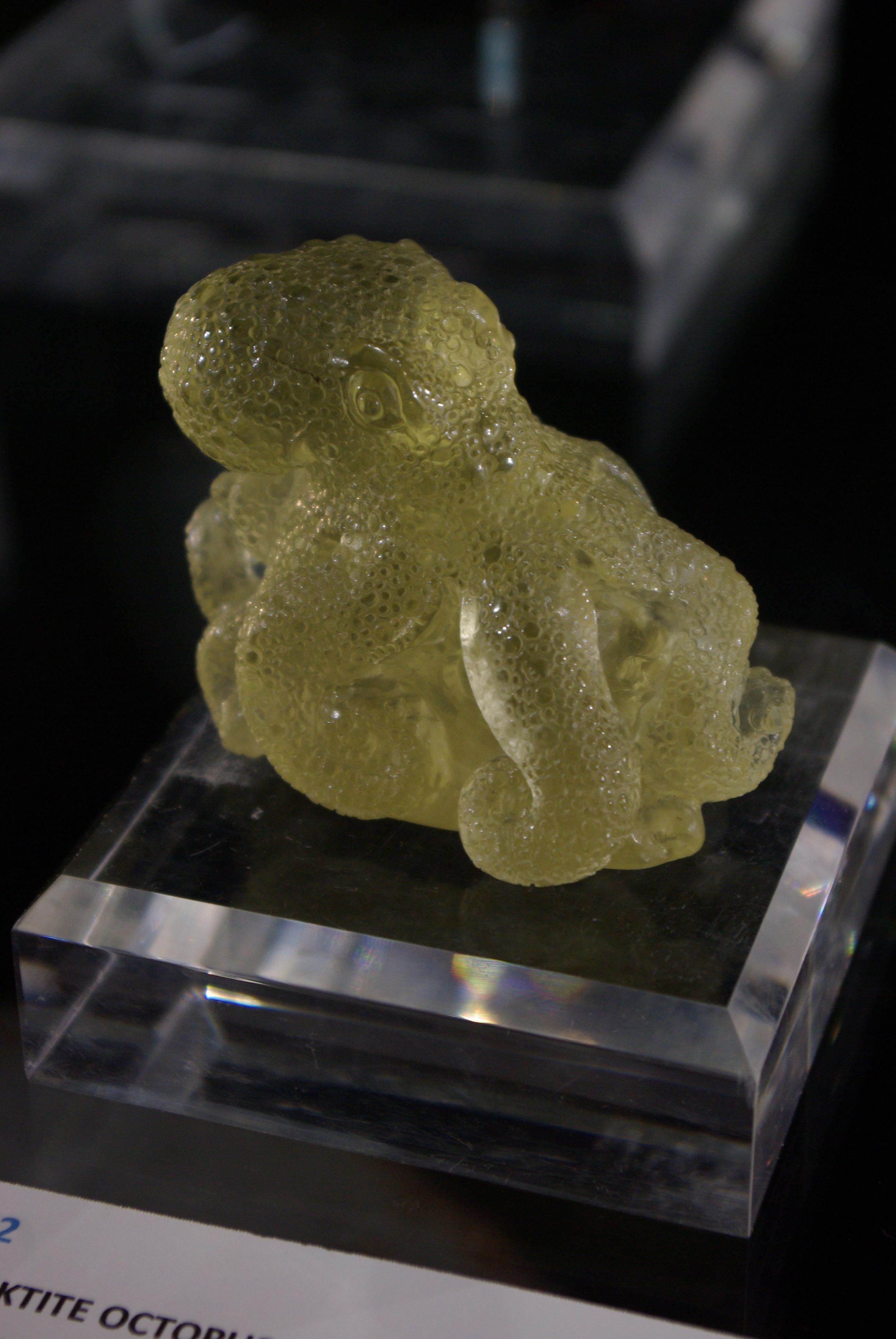
According to the catalogue from Heritage Auctions, this piece of glass was formed in what is now the Libyan Sahara 29 million years ago when a meteoroid struck the sand, creating massive heat that fused sand into glass. This light lemonade colored glass comes from only a small part of the Libyan sands. Tektite is collectible by itself. Some craftsman (unidentified and unplaced in time by Heritage Auctions) carved this piece into a cephalopod.
Taking an uncommonly large and clear specimen, the master lapidarist has carved the form of a malevolent-looking octopus, with superb rugose skin texture and a mass of curling tentacles. With a gorgeous translucence and lovely delicate green/yellow color, this exceptional sculpture measures 2¾ x 2 x 1¾ inches. Estimate: $2,800 – $3,200.
Compared to the giant articulated dinosaurs about 50 feet away from the display, one could easily overlook this little gem. Still, bidding online looked to be pretty active. Is P.Z. still in the British Isles? Is he bidding by internet? Is his Trophy Wife™ planning a Father’s Day surprise?
Tektites should pique your interest, Dear Reader. Glass formed only when interplanetary objects smash into the planet, providing clues to the makeup of our solar system and universe, dating back well before recorded time, found in only a few fields around the Earth. They are the perfect marriage-merger of geology, astronomy, geography, natural history, history and, in this case, art. They are popular among collectors. Who walks away with this one this afternoon?
Spread the word; friends don't allow friends to repeat history.
Anathema to many partisans of the immigration debates: What if we look at the real value of immigration? The U.S. needs more to encourage immigration than to discourage it. God, and devil, in the details.
From the Dallas Federal Reserve Bank:
In advance of an immigration policy conference, Dallas Fed Senior Economist Pia Orrenius discusses how immigration policy can help the U.S. economy and how the global competition for high-skilled immigrants is increasing. The Dallas Fed and the John Goodwin Tower Center for Political Studies at Southern Methodist University are co-sponsoring “Immigration Policy in an Era of Globalization” at the Dallas Fed on May 19-20, 2011.
This piece had only 329 views when I posted it. Shouldn’t carefully studied views of immigration get more circulation on the inter’tubes?
Do you recall seeing any coverage of the May 19-20 conference in your local news outlets, or anywhere else? The conference included high-faluting experts who discussed immigration policies for the U.S., Canada, the EU, Europe, Britain, Australia, Japan, South Korea, Italy, Switzerland, the Netherlands, Spain and Germany. One might think to find some value in the information there.
Can we get the immigration we need, legally? Do present proposals in Congress offer to boost our economy, or hurt it?
And in other news that didn’t make most U.S. local newspapers today, the government of Canada fell yesterday.
"The Conservative government in Canada was toppled on Friday after a vote of no-confidence passed in the parliament by 156 to 145." Cartoon at Politically Illustrated by Cam Cardow
You know: Canada. That nation north of North Dakota, the one that keeps Alaska stuck to the North American Continent. Remember? It’s got about 20% of the world’s fresh water. Those guys who helped us whip Hitler on D-Day.
Oh, c’mon. Google the place, will you? It’s the nation where, when you go there, ‘those bastards with the drug problem south of the border’ is the United States.
No, no, it’s probably not important. We buy a lot of our oil from Canada. Canada is our biggest trading partner. They buy a lot of the goods that we still produce here.
And the conservative government there, under a parliamentary system that kids in the U.S. are never tested on in Texas, lost a vote of confidence Friday, in Ottawa.
Ottawa? It’s the capital of Canada. No, Montreal isn’t even the capital of Quebec.
Oh, come on! Quebec. Quebec! It’s the province of Canada with all the French speakers. Yeah, Quebec City is the capital of Quebec.
Ottawa’s in Ontario. No, Ottawa is the capital of the whole nation, Canada. Ontario’s capital is Toronto.
Lone Ranger? No, Toronto has nothing to do with the Lone Ranger. It’s the biggest city in Canada.
Anyway, to get back to the topic, Canada’s government failed. Conservatives lost a vote because of ethics issues.
Ethics issues, conservatives. No news there. No wonder it wasn’t covered better.
Hopefully, whoever takes over next in Canada will be a bigger proponent of clean energy and fighting climate change than the Harper government has been. The Harper government has been a vocal proponent of tar sands oil expansion – pushing this dirty fuel in the United States and in Europe. In fact, the Harper government has been instrumental in undermining clean energy efforts at home and abroad all to promote the tar sands oil industry. A fresh approach in Canada gives the country a chance to get back to its green roots and to listen to its provincial governments such as Ontario, Quebec, Manitoba and British Columbia who have been developing innovative ways to promote clean energy and fight climate change. A fresh approach also provides an opportunity to lessen Canada’s dependence on the oil and gas sector and its heavy control over the Canadian dollar leading many to fear “Dutch disease.”
Clean energy and fighting climate change are critical issues now and in the coming decades. Hopefully, Canada can step forward as a leader on both in the future.
We can overlook the abuse of the word “hopefully” to extract important information, I think. Did your local paper cover this story today?
Voice of America: “Harper no-confidence vote topples Canada government”: “In calling for the no-confidence vote, the opposition parties alleged that Mr. Harper was in contempt of parliament for failure to fully disclose financial details of his anti-crime legislation, corporate tax cuts and plans to buy 65 American-made stealth fighter jets.”
Northern Light Productions made the film for the “Canyon Visitor Education Center in Yellowstone National Park. The film offers a compelling overview of the ‘big picture’ geology that has shaped and continues to influence Yellowstone and its ecosystem.”
Big picture geology? How about making this film available to schools to talk about geology, geography, and history?
Yellowstone National Park annually gets about three million visitors. Yellowstone is one of those places that ever American should see — but at that rate, it would be more than 100 years before everybody gets there.
We need good, beautifully shot, well-produced, interesting films on American landmarks in the classroom.
How do we get this one freed for America’s kids, Yellowstone Park?
Spread the word; friends don't allow friends to repeat history.
It’s highly improbable that dangerous levels of radiation would drift more than a few miles from the damaged nuclear power plants in Japan, but maybe seeing some actual readings might convince people there’s not much to worry about — other than our sympathy for Japan, the Japanese people and especially those workers who have stayed on the site of the power plant to work to secure the reactors so they do not become hazards to the population at large. Those workers may be exposed to significant, harmful radiation, and they deserve all the thanks you can give them.
Below is a map of the contiguous 48 states of the U.S., showing live readings from about a dozen sampling sites across the nation. The map should update about every minute (if it doesn’t, and you want to see updates, click through to the Radiation Network site).
Normal background levels are about 25 to 75; a low-level warning might be given if readings are sustained at 100. These numbers are Counts Per Minute (CPM), a very crude measure from a Geiger counter showing how many radioactive particles or rays hit the sensor in a minute. It does not distinguish alpha, beta or gamma, and it may be dependent on the design of the Geiger counter, especially the size of the sensor — differently designed machines give different readings even right next to each other.
So it’s a crude count, but it’s a map of counts.
Radiation Network map of radiation in the U.S. Read legend, use with caution. Click map to go to Radiation Network site.
Here is legend information for the map:
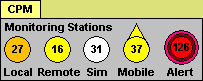
Sampling station symbols, Radiation Network
At left is a symbol used on the map to mark “nuclear sites” by the Radiation Network. Note that a nuclear “site” is not necessarily a nuclear power station. For example, there are nuclear sites designated near Moab, Utah; there are a couple of ore refining facilities or tailing ponds there, but no nuclear power station. The map shows a nuclear site in the Texas Panhandle. There is no nuclear power station there.
Instructions on how to read the map, from RadNet:
How to Read the Map:
Referring to the Map Legend at the bottom left corner of the map, locate Monitoring Stations around the country that are contributing radiation data to this map as you read this, and watch the numbers on those monitoring stations update as frequently as every minute (your browser will automatically refresh). The numbers represent radiation Counts per Minute, abbreviated CPM, and under normal conditions, quantify the level of background radiation, i.e. environmental radiation from outer space as well as from the earth’s crust and air. Depending on your location within the US, your elevation or altitude, and your model of Geiger counter, this background radiation level might average anywhere from 5 to 60 CPM, and while background radiation levels are random, it would be unusual for those levels to exceed 100 CPM. Thus, the “Alert Level” for the National Radiation Map is 100 CPM, so if you see any Monitoring Stations with CPM value above 100, further indicated by an Alert symbol over those stations, it probably means that some radioactive source above and beyond background radiation is responsible.
Notice the Time and Date Stamp at the bottom center of the Map. That is Arizona Time, from where we service the Network, and your indication of how recently the Radiation Levels have been updated to the Map.
(Please note: Any White circles on the map represent Monitoring Stations that are running Simulations, instead of using a real Geiger counter, so any Alert levels that may occur over those stations are to be ignored since they represent only momentary testing.)
Remember, “alert level” is sustained count above 100. But again, be alert that this is only counts per minute, and may be difficult to translate to an accurate radiation reading.
The Radiation Network is an all volunteer operation, no government funding or other involvement. In fact, the network is seeking volunteers to get a Geiger counter and hook it up to the internet to provide even more real-time readings. See “How to Participate in the Nationwide Radiation Network.”
If you’re a denier of global warming/climate change, you should use your usual denial tool, claiming that because radiation at background levels is “normal,” no level of radiation can be harmful. In fact, if you’d make that claim and volunteer to go staff the crews trying to cool the reactors, the entire world would salute you.
Should you be concerned? MIT’s Technology Review explains that the levels of radiation at the plant site itself are quite low, though higher than normal (article by Courtney Humphries). The article also explains that radiation levels rapidly drop the farther from the plant one is; while we may be able to detect increases in radiation attributable to the radiation from Fukushima site, it is highly unlikely that radiation will exceed safety standards:
In terms of potential health dangers from radiation from the Fukushima Daiichi Nuclear Power Station, “the people who are in the most immediate danger from acute and severe radiation doses are those people who are on site at the moment and who are desperately trying to keep the reactors under control,” says Jacqueline Williams, a radiation oncologist at the University of Rochester Medical Center.
Moving away from the immediate vicinity of the plant, radiation levels drop very rapidly. James Thrall, radiologist-in-chief at Massachusetts General Hospital, says that radiation levels are inversely proportional to the square of the distance from the source: The level at two miles from the source are one-quarter what they are at one mile, and “at 10 miles away, it’s almost an infinitesimal fraction,” he says. Individual exposure also varies widely depending on whether a person is outside or indoors, or shielded with protective clothing. Japanese authorities have evacuated the population living within a 20-kilometer radius of the plant, and have warned those living within 30 kilometers to stay indoors. Some experts say that people living beyond this range have no cause for concern at this time. “This has nothing to do with the general population,” McBride says.
The trickier question is whether lower doses of radiation—well below the threshold of acute illness—could lead to long-term health consequences for those in that area. Thrall says that epidemiological studies on survivors of nuclear attacks on Japan have found that those receiving 50 millisieverts or more had a slightly elevated cancer risk—about 5 percent higher than expected—and that risk seemed to rise with higher exposures. But scientists still vigorously debate whether that risk can be extrapolated down to even lower exposures.
After the nuclear disaster at Chernobyl, the population experienced a surge in thyroid cancers in children. However, scientists found that the culprit was not radiation in the air but radioactive contamination of the ground, which eventually found its way into cow’s milk. Thrall points out that in Japan, this is highly unlikely because the authorities are carefully monitoring the water and food supplies and keeping the public informed, which did not happen at Chernobyl.
Photographer Timothy H. O’Sullivan toured the western territories — not yet states — for either the U.S. Army Corps of Engineers or the U.S. Geological Survey, around 1868 and 1869. Color photography hadn’t been perfected. His plates were black and white only.
He had been one of the photographers who captured parts of the Civil War on film, with particularly poignant photos of the battlefield at Gettysburg, Pennsylvania, within hours after the battle ended on July 4, 1863.
O’Sullivan’s photos appear in the collection at the Library of Congress, and at the George Eastman House (Eastman was the founder of Kodak, as you know).
In this post we compare O’Sullivan’s photo up what he called “Great Cottonwood Canon of the Wahsatch,” what is today one of the beautiful canyons leading out of Salt Lake City, Big Cottonwood, in the Wasatch Front. O’Sullivan took a shot up the canyon, then very much unroaded, at an enormous block of granite that came to be known as Storm Mountain.
In 1869:
"Great Cottonwood Canyon, Wahsatch Mountains," 1869 photo by Timothy H. O'Sullivan - USGS photo from Eastman collection
Rich Legg of Salt Lake City captured the same mountain in 2006, and graciously consented to let us use it here for comparison. This is Storm Mountain, now:
Big Cottonwood Canyon, Utah, 2006 - photo by Rich Legg, copyright and rights reserved; image here by express permission
Note from LeggNet blog: This recent capture was made in Big Cottonwood Canyon just outside of Salt Lake City. The striking shadows along with the jagged ridges create a dramatic lighting effect.
Legg’s camera and film allowed a quicker shot, I’ll wager (if he used film at all — it may be an electronic image).
The granite didn’t change much. Storm Mountain is literally a fraction of a mile outside the city limits of Salt Lake City. A photo the other way would show dramatic change. A photo of Storm Mountain, which consists chiefly of naked granite, appears almost unchanged in over a century. It’s difficult even to find places where the vegetation has changed.
In the past 20 years we have seen comparisons of America’s and the world’s glaciers, from photos through the late 19th and 20th centuries, compared to photos of today. The archives of landscape photos held by groups like the George Eastman House offer opportunities for historians and land managers and policy makers to compare American lands from more than a century ago, to those same lands today. Much of those older photo archives are available on line, at least for searching. Will scholars make methodical use of these resources?
Spread the word; friends don't allow friends to repeat history.
I could see a bell-ringer in there somewhere. Who do you think ought to see this thing? What classes in public schools should see it, for what purpose?
I hope the year-long series lives up to the video. I hope there are a lot more videos to go along with it. As a piece of persuasive rhetoric, it does make a decent case for subscribing to National Geographic for a year. How’s that for rhetorical criticism?
Spread the word; friends don't allow friends to repeat history.
Looking at my print copy I was struck that most of the “states” listed — really communities of people — have lost economic ground in the past decade. Average per capita incomes dropped for most groups.
Since 1980, income inequality has fractured the nation. Click each icon to see each of the dozen states, which counties belong to them and how median income has changed over the last 30 years.
The old income inequality monster rearing its ugly, ugly head again. America is losing ground. No wonder the Republicans are discouraged — but why don’t they understand that its their policies that create the trouble?
Or, until that account is unsuspended by the forces supporting Donald Trump: Follow @FillmoreWhite, the account of the Millard Fillmore White House Library
We've been soaking in the Bathtub for several months, long enough that some of the links we've used have gone to the Great Internet in the Sky.
If you find a dead link, please leave a comment to that post, and tell us what link has expired.
Thanks!
Retired teacher of law, economics, history, AP government, psychology and science. Former speechwriter, press guy and legislative aide in U.S. Senate. Former Department of Education. Former airline real estate, telecom towers, Big 6 (that old!) consultant. Lab and field research in air pollution control.
My blog, Millard Fillmore's Bathtub, is a continuing experiment to test how to use blogs to improve and speed up learning processes for students, perhaps by making some of the courses actually interesting. It is a blog for teachers, to see if we can use blogs. It is for people interested in social studies and social studies education, to see if we can learn to get it right. It's a blog for science fans, to promote good science and good science policy. It's a blog for people interested in good government and how to achieve it.
BS in Mass Communication, University of Utah
Graduate study in Rhetoric and Speech Communication, University of Arizona
JD from the National Law Center, George Washington University


 Posted by Ed Darrell









 Millard Fillmore's Bathtub