Latitude and Longitude in two minutes

March 3, 2011

Teachers, can you use a video that covers latitude and longitude in just over two minutes?

A good idea, generally, from Matt Rosenberg (a better idea without “autoplay”) — a few more videos at Ask.com Geography.

[Editor’s note:  I’ve put the video below the fold because I can’t find an easy way to turn off the autoplay command.  My apologies to anyone bothered by the problem.]

Read the rest of this entry »


Firefall in Yosemite: Horsetail Fall’s spectacular February show

March 2, 2011

New program from Yosemite National Park’s “Nature Notes.”

This one has something to appeal to the heart of almost everybody:  Photos from Ansel Adams, photos from Galen Rowell, interviews with sons of each, discussion of the (properly) much-maligned old “firefall” of hot fire coals for tourists — and the story of the natural firefall one might see, if the conditions are right, and if one is in Yosemite in the right place, on the right days of February.

This video was produced by Steven M. Bumgardner, with extra camera help from Josh Helling.  Those guys do great work.  It features photographer Michael Frye, Michael Adams, Ansel Adams’ son, and Tony Rowell, the son of  Galen Rowell.


England? Britain? United Kingdom? Everything explained

February 4, 2011

Is it England, Britain or UK?  The explanation:

Tip of the old scrub brush to Joe Carter at First Things.


American Icons: Half Dome in Yosemite National Park

February 2, 2011

One of what should be an occasional series of posts on American iconic places, natural features, sights to see, etc.  For studies of U.S. history and U.S. geography, each of these posts covers subjects an educated American should know.  What is the value of these icons?  Individually and collectively, our preservation of them may do nothing at all for the defense of our nation.  But individually and collectively, they help make our nation worth defending.

This is a less-than-10-minute video you can insert into class as a bell ringer, or at the end of a class, or as part of a study of geologic formations, or in any of a number of other ways.  Yosemite Nature Notes provides glorious pictures and good information about Yosemite National Park — this video explains the modern incarnation of Half Dome, an enormous chunk of granite that captures the imagination of every living, breathing soul who ever sees it.

Potential questions for class discussion:

  • Have you put climbing Half Dome on your bucket list yet?  Why not?
  • Is it really wilderness when so many people go there?
  • How should the National Park Service, and the Forest Service and Bureau of Land Management, manage these spectacular, completely unique features, both to preserve their wild nature, and allow people to visit them?
  • What are the federalism issues involved in protecting Half Dome, or any grand feature, like the Great Smokey Mountains, Great Dismal Swamp, Big Bend, Yellowstone Falls, or Lincoln Memorial?
  • Does this feature make you wonder about how glaciers carve mountains and valleys?  (Maybe you should watch this video about glaciers in Yosemite.)
  • What is the history of the preservation of the Yosemite Valley?
  • Planning your trip to Yosemite:  Which large city airports might be convenient to fly to?  (What part of which state is this in?)
  • What other grand sights are there to see on your trip to Yosemite?
  • What does this image make you think?  Can you identify the people in it?

    John Muir and Teddy Roosevelt in Yosemite Valley

    Who are those guys? Why might it matter? (Answer below the fold)

  • How about this image? Who made this, and so what?

    Albert Bierstadt, Sunrise, Yosemite Valley, ca. 1870 - Amon Carter Museum, Fort Worth, Texas

    Photo or painting? Where could you see this work?

Read the rest of this entry »


Ironic: Super Bowl host cities shut down by ice

February 1, 2011

280 sanding trucks patrol the streets of Dallas County, but the thin sheet of ice closed us down.  Dallas ISD did the right thing — and it turns out that DISD’s closing for weather is so rare that every other institution we work with keys off of them, knowing that means fewer shutdowns.  But today, ice, no dice.

Dallas ice, January 2009 - photo by Lauren Allen

Sorta like this 2009 photo of north Dallas, but without the pretty sky, with duller ice, and more cold. Lauren Allen is a professional photographer -- did she add in the nice sunrise? (Buy the photo and see!) It doesn't look so treacherous as it is; not seen in the photo: an estimated (by me) 24 jackknifed 18-wheelers on I-635, just a few blocks away.

So, five days to Super Bowl, and Green Bay and Chicago Pittsburgh fans can’t fly to Dallas because of ice.  I imagine fans already here a jumping up and down in their $500-a-night hotel rooms, incredulous that such a thin sheet of cold stuff is keeping them holed up like naked mole rats.  Host city events in Fort Worth and Dallas are cancelled for today, and maybe for much of the rest of the week.

Son James, at Lawrence University in Appleton, Wisconsin, is just three degrees colder, but missing the ice and wind we have.  His windchill isn’t so great as ours.  Windy City, you ain’t seen nothing like the winds of Texas.  Usually they don’t blow so cold, though.

Our front gate is frozen.  The lock won’t budge.  We’ll have to snowshoe from the backyard to get the newspaper.

Global warming deniers are dancing with glee.  They think the fact that we’ve got Arctic weather means warming isn’t happening, forgetting to look to the Arctic, which is eerily warm.

But it’s all cool.  No school!


Depending on your perspective, the world looks pretty good

January 2, 2011

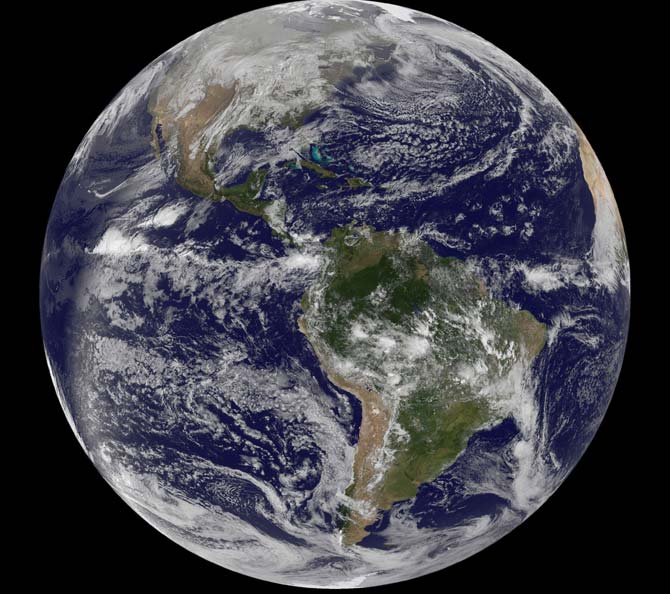
If you’re a few dozen miles from the Earth, for example:

Earth full disc, December 30, 2010 - NASA, GOES

From NASA: The GOES-13 satellite captured a "full-disk image" of North and South America in an image created December 30 at 1445 UTC (9:45 a.m. EST), as the world awaits the new year. Credit: NOAA/NASA GOES Project; click on picture for larger view

Press information from NASA:

As the World Turns to 2011 GOES Satellites Watch its Approach and Look Back at 2010

The GOES series of satellites keep an eye on the weather happening over the continental U.S. and eastern Pacific and Atlantic Oceans and had a busy time with wild weather in 2010. Today, GOES-13 captured one of the last images of North and South America in 2010 as the world continues to turn toward 2011.

The Geostationary Operational Environmental Satellite called GOES-13 satellite captured a “full-disk image” of North and South America in an image created December 30 at 1445 UTC (9:45 a.m. EST) as the world awaits the new year. The stunning image shows cloud cover associated low pressure areas over the upper Midwestern U.S. and Colorado’s Rocky Mountains.

NASA’s GOES Project, located at NASA’s Goddard Space Flight Center in Greenbelt, Md., procures and manages the development and launch of the GOES series of satellites for NOAA on a cost-reimbursable basis. NASA’s GOES Project also creates some of the GOES satellite images and GOES satellite imagery animations. NOAA manages the operational environmental satellite program and establishes requirements, provides all funding and distributes environmental satellite data for the United States.

NASA’s GOES Project was very busy this year. GOES-13 monitors the eastern continental U.S., Atlantic Ocean, Gulf of Mexico and Caribbean, while GOES-11 monitors weather conditions over the western U.S. and the Eastern Pacific Ocean.

In 2010, GOES satellites were busy providing images and animations of weather systems from nor’easters to tropical cyclones that caused blizzards, flooding and wind damage.

Most recently, the GOES project used satellite data to create an impressive animation of the great Christmas weekend blizzard that pummeled the northeastern U.S. Prior to that, GOES imagery showed travel conditions for the holiday weekend when that low was over the Colorado Rockies.

On Dec. 19, the GOES-11 satellite captured an image of the famous “Pineapple Express.” Occasionally in the winter, a large jet stream forms across the mid-Pacific, carrying a continuous flow of moisture from the vicinity of Hawaii to California, bringing heavy rain and snow to the Sierra-Nevada for several days.

On Dec. 8 GOES-13 satellite imagery revealed a snow-covered, winter-like upper Midwest, several weeks before astronomical winter. On Nov. 24, GOES satellites helped Thanksgiving travelers figure out where delays may be happening.

During the summer, on July 25, GOES-13 imagery tracked one of the most destructive storms in years to strike Washington, D.C. and the surrounding area. Strong winds downed trees and power lines, leaving hundreds of thousands of residents without power, stopping elevators, and darkening malls and movie theaters. Falling trees killed at least two people. The NASA GOES Project created a satellite animation of the storm as moved through the region.

GOES-13 was busy in the Atlantic during the 2010 hurricane season. The Atlantic season started on June 1 and ended on November 30. The Atlantic season tied for third with two other years (1995 and 1887) as having the largest number of named storms at 19, and tied with two other seasons (1969 and 1887) for the second largest number of hurricanes, with 12. GOES-13 covered all of those tropical cyclones. GOES-11 didn’t see the action in the Eastern Pacific tropics that GOES-13 did, however. Because of a La Niña event, the 2010 Pacific hurricane season (which began May 15 and ended Nov. 30) was the least active season in terms of the number of named storms and hurricanes on record. All tropical cyclones can be seen at NASA’s Hurricane page archives for 2010 at: http://www.nasa.gov/mission_pages/hurricanes/archives/index.html.

On April 14, months before hurricane season started, GOES-13 became the official GOES-EAST satellite. GOES-13 was moved from on-orbit storage and into active duty. It is perched 22,300 miles above the equator to spot potentially life-threatening weather, including tropical storm activity in the Atlantic Ocean and Gulf of Mexico..

Before GOES-13 moved into the position previously occupied by GOES-12, GOES-12 captured a parade of three large storms the flooded the upper Midwest and Northeast in the second half of March. In the first half of March, GOES-12 covered storms as they dumped heavy rainfall in the Northeastern U.S.

On March 12, GOES-12 captured a very rare event in the tropics: the second–ever known tropical cyclone called Tropical Storm 90Q formed in the South Atlantic Ocean off the coast of Argentina.

During the first two weeks of February 2010, the GOES-12 weather satellite also observed a record-setting series of “Nor’easter” snow storms which blanketed the mid-Atlantic coast in two blizzards.

Whatever and wherever the weather in 2011, the GOES series of satellites will always go.

Related Links:

› GOES-POES web site
› NOAA web site

Rob Gutro
NASA’s Goddard Space Flight Center, Greenbelt, Md.


Eclipse! Fun watching, little success photographing

December 21, 2010

Joni Mitchell warned us:  Clouds get in the way:

Lunar eclipse 12-21-2010 - beginning, with clouds - Photo by Ed Darrell - IMGP5738

A clouded view for openers

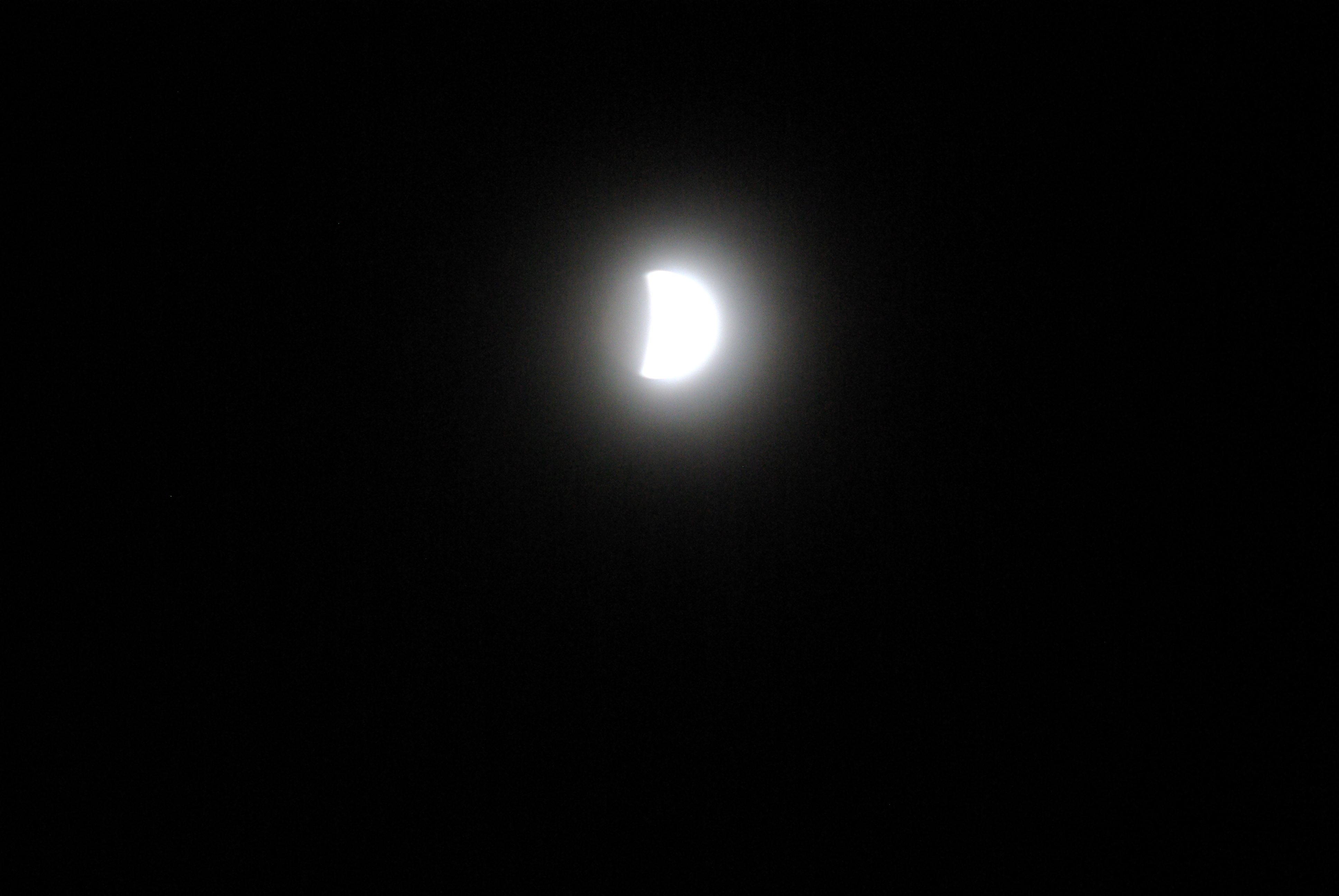
A long eclipse — more than an hour of almost-total coverage of the Moon’s disk.  Clouds came and went, with a few good viewing times.  With the naked eye, the view was spectacular.  Through the 200 mm Pentax zoom, not quite as spectacular, even with the tripod mount.  Photographing eclipses takes some skill that I don’t yet possess.

Solstice eclipse - clouds took a break IMGP5760 - Photo by Ed Darrell

Clouds took a break

Eclipse totality, with clouds - IMGP5778 - Photo by Ed Darrell

Eclipse totality

A better shot, near the end - IMGP5798 - photo by Ed Darrell

Eclipse nearing its end

Near the end of totality, where the shadow slips away from the full Moon, a bright white light provides a dazzlying view that confounds the light meters.

Bright sliver as eclipse totality ends - IMGP5813 - Ed Darrell photo

Celestial orange, tinged in silver

Ending eclipse with more of the sky - IMGP5822 - Ed Darrell photo

Step back, see a few of the starts, even from inside Dallas city limits

Bright light at the edge of Earth's shadow - IMGP5844 Ed Darrell photo

To every Earth shadow, there's a silver lining to confuse the built-in light meter

Blood-tinge gone, Earth's shadow retreats - IMGP5881 Ed Darrell photo

Blood-tinge gone, Earth's shadow retreats (all photos by Ed Darrell)

Eclipse over, clouds again fog the view - IMGP5884 - Ed Darrell photo

Eclipse nearly over, clouds again fog the view

Longer lens, better tripod next time.  (Heh.  We should live so long.)


Stunning photo: What happened here, 795 years ago?

December 5, 2010

Runnymede, Magna Carta Isle, photo by Wyrdlight, Antony McCallum, 2008 (Wikimedia)

What event critical to western history and the development of the democratic republic in the U.S. happened here in 1215?

A teacher might use some of these photos explaining the steps to the Constitution, in English law and the heritage of U.S. laws.  Other than the Magna Carta, all the events of Runnymede get overlooked in American studies of history. Antony McCallum, working under the name Wyrdlight, took these stunning shots of this historic meadow.  (He photographs stuff for studies of history, it appears.)

Maybe it’s a geography story.

View of Runnymede Meadow from Engham Village -- Wyrdlight photo through Wikimedia

View of Runnymede Meadow from Engham Village -- Wyrdlight photo through Wikimedia

Several monuments to different events of the past millennium populate the site.  The American Bar Association dedicated a memorial to the Magna Carta there — a small thing open to the air, but with a beautiful ceiling that is probably worth the trip to see it once you get to England.

Wikipedia explains briefly, with a note that the ABA plans to meet there again in 2015, the 800th anniversary of the Great Charter:

Magna Carta Memorial


The Magna Carta Memorial & view towards the ‘medes’


Engraved stone recalling the 1985 ABA visit

Situated in a grassed enclosure on the lower slopes of Cooper’s Hill, this memorial is of a domed classical style, containing a pillar of English granite on which is inscribed “To commemorate Magna Carta, symbol of Freedom Under Law”. The memorial was created by the American Bar Association to a design by Sir Edward Maufe R.A., and was unveiled on 18 July 1957 at a ceremony attended by American and English lawyers.[5]

Since 1957 representatives of the ABA have visited and rededicated the Memorial renewing pledges to the Great Charter. In 1971 and 1985 commemorative stones were placed on the Memorial plinth. In July 2000 the ABA came:

to celebrate Magna Carta, foundation of the rule of law for ages past and for the new millennium.

In 2007 on its 50th anniversary the ABA again visited Runnymede and during the convention installed as President Charles Rhyne who devised Law Day which seeks in the USA an annual reaffirmation of faith in the forces of law for peace.

The ABA will be meeting at Runnymede in 2015 on the 800th anniversary of the sealing of the original charter.

The Magna Carta Memorial is administered by the Magna Carta Trust, which is chaired by the Master of the Rolls.[10]

In 2008, flood lights were installed to light the memorial at night, but due to vandalism they now lie smashed.

I’ll wager the lights get fixed before 2015.

Detail of ceiling of the Magna Carta Memorial, Runnymede - Wikimedia image

Detail of ceiling of the Magna Carta Memorial detailing play of light, and star pattern, Runnymede - Wikimedia image

More, resources:


Leonid meteor shower 2010: Moon, Jupiter, and Leonids

November 17, 2010

Some stellar fireworks will be visible in your skies tonight, November 17, 2010.

The Moon is in conjunction with Jupiter.  The Leonid Meteor Shower will peak soon after the Moon and Jupiter set.

Oh, to be in the desert tonight, far away from the lights of the city!

Even in a city, the Moon and Jupiter should be clear, and near spectacular.

Things are great, if you’re looking up.

Moon and Jupiter, conjunction 1990 - ICSTAR

It won't be this spectacular -- this is a photo of the 1990 Moon/Jupiter conjunction (ICSTARS photo)


Butterflies are free, to move about the country

October 24, 2010

Great mysteries of science, history and spirit call to us:  How do the monarch butterflies do it?

Monarch butterflies (Danaus plexippus) fly north from their enclave in Mexico every spring, stopping to lay eggs on milkweed plants.  After a migration of several hundred miles, that first group that left Mexico dies off.  Their offspring hatch in a few days, devour the milkweed, make a chrysalis, metamorphose into butterflies, then fly farther north, where they repeat their parents’ behavior:  Lay some eggs, and die.  Within three generations, they’ve spread north into Canada.

Kathryn's butterfly plantings, October 2010 - photo by Ed Darrell

Inviting the monarchs in: You can see how Kathryn worked to attract butterflies. In this photo, you can see the butterfly weed (a milkweed), red Turk's cap, and blue ageratum especially for the monarchs.

Then the fourth generation does something so strange and wonderful people can’t stop talking about it:  They fly back to Mexico, to the same trees their great-great-great grandparents left.  There they sip some nectar, get some water, and spend a lot of time hanging in great globs, huddling over the winter, to start life for generations of monarch butterflies the next spring.

Sometimes in Texas in October, we can see clouds of monarch butterflies winging south.  If we’re lucky, they stop to visit our backyards and gardens, and we might provide some water and nectar to urge them homeward.  Kathryn, of course, plants the stuff the monarchs like, to help them, and to give us a chance to see them.

Monarch habitat in Mexico is under severe stress and threat.  Late storms and early freezes decimated monarch populations over the last decade [yes, that’s the proper use of “decimated;” look it up].  Human plantings are more critical to the monarch butterflies than ever before.

Two years ago Kathryn and I spent a September morning outside the library at Lawrence University, in Appleton, Wisconsin, watching monarchs sip nectar from local flowers for their journey.  Those same butterflies — we hope — passed through Texas a couple of weeks later.

Two weeks ago . . . well, see for yourself:

Monarch butterfly on blue porterweed, Dallas, TX October 2010 - photo by Ed Darrell IMGP5343

A monarch butterfly feeds on blue porterweed in Kathryn's garden, October 2010 - photo by Ed Darrell

Monarch butterfly on blue porterweed, Dallas, October 20101 - photo by Ed Darrell IMGP5347

. . . we're here with the camera, little guy, just open up those wings, please . . .

Monarch  butterfly on blue porterweed, Dallas, Texas October 2010 - photo by Ed Darrell IMGP5345

That's it! Beautiful! Have a safe trip, and come back next spring, will you?

Resources, more:

Conoclinium coelestinum


Sam O’Hare’s brilliant film, The Sand Pit

October 18, 2010

You can learn a lot just by observing.

Sam O’Hare’s observations, captured with his Nikon D-300, can teach you a lot.

Or, you can sit back an enjoy the images.  Spectacular stuff.

A day in the life of New York City, in miniature.

Winner: Prix Ars Electronica Award of Distinction 2010

Original Music: composed by Human (humanworldwide.com), co-written by Rosi Golan and Alex Wong.

Geography bell ringer?

Tip of the old scrub brush to Kenny in Beijing.


Columbus’s most prized possession

September 28, 2010

Columbus feared that King Ferdinand and Queen Isabella would not honor pledges they had made to him as recompense and honor for his great work of discovery on their behalf.  Before his final voyage, he assembled a legal document showing those promises made to him, and his work for Spain.

This illustrates, once again, the human dimension of the great drama of the age of exploration, of Columbus’s stumbling on to the America’s in his efforts to get to China.

The Library of Congress and the History Channel team up again to show off these grand snippets of history:

On January 5, 1502, prior to his fourth and final voyage to America, Columbus gathered several judges and notaries in his home in Seville. The purpose? To have them authorize copies of his archival collection of original documents through which Isabel and Fernando had granted titles, revenues, powers and privileges to Columbus and his descendants. These 36 documents are popularly called “Columbus’ Book of Privileges.” Four copies of his “Book” existed in 1502, three written on vellum and one on paper. The Library’s copy, one of the three on vellum, has a unique paper copy of the Papal Bull Dudum siquidem of September 26, 1493, which extended the Spanish claim for future explorations.

Borrowed with permission from Mr. Darrell’s Wayback Machine.


What does urban sprawl look like?

September 22, 2010

Teachers looking for a good way to portray urban sprawl, for geography and history classes, should take a look at this photo essay at the New York Times; unfortunately for teachers, Christoph Gielen’s stunning aerial landscapes cannot be copied for PowerPoint.

Gielen’s work is well known, and many of those same images can be found at other sites.  Images to illustrate “urbanization” and “urban sprawl” from internet sources generally carry a lot more punch than the stock photos delivered with textbooks.  Mind the copyrights.

Untitled X Nevada, urban sprawl in Nevada, copyright Christoph Gielen

(Caption from New York Times presentation): Untitled XI Nevada, 2010 This Vegas-area community was built by the same company that designed the circular communities on the outskirts of Phoenix in “Untitled X / XII / XI.” Credit: Christoph Gielen (Go see the presentation at the Times site to see the other photos)

More resources:


One more place to lose your heart, or stir it, near San Francisco

September 20, 2010

Did I mention that San Francisco is one of my favorite cities in the world?

A lot of reasons.  My father had businesses there (1930s?).  My parents wooed in and around there.  Our Favorite Aunt Linda did well in the area (Marin County, but that just adds to the beauty).

I was accepted at Hastings College of Law.  We figured we had enough saved that we could either pay tuition at Hastings, and live on what Kathryn could earn, if she could get a job; or we could buy a house in the D.C. area, keep our jobs on Senate staff, and pay tuition.

We had a wonderful week in San Francisco getting no job interviews.  On our last night we found a Tower Record Store and stocked up (back in the days of vinyl) for the next four years at George Washington, and sadly left the city.  In a fit of irony, Tower Records opened a store across the street from GW’s law school two years later.

Earlier, after the 1976 elections, I hid out at Aunt Linda’s joint, Red Robin Catering, tending bar, washing dishes, washing a lot of lettuce, and generally trying to make a car payment and enjoy San Francisco.  She catered the opening of the Marin/San Francisco ferry, which meant more than a dozen trips overall, as I recall, serving champagne mostly.  Now I look back on how unfair it was that my youth did not include electronic cameras.

Early mornings — and there were more than a few — the city is just unsurpassed in beauty.  Cousin Steve pushed me out of bed to go see the Muir Woods at near dawn (I confess I did not go often enough).  Some nights I’d just cruise across the Golden Gate Bridge for the views.

Like this one, a composition from several shots from the same place, woven together with the wonders of electronic camera software:

Golden Gate Bridge and San Francisco, and fog, from Marin County - Wikimedia image, panorama photo stitching by Mila Zinkova

Golden Gate Bridge and San Francisco, and fog, from Marin County - Wikimedia image, panorama photo stitching by Mila Zinkova

It’s shot from Marin County, west of the Golden Gate Bridge, I think — that’s the North Tower of the bridge, with the Bay Bridge and the city of San Francisco in the background.

Discussion at Wikimedia:  Those are crepuscular rays coming through the trees.  There’s an SAT vocabulary word for you:  Crepuscular.

More crepuscular rays from Marin County, Wikimedia photo by Mila Zinkova

More crepuscular rays from Marin County, Wikimedia photo by Mila Zinkova

More:

  • More great shots of San Francisco at Heida Biddle’s Tales of 7, here, and especially here

Powers of Ten day coming: 10/10/10

August 30, 2010

Press release from the office of the group that manages the estate and work of Charles and Ray Eames:

TENTH ANNUAL INTERNATIONAL POWERS OF TEN DAY

Santa Monica, California, August 27, 2010 /PRNewswire/ — The Eames Office announces with pleasure the Tenth Annual International Powers of Ten Day on October 10, 2010 (10/10/10). Powers of Ten Day promotes and encourages Powers of Ten Thinking, a form of rich, cross-disciplinary thought that approaches ideas from multiple interrelated perspectives, ranging from the infinitesimal to the cosmic—and the orders of magnitude in between.

Milky Way, by Charles and Ray Eames, from

The Milky Way Galaxy from the film, Powers of Ten, by Charles and Ray Eames. For use only in conjunction with press about Powers of Ten Day 2010. © 1977 Eames Office, LLC (eamesoffice.com) (caption provided)

Powers of Ten Day is inspired by the classic film Powers of Ten by designers Charles and Ray Eames. The film, a nine-minute visual journey of scale, takes the viewer from a picnic out to the edge of space and then back to a carbon atom in the hand of the man sleeping at the picnic. Every 10 seconds the view is from 10 times further away. In all, more than 40 Powers of Ten are visualized seamlessly. One of the most widely seen short films of all time—at the Smithsonian Air and Space Museum for decades and still widely used in schools around the world—Powers of Ten has influenced pop culture from The Simpsons to the rock band Coldplay, from Hummer commercials to the movie Men in Black. But Powers of Ten received perhaps the ultimate accolade in 1998 when the Library of Congress selected it, along with Easy Rider, Bride of Frankenstein, and Tootsie, for the National Film Registry—one of the 25 films of great cultural value chosen each year.

And the film’s importance only grows. Scale is not precisely just size, it is the relative size of things. As Eames Demetrios, director of the Eames Office, has said: “Scale is the new geography. So many of our challenges today are ultimately matters of scale. To be a good citizen of the world and have a chance to make it a better place, a person must have a real understanding of scale.”

Powers of Ten Day is for teachers, librarians, architects, designers, store owners, webmasters, business people, scientists, filmmakers, meditation gurus, parents, kids, and anyone wanting to extend the boundaries of their thinking. Participating can be as simple as watching the video (showing online throughout October [the tenth month] at www.powersof10.com), or putting together a screening of the film for friends or co-workers—at home, in a school, or at a library. Our goal is for as many people as possible to watch or share the film on that day. Some will be seeing it for the first time. Some will be revisiting a favorite classic. Everyone can be part of the conversation.

Powers of Ten Day can also be a lot more. Activities are happening worldwide throughout October. With the help of the DVD Scale is the New Geography as well as a Powers of Ten Box Kit, individuals (teachers in the broadest sense) can lead engaging workshops for kids and/or adults that let participants create their own scale journeys. Although those materials may be purchased at www.eamesoffice.com, as Eames Office Education Director Carla Hartman notes, “We’ve set aside some sets to be available at no charge for inquiring schools and teachers.” Those supplies are limited—and some are already being put to use. To inquire about availability of Powers of Ten supplies at no charge, email info@eamesoffice.com.

The Eames Office also encourages you to create and share your contributions. Over the years art has been created, music shared, global pilgrimages performed, and more. But most of all there has been hands-on learning. Events can be registered, and photographs, drawings, and writings uploaded. Sorted by power and by event, these will serve as inspiration and fodder for other events around the world—more than 1,000, possibly 10,000.

Anyone living in or visiting Southern California is welcome to visit the Powers of Ten Exhibition at the Eames Office in Santa Monica from now until the end of the year. There will be an event each day the exhibition is open during the month of October. Many more fun and thought-provoking activities will be available at www.powersof10.com by the end of the summer. The exhibit includes such things as a box that can hold 1 million pennies; as of mid-August, there were already 250,000! All the pennies collected will be given to TreePeople, an environmental nonprofit that unites the power of trees, people and technology to grow a sustainable future for Los Angeles.

Powers of Ten Thinking extends beyond this unique date of 10/10/10. As Demetrios says, “There is a little bit of the numerologist in all of us, so we love celebrating this date, but empowering people to explore and make connections between scales is a year-round goal of ours.” The Eames Office looks forward to tracking and inspiring another decade’s worth of Powers of Ten events. Towards that end, a map of the Earth on the website (and at the Office) will track events around our world.

The Eames Office is dedicated to communicating, preserving, and extending the work of Charles and Ray Eames. Additional information is available online at www.powersof10.com, as well as at www.eamesoffice.com and www.eamesfoundation.org.

The Powers of Ten Exhibition is open from 11 to 6, Wednesday through Saturday at the Eames Office, 850 Pico Boulevard, Santa Monica, CA 90405; 310/396-5991.

Powers of Ten Day is generously sponsored by IBM Corporation with additional support from Herman Miller Inc., Vitra, and Penfolds.

Your school should have one of the Eames versions of the film in the school library (they did more than one).  This is truly a classic, and it should be a good discussion starter for several different topics — map reading, map scaling, environmentalism, existentialism, transcendentalism, and more.

So what will you do for Powers of Ten Day?

Update:  A YouTube edition of the film, “Powers of Ten,” is now available. MFB post about the film, with embedded version and links, here.