Trinity test, world’s first atomic bomb – July 16, 1945

July 17, 2016

Another good reason to follow the National Archives on Twitter, Tumblr and other media:  Great updates.

Like this one on the explosive arrival of the Atomic Age:

 Atomic Age Begins

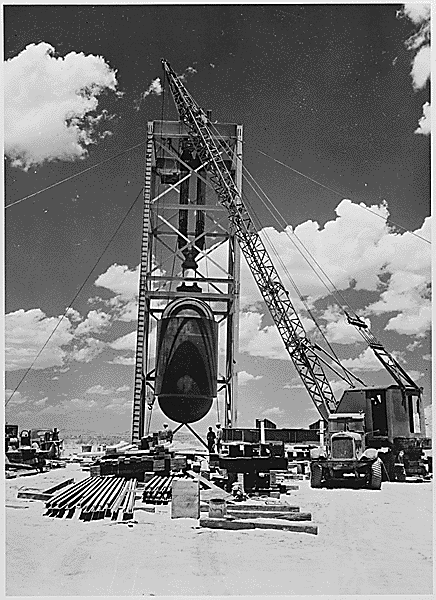
"Trinity" atomic device being positioned at White Sands, New Mexico - National Archives

Trinity atomic device “Jumbo” being positioned at White Sands, New Mexico – National Archives

Atomic Age Begins

On July 16, 1945 the United States tested a nuclear device, code named “Trinity”, for the first time in White Sands Proving Ground, New Mexico.

Above: [“Jumbo” atomic device being positioned for “Trinity” test at Alamogordo, New Mexico.], 1945

Below: [“Trinity” explosion], 07/16/1945

Source: research.archives.gov

It’s astonishing to think anyone could hide the explosion today. Near the end of World War II, after Germany had surrendered to end the war in Europe, no one really knew just what at atomic explosion would look or sound like. The test occurred near dawn in a very desolate part of New Mexico’s southern desert, a then sparsely populated state. A few thousand may have seen the flash; a few hundred may have heard or felt the explosion. No one in government confirmed any report of a weapon.

English: Rare color photograph of the first nu...

Rare color photograph of the first nuclear test at Trinity site, July 16, 1945. Blurriness is in the original photograph (done when color photography was still fairly new). (Photo credit: Wikipedia)

This is based on an earlier post, and is mostly an encore post.

This is based on an earlier post, and is mostly an encore post.


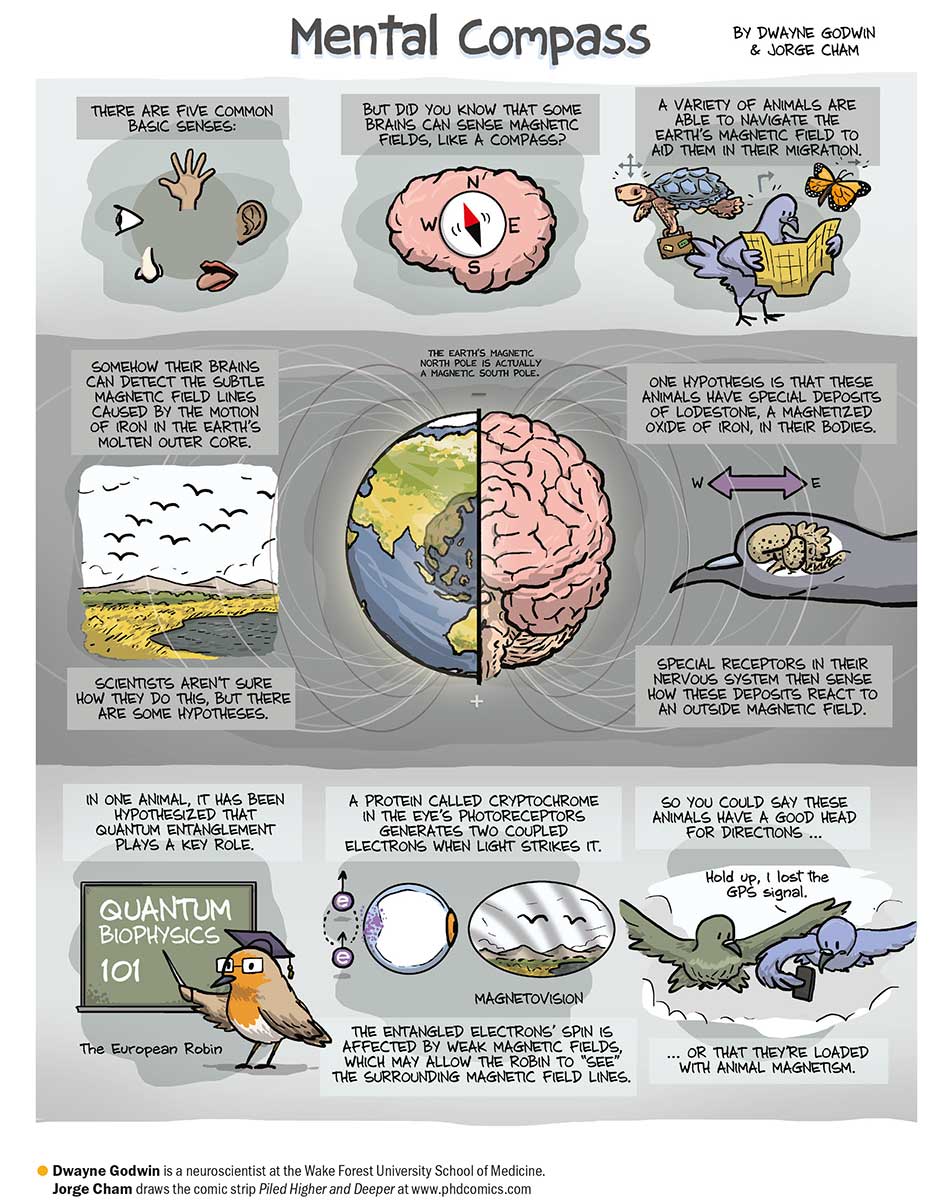
Are birds smarter than Columbus?

March 8, 2016

Another great find on Twitter, for geography, biology and physics classes.

How do birds navigate, compared to, say, Columbus? Most U.S. history texts make a big deal of Columbus’s navigation, made possible by invention of the magnetic compass and the sextant.

Birds are more accurate, and they have neither. Well, they don’t have external magnetic compasses. See the cartoon.

Neuroscientist and cartoonist team up to talk about birds

Neuroscientist and cartoonist team up to talk about birds “seeing” magnetic lines of the Earth! Information from Dwayne Godwin at Wake Forest University School of Medicine, with drawings by Jorge Cham, who draws Piled Higher and Deeper.

Teachers, have someone in the drafting department make this cartoon into a poster for your classroom.

As usual, the truth is more weird and wonderful than fiction writers could hope to invent.

Tip of the old scrub brush to Columbia University’s Twitter managers.


Timpanogos timelapse, a reverse setting sun?

February 25, 2016

Again from Twitter, a series of photographs of Utah’s Mount Timpanogos.

From top to bottom, it looks like a sunrise on the mountain. But Timpanogos faces west; the sun rises from behind this face. Two possible explanations. The more mundane explanation would be that the series starts with the bottom photo, progressing to the top. Shadows support that explanation.

The slightly more colorful explanation would be, as we often see here in Texas, weather moving from west to east; and in the late afternoon a cover of clouds moves far enough east that the setting sun finally is uncovered, peeking out from underneath the clouds to light the land with that wonderful golden hour sun for a few minutes, before setting.

Timpanogos, like the rock it is, sits majestically either way.

Tweet from sofiaaugustineadams (@sofiaaadams): Mountain time #timelapse #timpanogos

Tweet from sofiaaugustineadams (@sofiaaadams): Mountain time #timelapse #timpanogos

I Tweeted Ms. Adams (I’m presuming her name to be Sofia Augustine Adams) to ask which it is. For those who love Timpanogos, it won’t matter much.

My guess is the photo was taken from south of Orem, Utah, probably near Interstate Highway 15 which transects Utah County.

Update: Ms. Adams informs us  (see comments) it is a setting sun, with the bottom photo being the first in the series. Thank you!


Oil in Mt. Timpanogos?

February 19, 2016

During the RARE II Wilderness Assessment process, and during the Sagebrush Rebellion of the 1970s and 1980s, wildcatters along the Rocky Mountains spine of the west would say we couldn’t rule out any area as having no oil unless we drilled first.

But no one’s found oil in Timpanogos.

Instead, we’ve found Timpanogos in oil.

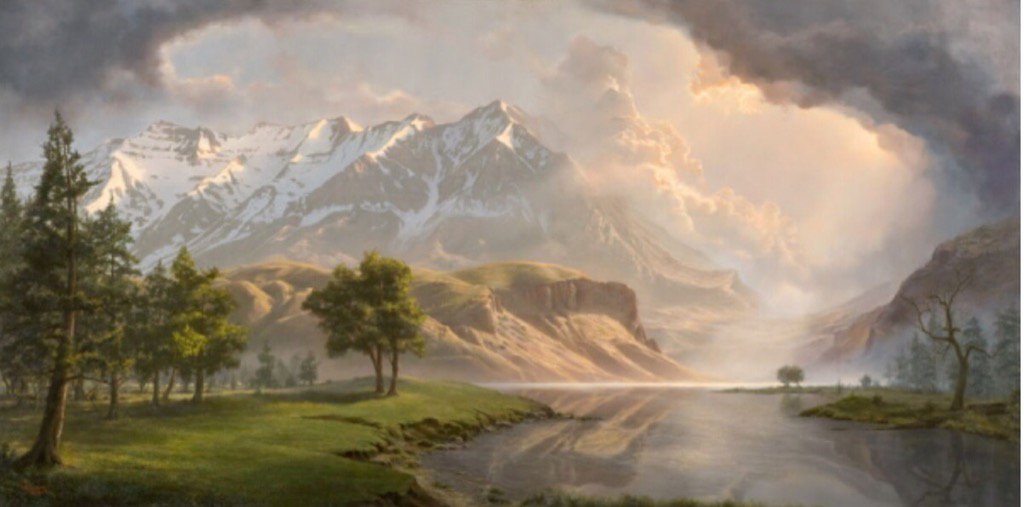
Mt. Timpanogos Millennium, by Adam Abram (b. 1976). From Tweet by Don Ruggles (@DHRuggles) and @TeresaVeiga1

Mt. Timpanogos Millennium, by Adam Abram (b. 1976). From Tweet by Don Ruggles (@DHRuggles) and @TeresaVeiga1

It’s an interesting view of the mountain, from the southwest. At the right of the picture is Provo Canyon. The body of water must be the Provo River, but in a serene state I think could not have existed at any time. The bluffs shown past the juniper trees are unfamiliar to me.  I’m guessing the artist, Adam Abram, has idealized Timpanogos as the Mormon pioneers might have found it. The area portrayed is probably part of Orem, Utah, today — covered by housing tracts and power lines.

Anyone know? A topological map covering the mouth of Provo Canyon to where the river enters Utah Lake might offer much more specific information. I don’t have one of those at the moment.

Compare it with this photo of Timpanogos (in late summer) by Bob Walker of Orem, 2012:

Utah's Mount Timpanogos looking Northeast; Provo Canyon to the left of the photo. Photo by Bob Walker.

Utah’s Mount Timpanogos looking Northeast; Provo Canyon to the left of the photo. Photo by Bob Walker.

Almost update: I went looking for Adam Abram. You can hang a print of his Mount Timpanogos Millennium for under $30 (a bargain).

Abram explains his painting:

I grew up in the shadow of beautiful Mt. Timpanogos.  This mountain, towering over Utah Valley, stands at 11,749 feet above sea level and once rose above the shores of ancient Lake Bonneville.  Its name is a Paiute word meaning “river of rock.” My goal as an artist was to memorialize my favorite mountain with a 19th century style similar to the Hudson River School. In the process of creation, I did studies of several trees from around the mountain and painted them in.  Sadly, those trees have been torn down with the growth of business and home development. This painting is a tribute to the beauty and majesty of this incredible mountain. This painting won 3rd place in the prestigious 2007 International ARC salon.

I’m not alone in loving that mountain. Who knew?


Wildlife refuge photos, early January 2016

January 5, 2016

National Wildlife Refuges. Four days ago, most people were very fuzzy on what they are, except for members of Ducks Unlimited, and conservationists.

Here are a few Tweets to help the rest along.

Moose at the National Elk Refuge, outside Jackson Hole, Wyoming:

Wisdom is a 64-year old albatross who remarkably returns to the Midway National Wildlife Refuge every year, and has raised chicks most of those years. Midway NWR is northwest of Hawaii:

Sparky the lightning catching bull bison, at the Midwest NWR:

Every Kid in a Park shares a photo of an unnamed wild area (threw it in just for the heck of it):

Yellow-rumped warbler at the Sacramento NWR:

USFWS workers conduct a controlled burn at the Okefenokee NWR in Florida:

Hamden Slough NWR, Minnesota, is 26 years old today, January 5:

Great blue heron at Sacramento NWR:

Pied-billed grebe at Sacramento NWR:

Conservatives keep misattributing a famous quote to Thomas Paine, but it was Ed Abbey who said it. Rumor is you can find Abbey at the Caza Prieta NWR in Arizona:

Buenos Aires NWR, Arizona:

Wichita Mountains NWR, Oklahoma:

Bosque del Apache NWR, New Mexico (near Las Vegas, New Mexico, home of the first Owl Cafe and the wonderful Owl Burger):

https//twitter.com/CherylRofer/status/683725871123791872

Back to the Midway Atoll NWR:

1908 photo from Oregon’s Malheur NWR:

Working against extinction of monarch butterflies, at St. Marks NWR:

Lake Klamath NWR in Oregon, critical habitat for ducks along the Pacific flyway:

Loxahatchee NWR:

“Conservatives” want to sell these lands off, or drill for oil or gas, or mine for minerals, on many of these lands. Will these places be preserved for your great grandchildren and America’s future?


January 5, 1502: A deal is a deal, with Columbus’s most prized possession

January 5, 2016

Who can you trust, if not the king and queen?

Columbus feared that King Ferdinand and Queen Isabella would not honor pledges they had made to him as recompense and honor for his great work of discovery on their behalf.  Before his final voyage, he assembled a legal document showing those promises made to him, and his work for Spain.

This illustrates, once again, the human dimension of the great drama of the age of exploration, of Columbus’s stumbling on to the America’s in his efforts to get to China.

The Library of Congress and the History Channel team up again to show off these grand snippets of history:

On January 5, 1502, prior to his fourth and final voyage to America, Columbus gathered several judges and notaries in his home in Seville. The purpose? To have them authorize copies of his archival collection of original documents through which Isabel and Fernando had granted titles, revenues, powers and privileges to Columbus and his descendants. These 36 documents are popularly called “Columbus’ Book of Privileges.” Four copies of his “Book” existed in 1502, three written on vellum and one on paper. The Library’s copy, one of the three on vellum, has a unique paper copy of the Papal Bull Dudum siquidem of September 26, 1493, which extended the Spanish claim for future explorations.

513 years ago today.

Parts of Christopher Columbus’s journals parked for a visit to Dallas, through January 3, at the Meadows Museum on the campus of Southern Methodist University. When we visited, the exhibits were not crowded. Who cares about ancient history today? Not enough.

Borrowed with permission from Mr. Darrell’s Wayback Machine. This has also appeared at Millard Fillmore’s Bathtub before.


Geography from space: Nile at night, a river of light

September 25, 2015

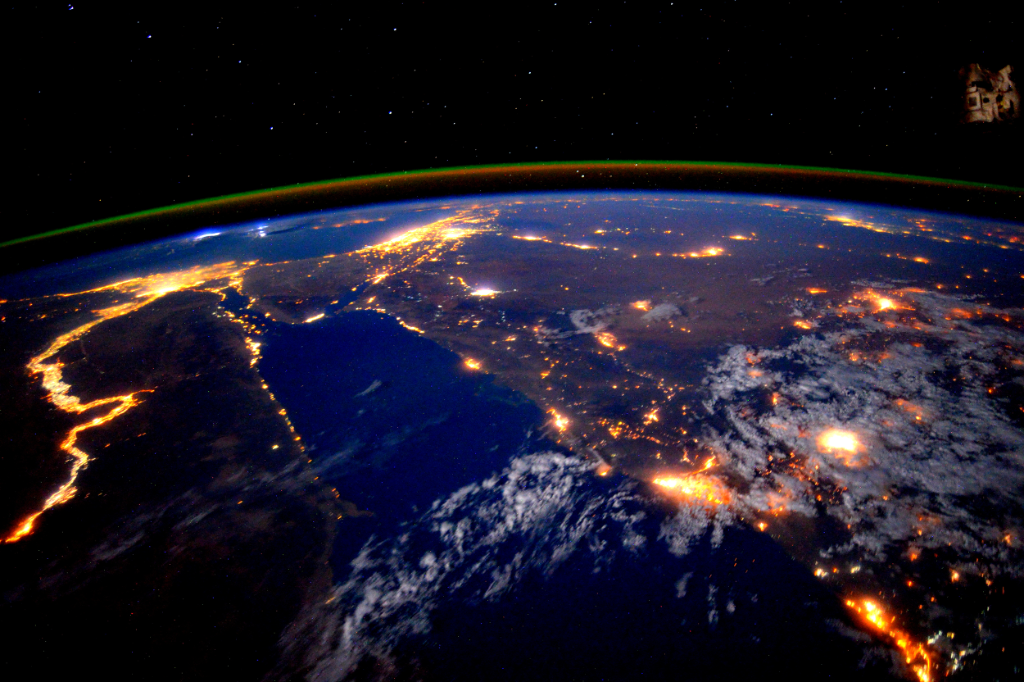
Geography teachers love the Nile Delta because it so well epitomizes what a river delta is — clear demonstration of the delta form, in real photos.

From the International Space Station, the model gets ramped up a bit:

A stunning pic taken by @StationCDRKelly while on @Space_Station shows the Nile River at night http://go.nasa.gov/1iAE3EV

Twitter caption: A stunning pic taken by @StationCDRKelly while on @Space_Station shows the Nile River at night http://go.nasa.gov/1iAE3EV

The Nile becomes a river of light, showing the advance of electrified human settlement along the banks, and providing stark contrast to the unlighted desert on either side of the river.

What other cities, landmarks, or geographical features can you identify in the photo?


Autumnal equinox, September 23, 2015

September 23, 2015

You can only get this shot on two days each year.

I was sad to discover most of my U.S. history students (juniors) didn’t know what an equinox is. So the autumnal equinox always offers a teaching moment that ticks off the teacher raters.

Summer 2015 ended at 4:15 a.m., September 23.

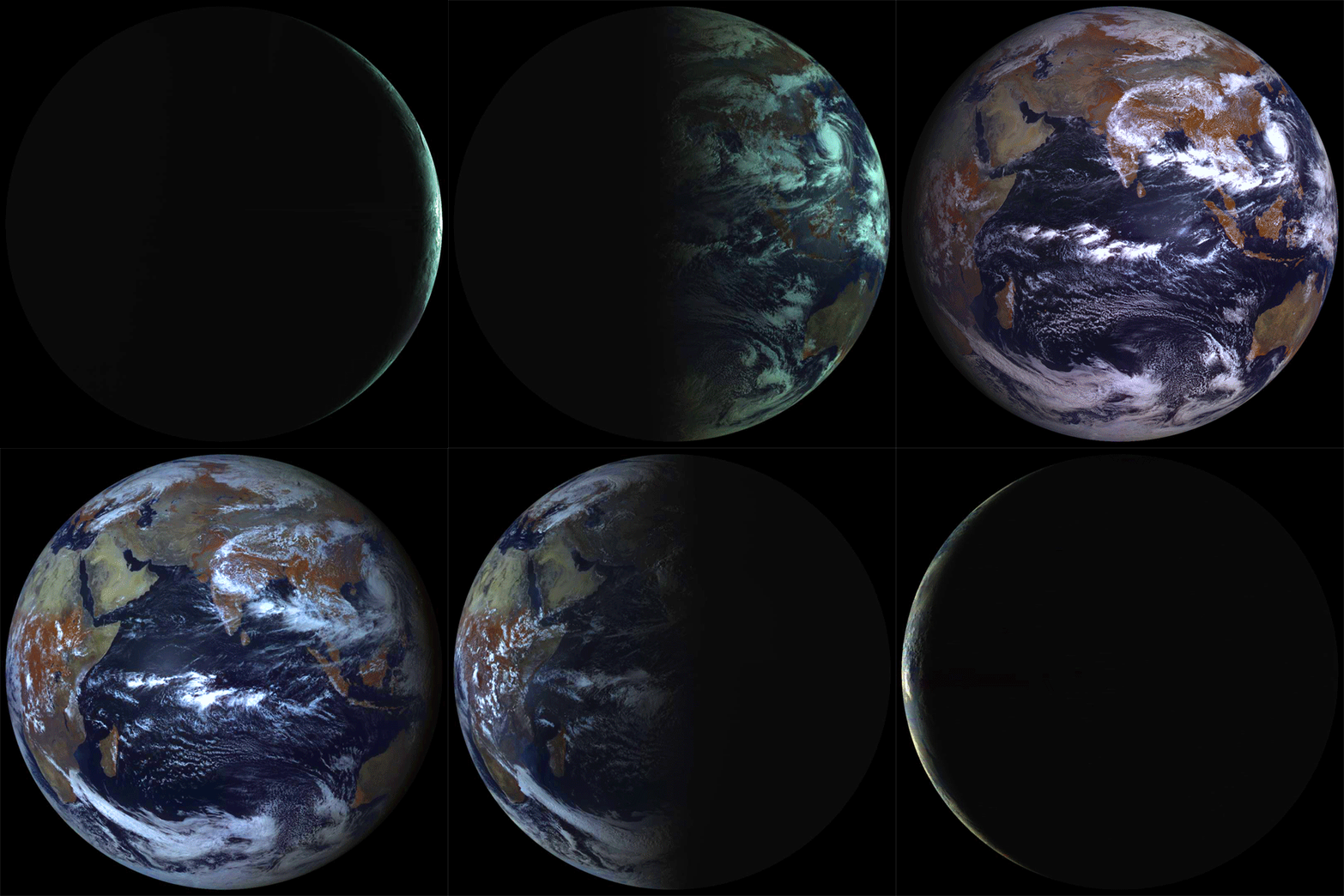
This is what an equinox looks like, from 2013 photos.

From Astronomy Picture of the Day: Earth at Equinox. From the Russian meteorological satellite Elektro-L

From Astronomy Picture of the Day: Earth at Equinox. From the Russian meteorological satellite Elektro-L

Explanation from NASA:

Equinox Earth
Image Credit: Roscosmos / NTSOMZ / zelenyikot.livejournal.com
Courtesy: Igor Tirsky, Vitaliy Egorov Explanation: From a geostationary orbit 36,000 kilometers above the equator, Russian meteorological satellite Elektro-L takes high-resolution images our fair planet every 30 minutes. But only twice a year, during an Equinox, can it capture an image like this one, showing an entire hemisphere bathed in sunlight. At an Equinox, the Earth’s axis of rotation is not tilted toward or away from the Sun, so the solar illumination can extend to both the planet’s poles. Of course, this Elektro-L picture was recorded on September 22nd [2013], at the northern hemisphere’s autumnal equinox. For a moment on that date, the Sun was behind the geostationary satellite and a telltale glint of reflected sunlight is seen crossing the equator, at the location on the planet with satellite and sun directly overhead (5MB animated gif).

Wait. Animated .gif?  Cool!

The Earth at equinox, 2013; from Russan space program, via NASA.

The Earth at equinox, 2013; from Russan space program, via NASA.

The autumnal equinox is at 8:22 GMT or 4:22 am EDT on Wednesday. The two satellite images below from the European Meteosat show the sun angle on Earth from June 22 near the summer solstice and then today at the same time.  Notice the sun angle has changed dramatically, and the High Arctic is no longer seeing 24 hour daylight.

June 22 2015 from Meteosat.

Below is today at the same time.

Seviri Sep22

More:

Yes, this is mostly an encore post. Fighting ignorance requires patience.

Yes, this is partly an encore post. Fighting ignorance requires patience.


Milky Way over Argentina observatory

September 22, 2015

From NASA’s Astronomy Picture of the Day:

Milky Way over Bosque Alegre Station in Argentina Image Credit & Copyright: Sebastián D' Alessandro. To see the picture in its unadorned glory without the explanatory overlay, click on the image to get to NASA's APOD site.

Milky Way over Bosque Alegre Station in Argentina Image Credit & Copyright: Sebastián D’ Alessandro. To see the picture in its unadorned glory without the explanatory overlay, click on the image to get to NASA’s APOD site.

Stars in the Southern Hemisphere differ a lot from what we see in the North, most famously with the Southern Cross (Crux, in the image above).

Glorious anyway; more glory to go around.

If you click over to the APOD site, you can also see this photo without the overlay, which is another whole world of wonderfulness.

APOD said:

Explanation: What are those streaks of light in the sky? First and foremost, the arching structure is the central band of our Milky Way galaxy. Visible in this galactic band are millions of distant stars mixed with numerous lanes of dark dust. Harder to discern is a nearly vertical beam of light rising from the horizon, just to the right of the image center. This beam is zodiacal light, sunlight scattered by dust in our Solar System that may be surprisingly prominent just after sunset or just before sunrise. In the foreground are several telescopes of the Bosque Alegre Astrophysical Station of the National University of Cordoba in Argentina. The station schedules weekend tours and conducts research into the nature of many astronomical objects including comets, active galaxies, and clusters of galaxies. The featured image was taken early this month.


Fly your flag August 21, for Hawaii Statehood in 1959

August 21, 2015

"On June 14, 1959, Boy Scout Milton Motooka helped get the word out for Hawaii’s statehood plebiscite to be held 13 days later. A new documentary will focus on Hawaii’s statehood." Hawaiians voted yes in the plebiscite, and statehood was declared two months later. (Whatever became of Scout Motooka?)

It’s been 56 years since the youngest state entered the union — the longest stretch in which the U.S. has not added another state.

"On June 14, 1959, Boy Scout Milton Motooka helped get the word out for Hawaii’s statehood plebiscite to be held 13 days later. A new documentary will focus on Hawaii’s statehood." Hawaiians voted yes in the plebiscite, and statehood was declared two months later. (Whatever became of Scout Motooka?)

“On June 14, 1959, Boy Scout Milton Motooka helped get the word out for Hawaii’s statehood plebiscite to be held 13 days later. A new documentary will focus on Hawaii’s statehood.” Hawaiians voted yes in the plebiscite, and statehood was declared two months later. (Whatever became of Scout Motooka?)

“On June 14, 1959, Boy Scout Milton Motooka helped get the word out for Hawaii’s statehood plebiscite to be held 13 days later. A new documentary will focus on Hawaii’s statehood.” Hawaiians voted yes in the plebiscite, and statehood was declared two months later. (Whatever became of Scout Motooka?)

June’s plebiscite smoothed the path for statehood, declared two months later.

A newsboy happily hawks the Honolulu Star-Bulletin with the headline showing the state had achieved statehood, August 21, 1959. Star-Bulletin photo

13-year-old paperboy Chester Kahapea happily hawks a commemorative edition of the Honolulu Star-Bulletin with the headline showing the state had achieved statehood after the U.S. House of Representatives passed the law authorizing Hawaii as a state. Star-Bulletin photo by Murray Befeler.

Hawaii’s official statehood day is August 21, commemorating the day in 1959 when Hawaii was recognized as a member of the union of the United States of America.  Hawaiians should fly their flags to day in honor of the date (you may, too).

Hawaii formally celebrates the day on the third Friday in August, this year coincidentally on the 21st.  I hope you joined in the festivities (it’s a holiday in Hawaii) — but under the U.S. Flag Code, you may certainly fly your flags on August 21, regardless which day of the week that is.

Specimen copy of the ballot used by Hawaiians in a June 27, 1959, plebiscite to approve conditions of statehood. Image from Hawaii Magazine, 2009

Specimen copy of the ballot used by Hawaiians in a June 27, 1959, plebiscite to approve conditions of statehood. Image from Hawaii Magazine, 2009

After the U.S. annexed Hawaii in 1898 (in action separate from the Spanish-American War) attempts at getting Hawaii admitted as a state got rolling.  After World War II, with the strategic importance of the islands firmly implanted in Americans’ minds, the project picked up some steam.  Still, it was 14 years after the end of the war that agreements were worked out between the people of Hawaii, the Hawaiian royal family, Congress and the executive branch.  The deal passed into law had to be ratified by a plebiscite among Hawaiian citizens.  The proposition won approval with 94% of votes in favor.

Some native Hawaiian opposition to statehood arose later, and deference to those complaints has muted statehood celebrations in the 21st century.

Other than the tiny handful of loudmouth birthers, most Americans today are happy to have Hawaii as a state, the fifth richest in the U.S. by personal income.  The nation has a lot of good and great beaches, but the idea of catching sun and surf in Hawaii on vacation might be considered an idealized part of the American dream.

U.S. and Hawaii flags flying together.

U.S. and Hawaii flags flying together.

More:

From Prologue, the blog of the National Archives: This petition, rolled onto a wooden spool, was signed by 116,000 supporters of Hawaii statehood and presented to the U.S. Senate on February 26, 1954. (RG 46, Records of the U.S. Senate)

From Prologue, the blog of the National Archives: This petition, rolled onto a wooden spool, was signed by 116,000 supporters of Hawaii statehood and presented to the U.S. Senate on February 26, 1954. (RG 46, Records of the U.S. Senate)


U.S. postage stamp issued in 2009 commemorating the 50th anniversary of Hawaii's admission to the union.

U.S. postage stamp issued in 2009 commemorating the 50th anniversary of Hawaii’s admission to the union.


Contrast the first class postage price above with the airmail postage price of this stamp issued in 1959 — August 21, 1959 7¢ Rose Hawaii Statehood C55 26432. Wikipedia image

Contrast the first class postage price above with the airmail postage price of this stamp issued in 1959 — August 21, 1959 7¢ Rose Hawaii Statehood stamp. Wikipedia image


This is an encore post.

This is an encore post.


Annals of global warming: Time to change maps of Arctic ice

August 11, 2015

National Geographic Society reminded us they’ve had to change maps of the arctic.

National Geographic Society composed this GIF to compare their maps over past 16 years: A GIF of National Geographic atlases from 1999 through 2014 shows how Arctic ice has melted over time.

National Geographic Society composed this GIF to compare their maps over past 16 years: A GIF of National Geographic atlases from 1999 through 2014 shows how Arctic ice has melted over time.

President Barack Obama noted the change in his announcement of U.S. actions to fight climate change. National Geo added details beyond what the president said.

As the ocean heats up due to global warming, Arctic sea ice has been locked in a downward spiral. Since the late 1970s, the ice has retreated by 12 percent per decade, worsening after 2007, according to NASA. May 2014 represented the third lowest extent of sea ice during that month in the satellite record, according to the National Snow and Ice Data Center (NSIDC).

Ice loss is accelerated in the Arctic because of a phenomenon known as the feedback loop: Thin ice is less reflective than thick ice, allowing more sunlight to be absorbed by the ocean, which in turn weakens the ice and warms the ocean even more, NASA says.

Because thinner ice is flatter, it allows melt ponds to accumulate on the surface, reducing the reflectiveness of the ice and absorbing more heat. (See pictures of our melting world in National Geographic magazine.)

“You hear reports all the time in the media about this,” Valdés said. “Until you have a hard-copy map in your hand, the message doesn’t really hit home.”

(More at National Geo’s site.)

At the last edition of the National Geographic Atlas, a video described why and how changes were made.

We used to think the old Earth was so massive, little could humans do to change it. While it’s probably still true the rock will survive after humans are extinct, we now know we can foul our nest enough to make it uncomfortable, or impossible for our species to stay here.

Global warming is changing the planet. Maps must be changed to show the new face.

Have we acted soon enough, and hard enough to save space for humans to live?

Tip of the old scrub brush to Chris Tackett on Twitter.


Milky Way over New Zealand

August 3, 2015

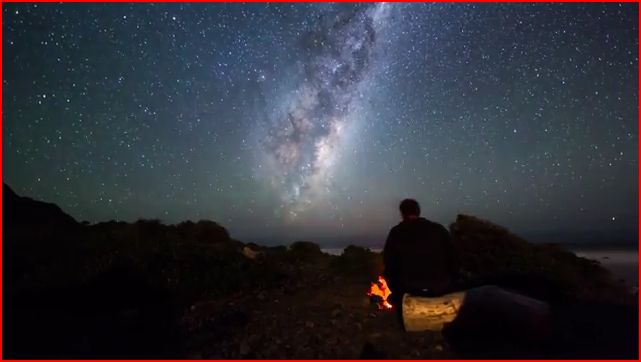
Screen capture of one frame of Mark Gee's short film, "After Dark."

Screen capture of one frame of Mark Gee’s short film, “After Dark.”

Great little .gif, of the night sky in New Zealand.

From a Tweet by BBC Earth.  It’s taken from a slightly longer film put together by Mark Gee.

1440 individual photographs captured over 13 hours cut together into one incredible time-lapse video.

Photographer and videographer Mark Gee shot this breath-taking footage of the southern skies around his hometown of Wellington, New Zealand. The stunning one-minute clip is a collection of Mark’s most memorable night sky moments over the past year.

The majority of the video was shot on Wellington’s South Coast (watch out for air traffic) while the campfire and the camping scenes were filmed in Cape Palliser and the Tararua Ranges.

From Gee’s Youtube site, the longer film (1 minute!):


Signs of life: Eagles on Highway

July 30, 2015

One of our local pharmacists travels on vacations, and takes photos.  Pharmacies being what they are, people wait in line with nothing to do but count ticks on the clock.  No one takes a book to the pharmacy to wait.

But the guy, Mark de Zeeuw, has a good sense of customer service.  He got one of those photo frames that had a video display to show photos.  Over time, it morphed to an extra computer screen, and probably an old computer (don’t know for sure).

At the Tom Thumb supermarket in Duncanville, Texas, customers get to see photos of the pharmacist’s travels.  A lover of travel and photography, and a too-frequent customer at the pharmacy, I think I may have seen every photo on that harddrive.  Many of them are very good. He travels to Alaska and across the American west, and he’s got at least one telephoto that works well on wildlife — this I know from watching the photos.  I’ve never discussed it with the guy (who is always busy working on prescriptions, or fighting with insurance companies over the phone; Tom Thumb’s being a large company, there may be other pharmacists on duty at the time).

Okay, I’m shy.  I’ve wanted to ask him for copies of several of the photos to share, one in particular.  It’s a nice shot of the yellow warning/information signs you see at the side of a highway.  With a bright blue sky in back, and obviously a lot of unpopulated territory, it says “Eagles On Highway.”  I broke the shyness enough to learn it was a photo from eastern Utah.

Surely someone else noticed the sign?

Yep! Wonders of Google, Bing and flickr:  Here’s a shot I found at Wanderlust Cafe:

“Eagles on Hwy.” Sign on eastbound Interstate 70, near the Moab turnoff in Utah. Photo by Lou Ann Granger, via Wanderlust Cafe

Out on Interstate 70, the rabbits and occasional ground squirrel, lizard or coyote fall victim to speeding cars in the night.  In the daylight, carrion eaters — including eagles — clean up the road.  Alas, eagles have not been bred to recognize those vehicles, tiny in the distance, rush at them at 70 miles per hour. Worse, it’s a violation of federal law and regulations to kill the eagles (few are ever cited for accidents).

Local authorities put up signs warning drivers of this odd hazard: “Eagles on Highway.” Drivers are supposed to slow down, be wary, and avoid hitting the eagles.

Others grew curious about the signs, too. The Deseret News in Salt Lake City explained back in 1990 that six of the signs were put up, in hopes of reducing kills of immature golden eagles.

They have to rank as the most unusual highway signs anywhere in the state. But preliminary indications are the six “Eagles on Highway” warning signs in central Utah are doing the job.

Not a single golden eagle was struck by a car during the 1989-90 winter season.In the two years previous, 30 golden eagles were killed and another 11 crippled by automobiles on a stretch of I-70 between the Colorado border and the San Rafael Swell.

“We don’t know whether it’s because the mild winter has spread the birds around more or whether it’s because the prairie dog population is down and the birds have moved elsewhere, or what,” said Miles Moretti, regional supervisor for the Division of Wildlife Resources.

“What we do know is we’ve received a lot of comments from people seeing signs and watching the birds and being aware of the problem. From a public awareness standpoint the program is a success.”

I wonder if we can track down someone in authority with numbers to show the signs are working after 25 years.  And maybe I can get a copy of pharmacist de Zeeuw’s photo here — his is better, I think.

More:

Read the rest of this entry »


Powers of Ten – Charles and Ray Eames’ brilliant, before-its-time film

May 23, 2015

Images from

Images from “Powers of Ten,” 1977 edition. From IconEye

AMNH’s “The Known Universe” is a cool film. Putting up that last post on the film, I looked back and noted that when I had previously written about the brilliant predecessor films from Charles and Ray Eames, “Powers of Ten,” the Eames films were not freely available on line.

That’s been fixed.

I like to use films like this as warmups to a year of history, and as a reminder once we get into studying the history of space exploration, of just how far we’ve come in understanding the universe, and how big this place is.

Of course, that means wer are just small parts.

The Eames’s genius showed the scale of things, from a couple picnicking in a park, to the outer reaches of the universe, and then back, zooming into the innermost reaches of a human down to the sub-atomic level.

There’s a series of these films; this one, published on YouTube by the Eames Office, was done in 1977, one of the later versions.

How can you use this in class, teachers? (I recommend buying it on DVD, as I did; better sound and pictures, generally.)

Film information:

Uploaded on Aug 26, 2010

Powers of Ten takes us on an adventure in magnitudes. Starting at a picnic by the lakeside in Chicago, this famous film transports us to the outer edges of the universe. Every ten seconds we view the starting point from ten times farther out until our own galaxy is visible only a s a speck of light among many others. Returning to Earth with breathtaking speed, we move inward- into the hand of the sleeping picnicker- with ten times more magnification every ten seconds. Our journey ends inside a proton of a carbon atom within a DNA molecule in a white blood cell. POWERS OF TEN © 1977 EAMES OFFICE LLC (Available at http://www.eamesoffice.com)

At the Eames Office Youtube site, you may find the film in with Mandarin Chinese, German, and Japanese translations (no Spanish?).  If you’re unfamiliar with the work of this couple — you would recognize much of the stuff they designed, I’m sure — check out a short film on an exhibit on Ray Eames (which has concluded, sadly):

More:

The very recognizable, famous Eames Chair, from Herman Miller. Ideally, you can sit in your Eames Chair while watching

The very recognizable, famous Eames Chair and Ottoman, from Herman Miller. Ideally, you can sit in your Eames Chair while watching “Powers of Ten.” Herman Miller image.


New Appalachian Wildlife Refuge protects very rare species: Mountain Bogs National Wildlife Refuge

May 15, 2015

A 39-acre donation from The Nature Conservancy and a lot of work by the Carolina Mountain Land Conservancy joined to birth a new National Wildlife Refuge in North Carolina.

Welcome the Mountain Bogs National Wildlife Refuge.

Jack-in-the-pulpit, one of the less rare of the rare plants protected by the creation of the Mountain Bogs National Wildlife Refuge in North Carolina. USFWS photo

Jack-in-the-pulpit, one of the less rare of the rare plants protected by the creation of the Mountain Bogs National Wildlife Refuge in North Carolina. USFWS photo

The April 22, 2015, press release from USFWS:

New National Wildlife Refuge Established to Protect Some of Appalachia’s Rarest Places

April 22, 2015

Trout lily blooming at Mountain Bogs National Wildlife Refuge. Credit: Gary Peeples, USFWS.

Trout lily blooming at Mountain Bogs National Wildlife Refuge. Credit: Gary Peeples, USFWS.

Asheville, N.C. – The Mountain Bogs National Wildlife Refuge became America’s 563rd refuge today.

U.S. Fish and Wildlife Service Deputy Director Jim Kurth visited Western North Carolina to announce the establishment of a new national wildlife refuge devoted to the conservation of southern Appalachian mountain bogs, one of the rarest and most imperiled habitats in the United States.  North Carolina is home to 11 refuges; Mountain Bogs Refuge is the first one west of Charlotte.

“The establishment of Mountain Bogs National Wildlife Refuge marks a turning point in the efforts of a number of dedicated partners in preserving this unique and threatened habitat,” said Kurth. “It will provide a focal point for mountain bog conservation in the area, and highlights the importance of our National Wildlife Refuge System in preserving our nation’s spectacular biodiversity for future generations of Americans.”

“While western North Carolina has beautiful swaths of conserved public lands, mountain bogs, which are home to several endangered species, are largely unprotected,” said Mike Oetker, Deputy Regional Director for the Service’s Southeast Region.  “People have worked for decades to conserve these bogs, and creating this refuge was an opportunity to build on that effort in a significant way.”

The Nature Conservancy donated an easement on a 39-acre parcel in Ashe County, the site of Kurth’s visit, which formally establishes the refuge.

“Today’s announcement is the culmination of years of work by conservation partners at the local, state and national level,” said The Nature Conservancy’s Fred Annand, who coordinates the Conservancy’s acquisition work. “Many people have worked together for years to make today a reality. Successful conservation depends on partnership, and that’s certainly the case today.”

Mountain bogs are typically small and widely scattered across the landscape, often isolated from other wetlands. Important to wildlife and plants, mountain bogs are home to five endangered species – bog turtles, green pitcher plant, mountain sweet pitcher plant, swamp pink (a lily), and bunched arrowhead. They also provide habitat for migratory birds and game animals, including mink, woodcock, ruffed grouse, turkey, and wood duck. Bogs are breeding habitat for many species of amphibians, especially salamanders, of which the Southern Appalachians have the greatest diversity in the nation. Bogs also provide key benefits to humans. They have a natural capacity for regulating water flow, holding floodwaters like giant sponges and slowly releasing water to nearby streams decreasing the impacts of floods and droughts.

In addition to The Nature Conservancy, Carolina Mountain Land Conservancy has long been active in bog conservation and has been supportive of establishing the new refuge.

“Southern Appalachian bogs are biodiversity hotspots,” said Kieran Roe, Executive Director at Carolina Mountain Land Conservancy. “But they are disappearing from our region at a rapid rate. Less than 20 percent of the mountain bogs that once existed still remain, so their protection is critical.”

The refuge may eventually grow to 23,000 acres, depending on the willingness of landowners to sell and the availability of funds to purchase those lands. To guide acquisition, and bog conservation in general, the Service has identified 30 sites, or Conservation Partnership Areas, containing bogs and surrounding lands. These sites are scattered across Alleghany, Ashe, Avery, Clay, Graham, Henderson, Jackson, Macon, Transylvania, Wilkes and Watauga counties in North Carolina, and Carter and Johnson counties in Tennessee. The Service will look primarily within these Conservation Partnership Areas to acquire land and/or easements. For those acres that won’t be acquired, the Service will work to support private landowners in their stewardship activities. Funding to acquire land and easements would likely come from the Land and Water Conservation Fund, funded by fees collected from the sale of publicly-owned offshore oil and gas drilling leases.

While some parts of the refuge would likely be too fragile for recreation, the Service anticipates other parts could be open for wildlife-based recreation, including hunting, fishing, wildlife observation and photography, education, and interpretation.

The Service manages national wildlife refuges for the conservation of fish, wildlife and plants. In 1903 President Theodore Roosevelt created the first national wildlife refuge to protect brown pelican breeding grounds on the east coast of Florida. The Refuge System now includes 563 refuges across the nation, protecting more than 150 million acres. It’s the only system of federally-managed lands dedicated to wildlife. For more information, visit www.fws.gov/mountainbogs.

The National Wildlife Refuge System protects wildlife and wildlife habitat on more than 150 million acres of land and water from the Caribbean to the Pacific, Maine to Alaska. Refuges also improve human health, provide outdoor recreation and support local economies. Visit our home page at http://www.fws.gov/refuges. Follow us on Facebook and Twitter.

Our Dallas area trout lilies have all blossomed, weeks ago. Interesting that bog-bound trout lilies share so much in common with their drier land cousins a few thousand miles away.
More: